Fall 2006, Syracuse University Lecture Notes for Internet Security 
Intrusion Detection System 
(1) Intrusion Detection Basics 
 What is intrusion detection 
 Process of monitoring the events occurring in a computer system or network and analyzing 
them for signs of intrusion. 
 Types of Intrusion Detection Systems 
 Information Sources: the different sources of event information used to determine whether 
an intrusion has taken place. 
 Network-based IDS 
 Host-based IDS 
 Application-Based IDS 
 Analysis: the most common analysis approaches are 
 Misuse Detection 
 Anomaly Detection 
 Response: the set of actions that the system takes once it detects intrusions. 
 Passive measure: reporting IDS findings to humans, who are then expected to take 
action based on those reports. 
 Active measure: involving some automated intervention on the part of the system. 
 Misuse Detection (signature-based ID) 
 Looking for events or sets of events that match a predefined pattern of events that describe 
a known attack. The patterns are called signatures. 
 Rule-based systems: encoding intrusion scenarios as a set of rules. 
 State-based intrusion scenario representations. 
 Advantages: 
 Very effective at detecting attacks without generating an overwhelming number of 
false alarms. 
 Disadvantages 
 Can only detect those attacks they know about—therefore they must be constanly 
updated with signatures of new attacks. 
 Many misuse detectors are designed to use tighly defined signatures that prevent them 
from detecting variants of common attacks. 
 Anomaly Detection 
 Identify abnormal unusual behavior (anomalies) on a host or network. They function on the 
assumption that attacks are different from “normal” (legitimate) activity and can therefore 
be detected by systems that identify these differences. 
 Static and dynamic: 
 Static: Static means a portion of the system remain constant, e.g. data integrity, tripwire, 
virus checkers. 
 Dynamic: profile. A profile consists of a set of observed measures of behavior for each 
of a set of dimensions. Frequently used dimensions include: 
• Preferred choices, e.g., log-in time, log-in location, and favorite editor. 
• Resources consumed cumulatively or per unit time. 
Wenliang Du Template: Page 1 of 4 8/26/2006
Fall 2006, Syracuse University Lecture Notes for Internet Security 
• Representative sequences of actions. 
• Program profiles: system call sequence. 
 Methods 
 Threshold detection: certain attributes of user and system behavior are expressed in 
terms of counts, with some level established as permissible. Such behavior attributes 
can include the number of files accessed by a user in a given period of time, the number 
of failed attempts to login to the system, the amount of CPU utilized by a process, etc. 
 Statistical measures 
• Parametric: The distribution of the profiled attributes is assumed to fit a particular 
pattern 
• Non-parametric: The distribution of the profiled attributes is “learned’ from a set of 
historical values, observed over time. 
 Rule-based measures: similar to non-parametric statistical measures in that ooberved 
data defines acceptable usage patterns, but differs in that those patterns are specified as 
rules, not numeric quantities. 
 Other methods: 
• Machine learning 
• Data mining 
• Neural networks, genetic algorithms, etc. 
 Advantages 
 Can detect unusual behavior and thus have the ability to detect symptoms of attacks 
without specific knowledge of details. 
 Can produce information that can in turn be used to define signatures for misuse 
detectors. 
 Disadvantages 
 Usually produce a large number of false alarms due to the unpredictable behaviors of 
users and networks. 
 Often require extensive “training sets” of system event records in order to characterize 
normal behavior patterns. 
 Host-based IDS 
 Using OS auditing mechanisms: e.g. BSM in Solaris logs all direct and indirect events 
generated by a user; strace monitors system calls made by a program. 
 Monitoring user activities: analyzing shell commands. 
 Monitoring executions of system programs, e.g. sendmail's system calls. 
 Advantages 
 Can detect attacks that cannot be seen by NIDS 
 Can operate in an environment in which network traffic is encrypted 
 Unaffected by switched networks 
 Can help detect Trojan horse or other attacks that involve software integrity breaches 
 Disadvantages 
 Since at least the information sources reside on the host targeted by attacks, the IDS 
may be attacked and disabled as port of the attack 
 Are not well suited by detecting network scans or other such surveillance that targets an 
entire network 
 Since they use the computing resources of the hosts they are monitoring, therefore 
inflicting a performance cost on the monitored systems. 
Wenliang Du Template: Page 2 of 4 8/26/2006
Fall 2006, Syracuse University Lecture Notes for Internet Security 
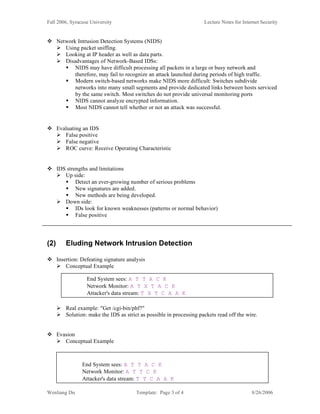
 Network Intrusion Detection Systems (NIDS) 
 Using packet sniffing. 
 Looking at IP header as well as data parts. 
 Disadvantages of Network-Based IDSs: 
 NIDS may have difficult processing all packets in a large or busy network and 
therefore, may fail to recognize an attack launched during periods of high traffic. 
 Modern switch-based networks make NIDS more difficult: Switches subdivide 
networks into many small segments and provide dedicated links between hosts serviced 
by the same switch. Most switches do not provide universal monitoring ports 
 NIDS cannot analyze encrypted information. 
 Most NIDS cannot tell whether or not an attack was successful. 
 Evaluating an IDS 
 False positive 
 False negative 
 ROC curve: Receive Operating Characteristic 
 IDS strengths and limitations 
 Up side: 
 Detect an ever-growing number of serious problems 
 New signatures are added. 
 New methods are being developed. 
 Down side: 
 IDs look for known weaknesses (patterns or normal behavior) 
 False positive 
(2) Eluding Network Intrusion Detection 
 Insertion: Defeating signature analysis 
 Conceptual Example 
End System sees: A T T A C K 
Network Monitor: A T X T A C K 
Attacker's data stream: T X T C A A K 
 Real example: "Get /cgi-bin/phf?" 
 Solution: make the IDS as strict as possible in processing packets read off the wire. 
 Evasion 
 Conceptual Example 
End System sees: A T T A C K 
Network Monitor: A T T C K 
Attacker's data stream: T T C A A K 
Wenliang Du Template: Page 3 of 4 8/26/2006
Fall 2006, Syracuse University Lecture Notes for Internet Security 
 How to achieve Insertion/Evasion Attacks based on IP 
 Checksum (easy to solve) 
 TTL: large enough for IDS monitor, but not enough for the end system. 
 Don't fragment 
 IP Options: 
 Many OS automatically reject source routed packets. 
 Timestamp: discard packets with illegal formats 
 MAC address: address the faked packet to IDS’s Mac address, so the end system will not 
receive it. 
 IP Reassembly Problem 
 IDS also needs to reassembly packets. 
 Subject to DOS attacks. 
 IDS must drop incomplete fragments (or late fragments) the same manner as the end 
system does. Otherwise inconsistence exists. 
 Overlapping fragments: must process them in the same manner as the end system. 
 Windows NT 4.0: always favors old data 
 Solaris 2.6: always favors old data 
 4.4BSD: Favors New data for forward overlap 
 Linux: Favors New data for forward overlap 
 How to achieve Insertion/Evasion Attacks based on TCP? 
 TCP Code: packets with illegal code will be discarded. 
 SYN packet may carry data, and some implementation may not process these data. 
 TCP Window size: inconsistence between end system and IDS can cause problems. 
 TCP Overlapping: NT 4.0 favors old data; others favor new data. 
 Establishing TCP Connections: consistency between IDS and end systems. 
 Tearing Down TCP Connections: consistency ... 
 Denial of Service Attacks on IDS 
 CPU, memory, bandwidth 
Wenliang Du Template: Page 4 of 4 8/26/2006

Intrusion detection

  • 1.
    Fall 2006, SyracuseUniversity Lecture Notes for Internet Security Intrusion Detection System (1) Intrusion Detection Basics  What is intrusion detection  Process of monitoring the events occurring in a computer system or network and analyzing them for signs of intrusion.  Types of Intrusion Detection Systems  Information Sources: the different sources of event information used to determine whether an intrusion has taken place.  Network-based IDS  Host-based IDS  Application-Based IDS  Analysis: the most common analysis approaches are  Misuse Detection  Anomaly Detection  Response: the set of actions that the system takes once it detects intrusions.  Passive measure: reporting IDS findings to humans, who are then expected to take action based on those reports.  Active measure: involving some automated intervention on the part of the system.  Misuse Detection (signature-based ID)  Looking for events or sets of events that match a predefined pattern of events that describe a known attack. The patterns are called signatures.  Rule-based systems: encoding intrusion scenarios as a set of rules.  State-based intrusion scenario representations.  Advantages:  Very effective at detecting attacks without generating an overwhelming number of false alarms.  Disadvantages  Can only detect those attacks they know about—therefore they must be constanly updated with signatures of new attacks.  Many misuse detectors are designed to use tighly defined signatures that prevent them from detecting variants of common attacks.  Anomaly Detection  Identify abnormal unusual behavior (anomalies) on a host or network. They function on the assumption that attacks are different from “normal” (legitimate) activity and can therefore be detected by systems that identify these differences.  Static and dynamic:  Static: Static means a portion of the system remain constant, e.g. data integrity, tripwire, virus checkers.  Dynamic: profile. A profile consists of a set of observed measures of behavior for each of a set of dimensions. Frequently used dimensions include: • Preferred choices, e.g., log-in time, log-in location, and favorite editor. • Resources consumed cumulatively or per unit time. Wenliang Du Template: Page 1 of 4 8/26/2006
  • 2.
    Fall 2006, SyracuseUniversity Lecture Notes for Internet Security • Representative sequences of actions. • Program profiles: system call sequence.  Methods  Threshold detection: certain attributes of user and system behavior are expressed in terms of counts, with some level established as permissible. Such behavior attributes can include the number of files accessed by a user in a given period of time, the number of failed attempts to login to the system, the amount of CPU utilized by a process, etc.  Statistical measures • Parametric: The distribution of the profiled attributes is assumed to fit a particular pattern • Non-parametric: The distribution of the profiled attributes is “learned’ from a set of historical values, observed over time.  Rule-based measures: similar to non-parametric statistical measures in that ooberved data defines acceptable usage patterns, but differs in that those patterns are specified as rules, not numeric quantities.  Other methods: • Machine learning • Data mining • Neural networks, genetic algorithms, etc.  Advantages  Can detect unusual behavior and thus have the ability to detect symptoms of attacks without specific knowledge of details.  Can produce information that can in turn be used to define signatures for misuse detectors.  Disadvantages  Usually produce a large number of false alarms due to the unpredictable behaviors of users and networks.  Often require extensive “training sets” of system event records in order to characterize normal behavior patterns.  Host-based IDS  Using OS auditing mechanisms: e.g. BSM in Solaris logs all direct and indirect events generated by a user; strace monitors system calls made by a program.  Monitoring user activities: analyzing shell commands.  Monitoring executions of system programs, e.g. sendmail's system calls.  Advantages  Can detect attacks that cannot be seen by NIDS  Can operate in an environment in which network traffic is encrypted  Unaffected by switched networks  Can help detect Trojan horse or other attacks that involve software integrity breaches  Disadvantages  Since at least the information sources reside on the host targeted by attacks, the IDS may be attacked and disabled as port of the attack  Are not well suited by detecting network scans or other such surveillance that targets an entire network  Since they use the computing resources of the hosts they are monitoring, therefore inflicting a performance cost on the monitored systems. Wenliang Du Template: Page 2 of 4 8/26/2006
  • 3.
    Fall 2006, SyracuseUniversity Lecture Notes for Internet Security  Network Intrusion Detection Systems (NIDS)  Using packet sniffing.  Looking at IP header as well as data parts.  Disadvantages of Network-Based IDSs:  NIDS may have difficult processing all packets in a large or busy network and therefore, may fail to recognize an attack launched during periods of high traffic.  Modern switch-based networks make NIDS more difficult: Switches subdivide networks into many small segments and provide dedicated links between hosts serviced by the same switch. Most switches do not provide universal monitoring ports  NIDS cannot analyze encrypted information.  Most NIDS cannot tell whether or not an attack was successful.  Evaluating an IDS  False positive  False negative  ROC curve: Receive Operating Characteristic  IDS strengths and limitations  Up side:  Detect an ever-growing number of serious problems  New signatures are added.  New methods are being developed.  Down side:  IDs look for known weaknesses (patterns or normal behavior)  False positive (2) Eluding Network Intrusion Detection  Insertion: Defeating signature analysis  Conceptual Example End System sees: A T T A C K Network Monitor: A T X T A C K Attacker's data stream: T X T C A A K  Real example: "Get /cgi-bin/phf?"  Solution: make the IDS as strict as possible in processing packets read off the wire.  Evasion  Conceptual Example End System sees: A T T A C K Network Monitor: A T T C K Attacker's data stream: T T C A A K Wenliang Du Template: Page 3 of 4 8/26/2006
  • 4.
    Fall 2006, SyracuseUniversity Lecture Notes for Internet Security  How to achieve Insertion/Evasion Attacks based on IP  Checksum (easy to solve)  TTL: large enough for IDS monitor, but not enough for the end system.  Don't fragment  IP Options:  Many OS automatically reject source routed packets.  Timestamp: discard packets with illegal formats  MAC address: address the faked packet to IDS’s Mac address, so the end system will not receive it.  IP Reassembly Problem  IDS also needs to reassembly packets.  Subject to DOS attacks.  IDS must drop incomplete fragments (or late fragments) the same manner as the end system does. Otherwise inconsistence exists.  Overlapping fragments: must process them in the same manner as the end system.  Windows NT 4.0: always favors old data  Solaris 2.6: always favors old data  4.4BSD: Favors New data for forward overlap  Linux: Favors New data for forward overlap  How to achieve Insertion/Evasion Attacks based on TCP?  TCP Code: packets with illegal code will be discarded.  SYN packet may carry data, and some implementation may not process these data.  TCP Window size: inconsistence between end system and IDS can cause problems.  TCP Overlapping: NT 4.0 favors old data; others favor new data.  Establishing TCP Connections: consistency between IDS and end systems.  Tearing Down TCP Connections: consistency ...  Denial of Service Attacks on IDS  CPU, memory, bandwidth Wenliang Du Template: Page 4 of 4 8/26/2006