Intrusion Detection/Prevention
Systems
Objectives and Deliverable
• Understand the concept of IDS/IPS and the
two major categorizations: by
features/models, and by location. Understand
the pros and cons of each approach
• Be able to write a snort rule when given the
signature and other configuration info
• Understand the difference between exploits
and vulnerabilities
Definitions
• Intrusion
– A set of actions aimed to compromise the security
goals, namely
• Integrity, confidentiality, or availability, of a computing and
networking resource
• Intrusion detection
– The process of identifying and responding to
intrusion activities
• Intrusion prevention
– Extension of ID with exercises of access control to
protect computers from exploitation
Elements of Intrusion Detection
• Primary assumptions:
– System activities are observable
– Normal and intrusive activities have distinct
evidence
• Components of intrusion detection systems:
– From an algorithmic perspective:
• Features - capture intrusion evidences
• Models - piece evidences together
– From a system architecture perspective:
• Various components: audit data processor, knowledge
base, decision engine, alarm generation and responses
Components of Intrusion
Detection System
Audit Data
Preprocessor
Audit Records
Activity Data
Detection
Models
Detection Engine
Alarms
Decision
Table
Decision Engine
Action/Report
system activities are
observable
normal and intrusive
activities have distinct
evidence
Intrusion Detection Approaches
• Modeling
– Features: evidences extracted from audit data
– Analysis approach: piecing the evidences
together
• Misuse detection (a.k.a. signature-based)
• Anomaly detection (a.k.a. statistical-based)
• Deployment: Network-based or Host-based
– Network based: monitor network traffic
– Host based: monitor computer processes
Misuse Detection
Intrusion
Patterns:
Sequences of
system calls,
patterns of
network traffic,
etc.
activities
pattern
matching
intrusion
Can’t detect new attacks
Example: if (traffic contains “x90+de[^rn]{30}”) then “attack detected”
Advantage: Mostly accurate. But problems?
Anomaly Detection
activity
measures
probable
intrusion
Relatively high false positive rates
• Anomalies can just be new normal activities.
• Anomalies caused by other element faults
• E.g., router failure or misconfiguration, P2P misconfig
• Which method will detect DDoS SYN flooding ?
Define a profile describing
“normal” behavior, then
detects deviations. Thus can detect potential new attacks.
Any problem ?
Host-Based IDSs
• Use OS auditing and monitoring/analysis
mechanisms to find malware
– Can execute full static and dynamic analysis of a program
• Monitor shell commands and system calls executed by user
applications and system programs
– Has the most comprehensive program info for detection,
thus accurate
• Problems:
– User dependent: install/update IDS on all user machines!
– If attacker takes over machine, can tamper with IDS
binaries and modify audit logs
– Only local view of the attack
The Spread of Sapphire/Slammer
Worms
Network Based IDSs
• At the early stage of the worm, only limited worm
samples.
• Host based sensors can only cover limited IP space,
which has scalability issues. Thus they might not be
able to detect the worm in its early stage.
Gateway routers
Internet
Our network
Host based
detection
Network IDSs
• Deploying sensors at strategic locations
– For example, Packet sniffing via tcpdump at routers
• Inspecting network traffic
– Watch for violations of protocols and unusual connection
patterns
– Look into the packet payload for malicious code
• Limitations
– Cannot execute the payload or do any code analysis !
– Even DPI gives limited application-level semantic
information
– Record and process huge amount of traffic
– May be easily defeated by encryption, but can be
mitigated with encryption only at the gateway/proxy
Host-based vs. Network-based IDS
• Give an attack that can only be detected by
host-based IDS but not network-based IDS
• Can you give an example only be detected by
network-based IDS but not host-based IDS ?
Key Metrics of IDS/IPS
• Algorithm
– Alarm: A; Intrusion: I
– Detection (true alarm) rate: P(A|I)
• False negative rate P(¬A|I)
– False alarm (aka, false positive) rate: P(A|¬I)
• True negative rate P(¬A|¬I)
• Architecture
– Throughput of NIDS, targeting 10s of Gbps
• E.g., 32 nsec for 40 byte TCP SYN packet
– Resilient to attacks
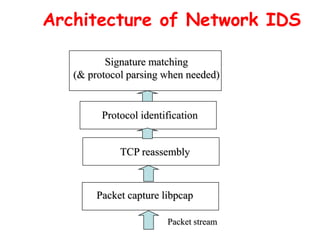
Architecture of Network IDS
Packet capture libpcap
TCP reassembly
Protocol identification
Packet stream
Signature matching
(& protocol parsing when needed)
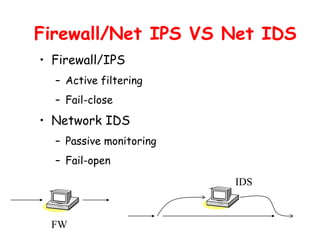
Firewall/Net IPS VS Net IDS
• Firewall/IPS
– Active filtering
– Fail-close
• Network IDS
– Passive monitoring
– Fail-open
FW
IDS
Gartner Magic
Quadrant for IPS
Ability to Execute
•Product/Service
•Overall Viability (Business Unit,
Financial, Strategy, Organization)
•Sales Execution/Pricing
•Market Responsiveness and Track
Record
•Marketing Execution
•Customer Experience
•Operations
Completeness of Vision
•Market Understanding
•Marketing Strategy
•Sales Strategy
•Offering (Product) Strategy
•Business Model
•Vertical/Industry Strategy
•Innovation
•Geographic Strategy
Case Study: Snort IDS
(not required for hw/exam except its signatures)
Backup Slides
Problems with Current IDSs
• Inaccuracy for exploit based signatures
• Cannot recognize unknown anomalies/intrusions
• Cannot provide quality info for forensics or
situational-aware analysis
– Hard to differentiate malicious events with
unintentional anomalies
• Anomalies can be caused by network element faults, e.g.,
router misconfiguration, link failures, etc., or application (such
as P2P) misconfiguration
– Cannot tell the situational-aware info: attack
scope/target/strategy, attacker (botnet) size, etc.
Limitations of Exploit Based Signature
1010101
10111101
11111100
00010111
Our network
Traffic
Filtering
Internet
Signature: 10.*01
X
X
Polymorphic worm might not have
exact exploit based signature
Polymorphism!
Vulnerability Signature
Work for polymorphic worms
Work for all the worms which target the
same vulnerability
Vulnerability
signature traffic
filtering
Internet
X
X
Our network
Vulnerability
X
X
Example of Vulnerability Signatures
• At least 75% vulnerabilities
are due to buffer overflow
Sample vulnerability signature
• Field length corresponding to
vulnerable buffer > certain
threshold
• Intrinsic to buffer overflow
vulnerability and hard to
evade
Vulnerable
buffer
Protocol message
Overflow!
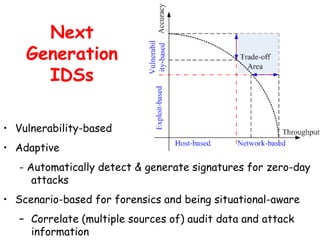
Next
Generation
IDSs
• Vulnerability-based
• Adaptive
- Automatically detect & generate signatures for zero-day
attacks
• Scenario-based for forensics and being situational-aware
– Correlate (multiple sources of) audit data and attack
information
Related Tools for Network IDS (I)
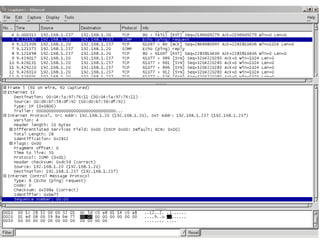
• While not an element of Snort, wireshark
(used to called Ethereal) is the best open
source GUI-based packet viewer
• www.wireshark.org offers:
– Support for various OS: windows, Mac OS.
• Included in standard packages of many
different versions of Linux and UNIX
• For both wired and wireless networks
Related Tools for Network IDS (II)
• Also not an element of Snort, tcpdump is a
well-established CLI packet capture tool
– www.tcpdump.org offers UNIX source
– http://www.winpcap.org/windump/ offers windump,
a Windows port of tcpdump

ids.ppt

  • 1.
  • 2.
    Objectives and Deliverable •Understand the concept of IDS/IPS and the two major categorizations: by features/models, and by location. Understand the pros and cons of each approach • Be able to write a snort rule when given the signature and other configuration info • Understand the difference between exploits and vulnerabilities
  • 3.
    Definitions • Intrusion – Aset of actions aimed to compromise the security goals, namely • Integrity, confidentiality, or availability, of a computing and networking resource • Intrusion detection – The process of identifying and responding to intrusion activities • Intrusion prevention – Extension of ID with exercises of access control to protect computers from exploitation
  • 4.
    Elements of IntrusionDetection • Primary assumptions: – System activities are observable – Normal and intrusive activities have distinct evidence • Components of intrusion detection systems: – From an algorithmic perspective: • Features - capture intrusion evidences • Models - piece evidences together – From a system architecture perspective: • Various components: audit data processor, knowledge base, decision engine, alarm generation and responses
  • 5.
    Components of Intrusion DetectionSystem Audit Data Preprocessor Audit Records Activity Data Detection Models Detection Engine Alarms Decision Table Decision Engine Action/Report system activities are observable normal and intrusive activities have distinct evidence
  • 6.
    Intrusion Detection Approaches •Modeling – Features: evidences extracted from audit data – Analysis approach: piecing the evidences together • Misuse detection (a.k.a. signature-based) • Anomaly detection (a.k.a. statistical-based) • Deployment: Network-based or Host-based – Network based: monitor network traffic – Host based: monitor computer processes
  • 7.
    Misuse Detection Intrusion Patterns: Sequences of systemcalls, patterns of network traffic, etc. activities pattern matching intrusion Can’t detect new attacks Example: if (traffic contains “x90+de[^rn]{30}”) then “attack detected” Advantage: Mostly accurate. But problems?
  • 8.
    Anomaly Detection activity measures probable intrusion Relatively highfalse positive rates • Anomalies can just be new normal activities. • Anomalies caused by other element faults • E.g., router failure or misconfiguration, P2P misconfig • Which method will detect DDoS SYN flooding ? Define a profile describing “normal” behavior, then detects deviations. Thus can detect potential new attacks. Any problem ?
  • 9.
    Host-Based IDSs • UseOS auditing and monitoring/analysis mechanisms to find malware – Can execute full static and dynamic analysis of a program • Monitor shell commands and system calls executed by user applications and system programs – Has the most comprehensive program info for detection, thus accurate • Problems: – User dependent: install/update IDS on all user machines! – If attacker takes over machine, can tamper with IDS binaries and modify audit logs – Only local view of the attack
  • 10.
    The Spread ofSapphire/Slammer Worms
  • 11.
    Network Based IDSs •At the early stage of the worm, only limited worm samples. • Host based sensors can only cover limited IP space, which has scalability issues. Thus they might not be able to detect the worm in its early stage. Gateway routers Internet Our network Host based detection
  • 12.
    Network IDSs • Deployingsensors at strategic locations – For example, Packet sniffing via tcpdump at routers • Inspecting network traffic – Watch for violations of protocols and unusual connection patterns – Look into the packet payload for malicious code • Limitations – Cannot execute the payload or do any code analysis ! – Even DPI gives limited application-level semantic information – Record and process huge amount of traffic – May be easily defeated by encryption, but can be mitigated with encryption only at the gateway/proxy
  • 13.
    Host-based vs. Network-basedIDS • Give an attack that can only be detected by host-based IDS but not network-based IDS • Can you give an example only be detected by network-based IDS but not host-based IDS ?
  • 14.
    Key Metrics ofIDS/IPS • Algorithm – Alarm: A; Intrusion: I – Detection (true alarm) rate: P(A|I) • False negative rate P(¬A|I) – False alarm (aka, false positive) rate: P(A|¬I) • True negative rate P(¬A|¬I) • Architecture – Throughput of NIDS, targeting 10s of Gbps • E.g., 32 nsec for 40 byte TCP SYN packet – Resilient to attacks
  • 15.
    Architecture of NetworkIDS Packet capture libpcap TCP reassembly Protocol identification Packet stream Signature matching (& protocol parsing when needed)
  • 16.
    Firewall/Net IPS VSNet IDS • Firewall/IPS – Active filtering – Fail-close • Network IDS – Passive monitoring – Fail-open FW IDS
  • 17.
    Gartner Magic Quadrant forIPS Ability to Execute •Product/Service •Overall Viability (Business Unit, Financial, Strategy, Organization) •Sales Execution/Pricing •Market Responsiveness and Track Record •Marketing Execution •Customer Experience •Operations Completeness of Vision •Market Understanding •Marketing Strategy •Sales Strategy •Offering (Product) Strategy •Business Model •Vertical/Industry Strategy •Innovation •Geographic Strategy
  • 18.
    Case Study: SnortIDS (not required for hw/exam except its signatures)
  • 19.
  • 20.
    Problems with CurrentIDSs • Inaccuracy for exploit based signatures • Cannot recognize unknown anomalies/intrusions • Cannot provide quality info for forensics or situational-aware analysis – Hard to differentiate malicious events with unintentional anomalies • Anomalies can be caused by network element faults, e.g., router misconfiguration, link failures, etc., or application (such as P2P) misconfiguration – Cannot tell the situational-aware info: attack scope/target/strategy, attacker (botnet) size, etc.
  • 21.
    Limitations of ExploitBased Signature 1010101 10111101 11111100 00010111 Our network Traffic Filtering Internet Signature: 10.*01 X X Polymorphic worm might not have exact exploit based signature Polymorphism!
  • 22.
    Vulnerability Signature Work forpolymorphic worms Work for all the worms which target the same vulnerability Vulnerability signature traffic filtering Internet X X Our network Vulnerability X X
  • 23.
    Example of VulnerabilitySignatures • At least 75% vulnerabilities are due to buffer overflow Sample vulnerability signature • Field length corresponding to vulnerable buffer > certain threshold • Intrinsic to buffer overflow vulnerability and hard to evade Vulnerable buffer Protocol message Overflow!
  • 24.
    Next Generation IDSs • Vulnerability-based • Adaptive -Automatically detect & generate signatures for zero-day attacks • Scenario-based for forensics and being situational-aware – Correlate (multiple sources of) audit data and attack information
  • 25.
    Related Tools forNetwork IDS (I) • While not an element of Snort, wireshark (used to called Ethereal) is the best open source GUI-based packet viewer • www.wireshark.org offers: – Support for various OS: windows, Mac OS. • Included in standard packages of many different versions of Linux and UNIX • For both wired and wireless networks
  • 27.
    Related Tools forNetwork IDS (II) • Also not an element of Snort, tcpdump is a well-established CLI packet capture tool – www.tcpdump.org offers UNIX source – http://www.winpcap.org/windump/ offers windump, a Windows port of tcpdump