INTRODUCTORY MATHEMATICALINTRODUCTORY MATHEMATICAL
ANALYSISANALYSISFor Business, Economics, and the Life and Social Sciences
©2007 Pearson Education Asia
Chapter 9Chapter 9
Additional Topics in ProbabilityAdditional Topics in Probability
©2007 Pearson Education Asia
INTRODUCTORY MATHEMATICAL
ANALYSIS
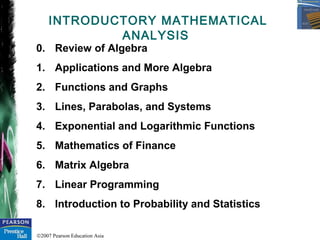
0. Review of Algebra
1. Applications and More Algebra
2. Functions and Graphs
3. Lines, Parabolas, and Systems
4. Exponential and Logarithmic Functions
5. Mathematics of Finance
6. Matrix Algebra
7. Linear Programming
8. Introduction to Probability and Statistics
©2007 Pearson Education Asia
9. Additional Topics in Probability
10. Limits and Continuity
11. Differentiation
12. Additional Differentiation Topics
13. Curve Sketching
14. Integration
15. Methods and Applications of Integration
16. Continuous Random Variables
17. Multivariable Calculus
INTRODUCTORY MATHEMATICAL
ANALYSIS
©2007 Pearson Education Asia
• To develop the probability distribution of a
random variable.
• To develop the binomial distribution and relate it
to the binomial theorem.
• To develop the notions of a Markov chain and
the associated transition matrix.
Chapter 9: Additional Topics in Probability
Chapter ObjectivesChapter Objectives
©2007 Pearson Education Asia
Discrete Random Variables and Expected Value
The Binomial Distribution
Markov Chains
9.1)
9.2)
9.3)
Chapter 9: Additional Topics in Probability
Chapter OutlineChapter Outline
©2007 Pearson Education Asia
Chapter 9: Additional Topics in Probability
9.1 Discrete Random Variables and Expected Value9.1 Discrete Random Variables and Expected Value
Example 1 – Random Variables
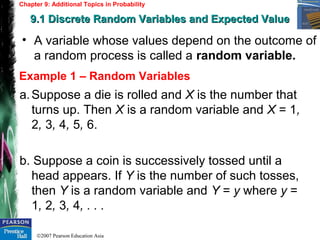
• A variable whose values depend on the outcome of
a random process is called a random variable.
a.Suppose a die is rolled and X is the number that
turns up. Then X is a random variable and X = 1,
2, 3, 4, 5, 6.
b. Suppose a coin is successively tossed until a
head appears. If Y is the number of such tosses,
then Y is a random variable and Y = y where y =
1, 2, 3, 4, . . .
©2007 Pearson Education Asia
Chapter 9: Additional Topics in Probability
9.1 Discrete Random Variables and Expected Value
Example 1 – Random Variables
c. A student is taking an exam with a one-hour limit.
If X is the number of minutes it takes to complete
the exam, then X is a random variable.
Values that X may assume = (0,60] or 0 < X ≤ 60.
• If X is a discrete random variable with distribution f,
then the mean of X is given by
( ) ( ) ( )∑===
x
xxfXEXμμ
©2007 Pearson Education Asia
Chapter 9: Additional Topics in Probability
9.1 Discrete Random Variables and Expected Value
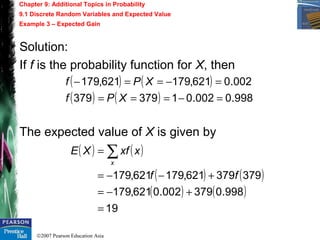
Example 3 – Expected Gain
An insurance company offers a $180,000
catastrophic fire insurance policy to homeowners of a
certain type of house. The policy provides protection
in the event that such a house is totally destroyed by
fire in a one-year period. The company has
determined that the probability of such an event is
0.002. If the annual policy premium is $379, find the
expected gain per policy for the company.
©2007 Pearson Education Asia
Chapter 9: Additional Topics in Probability
9.1 Discrete Random Variables and Expected Value
Example 3 – Expected Gain
Solution:
If f is the probability function for X, then
The expected value of X is given by
( ) ( )
( ) ( ) 998.0002.01379379
002.0621,179621,179
=−===
=−==−
XPf
XPf
( ) ( )
( ) ( )
( ) ( )
19
998.0379002.0621,179
379379621,179621,179
=
+−=
+−−=
= ∑
ff
xxfXE
x
©2007 Pearson Education Asia
Chapter 9: Additional Topics in Probability
9.1 Discrete Random Variables and Expected Value
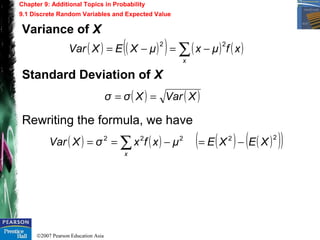
Variance of X
Standard Deviation of X
Rewriting the formula, we have
( ) ( )( ) ( ) ( )xfμxμXEXVar
x
∑ −=−=
22
( ) ( )XVarXσσ ==
( ) ( ) ( ) ( )( )( )22222
XEXEμxfxσXVar
x
−=−== ∑
©2007 Pearson Education Asia
Chapter 9: Additional Topics in Probability
9.2 Binomial Distribution9.2 Binomial Distribution
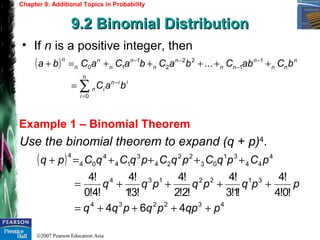
Example 1 – Binomial Theorem
• If n is a positive integer, then
Use the binomial theorem to expand (q + p)4
.
( )
iin
n
i
in
n
nn
n
nn
n
n
n
n
n
n
n
baC
bCabCbaCbaCaCba
−
=
−
−
−−
∑=
+++++=+
0
1
1
22
2
1
10 ...
( )
432234
3122134
4
44
31
03
22
24
3
14
4
04
4
464
!0!4
!4
!1!3
!4
!2!2
!4
!3!1
!4
!4!0
!4
pqppqpqq
ppqpqpqq
pCpqCpqCpqCqCpq
++++=
++++=
++++=+
©2007 Pearson Education Asia
Chapter 9: Additional Topics in Probability
9.2 Binomial Distribution
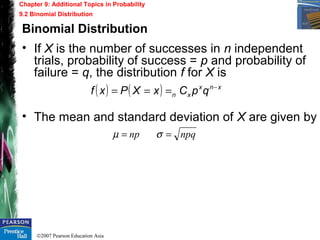
Binomial Distribution
• If X is the number of successes in n independent
trials, probability of success = p and probability of
failure = q, the distribution f for X is
• The mean and standard deviation of X are given by
( ) ( ) xnx
xn qpCxXPxf −
===
npqnp == σµ
©2007 Pearson Education Asia
Chapter 9: Additional Topics in Probability
9.2 Binomial Distribution
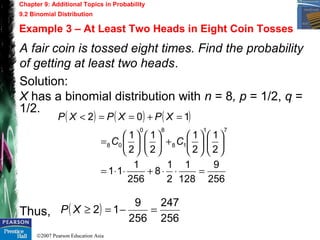
Example 3 – At Least Two Heads in Eight Coin Tosses
A fair coin is tossed eight times. Find the probability
of getting at least two heads.
Solution:
X has a binomial distribution with n = 8, p = 1/2, q =
1/2.
Thus,
( ) ( ) ( )
256
9
128
1
2
1
8
256
1
11
2
1
2
1
2
1
2
1
102
71
18
80
08
=⋅⋅+⋅⋅=












+











=
=+==<
CC
XPXPXP
( )
256
247
256
9
12 =−=≥XP
©2007 Pearson Education Asia
Chapter 9: Additional Topics in Probability
9.3 Markov Chains9.3 Markov Chains
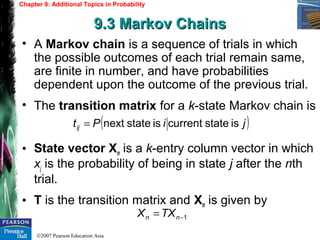
• A Markov chain is a sequence of trials in which
the possible outcomes of each trial remain same,
are finite in number, and have probabilities
dependent upon the outcome of the previous trial.
• The transition matrix for a k-state Markov chain is
• State vector Xn is a k-entry column vector in which
xj is the probability of being in state j after the nth
trial.
• T is the transition matrix and Xn is given by
( )jiPtij isstatecurrentisstatenext=
1−= nn TXX
©2007 Pearson Education Asia
Chapter 9: Additional Topics in Probability
9.3 Markov Chains
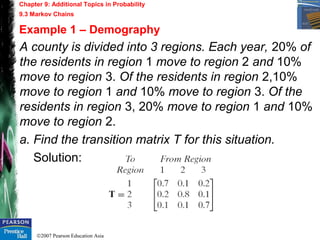
Example 1 – Demography
A county is divided into 3 regions. Each year, 20% of
the residents in region 1 move to region 2 and 10%
move to region 3. Of the residents in region 2,10%
move to region 1 and 10% move to region 3. Of the
residents in region 3, 20% move to region 1 and 10%
move to region 2.
a. Find the transition matrix T for this situation.
Solution:
©2007 Pearson Education Asia
Chapter 9: Additional Topics in Probability
9.3 Markov Chains
Example 1 – Demography
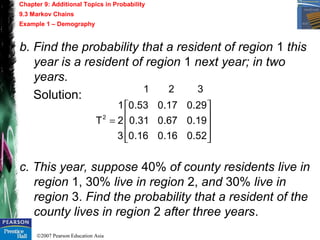
b. Find the probability that a resident of region 1 this
year is a resident of region 1 next year; in two
years.
Solution:
c. This year, suppose 40% of county residents live in
region 1, 30% live in region 2, and 30% live in
region 3. Find the probability that a resident of the
county lives in region 2 after three years.










=
52.016.016.0
19.067.031.0
29.017.053.0
3
2
1
T
321
2
©2007 Pearson Education Asia
Chapter 9: Additional Topics in Probability
9.3 Markov Chains
Example 1 – Demography
Solution:
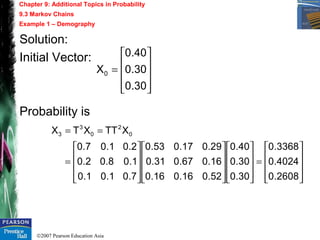
Initial Vector:
Probability is










=
30.0
30.0
40.0
X0










=






























=
==
2608.0
4024.0
3368.0
30.0
30.0
40.0
52.016.016.0
16.067.031.0
29.017.053.0
7.01.01.0
1.08.02.0
2.01.07.0
XTTXTX 0
2
0
3
3
©2007 Pearson Education Asia
Chapter 9: Additional Topics in Probability
9.3 Markov Chains
Steady-State Vectors
• When T is the k × k transition matrix, the steady-
state vector
is the solution to the matrix equations










=
kq
q
Q 
1
[ ]
( ) OQIT
Q
k =−
= 111 

Introductory maths analysis chapter 09 official

  • 1.
    INTRODUCTORY MATHEMATICALINTRODUCTORY MATHEMATICAL ANALYSISANALYSISForBusiness, Economics, and the Life and Social Sciences ©2007 Pearson Education Asia Chapter 9Chapter 9 Additional Topics in ProbabilityAdditional Topics in Probability
  • 2.
    ©2007 Pearson EducationAsia INTRODUCTORY MATHEMATICAL ANALYSIS 0. Review of Algebra 1. Applications and More Algebra 2. Functions and Graphs 3. Lines, Parabolas, and Systems 4. Exponential and Logarithmic Functions 5. Mathematics of Finance 6. Matrix Algebra 7. Linear Programming 8. Introduction to Probability and Statistics
  • 3.
    ©2007 Pearson EducationAsia 9. Additional Topics in Probability 10. Limits and Continuity 11. Differentiation 12. Additional Differentiation Topics 13. Curve Sketching 14. Integration 15. Methods and Applications of Integration 16. Continuous Random Variables 17. Multivariable Calculus INTRODUCTORY MATHEMATICAL ANALYSIS
  • 4.
    ©2007 Pearson EducationAsia • To develop the probability distribution of a random variable. • To develop the binomial distribution and relate it to the binomial theorem. • To develop the notions of a Markov chain and the associated transition matrix. Chapter 9: Additional Topics in Probability Chapter ObjectivesChapter Objectives
  • 5.
    ©2007 Pearson EducationAsia Discrete Random Variables and Expected Value The Binomial Distribution Markov Chains 9.1) 9.2) 9.3) Chapter 9: Additional Topics in Probability Chapter OutlineChapter Outline
  • 6.
    ©2007 Pearson EducationAsia Chapter 9: Additional Topics in Probability 9.1 Discrete Random Variables and Expected Value9.1 Discrete Random Variables and Expected Value Example 1 – Random Variables • A variable whose values depend on the outcome of a random process is called a random variable. a.Suppose a die is rolled and X is the number that turns up. Then X is a random variable and X = 1, 2, 3, 4, 5, 6. b. Suppose a coin is successively tossed until a head appears. If Y is the number of such tosses, then Y is a random variable and Y = y where y = 1, 2, 3, 4, . . .
  • 7.
    ©2007 Pearson EducationAsia Chapter 9: Additional Topics in Probability 9.1 Discrete Random Variables and Expected Value Example 1 – Random Variables c. A student is taking an exam with a one-hour limit. If X is the number of minutes it takes to complete the exam, then X is a random variable. Values that X may assume = (0,60] or 0 < X ≤ 60. • If X is a discrete random variable with distribution f, then the mean of X is given by ( ) ( ) ( )∑=== x xxfXEXμμ
  • 8.
    ©2007 Pearson EducationAsia Chapter 9: Additional Topics in Probability 9.1 Discrete Random Variables and Expected Value Example 3 – Expected Gain An insurance company offers a $180,000 catastrophic fire insurance policy to homeowners of a certain type of house. The policy provides protection in the event that such a house is totally destroyed by fire in a one-year period. The company has determined that the probability of such an event is 0.002. If the annual policy premium is $379, find the expected gain per policy for the company.
  • 9.
    ©2007 Pearson EducationAsia Chapter 9: Additional Topics in Probability 9.1 Discrete Random Variables and Expected Value Example 3 – Expected Gain Solution: If f is the probability function for X, then The expected value of X is given by ( ) ( ) ( ) ( ) 998.0002.01379379 002.0621,179621,179 =−=== =−==− XPf XPf ( ) ( ) ( ) ( ) ( ) ( ) 19 998.0379002.0621,179 379379621,179621,179 = +−= +−−= = ∑ ff xxfXE x
  • 10.
    ©2007 Pearson EducationAsia Chapter 9: Additional Topics in Probability 9.1 Discrete Random Variables and Expected Value Variance of X Standard Deviation of X Rewriting the formula, we have ( ) ( )( ) ( ) ( )xfμxμXEXVar x ∑ −=−= 22 ( ) ( )XVarXσσ == ( ) ( ) ( ) ( )( )( )22222 XEXEμxfxσXVar x −=−== ∑
  • 11.
    ©2007 Pearson EducationAsia Chapter 9: Additional Topics in Probability 9.2 Binomial Distribution9.2 Binomial Distribution Example 1 – Binomial Theorem • If n is a positive integer, then Use the binomial theorem to expand (q + p)4 . ( ) iin n i in n nn n nn n n n n n n n baC bCabCbaCbaCaCba − = − − −− ∑= +++++=+ 0 1 1 22 2 1 10 ... ( ) 432234 3122134 4 44 31 03 22 24 3 14 4 04 4 464 !0!4 !4 !1!3 !4 !2!2 !4 !3!1 !4 !4!0 !4 pqppqpqq ppqpqpqq pCpqCpqCpqCqCpq ++++= ++++= ++++=+
  • 12.
    ©2007 Pearson EducationAsia Chapter 9: Additional Topics in Probability 9.2 Binomial Distribution Binomial Distribution • If X is the number of successes in n independent trials, probability of success = p and probability of failure = q, the distribution f for X is • The mean and standard deviation of X are given by ( ) ( ) xnx xn qpCxXPxf − === npqnp == σµ
  • 13.
    ©2007 Pearson EducationAsia Chapter 9: Additional Topics in Probability 9.2 Binomial Distribution Example 3 – At Least Two Heads in Eight Coin Tosses A fair coin is tossed eight times. Find the probability of getting at least two heads. Solution: X has a binomial distribution with n = 8, p = 1/2, q = 1/2. Thus, ( ) ( ) ( ) 256 9 128 1 2 1 8 256 1 11 2 1 2 1 2 1 2 1 102 71 18 80 08 =⋅⋅+⋅⋅=             +            = =+==< CC XPXPXP ( ) 256 247 256 9 12 =−=≥XP
  • 14.
    ©2007 Pearson EducationAsia Chapter 9: Additional Topics in Probability 9.3 Markov Chains9.3 Markov Chains • A Markov chain is a sequence of trials in which the possible outcomes of each trial remain same, are finite in number, and have probabilities dependent upon the outcome of the previous trial. • The transition matrix for a k-state Markov chain is • State vector Xn is a k-entry column vector in which xj is the probability of being in state j after the nth trial. • T is the transition matrix and Xn is given by ( )jiPtij isstatecurrentisstatenext= 1−= nn TXX
  • 15.
    ©2007 Pearson EducationAsia Chapter 9: Additional Topics in Probability 9.3 Markov Chains Example 1 – Demography A county is divided into 3 regions. Each year, 20% of the residents in region 1 move to region 2 and 10% move to region 3. Of the residents in region 2,10% move to region 1 and 10% move to region 3. Of the residents in region 3, 20% move to region 1 and 10% move to region 2. a. Find the transition matrix T for this situation. Solution:
  • 16.
    ©2007 Pearson EducationAsia Chapter 9: Additional Topics in Probability 9.3 Markov Chains Example 1 – Demography b. Find the probability that a resident of region 1 this year is a resident of region 1 next year; in two years. Solution: c. This year, suppose 40% of county residents live in region 1, 30% live in region 2, and 30% live in region 3. Find the probability that a resident of the county lives in region 2 after three years.           = 52.016.016.0 19.067.031.0 29.017.053.0 3 2 1 T 321 2
  • 17.
    ©2007 Pearson EducationAsia Chapter 9: Additional Topics in Probability 9.3 Markov Chains Example 1 – Demography Solution: Initial Vector: Probability is           = 30.0 30.0 40.0 X0           =                               = == 2608.0 4024.0 3368.0 30.0 30.0 40.0 52.016.016.0 16.067.031.0 29.017.053.0 7.01.01.0 1.08.02.0 2.01.07.0 XTTXTX 0 2 0 3 3
  • 18.
    ©2007 Pearson EducationAsia Chapter 9: Additional Topics in Probability 9.3 Markov Chains Steady-State Vectors • When T is the k × k transition matrix, the steady- state vector is the solution to the matrix equations           = kq q Q  1 [ ] ( ) OQIT Q k =− = 111 