INTRODUCTORY MATHEMATICALINTRODUCTORY MATHEMATICAL
ANALYSISANALYSISFor Business, Economics, and the Life and Social Sciences
©2007 Pearson Education Asia
Chapter 7Chapter 7
Linear ProgrammingLinear Programming
©2007 Pearson Education Asia
INTRODUCTORY MATHEMATICAL
ANALYSIS
0. Review of Algebra
1. Applications and More Algebra
2. Functions and Graphs
3. Lines, Parabolas, and Systems
4. Exponential and Logarithmic Functions
5. Mathematics of Finance
6. Matrix Algebra
7. Linear Programming
8. Introduction to Probability and Statistics
©2007 Pearson Education Asia
9. Additional Topics in Probability
10. Limits and Continuity
11. Differentiation
12. Additional Differentiation Topics
13. Curve Sketching
14. Integration
15. Methods and Applications of Integration
16. Continuous Random Variables
17. Multivariable Calculus
INTRODUCTORY MATHEMATICAL
ANALYSIS
©2007 Pearson Education Asia
• To represent geometrically a linear inequality in two
variables.
• To state a linear programming problem and solve it
geometrically.
• To consider situations in which a linear programming
problem exists.
• To introduce the simplex method.
• To solve problems using the simplex method.
• To introduce use of artificial variables.
• To learn alteration of objective function.
• To define the dual of a linear programming problem.
Chapter 7: Linear Programming
Chapter ObjectivesChapter Objectives
©2007 Pearson Education Asia
Linear Inequalities in Two Variables
Linear Programming
Multiple Optimum Solutions
The Simplex Method
Degeneracy, Unbounded Solutions, and Multiple Solutio
Artificial Variables
Minimization
The Dual
7.1)
7.2)
7.3)
7.4)
Chapter 7: Linear Programming
Chapter OutlineChapter Outline
7.5)
7.6)
7.7)
7.8)
©2007 Pearson Education Asia
Chapter 7: Linear Programming
7.1 Linear Inequalities in 2 Variables7.1 Linear Inequalities in 2 Variables
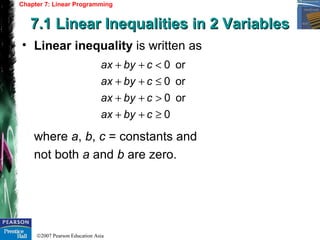
• Linear inequality is written as
where a, b, c = constants and
not both a and b are zero.
0
or0
or0
or0
≥++
>++
≤++
<++
cbyax
cbyax
cbyax
cbyax
©2007 Pearson Education Asia
Chapter 7: Linear Programming
7.1 Linear Inequalities in 2 Variables
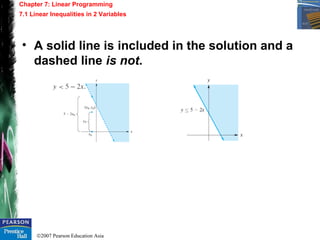
• A solid line is included in the solution and a
dashed line is not.
©2007 Pearson Education Asia
Chapter 7: Linear Programming
7.1 Linear Inequalities in 2 Variables
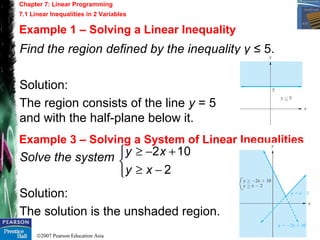
Example 1 – Solving a Linear Inequality
Example 3 – Solving a System of Linear Inequalities
Find the region defined by the inequality y ≤ 5.
Solution:
The region consists of the line y = 5
and with the half-plane below it.
Solve the system
Solution:
The solution is the unshaded region.



−≥
+−≥
2
102
xy
xy
©2007 Pearson Education Asia
Chapter 7: Linear Programming
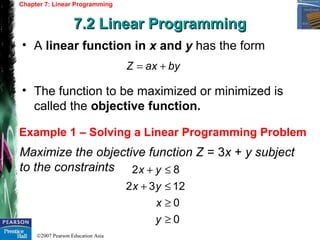
7.2 Linear Programming7.2 Linear Programming
Example 1 – Solving a Linear Programming Problem
• A linear function in x and y has the form
• The function to be maximized or minimized is
called the objective function.
byaxZ +=
Maximize the objective function Z = 3x + y subject
to the constraints
0
0
1232
82
≥
≥
≤+
≤+
y
x
yx
yx
©2007 Pearson Education Asia
Chapter 7: Linear Programming
7.2 Linear Programming
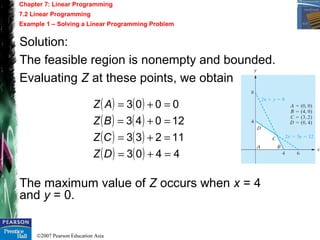
Example 1 – Solving a Linear Programming Problem
Solution:
The feasible region is nonempty and bounded.
Evaluating Z at these points, we obtain
The maximum value of Z occurs when x = 4
and y = 0.
( ) ( )
( ) ( )
( ) ( )
( ) ( ) 4403
11233
12043
0003
=+=
=+=
=+=
=+=
DZ
CZ
BZ
AZ
©2007 Pearson Education Asia
Chapter 7: Linear Programming
7.2 Linear Programming
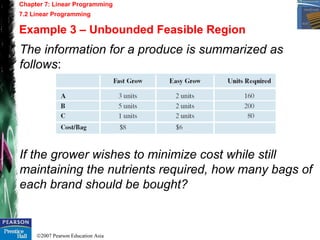
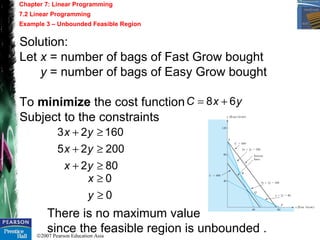
Example 3 – Unbounded Feasible Region
The information for a produce is summarized as
follows:
If the grower wishes to minimize cost while still
maintaining the nutrients required, how many bags of
each brand should be bought?
©2007 Pearson Education Asia
Chapter 7: Linear Programming
7.2 Linear Programming
Example 3 – Unbounded Feasible Region
Solution:
Let x = number of bags of Fast Grow bought
y = number of bags of Easy Grow bought
To minimize the cost function
Subject to the constraints
There is no maximum value
since the feasible region is unbounded .
yxC 68 +=
0
0
802
20025
16023
≥
≥
≥+
≥+
≥+
y
x
yx
yx
yx
©2007 Pearson Education Asia
Chapter 7: Linear Programming
7.3 Multiple Optimum Solutions7.3 Multiple Optimum Solutions
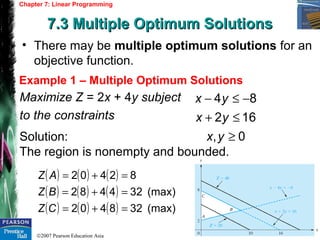
Example 1 – Multiple Optimum Solutions
• There may be multiple optimum solutions for an
objective function.
Maximize Z = 2x + 4y subject
to the constraints
Solution:
The region is nonempty and bounded.
0,
162
84
≥
≤+
−≤−
yx
yx
yx
( ) ( ) ( )
( ) ( ) ( )
( ) ( ) ( ) (max)328402
(max)324482
82402
=+=
=+=
=+=
CZ
BZ
AZ
©2007 Pearson Education Asia
Chapter 7: Linear Programming
7.4 The Simplex Method7.4 The Simplex Method
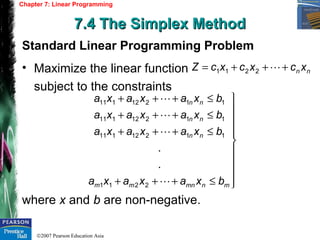
Standard Linear Programming Problem
• Maximize the linear function
subject to the constraints
where x and b are non-negative.
nn xcxcxcZ +++= 2211










≤+++
≤+++
≤+++
≤+++
mnmnmm
nn
nn
nn
bxaxaxa
bxaxaxa
bxaxaxa
bxaxaxa




2211
11212111
11212111
11212111
.
.
©2007 Pearson Education Asia
Chapter 7: Linear Programming
7.4 The Simplex Method
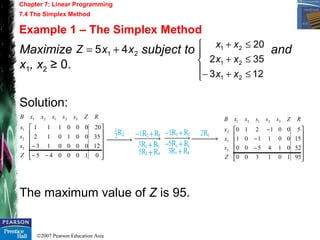
Example 1 – The Simplex Method
Maximize subject to and
x1, x2 ≥ 0.
Solution:
The maximum value of Z is 95.





≤+−
≤+
≤+
123
352
20
21
21
21
xx
xx
xx
21 45 xxZ +=














−−
−
0
12
35
20
100045
000013
001012
000111
3
2
1
32121
Z
s
s
s
RZsssxxB














−
−
−
95
52
15
5
101300
014500
001101
001210
3
1
2
32121
Z
s
x
x
RZsssxxB
©2007 Pearson Education Asia
Chapter 7: Linear Programming
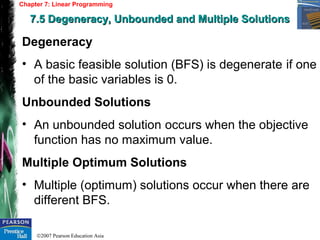
7.5 Degeneracy, Unbounded and Multiple Solutions7.5 Degeneracy, Unbounded and Multiple Solutions
Degeneracy
• A basic feasible solution (BFS) is degenerate if one
of the basic variables is 0.
Unbounded Solutions
• An unbounded solution occurs when the objective
function has no maximum value.
Multiple Optimum Solutions
• Multiple (optimum) solutions occur when there are
different BFS.
©2007 Pearson Education Asia
Chapter 7: Linear Programming
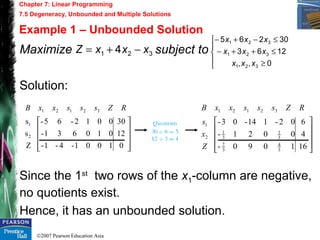
7.5 Degeneracy, Unbounded and Multiple Solutions
Example 1 – Unbounded Solution
Maximize subject to
Solution:
Since the 1st
two rows of the x1-column are negative,
no quotients exist.
Hence, it has an unbounded solution.
321 4 xxxZ −+=





≥
≤++−
≤−+−
0,,
1263
30265
321
321
321
xxx
xxx
xxx










0
12
30
1001-4-1-
010631-
0012-65-
Z
s
s
2
1
32121 RZsssxxB










16
4
6
1090-
0021-
02-114-03-
3
4
3
7
3
1
3
1
2
1
32121
Z
x
s
RZsssxxB
©2007 Pearson Education Asia
Chapter 7: Linear Programming
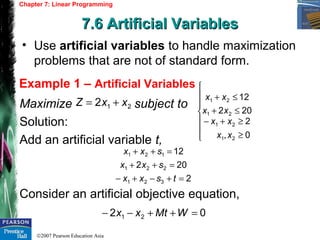
7.6 Artificial Variables7.6 Artificial Variables
Example 1 – Artificial Variables
• Use artificial variables to handle maximization
problems that are not of standard form.
Maximize subject to
Solution:
Add an artificial variable t,
Consider an artificial objective equation,
212 xxZ +=







≥
≥+−
≤+
≤+
0,
2
202
12
21
21
21
21
xx
xx
xx
xx
2
202
12
321
221
121
=+−+−
=++
=++
tsxx
sxx
sxx
02 21 =++−− WMtxx
©2007 Pearson Education Asia
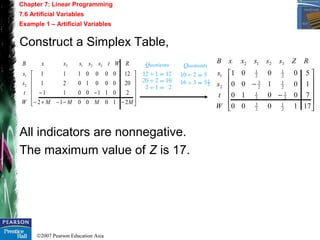
Construct a Simplex Table,
All indicators are nonnegative.
The maximum value of Z is 17.












−−−+−
−−
MMMMW
t
s
s
RWtsssxxB
2100012
20110011
200001021
120000111
2
1
3212`












−
−
171000
70010
10100
50001
2
1
2
3
2
1
2
1
2
1
2
3
2
1
2
1
2
1
3212`
W
t
s
s
RZsssxxB
Chapter 7: Linear Programming
7.6 Artificial Variables
Example 1 – Artificial Variables
©2007 Pearson Education Asia
Use the simplex method to maximize
subject to
Solution:
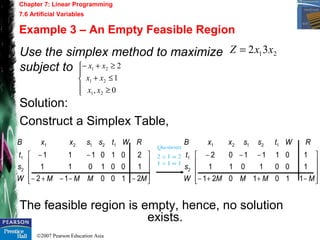
Construct a Simplex Table,
The feasible region is empty, hence, no solution
exists.










−++−
−−−
MMMMW
s
t
RWtssxxB
1101021
1001011
1011102
2
1
12121










−−−+−
−−
MMMMW
s
t
RWtssxxB
210012
1001011
2010111
2
1
12121
Chapter 7: Linear Programming
7.6 Artificial Variables
Example 3 – An Empty Feasible Region
2132 xxZ =





≥
≤+
≥+−
0,
1
2
21
21
21
xx
xx
xx
©2007 Pearson Education Asia
Chapter 7: Linear Programming
7.7 Minimization7.7 Minimization
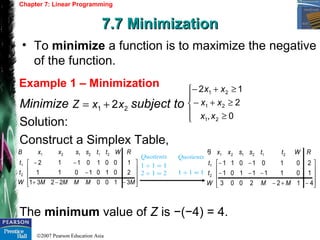
Example 1 – Minimization
• To minimize a function is to maximize the negative
of the function.
Minimize subject to
Solution:
Construct a Simplex Table,
The minimum value of Z is −(−4) = 4.
21 2xxZ +=





≥
≥+−
≥+−
0,
2
12
21
21
21
xx
xx
xx










−−+
−
−−
MMMMMW
t
t
RWttssxxB
31002231
20101011
10010112
2
1
212121










−+−
−−−
−−
4122003
10111101
20101011
2
1
212121
MMW
t
t
RWttssxxB
©2007 Pearson Education Asia
Chapter 7: Linear Programming
7.8 The Dual7.8 The Dual
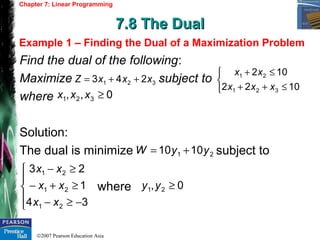
Example 1 – Finding the Dual of a Maximization Problem
Find the dual of the following:
Maximize subject to
where
Solution:
The dual is minimize subject to
where
321 243 xxxZ ++=



≤++
≤+
1022
102
321
21
xxx
xx
21 1010 yyW +=





−≥−
≥+−
≥−
34
1
23
21
21
21
xx
xx
xx
0,, 321 ≥xxx
0, 21 ≥yy
©2007 Pearson Education Asia
Chapter 7: Linear Programming
7.8 The Dual
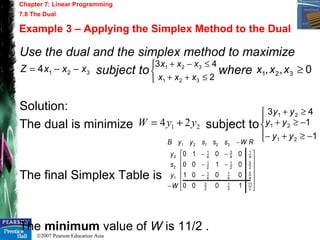
Example 3 – Applying the Simplex Method to the Dual
Use the dual and the simplex method to maximize
subject to where
Solution:
The dual is minimize subject to
The final Simplex Table is
The minimum value of W is 11/2 .
21 24 yyW +=
0,, 321 ≥xxx3214 xxxZ −−=



≤++
≤−+
2
43
321
321
xxx
xxx




−≥+−
−≥+
≥+
1
1
43
21
21
21
yy
yy
yy












−
−−
−−
−
−
2
11
2
1
2
3
4
5
4
1
4
1
2
5
2
1
2
1
4
1
4
3
4
1
1
2
2
32121
1000
0001
0100
0010
W
y
s
y
RWsssyyB

Chapter 7 - Linear Programming

  • 1.
    INTRODUCTORY MATHEMATICALINTRODUCTORY MATHEMATICAL ANALYSISANALYSISForBusiness, Economics, and the Life and Social Sciences ©2007 Pearson Education Asia Chapter 7Chapter 7 Linear ProgrammingLinear Programming
  • 2.
    ©2007 Pearson EducationAsia INTRODUCTORY MATHEMATICAL ANALYSIS 0. Review of Algebra 1. Applications and More Algebra 2. Functions and Graphs 3. Lines, Parabolas, and Systems 4. Exponential and Logarithmic Functions 5. Mathematics of Finance 6. Matrix Algebra 7. Linear Programming 8. Introduction to Probability and Statistics
  • 3.
    ©2007 Pearson EducationAsia 9. Additional Topics in Probability 10. Limits and Continuity 11. Differentiation 12. Additional Differentiation Topics 13. Curve Sketching 14. Integration 15. Methods and Applications of Integration 16. Continuous Random Variables 17. Multivariable Calculus INTRODUCTORY MATHEMATICAL ANALYSIS
  • 4.
    ©2007 Pearson EducationAsia • To represent geometrically a linear inequality in two variables. • To state a linear programming problem and solve it geometrically. • To consider situations in which a linear programming problem exists. • To introduce the simplex method. • To solve problems using the simplex method. • To introduce use of artificial variables. • To learn alteration of objective function. • To define the dual of a linear programming problem. Chapter 7: Linear Programming Chapter ObjectivesChapter Objectives
  • 5.
    ©2007 Pearson EducationAsia Linear Inequalities in Two Variables Linear Programming Multiple Optimum Solutions The Simplex Method Degeneracy, Unbounded Solutions, and Multiple Solutio Artificial Variables Minimization The Dual 7.1) 7.2) 7.3) 7.4) Chapter 7: Linear Programming Chapter OutlineChapter Outline 7.5) 7.6) 7.7) 7.8)
  • 6.
    ©2007 Pearson EducationAsia Chapter 7: Linear Programming 7.1 Linear Inequalities in 2 Variables7.1 Linear Inequalities in 2 Variables • Linear inequality is written as where a, b, c = constants and not both a and b are zero. 0 or0 or0 or0 ≥++ >++ ≤++ <++ cbyax cbyax cbyax cbyax
  • 7.
    ©2007 Pearson EducationAsia Chapter 7: Linear Programming 7.1 Linear Inequalities in 2 Variables • A solid line is included in the solution and a dashed line is not.
  • 8.
    ©2007 Pearson EducationAsia Chapter 7: Linear Programming 7.1 Linear Inequalities in 2 Variables Example 1 – Solving a Linear Inequality Example 3 – Solving a System of Linear Inequalities Find the region defined by the inequality y ≤ 5. Solution: The region consists of the line y = 5 and with the half-plane below it. Solve the system Solution: The solution is the unshaded region.    −≥ +−≥ 2 102 xy xy
  • 9.
    ©2007 Pearson EducationAsia Chapter 7: Linear Programming 7.2 Linear Programming7.2 Linear Programming Example 1 – Solving a Linear Programming Problem • A linear function in x and y has the form • The function to be maximized or minimized is called the objective function. byaxZ += Maximize the objective function Z = 3x + y subject to the constraints 0 0 1232 82 ≥ ≥ ≤+ ≤+ y x yx yx
  • 10.
    ©2007 Pearson EducationAsia Chapter 7: Linear Programming 7.2 Linear Programming Example 1 – Solving a Linear Programming Problem Solution: The feasible region is nonempty and bounded. Evaluating Z at these points, we obtain The maximum value of Z occurs when x = 4 and y = 0. ( ) ( ) ( ) ( ) ( ) ( ) ( ) ( ) 4403 11233 12043 0003 =+= =+= =+= =+= DZ CZ BZ AZ
  • 11.
    ©2007 Pearson EducationAsia Chapter 7: Linear Programming 7.2 Linear Programming Example 3 – Unbounded Feasible Region The information for a produce is summarized as follows: If the grower wishes to minimize cost while still maintaining the nutrients required, how many bags of each brand should be bought?
  • 12.
    ©2007 Pearson EducationAsia Chapter 7: Linear Programming 7.2 Linear Programming Example 3 – Unbounded Feasible Region Solution: Let x = number of bags of Fast Grow bought y = number of bags of Easy Grow bought To minimize the cost function Subject to the constraints There is no maximum value since the feasible region is unbounded . yxC 68 += 0 0 802 20025 16023 ≥ ≥ ≥+ ≥+ ≥+ y x yx yx yx
  • 13.
    ©2007 Pearson EducationAsia Chapter 7: Linear Programming 7.3 Multiple Optimum Solutions7.3 Multiple Optimum Solutions Example 1 – Multiple Optimum Solutions • There may be multiple optimum solutions for an objective function. Maximize Z = 2x + 4y subject to the constraints Solution: The region is nonempty and bounded. 0, 162 84 ≥ ≤+ −≤− yx yx yx ( ) ( ) ( ) ( ) ( ) ( ) ( ) ( ) ( ) (max)328402 (max)324482 82402 =+= =+= =+= CZ BZ AZ
  • 14.
    ©2007 Pearson EducationAsia Chapter 7: Linear Programming 7.4 The Simplex Method7.4 The Simplex Method Standard Linear Programming Problem • Maximize the linear function subject to the constraints where x and b are non-negative. nn xcxcxcZ +++= 2211           ≤+++ ≤+++ ≤+++ ≤+++ mnmnmm nn nn nn bxaxaxa bxaxaxa bxaxaxa bxaxaxa     2211 11212111 11212111 11212111 . .
  • 15.
    ©2007 Pearson EducationAsia Chapter 7: Linear Programming 7.4 The Simplex Method Example 1 – The Simplex Method Maximize subject to and x1, x2 ≥ 0. Solution: The maximum value of Z is 95.      ≤+− ≤+ ≤+ 123 352 20 21 21 21 xx xx xx 21 45 xxZ +=               −− − 0 12 35 20 100045 000013 001012 000111 3 2 1 32121 Z s s s RZsssxxB               − − − 95 52 15 5 101300 014500 001101 001210 3 1 2 32121 Z s x x RZsssxxB
  • 16.
    ©2007 Pearson EducationAsia Chapter 7: Linear Programming 7.5 Degeneracy, Unbounded and Multiple Solutions7.5 Degeneracy, Unbounded and Multiple Solutions Degeneracy • A basic feasible solution (BFS) is degenerate if one of the basic variables is 0. Unbounded Solutions • An unbounded solution occurs when the objective function has no maximum value. Multiple Optimum Solutions • Multiple (optimum) solutions occur when there are different BFS.
  • 17.
    ©2007 Pearson EducationAsia Chapter 7: Linear Programming 7.5 Degeneracy, Unbounded and Multiple Solutions Example 1 – Unbounded Solution Maximize subject to Solution: Since the 1st two rows of the x1-column are negative, no quotients exist. Hence, it has an unbounded solution. 321 4 xxxZ −+=      ≥ ≤++− ≤−+− 0,, 1263 30265 321 321 321 xxx xxx xxx           0 12 30 1001-4-1- 010631- 0012-65- Z s s 2 1 32121 RZsssxxB           16 4 6 1090- 0021- 02-114-03- 3 4 3 7 3 1 3 1 2 1 32121 Z x s RZsssxxB
  • 18.
    ©2007 Pearson EducationAsia Chapter 7: Linear Programming 7.6 Artificial Variables7.6 Artificial Variables Example 1 – Artificial Variables • Use artificial variables to handle maximization problems that are not of standard form. Maximize subject to Solution: Add an artificial variable t, Consider an artificial objective equation, 212 xxZ +=        ≥ ≥+− ≤+ ≤+ 0, 2 202 12 21 21 21 21 xx xx xx xx 2 202 12 321 221 121 =+−+− =++ =++ tsxx sxx sxx 02 21 =++−− WMtxx
  • 19.
    ©2007 Pearson EducationAsia Construct a Simplex Table, All indicators are nonnegative. The maximum value of Z is 17.             −−−+− −− MMMMW t s s RWtsssxxB 2100012 20110011 200001021 120000111 2 1 3212`             − − 171000 70010 10100 50001 2 1 2 3 2 1 2 1 2 1 2 3 2 1 2 1 2 1 3212` W t s s RZsssxxB Chapter 7: Linear Programming 7.6 Artificial Variables Example 1 – Artificial Variables
  • 20.
    ©2007 Pearson EducationAsia Use the simplex method to maximize subject to Solution: Construct a Simplex Table, The feasible region is empty, hence, no solution exists.           −++− −−− MMMMW s t RWtssxxB 1101021 1001011 1011102 2 1 12121           −−−+− −− MMMMW s t RWtssxxB 210012 1001011 2010111 2 1 12121 Chapter 7: Linear Programming 7.6 Artificial Variables Example 3 – An Empty Feasible Region 2132 xxZ =      ≥ ≤+ ≥+− 0, 1 2 21 21 21 xx xx xx
  • 21.
    ©2007 Pearson EducationAsia Chapter 7: Linear Programming 7.7 Minimization7.7 Minimization Example 1 – Minimization • To minimize a function is to maximize the negative of the function. Minimize subject to Solution: Construct a Simplex Table, The minimum value of Z is −(−4) = 4. 21 2xxZ +=      ≥ ≥+− ≥+− 0, 2 12 21 21 21 xx xx xx           −−+ − −− MMMMMW t t RWttssxxB 31002231 20101011 10010112 2 1 212121           −+− −−− −− 4122003 10111101 20101011 2 1 212121 MMW t t RWttssxxB
  • 22.
    ©2007 Pearson EducationAsia Chapter 7: Linear Programming 7.8 The Dual7.8 The Dual Example 1 – Finding the Dual of a Maximization Problem Find the dual of the following: Maximize subject to where Solution: The dual is minimize subject to where 321 243 xxxZ ++=    ≤++ ≤+ 1022 102 321 21 xxx xx 21 1010 yyW +=      −≥− ≥+− ≥− 34 1 23 21 21 21 xx xx xx 0,, 321 ≥xxx 0, 21 ≥yy
  • 23.
    ©2007 Pearson EducationAsia Chapter 7: Linear Programming 7.8 The Dual Example 3 – Applying the Simplex Method to the Dual Use the dual and the simplex method to maximize subject to where Solution: The dual is minimize subject to The final Simplex Table is The minimum value of W is 11/2 . 21 24 yyW += 0,, 321 ≥xxx3214 xxxZ −−=    ≤++ ≤−+ 2 43 321 321 xxx xxx     −≥+− −≥+ ≥+ 1 1 43 21 21 21 yy yy yy             − −− −− − − 2 11 2 1 2 3 4 5 4 1 4 1 2 5 2 1 2 1 4 1 4 3 4 1 1 2 2 32121 1000 0001 0100 0010 W y s y RWsssyyB