THE
TEACHING
PROFESSION
Source: The Teaching Profession by Bilbao et. al., 2012
TYPES OF TEACHERS
Some teachers are teachers
by:
• CHOICE
• CHANCE
• FORCE
• ACCIDENT
THE TEACHING PROFESSION
Can be regarded in three ways:
Teaching as a profession
Teaching as a mission
Teaching as a vocation
The word “profession” is synonymous to:
occupation, job,
career, work, line
of work
“Teaching is a noble profession”
Teaching as a PROFESSION
The word “professional” means long & arduous years of
preparation, a striving for excellence, a dedication to
public interest and commitment to moral & ethical values.
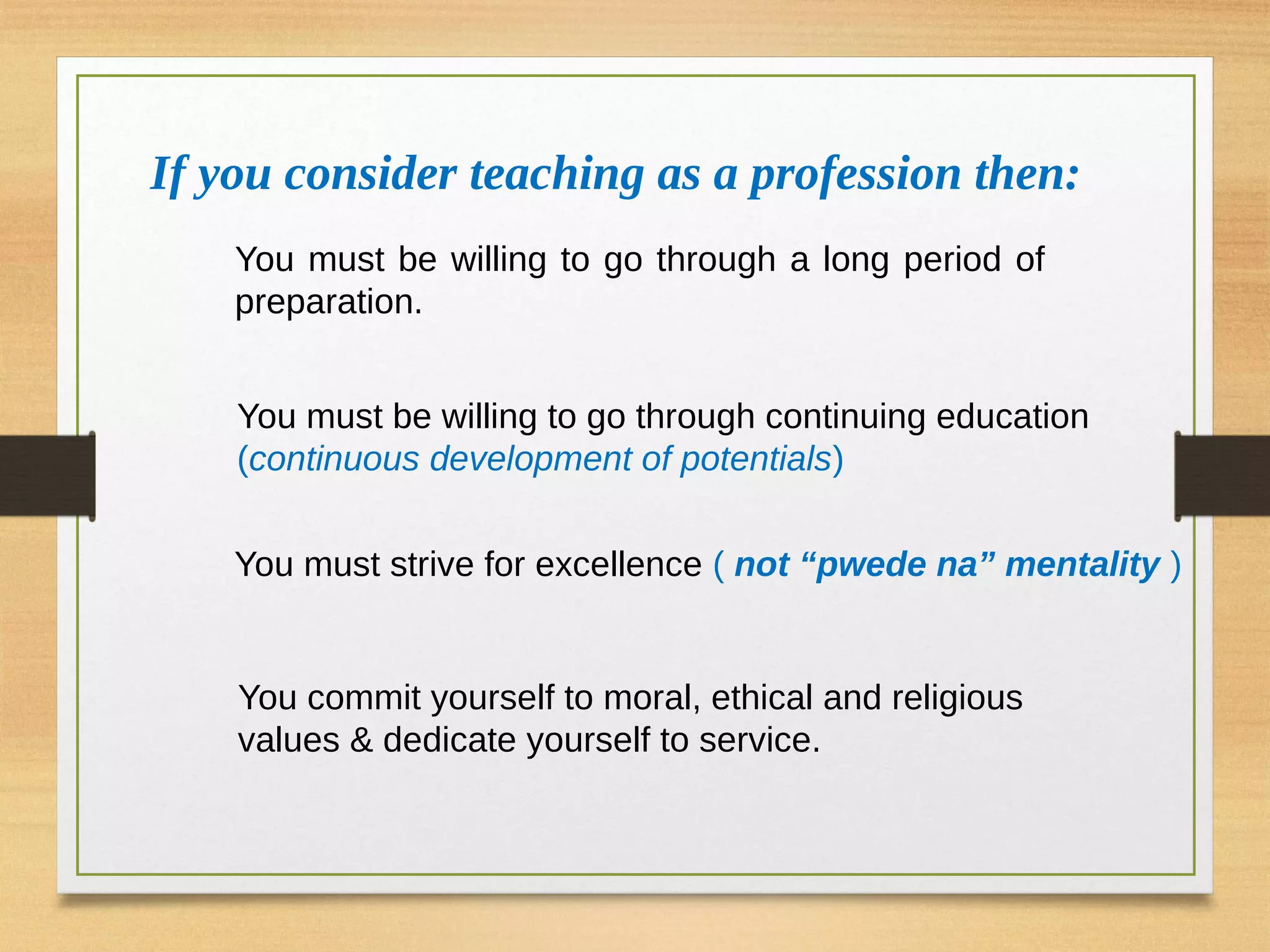
You must be willing to go through continuing education
(continuous development of potentials)
You must strive for excellence ( not “pwede na” mentality )
You commit yourself to moral, ethical and religious
values & dedicate yourself to service.
If you consider teaching as a profession then:
You must be willing to go through a long period of
preparation.
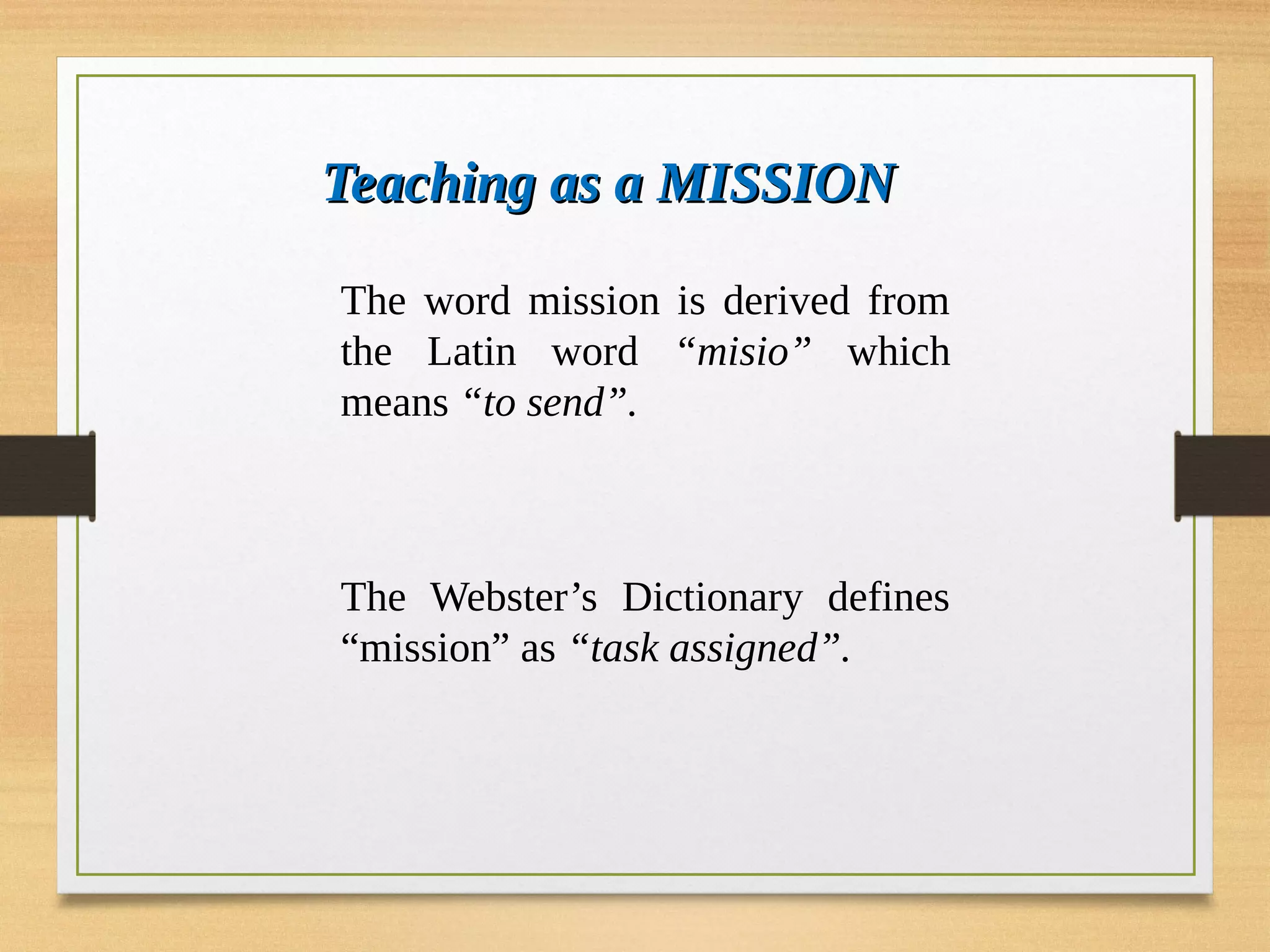
Teaching as a MISSION
The word mission is derived from
the Latin word “misio” which
means “to send”.
The Webster’s Dictionary defines
“mission” as “task assigned”.
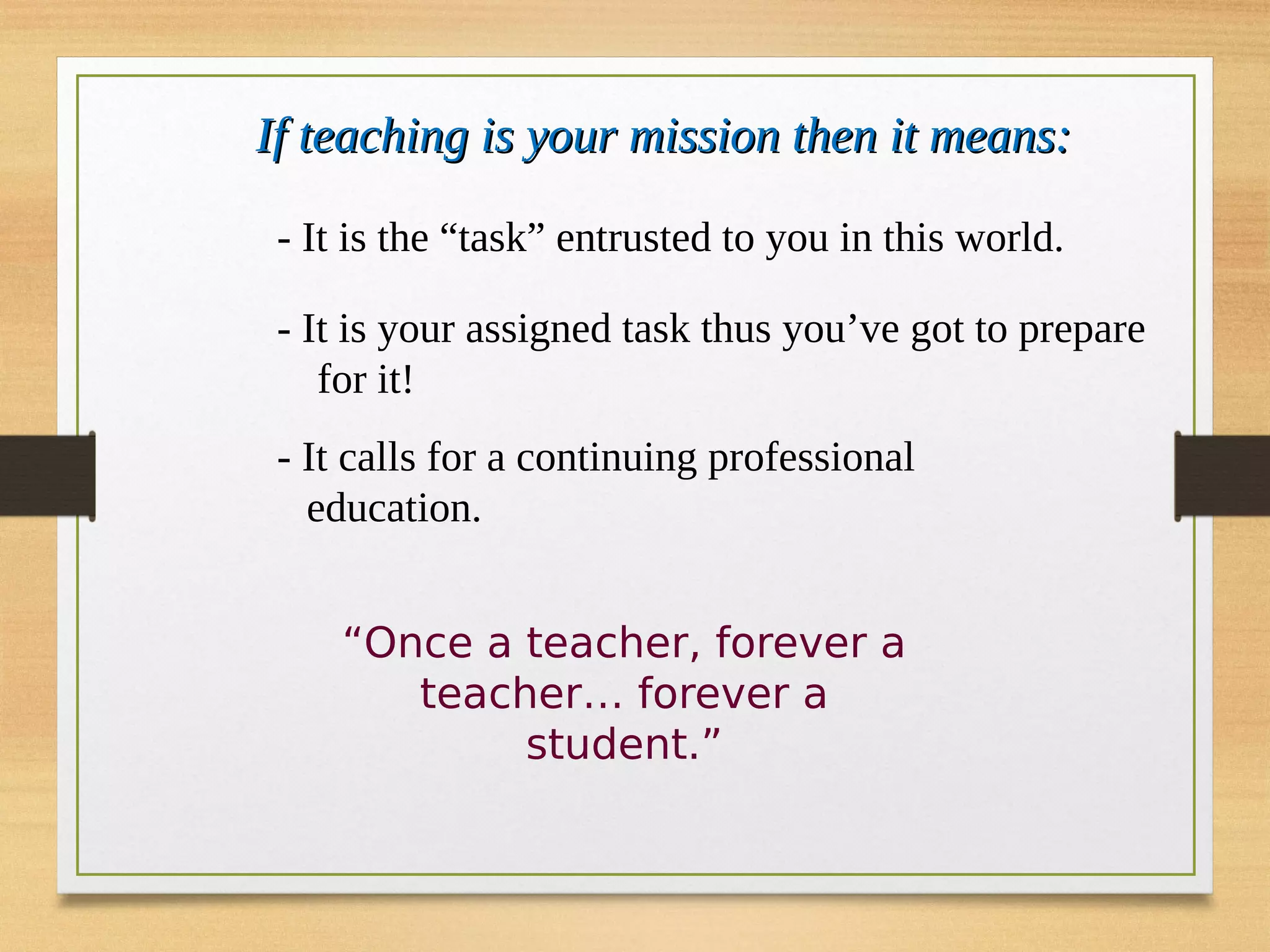
If teaching is your mission then it means:
- It is the “task” entrusted to you in this world.
- It is your assigned task thus you’ve got to prepare
for it!
- It calls for a continuing professional
education.
“Once a teacher, forever a
teacher… forever a
student.”
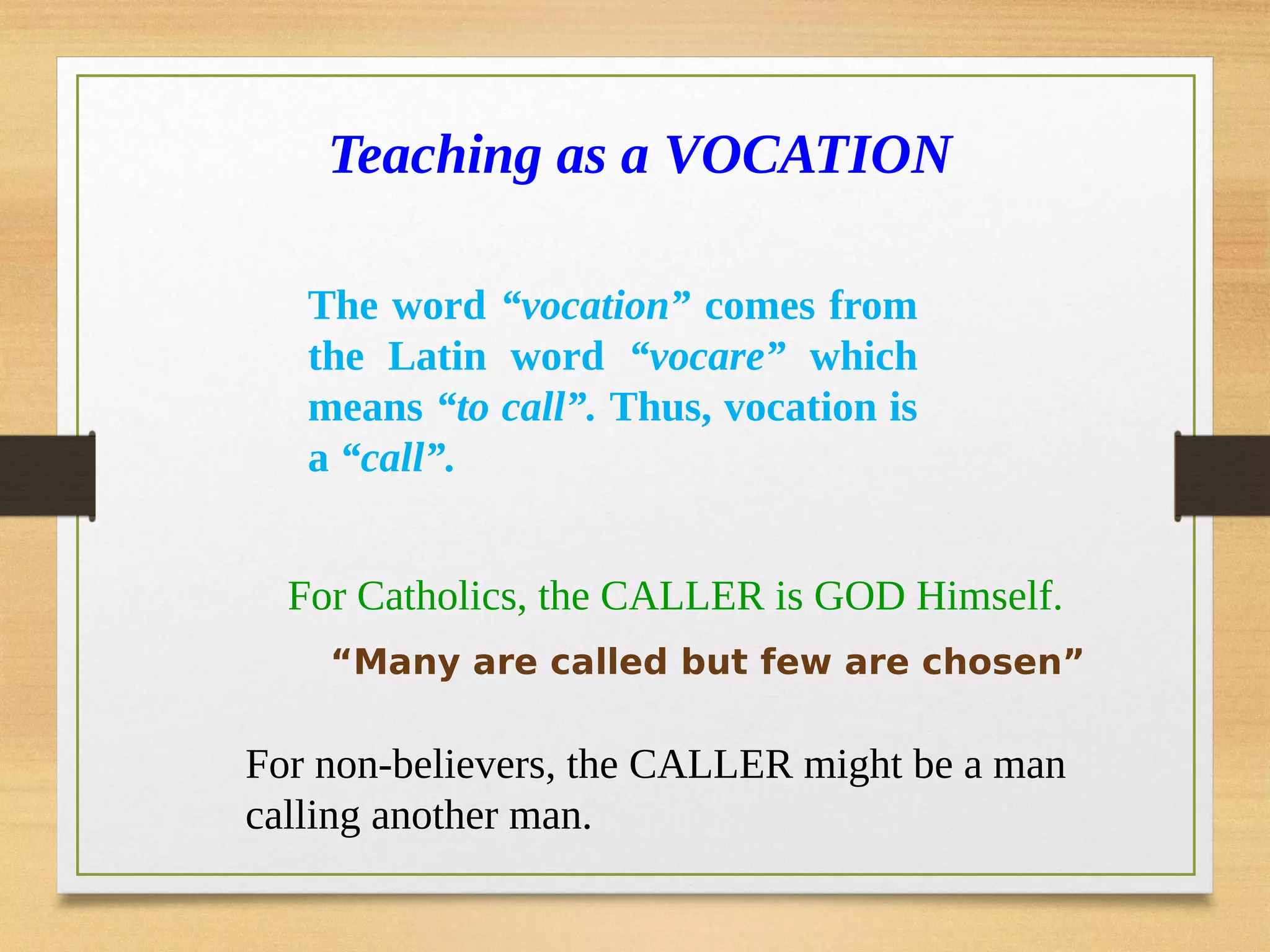
Teaching as a VOCATION
For Catholics, the CALLER is GOD Himself.
For non-believers, the CALLER might be a man
calling another man.
“Many are called but few are chosen”
The word “vocation” comes from
the Latin word “vocare” which
means “to call”. Thus, vocation is
a “call”.
If teaching is your vocation then it means:
You said ‘YES’to your call to teach!
You commit yourself in the total transformation of the
learner.
You consider teaching as a lifetime commitment
thus aim through the years towards quality
teaching.
“Teaching may not guarantee financial security but love of teaching
has served as a motivating factor to many teachers through the
years”. Teaching has remained inspiring & fulfilling.
Special Rights of a Teacher (Batas Pambansa
Blg. 232, Chapter 2, Section 11)
1. The right to be free from compulsory assignments not related to
their duties as defined in their appointment or employment
contracts, unless compensated…
2. The right to intellectual property consistent with applicable laws.
3. Teachers shall be deemed persons in authority when in discharge
of lawful duties & responsibilities and shall therefore, be
accorded due respect and protection.
4. Teachers shall be accorded the opportunity to choose alternative
career lines in school administration, in classroom teaching, or
others, for purposes of career advancement.
Teacher’s Obligations
(Batas Pambansa Blg. 232, Chapter 3, Section 16)
Every teacher shall:
1. Perform his duties to the school by discharging his
responsibilities in accordance with the philosophy, goals
& objectives of the school.
2. Be accountable for the efficient & effective attainment of
special learning objectives in pursuance of national
development goals, within the limits of available school
resources.
3. Render regular reports on performance of each student
and to the latter and the latter’s parents or guardians with
specific suggestions for improvement.
4. Assume the responsibility to maintain and sustain his
professional growth and advancement & maintain
professionalism in his behavior at all times.
5. Refrain from making deductions in student’s scholastic
ratings for acts that are not clearly manifestations of
poor scholarship.
6. Participate as an agent of constructive social, economic,
moral, intellectual, cultural and political change in his
school and the community within the context of national
policies.
References:
Acero, V. et. al., (2007). Principles of Teaching I. Philippines: Rex Book
Store.
Bilbao, P. et. al., (2012). The Teaching Profession. Philippines: Lorimar
Publishing Co., Inc.
Activity #1: Becoming a
Teacher
• Write your own story of “becoming a teacher”.
• Is your story based on:
• Choice
• Chance
• Force
• Accident?
Write your answer in your journal
notebook.
Activity #2: Teaching as a
Vocation
• Interview 3 teachers: (Get their names, subjects taught
and school.)
• 1-3 years;
• 5-10 years; and
• 15 years and above in teaching the teaching profession.
Ask them about “teaching as a vocation”. “What inspires
them to stay in the teaching profession?”
In a bond paper (long, landscape format, 12, Times New
Roman), Make a summary a the answers. Present them
in a matrix.

Introduction_of_Teaching_Profession.ppt.pdf

  • 1.
    THE TEACHING PROFESSION Source: The TeachingProfession by Bilbao et. al., 2012
  • 2.
    TYPES OF TEACHERS Someteachers are teachers by: • CHOICE • CHANCE • FORCE • ACCIDENT
  • 3.
    THE TEACHING PROFESSION Canbe regarded in three ways: Teaching as a profession Teaching as a mission Teaching as a vocation
  • 4.
    The word “profession”is synonymous to: occupation, job, career, work, line of work “Teaching is a noble profession” Teaching as a PROFESSION Teaching as a PROFESSION The word “professional” means long & arduous years of preparation, a striving for excellence, a dedication to public interest and commitment to moral & ethical values.
  • 5.
    You must bewilling to go through continuing education (continuous development of potentials) You must strive for excellence ( not “pwede na” mentality ) You commit yourself to moral, ethical and religious values & dedicate yourself to service. If you consider teaching as a profession then: You must be willing to go through a long period of preparation.
  • 6.
    Teaching as aMISSION Teaching as a MISSION The word mission is derived from the Latin word “misio” which means “to send”. The Webster’s Dictionary defines “mission” as “task assigned”.
  • 7.
    If teaching isyour mission then it means: If teaching is your mission then it means: - It is the “task” entrusted to you in this world. - It is your assigned task thus you’ve got to prepare for it! - It calls for a continuing professional education. “Once a teacher, forever a teacher… forever a student.”
  • 8.
    Teaching as aVOCATION For Catholics, the CALLER is GOD Himself. For non-believers, the CALLER might be a man calling another man. “Many are called but few are chosen” The word “vocation” comes from the Latin word “vocare” which means “to call”. Thus, vocation is a “call”.
  • 9.
    If teaching isyour vocation then it means: You said ‘YES’to your call to teach! You commit yourself in the total transformation of the learner. You consider teaching as a lifetime commitment thus aim through the years towards quality teaching. “Teaching may not guarantee financial security but love of teaching has served as a motivating factor to many teachers through the years”. Teaching has remained inspiring & fulfilling.
  • 10.
    Special Rights ofa Teacher (Batas Pambansa Blg. 232, Chapter 2, Section 11) 1. The right to be free from compulsory assignments not related to their duties as defined in their appointment or employment contracts, unless compensated… 2. The right to intellectual property consistent with applicable laws. 3. Teachers shall be deemed persons in authority when in discharge of lawful duties & responsibilities and shall therefore, be accorded due respect and protection. 4. Teachers shall be accorded the opportunity to choose alternative career lines in school administration, in classroom teaching, or others, for purposes of career advancement.
  • 11.
    Teacher’s Obligations (Batas PambansaBlg. 232, Chapter 3, Section 16) Every teacher shall: 1. Perform his duties to the school by discharging his responsibilities in accordance with the philosophy, goals & objectives of the school. 2. Be accountable for the efficient & effective attainment of special learning objectives in pursuance of national development goals, within the limits of available school resources. 3. Render regular reports on performance of each student and to the latter and the latter’s parents or guardians with specific suggestions for improvement.
  • 12.
    4. Assume theresponsibility to maintain and sustain his professional growth and advancement & maintain professionalism in his behavior at all times. 5. Refrain from making deductions in student’s scholastic ratings for acts that are not clearly manifestations of poor scholarship. 6. Participate as an agent of constructive social, economic, moral, intellectual, cultural and political change in his school and the community within the context of national policies.
  • 13.
    References: Acero, V. et.al., (2007). Principles of Teaching I. Philippines: Rex Book Store. Bilbao, P. et. al., (2012). The Teaching Profession. Philippines: Lorimar Publishing Co., Inc.
  • 14.
    Activity #1: Becominga Teacher • Write your own story of “becoming a teacher”. • Is your story based on: • Choice • Chance • Force • Accident? Write your answer in your journal notebook.
  • 15.
    Activity #2: Teachingas a Vocation • Interview 3 teachers: (Get their names, subjects taught and school.) • 1-3 years; • 5-10 years; and • 15 years and above in teaching the teaching profession. Ask them about “teaching as a vocation”. “What inspires them to stay in the teaching profession?” In a bond paper (long, landscape format, 12, Times New Roman), Make a summary a the answers. Present them in a matrix.