The Teaching
Profession
Main Reference: The Teaching Profession
by: Bilbao, etal., Lorimar Publishing, Inc.
Course Outline
• The Teaching Profession
• The Demands of Society from the Teacher as a
Professional and as a Person
• The Code of Ethics for Professional Teachers
• The Rights and Privileges of Teachers in the Philippines
• On Becoming a Global Teacher
• Ensuring Teacher quality through Competency
Framework and Standards
• Continuing Professional Development: The Lifeblood of
the Teaching Profession
• Philosophies of Education
• Teaching, the Noblest of all Profession
• Explain teaching as a vocation and mission.
• When a mother says, “I think my son has a
vocation,” what does she mean?
• A soldier reports and says “Mission accomplished.”
What does this imply? What does he mean?
Some teachers regard teaching as just a job. Others
see it as their mission. What’s the difference?
Read Teaching: Mission and/or Job below.
If you are doing it only because you are paid for it, it’s a job;
If you are doing it not only for the pay but also for service, it’s
a mission.
If you quit because your boss or colleagues criticized you, it’s
a job;
If you keep on teaching out of love, it’s a mission.
If you teach because it does not interfere with your other
activities, it’s a job;
If you are committed to teaching even if it means letting go
of other activities, it’s a mission.
If you quit because no one praises or thanks you for what you
do, it’s a job;
If you remain teaching even though nobody recognizes your
efforts, it’s a mission.
It’s hard to get excited about a teaching job;
It’s almost impossible not to get excited about a mission.
If our concern is success, it’s a job;
If our concern in teaching is success plus faithfulness in our
job, teaching is a mission.
An average school is filled by teachers doing their teaching
job;
A great school is filled with teachers involved in a mission of
teaching.

(Adapted from Ministry or Job by Anna Sandberg)
1. What is meant by vocation? mission?
2. Are these two (vocation and mission)
related?
3. Teaching is a job or a mission. What’s the
difference?
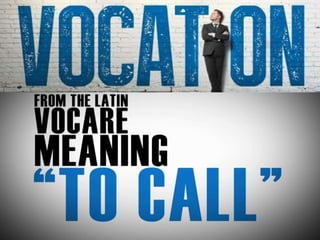
The fact that you are now in the College of Teacher Education signifies
that you said YES to the call to teach. Perhaps you never dreamt to
become a teacher. But here you are now preparing to become one!
Teaching must be your vocation, your calling. May this YES response
remain a YES and become even firmer through the years.
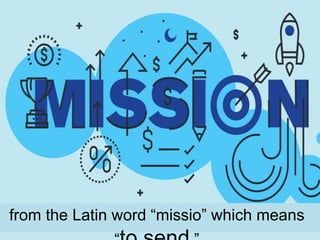
from the Latin word “missio” which means
You responded to the call to be a teacher
and so your mission in the world is to
teach, the task entrusted to you in this
world.
Flowing from your uniqueness, you are expected to contribute to
the betterment of this world in your own unique way. Your unique
and most significant contribution to the humanization of life on
earth is in the field for which you are prepared – teaching.
To teach is to influence every child entrusted in your care to
become better and happier because life becomes more
meaningful. To teach is to help the child become more human
Teaching may not be a lucrative position. It cannot guarantee financial
security. It even means investing your personal time, energy, and
resources. Sometimes it means disappointments, heartaches, and pains.
But touching the hearts of people and opening the minds of children can
give you joy and contentment which money could not buy. These are the
moments I teach for. These are the moments I live for.
- Dr. Josette T. Biyo, 1st Asian Teacher Intel Excellence in Teaching Awardee
Many leave teaching after three or five years for
varied reasons.
May you be found faithful to your vocation and
mission till the end.
The striving for excellent accomplishment sometimes
brings us to our “pwede na” mentality, which is
inimical to excellence. This mentality is expressed in
other ways like “talagang ganyan ‘yan,” “wala na
tayong magagawa,” “di na mahahalata,” “di ko na
sagot ‘yan,” “dagdag trabaho/gastos lang ‘yan” – all
indicators of defeatism and resignation to mediocrity.
The mortality rate in the Licensure Examination for
Teachers these past years is a glaring evidence that
excellence is vey much wanting of our teacher education
graduates. If we remain true to our calling and mission as
a professional teacher, we have no choice but to take the
endless and the “less travelled road” to excellence.
Read this letter given by a private school principal to
her teachers on the first day of a new school year.
It may make your humanizing mission in teaching
crystal clear.
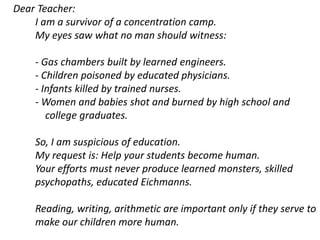
Dear Teacher:
I am a survivor of a concentration camp.
My eyes saw what no man should witness:
- Gas chambers built by learned engineers.
- Children poisoned by educated physicians.
- Infants killed by trained nurses.
- Women and babies shot and burned by high school and
college graduates.
So, I am suspicious of education.
My request is: Help your students become human.
Your efforts must never produce learned monsters, skilled
psychopaths, educated Eichmanns.
Reading, writing, arithmetic are important only if they serve to
make our children more human.
Question: Explain your mission as a
professional teacher by helping children
become more human.
Watch “Discovering Your Life’s True Calling” by Lou Sabrina
Ongkiko on You Tube.
Based on the video, what is your life’s true calling?
How can you apply that in your calling to teach?
https://www.youtube.com/watch?v=Z39yyx_8JY4
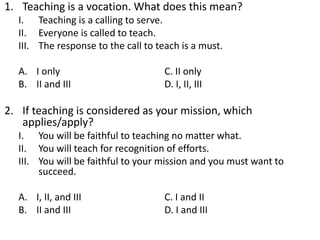
1. Teaching is a vocation. What does this mean?
I. Teaching is a calling to serve.
II. Everyone is called to teach.
III. The response to the call to teach is a must.
A. I only C. II only
B. II and III D. I, II, III
2. If teaching is considered as your mission, which
applies/apply?
I. You will be faithful to teaching no matter what.
II. You will teach for recognition of efforts.
III. You will be faithful to your mission and you must want to
succeed.
A. I, II, and III C. I and II
B. II and III D. I and III
• To be true to your vocation and mission as a
teacher, you have to “have more, do more in order
to be more” to your students and all others to
whom you were sent. What does “do more, have
more in order to be more” mean?
• The Greatest Teacher, Jesus Christ, spent much time
to prepare his apostles before he “sent” them for
their mission to “go into the world baptizing them
in the name of the Father, and of the son, and of
the Holy Spirit.” What is the equivalent of this
preparation in your life as a future professional
teacher?
• Here is an excerpt of The True Decalogue of
Apolinario Mabini.
Third. Develop the special talents that God has given you,
working and studying according to your capabilities, never
straying from the path of good and justice, in order to
achieve your own perfection, and by this means you will
contribute to the progress of humanity: thus you will
accomplish the mission that God himself has given you in
this life, and achieving this, you will have honor, and
having honor, you will be glorifying God.
* What mission has God given to teachers according
to The True Decalogue of Mabini? Explain.
• If you say “yes” to the call and mission to teach in
this life, reflect on how you are going to prepare
yourself in this 4-year teacher education course.
Lesson 1c - Teaching as a Vocation and Mission.pptx

Lesson 1c - Teaching as a Vocation and Mission.pptx

  • 1.
    The Teaching Profession Main Reference:The Teaching Profession by: Bilbao, etal., Lorimar Publishing, Inc.
  • 2.
    Course Outline • TheTeaching Profession • The Demands of Society from the Teacher as a Professional and as a Person • The Code of Ethics for Professional Teachers • The Rights and Privileges of Teachers in the Philippines • On Becoming a Global Teacher • Ensuring Teacher quality through Competency Framework and Standards • Continuing Professional Development: The Lifeblood of the Teaching Profession • Philosophies of Education • Teaching, the Noblest of all Profession
  • 4.
    • Explain teachingas a vocation and mission.
  • 6.
    • When amother says, “I think my son has a vocation,” what does she mean? • A soldier reports and says “Mission accomplished.” What does this imply? What does he mean? Some teachers regard teaching as just a job. Others see it as their mission. What’s the difference? Read Teaching: Mission and/or Job below.
  • 7.
    If you aredoing it only because you are paid for it, it’s a job; If you are doing it not only for the pay but also for service, it’s a mission. If you quit because your boss or colleagues criticized you, it’s a job; If you keep on teaching out of love, it’s a mission. If you teach because it does not interfere with your other activities, it’s a job; If you are committed to teaching even if it means letting go of other activities, it’s a mission. If you quit because no one praises or thanks you for what you do, it’s a job; If you remain teaching even though nobody recognizes your efforts, it’s a mission.
  • 8.
    It’s hard toget excited about a teaching job; It’s almost impossible not to get excited about a mission. If our concern is success, it’s a job; If our concern in teaching is success plus faithfulness in our job, teaching is a mission. An average school is filled by teachers doing their teaching job; A great school is filled with teachers involved in a mission of teaching. (Adapted from Ministry or Job by Anna Sandberg)

  • 9.
    1. What ismeant by vocation? mission? 2. Are these two (vocation and mission) related? 3. Teaching is a job or a mission. What’s the difference?
  • 13.
    The fact thatyou are now in the College of Teacher Education signifies that you said YES to the call to teach. Perhaps you never dreamt to become a teacher. But here you are now preparing to become one! Teaching must be your vocation, your calling. May this YES response remain a YES and become even firmer through the years.
  • 14.
    from the Latinword “missio” which means
  • 15.
    You responded tothe call to be a teacher and so your mission in the world is to teach, the task entrusted to you in this world.
  • 16.
    Flowing from youruniqueness, you are expected to contribute to the betterment of this world in your own unique way. Your unique and most significant contribution to the humanization of life on earth is in the field for which you are prepared – teaching.
  • 17.
    To teach isto influence every child entrusted in your care to become better and happier because life becomes more meaningful. To teach is to help the child become more human
  • 18.
    Teaching may notbe a lucrative position. It cannot guarantee financial security. It even means investing your personal time, energy, and resources. Sometimes it means disappointments, heartaches, and pains. But touching the hearts of people and opening the minds of children can give you joy and contentment which money could not buy. These are the moments I teach for. These are the moments I live for. - Dr. Josette T. Biyo, 1st Asian Teacher Intel Excellence in Teaching Awardee
  • 19.
    Many leave teachingafter three or five years for varied reasons. May you be found faithful to your vocation and mission till the end.
  • 20.
    The striving forexcellent accomplishment sometimes brings us to our “pwede na” mentality, which is inimical to excellence. This mentality is expressed in other ways like “talagang ganyan ‘yan,” “wala na tayong magagawa,” “di na mahahalata,” “di ko na sagot ‘yan,” “dagdag trabaho/gastos lang ‘yan” – all indicators of defeatism and resignation to mediocrity.
  • 21.
    The mortality ratein the Licensure Examination for Teachers these past years is a glaring evidence that excellence is vey much wanting of our teacher education graduates. If we remain true to our calling and mission as a professional teacher, we have no choice but to take the endless and the “less travelled road” to excellence.
  • 22.
    Read this lettergiven by a private school principal to her teachers on the first day of a new school year. It may make your humanizing mission in teaching crystal clear.
  • 23.
    Dear Teacher: I ama survivor of a concentration camp. My eyes saw what no man should witness: - Gas chambers built by learned engineers. - Children poisoned by educated physicians. - Infants killed by trained nurses. - Women and babies shot and burned by high school and college graduates. So, I am suspicious of education. My request is: Help your students become human. Your efforts must never produce learned monsters, skilled psychopaths, educated Eichmanns. Reading, writing, arithmetic are important only if they serve to make our children more human.
  • 24.
    Question: Explain yourmission as a professional teacher by helping children become more human.
  • 25.
    Watch “Discovering YourLife’s True Calling” by Lou Sabrina Ongkiko on You Tube. Based on the video, what is your life’s true calling? How can you apply that in your calling to teach? https://www.youtube.com/watch?v=Z39yyx_8JY4
  • 27.
    1. Teaching isa vocation. What does this mean? I. Teaching is a calling to serve. II. Everyone is called to teach. III. The response to the call to teach is a must. A. I only C. II only B. II and III D. I, II, III 2. If teaching is considered as your mission, which applies/apply? I. You will be faithful to teaching no matter what. II. You will teach for recognition of efforts. III. You will be faithful to your mission and you must want to succeed. A. I, II, and III C. I and II B. II and III D. I and III
  • 29.
    • To betrue to your vocation and mission as a teacher, you have to “have more, do more in order to be more” to your students and all others to whom you were sent. What does “do more, have more in order to be more” mean? • The Greatest Teacher, Jesus Christ, spent much time to prepare his apostles before he “sent” them for their mission to “go into the world baptizing them in the name of the Father, and of the son, and of the Holy Spirit.” What is the equivalent of this preparation in your life as a future professional teacher?
  • 30.
    • Here isan excerpt of The True Decalogue of Apolinario Mabini. Third. Develop the special talents that God has given you, working and studying according to your capabilities, never straying from the path of good and justice, in order to achieve your own perfection, and by this means you will contribute to the progress of humanity: thus you will accomplish the mission that God himself has given you in this life, and achieving this, you will have honor, and having honor, you will be glorifying God. * What mission has God given to teachers according to The True Decalogue of Mabini? Explain.
  • 31.
    • If yousay “yes” to the call and mission to teach in this life, reflect on how you are going to prepare yourself in this 4-year teacher education course.