Vocation, mission and
Profession.
Teaching as your
B Y : D a n i e l G . T a m b a n i l l o
A r j o l y n A p a s
“ One looks back with appreciation the brilliant
teachers, but with gratitude to those who touch our
human feelings…”-Carl Jung
ETYMOLOGY OF THE WORD “VOCATION”
Vocation comes from the latin word
“Vocare” which means to call. For
Christians, the caller is God Himself, while
for Muslims, Allah. Believers in the supreme
being view the call as having a vertical
dimension, while non-believers view it as
having a horizontal dimension. It is like man
calling another man, never a superior being.
The Bible is full of stories of men and women who
were called by God to do something not for
themselves, but for others. Abraham was called
to become the father of a great nation. Moses to
lead God’s chosen people out of Egypt, Mary to
become the mother of Jesus Christ, Muhammad
to spread the teachings of Allah, and Buddha to
abondon his royal life to seek the answer to the
problem of suffering. All of them responded
positively to God’s call.
TEACHING AS YOUR
VOCATION
 The most important details in this text
are that God called you to teach, just as
Abraham, Moses, and Mary did. These
biblical figures did not understand the
events surrounding their call, but in their
great faith, they answered Yes. The fact
that you are now in the college of
Teacher Education signifies that you
positively responded to the call to
teach. May this YES response remain a
YES and become even firmer through
the years.
ETYMOLOGY OF THE WORD
"MISSION"
Teaching is also a mission. The word mission
comes from the Latin word "misio" which
means "to send". You are called to be a teacher
and you are sent into the world to accomplish a
mission, to teach. The Webster's New
Collegiate Dictionary defines mission as "task
assigned. You are sent to accomplish an
assigned task.
TEACHING AS YOUR MISSION
Teaching is a mission, so it is impor ant to prepare yourself for
it. Four years of pre-service preparation will equip you with the
knowledge, skills and at ttude to become an effective teacher.
However, never commit the mistake of culminating your
mission preparation at the end of the four-years pre-service
education. As the saying goes, "once a teacher forever a
student."
You are expected to contribute to the betterment of the world
in your own unique way, and your most significant contribution
is in the field where you are prepared for teaching.
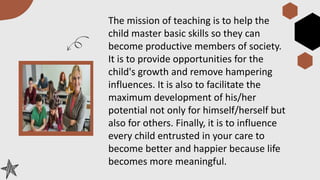
The mission of teaching is to help the
child master basic skills so they can
become productive members of society.
It is to provide opportunities for the
child's growth and remove hampering
influences. It is also to facilitate the
maximum development of his/her
potential not only for himself/herself but
also for others. Finally, it is to influence
every child entrusted in your care to
become better and happier because life
becomes more meaningful.
A letter given by a private school principal to her
teachers on the first day of a new school year may make
crystal clear for your humanizing mission in teaching:
Dear Teacher: I am a survivor of a concentration camp.
My eyes saw what no man should witness:
-Gas chambers built by learned engineers.
-Children poisoned by educated physician
-Infants killed by trained nurses.
-Women and babies shot and burned by high
school and college graduates.
So I am suspicious of education.
My request is: Help your students become
human. Your effort must never produce
learned monsters, skilled psychopaths, and
Eichmann's.
Reading, writing, arithmetic are important only
if they serve to make our children more
human.
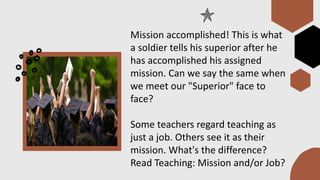
Mission accomplished! This is what
a soldier tells his superior after he
has accomplished his assigned
mission. Can we say the same when
we meet our "Superior" face to
face?
Some teachers regard teaching as
just a job. Others see it as their
mission. What's the difference?
Read Teaching: Mission and/or Job?
Teaching: Mission and/or Job?
If you are doing it only because you are paid for it, it's a
job; If you are doing it not only for the pay but also for service,
it's a mission.
If you quit because your boss or colleague criticized you,it's a
job:
If you keep on teaching out of love, it's a mission. If you teach
because it does not interfere with your other activities, it's job;
If you are committed to teaching even if it means letting go of
other activities, it's a mission.
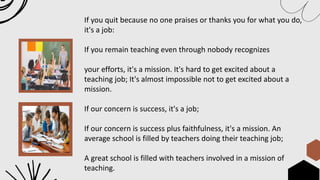
If you quit because no one praises or thanks you for what you do,
it's a job:
If you remain teaching even through nobody recognizes
your efforts, it's a mission. It's hard to get excited about a
teaching job; It's almost impossible not to get excited about a
mission.
If our concern is success, it's a job;
If our concern is success plus faithfulness, it's a mission. An
average school is filled by teachers doing their teaching job;
A great school is filled with teachers involved in a mission of
teaching.
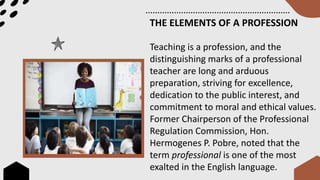
THE ELEMENTS OF A PROFESSION
Teaching is a profession, and the
distinguishing marks of a professional
teacher are long and arduous
preparation, striving for excellence,
dedication to the public interest, and
commitment to moral and ethical values.
Former Chairperson of the Professional
Regulation Commission, Hon.
Hermogenes P. Pobre, noted that the
term professional is one of the most
exalted in the English language.
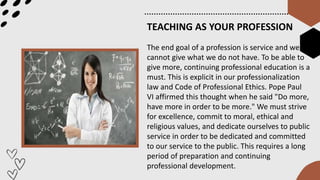
TEACHING AS YOUR PROFESSION
The end goal of a profession is service and we
cannot give what we do not have. To be able to
give more, continuing professional education is a
must. This is explicit in our professionalization
law and Code of Professional Ethics. Pope Paul
VI affirmed this thought when he said "Do more,
have more in order to be more." We must strive
for excellence, commit to moral, ethical and
religious values, and dedicate ourselves to public
service in order to be dedicated and committed
to our service to the public. This requires a long
period of preparation and continuing
professional development.
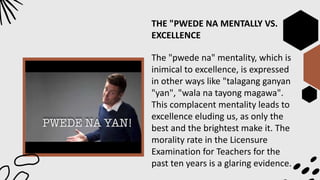
THE "PWEDE NA MENTALLY VS.
EXCELLENCE
The "pwede na" mentality, which is
inimical to excellence, is expressed
in other ways like "talagang ganyan
"yan", "wala na tayong magawa".
This complacent mentality leads to
excellence eluding us, as only the
best and the brightest make it. The
morality rate in the Licensure
Examination for Teachers for the
past ten years is a glaring evidence.
TEACHING AND A LIFE OF MEANING
Want to give your life a meaning? Spend it
passionately in teaching, the most noble
profession. Dr. Joset e T. Biyo, the first Asian
teacher to win the Intel Excellence Award in an
International competition, said in a speech
delivered before a selected group of teachers,
superintendents, DepEd officials and
consultants, to wit:
Teaching may not be a lucrative position. It cannot
guarantee financial security. It even means
investing your personal time, energy, and
resources. Sometimes it mean's disappointments,
heartaches, and pains. But touching the hearts of
people and opening the minds of children can give
you joy and contentment which money could not
buy. These are the moments I teach for. These are
the moments I live for.

DANIEL PROF ED2.pptx hehehehehehe hope it

  • 1.
    Vocation, mission and Profession. Teachingas your B Y : D a n i e l G . T a m b a n i l l o A r j o l y n A p a s “ One looks back with appreciation the brilliant teachers, but with gratitude to those who touch our human feelings…”-Carl Jung
  • 2.
    ETYMOLOGY OF THEWORD “VOCATION” Vocation comes from the latin word “Vocare” which means to call. For Christians, the caller is God Himself, while for Muslims, Allah. Believers in the supreme being view the call as having a vertical dimension, while non-believers view it as having a horizontal dimension. It is like man calling another man, never a superior being.
  • 3.
    The Bible isfull of stories of men and women who were called by God to do something not for themselves, but for others. Abraham was called to become the father of a great nation. Moses to lead God’s chosen people out of Egypt, Mary to become the mother of Jesus Christ, Muhammad to spread the teachings of Allah, and Buddha to abondon his royal life to seek the answer to the problem of suffering. All of them responded positively to God’s call.
  • 4.
    TEACHING AS YOUR VOCATION The most important details in this text are that God called you to teach, just as Abraham, Moses, and Mary did. These biblical figures did not understand the events surrounding their call, but in their great faith, they answered Yes. The fact that you are now in the college of Teacher Education signifies that you positively responded to the call to teach. May this YES response remain a YES and become even firmer through the years.
  • 5.
    ETYMOLOGY OF THEWORD "MISSION" Teaching is also a mission. The word mission comes from the Latin word "misio" which means "to send". You are called to be a teacher and you are sent into the world to accomplish a mission, to teach. The Webster's New Collegiate Dictionary defines mission as "task assigned. You are sent to accomplish an assigned task.
  • 6.
    TEACHING AS YOURMISSION Teaching is a mission, so it is impor ant to prepare yourself for it. Four years of pre-service preparation will equip you with the knowledge, skills and at ttude to become an effective teacher. However, never commit the mistake of culminating your mission preparation at the end of the four-years pre-service education. As the saying goes, "once a teacher forever a student." You are expected to contribute to the betterment of the world in your own unique way, and your most significant contribution is in the field where you are prepared for teaching.
  • 7.
    The mission ofteaching is to help the child master basic skills so they can become productive members of society. It is to provide opportunities for the child's growth and remove hampering influences. It is also to facilitate the maximum development of his/her potential not only for himself/herself but also for others. Finally, it is to influence every child entrusted in your care to become better and happier because life becomes more meaningful.
  • 8.
    A letter givenby a private school principal to her teachers on the first day of a new school year may make crystal clear for your humanizing mission in teaching: Dear Teacher: I am a survivor of a concentration camp. My eyes saw what no man should witness: -Gas chambers built by learned engineers. -Children poisoned by educated physician -Infants killed by trained nurses. -Women and babies shot and burned by high school and college graduates.
  • 9.
    So I amsuspicious of education. My request is: Help your students become human. Your effort must never produce learned monsters, skilled psychopaths, and Eichmann's. Reading, writing, arithmetic are important only if they serve to make our children more human.
  • 10.
    Mission accomplished! Thisis what a soldier tells his superior after he has accomplished his assigned mission. Can we say the same when we meet our "Superior" face to face? Some teachers regard teaching as just a job. Others see it as their mission. What's the difference? Read Teaching: Mission and/or Job?
  • 11.
    Teaching: Mission and/orJob? If you are doing it only because you are paid for it, it's a job; If you are doing it not only for the pay but also for service, it's a mission. If you quit because your boss or colleague criticized you,it's a job: If you keep on teaching out of love, it's a mission. If you teach because it does not interfere with your other activities, it's job; If you are committed to teaching even if it means letting go of other activities, it's a mission.
  • 12.
    If you quitbecause no one praises or thanks you for what you do, it's a job: If you remain teaching even through nobody recognizes your efforts, it's a mission. It's hard to get excited about a teaching job; It's almost impossible not to get excited about a mission. If our concern is success, it's a job; If our concern is success plus faithfulness, it's a mission. An average school is filled by teachers doing their teaching job; A great school is filled with teachers involved in a mission of teaching.
  • 13.
    THE ELEMENTS OFA PROFESSION Teaching is a profession, and the distinguishing marks of a professional teacher are long and arduous preparation, striving for excellence, dedication to the public interest, and commitment to moral and ethical values. Former Chairperson of the Professional Regulation Commission, Hon. Hermogenes P. Pobre, noted that the term professional is one of the most exalted in the English language.
  • 14.
    TEACHING AS YOURPROFESSION The end goal of a profession is service and we cannot give what we do not have. To be able to give more, continuing professional education is a must. This is explicit in our professionalization law and Code of Professional Ethics. Pope Paul VI affirmed this thought when he said "Do more, have more in order to be more." We must strive for excellence, commit to moral, ethical and religious values, and dedicate ourselves to public service in order to be dedicated and committed to our service to the public. This requires a long period of preparation and continuing professional development.
  • 15.
    THE "PWEDE NAMENTALLY VS. EXCELLENCE The "pwede na" mentality, which is inimical to excellence, is expressed in other ways like "talagang ganyan "yan", "wala na tayong magawa". This complacent mentality leads to excellence eluding us, as only the best and the brightest make it. The morality rate in the Licensure Examination for Teachers for the past ten years is a glaring evidence.
  • 16.
    TEACHING AND ALIFE OF MEANING Want to give your life a meaning? Spend it passionately in teaching, the most noble profession. Dr. Joset e T. Biyo, the first Asian teacher to win the Intel Excellence Award in an International competition, said in a speech delivered before a selected group of teachers, superintendents, DepEd officials and consultants, to wit:
  • 17.
    Teaching may notbe a lucrative position. It cannot guarantee financial security. It even means investing your personal time, energy, and resources. Sometimes it mean's disappointments, heartaches, and pains. But touching the hearts of people and opening the minds of children can give you joy and contentment which money could not buy. These are the moments I teach for. These are the moments I live for.