TEACHING PROFESSION
Prepared By:
Regine Abrazado
Maria Paz Adorco
Mary Joy Almario
Ronalyn Alvarez
LEARNING OUTCOMES
 Explain the meaning of teaching as a profession.
 Trace the historical development of teaching as a profession in the Philippines.
TEACHING AS A “PROFESSION”
 A professional is one who conforms to the technical or ethical standards of a
profession. So two elements of a profession are competence and a code of
ethics.
THE OTHER ELEMENT OF A
PROFESSION ARE:
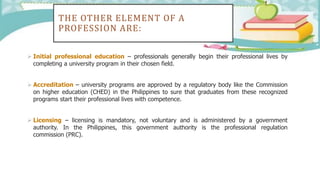
 Initial professional education – professionals generally begin their professional lives by
completing a university program in their chosen field.
 Accreditation – university programs are approved by a regulatory body like the Commission
on higher education (CHED) in the Philippines to sure that graduates from these recognized
programs start their professional lives with competence.
 Licensing – licensing is mandatory, not voluntary and is administered by a government
authority. In the Philippines, this government authority is the professional regulation
commission (PRC).
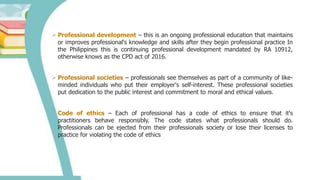
 Professional development – this is an ongoing professional education that maintains
or improves professional's knowledge and skills after they begin professional practice In
the Philippines this is continuing professional development mandated by RA 10912,
otherwise knows as the CPD act of 2016.
 Professional societies – professionals see themselves as part of a community of like-
minded individuals who put their employer's self-interest. These professional societies
put dedication to the public interest and commitment to moral and ethical values.
 Code of ethics – Each of professional has a code of ethics to ensure that it's
practitioners behave responsibly. The code states what professionals should do.
Professionals can be ejected from their professionals society or lose their licenses to
practice for violating the code of ethics
TEACHING AS A “VOCATION”
ETYMOLOGY:
 It comes from the Latin word “vocare” which means “ to call”.
 Teaching is more than a noble profession. It is a vocation… a calling
“ If there” a call there must be a caller and someone
who called. There must also be response.”
Christians – caller is GOD
Muslim – caller is ALLAH
 Believers in the SUPREME BEING will look at his voiceless call to have a vertical
dimension.
 Non-believers. The call is experienced but viewed solely along a horizontal
dimension. It is like man calling another man, never a Superior being calling
man.
Vocation is a strong feeling of suitability for a particular
career or occupation.
Unlike any other profession, teaching requires dedication and
services in order for an individual to be considered as a real
teacher.
EXAMPLE:
Teacher Mark is treated as a teacher for teaching his students the lessons every day.
He teaches everything he knows, showing off his mastery of the subject, but not even
considering the feelings of his students towards difficult topics. On the other hand, a
volunteer named Joy is addressed as a teacher for teaching and serving the children of
a far rural community. She travels almost 20 kilometers everyday for the sake of her
students learning and development.
What is the difference between the teaching practices of Teacher Mark and Joy?
- The main difference lies in their dedication to the service.
When someone practices teaching as a vocation, they teach with
dedication.
In summary, Vocation is only for some who are really dedicated not just to
work but also to serve other people.
“There are very few real teachers. Teaching is not a job; it is a vocation. To be a
great one many qualities must be combined: love of truth, knowledge, reverence,
loving concern for one’s students, clarity and patience.”
-Alice von Hildebrand-
TEACHING AS A “MISSION”
ETYMOLOGY:
It comes from the Latin word “misio” which means “to send”
We are sent into the world to accomplish an mission.
Teaching is your mission means it is the task entrusted to you in this
world.
Every teacher has its own unique mission, purpose, or objective that
they need to accomplish.
 we are expected to contribute to the betterment of this world in your
own unique way.
“WHAT EXACTLY IS THE MISSION TO
TEACH?”
 Alfred North Whitehead
It is to help the child become the “ man of culture and of expertise”?
 Bertrand Russell
Is it provide opportunities for the child’s growth and to remove hampering
influences?
 To teach is to influence every child
entrusted in your care to become
better an happier because life become
more meaningful.
 To teach is to help child become more
human.
Some teachers regard teaching as
just a job. Others see it as their
mission.
What’s the difference?
TEACHING: MISSION AND/OR JOB?
 If you are doing it only because you are paid for it, it’s a job.
 If you are doing it not only for the pay but also for services, it’s a mission.
 If you quit because your boss or colleague criticized you, it’s a job
 If you keep teaching out of love, it’s mission.
 If you teach because it does not interfere with your other activities, it’s a job.
 If you are committed to teaching even if it means letting go of other activities,
it’ a mission.
 If you quit because no one praises or thanks you for what you do, it’s a
job
 If you teaching even though nobody recognizes your efforts, it’s a mission
 It’s hard to get excited about teaching job;
 Its almost impossible not to get excited about mission.
 If our concern is success, it’s a job;
 If our concern is success plus faithfulness, it’s mission.
 An average school is filled by teachers doing their teaching job;
 A great school is filled with teachers involved in mission of teaching.
SO WHAT EXACTLY IS OUR MISSION?
It is to be an effective educator or facilitator of learning, imparting
knowledge that is not just what written in books but also in life. Our
mission is to touch hearts and mind while leading children to be a better
individual who have a strong desire to contribute to the betterment of the
society and serve the country.
TEACHING AND A LIFE OF MEANING
Teaching may not be a lucrative position.
It can not guarantee financial security.
It even means investing your personal time, energy, and resources.
Sometimes it means disappointments, heartaches, and pains.
But touching the hearts of people and opening the minds of children can give you joy and
contentment which money could not buy.
There are the moments I teach for.
These are the moments I live for.
-Dr. Josette T. Biyo 1st Asian Teacher,
Intel Excellent in Teaching award
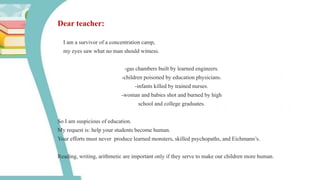
Dear teacher:
I am a survivor of a concentration camp,
my eyes saw what no man should witness.
-gas chambers built by learned engineers.
-children poisoned by education physicians.
-infants killed by trained nurses.
-woman and babies shot and burned by high
school and college graduates.
So I am suspicious of education.
My request is: help your students become human.
Your efforts must never produce learned monsters, skilled psychopaths, and Eichmann’s.
Reading, writing, arithmetic are important only if they serve to make our children more human.
-End-
Thank You

teaching-profession.pptx

  • 1.
    TEACHING PROFESSION Prepared By: RegineAbrazado Maria Paz Adorco Mary Joy Almario Ronalyn Alvarez
  • 2.
    LEARNING OUTCOMES  Explainthe meaning of teaching as a profession.  Trace the historical development of teaching as a profession in the Philippines.
  • 3.
    TEACHING AS A“PROFESSION”  A professional is one who conforms to the technical or ethical standards of a profession. So two elements of a profession are competence and a code of ethics.
  • 4.
    THE OTHER ELEMENTOF A PROFESSION ARE:  Initial professional education – professionals generally begin their professional lives by completing a university program in their chosen field.  Accreditation – university programs are approved by a regulatory body like the Commission on higher education (CHED) in the Philippines to sure that graduates from these recognized programs start their professional lives with competence.  Licensing – licensing is mandatory, not voluntary and is administered by a government authority. In the Philippines, this government authority is the professional regulation commission (PRC).
  • 5.
     Professional development– this is an ongoing professional education that maintains or improves professional's knowledge and skills after they begin professional practice In the Philippines this is continuing professional development mandated by RA 10912, otherwise knows as the CPD act of 2016.  Professional societies – professionals see themselves as part of a community of like- minded individuals who put their employer's self-interest. These professional societies put dedication to the public interest and commitment to moral and ethical values.  Code of ethics – Each of professional has a code of ethics to ensure that it's practitioners behave responsibly. The code states what professionals should do. Professionals can be ejected from their professionals society or lose their licenses to practice for violating the code of ethics
  • 6.
    TEACHING AS A“VOCATION” ETYMOLOGY:  It comes from the Latin word “vocare” which means “ to call”.  Teaching is more than a noble profession. It is a vocation… a calling
  • 7.
    “ If there”a call there must be a caller and someone who called. There must also be response.” Christians – caller is GOD Muslim – caller is ALLAH  Believers in the SUPREME BEING will look at his voiceless call to have a vertical dimension.  Non-believers. The call is experienced but viewed solely along a horizontal dimension. It is like man calling another man, never a Superior being calling man.
  • 8.
    Vocation is astrong feeling of suitability for a particular career or occupation. Unlike any other profession, teaching requires dedication and services in order for an individual to be considered as a real teacher.
  • 9.
    EXAMPLE: Teacher Mark istreated as a teacher for teaching his students the lessons every day. He teaches everything he knows, showing off his mastery of the subject, but not even considering the feelings of his students towards difficult topics. On the other hand, a volunteer named Joy is addressed as a teacher for teaching and serving the children of a far rural community. She travels almost 20 kilometers everyday for the sake of her students learning and development. What is the difference between the teaching practices of Teacher Mark and Joy? - The main difference lies in their dedication to the service.
  • 10.
    When someone practicesteaching as a vocation, they teach with dedication. In summary, Vocation is only for some who are really dedicated not just to work but also to serve other people. “There are very few real teachers. Teaching is not a job; it is a vocation. To be a great one many qualities must be combined: love of truth, knowledge, reverence, loving concern for one’s students, clarity and patience.” -Alice von Hildebrand-
  • 11.
    TEACHING AS A“MISSION” ETYMOLOGY: It comes from the Latin word “misio” which means “to send” We are sent into the world to accomplish an mission.
  • 12.
    Teaching is yourmission means it is the task entrusted to you in this world. Every teacher has its own unique mission, purpose, or objective that they need to accomplish.  we are expected to contribute to the betterment of this world in your own unique way.
  • 13.
    “WHAT EXACTLY ISTHE MISSION TO TEACH?”  Alfred North Whitehead It is to help the child become the “ man of culture and of expertise”?  Bertrand Russell Is it provide opportunities for the child’s growth and to remove hampering influences?
  • 14.
     To teachis to influence every child entrusted in your care to become better an happier because life become more meaningful.  To teach is to help child become more human. Some teachers regard teaching as just a job. Others see it as their mission. What’s the difference?
  • 15.
    TEACHING: MISSION AND/ORJOB?  If you are doing it only because you are paid for it, it’s a job.  If you are doing it not only for the pay but also for services, it’s a mission.  If you quit because your boss or colleague criticized you, it’s a job  If you keep teaching out of love, it’s mission.  If you teach because it does not interfere with your other activities, it’s a job.  If you are committed to teaching even if it means letting go of other activities, it’ a mission.
  • 16.
     If youquit because no one praises or thanks you for what you do, it’s a job  If you teaching even though nobody recognizes your efforts, it’s a mission  It’s hard to get excited about teaching job;  Its almost impossible not to get excited about mission.  If our concern is success, it’s a job;  If our concern is success plus faithfulness, it’s mission.  An average school is filled by teachers doing their teaching job;  A great school is filled with teachers involved in mission of teaching.
  • 17.
    SO WHAT EXACTLYIS OUR MISSION? It is to be an effective educator or facilitator of learning, imparting knowledge that is not just what written in books but also in life. Our mission is to touch hearts and mind while leading children to be a better individual who have a strong desire to contribute to the betterment of the society and serve the country.
  • 18.
    TEACHING AND ALIFE OF MEANING Teaching may not be a lucrative position. It can not guarantee financial security. It even means investing your personal time, energy, and resources. Sometimes it means disappointments, heartaches, and pains. But touching the hearts of people and opening the minds of children can give you joy and contentment which money could not buy. There are the moments I teach for. These are the moments I live for. -Dr. Josette T. Biyo 1st Asian Teacher, Intel Excellent in Teaching award
  • 19.
    Dear teacher: I ama survivor of a concentration camp, my eyes saw what no man should witness. -gas chambers built by learned engineers. -children poisoned by education physicians. -infants killed by trained nurses. -woman and babies shot and burned by high school and college graduates. So I am suspicious of education. My request is: help your students become human. Your efforts must never produce learned monsters, skilled psychopaths, and Eichmann’s. Reading, writing, arithmetic are important only if they serve to make our children more human.
  • 20.