


SECRETARYSHIP
About Secretary
What is secretary?
• A secretary shall be defined as an executive
assistant who possesses a mastery of office
skills, demonstrates the ability to assume
responsibility without direction or
supervision, exercises initiative and
judgment, and makes decisions within the
scope of assigned authority
The Classification of a Secretary
•

Secretary level B
Performs a limited range of secretarial duties
in a small company or for a supervisor in a
large firm. May take dictation and transcribe
from notes and dictaphone with speed and
accuracy. Screen calls, make
appointment, handles travel
arrangement, answer routine
correspondence, and maintains filling
system.
•

Secretary level A
Performs an unlimited range of secretarial
duties for middle management personnel or
more than individual. Composes and/or
takes and transcribes correspondence of a
complex and confidential nature. Position
requires a knowledge of company
policy, procedures, and above average
secretarial and administrative skills.
•

Executive Secretary/Administrative
Assistant
Performs a full range of secretarial and
administrative duties for high level members
of executive staff. Handles project oriented
duties and maybe held accountable for the
timely completion of this tasks. Relieves
executive of routine administrative detail.
Position requires an in depth knowledge of
company practice, structure, and high
degree of technical skill.
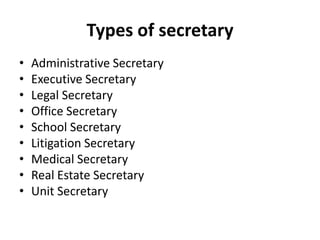
Types of secretary
•
•
•
•
•
•
•
•
•

Administrative Secretary
Executive Secretary
Legal Secretary
Office Secretary
School Secretary
Litigation Secretary
Medical Secretary
Real Estate Secretary
Unit Secretary
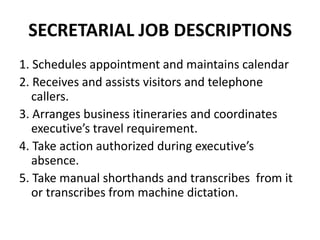
SECRETARIAL JOB DESCRIPTIONS
1. Schedules appointment and maintains calendar
2. Receives and assists visitors and telephone
callers.
3. Arranges business itineraries and coordinates
executive’s travel requirement.
4. Take action authorized during executive’s
absence.
5. Take manual shorthands and transcribes from it
or transcribes from machine dictation.
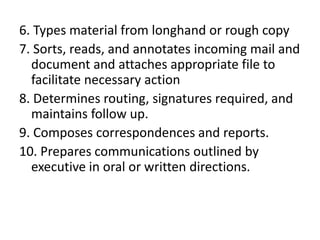
6. Types material from longhand or rough copy
7. Sorts, reads, and annotates incoming mail and
document and attaches appropriate file to
facilitate necessary action
8. Determines routing, signatures required, and
maintains follow up.
9. Composes correspondences and reports.
10. Prepares communications outlined by
executive in oral or written directions.
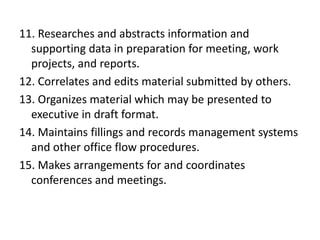
11. Researches and abstracts information and
supporting data in preparation for meeting, work
projects, and reports.
12. Correlates and edits material submitted by others.
13. Organizes material which may be presented to
executive in draft format.
14. Maintains fillings and records management systems
and other office flow procedures.
15. Makes arrangements for and coordinates
conferences and meetings.
16. May serve as recorder of minutes with
responsibility for transcription and distribution to
participants.
17. May supervise or hire other employees
18. Select and/or make recommendations for
purchase of supplies and equipment, maintain
budget and expense account records, financial
records, and confidential files.
19. Maintains up-to-date procedures manual for the
specific duties handled on the job.
20. Performs other duties as assigned or as
judgment or necessity dictates.
There are four scopes or area of
secretarial duties :
1. Technical skills
2. An understanding of business functions and
interlocking functions
3. Skill in human relation
4. Facility in oral and written communication
DIVISION OF THE SECRETARIAL FUNCTION
•
1.
2.
3.
4.
5.

TYPING ACTIVITIES
Correspondence
Reports
Business forms
Machine transcriptions
Files

• NONTYPING ACTIVITIES
1. Handling mail
2. Scheduling appointments
3. Making travel
arrangements
4. Researching information
5. Other secretarial services
QUALITIES OF AN IDEAL SECRETARY
•
•
•
•
•
•
•

Accurate, alert
Neat, nicely groomed
Industrious, intelligent, interest in job
Dependable, dlligent
Efficient, exercise poise
Ambitious. agreeable
Loyal. logical
•
•
•
•
•
•
•
•
•

Sincere, systematic
Enthusiastic
Cheerful, courteous, cooperative, confident
Reliable, resourceful
Eager to please, exercises good judgment
Tactful, thorough, trustworthy, truthfful
Attentive, adaptable
Responsible, refined
Your attitude (thoughtfulness, and helpfulness
toward others)
SECRETARIAL ENVIRONMENT
•
1.
2.
3.
4.
5.

Company officers
President
Executive vice president
Vice president
Secretary
Treasurer
•
1.
2.
3.

Divisions of a company
Production
Purchasing
Marketing :
a. Sales department
b. Advertising department
c. Market research department
4. Finance division
5. Research and development division
6. Administrative services division :
a. Personnel department
b. Information services
Why are you needed?
• Every businessperson dreams of having the
perfect administrative assistant, and every
administrative assistant dreams of having the
perfect boss
What do employers want?
Few of the most important qualities:
1. Punctuality
2. Dependability
3. Ability to learn
4. Willingness to follow instruction
5. Loyalty and confidentiality
6. And something else
COMMUNICATION
Communication is important in all situations and in
particular the situations where you can build first
impressions:
• meetings;
• on the phone;
• networking;
• giving presentations;
• business conferences;
• e-mails;
• social occasions.
Visual, auditory and kinaesthetic
• You can tell whether people are
visual, auditory or kinaesthetic by their body
language and the language they use, as
outlined below:
VISUAL
• Visual people process their world by means of
pictures and what they see, including the use
of pictures in their decision making.
AUDITORY
• Auditory people process their world and arrive
at their decisions by means of the words that
are used and what they hear.
KINAESTHETIC
• Kinaesthetic people base their decisions on how
they feel.
• They drop their eyes down towards the ground
when you talk to them, and talk about how they
feel:
‘That feels right’, ‘That makes me feel sad’, ‘That
makes me feel good’, ‘I understand how you
feel’, ‘I feel you are worried about…’, ‘I feel as if
you are uncomfortable…’, ‘I sense you’re thinking
about…’ and so on.
DAILY ROUTINE
•
•
•
•
•

YOUR OFFICE
YOUR WORK STATION
OFFICE SUPPLIES
REFERENCE WORKS
WORKS PLANNING
Firstmeeting secretary

Firstmeeting secretary

  • 1.
  • 2.
    What is secretary? •A secretary shall be defined as an executive assistant who possesses a mastery of office skills, demonstrates the ability to assume responsibility without direction or supervision, exercises initiative and judgment, and makes decisions within the scope of assigned authority
  • 3.
    The Classification ofa Secretary • Secretary level B Performs a limited range of secretarial duties in a small company or for a supervisor in a large firm. May take dictation and transcribe from notes and dictaphone with speed and accuracy. Screen calls, make appointment, handles travel arrangement, answer routine correspondence, and maintains filling system.
  • 4.
    • Secretary level A Performsan unlimited range of secretarial duties for middle management personnel or more than individual. Composes and/or takes and transcribes correspondence of a complex and confidential nature. Position requires a knowledge of company policy, procedures, and above average secretarial and administrative skills.
  • 5.
    • Executive Secretary/Administrative Assistant Performs afull range of secretarial and administrative duties for high level members of executive staff. Handles project oriented duties and maybe held accountable for the timely completion of this tasks. Relieves executive of routine administrative detail. Position requires an in depth knowledge of company practice, structure, and high degree of technical skill.
  • 6.
    Types of secretary • • • • • • • • • AdministrativeSecretary Executive Secretary Legal Secretary Office Secretary School Secretary Litigation Secretary Medical Secretary Real Estate Secretary Unit Secretary
  • 7.
    SECRETARIAL JOB DESCRIPTIONS 1.Schedules appointment and maintains calendar 2. Receives and assists visitors and telephone callers. 3. Arranges business itineraries and coordinates executive’s travel requirement. 4. Take action authorized during executive’s absence. 5. Take manual shorthands and transcribes from it or transcribes from machine dictation.
  • 8.
    6. Types materialfrom longhand or rough copy 7. Sorts, reads, and annotates incoming mail and document and attaches appropriate file to facilitate necessary action 8. Determines routing, signatures required, and maintains follow up. 9. Composes correspondences and reports. 10. Prepares communications outlined by executive in oral or written directions.
  • 9.
    11. Researches andabstracts information and supporting data in preparation for meeting, work projects, and reports. 12. Correlates and edits material submitted by others. 13. Organizes material which may be presented to executive in draft format. 14. Maintains fillings and records management systems and other office flow procedures. 15. Makes arrangements for and coordinates conferences and meetings.
  • 10.
    16. May serveas recorder of minutes with responsibility for transcription and distribution to participants. 17. May supervise or hire other employees 18. Select and/or make recommendations for purchase of supplies and equipment, maintain budget and expense account records, financial records, and confidential files. 19. Maintains up-to-date procedures manual for the specific duties handled on the job. 20. Performs other duties as assigned or as judgment or necessity dictates.
  • 11.
    There are fourscopes or area of secretarial duties : 1. Technical skills 2. An understanding of business functions and interlocking functions 3. Skill in human relation 4. Facility in oral and written communication
  • 12.
    DIVISION OF THESECRETARIAL FUNCTION • 1. 2. 3. 4. 5. TYPING ACTIVITIES Correspondence Reports Business forms Machine transcriptions Files • NONTYPING ACTIVITIES 1. Handling mail 2. Scheduling appointments 3. Making travel arrangements 4. Researching information 5. Other secretarial services
  • 13.
    QUALITIES OF ANIDEAL SECRETARY • • • • • • • Accurate, alert Neat, nicely groomed Industrious, intelligent, interest in job Dependable, dlligent Efficient, exercise poise Ambitious. agreeable Loyal. logical
  • 14.
    • • • • • • • • • Sincere, systematic Enthusiastic Cheerful, courteous,cooperative, confident Reliable, resourceful Eager to please, exercises good judgment Tactful, thorough, trustworthy, truthfful Attentive, adaptable Responsible, refined Your attitude (thoughtfulness, and helpfulness toward others)
  • 15.
  • 16.
    • 1. 2. 3. Divisions of acompany Production Purchasing Marketing : a. Sales department b. Advertising department c. Market research department
  • 17.
    4. Finance division 5.Research and development division 6. Administrative services division : a. Personnel department b. Information services
  • 18.
    Why are youneeded? • Every businessperson dreams of having the perfect administrative assistant, and every administrative assistant dreams of having the perfect boss
  • 19.
    What do employerswant? Few of the most important qualities: 1. Punctuality 2. Dependability 3. Ability to learn 4. Willingness to follow instruction 5. Loyalty and confidentiality 6. And something else
  • 20.
    COMMUNICATION Communication is importantin all situations and in particular the situations where you can build first impressions: • meetings; • on the phone; • networking; • giving presentations; • business conferences; • e-mails; • social occasions.
  • 21.
    Visual, auditory andkinaesthetic • You can tell whether people are visual, auditory or kinaesthetic by their body language and the language they use, as outlined below:
  • 22.
    VISUAL • Visual peopleprocess their world by means of pictures and what they see, including the use of pictures in their decision making.
  • 23.
    AUDITORY • Auditory peopleprocess their world and arrive at their decisions by means of the words that are used and what they hear.
  • 24.
    KINAESTHETIC • Kinaesthetic peoplebase their decisions on how they feel. • They drop their eyes down towards the ground when you talk to them, and talk about how they feel: ‘That feels right’, ‘That makes me feel sad’, ‘That makes me feel good’, ‘I understand how you feel’, ‘I feel you are worried about…’, ‘I feel as if you are uncomfortable…’, ‘I sense you’re thinking about…’ and so on.
  • 25.
    DAILY ROUTINE • • • • • YOUR OFFICE YOURWORK STATION OFFICE SUPPLIES REFERENCE WORKS WORKS PLANNING