
October 9, 2013, London
Manfred
Overview
 Agile software development: Motivation
 Scrum






Core principles
Roles
Artefacts
Ceremonies
Rules

 Take-aways & application of lessons-learned
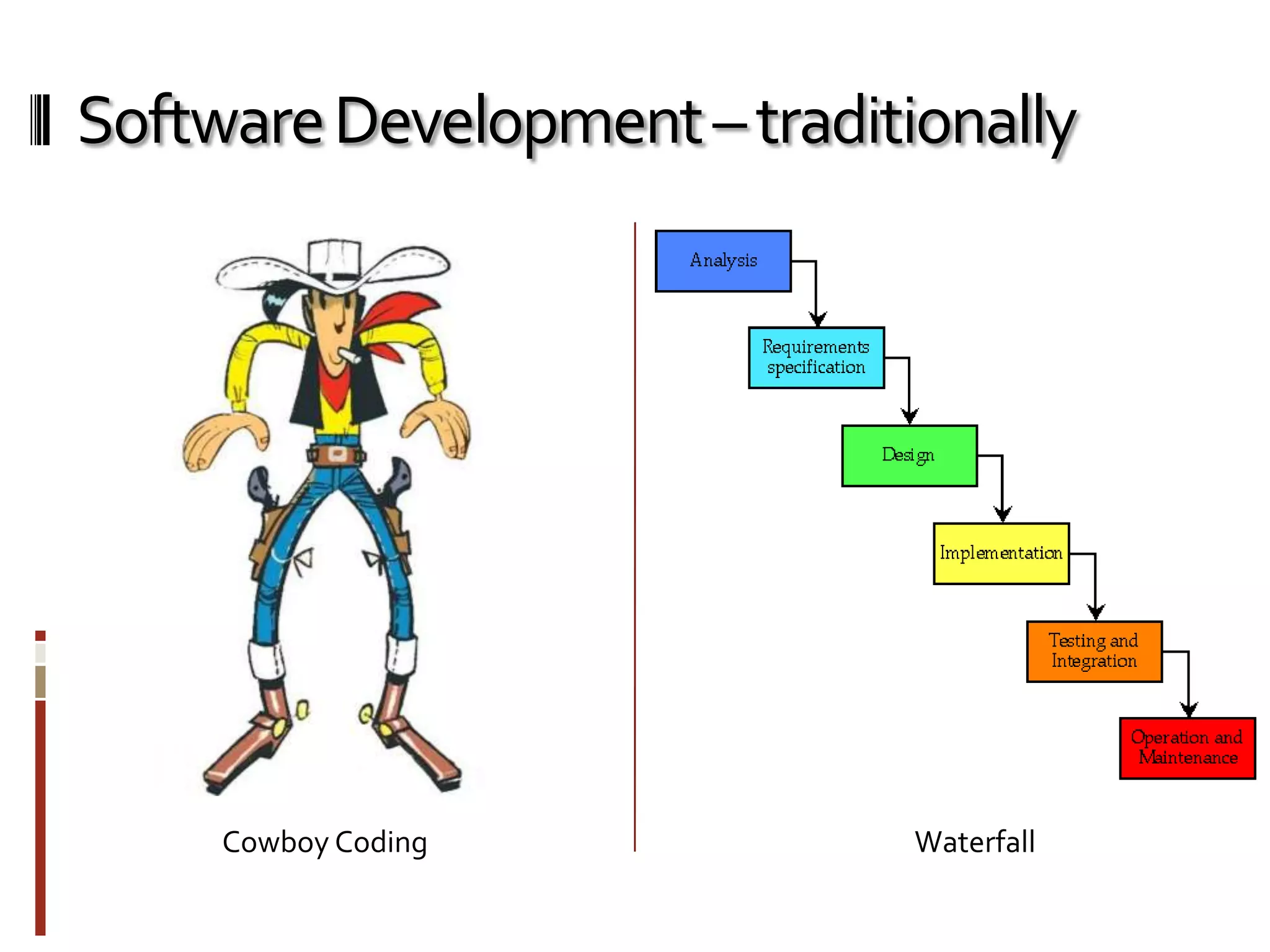
Software Development – traditionally

Cowboy Coding

Waterfall
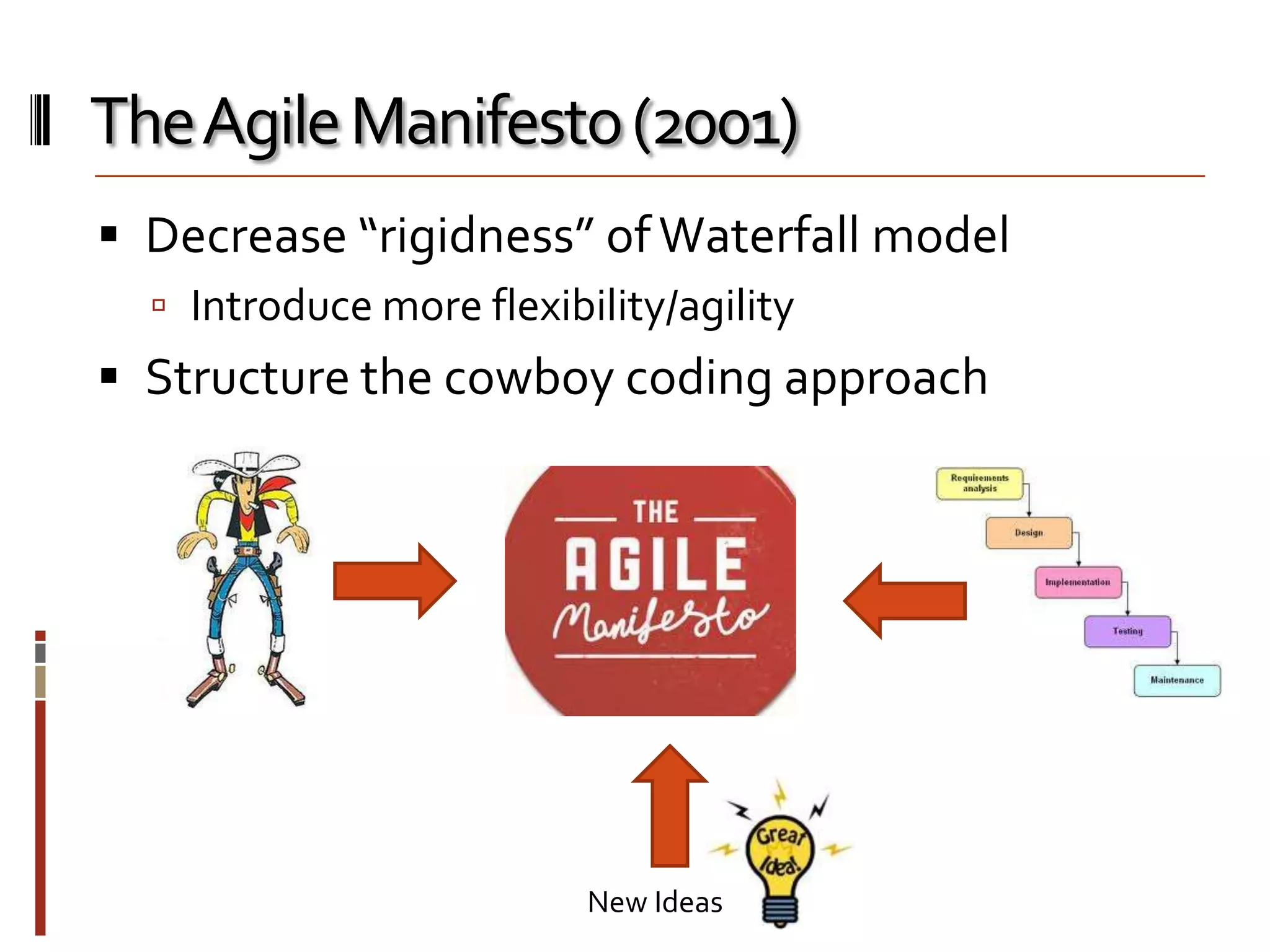
The Agile Manifesto (2001)
 Decrease “rigidness” of Waterfall model
 Introduce more flexibility/agility

 Structure the cowboy coding approach

New Ideas
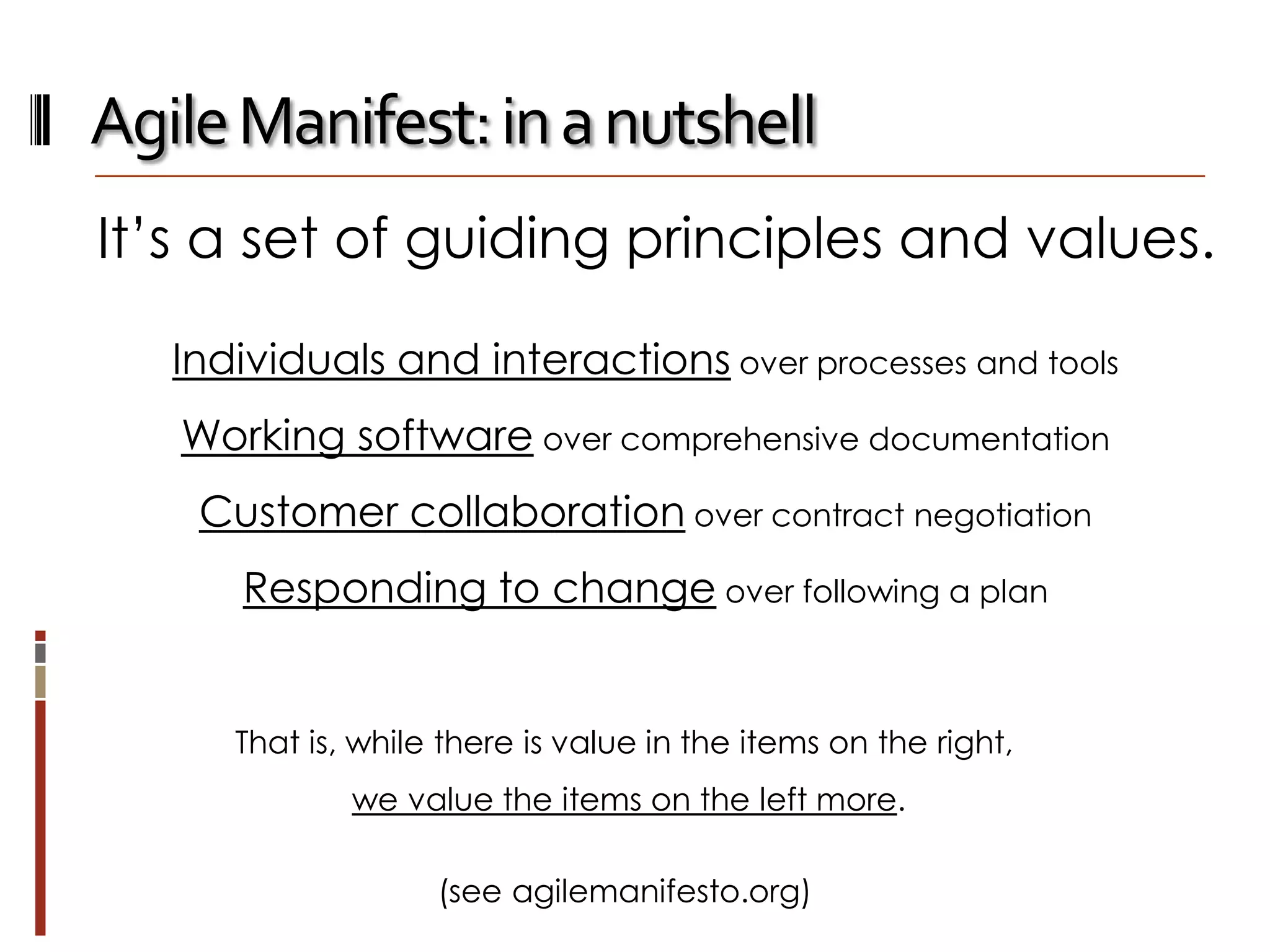
Agile Manifest: in a nutshell
It’s a set of guiding principles and values.
Individuals and interactions over processes and tools
Working software over comprehensive documentation

Customer collaboration over contract negotiation
Responding to change over following a plan

That is, while there is value in the items on the right,
we value the items on the left more.
(see agilemanifesto.org)
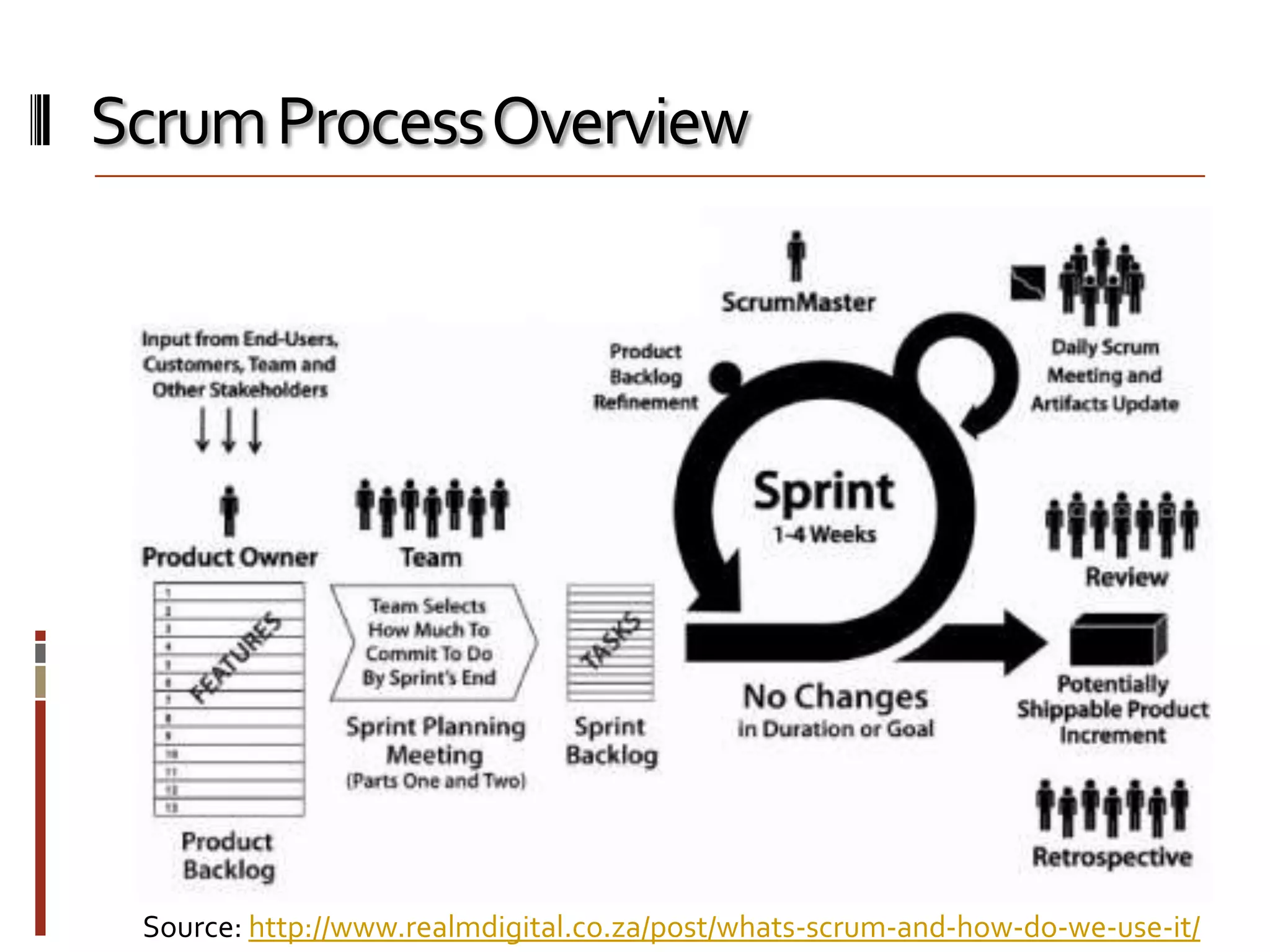
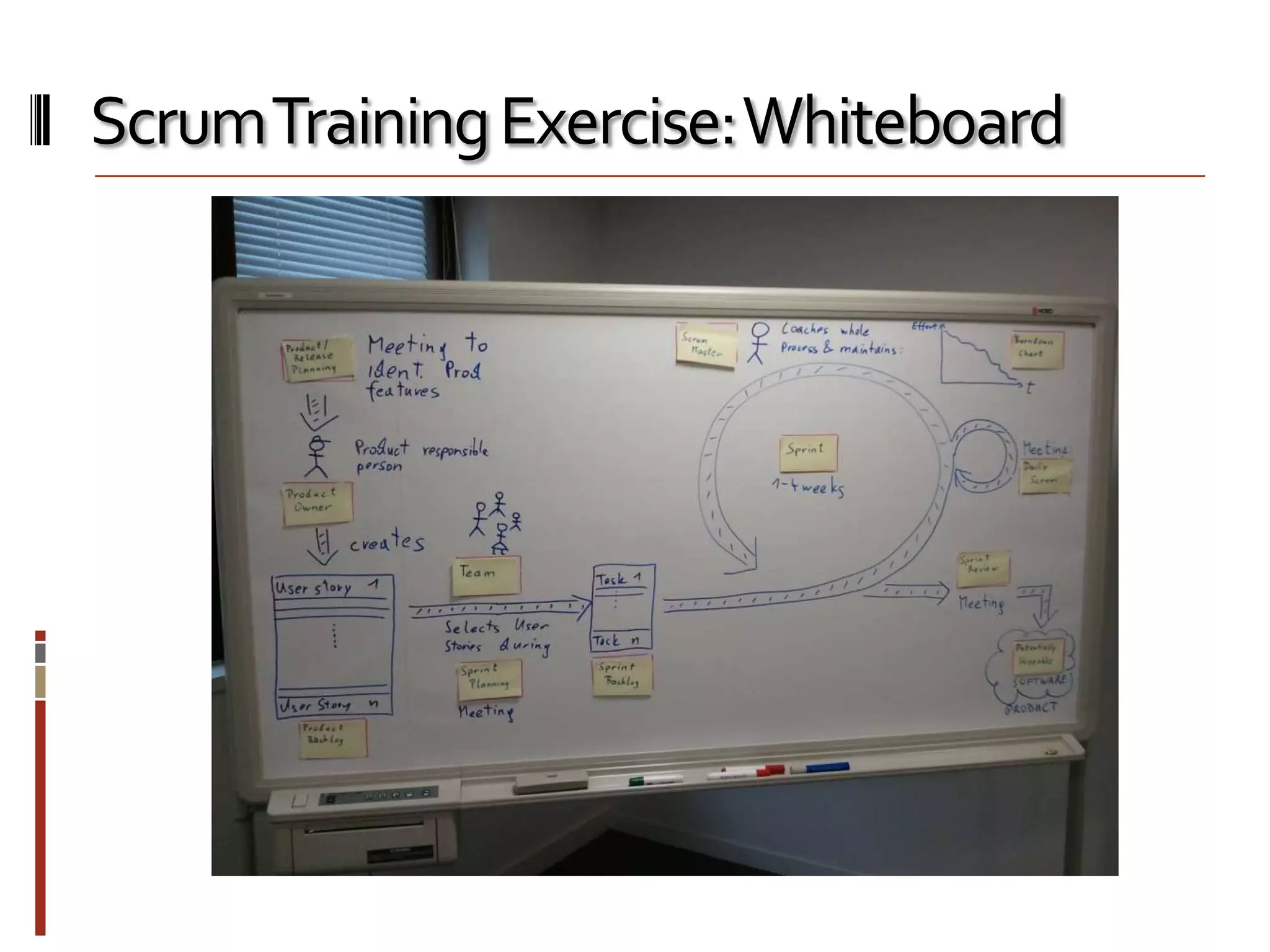
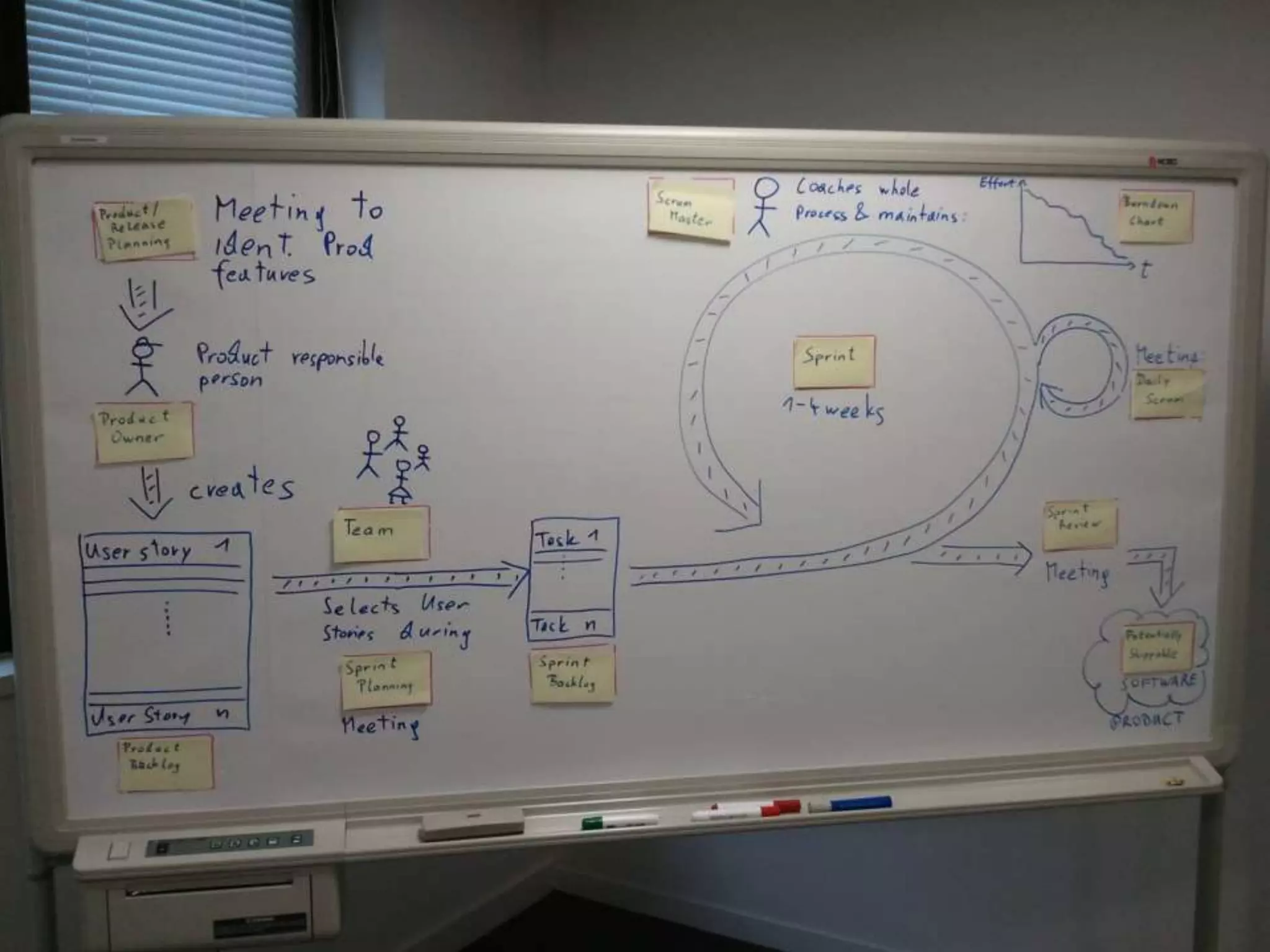
Scrum Process Overview
Exercise:
Whiteboard
(see appendix)

Source: http://www.realmdigital.co.za/post/whats-scrum-and-how-do-we-use-it/
Scrum :=
…is an agile framework for software

development

…that focuses on iterative and incremental
production of working software
…with emphasis on stakeholder
communication.
Scrum Foundations
1. Core principles
2. Roles
3. Artefacts
4. Ceremonies
5. Rules
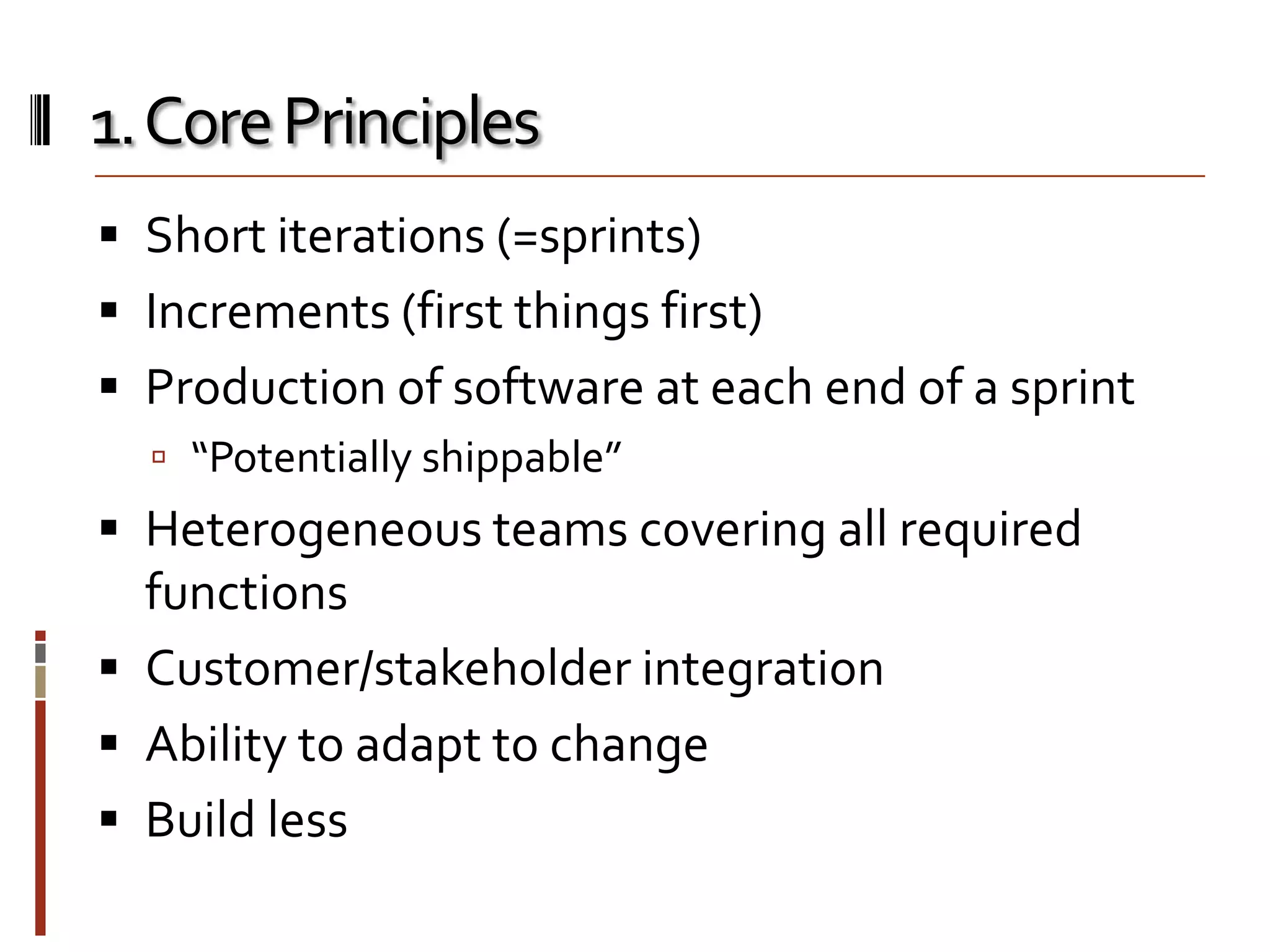
1. Core Principles
 Short iterations (=sprints)

 Increments (first things first)
 Production of software at each end of a sprint
 “Potentially shippable”

 Heterogeneous teams covering all required
functions
 Customer/stakeholder integration

 Ability to adapt to change
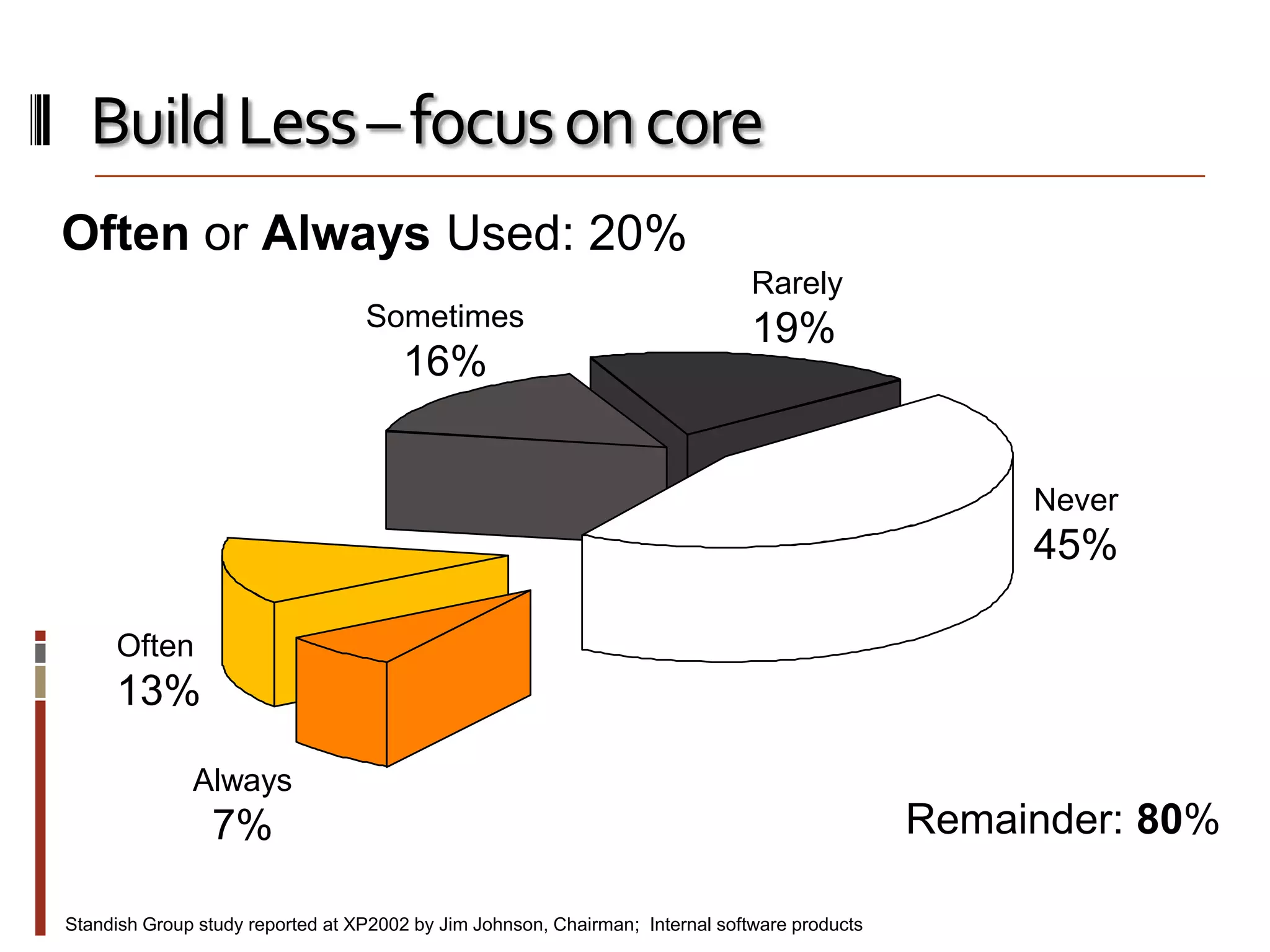
 Build less
Build Less – focus on core
Often or Always Used: 20%
Rarely
Sometimes

16%

19%

Never

45%
Often

13%
Always

7%
Standish Group study reported at XP2002 by Jim Johnson, Chairman; Internal software products

Remainder: 80%
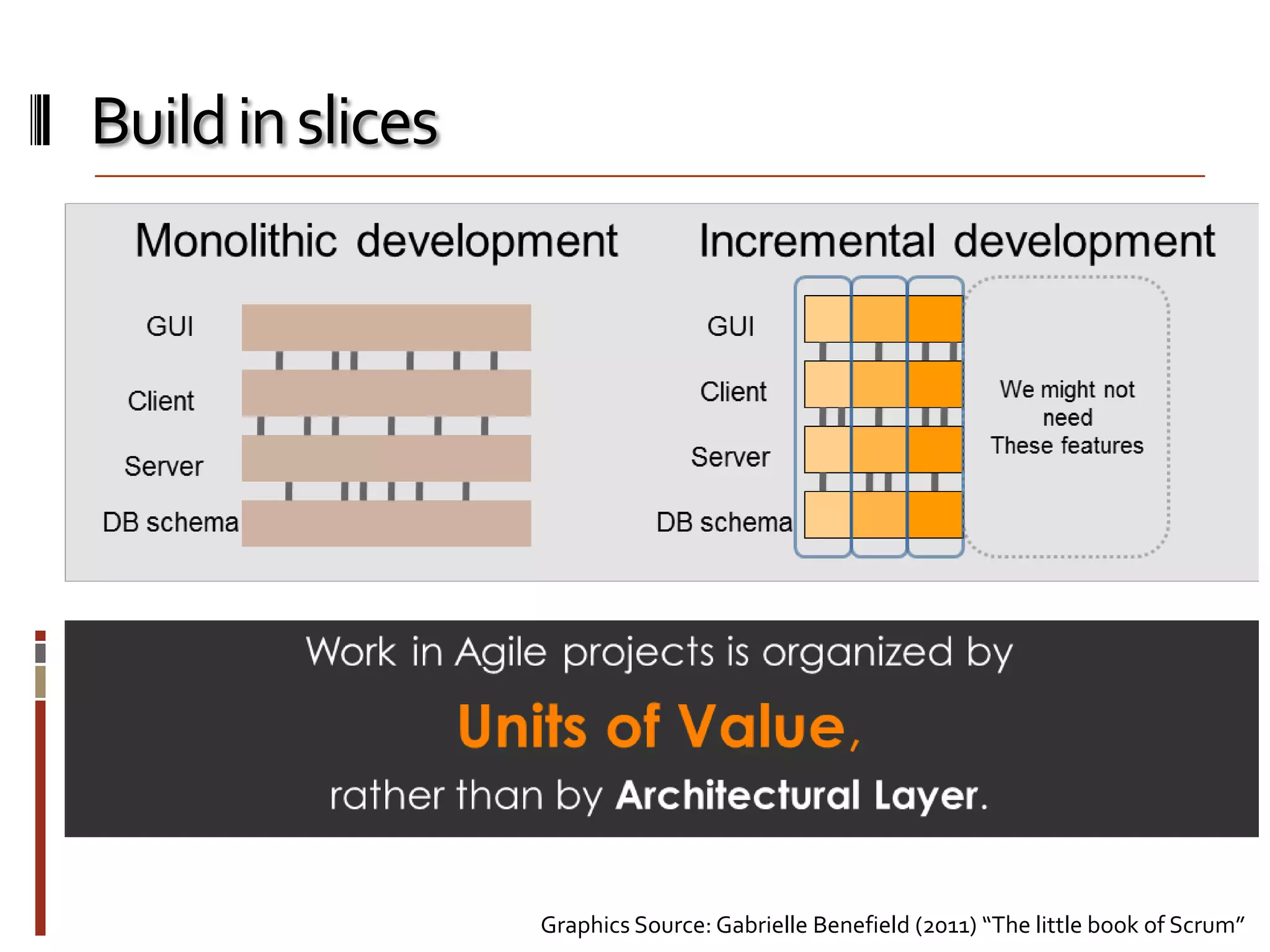
Build in slices

Graphics Source: Gabrielle Benefield (2011) “The little book of Scrum”
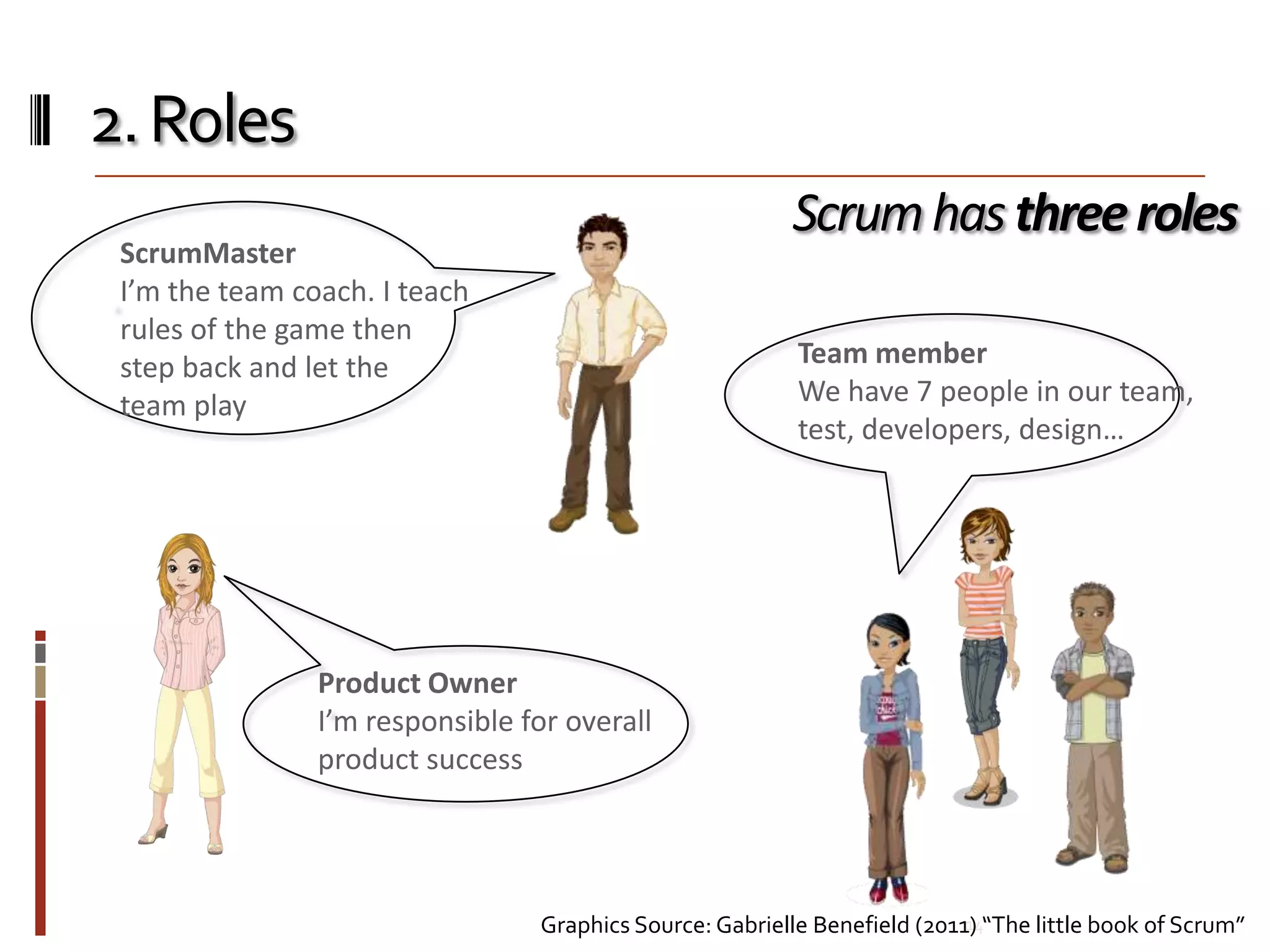
2. Roles
Scrum has three roles

ScrumMaster
I’m the team coach. I teach
`rules of the game then
step back and let the
team play

Team member
We have 7 people in our team,
`
test, developers, design…

Product Owner
I’m responsible for overall
`
product success

14
Graphics Source: Gabrielle Benefield (2011) “The little book of Scrum”
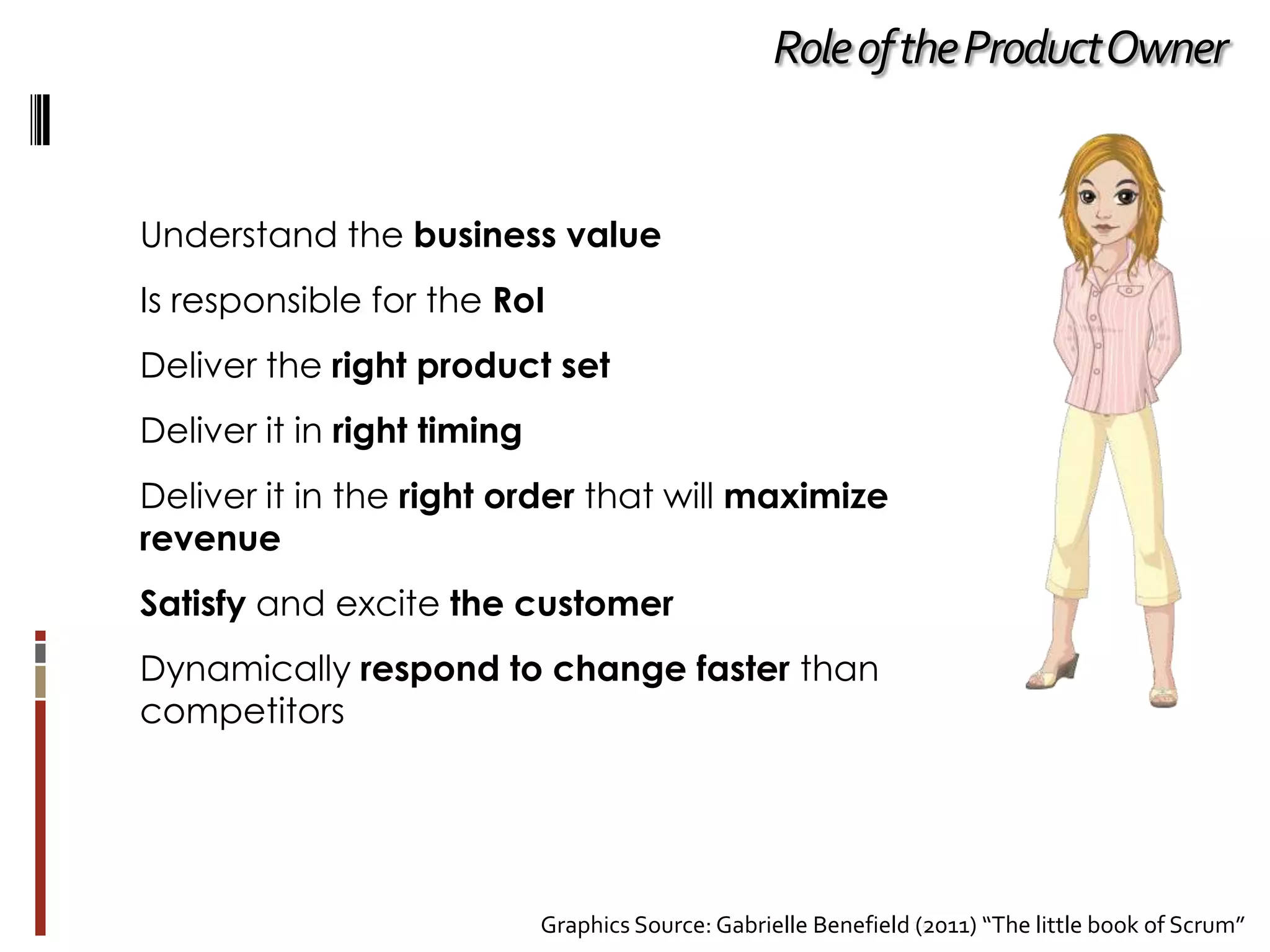
Role of the Product Owner

Understand the business value
Is responsible for the RoI
Deliver the right product set
Deliver it in right timing
Deliver it in the right order that will maximize
revenue
Satisfy and excite the customer
Dynamically respond to change faster than
competitors

Graphics Source: Gabrielle Benefield 15
(2011) “The little book of Scrum”
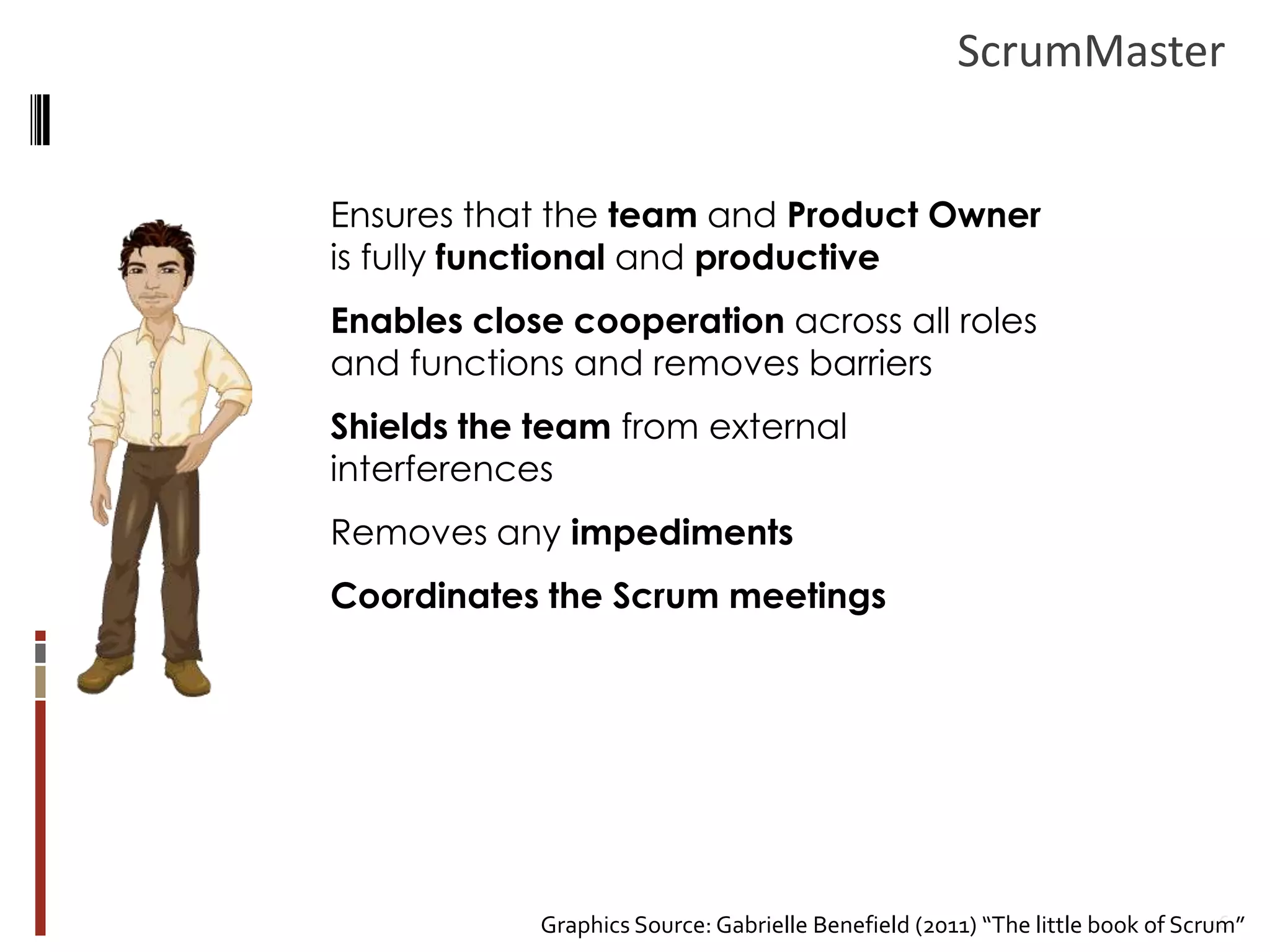
ScrumMaster
Ensures that the team and Product Owner
is fully functional and productive

Enables close cooperation across all roles
and functions and removes barriers
Shields the team from external
interferences

Removes any impediments
Coordinates the Scrum meetings

16
Graphics Source: Gabrielle Benefield (2011) “The little book of Scrum”
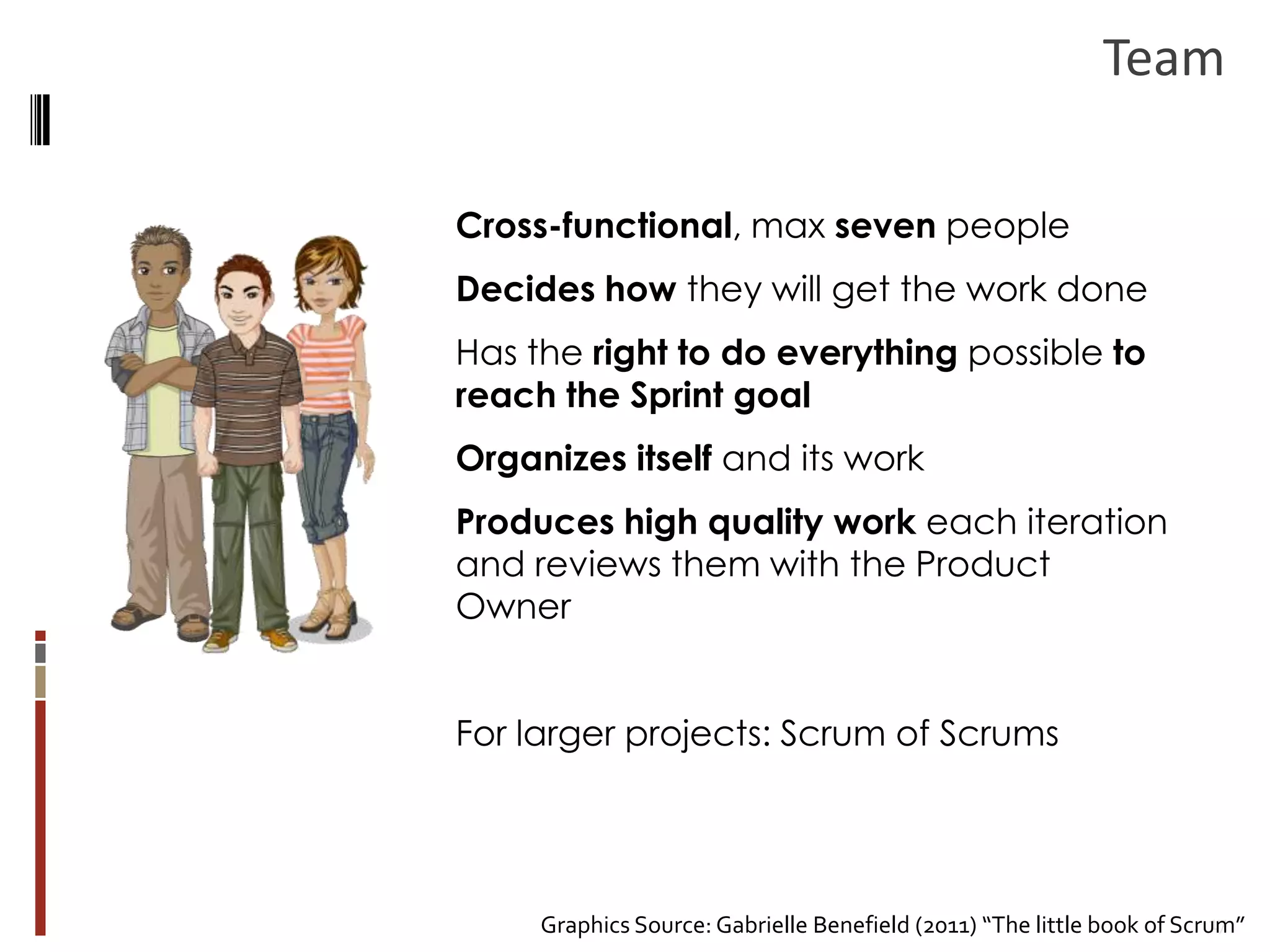
Team
Cross-functional, max seven people
Decides how they will get the work done
Has the right to do everything possible to
reach the Sprint goal
Organizes itself and its work
Produces high quality work each iteration
and reviews them with the Product
Owner
For larger projects: Scrum of Scrums

17
Graphics Source: Gabrielle Benefield (2011) “The little book of Scrum”
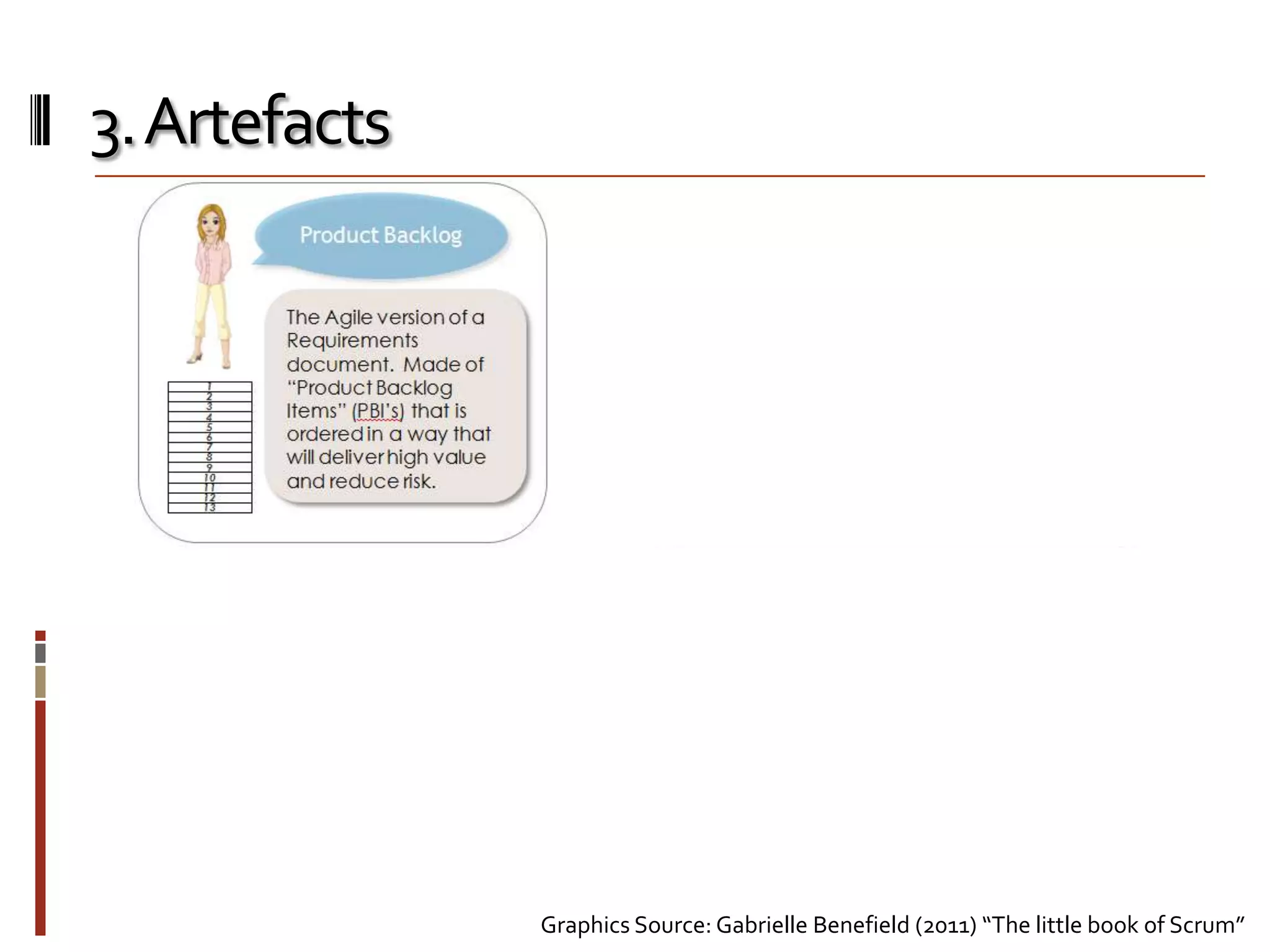
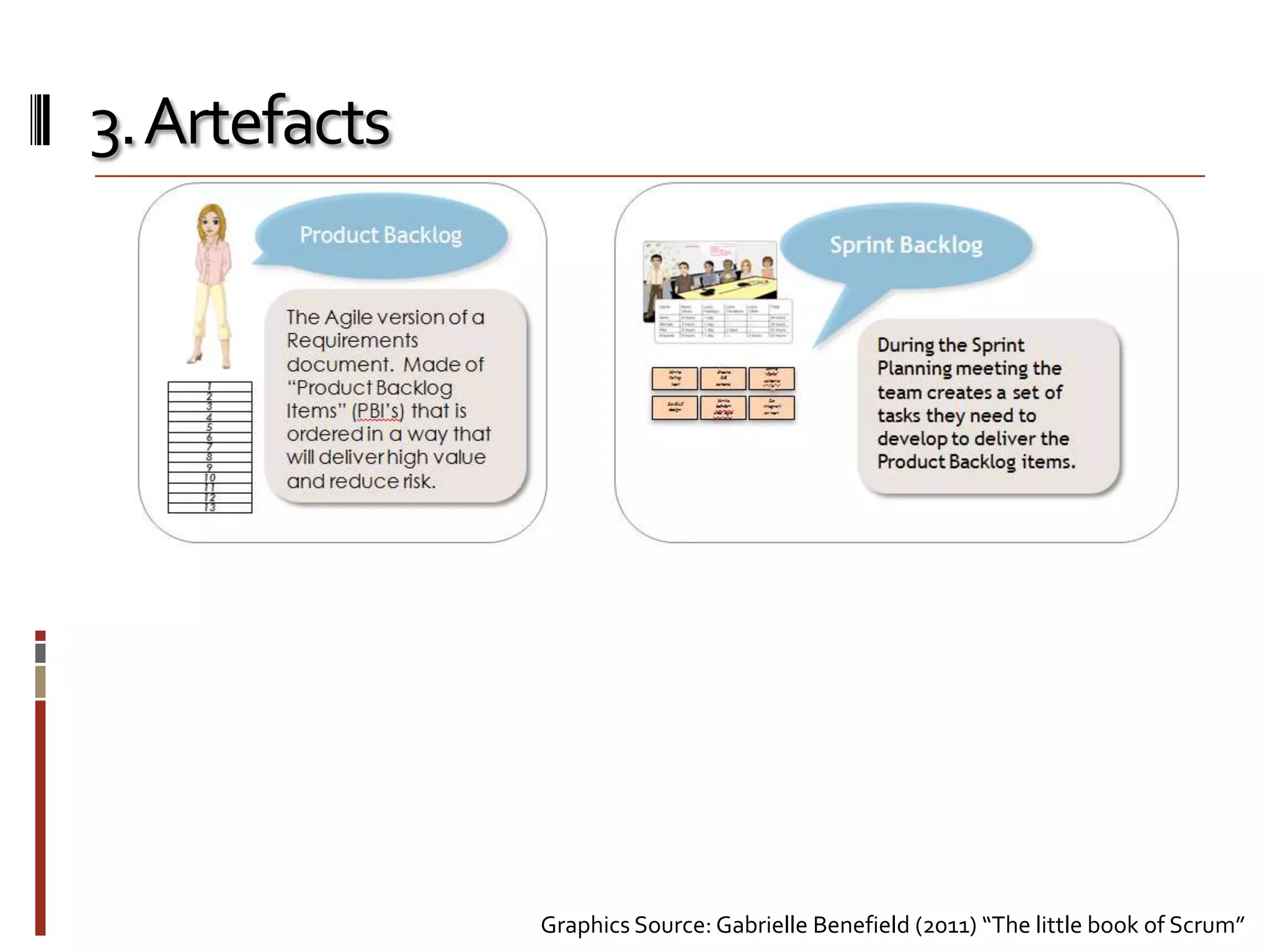
3. Artefacts

Graphics Source: Gabrielle Benefield (2011) “The little book of Scrum”
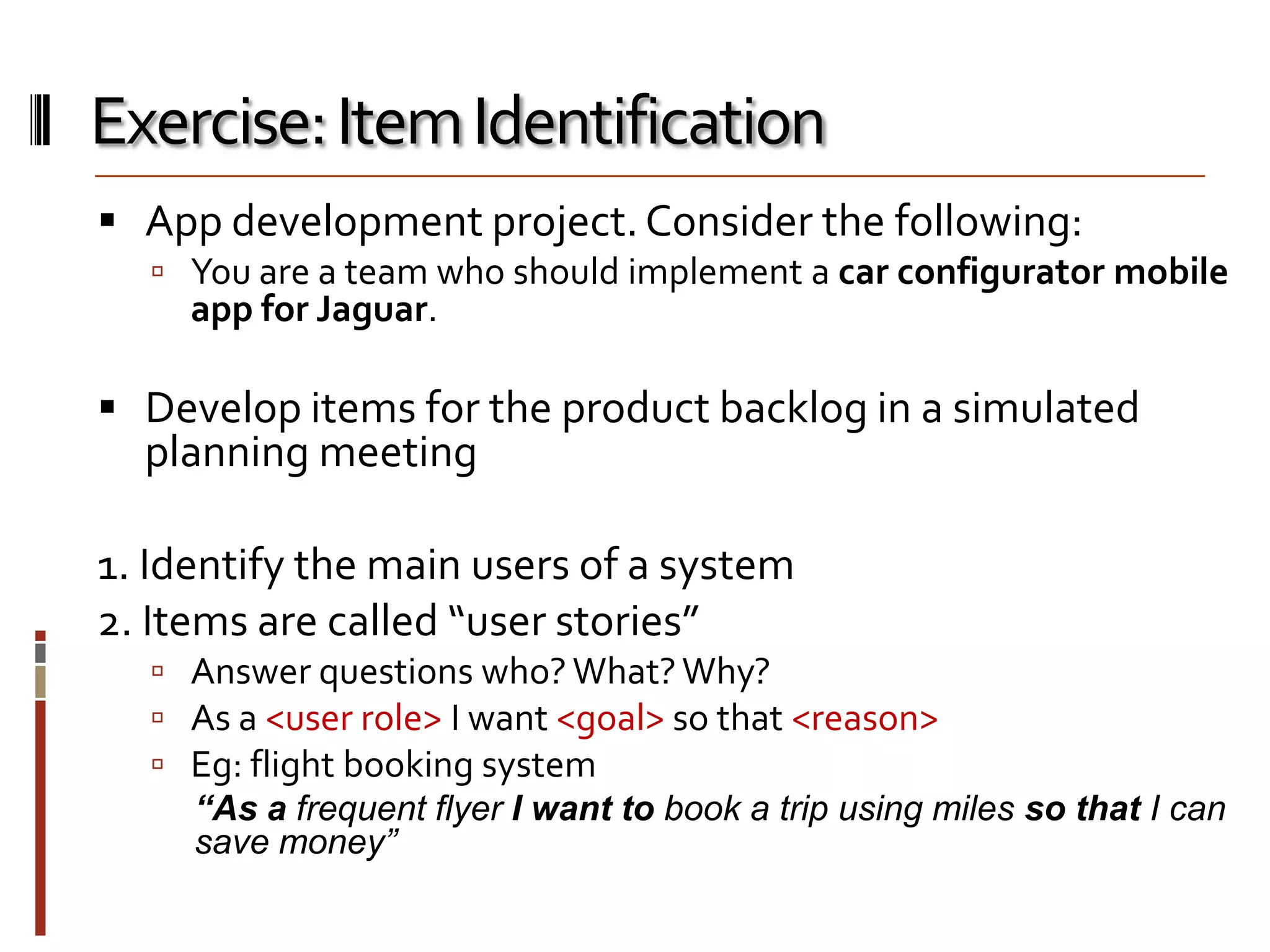
Exercise: Item Identification
 App development project. Consider the following:
 You are a team who should implement a car configurator mobile

app for Jaguar.

 Develop items for the product backlog in a simulated

planning meeting

1. Identify the main users of a system
2. Items are called “user stories”
 Answer questions who? What? Why?
 As a <user role> I want <goal> so that <reason>
 Eg: flight booking system
“As a frequent flyer I want to book a trip using miles so that I can
save money”
Exercise: Silent Sort
 In your teams, sort the various user stories

according to priority
 5’ strictly no speaking
 Feel free to change and change and change again
 Add stories if they come up

 5’ discussion and creating consens
 Add further stories if they come up
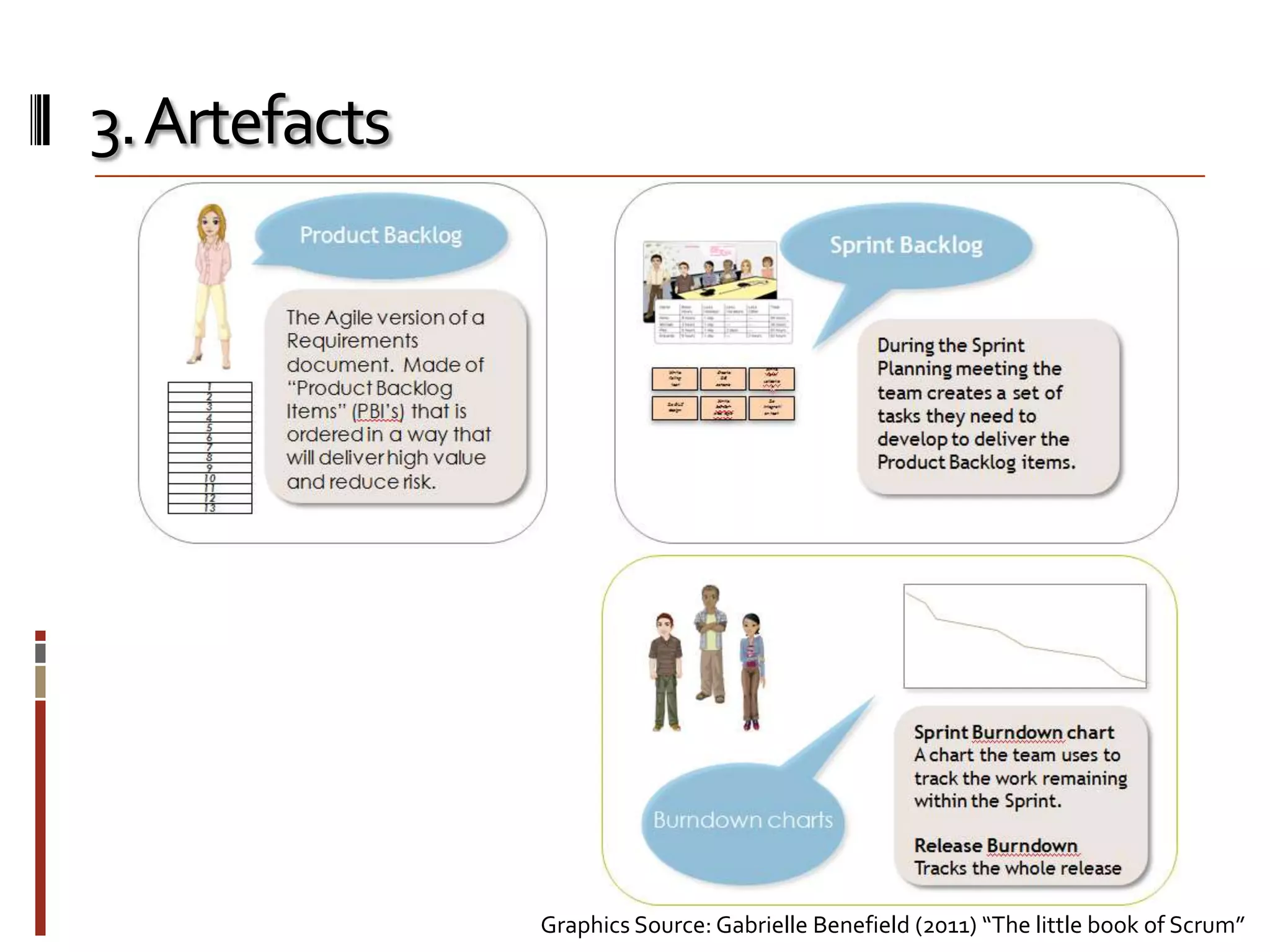
3. Artefacts

Graphics Source: Gabrielle Benefield (2011) “The little book of Scrum”
3. Artefacts

Graphics Source: Gabrielle Benefield (2011) “The little book of Scrum”
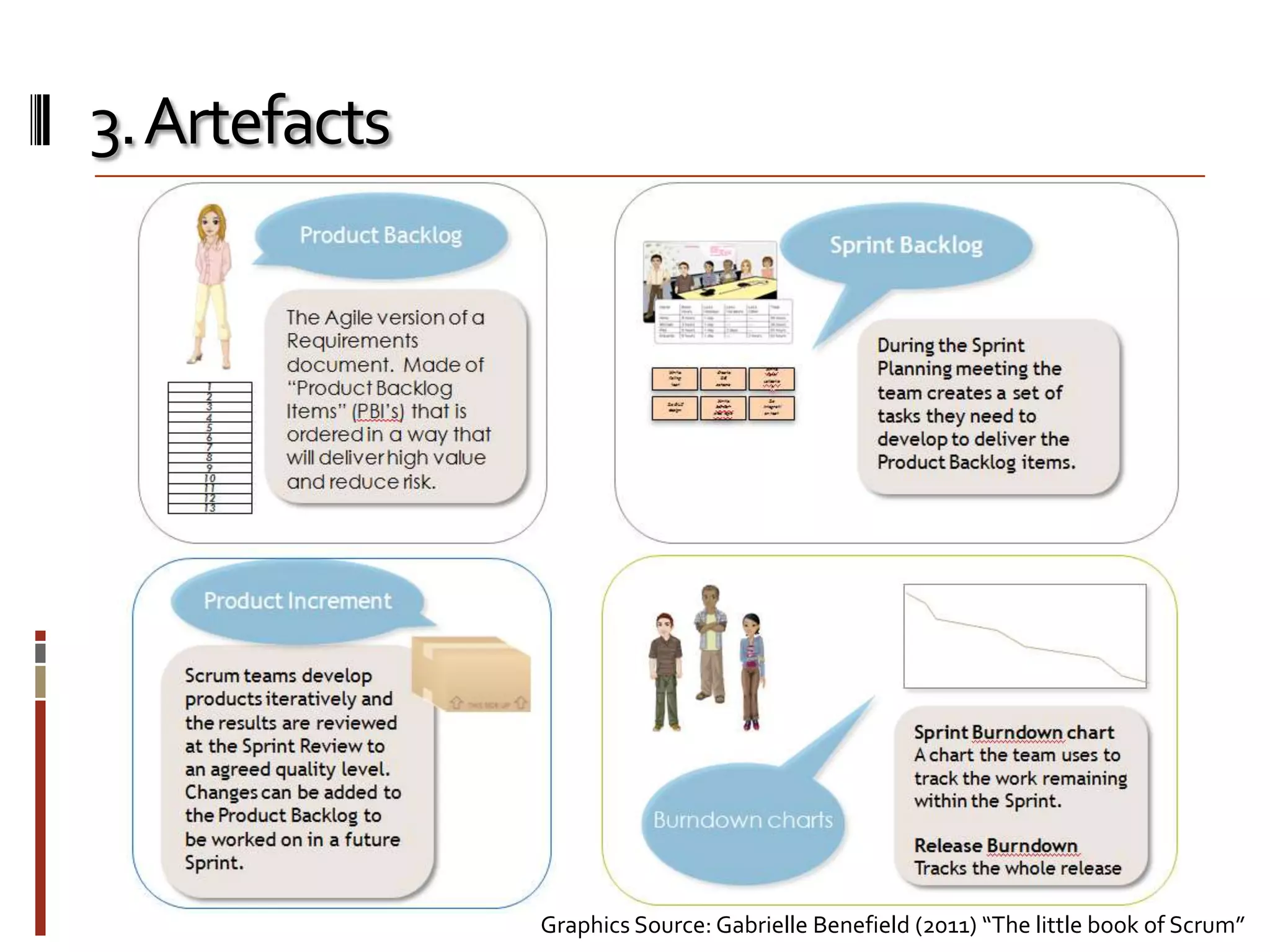
3. Artefacts

Graphics Source: Gabrielle Benefield (2011) “The little book of Scrum”
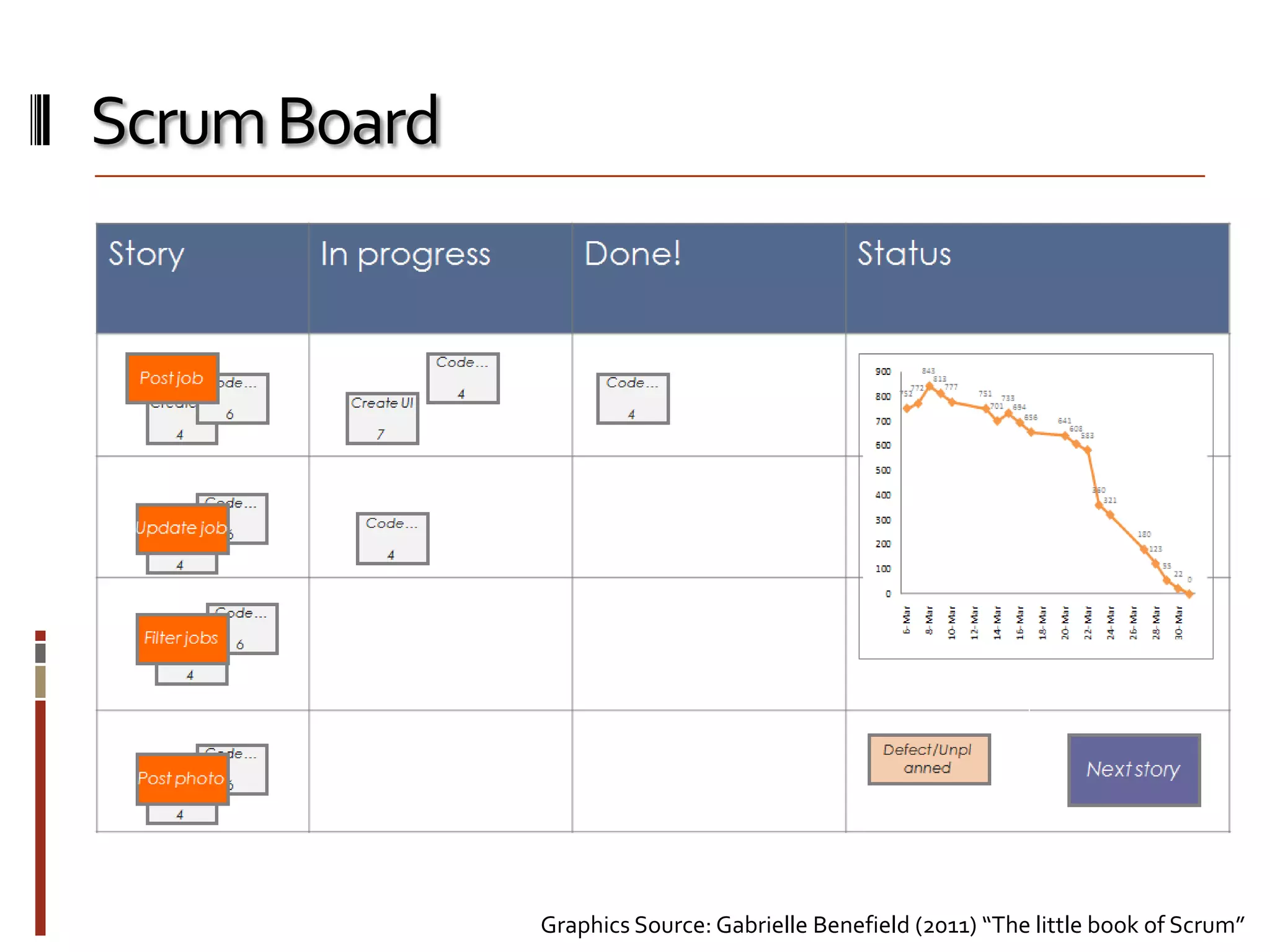
Scrum Board

Graphics Source: Gabrielle Benefield (2011) “The little book of Scrum”
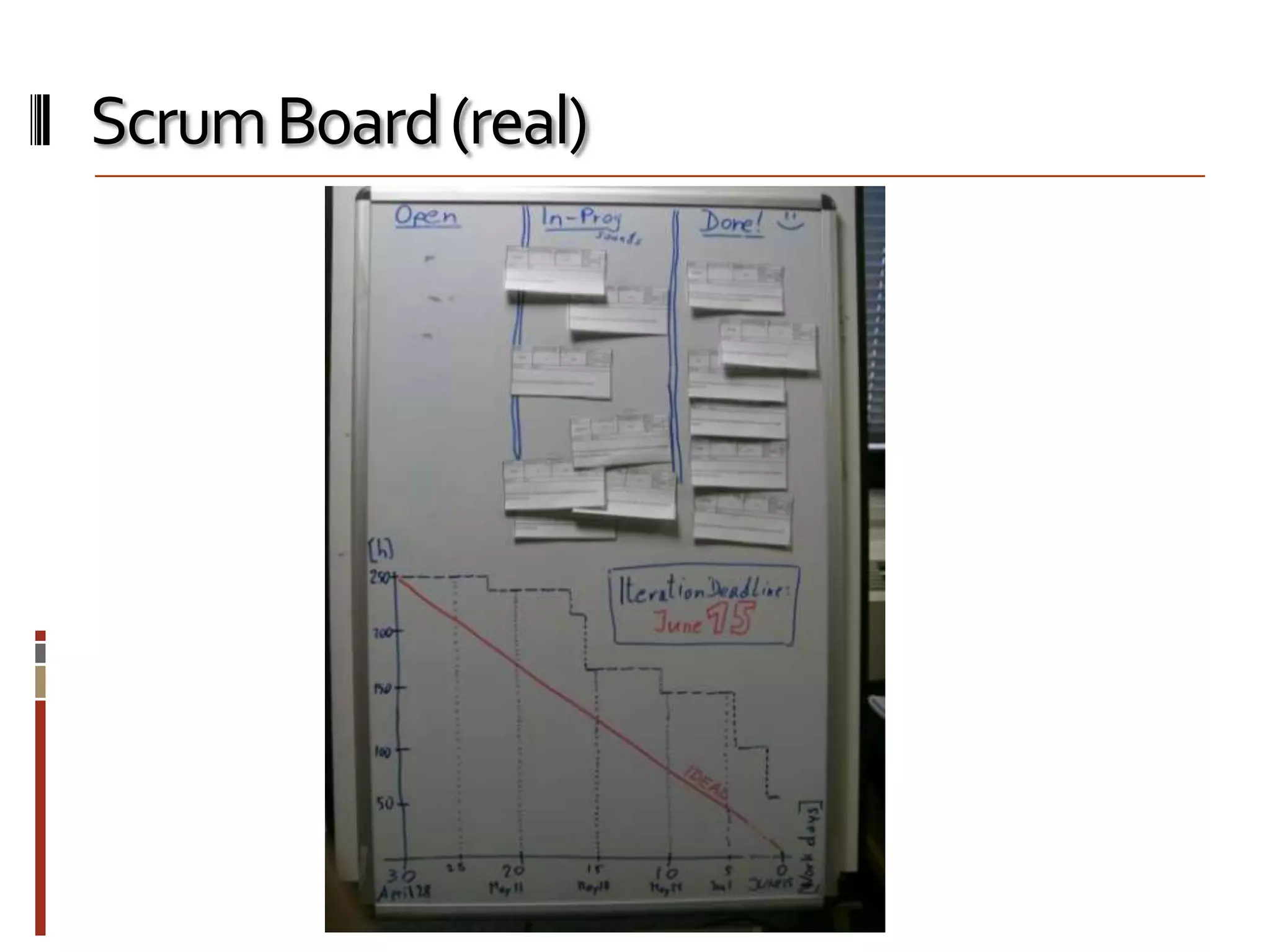
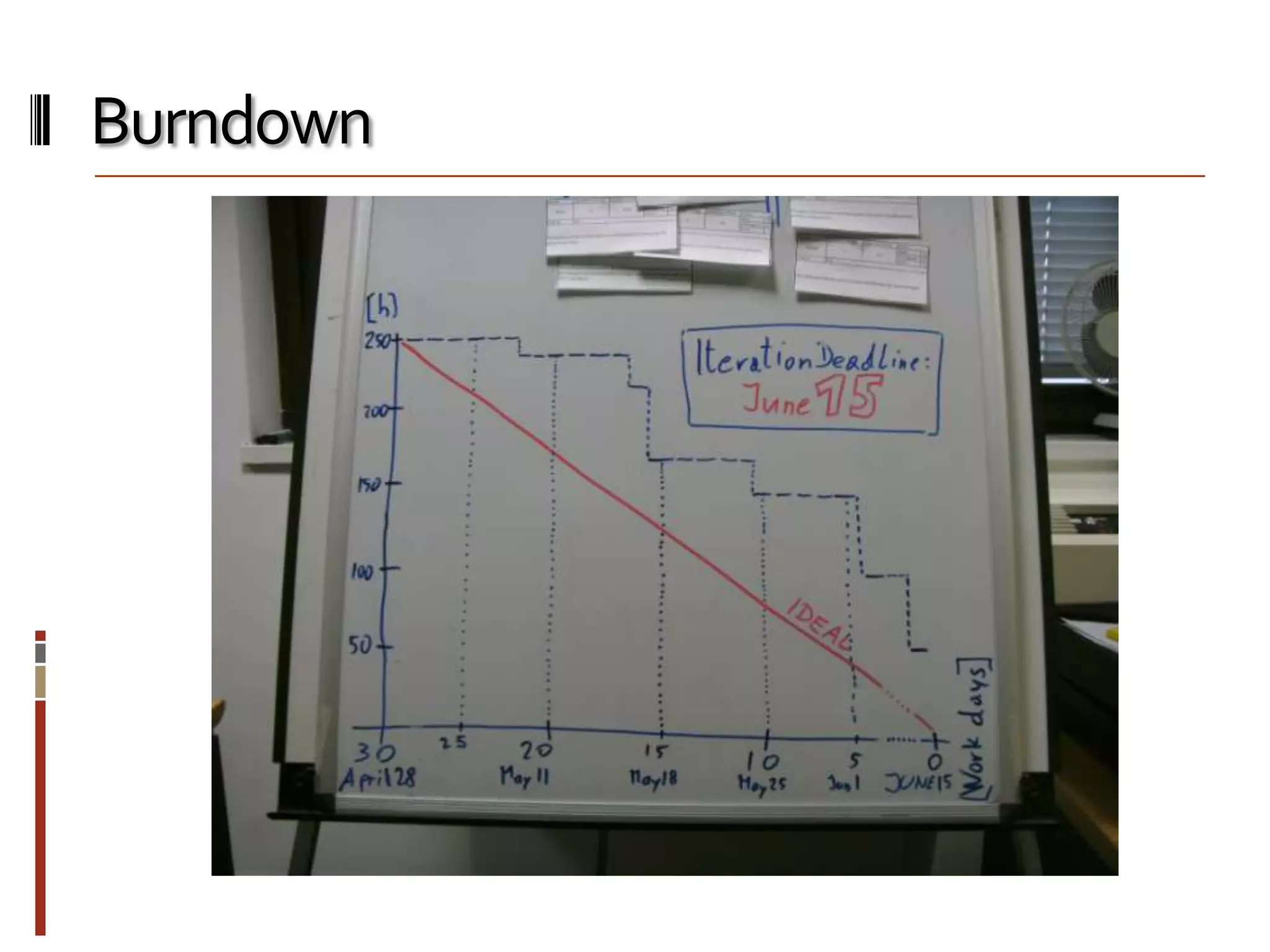
Scrum Board (real)
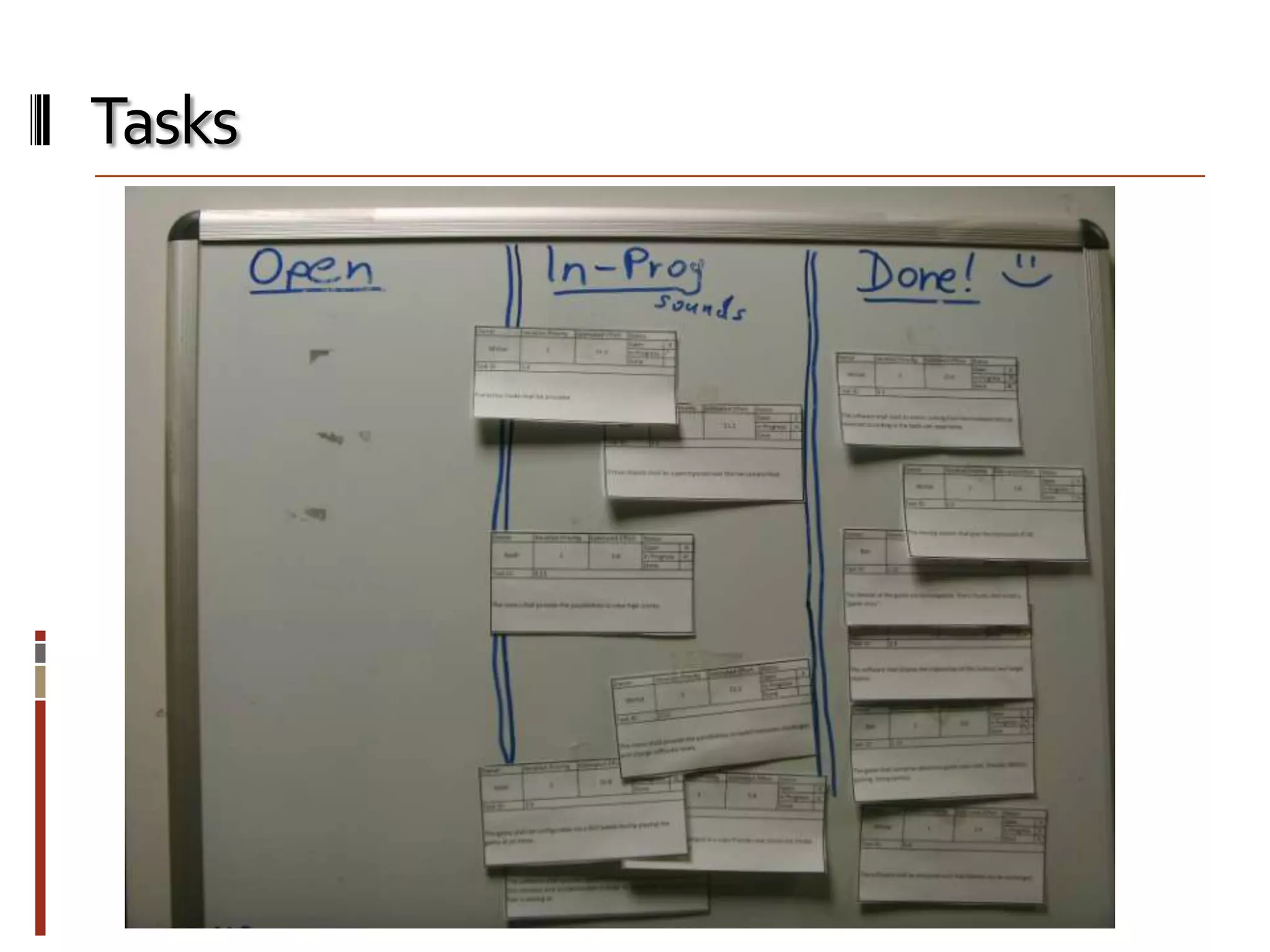
Tasks
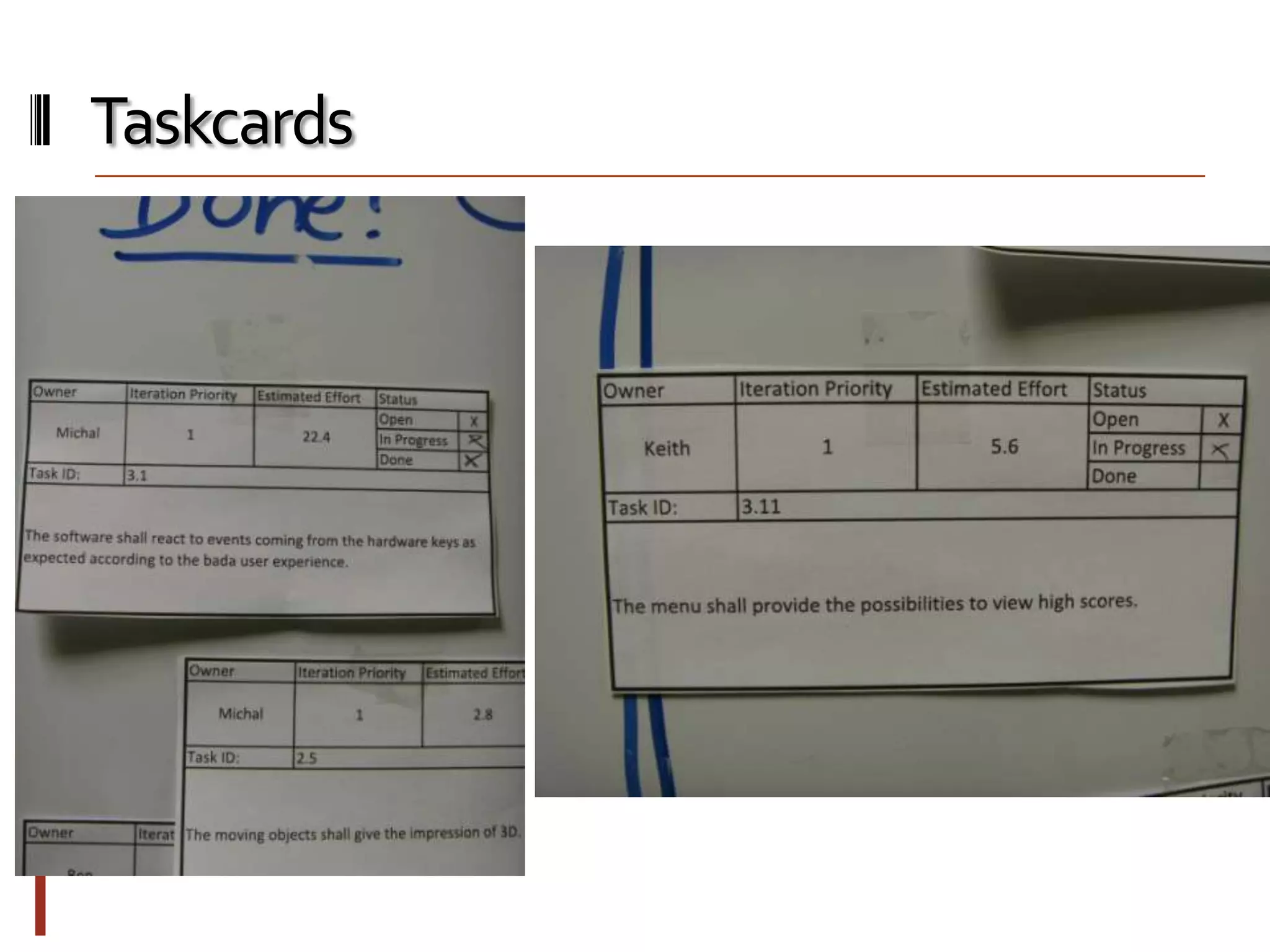
Taskcards
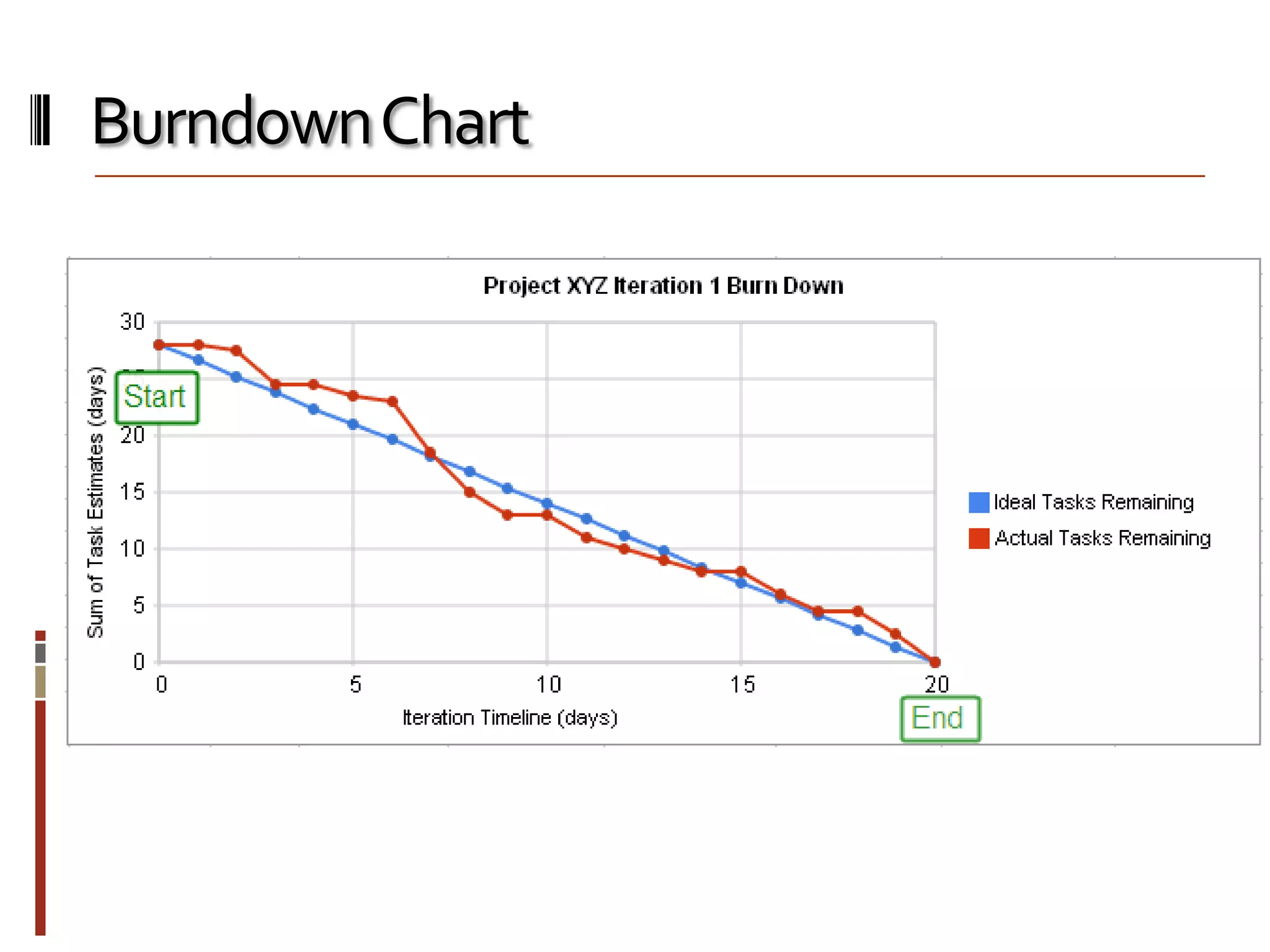
BurndownChart
Burndown
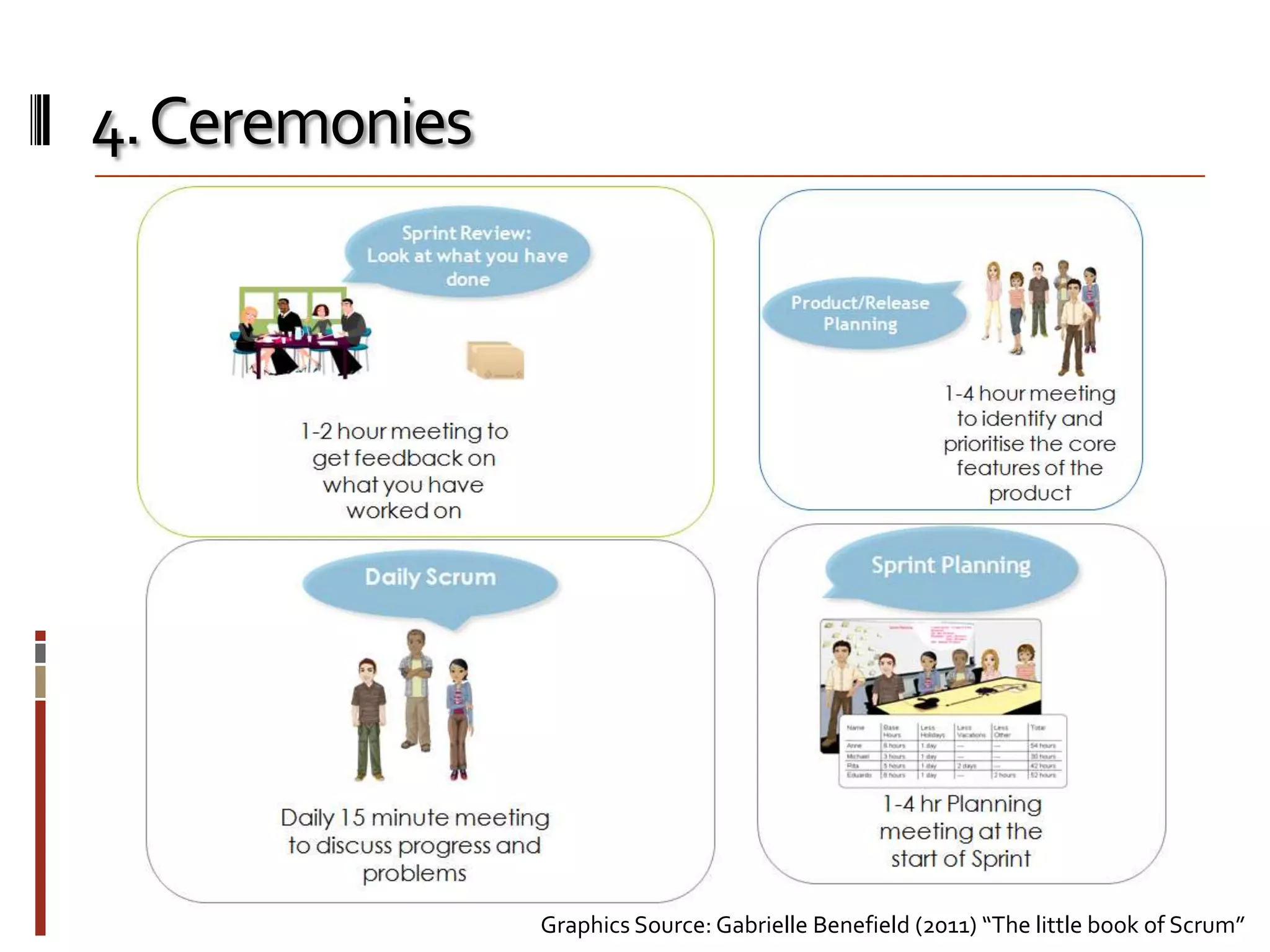
4. Ceremonies

Graphics Source: Gabrielle Benefield (2011) “The little book of Scrum”
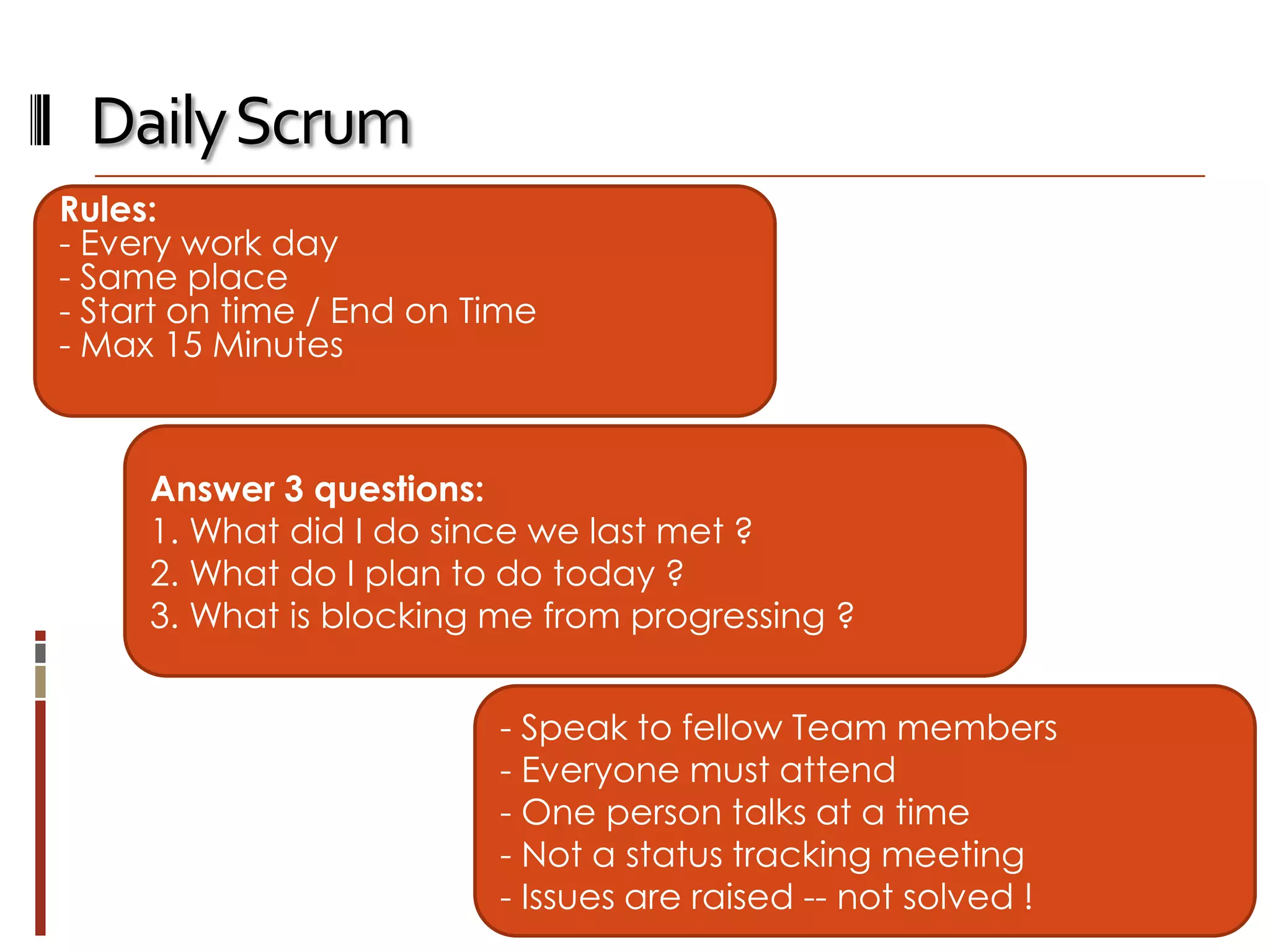
Daily Scrum
Rules:
- Every work day
- Same place
- Start on time / End on Time
- Max 15 Minutes

Answer 3 questions:
1. What did I do since we last met ?
2. What do I plan to do today ?
3. What is blocking me from progressing ?
- Speak to fellow Team members
- Everyone must attend
- One person talks at a time
- Not a status tracking meeting
- Issues are raised -- not solved !
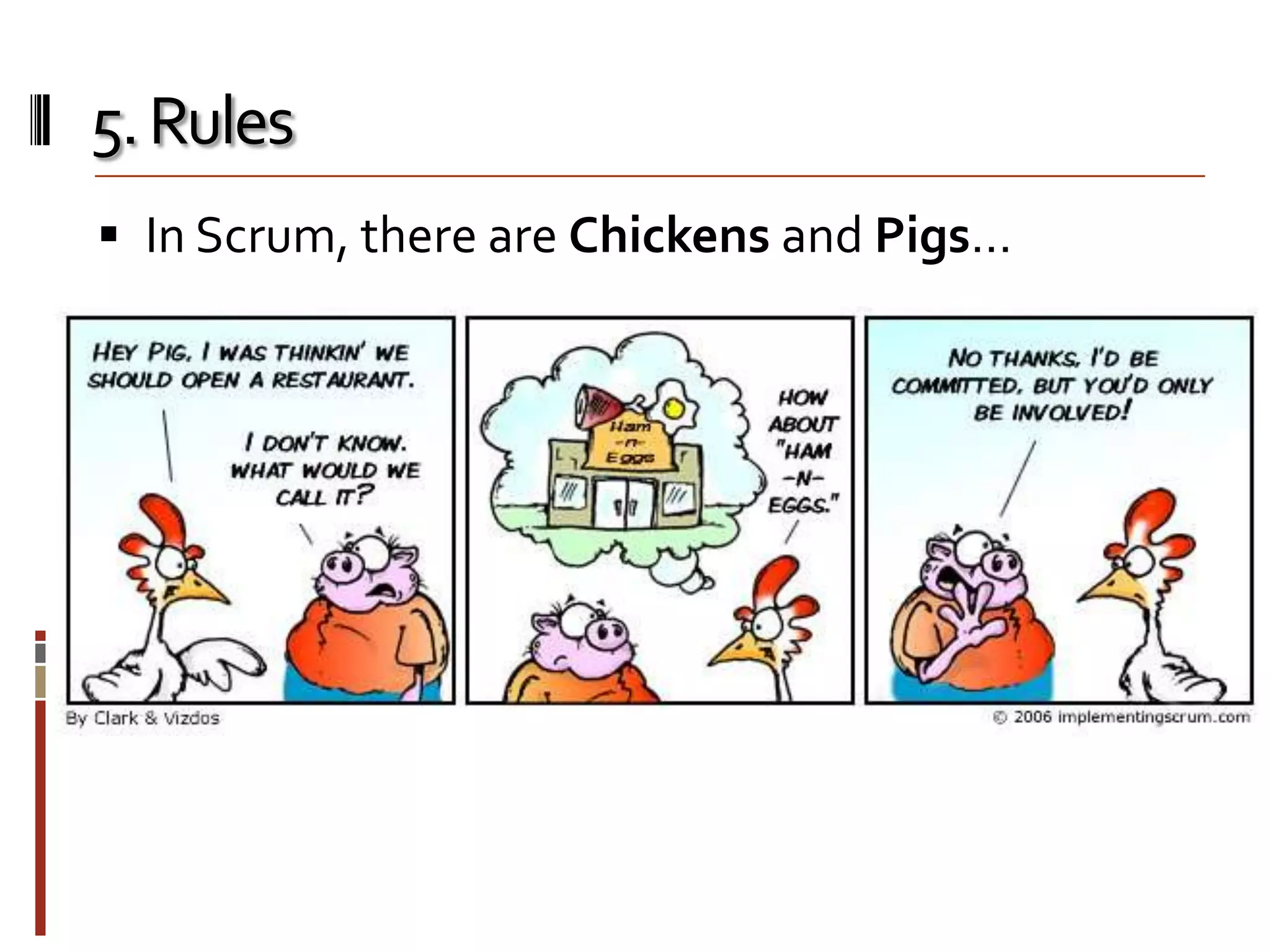
5. Rules
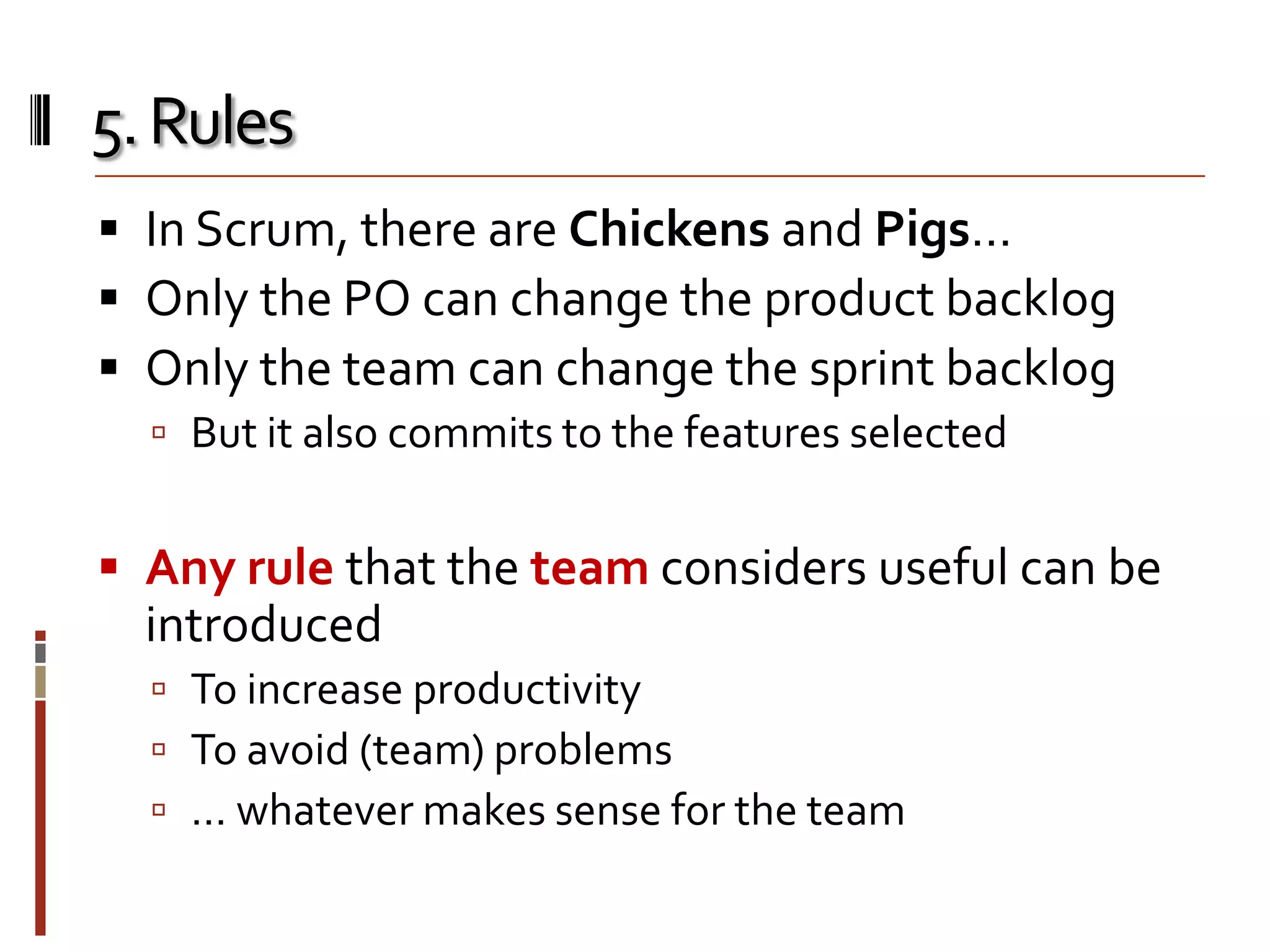
 In Scrum, there are Chickens and Pigs…
5. Rules
 In Scrum, there are Chickens and Pigs…
 Only the PO can change the product backlog
 Only the team can change the sprint backlog
 But it also commits to the features selected

 Any rule that the team considers useful can be

introduced
 To increase productivity
 To avoid (team) problems
 … whatever makes sense for the team
Scrum Foundations – Recap
1. Core principles
2. Roles
3. Artefacts
4. Ceremonies
5. Rules
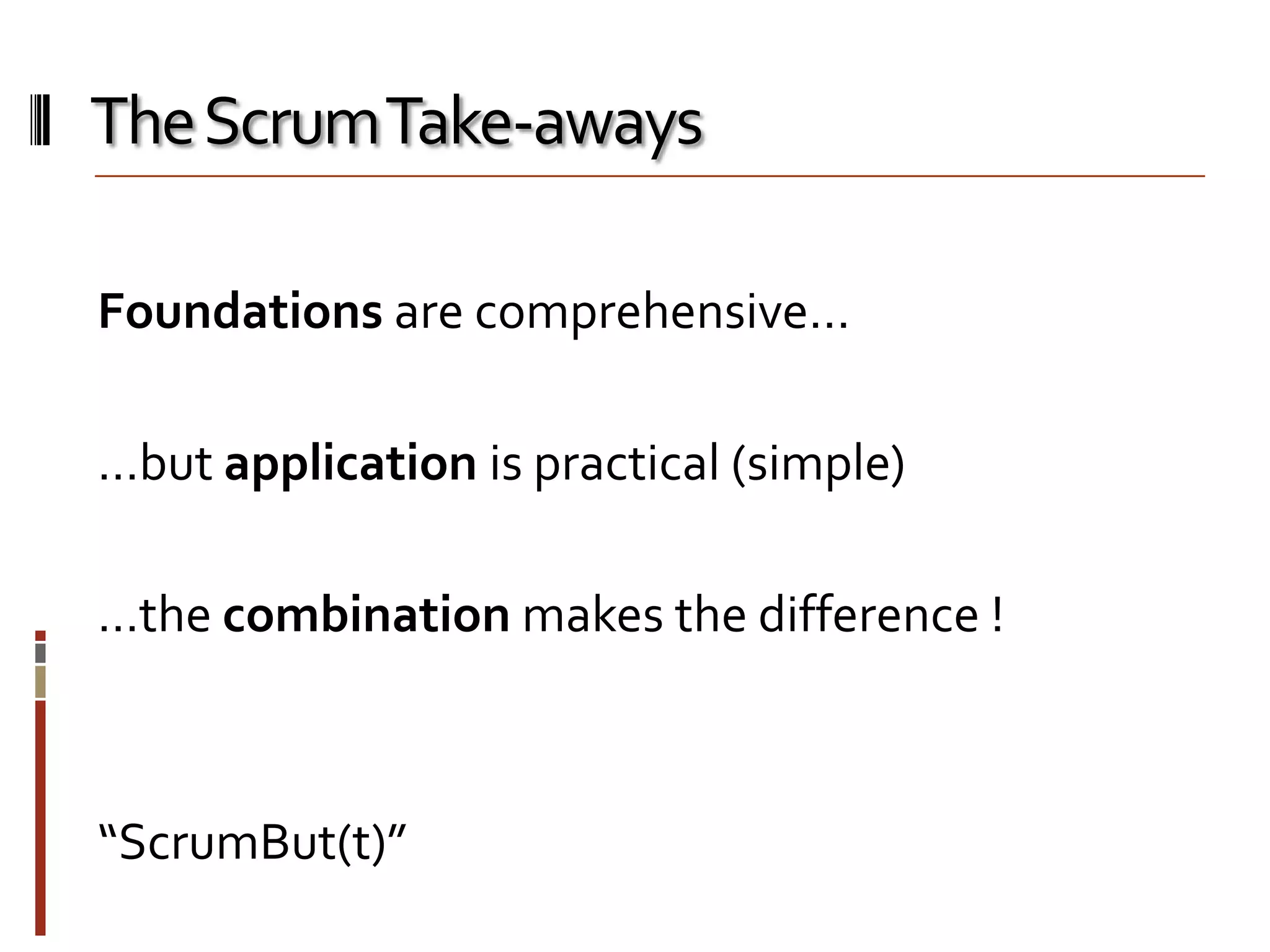
The Scrum Take-aways
Foundations are comprehensive…
…but application is practical (simple)
…the combination makes the difference !

“ScrumBut(t)”
The Scrum Take-aways
My personal differentiators of Scrum are:
 Iterations and increments
 Flexible and adaptive

 Focus on core of software development
 Working software instead of extensive documentation

 Split up of Project Manager role
 Project Owner and ScrumMaster

 Focus on communication
 Daily scrum

 Co-Location, attitude and tools
 Discipline, good old whiteboard
Any Questions ?
Appendix
Scrum Training Exercise: Whiteboard
Scrum Training Exercise

Introduction to Scrum

  • 1.
    October 9, 2013,London Manfred
  • 2.
    Overview  Agile softwaredevelopment: Motivation  Scrum      Core principles Roles Artefacts Ceremonies Rules  Take-aways & application of lessons-learned
  • 3.
    Software Development –traditionally Cowboy Coding Waterfall
  • 4.
    The Agile Manifesto(2001)  Decrease “rigidness” of Waterfall model  Introduce more flexibility/agility  Structure the cowboy coding approach New Ideas
  • 5.
    Agile Manifest: ina nutshell It’s a set of guiding principles and values. Individuals and interactions over processes and tools Working software over comprehensive documentation Customer collaboration over contract negotiation Responding to change over following a plan That is, while there is value in the items on the right, we value the items on the left more. (see agilemanifesto.org)
  • 8.
    Scrum Process Overview Exercise: Whiteboard (seeappendix) Source: http://www.realmdigital.co.za/post/whats-scrum-and-how-do-we-use-it/
  • 9.
    Scrum := …is anagile framework for software development …that focuses on iterative and incremental production of working software …with emphasis on stakeholder communication.
  • 10.
    Scrum Foundations 1. Coreprinciples 2. Roles 3. Artefacts 4. Ceremonies 5. Rules
  • 11.
    1. Core Principles Short iterations (=sprints)  Increments (first things first)  Production of software at each end of a sprint  “Potentially shippable”  Heterogeneous teams covering all required functions  Customer/stakeholder integration  Ability to adapt to change  Build less
  • 12.
    Build Less –focus on core Often or Always Used: 20% Rarely Sometimes 16% 19% Never 45% Often 13% Always 7% Standish Group study reported at XP2002 by Jim Johnson, Chairman; Internal software products Remainder: 80%
  • 13.
    Build in slices GraphicsSource: Gabrielle Benefield (2011) “The little book of Scrum”
  • 14.
    2. Roles Scrum hasthree roles ScrumMaster I’m the team coach. I teach `rules of the game then step back and let the team play Team member We have 7 people in our team, ` test, developers, design… Product Owner I’m responsible for overall ` product success 14 Graphics Source: Gabrielle Benefield (2011) “The little book of Scrum”
  • 15.
    Role of theProduct Owner Understand the business value Is responsible for the RoI Deliver the right product set Deliver it in right timing Deliver it in the right order that will maximize revenue Satisfy and excite the customer Dynamically respond to change faster than competitors Graphics Source: Gabrielle Benefield 15 (2011) “The little book of Scrum”
  • 16.
    ScrumMaster Ensures that theteam and Product Owner is fully functional and productive Enables close cooperation across all roles and functions and removes barriers Shields the team from external interferences Removes any impediments Coordinates the Scrum meetings 16 Graphics Source: Gabrielle Benefield (2011) “The little book of Scrum”
  • 17.
    Team Cross-functional, max sevenpeople Decides how they will get the work done Has the right to do everything possible to reach the Sprint goal Organizes itself and its work Produces high quality work each iteration and reviews them with the Product Owner For larger projects: Scrum of Scrums 17 Graphics Source: Gabrielle Benefield (2011) “The little book of Scrum”
  • 18.
    3. Artefacts Graphics Source:Gabrielle Benefield (2011) “The little book of Scrum”
  • 19.
    Exercise: Item Identification App development project. Consider the following:  You are a team who should implement a car configurator mobile app for Jaguar.  Develop items for the product backlog in a simulated planning meeting 1. Identify the main users of a system 2. Items are called “user stories”  Answer questions who? What? Why?  As a <user role> I want <goal> so that <reason>  Eg: flight booking system “As a frequent flyer I want to book a trip using miles so that I can save money”
  • 20.
    Exercise: Silent Sort In your teams, sort the various user stories according to priority  5’ strictly no speaking  Feel free to change and change and change again  Add stories if they come up  5’ discussion and creating consens  Add further stories if they come up
  • 21.
    3. Artefacts Graphics Source:Gabrielle Benefield (2011) “The little book of Scrum”
  • 22.
    3. Artefacts Graphics Source:Gabrielle Benefield (2011) “The little book of Scrum”
  • 23.
    3. Artefacts Graphics Source:Gabrielle Benefield (2011) “The little book of Scrum”
  • 24.
    Scrum Board Graphics Source:Gabrielle Benefield (2011) “The little book of Scrum”
  • 25.
  • 26.
  • 27.
  • 28.
  • 29.
  • 30.
    4. Ceremonies Graphics Source:Gabrielle Benefield (2011) “The little book of Scrum”
  • 31.
    Daily Scrum Rules: - Everywork day - Same place - Start on time / End on Time - Max 15 Minutes Answer 3 questions: 1. What did I do since we last met ? 2. What do I plan to do today ? 3. What is blocking me from progressing ? - Speak to fellow Team members - Everyone must attend - One person talks at a time - Not a status tracking meeting - Issues are raised -- not solved !
  • 32.
    5. Rules  InScrum, there are Chickens and Pigs…
  • 33.
    5. Rules  InScrum, there are Chickens and Pigs…  Only the PO can change the product backlog  Only the team can change the sprint backlog  But it also commits to the features selected  Any rule that the team considers useful can be introduced  To increase productivity  To avoid (team) problems  … whatever makes sense for the team
  • 34.
    Scrum Foundations –Recap 1. Core principles 2. Roles 3. Artefacts 4. Ceremonies 5. Rules
  • 36.
    The Scrum Take-aways Foundationsare comprehensive… …but application is practical (simple) …the combination makes the difference ! “ScrumBut(t)”
  • 37.
    The Scrum Take-aways Mypersonal differentiators of Scrum are:  Iterations and increments  Flexible and adaptive  Focus on core of software development  Working software instead of extensive documentation  Split up of Project Manager role  Project Owner and ScrumMaster  Focus on communication  Daily scrum  Co-Location, attitude and tools  Discipline, good old whiteboard
  • 38.
  • 39.
  • 40.
  • 41.