1
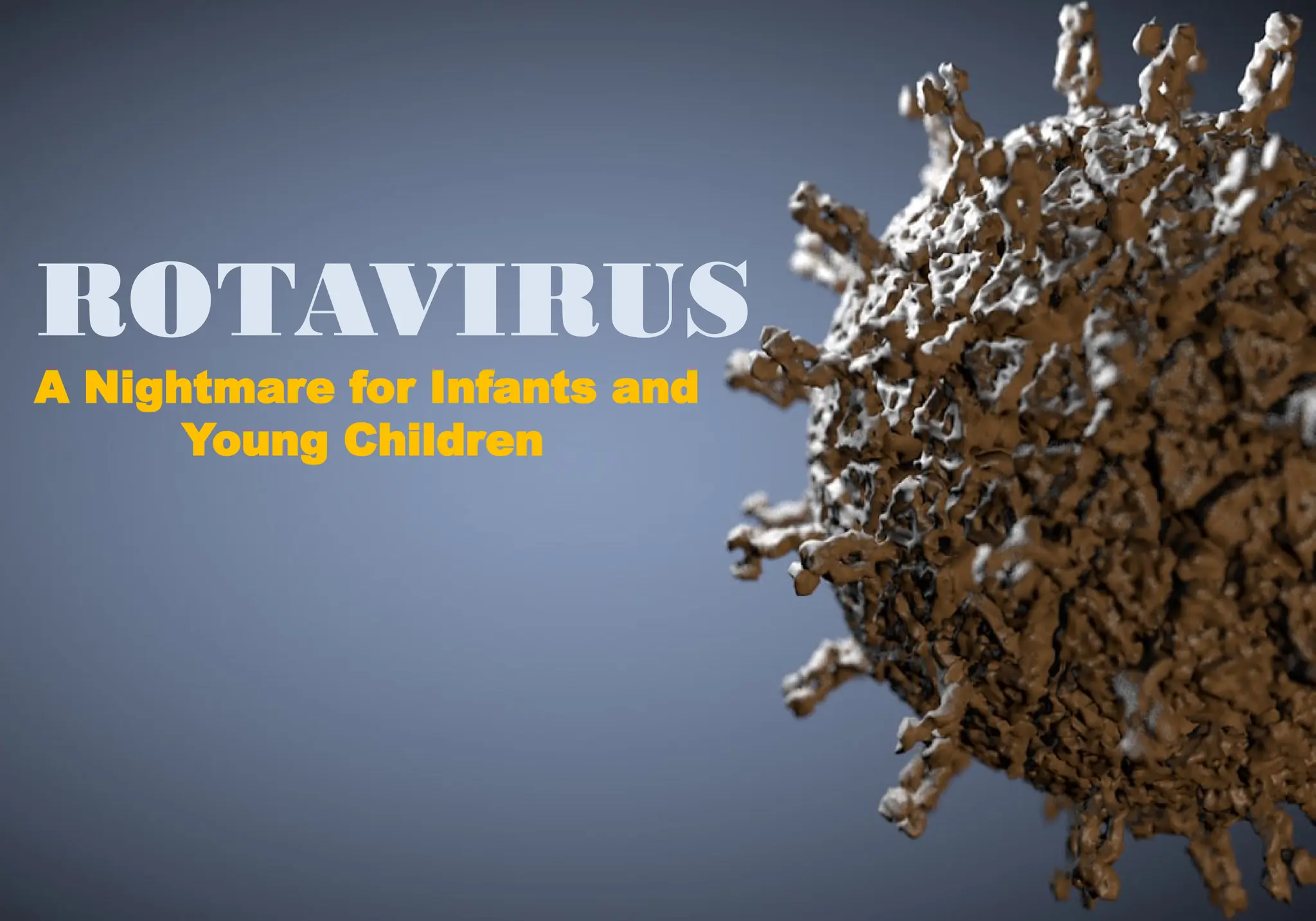
ROTAVIRUS
A Nightmare for Infants and
Young Children
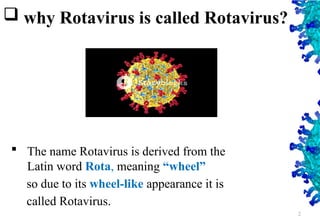
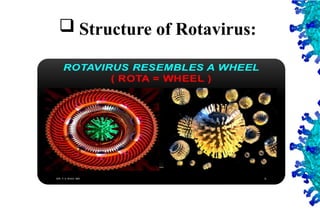
 why Rotavirus is called Rotavirus?
 The name Rotavirus is derived from the
Latin word Rota, meaning “wheel”
so due to its wheel-like appearance it is
called Rotavirus.
2
3
 Rotavirus is responsible for ?
 Gastroenteritis (infectious Diarrhea)
 It infects and damages the cells that line the small intestine
and causes gastroenteritis.
 It is the most common cause of severe diarrhea
among infants and children globally.
Nearly every child in the world will have at least
one rotavirus infection before age 3.
4
 Adults can get infected too.
 Infection is less severe in adults as compare to the children.
 Immunity develop with each infection, subsequent infections
are less severe.
 Rotavirus also infects animals, and is a pathogen of
livestock.
 Each year Rotavirus is responsible for:
114 million illness
24 million clinic visits
2.4 million hospitalizations
5
 HISTORY:
 1973 The virus was identified by Ruth Bishop and colleagues.
 1974 Named by Thomas Henry Flewett.
 1976 Rotaviruses were described in several species of animal.
 1980 Rotavirus serotypes were first described.
 1981 Rotavirus from humans was first grown in cell cultures
derived from monkey kidneys, by adding trypsin to
the culture medium.
6
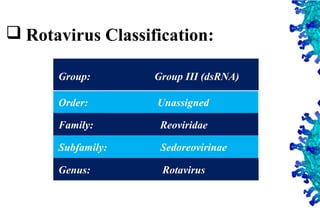
 Rotavirus Classification:
Group: Group III (dsRNA)
Order: Unassigned
Family: Reoviridae
Subfamily: Sedoreovirinae
Genus: Rotavirus
7
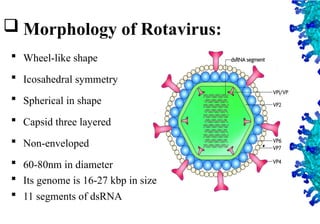
 Morphology of Rotavirus:
 Wheel-like shape
 Icosahedral symmetry
 Spherical in shape
 Capsid three layered
 Non-enveloped
 60-80nm in diameter
 Its genome is 16-27 kbp in size
 11 segments of dsRNA
8
 Structure of Rotavirus:
9
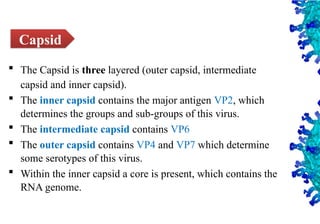
Capsid
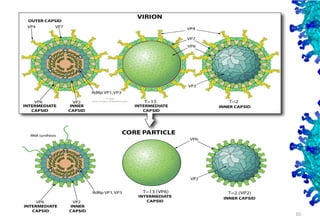
 The Capsid is three layered (outer capsid, intermediate
capsid and inner capsid).
 The inner capsid contains the major antigen VP2, which
determines the groups and sub-groups of this virus.
 The intermediate capsid contains VP6
 The outer capsid contains VP4 and VP7 which determine
some serotypes of this virus.
 Within the inner capsid a core is present, which contains the
RNA genome.
10
11
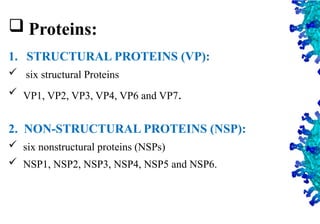
 Proteins:
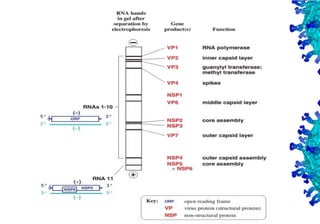
1. STRUCTURAL PROTEINS (VP):
 six structural Proteins
 VP1, VP2, VP3, VP4, VP6 and VP7.
2. NON-STRUCTURAL PROTEINS (NSP):
 six nonstructural proteins (NSPs)
 NSP1, NSP2, NSP3, NSP4, NSP5 and NSP6.
12
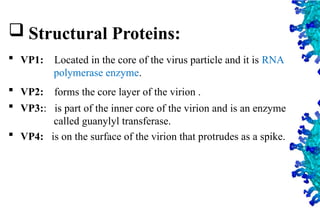
 Structural Proteins:
 VP1: Located in the core of the virus particle and it is RNA
polymerase enzyme.
 VP2: forms the core layer of the virion .
 VP3:: is part of the inner core of the virion and is an enzyme
called guanylyl transferase.
 VP4: is on the surface of the virion that protrudes as a spike.
13
VP6: forms the middle layer of the capsid. It is highly
antigenic and can be used to identify rotavirus species.
 VP7: is a glycoprotein that forms the outer surface of the
virion. It is involved in immunity to infection by
determining the G type of the strain and along with
VP4.
 Structural Proteins:
14
 NON-STRUCTURAL PROTEINS:
 NSP1: It is a nonstructural RNA-binding protein.
 NSP2: Required for genome replication.
 NSP3: It is responsible for the shutdown of cellular protein
synthesis.
15
 NSP4: is a viral enterotoxin that induces diarrhea and
was the first viral enterotoxin discovered.
 NSP5: It accumulates in the viroplasm of infected cell.
 NSP6: It is a nucleic acid binding protein and is encoded by
gene 11 from an out-of phase open reading frame.
16
17
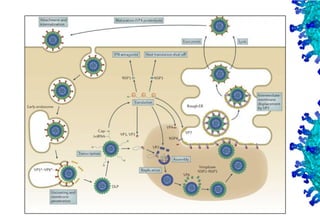
 LIFE CYCLE OF ROTAVIRUS::
 Attachment: of the virus to the host cells is mediated by VP4
and VP7.
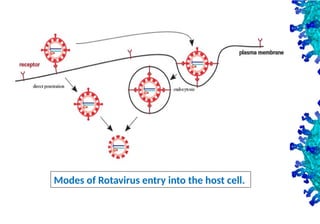
 Entry: There are two possible ways in which a virion can enter
the cell:
1. Direct penetration of the virion across the plasma membrane.
2. Endocytosis
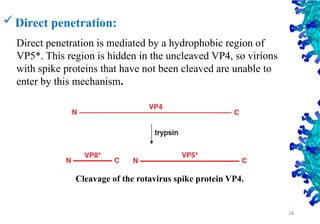
Direct penetration:
Direct penetration is mediated by a hydrophobic region of
VP5*. This region is hidden in the uncleaved VP4, so virions
with spike proteins that have not been cleaved are unable to
enter by this mechanism.
Cleavage of the rotavirus spike protein VP4.
18
19
Modes of Rotavirus entry into the host cell.
20
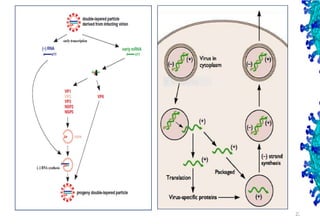
 Cytoplasmic Replication.
 After the entry, triple layer particle converted into the double
layer.
 DLP is transcriptionally active, starts transcribing of the viral
genome.
 Early Events
 LIFE CYCLE OF ROTAVIRUS:
21
 Some of the (+) RNA is synthesized functions as mRNA and
undergo translation.
 Some of the (+) RNA functions as templetes for synthesis of
(−) RNA, to form dsRNA.
 Synthesis of (−) RNA takes place during the entry of the (+)
strands into the core.
 (+) RNA is capped at 5` end, no polyA tail at 3` end.
 VP6 is added to the core to form a second layer of the capsid.
 Transcription and Translation:
22
23
 Assembly:
 NSP2 and NSP5 plays role in the assembly of the
viroplasms.
 VP1, VP2 and VP3 forms the inner layer of the capsid
(core).
 VP6 is added to the core to form a second layer of the
capsid.
24
 Late events:
 Late transcription occurs with in the progeny cores.
 In contrast to the early transcripts, the late transcripts are not
capped because translation of cell proteins has been shut
down while translation of virus proteins continues.
25
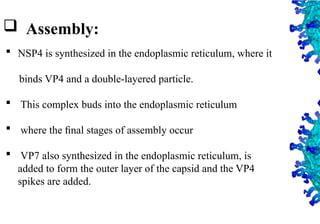
 Assembly:
 NSP4 is synthesized in the endoplasmic reticulum, where it
binds VP4 and a double-layered particle.
 This complex buds into the endoplasmic reticulum
 where the final stages of assembly occur
 VP7 also synthesized in the endoplasmic reticulum, is
added to form the outer layer of the capsid and the VP4
spikes are added.
26
 Release:
 Virions are released from the cell either by,
lysis or exocytosis.
27
 TYPES OF ROTAVIRUS:
 Nine types of rotavirus
 Rotavirus A, B, C, D, E, F, G, H and I.
 Humans are primarily infected by species A, B and C,
most commonly by species A.
 E and H infects pigs
 D, F and G infect birds
 I infect cats normally.
28
 Rotavirus A can also be classified on the basis of two
proteins on the surface of the virus.
1. VP7 (G protein)
G protein which is called glycoprotein, also called
g-serotypes.
2. VP4 (P protein))
P protein is protease sensitive protein, also called
P-serotypes.
29
30
 Symptoms:
 Fever
 Vomiting
 Watery diarrhea
 Abdominal pain
 Dehydration (dry mouth, crying without tears, little
or no urination)
 Sometimes bloody diarrhea
31
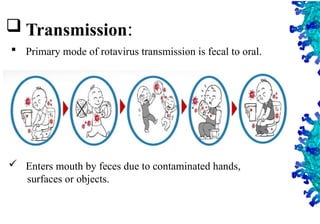
 Transmission:
 Primary mode of rotavirus transmission is fecal to oral.
 Enters mouth by feces due to contaminated hands,
surfaces or objects.
32
 Amount of virus shed in stool:
 10-100 billion virions/gram of stool
 Amount of ingested virus required to cause infection:
 As few as 10 infective virions.
 Incubation period:
 1-2 days.
33
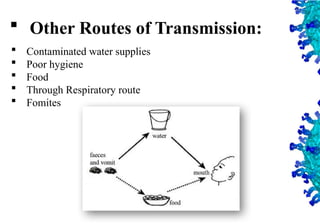
 Other Routes of Transmission:
 Contaminated water supplies
 Poor hygiene
 Food
 Through Respiratory route
 Fomites
34
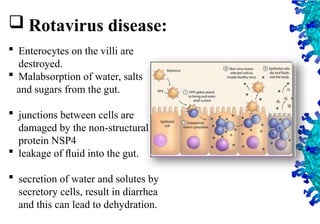
 Rotavirus disease:
 Enterocytes on the villi are
destroyed.
 Malabsorption of water, salts
and sugars from the gut.
 junctions between cells are
damaged by the non-structural
protein NSP4
 leakage of fluid into the gut.
 secretion of water and solutes by
secretory cells, result in diarrhea
and this can lead to dehydration.
35
 Diagnosis of Rotavirus:
 Diagnosed on the basis of physical examination and
symptoms appeared.
 In laboratory, antigen detection in the stool.
 Antigen detection in serum of patient.
36
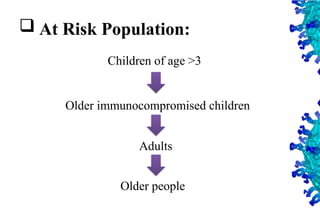
 At Risk Population:
Children of age >3
Older immunocompromised children
Adults
Older people
37
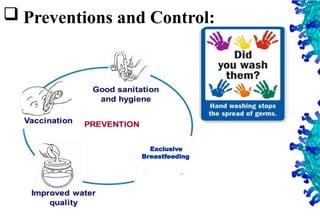
Exclusive
Breastfeeding
 Preventions and Control:
38
 Treatment:
.
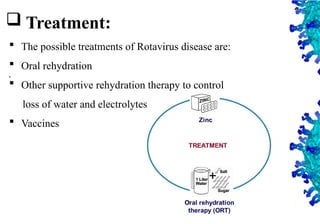
 The possible treatments of Rotavirus disease are:
 Oral rehydration
 Other supportive rehydration therapy to control
loss of water and electrolytes
 Vaccines
39
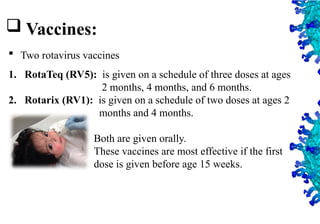
 Vaccines:
 Two rotavirus vaccines
1. RotaTeq (RV5): is given on a schedule of three doses at ages
2 months, 4 months, and 6 months.
2. Rotarix (RV1): is given on a schedule of two doses at ages 2
months and 4 months.
Both are given orally.
These vaccines are most effective if the first
dose is given before age 15 weeks.
40
 Rotavirus vaccine:
 Precautions:
 Rotavirus vaccine should not be given to infants with a
known immunodeficiency.
 Side effects:
 Uncommon and rare
 Risk of vomiting and diarrhea
41
Epidemiology:
42
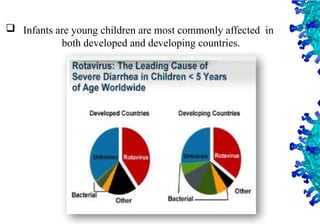
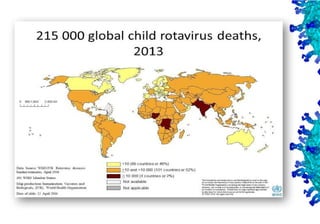
 Infants are young children are most commonly affected in
both developed and developing countries.
43
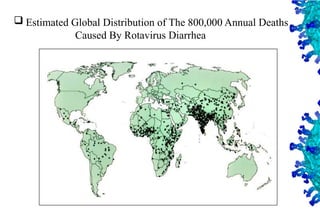
 Estimated Global Distribution of The 800,000 Annual Deaths
Caused By Rotavirus Diarrhea
44
45
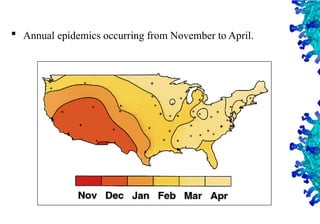
 Annual epidemics occurring from November to April.
46
 Unique features of Rotavirus:
 Wheel-like appearance
 Triple layered capsid
 Presence of Glycoproteins in the outer capsid layer
47
 Conclusion:
Rotavirus infection equally prevalent in industrialized and
developing countries Worldwide, rotavirus infection is still a
significant cause of death in infants and children.
Vaccines have huge impact in reducing the burden of diarrhoea
so, we should create awareness about this disease and a proper
vaccination programme can eradicate this disease.
48
 References:
 www.nlv.ch/Rovirus/graphics/rotavirusdistribution
 http://goo.gl/images/w8bcd6
 Researchgate.net
 viralzone.expasy.org
 Reoviridae.org
 general virology book.
49

Introduction to Rotavirus and its Lifecycle.pptx

  • 1.
    1 ROTAVIRUS A Nightmare forInfants and Young Children
  • 2.
     why Rotavirusis called Rotavirus?  The name Rotavirus is derived from the Latin word Rota, meaning “wheel” so due to its wheel-like appearance it is called Rotavirus. 2
  • 3.
    3  Rotavirus isresponsible for ?  Gastroenteritis (infectious Diarrhea)  It infects and damages the cells that line the small intestine and causes gastroenteritis.  It is the most common cause of severe diarrhea among infants and children globally. Nearly every child in the world will have at least one rotavirus infection before age 3.
  • 4.
    4  Adults canget infected too.  Infection is less severe in adults as compare to the children.  Immunity develop with each infection, subsequent infections are less severe.  Rotavirus also infects animals, and is a pathogen of livestock.  Each year Rotavirus is responsible for: 114 million illness 24 million clinic visits 2.4 million hospitalizations
  • 5.
    5  HISTORY:  1973The virus was identified by Ruth Bishop and colleagues.  1974 Named by Thomas Henry Flewett.  1976 Rotaviruses were described in several species of animal.  1980 Rotavirus serotypes were first described.  1981 Rotavirus from humans was first grown in cell cultures derived from monkey kidneys, by adding trypsin to the culture medium.
  • 6.
    6  Rotavirus Classification: Group:Group III (dsRNA) Order: Unassigned Family: Reoviridae Subfamily: Sedoreovirinae Genus: Rotavirus
  • 7.
    7  Morphology ofRotavirus:  Wheel-like shape  Icosahedral symmetry  Spherical in shape  Capsid three layered  Non-enveloped  60-80nm in diameter  Its genome is 16-27 kbp in size  11 segments of dsRNA
  • 8.
  • 9.
    9 Capsid  The Capsidis three layered (outer capsid, intermediate capsid and inner capsid).  The inner capsid contains the major antigen VP2, which determines the groups and sub-groups of this virus.  The intermediate capsid contains VP6  The outer capsid contains VP4 and VP7 which determine some serotypes of this virus.  Within the inner capsid a core is present, which contains the RNA genome.
  • 10.
  • 11.
    11  Proteins: 1. STRUCTURALPROTEINS (VP):  six structural Proteins  VP1, VP2, VP3, VP4, VP6 and VP7. 2. NON-STRUCTURAL PROTEINS (NSP):  six nonstructural proteins (NSPs)  NSP1, NSP2, NSP3, NSP4, NSP5 and NSP6.
  • 12.
    12  Structural Proteins: VP1: Located in the core of the virus particle and it is RNA polymerase enzyme.  VP2: forms the core layer of the virion .  VP3:: is part of the inner core of the virion and is an enzyme called guanylyl transferase.  VP4: is on the surface of the virion that protrudes as a spike.
  • 13.
    13 VP6: forms themiddle layer of the capsid. It is highly antigenic and can be used to identify rotavirus species.  VP7: is a glycoprotein that forms the outer surface of the virion. It is involved in immunity to infection by determining the G type of the strain and along with VP4.  Structural Proteins:
  • 14.
    14  NON-STRUCTURAL PROTEINS: NSP1: It is a nonstructural RNA-binding protein.  NSP2: Required for genome replication.  NSP3: It is responsible for the shutdown of cellular protein synthesis.
  • 15.
    15  NSP4: isa viral enterotoxin that induces diarrhea and was the first viral enterotoxin discovered.  NSP5: It accumulates in the viroplasm of infected cell.  NSP6: It is a nucleic acid binding protein and is encoded by gene 11 from an out-of phase open reading frame.
  • 16.
  • 17.
    17  LIFE CYCLEOF ROTAVIRUS::  Attachment: of the virus to the host cells is mediated by VP4 and VP7.  Entry: There are two possible ways in which a virion can enter the cell: 1. Direct penetration of the virion across the plasma membrane. 2. Endocytosis
  • 18.
    Direct penetration: Direct penetrationis mediated by a hydrophobic region of VP5*. This region is hidden in the uncleaved VP4, so virions with spike proteins that have not been cleaved are unable to enter by this mechanism. Cleavage of the rotavirus spike protein VP4. 18
  • 19.
    19 Modes of Rotavirusentry into the host cell.
  • 20.
    20  Cytoplasmic Replication. After the entry, triple layer particle converted into the double layer.  DLP is transcriptionally active, starts transcribing of the viral genome.  Early Events  LIFE CYCLE OF ROTAVIRUS:
  • 21.
    21  Some ofthe (+) RNA is synthesized functions as mRNA and undergo translation.  Some of the (+) RNA functions as templetes for synthesis of (−) RNA, to form dsRNA.  Synthesis of (−) RNA takes place during the entry of the (+) strands into the core.  (+) RNA is capped at 5` end, no polyA tail at 3` end.  VP6 is added to the core to form a second layer of the capsid.  Transcription and Translation:
  • 22.
  • 23.
    23  Assembly:  NSP2and NSP5 plays role in the assembly of the viroplasms.  VP1, VP2 and VP3 forms the inner layer of the capsid (core).  VP6 is added to the core to form a second layer of the capsid.
  • 24.
    24  Late events: Late transcription occurs with in the progeny cores.  In contrast to the early transcripts, the late transcripts are not capped because translation of cell proteins has been shut down while translation of virus proteins continues.
  • 25.
    25  Assembly:  NSP4is synthesized in the endoplasmic reticulum, where it binds VP4 and a double-layered particle.  This complex buds into the endoplasmic reticulum  where the final stages of assembly occur  VP7 also synthesized in the endoplasmic reticulum, is added to form the outer layer of the capsid and the VP4 spikes are added.
  • 26.
    26  Release:  Virionsare released from the cell either by, lysis or exocytosis.
  • 27.
  • 28.
     TYPES OFROTAVIRUS:  Nine types of rotavirus  Rotavirus A, B, C, D, E, F, G, H and I.  Humans are primarily infected by species A, B and C, most commonly by species A.  E and H infects pigs  D, F and G infect birds  I infect cats normally. 28
  • 29.
     Rotavirus Acan also be classified on the basis of two proteins on the surface of the virus. 1. VP7 (G protein) G protein which is called glycoprotein, also called g-serotypes. 2. VP4 (P protein)) P protein is protease sensitive protein, also called P-serotypes. 29
  • 30.
    30  Symptoms:  Fever Vomiting  Watery diarrhea  Abdominal pain  Dehydration (dry mouth, crying without tears, little or no urination)  Sometimes bloody diarrhea
  • 31.
    31  Transmission:  Primarymode of rotavirus transmission is fecal to oral.  Enters mouth by feces due to contaminated hands, surfaces or objects.
  • 32.
    32  Amount ofvirus shed in stool:  10-100 billion virions/gram of stool  Amount of ingested virus required to cause infection:  As few as 10 infective virions.  Incubation period:  1-2 days.
  • 33.
    33  Other Routesof Transmission:  Contaminated water supplies  Poor hygiene  Food  Through Respiratory route  Fomites
  • 34.
    34  Rotavirus disease: Enterocytes on the villi are destroyed.  Malabsorption of water, salts and sugars from the gut.  junctions between cells are damaged by the non-structural protein NSP4  leakage of fluid into the gut.  secretion of water and solutes by secretory cells, result in diarrhea and this can lead to dehydration.
  • 35.
    35  Diagnosis ofRotavirus:  Diagnosed on the basis of physical examination and symptoms appeared.  In laboratory, antigen detection in the stool.  Antigen detection in serum of patient.
  • 36.
    36  At RiskPopulation: Children of age >3 Older immunocompromised children Adults Older people
  • 37.
  • 38.
    38  Treatment: .  Thepossible treatments of Rotavirus disease are:  Oral rehydration  Other supportive rehydration therapy to control loss of water and electrolytes  Vaccines
  • 39.
    39  Vaccines:  Tworotavirus vaccines 1. RotaTeq (RV5): is given on a schedule of three doses at ages 2 months, 4 months, and 6 months. 2. Rotarix (RV1): is given on a schedule of two doses at ages 2 months and 4 months. Both are given orally. These vaccines are most effective if the first dose is given before age 15 weeks.
  • 40.
    40  Rotavirus vaccine: Precautions:  Rotavirus vaccine should not be given to infants with a known immunodeficiency.  Side effects:  Uncommon and rare  Risk of vomiting and diarrhea
  • 41.
  • 42.
    42  Infants areyoung children are most commonly affected in both developed and developing countries.
  • 43.
    43  Estimated GlobalDistribution of The 800,000 Annual Deaths Caused By Rotavirus Diarrhea
  • 44.
  • 45.
    45  Annual epidemicsoccurring from November to April.
  • 46.
    46  Unique featuresof Rotavirus:  Wheel-like appearance  Triple layered capsid  Presence of Glycoproteins in the outer capsid layer
  • 47.
    47  Conclusion: Rotavirus infectionequally prevalent in industrialized and developing countries Worldwide, rotavirus infection is still a significant cause of death in infants and children. Vaccines have huge impact in reducing the burden of diarrhoea so, we should create awareness about this disease and a proper vaccination programme can eradicate this disease.
  • 48.
    48  References:  www.nlv.ch/Rovirus/graphics/rotavirusdistribution http://goo.gl/images/w8bcd6  Researchgate.net  viralzone.expasy.org  Reoviridae.org  general virology book.
  • 49.