INTRODUCTION TO
PROSTHODONTICS
By
Dr. Haitham Aboud
Lecturer of removable prosthodontics
DEFINITIONS
• Prosthetics:
• Replacements for missing parts of the human body.
• Prosthodontics:
• The branch of dentistry pertaining to the
restoration and maintenance of oral function,
comfort, appearance, and health of the patient.
• Prosthesis:
• An artificial replacement of absent part of human
body.
DEFINITIONS
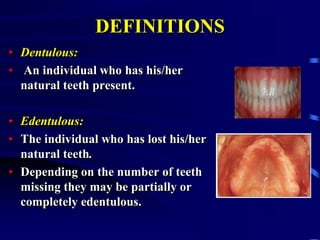
• Dentulous:
• An individual who has his/her
natural teeth present.
• Edentulous:
• The individual who has lost his/her
natural teeth.
• Depending on the number of teeth
missing they may be partially or
completely edentulous.
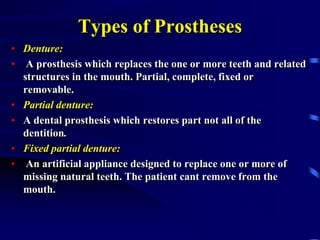
Types of Prostheses
• Denture:
• A prosthesis which replaces the one or more teeth and related
structures in the mouth. Partial, complete, fixed or
removable.
• Partial denture:
• A dental prosthesis which restores part not all of the
dentition.
• Fixed partial denture:
• An artificial appliance designed to replace one or more of
missing natural teeth. The patient cant remove from the
mouth.
Types of Prostheses
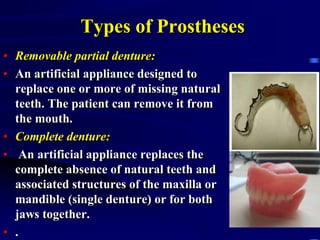
• Removable partial denture:
• An artificial appliance designed to
replace one or more of missing natural
teeth. The patient can remove it from
the mouth.
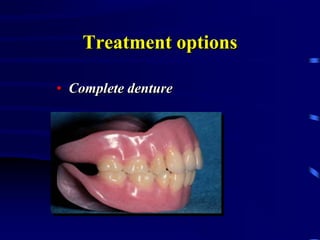
• Complete denture:
• An artificial appliance replaces the
complete absence of natural teeth and
associated structures of the maxilla or
mandible (single denture) or for both
jaws together.
• .
Why Edentulous Patient Must Restore His Missing
Natural Teeth
-To restore the function of mastication
-To improve speech and cosmetic appearance.
-To avoid abnormal masticator habits that lead to
TMJ disorders.
Reasons for tooth loss
• Traumatic injuries
• Caries
• Periodontal diseases
• Cysts, malignancies and tumors
• Radiation therapy for tumors
• Grossly malaligned teeth
• Iatrogenic extraction
• Congenitally missing teeth
• Failure to erupt (impacted teeth)
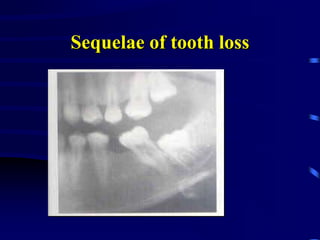
Sequelae of tooth loss
• Resorption:
• The socket gradually remodels until it assumes the
shape of the rounded edentulous ridge.
• Tilting
• Drifting
• Occlusal disharmony leads to discomfort, pain, or
damage to temporomandibular joints.
Sequelae of tooth loss
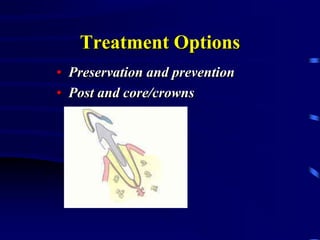
Treatment Options
• Preservation and prevention
• Post and core/crowns
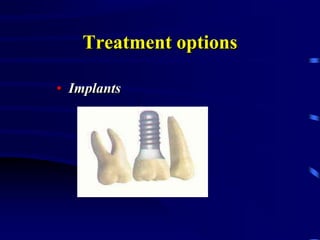
Treatment options
• Implants
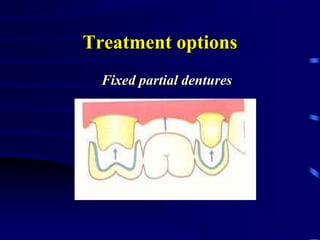
Treatment options
Fixed partial dentures
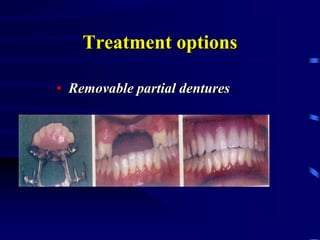
Treatment options
• Removable partial dentures
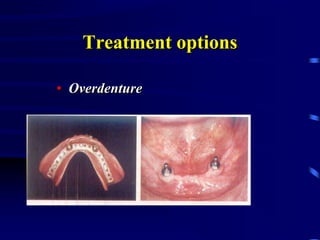
Treatment options
• Overdenture
Treatment options
• Complete denture
Treatment options
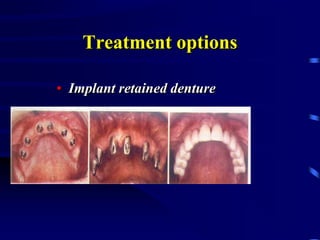
• Implant retained denture
Treatment options
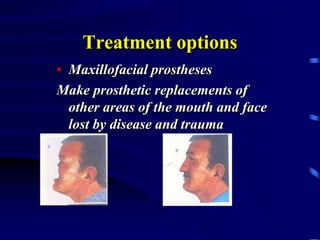
• Maxillofacial prostheses
Make prosthetic replacements of
other areas of the mouth and face
lost by disease and trauma
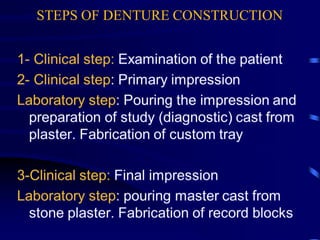
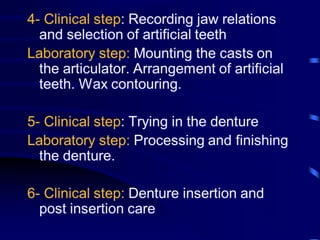
STEPS OF DENTURE CONSTRUCTION
Thank you

Introduction to Prosthodontics CD .ppt

  • 1.
    INTRODUCTION TO PROSTHODONTICS By Dr. HaithamAboud Lecturer of removable prosthodontics
  • 3.
    DEFINITIONS • Prosthetics: • Replacementsfor missing parts of the human body. • Prosthodontics: • The branch of dentistry pertaining to the restoration and maintenance of oral function, comfort, appearance, and health of the patient. • Prosthesis: • An artificial replacement of absent part of human body.
  • 4.
    DEFINITIONS • Dentulous: • Anindividual who has his/her natural teeth present. • Edentulous: • The individual who has lost his/her natural teeth. • Depending on the number of teeth missing they may be partially or completely edentulous.
  • 5.
    Types of Prostheses •Denture: • A prosthesis which replaces the one or more teeth and related structures in the mouth. Partial, complete, fixed or removable. • Partial denture: • A dental prosthesis which restores part not all of the dentition. • Fixed partial denture: • An artificial appliance designed to replace one or more of missing natural teeth. The patient cant remove from the mouth.
  • 6.
    Types of Prostheses •Removable partial denture: • An artificial appliance designed to replace one or more of missing natural teeth. The patient can remove it from the mouth. • Complete denture: • An artificial appliance replaces the complete absence of natural teeth and associated structures of the maxilla or mandible (single denture) or for both jaws together. • .
  • 7.
    Why Edentulous PatientMust Restore His Missing Natural Teeth -To restore the function of mastication -To improve speech and cosmetic appearance. -To avoid abnormal masticator habits that lead to TMJ disorders.
  • 8.
    Reasons for toothloss • Traumatic injuries • Caries • Periodontal diseases • Cysts, malignancies and tumors • Radiation therapy for tumors • Grossly malaligned teeth • Iatrogenic extraction • Congenitally missing teeth • Failure to erupt (impacted teeth)
  • 9.
    Sequelae of toothloss • Resorption: • The socket gradually remodels until it assumes the shape of the rounded edentulous ridge. • Tilting • Drifting • Occlusal disharmony leads to discomfort, pain, or damage to temporomandibular joints.
  • 10.
  • 11.
    Treatment Options • Preservationand prevention • Post and core/crowns
  • 12.
  • 13.
  • 14.
  • 15.
  • 16.
  • 17.
  • 18.
    Treatment options • Maxillofacialprostheses Make prosthetic replacements of other areas of the mouth and face lost by disease and trauma
  • 19.
    STEPS OF DENTURECONSTRUCTION
  • 21.