Maxillary 1st premolar
Dr. amna radhi
Dr. mohammed aljaberi
Dr. Zain Sajad
Measurements
LENGTH OF CROWN 8.5 mm
LENGTH OF ROOT 14 mm
MESIODISTAL DIAMETER OF
CROWN
7 mm
MESIODISTAL DIAMETER OF
CROWN AT CERVIX
5 mm
LABIOLINGUAL DIAMETER
OF CROWN 9 mm
LABIOLINGUAL DIAMETER
OF CROWN AT CERVIX
8 mm
CURVATURE OF CERVICAL
LINE—MESIAL
1 mm
CURVATURE OF CERVICAL
LINE—DISTAL
0.5 mm
Distal Mesial
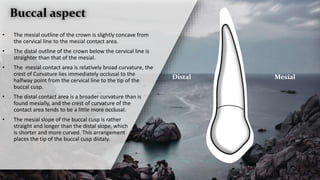
Buccal aspect
• The mesial outline of the crown is slightly concave from
the cervical line to the mesial contact area.
• The distal outline of the crown below the cervical line is
straighter than that of the mesial.
• The mesial contact area is relatively broad curvature, the
crest of Curvature lies immediately occlusal to the
halfway point from the cervical line to the tip of the
buccal cusp.
• The distal contact area is a broader curvature than is
found mesially, and the crest of curvature of the
contact area tends to be a little more occlusal.
• The mesial slope of the buccal cusp is rather
straight and longer than the distal slope, which
is shorter and more curved. This arrangement
places the tip of the buccal cusp distaly.
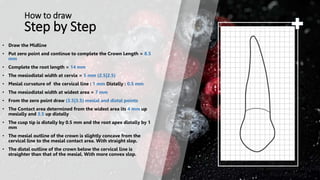
Step by Step
• Draw the Midline
• Put zero point and continue to complete the Crown Length = 8.5
mm
• Complete the root length = 14 mm
• The mesiodistal width at cervix = 5 mm (2.5|2.5)
• Mesial curvature of the cervical line : 1 mm Distally : 0.5 mm
• The mesiodistal width at widest area = 7 mm
• From the zero point draw (3.5|3.5) mesial and distal points
• The Contact area determined from the widest area its 4 mm up
mesially and 3.5 up distally
• The cusp tip is distally by 0.5 mm and the root apex distally by 1
mm
• The mesial outline of the crown is slightly concave from the
cervical line to the mesial contact area. With straight slop.
• The distal outline of the crown below the cervical line is
straighter than that of the mesial. With more convex slop.
How to draw
8.5
OWN
LENGTH
1.0 MM
3.5 MM
3.5 MM
2.5 MM
2.5 MM
4.0
MM
3.5
MM
14.0
MM
ROOT
LENGTH
0.0
8.5mm
3.5mm 3.5mm
2.5mm 2.5mm
0.5mm 1mm
4mm
0.5
• the lingual portion of the crown is narrower than the buccal portion.
• the lingual cusp is not as long as the buccal cusp.
• The lingual cusp is pointed, the mesial slop and distal
slop meeting at 90 degree angle. ( the cusp at the center )
Mesial Distal
Lingual aspect
• buccal outline of the crown curves outward below the cervical line.
The crest of curvature is often located approximately at the
junction of cervical and middle thirds.
• The lingual outline of the crown may be described as a
smoothly curved line starting at the cervical line and ending
at the tip of the lingual cusp. The crest of this curvature is
most often near the center of the middle third.
• Lingual cusp is shorter than buccal cusp.
mesial aspect
Step by Step
• Draw the Midline
• Put zero point and continue to complete the Crown Length = 8.5
mm.
• Complete the root length = 14 mm.
• Labiolingual diameter of the crown at cervix = 8 mm (4|4).
• Mesial curvature of the cervical line : 1 mm.
• The widest area of the buccal side should be 2.5 mm occlusally
from the cervical line and 4.5 mm buccally to the midline .
• The widest area of the lingual side should be 4 mm occlusally to
the cervical line and 4.5 mm lingually to the midline.
• The distance between the cusp tips is 5 mm ( 2.5/2.5 ) the same
for the root apex.
• The lingual cusp is shorter by 1 mm.
• The junction of the two cusps 2.5 mm cervically f.rom zero point.
• The bifurcation of the roots is 7 mm from cervical line.
How to draw
Mesial aspect
2.5 MM
2.5 MM
4.0 MM
4.0 MM
2.5
MM
4.0
MM
4.5 MM
4.5 MM
1.0
MM
1.0
MM
7.0
MM
2.5
MM
0.0
8.5
4.5mm
2.5mm
1mm
4.5mm
1mm
2.5mm 2.5mm
2.5mm
0.5mm
0.5mm
• A deep developmental groove crossing the distal marginal
ridge of the crown is not evident.
Distal aspect
• Hexagonal shaped.
• Well defined central developmental groove, that joins the mesial
marginal groove at the mesial side.
• Mesiobuccal and distobuccal developmental grooves join the
central groove mesial and distal pits .
• There are two fossae, mesial and distal triangular fossae.
• The buccal side is convex with strongly developed
middle buccal ridge.
occlusal aspect
Thank y
Thank y

first premolar.pptx

  • 1.
    Maxillary 1st premolar Dr.amna radhi Dr. mohammed aljaberi Dr. Zain Sajad
  • 2.
    Measurements LENGTH OF CROWN8.5 mm LENGTH OF ROOT 14 mm MESIODISTAL DIAMETER OF CROWN 7 mm MESIODISTAL DIAMETER OF CROWN AT CERVIX 5 mm LABIOLINGUAL DIAMETER OF CROWN 9 mm LABIOLINGUAL DIAMETER OF CROWN AT CERVIX 8 mm CURVATURE OF CERVICAL LINE—MESIAL 1 mm CURVATURE OF CERVICAL LINE—DISTAL 0.5 mm
  • 3.
    Distal Mesial Buccal aspect •The mesial outline of the crown is slightly concave from the cervical line to the mesial contact area. • The distal outline of the crown below the cervical line is straighter than that of the mesial. • The mesial contact area is relatively broad curvature, the crest of Curvature lies immediately occlusal to the halfway point from the cervical line to the tip of the buccal cusp. • The distal contact area is a broader curvature than is found mesially, and the crest of curvature of the contact area tends to be a little more occlusal. • The mesial slope of the buccal cusp is rather straight and longer than the distal slope, which is shorter and more curved. This arrangement places the tip of the buccal cusp distaly.
  • 4.
    Step by Step •Draw the Midline • Put zero point and continue to complete the Crown Length = 8.5 mm • Complete the root length = 14 mm • The mesiodistal width at cervix = 5 mm (2.5|2.5) • Mesial curvature of the cervical line : 1 mm Distally : 0.5 mm • The mesiodistal width at widest area = 7 mm • From the zero point draw (3.5|3.5) mesial and distal points • The Contact area determined from the widest area its 4 mm up mesially and 3.5 up distally • The cusp tip is distally by 0.5 mm and the root apex distally by 1 mm • The mesial outline of the crown is slightly concave from the cervical line to the mesial contact area. With straight slop. • The distal outline of the crown below the cervical line is straighter than that of the mesial. With more convex slop. How to draw
  • 5.
    8.5 OWN LENGTH 1.0 MM 3.5 MM 3.5MM 2.5 MM 2.5 MM 4.0 MM 3.5 MM 14.0 MM ROOT LENGTH
  • 6.
  • 7.
    • the lingualportion of the crown is narrower than the buccal portion. • the lingual cusp is not as long as the buccal cusp. • The lingual cusp is pointed, the mesial slop and distal slop meeting at 90 degree angle. ( the cusp at the center ) Mesial Distal Lingual aspect
  • 8.
    • buccal outlineof the crown curves outward below the cervical line. The crest of curvature is often located approximately at the junction of cervical and middle thirds. • The lingual outline of the crown may be described as a smoothly curved line starting at the cervical line and ending at the tip of the lingual cusp. The crest of this curvature is most often near the center of the middle third. • Lingual cusp is shorter than buccal cusp. mesial aspect
  • 9.
    Step by Step •Draw the Midline • Put zero point and continue to complete the Crown Length = 8.5 mm. • Complete the root length = 14 mm. • Labiolingual diameter of the crown at cervix = 8 mm (4|4). • Mesial curvature of the cervical line : 1 mm. • The widest area of the buccal side should be 2.5 mm occlusally from the cervical line and 4.5 mm buccally to the midline . • The widest area of the lingual side should be 4 mm occlusally to the cervical line and 4.5 mm lingually to the midline. • The distance between the cusp tips is 5 mm ( 2.5/2.5 ) the same for the root apex. • The lingual cusp is shorter by 1 mm. • The junction of the two cusps 2.5 mm cervically f.rom zero point. • The bifurcation of the roots is 7 mm from cervical line. How to draw Mesial aspect
  • 10.
    2.5 MM 2.5 MM 4.0MM 4.0 MM 2.5 MM 4.0 MM 4.5 MM 4.5 MM 1.0 MM 1.0 MM 7.0 MM 2.5 MM
  • 11.
  • 12.
    • A deepdevelopmental groove crossing the distal marginal ridge of the crown is not evident. Distal aspect
  • 13.
    • Hexagonal shaped. •Well defined central developmental groove, that joins the mesial marginal groove at the mesial side. • Mesiobuccal and distobuccal developmental grooves join the central groove mesial and distal pits . • There are two fossae, mesial and distal triangular fossae. • The buccal side is convex with strongly developed middle buccal ridge. occlusal aspect
  • 14.