

INTRODUCTION TO PROKARYOTES AND
EUKARYOTES
1
Presented By
Ms. Swapnali Satish Pharande
Assistant Professor
Department of Pharmaceutics
(Pharm D
Email:swapnalipharandemcpl@gmail.com
Progressive Education Society’s
Modern College of Pharmacy For Ladies,
Moshi, Pune
CONTENTS
❖ Introduction to Cell
❖ Introduction to Prokaryotes
❖ Introduction to Eukaryotes
❖ Difference Between Prokaryotes and Eukaryotes.
2
Swapnali S. Pharande
LEARNING OUTCOMES
❖ After completion of this topic students should be able to:
✓ Define Prokaryotes and Eukaryotes.
✓ Describe the structure of Prokaryotes and Eukaryotes.
✓ Distinguish between Prokaryotes and Eukaryotes with their
examples.
3
Swapnali S. Pharande
INTRODUCTION TO CELL
❖Cell
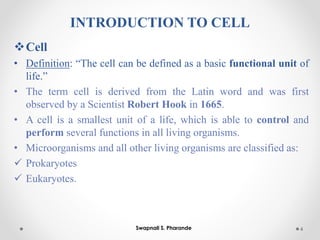
• Definition: “The cell can be defined as a basic functional unit of
life.”
• The term cell is derived from the Latin word and was first
observed by a Scientist Robert Hook in 1665.
• A cell is a smallest unit of a life, which is able to control and
perform several functions in all living organisms.
• Microorganisms and all other living organisms are classified as:
✓ Prokaryotes
✓ Eukaryotes.
4
Swapnali S. Pharande
PROKARYOTES
❖ Prokaryotes
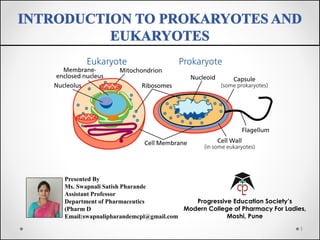
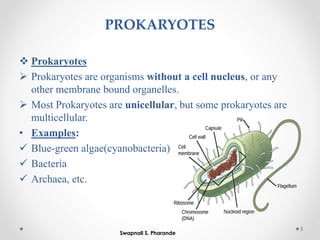
➢ Prokaryotes are organisms without a cell nucleus, or any
other membrane bound organelles.
➢ Most Prokaryotes are unicellular, but some prokaryotes are
multicellular.
• Examples:
✓ Blue-green algae(cyanobacteria)
✓ Bacteria
✓ Archaea, etc.
5
Swapnali S. Pharande
PROKARYOTIC CELL
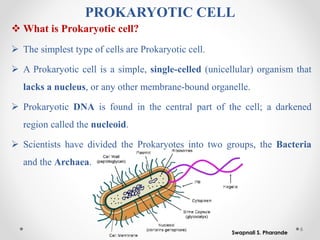
❖ What is Prokaryotic cell?
➢ The simplest type of cells are Prokaryotic cell.
➢ A Prokaryotic cell is a simple, single-celled (unicellular) organism that
lacks a nucleus, or any other membrane-bound organelle.
➢ Prokaryotic DNA is found in the central part of the cell; a darkened
region called the nucleoid.
➢ Scientists have divided the Prokaryotes into two groups, the Bacteria
and the Archaea.
6
Swapnali S. Pharande
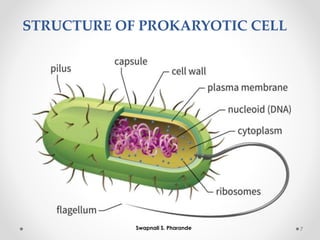
STRUCTURE OF PROKARYOTIC CELL
7
Swapnali S. Pharande
PROKARYOTIC CELL
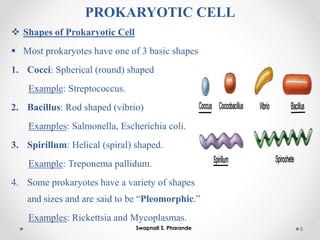
❖ Shapes of Prokaryotic Cell
▪ Most prokaryotes have one of 3 basic shapes
1. Cocci: Spherical (round) shaped
Example: Streptococcus.
2. Bacillus: Rod shaped (vibrio)
Examples: Salmonella, Escherichia coli.
3. Spirillum: Helical (spiral) shaped.
Example: Treponema pallidum.
4. Some prokaryotes have a variety of shapes
and sizes and are said to be “Pleomorphic.”
Examples: Rickettsia and Mycoplasmas.
8
Swapnali S. Pharande
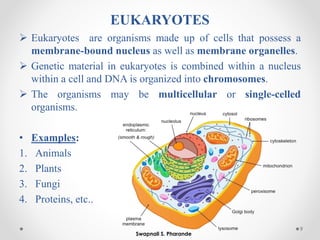
EUKARYOTES
➢ Eukaryotes are organisms made up of cells that possess a
membrane-bound nucleus as well as membrane organelles.
➢ Genetic material in eukaryotes is combined within a nucleus
within a cell and DNA is organized into chromosomes.
➢ The organisms may be multicellular or single-celled
organisms.
• Examples:
1. Animals
2. Plants
3. Fungi
4. Proteins, etc..
9
Swapnali S. Pharande
EUKARYOTIC CELL
❖ Eukaryotic Cell
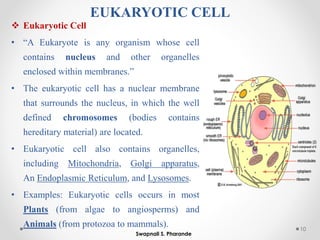
• “A Eukaryote is any organism whose cell
contains nucleus and other organelles
enclosed within membranes.”
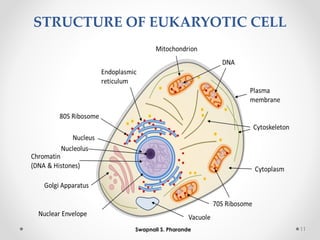
• The eukaryotic cell has a nuclear membrane
that surrounds the nucleus, in which the well
defined chromosomes (bodies contains
hereditary material) are located.
• Eukaryotic cell also contains organelles,
including Mitochondria, Golgi apparatus,
An Endoplasmic Reticulum, and Lysosomes.
• Examples: Eukaryotic cells occurs in most
Plants (from algae to angiosperms) and
Animals (from protozoa to mammals). 10
Swapnali S. Pharande
STRUCTURE OF EUKARYOTIC CELL
11
Swapnali S. Pharande
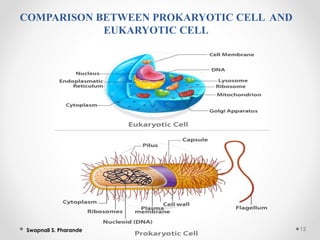
COMPARISON BETWEEN PROKARYOTIC CELL AND
EUKARYOTIC CELL
12
Swapnali S. Pharande
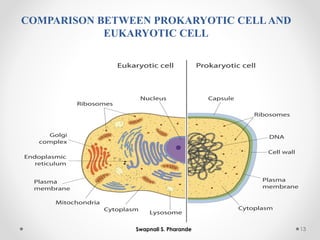
COMPARISON BETWEEN PROKARYOTIC CELLAND
EUKARYOTIC CELL
13
Swapnali S. Pharande
COMPARISON BETWEEN PROKARYOTIC CELLAND
EUKARYOTIC CELL
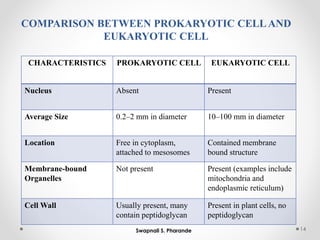
CHARACTERISTICS PROKARYOTIC CELL EUKARYOTIC CELL
Nucleus Absent Present
Average Size 0.2–2 mm in diameter 10–100 mm in diameter
Location Free in cytoplasm,
attached to mesosomes
Contained membrane
bound structure
Membrane-bound
Organelles
Not present Present (examples include
mitochondria and
endoplasmic reticulum)
Cell Wall Usually present, many
contain peptidoglycan
Present in plant cells, no
peptidoglycan
14
Swapnali S. Pharande
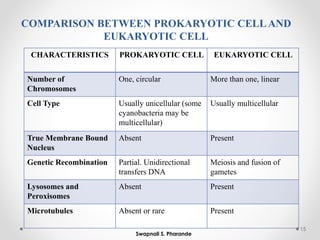
CHARACTERISTICS PROKARYOTIC CELL EUKARYOTIC CELL
Number of
Chromosomes
One, circular More than one, linear
Cell Type Usually unicellular (some
cyanobacteria may be
multicellular)
Usually multicellular
True Membrane Bound
Nucleus
Absent Present
Genetic Recombination Partial. Unidirectional
transfers DNA
Meiosis and fusion of
gametes
Lysosomes and
Peroxisomes
Absent Present
Microtubules Absent or rare Present
15
Swapnali S. Pharande
COMPARISON BETWEEN PROKARYOTIC CELLAND
EUKARYOTIC CELL
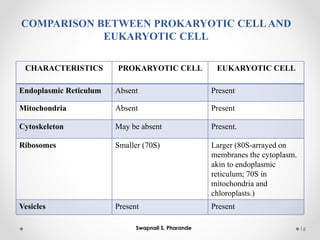
CHARACTERISTICS PROKARYOTIC CELL EUKARYOTIC CELL
Endoplasmic Reticulum Absent Present
Mitochondria Absent Present
Cytoskeleton May be absent Present.
Ribosomes Smaller (70S) Larger (80S-arrayed on
membranes the cytoplasm.
akin to endoplasmic
reticulum; 70S in
mitochondria and
chloroplasts.)
Vesicles Present Present
16
Swapnali S. Pharande
COMPARISON BETWEEN PROKARYOTIC CELLAND
EUKARYOTIC CELL
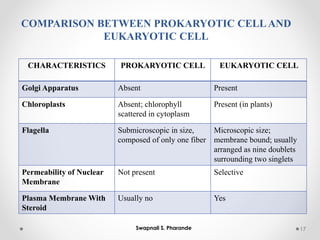
CHARACTERISTICS PROKARYOTIC CELL EUKARYOTIC CELL
Golgi Apparatus Absent Present
Chloroplasts Absent; chlorophyll
scattered in cytoplasm
Present (in plants)
Flagella Submicroscopic in size,
composed of only one fiber
Microscopic size;
membrane bound; usually
arranged as nine doublets
surrounding two singlets
Permeability of Nuclear
Membrane
Not present Selective
Plasma Membrane With
Steroid
Usually no Yes
17
Swapnali S. Pharande
COMPARISON BETWEEN PROKARYOTIC CELLAND
EUKARYOTIC CELL
CHARACTERISTICS PROKARYOTIC CELL EUKARYOTIC CELL
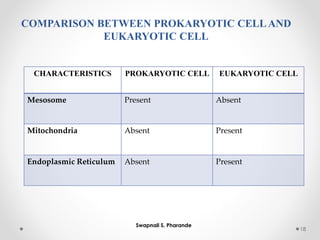
Mesosome Present Absent
Mitochondria Absent Present
Endoplasmic Reticulum Absent Present
18
Swapnali S. Pharande
COMPARISON BETWEEN PROKARYOTIC CELLAND
EUKARYOTIC CELL
REFERENCES
1. Pharmaceutical Microbiology By Ashutosh Kar, New Age International
Publishers ISBN(13):978-81-224-2867-4, 2018; Page no:26-36.
2. Textbook of Microbiology & Immunology By S. C. Parija, Elsevier
Publishers, ISBN: 978-81-312-2810-4; 2nd edition (2012); Page no:9-23.
3. Lippincott’s Illustrated Reviews: Microbiology By R. A. Harvey, ISBN
978-1-60831-733-2 , 3rd Edition (2013);Page No.:13-14.
4. Microbiology Principles and Explorations By Jacquelyn G. Black, ISBN
978-0-470-54109-8; 8th edition; Page No:76-112.
5. Ananthnarayan & Paniker’s Textbook of Microbiology By C K J Paniker ,
7th edition(2005); Page no.:7-8.
6. Pharmaceutical Microbiology By W.B. Hugo & A.D. Russel, Blackwell
Science Ltd. 6th edition(1998);Page No: 3-4.
19
Swapnali S. Pharande
THANK YOU
20
Swapnali S. Pharande

Introduction to Prokaryotes and Eukaryotes.pdf

  • 1.
    INTRODUCTION TO PROKARYOTESAND EUKARYOTES 1 Presented By Ms. Swapnali Satish Pharande Assistant Professor Department of Pharmaceutics (Pharm D Email:swapnalipharandemcpl@gmail.com Progressive Education Society’s Modern College of Pharmacy For Ladies, Moshi, Pune
  • 2.
    CONTENTS ❖ Introduction toCell ❖ Introduction to Prokaryotes ❖ Introduction to Eukaryotes ❖ Difference Between Prokaryotes and Eukaryotes. 2 Swapnali S. Pharande
  • 3.
    LEARNING OUTCOMES ❖ Aftercompletion of this topic students should be able to: ✓ Define Prokaryotes and Eukaryotes. ✓ Describe the structure of Prokaryotes and Eukaryotes. ✓ Distinguish between Prokaryotes and Eukaryotes with their examples. 3 Swapnali S. Pharande
  • 4.
    INTRODUCTION TO CELL ❖Cell •Definition: “The cell can be defined as a basic functional unit of life.” • The term cell is derived from the Latin word and was first observed by a Scientist Robert Hook in 1665. • A cell is a smallest unit of a life, which is able to control and perform several functions in all living organisms. • Microorganisms and all other living organisms are classified as: ✓ Prokaryotes ✓ Eukaryotes. 4 Swapnali S. Pharande
  • 5.
    PROKARYOTES ❖ Prokaryotes ➢ Prokaryotesare organisms without a cell nucleus, or any other membrane bound organelles. ➢ Most Prokaryotes are unicellular, but some prokaryotes are multicellular. • Examples: ✓ Blue-green algae(cyanobacteria) ✓ Bacteria ✓ Archaea, etc. 5 Swapnali S. Pharande
  • 6.
    PROKARYOTIC CELL ❖ Whatis Prokaryotic cell? ➢ The simplest type of cells are Prokaryotic cell. ➢ A Prokaryotic cell is a simple, single-celled (unicellular) organism that lacks a nucleus, or any other membrane-bound organelle. ➢ Prokaryotic DNA is found in the central part of the cell; a darkened region called the nucleoid. ➢ Scientists have divided the Prokaryotes into two groups, the Bacteria and the Archaea. 6 Swapnali S. Pharande
  • 7.
    STRUCTURE OF PROKARYOTICCELL 7 Swapnali S. Pharande
  • 8.
    PROKARYOTIC CELL ❖ Shapesof Prokaryotic Cell ▪ Most prokaryotes have one of 3 basic shapes 1. Cocci: Spherical (round) shaped Example: Streptococcus. 2. Bacillus: Rod shaped (vibrio) Examples: Salmonella, Escherichia coli. 3. Spirillum: Helical (spiral) shaped. Example: Treponema pallidum. 4. Some prokaryotes have a variety of shapes and sizes and are said to be “Pleomorphic.” Examples: Rickettsia and Mycoplasmas. 8 Swapnali S. Pharande
  • 9.
    EUKARYOTES ➢ Eukaryotes areorganisms made up of cells that possess a membrane-bound nucleus as well as membrane organelles. ➢ Genetic material in eukaryotes is combined within a nucleus within a cell and DNA is organized into chromosomes. ➢ The organisms may be multicellular or single-celled organisms. • Examples: 1. Animals 2. Plants 3. Fungi 4. Proteins, etc.. 9 Swapnali S. Pharande
  • 10.
    EUKARYOTIC CELL ❖ EukaryoticCell • “A Eukaryote is any organism whose cell contains nucleus and other organelles enclosed within membranes.” • The eukaryotic cell has a nuclear membrane that surrounds the nucleus, in which the well defined chromosomes (bodies contains hereditary material) are located. • Eukaryotic cell also contains organelles, including Mitochondria, Golgi apparatus, An Endoplasmic Reticulum, and Lysosomes. • Examples: Eukaryotic cells occurs in most Plants (from algae to angiosperms) and Animals (from protozoa to mammals). 10 Swapnali S. Pharande
  • 11.
    STRUCTURE OF EUKARYOTICCELL 11 Swapnali S. Pharande
  • 12.
    COMPARISON BETWEEN PROKARYOTICCELL AND EUKARYOTIC CELL 12 Swapnali S. Pharande
  • 13.
    COMPARISON BETWEEN PROKARYOTICCELLAND EUKARYOTIC CELL 13 Swapnali S. Pharande
  • 14.
    COMPARISON BETWEEN PROKARYOTICCELLAND EUKARYOTIC CELL CHARACTERISTICS PROKARYOTIC CELL EUKARYOTIC CELL Nucleus Absent Present Average Size 0.2–2 mm in diameter 10–100 mm in diameter Location Free in cytoplasm, attached to mesosomes Contained membrane bound structure Membrane-bound Organelles Not present Present (examples include mitochondria and endoplasmic reticulum) Cell Wall Usually present, many contain peptidoglycan Present in plant cells, no peptidoglycan 14 Swapnali S. Pharande
  • 15.
    CHARACTERISTICS PROKARYOTIC CELLEUKARYOTIC CELL Number of Chromosomes One, circular More than one, linear Cell Type Usually unicellular (some cyanobacteria may be multicellular) Usually multicellular True Membrane Bound Nucleus Absent Present Genetic Recombination Partial. Unidirectional transfers DNA Meiosis and fusion of gametes Lysosomes and Peroxisomes Absent Present Microtubules Absent or rare Present 15 Swapnali S. Pharande COMPARISON BETWEEN PROKARYOTIC CELLAND EUKARYOTIC CELL
  • 16.
    CHARACTERISTICS PROKARYOTIC CELLEUKARYOTIC CELL Endoplasmic Reticulum Absent Present Mitochondria Absent Present Cytoskeleton May be absent Present. Ribosomes Smaller (70S) Larger (80S-arrayed on membranes the cytoplasm. akin to endoplasmic reticulum; 70S in mitochondria and chloroplasts.) Vesicles Present Present 16 Swapnali S. Pharande COMPARISON BETWEEN PROKARYOTIC CELLAND EUKARYOTIC CELL
  • 17.
    CHARACTERISTICS PROKARYOTIC CELLEUKARYOTIC CELL Golgi Apparatus Absent Present Chloroplasts Absent; chlorophyll scattered in cytoplasm Present (in plants) Flagella Submicroscopic in size, composed of only one fiber Microscopic size; membrane bound; usually arranged as nine doublets surrounding two singlets Permeability of Nuclear Membrane Not present Selective Plasma Membrane With Steroid Usually no Yes 17 Swapnali S. Pharande COMPARISON BETWEEN PROKARYOTIC CELLAND EUKARYOTIC CELL
  • 18.
    CHARACTERISTICS PROKARYOTIC CELLEUKARYOTIC CELL Mesosome Present Absent Mitochondria Absent Present Endoplasmic Reticulum Absent Present 18 Swapnali S. Pharande COMPARISON BETWEEN PROKARYOTIC CELLAND EUKARYOTIC CELL
  • 19.
    REFERENCES 1. Pharmaceutical MicrobiologyBy Ashutosh Kar, New Age International Publishers ISBN(13):978-81-224-2867-4, 2018; Page no:26-36. 2. Textbook of Microbiology & Immunology By S. C. Parija, Elsevier Publishers, ISBN: 978-81-312-2810-4; 2nd edition (2012); Page no:9-23. 3. Lippincott’s Illustrated Reviews: Microbiology By R. A. Harvey, ISBN 978-1-60831-733-2 , 3rd Edition (2013);Page No.:13-14. 4. Microbiology Principles and Explorations By Jacquelyn G. Black, ISBN 978-0-470-54109-8; 8th edition; Page No:76-112. 5. Ananthnarayan & Paniker’s Textbook of Microbiology By C K J Paniker , 7th edition(2005); Page no.:7-8. 6. Pharmaceutical Microbiology By W.B. Hugo & A.D. Russel, Blackwell Science Ltd. 6th edition(1998);Page No: 3-4. 19 Swapnali S. Pharande
  • 20.