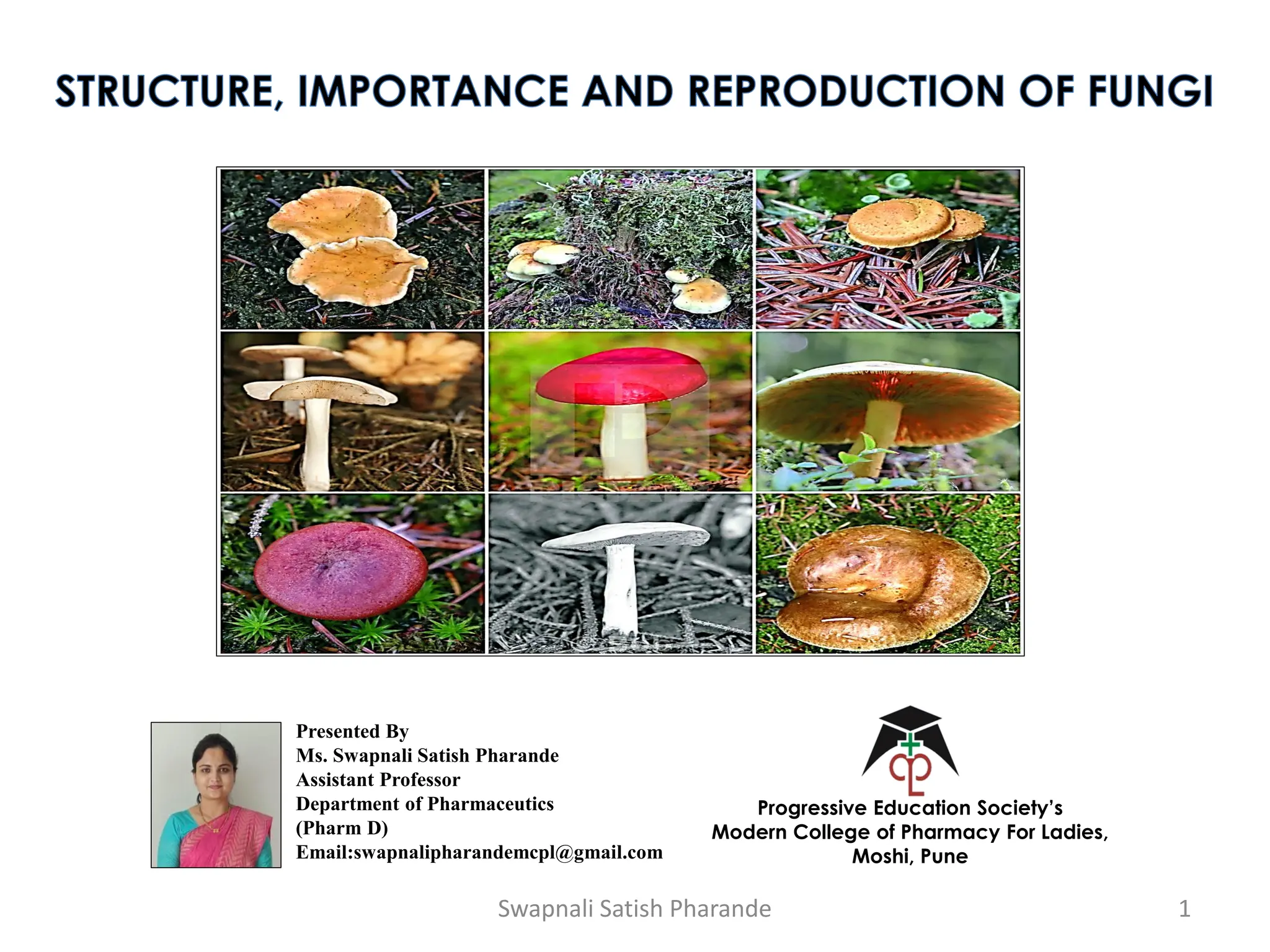
STRUCTURE, IMPORTANCE AND REPRODUCTION OF FUNGI
Swapnali Satish Pharande 1
Presented By
Ms. Swapnali Satish Pharande
Assistant Professor
Department of Pharmaceutics
(Pharm D)
Email:swapnalipharandemcpl@gmail.com
Progressive Education Society’s
Modern College of Pharmacy For Ladies,
Moshi, Pune
CONTENTS
❖ Structure of Fungi
❖ Importance of fungi
❖ Reproduction of fungi
❖ Pathogenic fungi
Swapnali Satish Pharande 2
LEARNING OUTCOMES
❖ After completion of this topic students should be able to:
✓ Explain structure, importance and reproduction of fungi.
Swapnali Satish Pharande 3
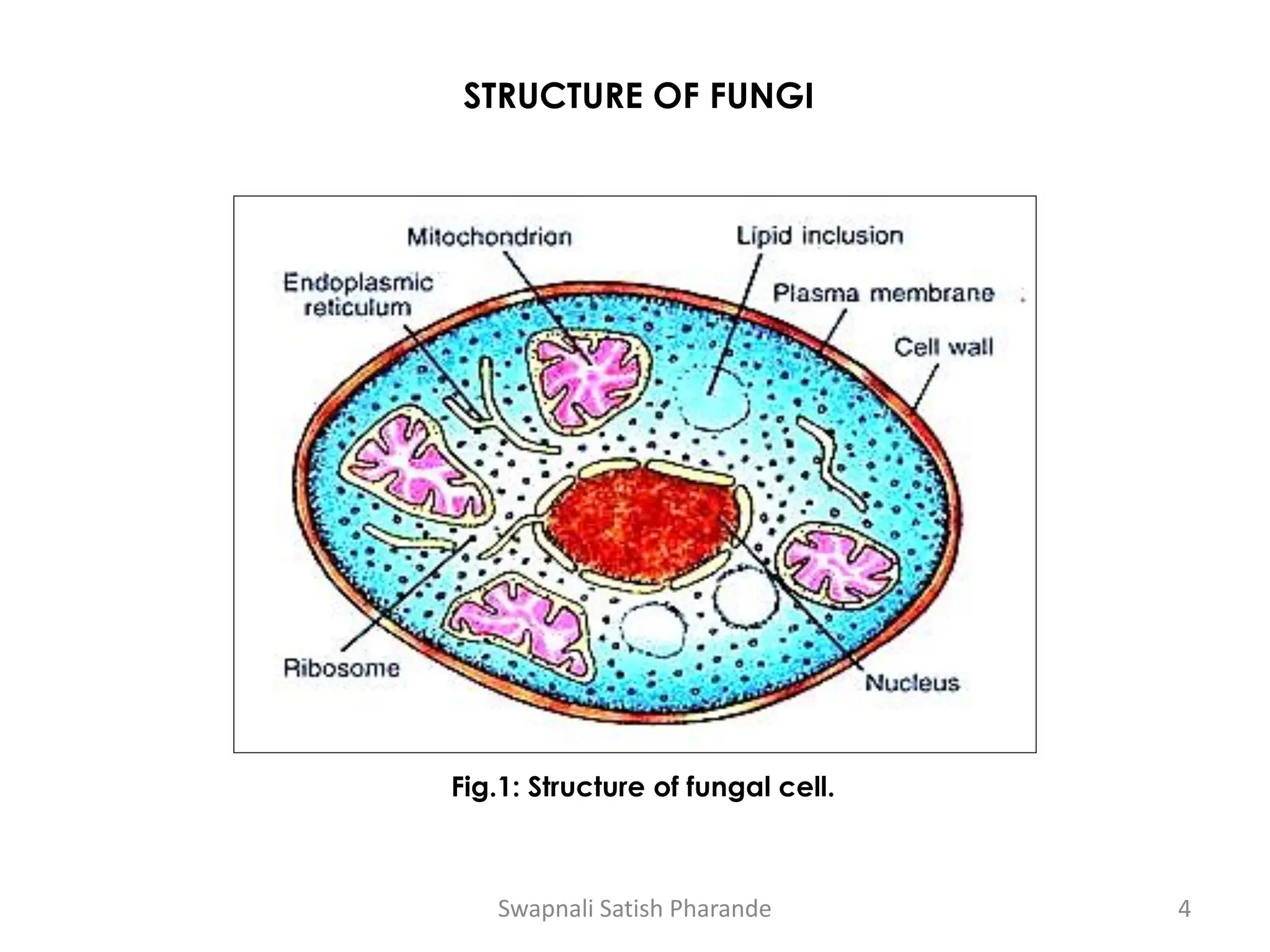
STRUCTURE OF FUNGI
Fig.1: Structure of fungal cell.
Swapnali Satish Pharande 4
IMPORTANCE OF FUNGI
1. Fungi are important sources of antibiotics.
• Examples:
✓ Penicillin(Penicillium notatum),
✓ Griseofulvin (Penicillium griseofulvum ),
✓ Cephalothin (Cephalosporium species) etc.
2. Yeasts and moulds are good sources of different enzymes.
• Example: Amylase produces from Aspergillus species.
3. Moulds (Aspergillus species) are used in the production of citric, oxalic
and gluconic acid.
• Example: Aspergillus species.
4. Moulds are also used for production of industrial alcohol by fermentation.
• Example: Fusarium species.
Swapnali Satish Pharande 5
IMPORTANCE OF FUNGI
5. Fungi have been used to alter the texture, improve the flavor, increase
the palatability and digestibility of natural or processed foods.
• Example: Penicillium species is used for ripening of certain varieties of
cheese.
6. Edible wild or domesticated varieties of mushrooms are important as food
sources.
7. Yeasts are used for fermentation purposes in production of beverages
and juices as well as brewing and baking.
• Example: Saccharomyces cerevisiae.
8. Fungi have capability to breakdown complex organic substrates.
• This is an essential activity in the recycling of carbon and other elements
in the cycle of life.
Swapnali Satish Pharande 6
ECONOMICAL IMPORTANCE OF FUNGI
❖ Fungi are used in many Industrial processes:
1. Fermentation
• Example: Manufacturing of bread, beer, cheese.
2. Preparation of Antibiotics
• Example: Penicillin.
3. Manufacturing of corticosteroids
4. Manufacturing of Enzymes
• Examples: Lipase, Amylase, Protease.
5. Manufacturing of Vitamins
• Examples: Vitamin B1, Vitamin B2, Vitamin B6, Biotin.
Swapnali Satish Pharande 7
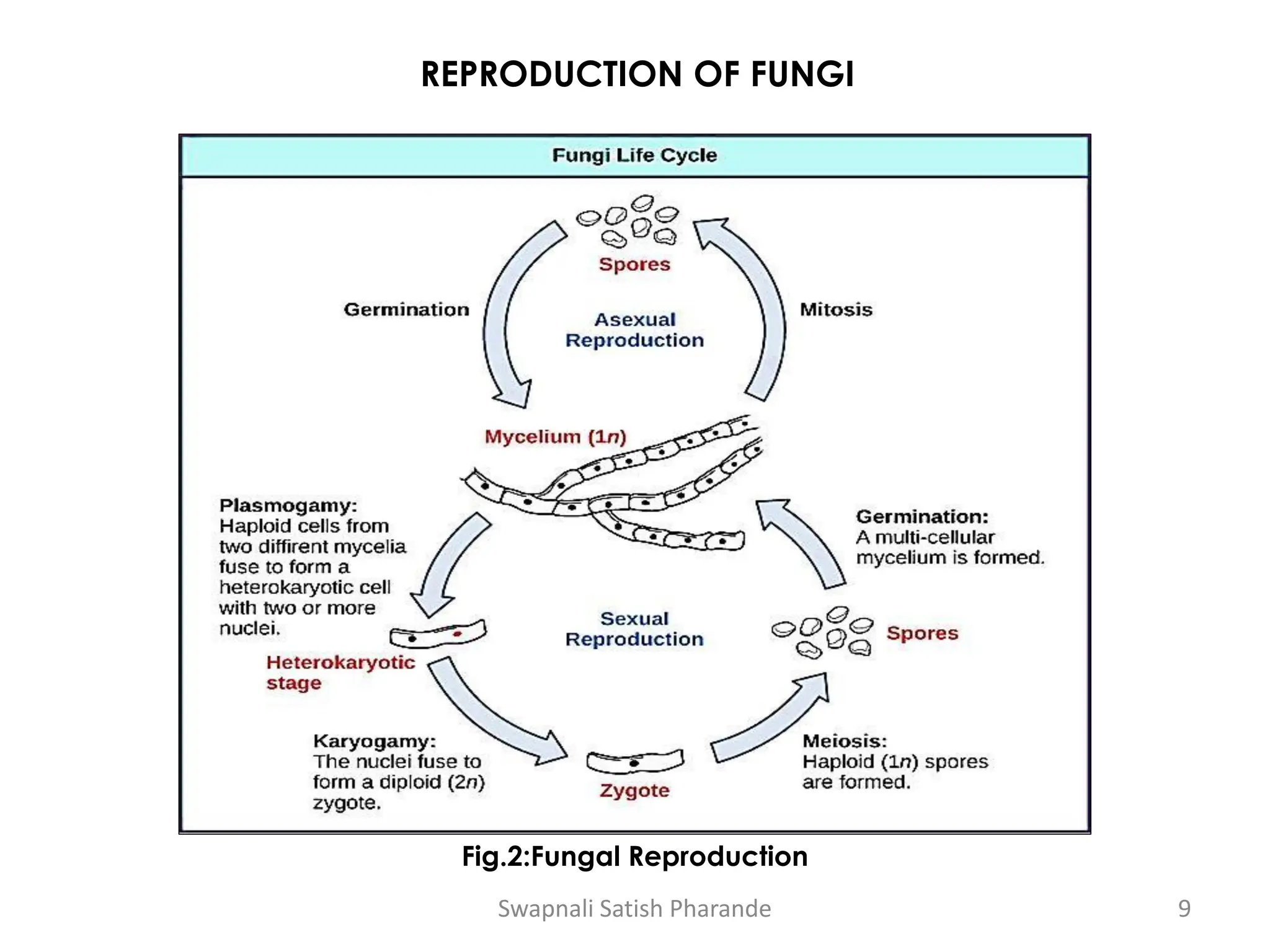
REPRODUCTION OF FUNGI
• Fungi can reproduce asexually by fragmentation, budding, or producing
spores, or sexually with homothallic or heterothallic mycelia.
❖ Reproduction of Fungi
1. Asexual Reproduction of Fungi
2. Sexual Reproduction of Fungi
Swapnali Satish Pharande 8
REPRODUCTION OF FUNGI
Fig.2:Fungal Reproduction
Swapnali Satish Pharande 9
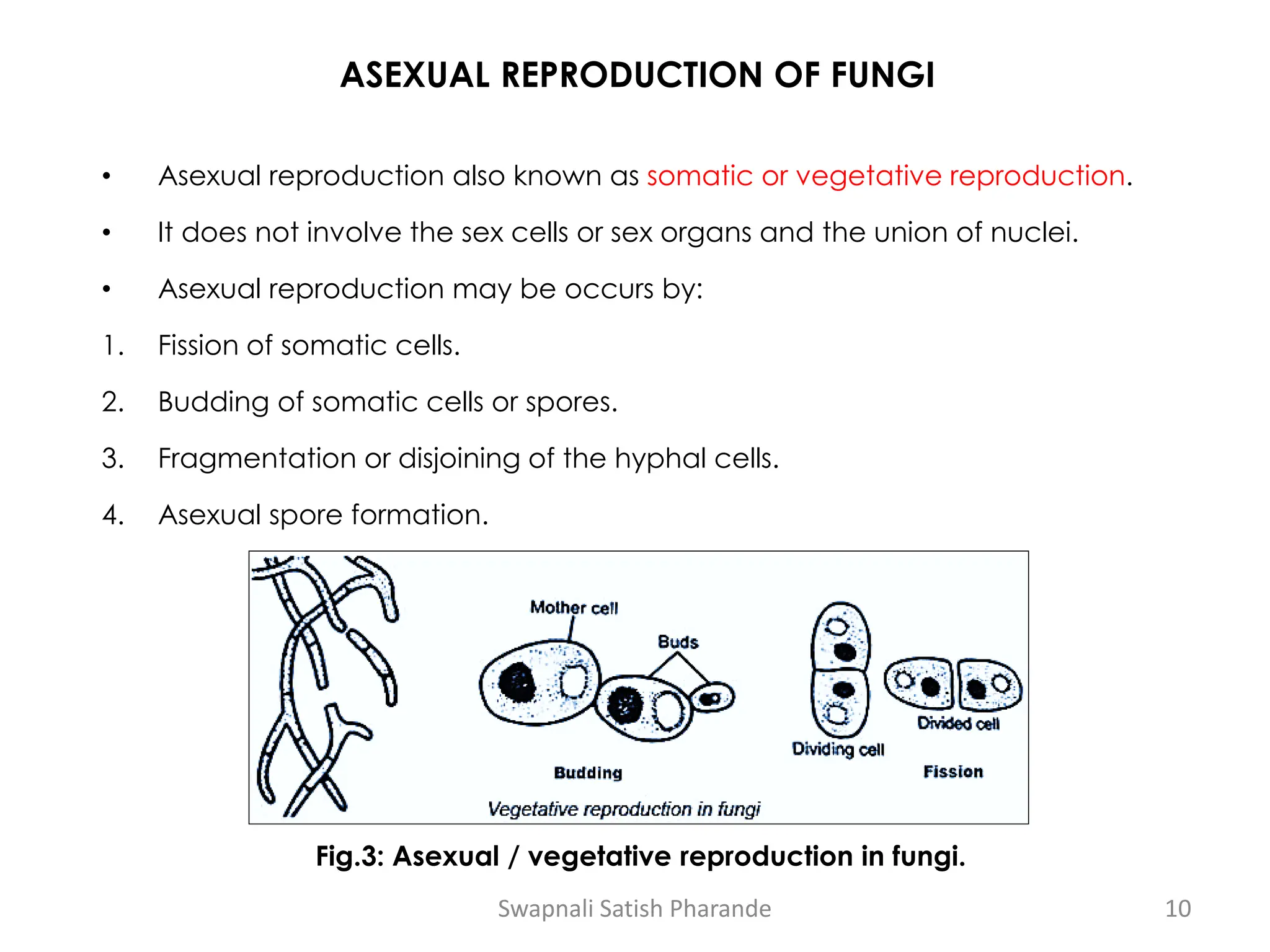
ASEXUAL REPRODUCTION OF FUNGI
• Asexual reproduction also known as somatic or vegetative reproduction.
• It does not involve the sex cells or sex organs and the union of nuclei.
• Asexual reproduction may be occurs by:
1. Fission of somatic cells.
2. Budding of somatic cells or spores.
3. Fragmentation or disjoining of the hyphal cells.
4. Asexual spore formation.
Swapnali Satish Pharande 10
Fig.3: Asexual / vegetative reproduction in fungi.
ASEXUAL REPRODUCTION OF FUNGI
1. Fission of somatic cells
• In binary fission a mature cell elongates and its nucleus divides into two
daughter nuclei.
• The daughter nuclei separates, cleaves cytoplasm centripetally in the
middle till it divides parent protoplasm into two daughter protoplasm.
• A double cross wall is deposited in the middle to form two daughter cell.
• Ultimately the middle layer of double cross wall degenerates and daughter
cells are separated.
• Examples: Saccharomyces pobbe, Psygosaccharomyces.
Swapnali Satish Pharande 11
ASEXUAL REPRODUCTION OF FUNGI
2. Budding of somatic cells or spores
• The cell wall bulge out and softens in the area probably by certain
enzymes brought by vesicles.
• The protoplasm also bulge out in this region as small protuberance.
• The parent nucleus also divides into two, one of the daughter nucleus
migrates into bud, the cytoplasm of bud and mother remain continuous for
some time
• As the bud enlarges, a septum is laid down at the joining of bud with
mother cell. Then bud separates and leads independent life.
• Some time, bud starts reproducing while still attached with mother cell. This
gives branching appearance.
• Budding is the typical reproductive characteristics of Ascomycetes.
• Examples: yeast.
Swapnali Satish Pharande 12
ASEXUAL REPRODUCTION OF FUNGI
3. Fragmentation or disjoining of the hyphal cells
• In some fungi, fragmentation or disjoining of hyphae occurs and each
hyphae become a new organism.
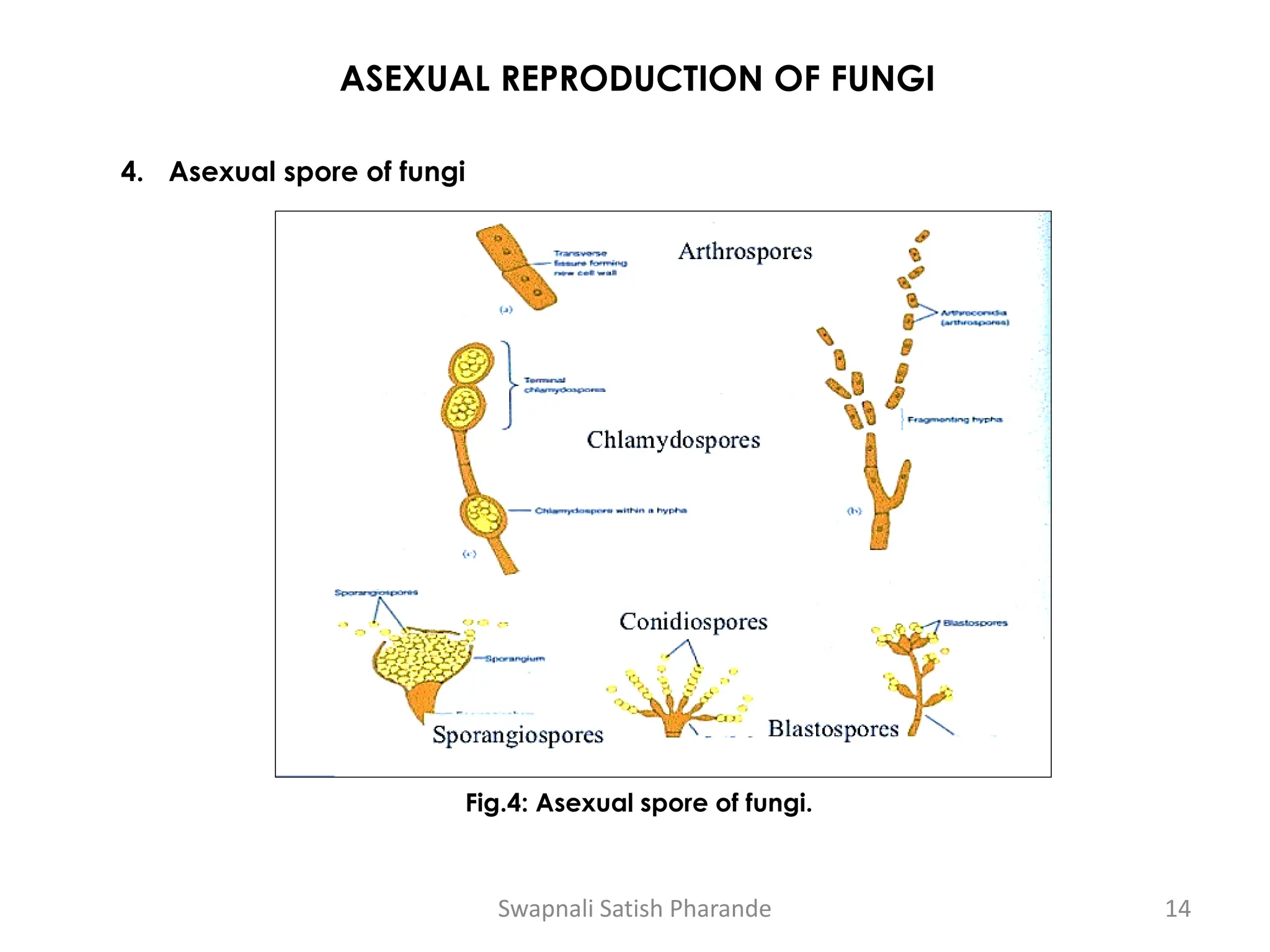
4. Asexual spore of fungi
• Spore formation is the characteristic feature of fungi.
• Different fungi forms different types of spore,
• Types of asexual spore:
a) Sporangiospore
b) Conidiospore
c) Arthrospore
d) Chlamydospore
e) Blastospore.
Swapnali Satish Pharande 13
ASEXUAL REPRODUCTION OF FUNGI
4. Asexual spore of fungi
Fig.4: Asexual spore of fungi.
Swapnali Satish Pharande 14
TYPES OF ASEXUAL SPORE
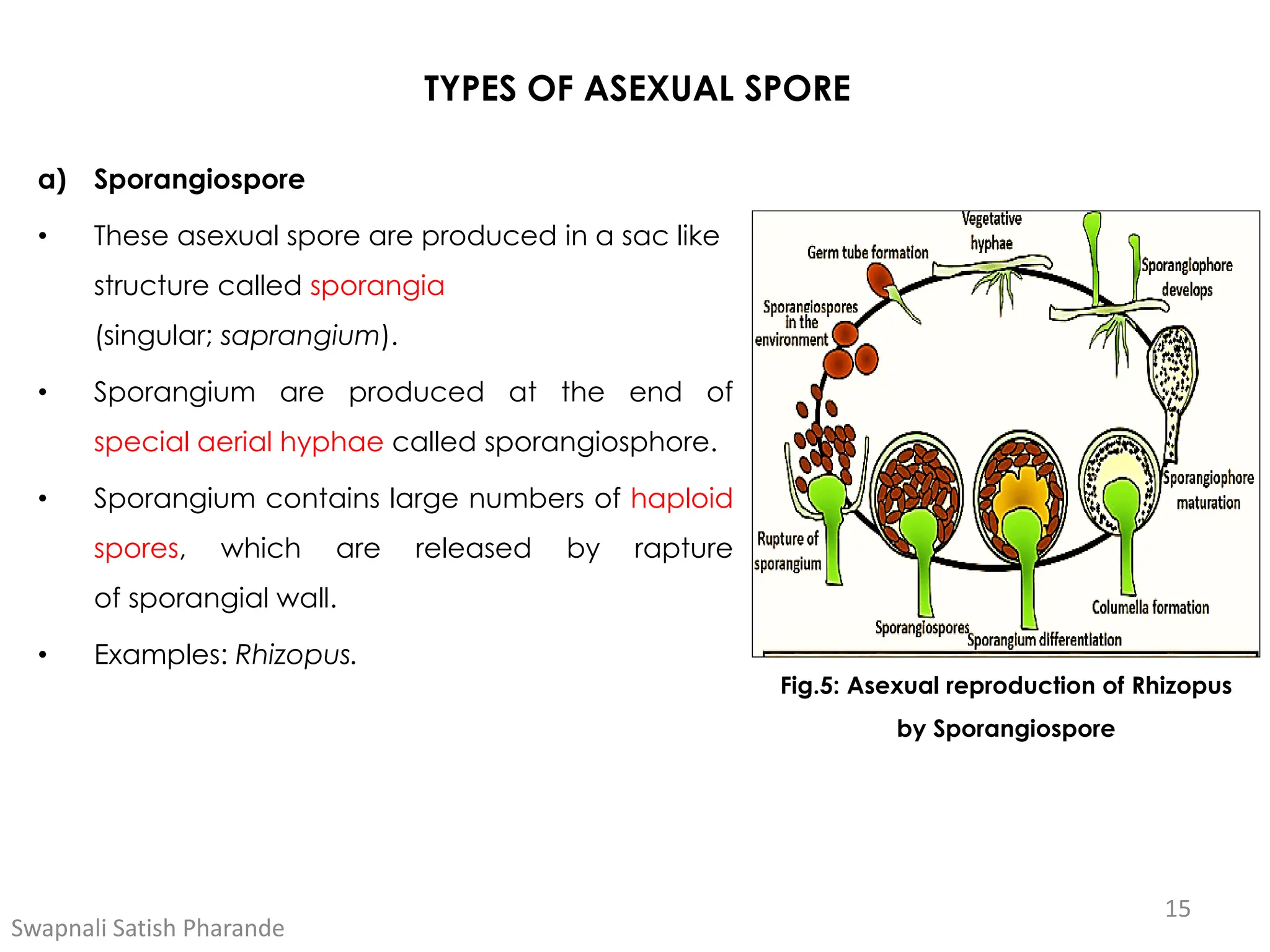
a) Sporangiospore
• These asexual spore are produced in a sac like
structure called sporangia
(singular; saprangium).
• Sporangium are produced at the end of
special aerial hyphae called sporangiosphore.
• Sporangium contains large numbers of haploid
spores, which are released by rapture
of sporangial wall.
• Examples: Rhizopus.
Fig.5: Asexual reproduction of Rhizopus
by Sporangiospore
Swapnali Satish Pharande
15
TYPES OF ASEXUAL SPORE
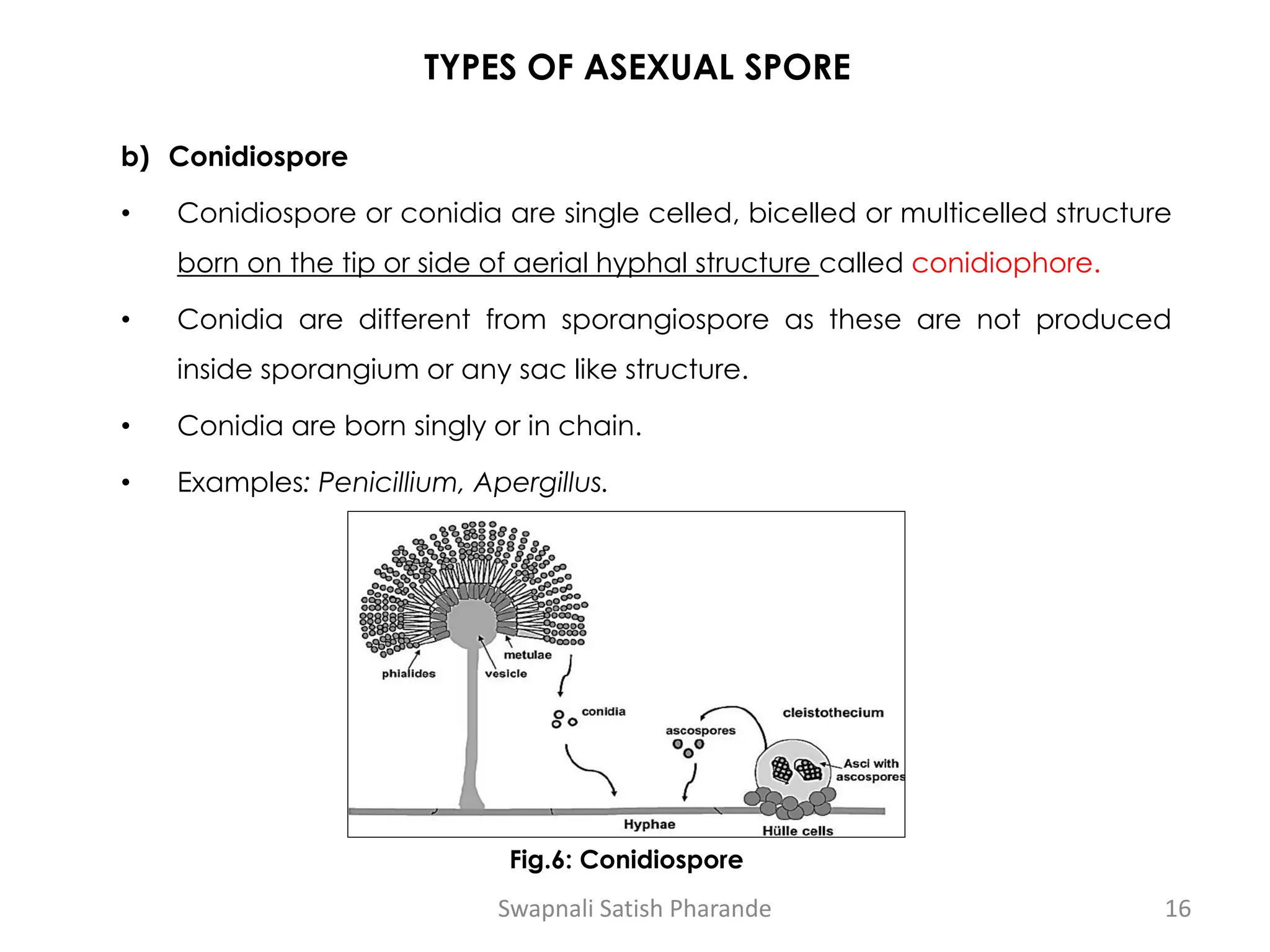
b) Conidiospore
• Conidiospore or conidia are single celled, bicelled or multicelled structure
born on the tip or side of aerial hyphal structure called conidiophore.
• Conidia are different from sporangiospore as these are not produced
inside sporangium or any sac like structure.
• Conidia are born singly or in chain.
• Examples: Penicillium, Apergillus.
Fig.6: Conidiospore
Swapnali Satish Pharande 16
TYPES OF ASEXUAL SPORE
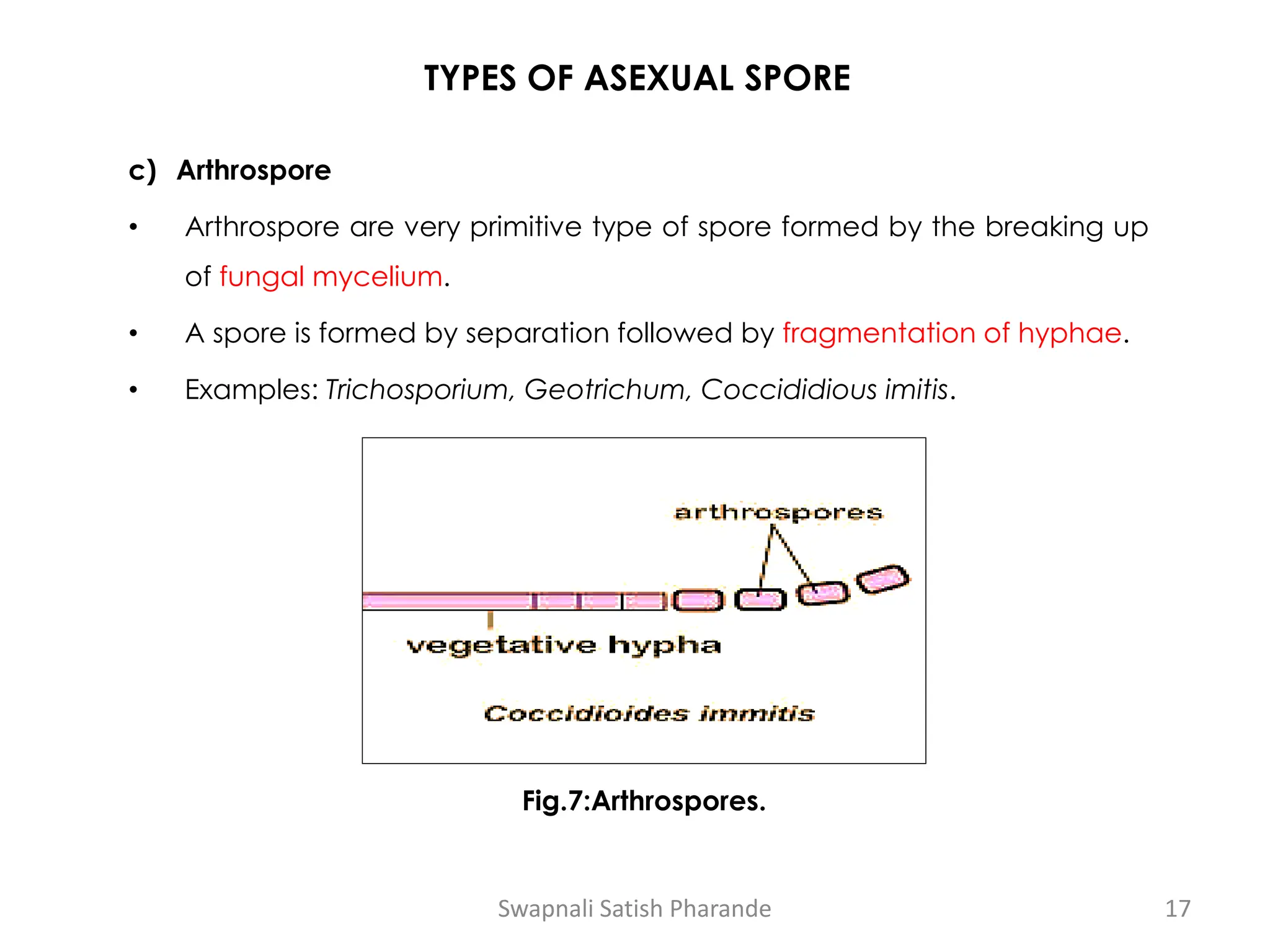
c) Arthrospore
• Arthrospore are very primitive type of spore formed by the breaking up
of fungal mycelium.
• A spore is formed by separation followed by fragmentation of hyphae.
• Examples: Trichosporium, Geotrichum, Coccididious imitis.
Fig.7:Arthrospores.
Swapnali Satish Pharande 17
TYPES OF ASEXUAL SPORE
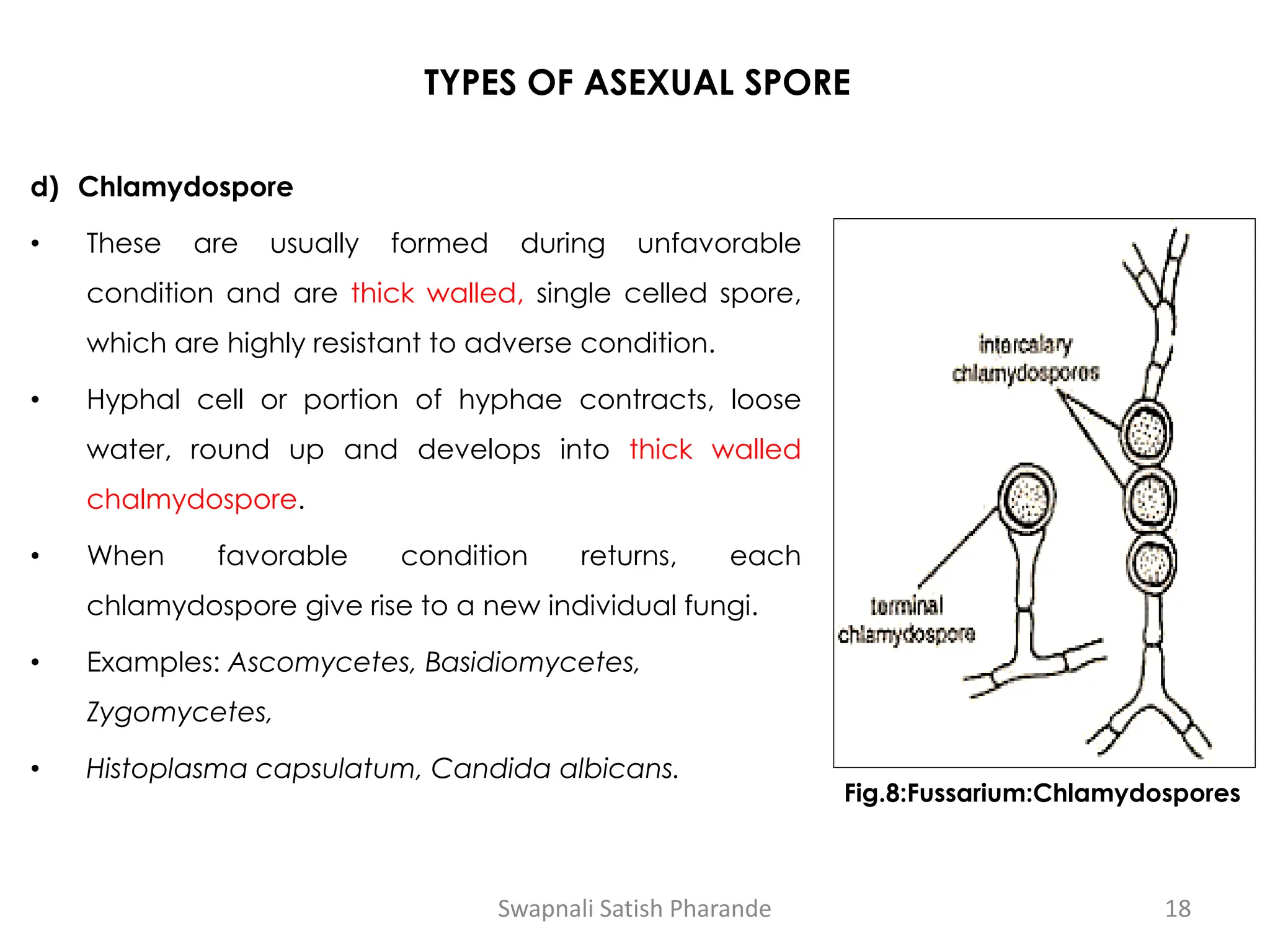
d) Chlamydospore
• These are usually formed during unfavorable
condition and are thick walled, single celled spore,
which are highly resistant to adverse condition.
• Hyphal cell or portion of hyphae contracts, loose
water, round up and develops into thick walled
chalmydospore.
• When favorable condition returns, each
chlamydospore give rise to a new individual fungi.
• Examples: Ascomycetes, Basidiomycetes,
Zygomycetes,
• Histoplasma capsulatum, Candida albicans.
Fig.8:Fussarium:Chlamydospores
Swapnali Satish Pharande 18
TYPES OF ASEXUAL SPORE
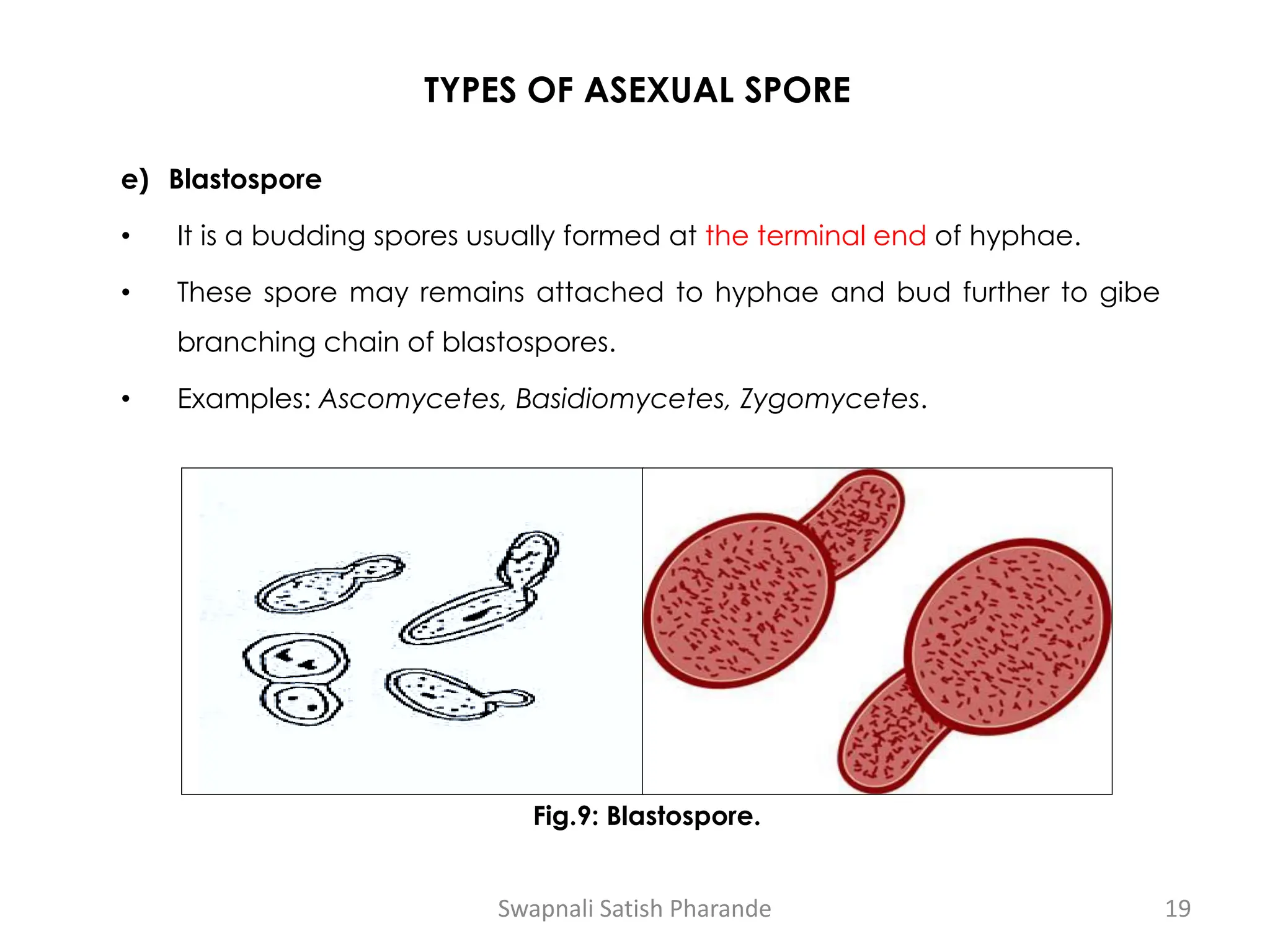
e) Blastospore
• It is a budding spores usually formed at the terminal end of hyphae.
• These spore may remains attached to hyphae and bud further to gibe
branching chain of blastospores.
• Examples: Ascomycetes, Basidiomycetes, Zygomycetes.
Fig.9: Blastospore.
Swapnali Satish Pharande 19
SEXUAL REPRODUCTION IN FUNGI
• Sexual reproduction is carried out by diffusion of compatible nuclei from
two parent at a definite state in the life cycle of fungi.
• The process of sexual reproduction involves three phases:
i. Plasmogamy: fusion of protoplasm
ii. Karyogamy: fusion of nucleus
iii. Meiosis: reductional nuclear division.
Swapnali Satish Pharande 20
SEXUAL REPRODUCTION IN FUNGI
❖ Various methods by which compatible nuclei are brought together
in plasmogamy. Some are:
a) Gametic copulation
b) Gamete-gametangial copulation
c) Gametangial copulation
d) Somatic copulation
e) Spermatization
Swapnali Satish Pharande 21
SEXUAL REPRODUCTION IN FUNGI
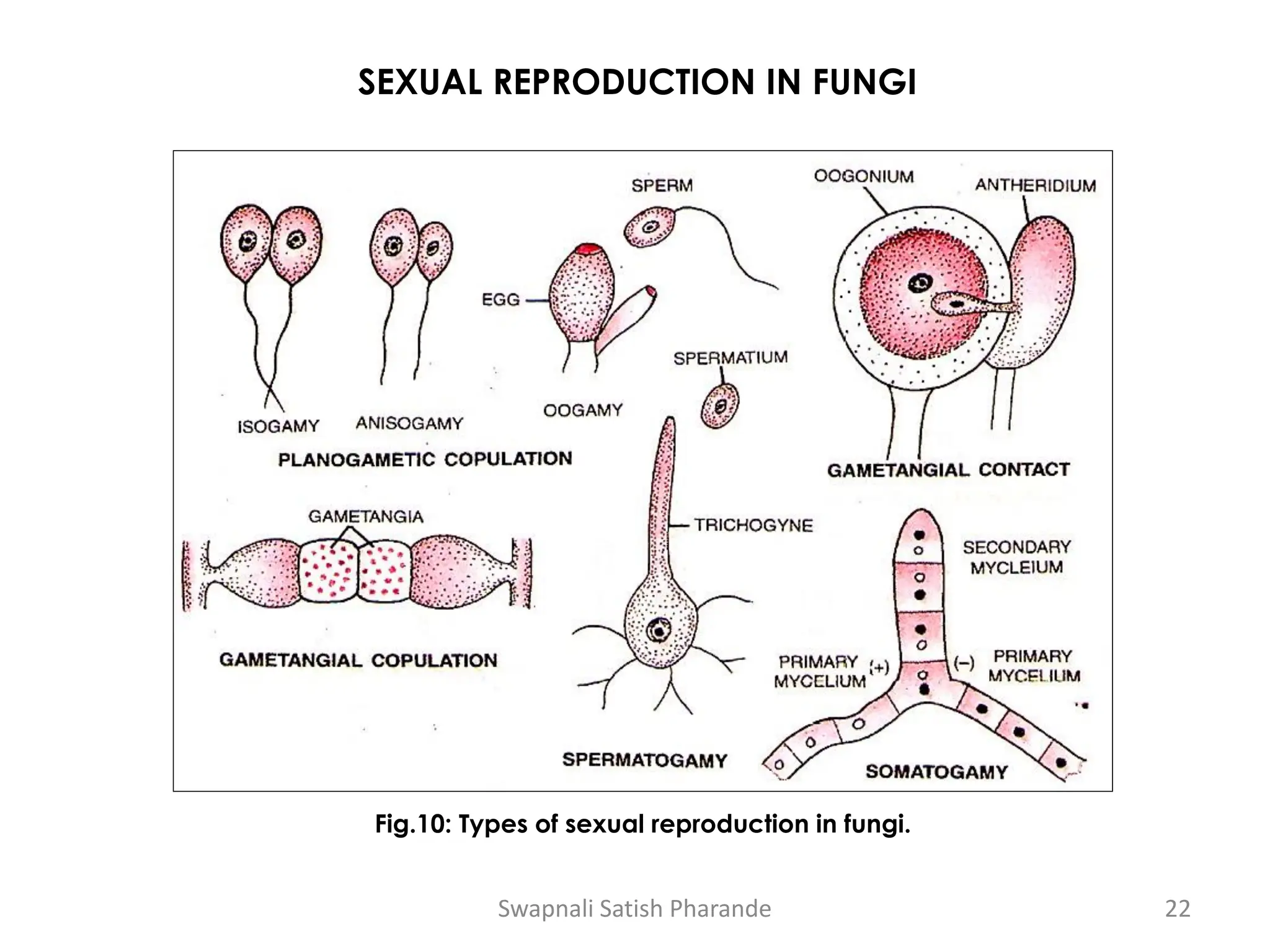
Fig.10: Types of sexual reproduction in fungi.
Swapnali Satish Pharande 22
SEXUAL REPRODUCTION IN FUNGI
a) Gametic copulation
• Fusion of two naked gametes, one or both of them are motile.
i. Isogamous
ii. Anisogamous
iii. Oogamous.
b) Gamete-gametangial copulation
• Male and female gametangia comes into contact but do not fuse.
• A fertilization tube formed from where male gametangium enters the
female gametangium and male gamete passes through this tube.
Swapnali Satish Pharande 23
SEXUAL REPRODUCTION IN FUNGI
c) Gametangial copulation
• Two gametangia or their protoplast fuse and give rise to zygospore.
d) Somatic copulation
• Also known as somatogamy.
• In this process fusion of somatic cell occurs.
• This sexual fusion of undifferentiated vegetative cell results in dikaryotic
hyphae, so the process is also called dikaryotization.
Swapnali Satish Pharande 24
SEXUAL REPRODUCTION IN FUNGI
e) Spermatization
• It is an union of special male structure called spermatium with a female
receptive structure.
• Spermatium empties its content into receptive hyphae during
plasmogamy.
Swapnali Satish Pharande 25
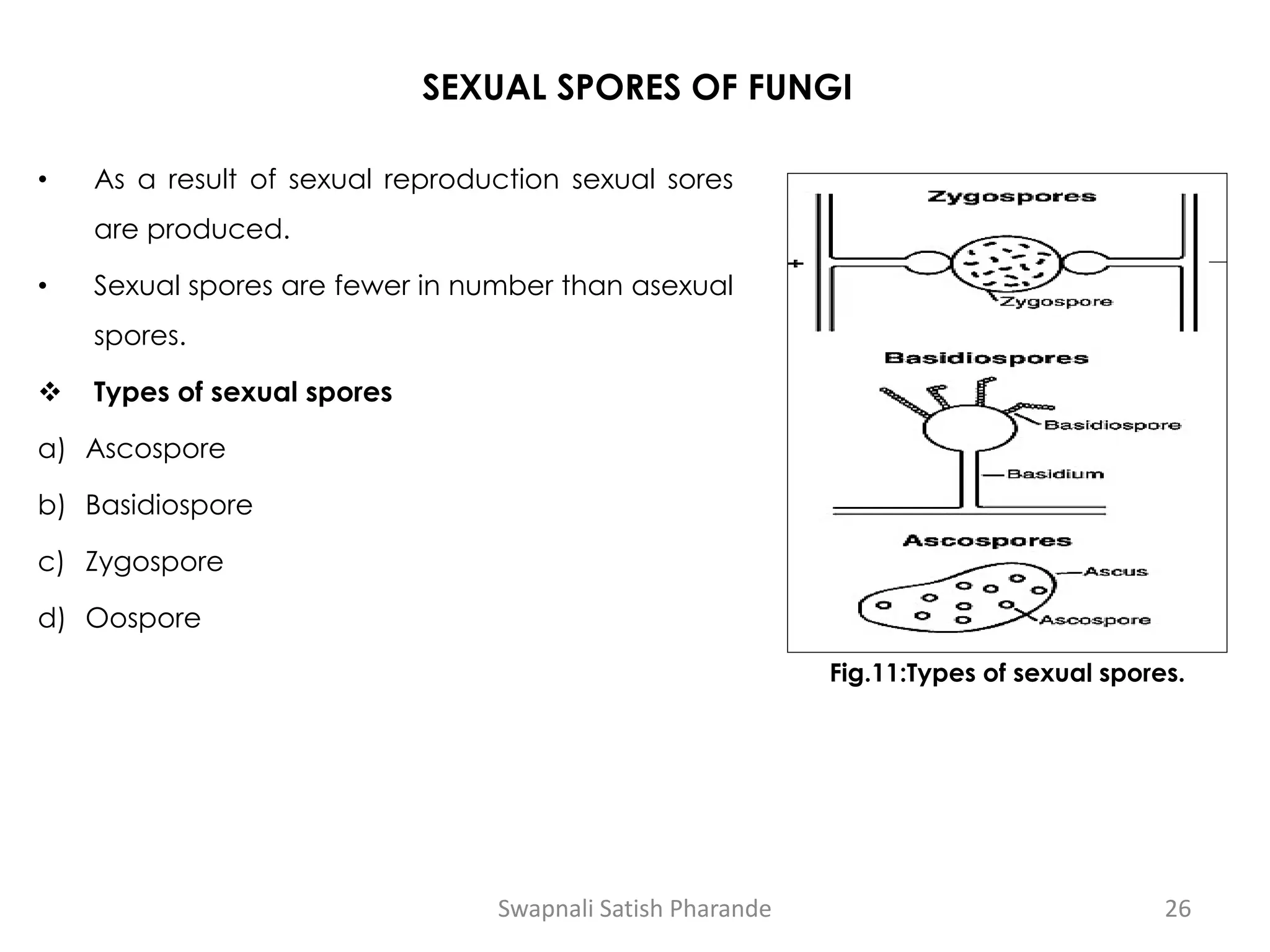
SEXUAL SPORES OF FUNGI
• As a result of sexual reproduction sexual sores
are produced.
• Sexual spores are fewer in number than asexual
spores.
❖ Types of sexual spores
a) Ascospore
b) Basidiospore
c) Zygospore
d) Oospore
Fig.11:Types of sexual spores.
Swapnali Satish Pharande 26
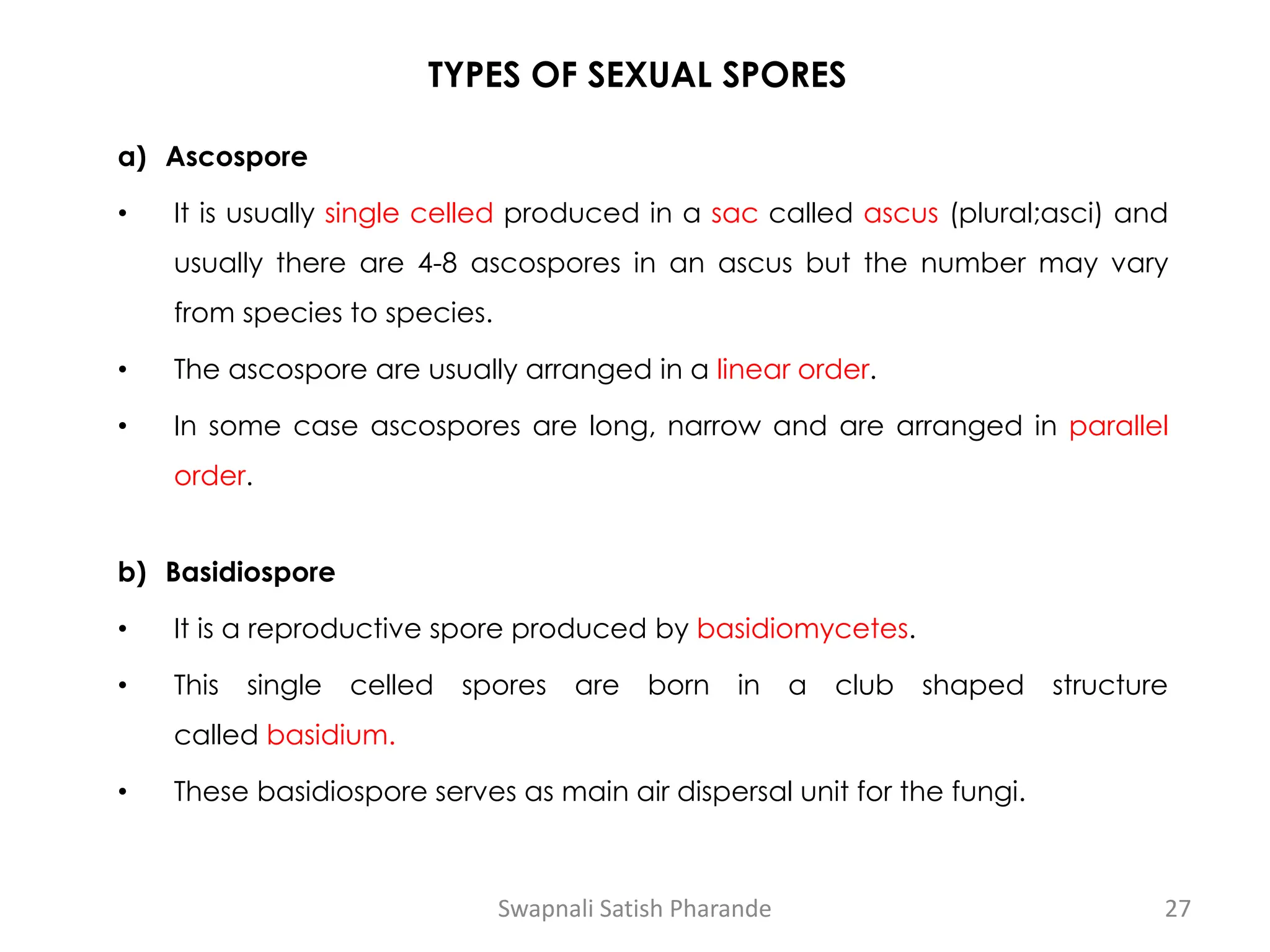
TYPES OF SEXUAL SPORES
a) Ascospore
• It is usually single celled produced in a sac called ascus (plural;asci) and
usually there are 4-8 ascospores in an ascus but the number may vary
from species to species.
• The ascospore are usually arranged in a linear order.
• In some case ascospores are long, narrow and are arranged in parallel
order.
b) Basidiospore
• It is a reproductive spore produced by basidiomycetes.
• This single celled spores are born in a club shaped structure
called basidium.
• These basidiospore serves as main air dispersal unit for the fungi.
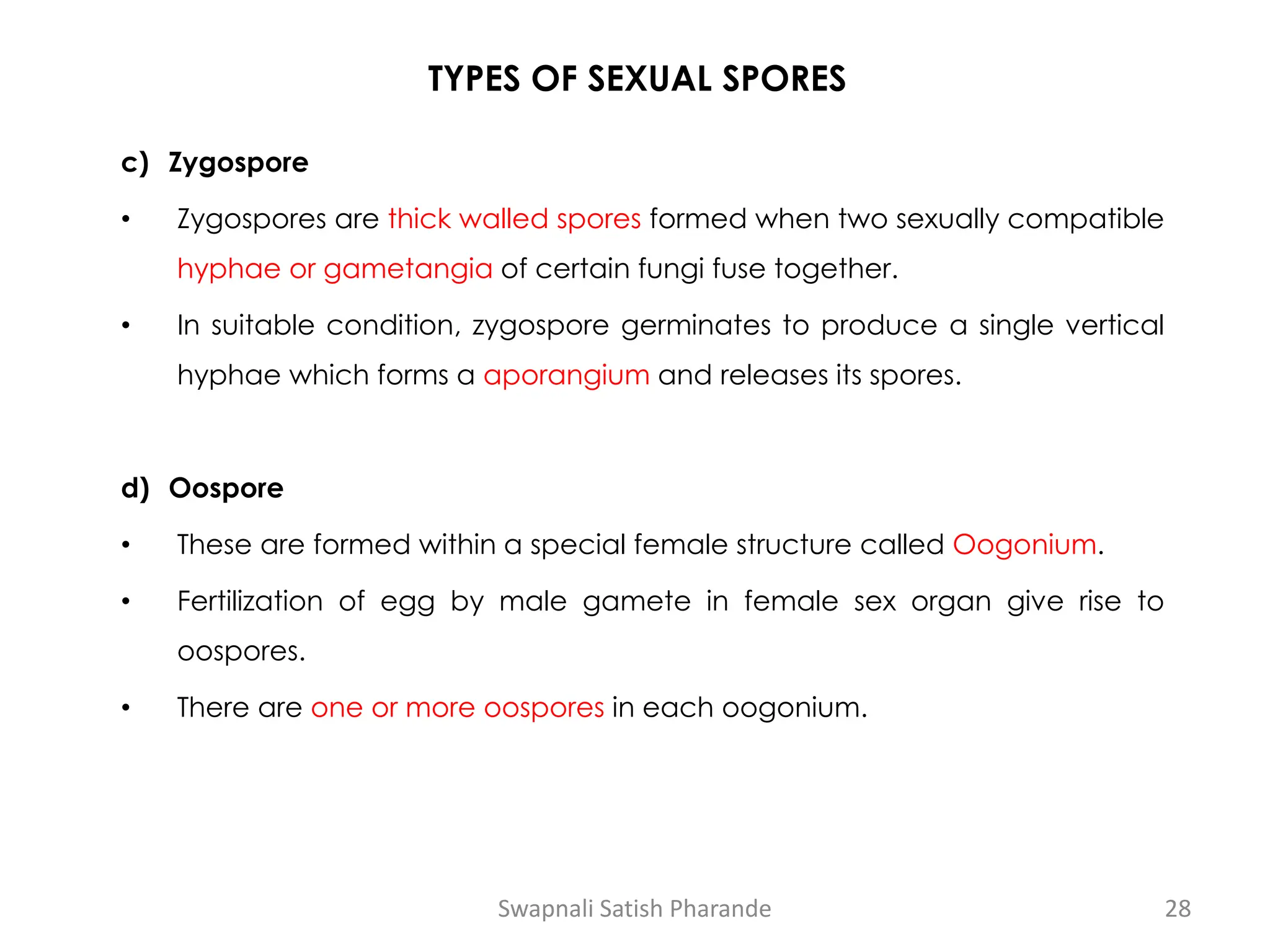
Swapnali Satish Pharande 27
TYPES OF SEXUAL SPORES
c) Zygospore
• Zygospores are thick walled spores formed when two sexually compatible
hyphae or gametangia of certain fungi fuse together.
• In suitable condition, zygospore germinates to produce a single vertical
hyphae which forms a aporangium and releases its spores.
d) Oospore
• These are formed within a special female structure called Oogonium.
• Fertilization of egg by male gamete in female sex organ give rise to
oospores.
• There are one or more oospores in each oogonium.
Swapnali Satish Pharande 28
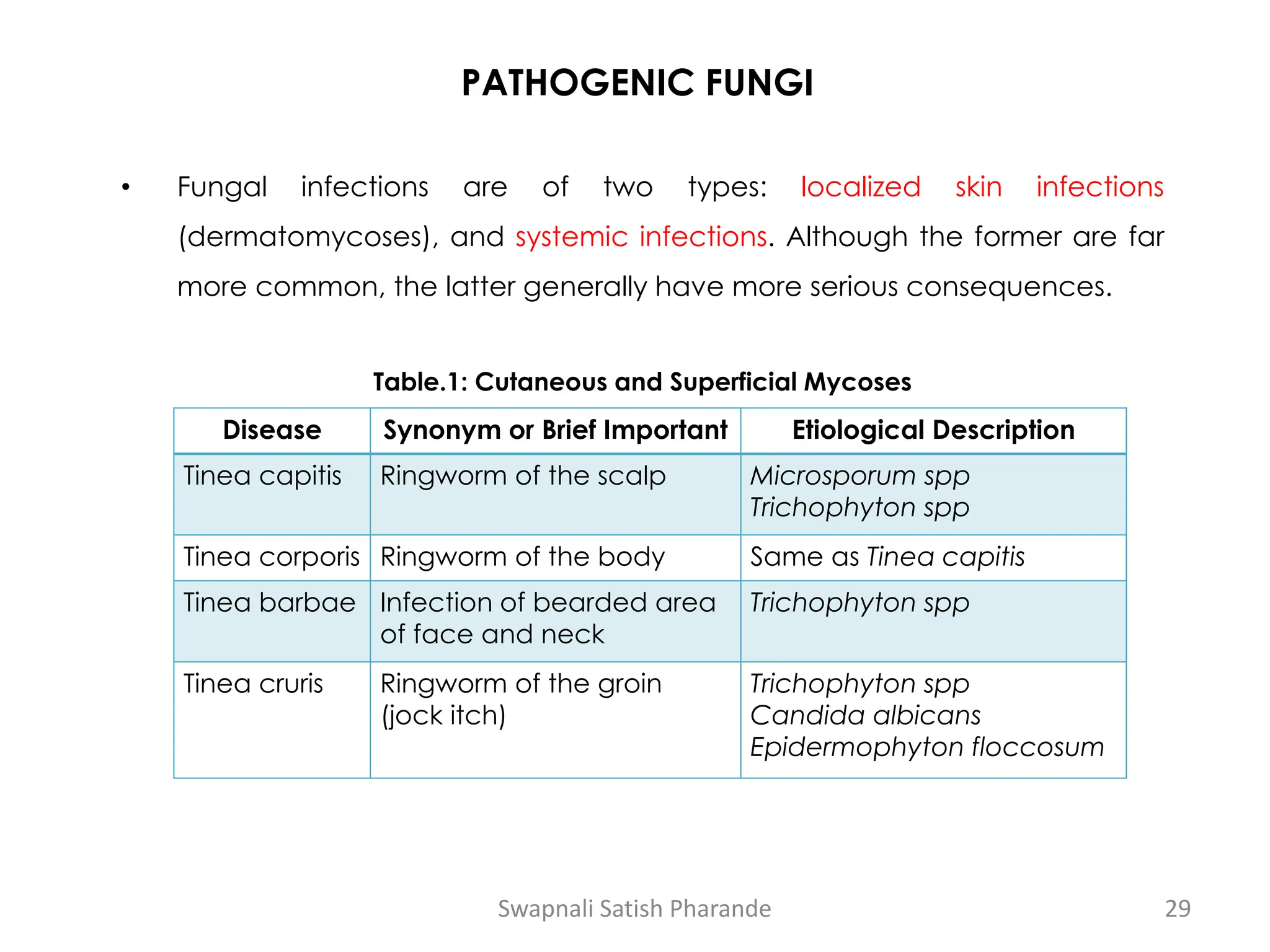
PATHOGENIC FUNGI
• Fungal infections are of two types: localized skin infections
(dermatomycoses), and systemic infections. Although the former are far
more common, the latter generally have more serious consequences.
Table.1: Cutaneous and Superficial Mycoses
Disease Synonym or Brief Important Etiological Description
Tinea capitis Ringworm of the scalp Microsporum spp
Trichophyton spp
Tinea corporis Ringworm of the body Same as Tinea capitis
Tinea barbae Infection of bearded area
of face and neck
Trichophyton spp
Tinea cruris Ringworm of the groin
(jock itch)
Trichophyton spp
Candida albicans
Epidermophyton floccosum
Swapnali Satish Pharande 29
PATHOGENIC FUNGI
Table.2:Cutaneous and Superficial Mycoses
Disease Synonym or Brief Important Etiological Description
Tinea pedis Ringworm of the feet (athlete’s
foot).
Same as Tinea cruris
Tinea versicolor Depigmented, scaly patches
of skin.
Malassezia furfur
Otomycosis
(aspergillosis)
Fungus infection of the ear
canal.
Aspergillus spp
Cutaneous
Candidiasis
(moniliasis, thrush)
Yeast infection of nails, skin
mouth, Vagina.
Candida albicans and
other species
Mycetoma Tumor-like swelling, draining
abscess.
Pseudallescheria boydii and
other
Actinomycosis Chronic, suppurative or
granulomatous disease of jaw,
thorax, or abdomen.
Actinomyces israelii
[actuallyclassified
asbacteria, but causefungus-
like infections]
Swapnali Satish Pharande 30
PATHOGENIC FUNGI
Table.3: Subcutaneous and Systemic Fungus Infections
Disease Synonym or Brief Important Etiological Description
Nocardiosis Infection of lungs, other organs,
and lower extremities (Madura
foot)
NocardIa asteroids[actually
classified asbacteria, but
cause fungus-like infections]
Chromoblastomycosis Warty nodules or vegetations of
skin and subcutaneous tissues
N. brasIlIensIs
Cladosporium carrionii
Sporotrichosis Ulcers of skin and underlying
tissues and gumma-like swelling
of regional lymph nodes.
Fonsecaea pedrosoi
Blastomycosis Inflamatory lesions of the skin,
lungs,or bones.
Phialophora verrucosa
Sporot schenkii
Coccidioidomycosis Self-limited respiratory disease
orchronic progresssive infection
of various organs
Blastomyces dermatltidis
Histoplasmosis Fungus infection of the lungs,
with fever; anemia; loss of
weight, enlargement of lymph
nodes, liver, spleen
Coccidioides immitis
Histoplasma capsulatum
Cryptococcosis Systemic fungus infection of
lungs or meninges
Cryptococcus noeformans
Swapnali Satish Pharande 31
PATHOGENIC FUNGI
• Diseases caused by fungi are collectively called mycoses (singular,
mycosis).
• They are divided into four general categories on the basis of the primary
tissue affected by the pathogen:
1. Superficial mycoses are infections limited to the hair and dead layers
of the skin.
2. Cutaneous mycoses ( dermatophytoses or ringworm) affect only the skin,
hair, and nails.
3. Subcutaneous mycoses affect the subcutaneous tissue below the skin
and occasionally bone.
4. Systemic (“deep”) mycoses infect the internal organs and may spread
throughout the host.
Swapnali Satish Pharande 32
REFERENCES
1. Textbook of Microbiology & Immunology By S. C. Parija, Elsevier
Publishers, ISBN: 978-81-312-2810-4; 2nd edition (2012):593-595.
2. Pharmaceutical Microbiology By Ashutosh Kar, New Age International
Publishers ISBN(13):978-81-224-2867-4, 2018; Page no:156-160.
3. Essentials of Medical Microbiology By Rajesh Bhatia, R. L. Icchpujani,
ISBN 81-8448-154-3, 4th edition (2008):415-419.
4. file:///C:/Users/Administrator/Downloads/MORPHOLOGYANDGENERAL.
pdf
5. https://www.onlinebiologynotes.com/reproduction-in-fungi-asexual-
and-sexual-methods/
Swapnali Satish Pharande 33
THANK YOU
Swapnali Satish Pharande 34

Structure, Importance and Reproduction of Fungi

  • 1.
    STRUCTURE, IMPORTANCE ANDREPRODUCTION OF FUNGI Swapnali Satish Pharande 1 Presented By Ms. Swapnali Satish Pharande Assistant Professor Department of Pharmaceutics (Pharm D) Email:swapnalipharandemcpl@gmail.com Progressive Education Society’s Modern College of Pharmacy For Ladies, Moshi, Pune
  • 2.
    CONTENTS ❖ Structure ofFungi ❖ Importance of fungi ❖ Reproduction of fungi ❖ Pathogenic fungi Swapnali Satish Pharande 2
  • 3.
    LEARNING OUTCOMES ❖ Aftercompletion of this topic students should be able to: ✓ Explain structure, importance and reproduction of fungi. Swapnali Satish Pharande 3
  • 4.
    STRUCTURE OF FUNGI Fig.1:Structure of fungal cell. Swapnali Satish Pharande 4
  • 5.
    IMPORTANCE OF FUNGI 1.Fungi are important sources of antibiotics. • Examples: ✓ Penicillin(Penicillium notatum), ✓ Griseofulvin (Penicillium griseofulvum ), ✓ Cephalothin (Cephalosporium species) etc. 2. Yeasts and moulds are good sources of different enzymes. • Example: Amylase produces from Aspergillus species. 3. Moulds (Aspergillus species) are used in the production of citric, oxalic and gluconic acid. • Example: Aspergillus species. 4. Moulds are also used for production of industrial alcohol by fermentation. • Example: Fusarium species. Swapnali Satish Pharande 5
  • 6.
    IMPORTANCE OF FUNGI 5.Fungi have been used to alter the texture, improve the flavor, increase the palatability and digestibility of natural or processed foods. • Example: Penicillium species is used for ripening of certain varieties of cheese. 6. Edible wild or domesticated varieties of mushrooms are important as food sources. 7. Yeasts are used for fermentation purposes in production of beverages and juices as well as brewing and baking. • Example: Saccharomyces cerevisiae. 8. Fungi have capability to breakdown complex organic substrates. • This is an essential activity in the recycling of carbon and other elements in the cycle of life. Swapnali Satish Pharande 6
  • 7.
    ECONOMICAL IMPORTANCE OFFUNGI ❖ Fungi are used in many Industrial processes: 1. Fermentation • Example: Manufacturing of bread, beer, cheese. 2. Preparation of Antibiotics • Example: Penicillin. 3. Manufacturing of corticosteroids 4. Manufacturing of Enzymes • Examples: Lipase, Amylase, Protease. 5. Manufacturing of Vitamins • Examples: Vitamin B1, Vitamin B2, Vitamin B6, Biotin. Swapnali Satish Pharande 7
  • 8.
    REPRODUCTION OF FUNGI •Fungi can reproduce asexually by fragmentation, budding, or producing spores, or sexually with homothallic or heterothallic mycelia. ❖ Reproduction of Fungi 1. Asexual Reproduction of Fungi 2. Sexual Reproduction of Fungi Swapnali Satish Pharande 8
  • 9.
    REPRODUCTION OF FUNGI Fig.2:FungalReproduction Swapnali Satish Pharande 9
  • 10.
    ASEXUAL REPRODUCTION OFFUNGI • Asexual reproduction also known as somatic or vegetative reproduction. • It does not involve the sex cells or sex organs and the union of nuclei. • Asexual reproduction may be occurs by: 1. Fission of somatic cells. 2. Budding of somatic cells or spores. 3. Fragmentation or disjoining of the hyphal cells. 4. Asexual spore formation. Swapnali Satish Pharande 10 Fig.3: Asexual / vegetative reproduction in fungi.
  • 11.
    ASEXUAL REPRODUCTION OFFUNGI 1. Fission of somatic cells • In binary fission a mature cell elongates and its nucleus divides into two daughter nuclei. • The daughter nuclei separates, cleaves cytoplasm centripetally in the middle till it divides parent protoplasm into two daughter protoplasm. • A double cross wall is deposited in the middle to form two daughter cell. • Ultimately the middle layer of double cross wall degenerates and daughter cells are separated. • Examples: Saccharomyces pobbe, Psygosaccharomyces. Swapnali Satish Pharande 11
  • 12.
    ASEXUAL REPRODUCTION OFFUNGI 2. Budding of somatic cells or spores • The cell wall bulge out and softens in the area probably by certain enzymes brought by vesicles. • The protoplasm also bulge out in this region as small protuberance. • The parent nucleus also divides into two, one of the daughter nucleus migrates into bud, the cytoplasm of bud and mother remain continuous for some time • As the bud enlarges, a septum is laid down at the joining of bud with mother cell. Then bud separates and leads independent life. • Some time, bud starts reproducing while still attached with mother cell. This gives branching appearance. • Budding is the typical reproductive characteristics of Ascomycetes. • Examples: yeast. Swapnali Satish Pharande 12
  • 13.
    ASEXUAL REPRODUCTION OFFUNGI 3. Fragmentation or disjoining of the hyphal cells • In some fungi, fragmentation or disjoining of hyphae occurs and each hyphae become a new organism. 4. Asexual spore of fungi • Spore formation is the characteristic feature of fungi. • Different fungi forms different types of spore, • Types of asexual spore: a) Sporangiospore b) Conidiospore c) Arthrospore d) Chlamydospore e) Blastospore. Swapnali Satish Pharande 13
  • 14.
    ASEXUAL REPRODUCTION OFFUNGI 4. Asexual spore of fungi Fig.4: Asexual spore of fungi. Swapnali Satish Pharande 14
  • 15.
    TYPES OF ASEXUALSPORE a) Sporangiospore • These asexual spore are produced in a sac like structure called sporangia (singular; saprangium). • Sporangium are produced at the end of special aerial hyphae called sporangiosphore. • Sporangium contains large numbers of haploid spores, which are released by rapture of sporangial wall. • Examples: Rhizopus. Fig.5: Asexual reproduction of Rhizopus by Sporangiospore Swapnali Satish Pharande 15
  • 16.
    TYPES OF ASEXUALSPORE b) Conidiospore • Conidiospore or conidia are single celled, bicelled or multicelled structure born on the tip or side of aerial hyphal structure called conidiophore. • Conidia are different from sporangiospore as these are not produced inside sporangium or any sac like structure. • Conidia are born singly or in chain. • Examples: Penicillium, Apergillus. Fig.6: Conidiospore Swapnali Satish Pharande 16
  • 17.
    TYPES OF ASEXUALSPORE c) Arthrospore • Arthrospore are very primitive type of spore formed by the breaking up of fungal mycelium. • A spore is formed by separation followed by fragmentation of hyphae. • Examples: Trichosporium, Geotrichum, Coccididious imitis. Fig.7:Arthrospores. Swapnali Satish Pharande 17
  • 18.
    TYPES OF ASEXUALSPORE d) Chlamydospore • These are usually formed during unfavorable condition and are thick walled, single celled spore, which are highly resistant to adverse condition. • Hyphal cell or portion of hyphae contracts, loose water, round up and develops into thick walled chalmydospore. • When favorable condition returns, each chlamydospore give rise to a new individual fungi. • Examples: Ascomycetes, Basidiomycetes, Zygomycetes, • Histoplasma capsulatum, Candida albicans. Fig.8:Fussarium:Chlamydospores Swapnali Satish Pharande 18
  • 19.
    TYPES OF ASEXUALSPORE e) Blastospore • It is a budding spores usually formed at the terminal end of hyphae. • These spore may remains attached to hyphae and bud further to gibe branching chain of blastospores. • Examples: Ascomycetes, Basidiomycetes, Zygomycetes. Fig.9: Blastospore. Swapnali Satish Pharande 19
  • 20.
    SEXUAL REPRODUCTION INFUNGI • Sexual reproduction is carried out by diffusion of compatible nuclei from two parent at a definite state in the life cycle of fungi. • The process of sexual reproduction involves three phases: i. Plasmogamy: fusion of protoplasm ii. Karyogamy: fusion of nucleus iii. Meiosis: reductional nuclear division. Swapnali Satish Pharande 20
  • 21.
    SEXUAL REPRODUCTION INFUNGI ❖ Various methods by which compatible nuclei are brought together in plasmogamy. Some are: a) Gametic copulation b) Gamete-gametangial copulation c) Gametangial copulation d) Somatic copulation e) Spermatization Swapnali Satish Pharande 21
  • 22.
    SEXUAL REPRODUCTION INFUNGI Fig.10: Types of sexual reproduction in fungi. Swapnali Satish Pharande 22
  • 23.
    SEXUAL REPRODUCTION INFUNGI a) Gametic copulation • Fusion of two naked gametes, one or both of them are motile. i. Isogamous ii. Anisogamous iii. Oogamous. b) Gamete-gametangial copulation • Male and female gametangia comes into contact but do not fuse. • A fertilization tube formed from where male gametangium enters the female gametangium and male gamete passes through this tube. Swapnali Satish Pharande 23
  • 24.
    SEXUAL REPRODUCTION INFUNGI c) Gametangial copulation • Two gametangia or their protoplast fuse and give rise to zygospore. d) Somatic copulation • Also known as somatogamy. • In this process fusion of somatic cell occurs. • This sexual fusion of undifferentiated vegetative cell results in dikaryotic hyphae, so the process is also called dikaryotization. Swapnali Satish Pharande 24
  • 25.
    SEXUAL REPRODUCTION INFUNGI e) Spermatization • It is an union of special male structure called spermatium with a female receptive structure. • Spermatium empties its content into receptive hyphae during plasmogamy. Swapnali Satish Pharande 25
  • 26.
    SEXUAL SPORES OFFUNGI • As a result of sexual reproduction sexual sores are produced. • Sexual spores are fewer in number than asexual spores. ❖ Types of sexual spores a) Ascospore b) Basidiospore c) Zygospore d) Oospore Fig.11:Types of sexual spores. Swapnali Satish Pharande 26
  • 27.
    TYPES OF SEXUALSPORES a) Ascospore • It is usually single celled produced in a sac called ascus (plural;asci) and usually there are 4-8 ascospores in an ascus but the number may vary from species to species. • The ascospore are usually arranged in a linear order. • In some case ascospores are long, narrow and are arranged in parallel order. b) Basidiospore • It is a reproductive spore produced by basidiomycetes. • This single celled spores are born in a club shaped structure called basidium. • These basidiospore serves as main air dispersal unit for the fungi. Swapnali Satish Pharande 27
  • 28.
    TYPES OF SEXUALSPORES c) Zygospore • Zygospores are thick walled spores formed when two sexually compatible hyphae or gametangia of certain fungi fuse together. • In suitable condition, zygospore germinates to produce a single vertical hyphae which forms a aporangium and releases its spores. d) Oospore • These are formed within a special female structure called Oogonium. • Fertilization of egg by male gamete in female sex organ give rise to oospores. • There are one or more oospores in each oogonium. Swapnali Satish Pharande 28
  • 29.
    PATHOGENIC FUNGI • Fungalinfections are of two types: localized skin infections (dermatomycoses), and systemic infections. Although the former are far more common, the latter generally have more serious consequences. Table.1: Cutaneous and Superficial Mycoses Disease Synonym or Brief Important Etiological Description Tinea capitis Ringworm of the scalp Microsporum spp Trichophyton spp Tinea corporis Ringworm of the body Same as Tinea capitis Tinea barbae Infection of bearded area of face and neck Trichophyton spp Tinea cruris Ringworm of the groin (jock itch) Trichophyton spp Candida albicans Epidermophyton floccosum Swapnali Satish Pharande 29
  • 30.
    PATHOGENIC FUNGI Table.2:Cutaneous andSuperficial Mycoses Disease Synonym or Brief Important Etiological Description Tinea pedis Ringworm of the feet (athlete’s foot). Same as Tinea cruris Tinea versicolor Depigmented, scaly patches of skin. Malassezia furfur Otomycosis (aspergillosis) Fungus infection of the ear canal. Aspergillus spp Cutaneous Candidiasis (moniliasis, thrush) Yeast infection of nails, skin mouth, Vagina. Candida albicans and other species Mycetoma Tumor-like swelling, draining abscess. Pseudallescheria boydii and other Actinomycosis Chronic, suppurative or granulomatous disease of jaw, thorax, or abdomen. Actinomyces israelii [actuallyclassified asbacteria, but causefungus- like infections] Swapnali Satish Pharande 30
  • 31.
    PATHOGENIC FUNGI Table.3: Subcutaneousand Systemic Fungus Infections Disease Synonym or Brief Important Etiological Description Nocardiosis Infection of lungs, other organs, and lower extremities (Madura foot) NocardIa asteroids[actually classified asbacteria, but cause fungus-like infections] Chromoblastomycosis Warty nodules or vegetations of skin and subcutaneous tissues N. brasIlIensIs Cladosporium carrionii Sporotrichosis Ulcers of skin and underlying tissues and gumma-like swelling of regional lymph nodes. Fonsecaea pedrosoi Blastomycosis Inflamatory lesions of the skin, lungs,or bones. Phialophora verrucosa Sporot schenkii Coccidioidomycosis Self-limited respiratory disease orchronic progresssive infection of various organs Blastomyces dermatltidis Histoplasmosis Fungus infection of the lungs, with fever; anemia; loss of weight, enlargement of lymph nodes, liver, spleen Coccidioides immitis Histoplasma capsulatum Cryptococcosis Systemic fungus infection of lungs or meninges Cryptococcus noeformans Swapnali Satish Pharande 31
  • 32.
    PATHOGENIC FUNGI • Diseasescaused by fungi are collectively called mycoses (singular, mycosis). • They are divided into four general categories on the basis of the primary tissue affected by the pathogen: 1. Superficial mycoses are infections limited to the hair and dead layers of the skin. 2. Cutaneous mycoses ( dermatophytoses or ringworm) affect only the skin, hair, and nails. 3. Subcutaneous mycoses affect the subcutaneous tissue below the skin and occasionally bone. 4. Systemic (“deep”) mycoses infect the internal organs and may spread throughout the host. Swapnali Satish Pharande 32
  • 33.
    REFERENCES 1. Textbook ofMicrobiology & Immunology By S. C. Parija, Elsevier Publishers, ISBN: 978-81-312-2810-4; 2nd edition (2012):593-595. 2. Pharmaceutical Microbiology By Ashutosh Kar, New Age International Publishers ISBN(13):978-81-224-2867-4, 2018; Page no:156-160. 3. Essentials of Medical Microbiology By Rajesh Bhatia, R. L. Icchpujani, ISBN 81-8448-154-3, 4th edition (2008):415-419. 4. file:///C:/Users/Administrator/Downloads/MORPHOLOGYANDGENERAL. pdf 5. https://www.onlinebiologynotes.com/reproduction-in-fungi-asexual- and-sexual-methods/ Swapnali Satish Pharande 33
  • 34.