Introduction to
Pre-Clinical Trials
By- Gargi Nanda (Exam No. 1)
Kirti Jadhav (Exam No. 2)
M.Pharm- 1 (PT)
Guided By- Madam Krutika Sawant
Overview
• Drug Development Review
• Introduction
• Review By FDA
• Objectives
• Importance
• Goals
• Types
• Stages Of Preclinical Trials
Introduction to Pre-
Clinical Trials
2
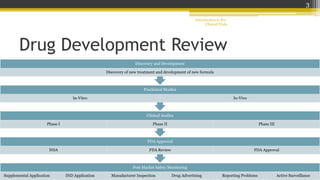
Drug Development Review
Post Market Safety Monitoring
Supplemental Application IND Application Manufacturer Inspection Drug Advertising Reporting Problems Active Surveillance
FDA Approval
NDA FDA Review FDA Approval
Clinical studies
Phase I Phase II Phase III
Preclinical Studies
In-Vitro In-Vivo
Discovery and Development
Discovery of new treatment and development of new formula
Introduction to Pre-
Clinical Trials
3
Introduction
• Pre-Clinical Trials is a study to test a drug, a procedure, or another
medical treatment in animals.
• In drug development, pre-clinical development, also
named preclinical studies and nonclinical studies, is a stage of
research that begins before clinical trials (testing in humans) can
begin, and during which important feasibility, iterative testing and
drug safety data is collected.
• It also means in vivo or in vitro experiments in which test articles
are studied prospectively in test systems under laboratory
conditions to determine their safety.
Introduction to Pre-
Clinical Trials
4
Introduction (Contd.)
• We assume that
▫ In vitro assays predict in vivo effects
▫ The effects of chemicals in laboratory animals apply to humans
▫ The use of high doses in animals is valid for predicting possible toxicity
in humans.
• These assumptions are broadly true, but despite this, we cannot be
certain that a chemical will show no toxic effects in humans.
Introduction to Pre-
Clinical Trials
5
Preclinical Review by FDA
• Under FDA requirements, a sponsor must first submit data showing
that the drug is reasonably safe for use in initial, small-scale clinical
studies. Depending on whether the compound has been studied or
marketed previously, the sponsor may have several options for
fulfilling this requirement:
▫ Compiling existing nonclinical data from past in vitro laboratory or
animal studies on the compound
▫ Compiling data from previous clinical testing or marketing of the drug
▫ Undertaking new preclinical studies designed to provide the evidence
necessary to support the safety of administering the compound to
humans.
Introduction to Pre-
Clinical Trials
6
Preclinical Review By FDA (Contd.)
• At the preclinical stage, the FDA will generally ask,
▫ Develop a pharmacological profile of the drug
▫ Determine the acute toxicity of the drug in at least two species of animals
▫ Conduct short-term toxicity studies ranging from 2 weeks to 3 months,
depending on the proposed duration of use of the substance in the
proposed clinical studies.
Introduction to Pre-
Clinical Trials
7
Objectives of Preclinical Trial
• Objective is to develop adequate data to decide that it is reasonably
safe to proceed with human trials of the drug, means, a laboratory
test of a new drug or a new medical device, usually done on animal
subjects, to see if the treatment really works and if it is safe to test
on humans.
Introduction to Pre-
Clinical Trials
8
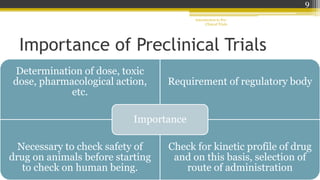
Importance of Preclinical Trials
Determination of dose, toxic
dose, pharmacological action,
etc.
Requirement of regulatory body
Necessary to check safety of
drug on animals before starting
to check on human being.
Check for kinetic profile of drug
and on this basis, selection of
route of administration
Importance
Introduction to Pre-
Clinical Trials
9
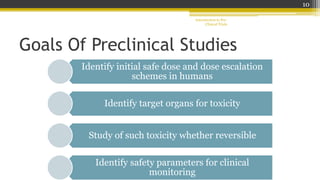
Goals Of Preclinical Studies
Identify initial safe dose and dose escalation
schemes in humans
Identify target organs for toxicity
Study of such toxicity whether reversible
Identify safety parameters for clinical
monitoring
Introduction to Pre-
Clinical Trials
10
Introduction to Pre-
Clinical Trials
11
Types of Trials
In Vitro Preclinical
Trials
Pharmacokinetics
Pharmacodynamics
In Vivo Preclinical Trials
Screening
Isolated Organ
Bacteria Culture
Animal Models
General Observation
Confirmatory
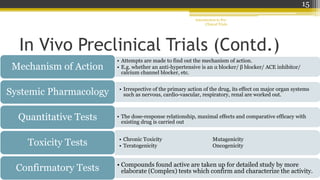
Mechanism of Action
Systemic Pharmacology
Quantitative Test
Toxicity Tests
Introduction to Pre-
Clinical Trials
12
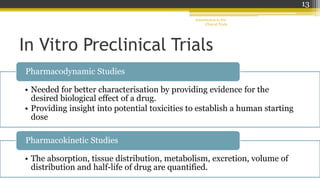
In Vitro Preclinical Trials
• Needed for better characterisation by providing evidence for the
desired biological effect of a drug.
• Providing insight into potential toxicities to establish a human starting
dose
Pharmacodynamic Studies
• The absorption, tissue distribution, metabolism, excretion, volume of
distribution and half-life of drug are quantified.
Pharmacokinetic Studies
Introduction to Pre-
Clinical Trials
13
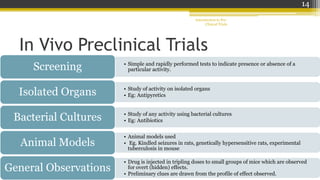
In Vivo Preclinical Trials
• Simple and rapidly performed tests to indicate presence or absence of a
particular activity.Screening
• Study of activity on isolated organs
• Eg: AntipyreticsIsolated Organs
• Study of any activity using bacterial cultures
• Eg: AntibioticsBacterial Cultures
• Animal models used
• Eg. Kindled seizures in rats, genetically hypersensitive rats, experimental
tuberculosis in mouse
Animal Models
• Drug is injected in tripling doses to small groups of mice which are observed
for overt (hidden) effects.
• Preliminary clues are drawn from the profile of effect observed.
General Observations
Introduction to Pre-
Clinical Trials
14
In Vivo Preclinical Trials (Contd.)
Introduction to Pre-
Clinical Trials
15
• Attempts are made to find out the mechanism of action.
• E.g. whether an anti-hypertensive is an α blocker/ β blocker/ ACE inhibitor/
calcium channel blocker, etc.
Mechanism of Action
• Irrespective of the primary action of the drug, its effect on major organ systems
such as nervous, cardio-vascular, respiratory, renal are worked out.Systemic Pharmacology
• The dose-response relationship, maximal effects and comparative efficacy with
existing drug is carried out
Quantitative Tests
• Chronic Toxicity Mutagenicity
• Teratogenicity OncogenicityToxicity Tests
• Compounds found active are taken up for detailed study by more
elaborate (Complex) tests which confirm and characterize the activity.Confirmatory Tests
Introduction to Pre-
Clinical Trials
16
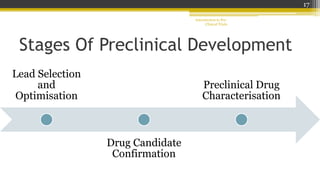
Stages Of Preclinical Development
Lead Selection
and
Optimisation
Drug Candidate
Confirmation
Preclinical Drug
Characterisation
Introduction to Pre-
Clinical Trials
17
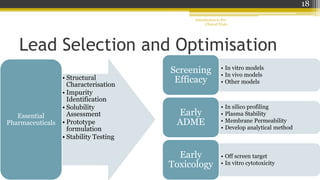
Lead Selection and Optimisation
• Structural
Characterisation
• Impurity
Identification
• Solubility
Assessment
• Prototype
formulation
• Stability Testing
Essential
Pharmaceuticals
Introduction to Pre-
Clinical Trials
18
• In vitro models
• In vivo models
• Other models
Screening
Efficacy
• In silico profiling
• Plasma Stability
• Membrane Permeability
• Develop analytical method
Early
ADME
• Off screen target
• In vitro cytotoxicity
Early
Toxicology
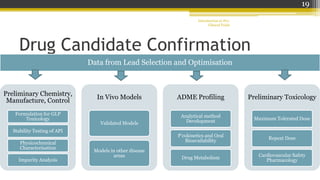
Drug Candidate Confirmation
Preliminary Chemistry,
Manufacture, Control
Formulation for GLP
Toxicology
Stability Testing of API
Physicochemical
Characterisation
Impurity Analysis
In Vivo Models
Validated Models
Models in other disease
areas
ADME Profiling
Analytical method
Development
P’cokinetics and Oral
Bioavailability
Drug Metabolism
Preliminary Toxicology
Maximum Tolerated Dose
Repeat Dose
Cardiovascular Safety
Pharmacology
Data from Lead Selection and Optimisation
Introduction to Pre-
Clinical Trials
19
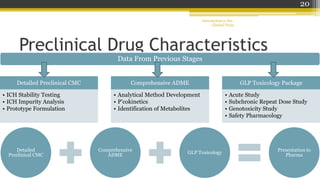
Preclinical Drug Characteristics
Detailed Preclinical CMC
• ICH Stability Testing
• ICH Impurity Analysis
• Prototype Formulation
Comprehensive ADME
• Analytical Method Development
• P’cokinetics
• Identification of Metabolites
GLP Toxicology Package
• Acute Study
• Subchronic Repeat Dose Study
• Genotoxicity Study
• Safety Pharmacology
Detailed
Preclinical CMC
Comprehensive
ADME GLP Toxicology
Presentation to
Pharma
Introduction to Pre-
Clinical Trials
20
Data From Previous Stages
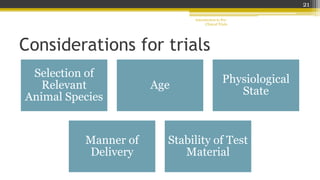
Considerations for trials
Selection of
Relevant
Animal Species
Age
Physiological
State
Manner of
Delivery
Stability of Test
Material
Introduction to Pre-
Clinical Trials
21
Reference
• www.fda.gov
• www.medicinenet.com
• ICH Guidelines
• BRITISH JOURNAL OF PHARMACOLOGY The successes
and limitations of preclinical studies in predicting the
pharmacodynamics and safety of cell-surface-
targeted biological agents in patients; Andrew G
Polson and Reina N Fuji
Introduction to Pre-
Clinical Trials
22
Introduction to Pre-Clinical Trials
23
Thank You

Introduction to Pre-clinical Trials

  • 1.
    Introduction to Pre-Clinical Trials By-Gargi Nanda (Exam No. 1) Kirti Jadhav (Exam No. 2) M.Pharm- 1 (PT) Guided By- Madam Krutika Sawant
  • 2.
    Overview • Drug DevelopmentReview • Introduction • Review By FDA • Objectives • Importance • Goals • Types • Stages Of Preclinical Trials Introduction to Pre- Clinical Trials 2
  • 3.
    Drug Development Review PostMarket Safety Monitoring Supplemental Application IND Application Manufacturer Inspection Drug Advertising Reporting Problems Active Surveillance FDA Approval NDA FDA Review FDA Approval Clinical studies Phase I Phase II Phase III Preclinical Studies In-Vitro In-Vivo Discovery and Development Discovery of new treatment and development of new formula Introduction to Pre- Clinical Trials 3
  • 4.
    Introduction • Pre-Clinical Trialsis a study to test a drug, a procedure, or another medical treatment in animals. • In drug development, pre-clinical development, also named preclinical studies and nonclinical studies, is a stage of research that begins before clinical trials (testing in humans) can begin, and during which important feasibility, iterative testing and drug safety data is collected. • It also means in vivo or in vitro experiments in which test articles are studied prospectively in test systems under laboratory conditions to determine their safety. Introduction to Pre- Clinical Trials 4
  • 5.
    Introduction (Contd.) • Weassume that ▫ In vitro assays predict in vivo effects ▫ The effects of chemicals in laboratory animals apply to humans ▫ The use of high doses in animals is valid for predicting possible toxicity in humans. • These assumptions are broadly true, but despite this, we cannot be certain that a chemical will show no toxic effects in humans. Introduction to Pre- Clinical Trials 5
  • 6.
    Preclinical Review byFDA • Under FDA requirements, a sponsor must first submit data showing that the drug is reasonably safe for use in initial, small-scale clinical studies. Depending on whether the compound has been studied or marketed previously, the sponsor may have several options for fulfilling this requirement: ▫ Compiling existing nonclinical data from past in vitro laboratory or animal studies on the compound ▫ Compiling data from previous clinical testing or marketing of the drug ▫ Undertaking new preclinical studies designed to provide the evidence necessary to support the safety of administering the compound to humans. Introduction to Pre- Clinical Trials 6
  • 7.
    Preclinical Review ByFDA (Contd.) • At the preclinical stage, the FDA will generally ask, ▫ Develop a pharmacological profile of the drug ▫ Determine the acute toxicity of the drug in at least two species of animals ▫ Conduct short-term toxicity studies ranging from 2 weeks to 3 months, depending on the proposed duration of use of the substance in the proposed clinical studies. Introduction to Pre- Clinical Trials 7
  • 8.
    Objectives of PreclinicalTrial • Objective is to develop adequate data to decide that it is reasonably safe to proceed with human trials of the drug, means, a laboratory test of a new drug or a new medical device, usually done on animal subjects, to see if the treatment really works and if it is safe to test on humans. Introduction to Pre- Clinical Trials 8
  • 9.
    Importance of PreclinicalTrials Determination of dose, toxic dose, pharmacological action, etc. Requirement of regulatory body Necessary to check safety of drug on animals before starting to check on human being. Check for kinetic profile of drug and on this basis, selection of route of administration Importance Introduction to Pre- Clinical Trials 9
  • 10.
    Goals Of PreclinicalStudies Identify initial safe dose and dose escalation schemes in humans Identify target organs for toxicity Study of such toxicity whether reversible Identify safety parameters for clinical monitoring Introduction to Pre- Clinical Trials 10
  • 11.
  • 12.
    Types of Trials InVitro Preclinical Trials Pharmacokinetics Pharmacodynamics In Vivo Preclinical Trials Screening Isolated Organ Bacteria Culture Animal Models General Observation Confirmatory Mechanism of Action Systemic Pharmacology Quantitative Test Toxicity Tests Introduction to Pre- Clinical Trials 12
  • 13.
    In Vitro PreclinicalTrials • Needed for better characterisation by providing evidence for the desired biological effect of a drug. • Providing insight into potential toxicities to establish a human starting dose Pharmacodynamic Studies • The absorption, tissue distribution, metabolism, excretion, volume of distribution and half-life of drug are quantified. Pharmacokinetic Studies Introduction to Pre- Clinical Trials 13
  • 14.
    In Vivo PreclinicalTrials • Simple and rapidly performed tests to indicate presence or absence of a particular activity.Screening • Study of activity on isolated organs • Eg: AntipyreticsIsolated Organs • Study of any activity using bacterial cultures • Eg: AntibioticsBacterial Cultures • Animal models used • Eg. Kindled seizures in rats, genetically hypersensitive rats, experimental tuberculosis in mouse Animal Models • Drug is injected in tripling doses to small groups of mice which are observed for overt (hidden) effects. • Preliminary clues are drawn from the profile of effect observed. General Observations Introduction to Pre- Clinical Trials 14
  • 15.
    In Vivo PreclinicalTrials (Contd.) Introduction to Pre- Clinical Trials 15 • Attempts are made to find out the mechanism of action. • E.g. whether an anti-hypertensive is an α blocker/ β blocker/ ACE inhibitor/ calcium channel blocker, etc. Mechanism of Action • Irrespective of the primary action of the drug, its effect on major organ systems such as nervous, cardio-vascular, respiratory, renal are worked out.Systemic Pharmacology • The dose-response relationship, maximal effects and comparative efficacy with existing drug is carried out Quantitative Tests • Chronic Toxicity Mutagenicity • Teratogenicity OncogenicityToxicity Tests • Compounds found active are taken up for detailed study by more elaborate (Complex) tests which confirm and characterize the activity.Confirmatory Tests
  • 16.
  • 17.
    Stages Of PreclinicalDevelopment Lead Selection and Optimisation Drug Candidate Confirmation Preclinical Drug Characterisation Introduction to Pre- Clinical Trials 17
  • 18.
    Lead Selection andOptimisation • Structural Characterisation • Impurity Identification • Solubility Assessment • Prototype formulation • Stability Testing Essential Pharmaceuticals Introduction to Pre- Clinical Trials 18 • In vitro models • In vivo models • Other models Screening Efficacy • In silico profiling • Plasma Stability • Membrane Permeability • Develop analytical method Early ADME • Off screen target • In vitro cytotoxicity Early Toxicology
  • 19.
    Drug Candidate Confirmation PreliminaryChemistry, Manufacture, Control Formulation for GLP Toxicology Stability Testing of API Physicochemical Characterisation Impurity Analysis In Vivo Models Validated Models Models in other disease areas ADME Profiling Analytical method Development P’cokinetics and Oral Bioavailability Drug Metabolism Preliminary Toxicology Maximum Tolerated Dose Repeat Dose Cardiovascular Safety Pharmacology Data from Lead Selection and Optimisation Introduction to Pre- Clinical Trials 19
  • 20.
    Preclinical Drug Characteristics DetailedPreclinical CMC • ICH Stability Testing • ICH Impurity Analysis • Prototype Formulation Comprehensive ADME • Analytical Method Development • P’cokinetics • Identification of Metabolites GLP Toxicology Package • Acute Study • Subchronic Repeat Dose Study • Genotoxicity Study • Safety Pharmacology Detailed Preclinical CMC Comprehensive ADME GLP Toxicology Presentation to Pharma Introduction to Pre- Clinical Trials 20 Data From Previous Stages
  • 21.
    Considerations for trials Selectionof Relevant Animal Species Age Physiological State Manner of Delivery Stability of Test Material Introduction to Pre- Clinical Trials 21
  • 22.
    Reference • www.fda.gov • www.medicinenet.com •ICH Guidelines • BRITISH JOURNAL OF PHARMACOLOGY The successes and limitations of preclinical studies in predicting the pharmacodynamics and safety of cell-surface- targeted biological agents in patients; Andrew G Polson and Reina N Fuji Introduction to Pre- Clinical Trials 22
  • 23.
    Introduction to Pre-ClinicalTrials 23 Thank You