INTRODUCTION TO PLACENTA , ITS
TYPES AND FUNCTIONS IN
DIFFERENT ANIMALS:
Presented By:
Saleem khan
BVSc&AH student
(internship)
from CVASc ,Pantnagar
Email:skhan6548@gmail.com
PLACENTA
It is defined as intimate apposition or fusion of foetal
membrane to the maternal endometrium to permit
physiological exchange between foetus and mother.
It is composed of 2 parts :
1) foetal part- Allantochorion.
2)Maternal part- endometrium.
x
TYPES OF PLACENTA
The placenta classified on the basis of :
1)Loss of maternal tissue ( decidua ) during birth :
a) Deciduate :
- conciderable loss of tissue shed off along with placenta.
-also k/a conjoined placenta or placenta Vera .
-seen in :Bitch and cat (moderate),human and monkey(extreme).
b)Non- deciduate :
-no loss of matrnal tissue
-also k/a apposed type or adeciduate placenta
-seen in : most of the farm animals like ,cow , buffalo , sheep ,goat
,mare and sow.
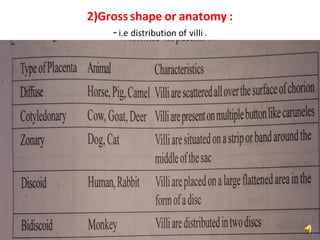
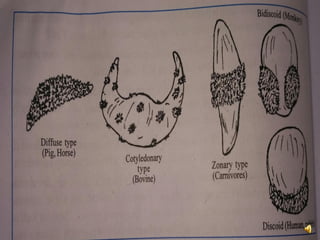
2)Grossshape or anatomy :
-i.e distribution of villi .
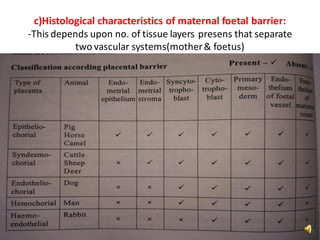
c)Histological characteristics of maternal foetal barrier:
-This depends upon no. of tissue layers presens that separate
two vascular systems(mother& foetus)
FUNCTIONS OF PLACENTA
-Nutrition of foetus is haematotrophic type and therefore
vascularization of placenta is important.
-Placentaperforms following functions:
1)Transportation : Transportation of nutrients, gasses of respiration,
water,electrolyte,inorganic nutrients(Na,Fe,Cu,Ca,P etc.),water soluble
vitamins and hormones.
2) Storage: Storage of waste products ,foetal urine , saliva,meconium.
3)Biosynthesis: Biosynthesis of hormones (oestrogen, progesteron,
gonadotropins).
4)Excretion: Excretion of fluid waste products like urea of foetal
metabolismthat escape into placenta having kidney like function.
5)Protective Barrier: Placenta is impermeable to bacteria and even
larger molecules but this is selective barrier .
6)Immunity: Passive transfer of immunity from dam to foetus in vitro.

Introduction to placenta , its types and functions copy

  • 1.
    INTRODUCTION TO PLACENTA, ITS TYPES AND FUNCTIONS IN DIFFERENT ANIMALS: Presented By: Saleem khan BVSc&AH student (internship) from CVASc ,Pantnagar Email:skhan6548@gmail.com
  • 2.
    PLACENTA It is definedas intimate apposition or fusion of foetal membrane to the maternal endometrium to permit physiological exchange between foetus and mother. It is composed of 2 parts : 1) foetal part- Allantochorion. 2)Maternal part- endometrium. x
  • 3.
    TYPES OF PLACENTA Theplacenta classified on the basis of : 1)Loss of maternal tissue ( decidua ) during birth : a) Deciduate : - conciderable loss of tissue shed off along with placenta. -also k/a conjoined placenta or placenta Vera . -seen in :Bitch and cat (moderate),human and monkey(extreme). b)Non- deciduate : -no loss of matrnal tissue -also k/a apposed type or adeciduate placenta -seen in : most of the farm animals like ,cow , buffalo , sheep ,goat ,mare and sow.
  • 4.
    2)Grossshape or anatomy: -i.e distribution of villi .
  • 6.
    c)Histological characteristics ofmaternal foetal barrier: -This depends upon no. of tissue layers presens that separate two vascular systems(mother& foetus)
  • 7.
    FUNCTIONS OF PLACENTA -Nutritionof foetus is haematotrophic type and therefore vascularization of placenta is important. -Placentaperforms following functions: 1)Transportation : Transportation of nutrients, gasses of respiration, water,electrolyte,inorganic nutrients(Na,Fe,Cu,Ca,P etc.),water soluble vitamins and hormones. 2) Storage: Storage of waste products ,foetal urine , saliva,meconium. 3)Biosynthesis: Biosynthesis of hormones (oestrogen, progesteron, gonadotropins). 4)Excretion: Excretion of fluid waste products like urea of foetal metabolismthat escape into placenta having kidney like function. 5)Protective Barrier: Placenta is impermeable to bacteria and even larger molecules but this is selective barrier . 6)Immunity: Passive transfer of immunity from dam to foetus in vitro.