• FORMATION OF PLACENTA
SHREE B G GARAIYA
HOMOEOPATHIC MEDICAL
COLLEGE
GUIDED BY :- Dr. Purvi Dave
DEPARTMENT OF ANATOMY
PRESENTED BY :- Sneha Vekariya
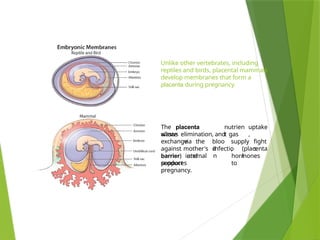
Unlike other vertebrates, including
reptiles and birds, placental mammals
develop membranes that form a
placenta during pregnancy.
The placenta
allows
nutrien
t
uptake
,
waste elimination, and gas
exchange bloo
d
supply
,
fight
s
via the
mother's
internal
infectio
n
(placenta
l
against
barrier) and
produces
hormones
to
support
pregnancy.
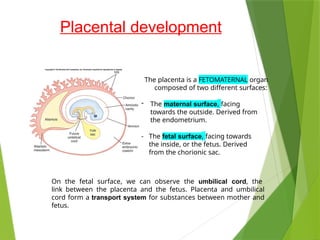
The placenta is a FETOMATERNAL organ
composed of two different surfaces:
- The maternal surface, facing
towards the outside. Derived from
the endometrium.
- The fetal surface, facing towards
the inside, or the fetus. Derived
from the chorionic sac.
Placental development
On the fetal surface, we can observe the umbilical cord, the
link between the placenta and the fetus. Placenta and umbilical
cord form a transport system for substances between mother and
fetus.
In the mammalian organisms, the three germ layers give rise
to the four extraembryonic membranes that surround the
developing embryo
Amnion – fluid filled membranous sac that encloses the embryo. Protects
embryo from shock.
Yolk sac – Source of stem cells that give rise to blood and lymphoid cells. Stem
cells migrate to into the developing embryo
Allantois - storage of metabolic wastes during development. Contributes to the
formation of the umbilical cord
Chorion - lies beneath the eggshell and encloses the embryo and other
extraembryonic membrane. It forms most of the Placenta.
As embryo grows, the need for oxygen increases: Allantois and Chorion fuse to
form a respiratory surface, the
chorioallantoic membrane.
As the fetus is in full development, it requires a certain
amount of gases and nutrients to help support its growth.
Because the fetus is unable to do so on its own, the placenta
provides these gases and nutrients throughout pregnancy.
During pregnancy, the placenta has 6 main roles to
maintain good health and a good environment for the
growing fetus:
•1 Respiration
•2 Nutrition
•3 Excretion
•4 Protection
•5 Endocrine
•6 Immunity
Placental functions
•1 Respiration
The fetus must obtain oxygen and excrete carbon dioxide through
the placenta. Oxygen from the mother’s blood passes into the fetal
blood by simple diffusion; similarly the fetus gives off carbon
dioxide into the maternal blood
•2 Nutrition
The fetus needs nutrients for growth and development. They
are actively transferred from the maternal to the fetal blood
through the walls of the villi
•3 Storage
Placenta metabolizes glucose, stores it in the form of glycogen
and reconverts it to glucose as required. It can also store iron,
fat and soluble vitamins.
•4 Excretion
The main substance exctreted from the fetus is carbon dioxide.
Bilirubin
will also be excreted as red blood cells are replaced relatively
frequently
•5 Protection
The placenta provides a limited barrier to infection. However,
substances including alcohol, some chemicals and several types of
viruses, such as human cytomegalovirus and rubella are not filtered
out. These substances can cross the placental barrier freely and may
cause congenital abnormalities
•6 Endocrine
Oestrogens are growth stimulating hormones, which are secreted
throughout pregnancy. They are produced by the placenta as the
activity of the corpus luteum declines, the fetus providing the placenta
with the vital precursor for their production
Placenta: definition and
classification
The placenta is a “vascular organ in most mammals that provide
connection between the fetus to the uterus of the mother. It mediates
the metabolic exchanges of the developing individual through an
intimate association of embryonic tissues and of certain uterine
tissues, serving the functions of nutrition, respiration, and excretion.”
Placenta: definition
and classification
The placentas of all eutherian (placental) mammals provide
common structural and functional features, but there are differences
among species in gross and microscopic structure of the placenta.
Two characteristics are particularly divergent and form
bases for classification of placental types:
-The gross shape of the placenta and the distribution
of
contact sites between fetal membranes and
endometrium.
-The number of layers of tissue between maternal and
fetal vascular systems.
Gross anatomical classification of placentas
is based on the pattern of contact between
chorion and endometrium
Gross anatomical classification of
placentas is based on the pattern of
contact between chorion
andendometrium
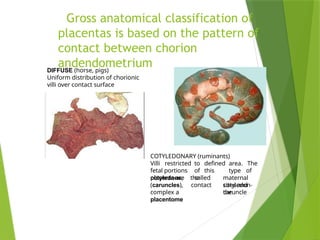
DIFFUSE (horse, pigs)
Uniform distribution of chorionic
villi over contact surface
COTYLEDONARY (ruminants)
Villi restricted to defined area. The
fetal portions of this type of
placenta are called
cotyledons,
(caruncles),
the maternal
contact sites and
the
cotyledon-
caruncle
complex a
placentome
Gross anatomical classification of
placentas is based on the pattern
ofcontact between chorion and
endometrium
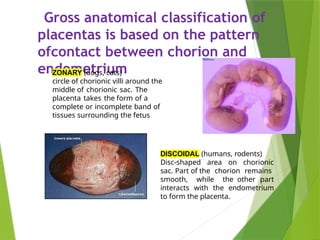
ZONARY (dogs, cats)
circle of chorionic villi around the
middle of chorionic sac. The
placenta takes the form of a
complete or incomplete band of
tissues surrounding the fetus
DISCOIDAL (humans, rodents)
Disc-shaped area on chorionic
sac. Part of the chorion remains
smooth, while the other part
interacts with the endometrium
to form the placenta.
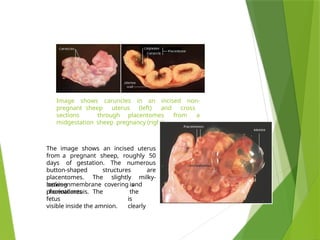
Image shows caruncles in an incised non-
pregnant sheep uterus (left) and cross
sections through placentomes from a
midgestation sheep pregnancy (right).
The image shows an incised uterus
from a pregnant sheep, roughly 50
days of gestation. The numerous
button-shaped structures are
placentomes. The slightly milky-
looking membrane covering and
between
placentomes
is
the
is
clearly
chorioallantois. The
fetus
visible inside the amnion.
Histological classification of placentas
is based on the degree of removal of
the maternal layers (number of layers)
There are 3 layers of fetal
extraembryonic membranes in the
chorioallantoic placenta of all
mammals, all of which are
components of the mature placenta:
1.Endothelium lining allantoic
capillaries
2.Connective tissue
3. Chorionic epithelium, the
outermost layer of fetal membranes
There are also 3 layers on the maternal
side, but the number of these layers
which are retained varies greatly
among species.
The three potential maternal layers in
a placenta are:
1.Endothelium lining endometrial
blood vessels
2.Connective tissue of the
endometrium
3.Endometrial epithelial cells
Maternal
endometrial
epithelium intact
(Pig; Horse)
Removal of
endometrial
epithelium and
connective tissue
(Dog; Cat)
Removal of
maternal
endothelium
(Human; Rodent)
Syncytium of
maternal epithelium
and chorion
(Ruminants)
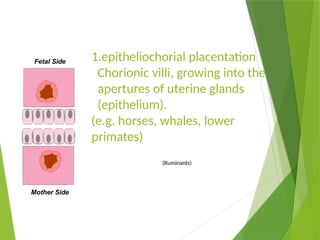
Fetal Side
Mother Side
1.epitheliochorial placentation
Chorionic villi, growing into the
apertures of uterine glands
(epithelium).
(e.g. horses, whales, lower
primates)
(Ruminants)
Fetal Side
Mother Side
 Synepitheliochorial
placentation
Syncytium of
maternal
 endometral epithelium and
chorion
Fetal Side
Mother Side
Endotheliochorial placentation
In this type of placentation, the
chorionic villi are in contact with the
endothelium of maternal blood
vessels. (e.g. in most carnivores
like cats and dogs)
Fetal Side
Mother Side
Hemochorial placentation
(e.g. in higher order primates,
including humans, and also in rabbits, guinea
pigs, mice, and rats). The haemochorial
placenta shows the intimate juxtaposition of
foetal and maternal blood allowing efficient
exchange.
THANK YOU

placenta , .pptx

  • 1.
    • FORMATION OFPLACENTA SHREE B G GARAIYA HOMOEOPATHIC MEDICAL COLLEGE GUIDED BY :- Dr. Purvi Dave DEPARTMENT OF ANATOMY PRESENTED BY :- Sneha Vekariya
  • 2.
    Unlike other vertebrates,including reptiles and birds, placental mammals develop membranes that form a placenta during pregnancy. The placenta allows nutrien t uptake , waste elimination, and gas exchange bloo d supply , fight s via the mother's internal infectio n (placenta l against barrier) and produces hormones to support pregnancy.
  • 3.
    The placenta isa FETOMATERNAL organ composed of two different surfaces: - The maternal surface, facing towards the outside. Derived from the endometrium. - The fetal surface, facing towards the inside, or the fetus. Derived from the chorionic sac. Placental development On the fetal surface, we can observe the umbilical cord, the link between the placenta and the fetus. Placenta and umbilical cord form a transport system for substances between mother and fetus.
  • 4.
    In the mammalianorganisms, the three germ layers give rise to the four extraembryonic membranes that surround the developing embryo Amnion – fluid filled membranous sac that encloses the embryo. Protects embryo from shock. Yolk sac – Source of stem cells that give rise to blood and lymphoid cells. Stem cells migrate to into the developing embryo Allantois - storage of metabolic wastes during development. Contributes to the formation of the umbilical cord Chorion - lies beneath the eggshell and encloses the embryo and other extraembryonic membrane. It forms most of the Placenta. As embryo grows, the need for oxygen increases: Allantois and Chorion fuse to form a respiratory surface, the chorioallantoic membrane.
  • 5.
    As the fetusis in full development, it requires a certain amount of gases and nutrients to help support its growth. Because the fetus is unable to do so on its own, the placenta provides these gases and nutrients throughout pregnancy. During pregnancy, the placenta has 6 main roles to maintain good health and a good environment for the growing fetus: •1 Respiration •2 Nutrition •3 Excretion •4 Protection •5 Endocrine •6 Immunity Placental functions
  • 6.
    •1 Respiration The fetusmust obtain oxygen and excrete carbon dioxide through the placenta. Oxygen from the mother’s blood passes into the fetal blood by simple diffusion; similarly the fetus gives off carbon dioxide into the maternal blood •2 Nutrition The fetus needs nutrients for growth and development. They are actively transferred from the maternal to the fetal blood through the walls of the villi •3 Storage Placenta metabolizes glucose, stores it in the form of glycogen and reconverts it to glucose as required. It can also store iron, fat and soluble vitamins.
  • 7.
    •4 Excretion The mainsubstance exctreted from the fetus is carbon dioxide. Bilirubin will also be excreted as red blood cells are replaced relatively frequently •5 Protection The placenta provides a limited barrier to infection. However, substances including alcohol, some chemicals and several types of viruses, such as human cytomegalovirus and rubella are not filtered out. These substances can cross the placental barrier freely and may cause congenital abnormalities •6 Endocrine Oestrogens are growth stimulating hormones, which are secreted throughout pregnancy. They are produced by the placenta as the activity of the corpus luteum declines, the fetus providing the placenta with the vital precursor for their production
  • 8.
    Placenta: definition and classification Theplacenta is a “vascular organ in most mammals that provide connection between the fetus to the uterus of the mother. It mediates the metabolic exchanges of the developing individual through an intimate association of embryonic tissues and of certain uterine tissues, serving the functions of nutrition, respiration, and excretion.”
  • 9.
    Placenta: definition and classification Theplacentas of all eutherian (placental) mammals provide common structural and functional features, but there are differences among species in gross and microscopic structure of the placenta. Two characteristics are particularly divergent and form bases for classification of placental types: -The gross shape of the placenta and the distribution of contact sites between fetal membranes and endometrium. -The number of layers of tissue between maternal and fetal vascular systems.
  • 10.
    Gross anatomical classificationof placentas is based on the pattern of contact between chorion and endometrium
  • 11.
    Gross anatomical classificationof placentas is based on the pattern of contact between chorion andendometrium DIFFUSE (horse, pigs) Uniform distribution of chorionic villi over contact surface COTYLEDONARY (ruminants) Villi restricted to defined area. The fetal portions of this type of placenta are called cotyledons, (caruncles), the maternal contact sites and the cotyledon- caruncle complex a placentome
  • 12.
    Gross anatomical classificationof placentas is based on the pattern ofcontact between chorion and endometrium ZONARY (dogs, cats) circle of chorionic villi around the middle of chorionic sac. The placenta takes the form of a complete or incomplete band of tissues surrounding the fetus DISCOIDAL (humans, rodents) Disc-shaped area on chorionic sac. Part of the chorion remains smooth, while the other part interacts with the endometrium to form the placenta.
  • 13.
    Image shows carunclesin an incised non- pregnant sheep uterus (left) and cross sections through placentomes from a midgestation sheep pregnancy (right). The image shows an incised uterus from a pregnant sheep, roughly 50 days of gestation. The numerous button-shaped structures are placentomes. The slightly milky- looking membrane covering and between placentomes is the is clearly chorioallantois. The fetus visible inside the amnion.
  • 14.
    Histological classification ofplacentas is based on the degree of removal of the maternal layers (number of layers) There are 3 layers of fetal extraembryonic membranes in the chorioallantoic placenta of all mammals, all of which are components of the mature placenta: 1.Endothelium lining allantoic capillaries 2.Connective tissue 3. Chorionic epithelium, the outermost layer of fetal membranes There are also 3 layers on the maternal side, but the number of these layers which are retained varies greatly among species. The three potential maternal layers in a placenta are: 1.Endothelium lining endometrial blood vessels 2.Connective tissue of the endometrium 3.Endometrial epithelial cells
  • 15.
    Maternal endometrial epithelium intact (Pig; Horse) Removalof endometrial epithelium and connective tissue (Dog; Cat) Removal of maternal endothelium (Human; Rodent) Syncytium of maternal epithelium and chorion (Ruminants)
  • 16.
    Fetal Side Mother Side 1.epitheliochorialplacentation Chorionic villi, growing into the apertures of uterine glands (epithelium). (e.g. horses, whales, lower primates) (Ruminants)
  • 17.
    Fetal Side Mother Side Synepitheliochorial placentation Syncytium of maternal  endometral epithelium and chorion
  • 18.
    Fetal Side Mother Side Endotheliochorialplacentation In this type of placentation, the chorionic villi are in contact with the endothelium of maternal blood vessels. (e.g. in most carnivores like cats and dogs)
  • 19.
    Fetal Side Mother Side Hemochorialplacentation (e.g. in higher order primates, including humans, and also in rabbits, guinea pigs, mice, and rats). The haemochorial placenta shows the intimate juxtaposition of foetal and maternal blood allowing efficient exchange.
  • 20.