Semester 2 2012/2013


“INTRODUCTION TO MILITARY
      LEADRDESHIP”

                LECTURER:
LT KOL UNGKU AZLY BIN UNGKU ZAHAR - FPPP

 NATIONAL DEFENCE UNIVERSITY of MALAYSIA
          Sungai Besi Camp, 57000
               Kuala Lumpur
“I SHALL
RETURN”
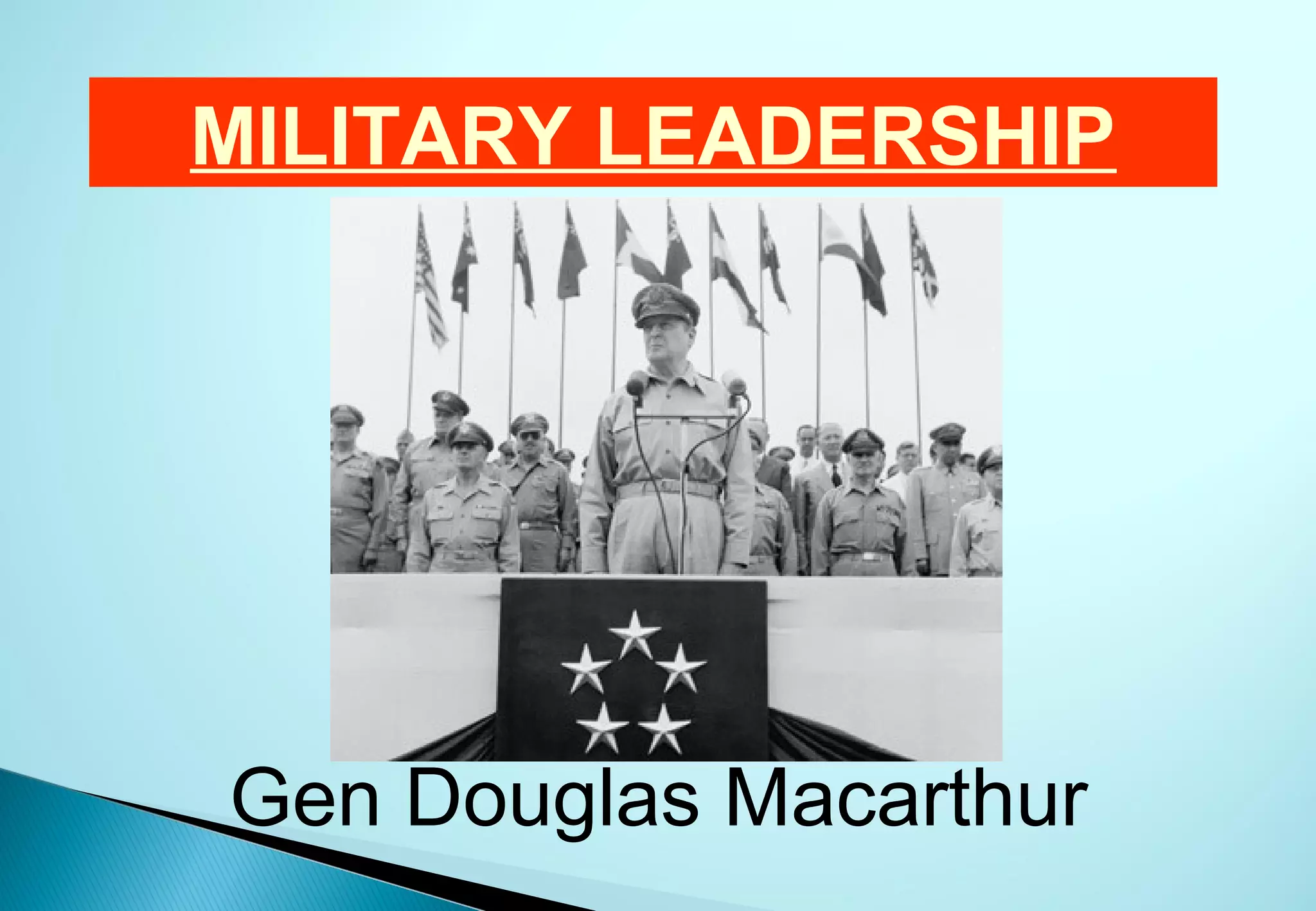
MILITARY LEADERSHIP


Gen Douglas Macarthur
SCOPE
 INTRODUCTION.

 MILITARY LEADRESHIP – A LEADER & A MANAGER.

 MILITARY LEADERSHIP CONCEPT.

 PROCESS OF EFFECTIVE MILITARY LEADER.

 MILITARY LEADERSHIP QUALITIES.

 HUMAN & MOTIVATION.

 CONCLUSION.
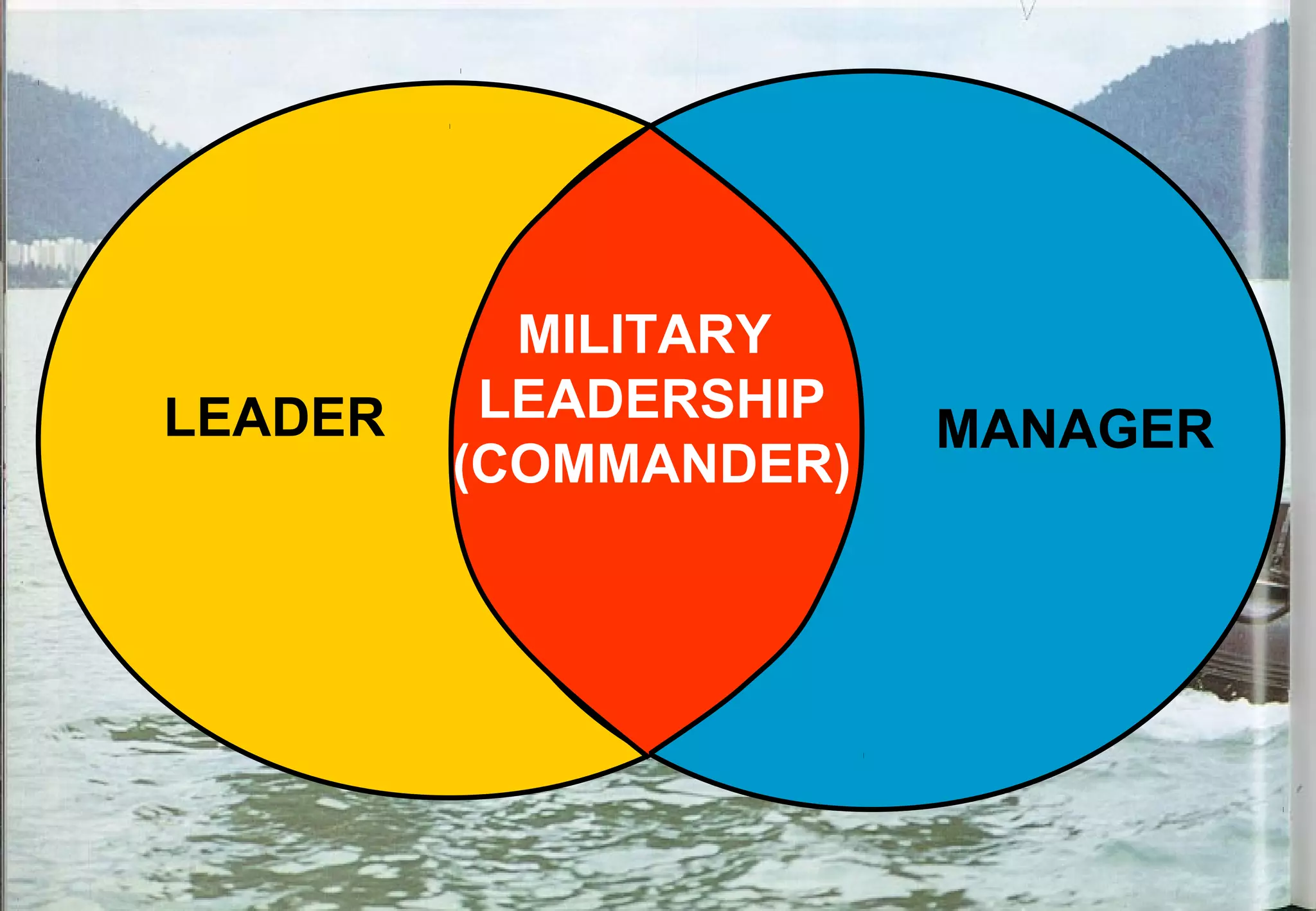
MILITARY
LEADER    LEADERSHIP
                       MANAGER
         (COMMANDER)
COMMAND


  THE AUTHORITY A MEMBER OF THE
 ARMED FORCES LAWFULLY EXERTS
OVER SUBORDINATES BY VIRTUE OF HIS
       RANK OR ASSIGNMENT.
LEADER

A PERSON WHO INFLUENCES
   AND DIRECTS OTHERS.
MANAGEMENT
   THE PROCESS WHEREBY THE
  RESOURCES OF MEN, MONEY,
  MATERIAL AND FACILITIES ARE
  UTILIZED TO ACCOMPLISH THE
  MISSIONS AND TASKS OF THE
ORGANISATION. THE FUNCTION OF
  MANAGEMENT ARE PLANNING,
   ORGANIZING, DIRECTING, CO-
 ORDINATING AND CONTROLLING.
MILITARY LEADERSHIP

   THE ART OF INFLUENCING AND
DIRECTING MAN IN SUCH A WAY AS TO
 OBTAIN THEIR WILLING OBEDIENCE,
 CONFIDENCE, RESPECT AND LOYAL
    COOPERATION IN ORDER TO
     ACCOMPLISH THE MISSION.
IN WAR THE CHIEF
INCALCULABLE IS THE.

     HUMAN WILL

           LIDDELL HART
LEADERSHIP TRAITS

  PERSONAL QUALITIES OF DIRECT
VALUE TO THE LEADER IN GAINING THE
 WILLING OBEDIENCE, RESPECT AND
 LOYAL COOPERATION OF HIS MEN IN
   ACCOMPLISHING HIS MISSION.
LEADERSHIP PRINCIPLES

 FUNDAMENTAL GUIDELINES FOR THE
SELECTION OF APPROPRIATE ACTIONS
AND ORDER IN THE PROPER EXERCISE
          OF COMMAND.
“The ability to keep a cool head in
  an emergency, maintain poise in
the midst of excitement and refuse
to be stampeded are true marks of
             leadership”

                      - R.SHAHNON -
FIVE DISTINCT ASPECT OF
      AN EFFECTIVE LEADER

 Provide direction
 Team building
 Develop commitment
 Sets example
 Being accepted
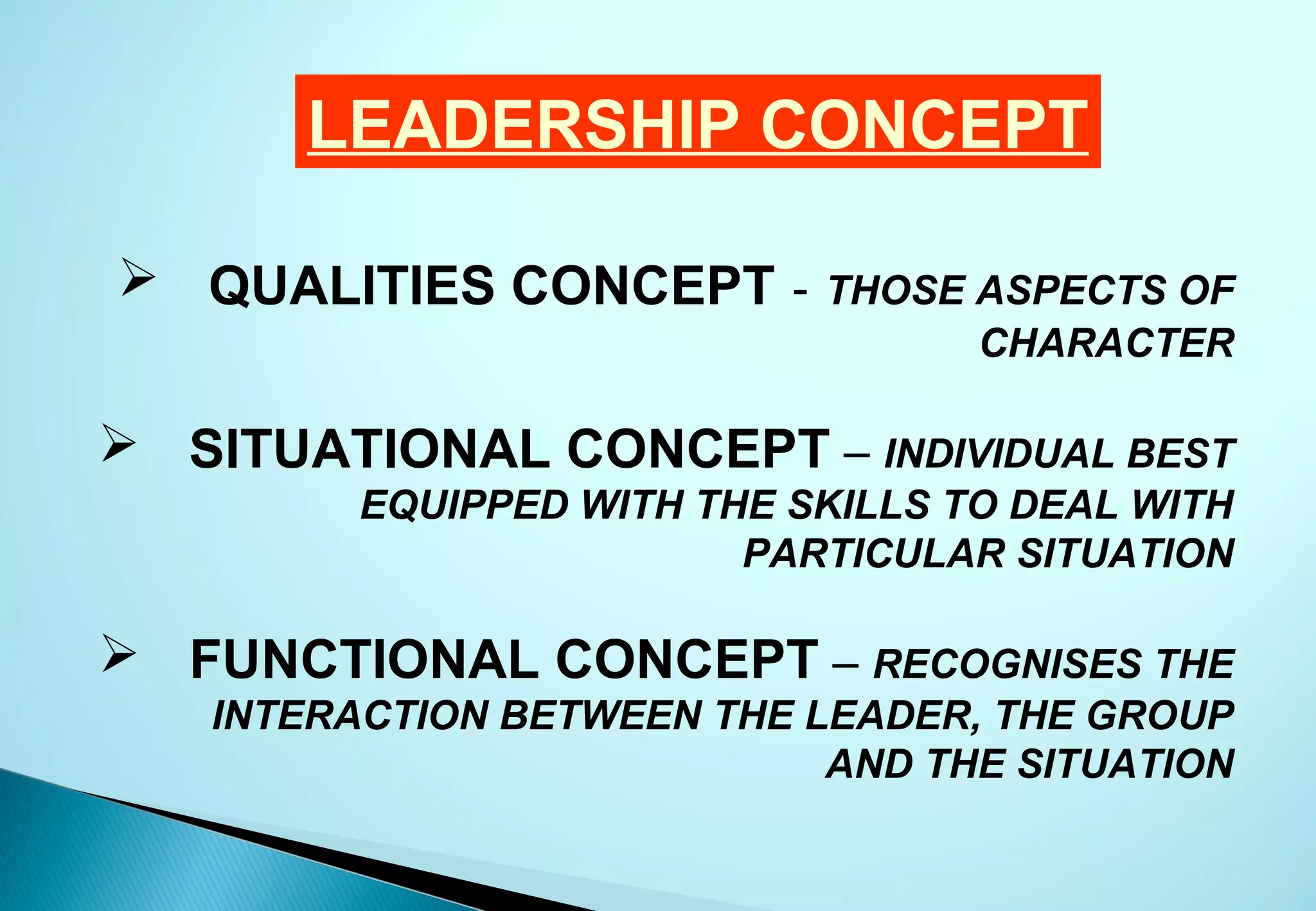
LEADERSHIP CONCEPT

 QUALITIES CONCEPT -       THOSE ASPECTS OF
                                  CHARACTER

 SITUATIONAL CONCEPT – INDIVIDUAL BEST
         EQUIPPED WITH THE SKILLS TO DEAL WITH
                         PARTICULAR SITUATION

 FUNCTIONAL CONCEPT – RECOGNISES THE
   INTERACTION BETWEEN THE LEADER, THE GROUP
                            AND THE SITUATION
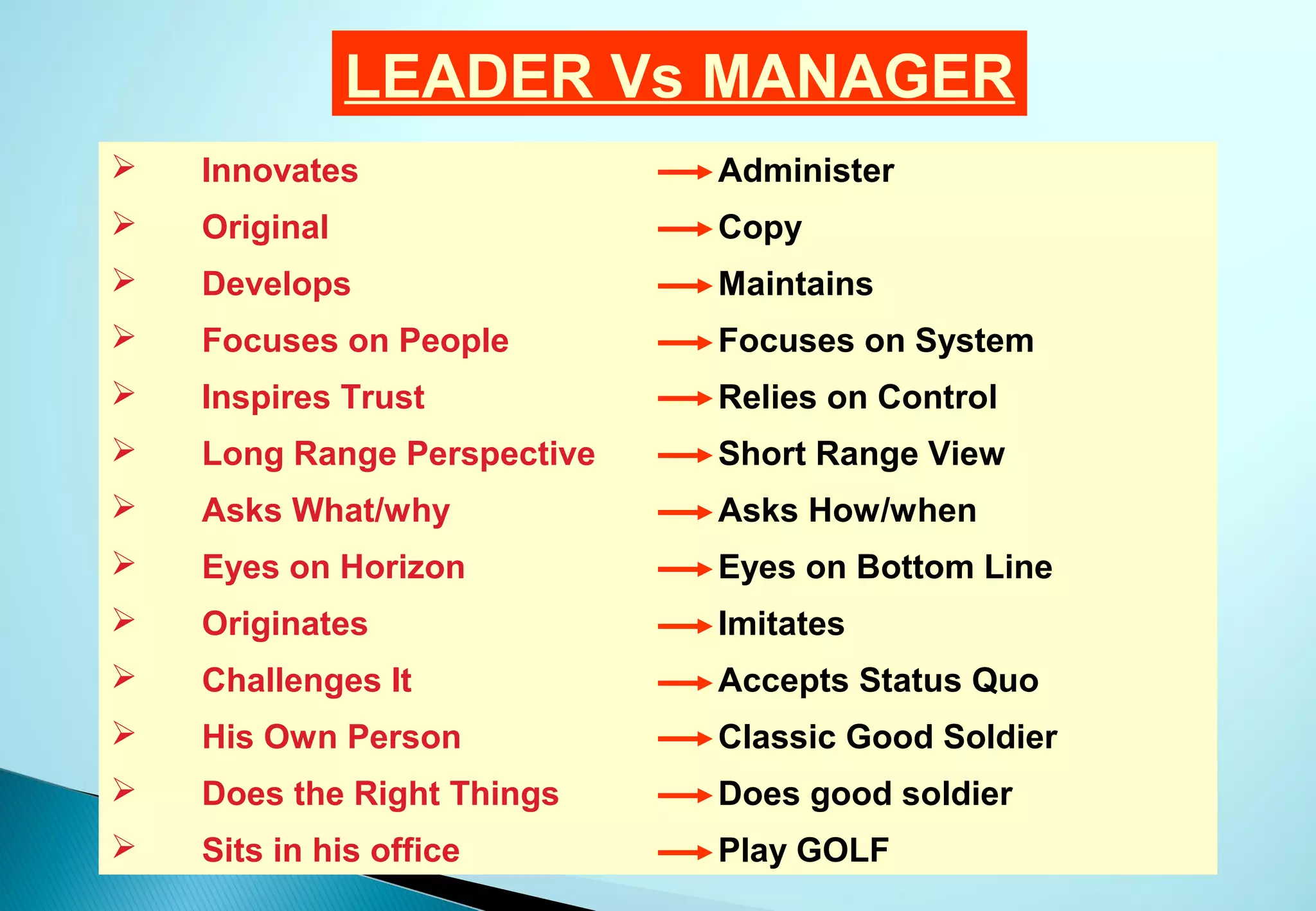
LEADER Vs MANAGER
   Innovates                Administer
   Original                 Copy
   Develops                 Maintains
   Focuses on People        Focuses on System
   Inspires Trust           Relies on Control
   Long Range Perspective   Short Range View
   Asks What/why            Asks How/when
   Eyes on Horizon          Eyes on Bottom Line
   Originates               Imitates
   Challenges It            Accepts Status Quo
   His Own Person           Classic Good Soldier
   Does the Right Things    Does good soldier
   Sits in his office       Play GOLF
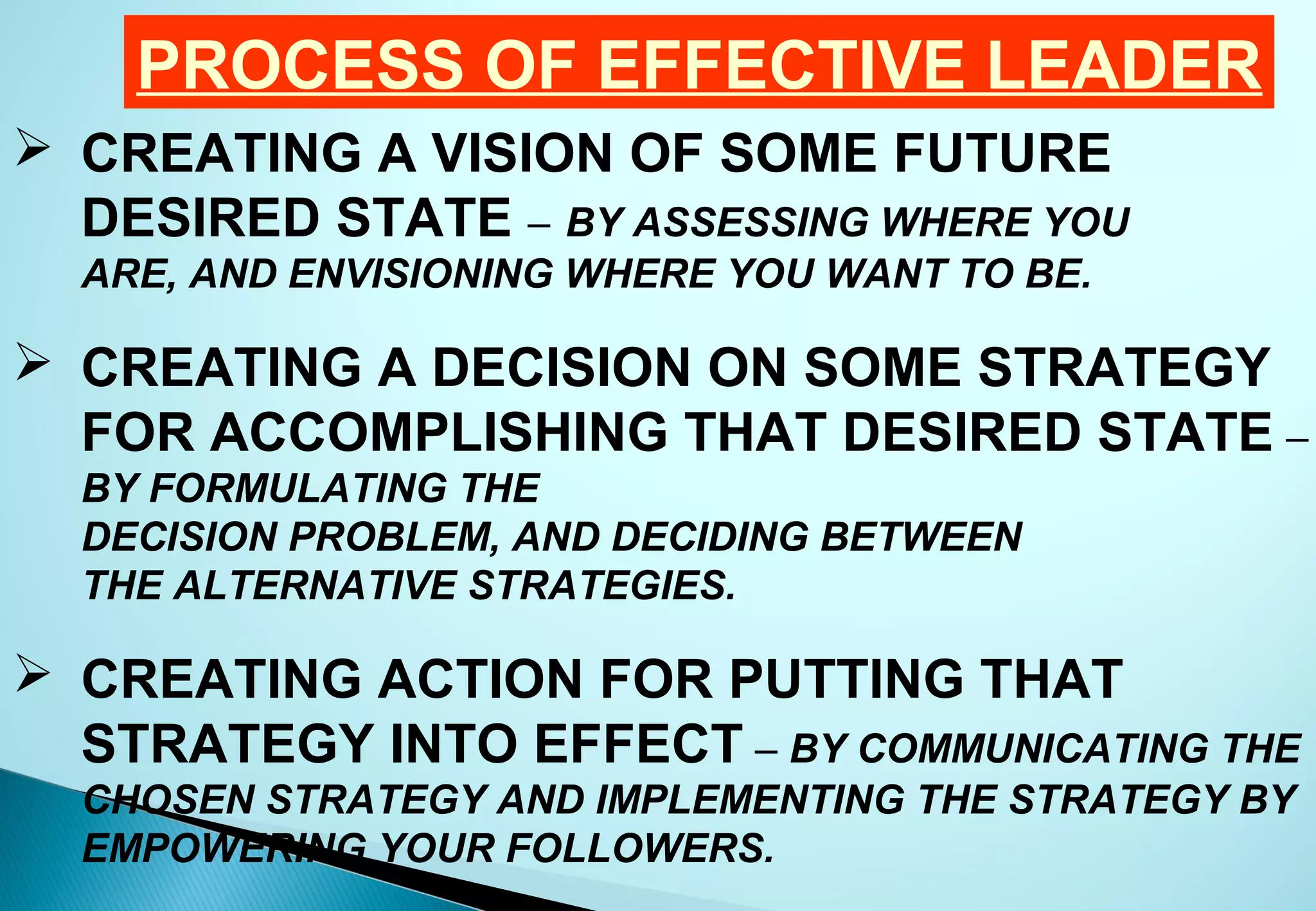
PROCESS OF EFFECTIVE LEADER
 CREATING A VISION OF SOME FUTURE
  DESIRED STATE – BY ASSESSING WHERE YOU
  ARE, AND ENVISIONING WHERE YOU WANT TO BE.

 CREATING A DECISION ON SOME STRATEGY
  FOR ACCOMPLISHING THAT DESIRED STATE –
  BY FORMULATING THE
  DECISION PROBLEM, AND DECIDING BETWEEN
  THE ALTERNATIVE STRATEGIES.

 CREATING ACTION FOR PUTTING THAT
  STRATEGY INTO EFFECT – BY COMMUNICATING THE
  CHOSEN STRATEGY AND IMPLEMENTING THE STRATEGY BY
  EMPOWERING YOUR FOLLOWERS.
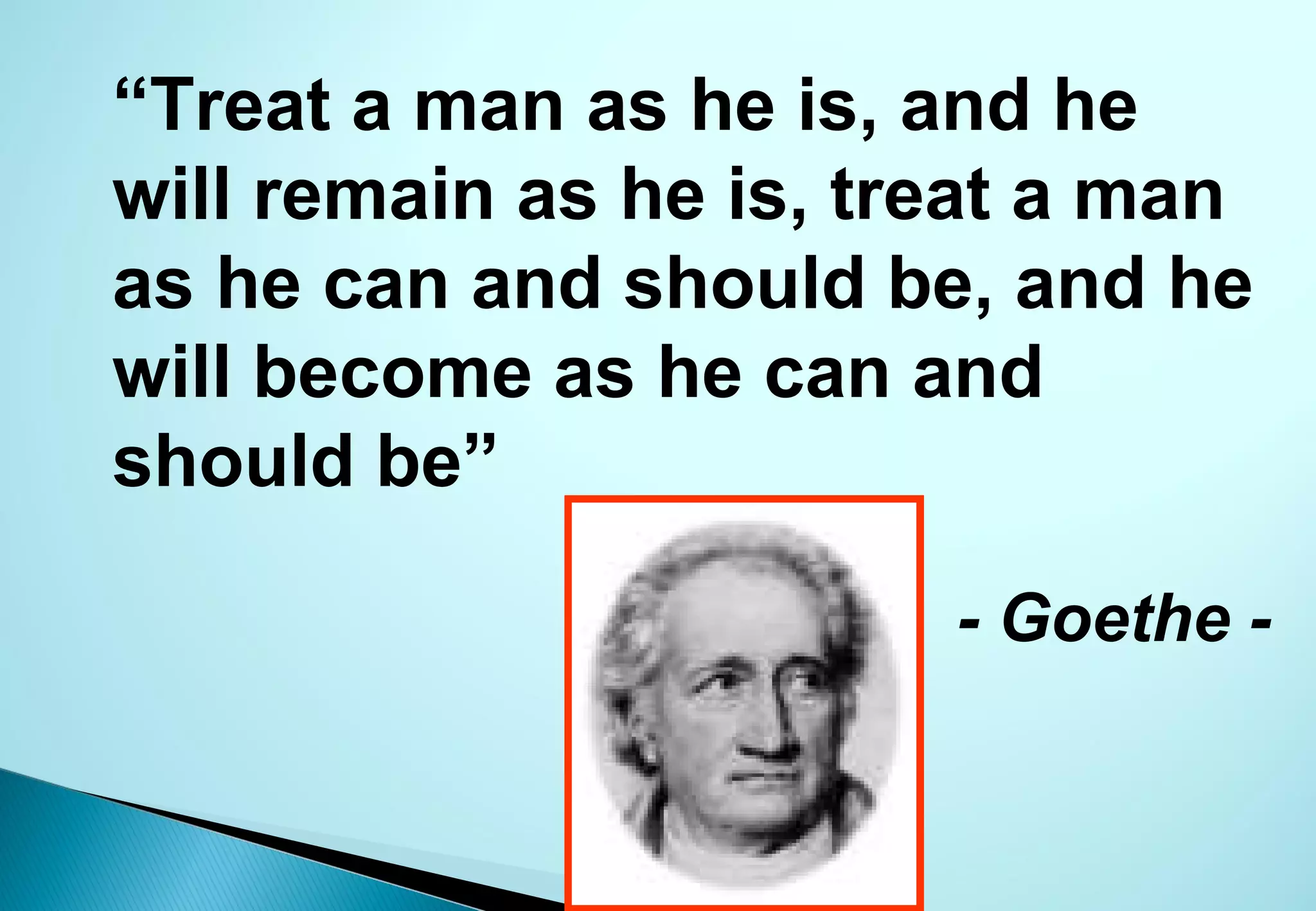
“Treat a man as he is, and he
will remain as he is, treat a man
as he can and should be, and he
will become as he can and
should be”

                        - Goethe -
LEADERSHIP TRAITS
   LOYALTY.
   COURAGE.
   WILL POWER.
   PROFESSIONAL KNOWLEDGE.
   INITIATIVE.
   JUDGEMENT.
   INTEGRITY.
   SELF CONFIDENCE.
   ENTHUSIUM.
   ABILITY TO COMMUNICATE
   COMPETENCE.
   LOOKING FORWARD.
   ENDURANCE.
   EMPATHY.
1. Integrity       value we place in

2. Maturity        courage and
               consideration

3. Abundance       deep sense of
                Mentality personal worth

                and security
Tries to please
everybody eventually
 become nothing to
      everyone.
 being competitive rather than cooperative.
 Methods of manipulations
      threats
      fear
      bribery
      pressure
      deceit
      charms us
 Achieving the ends state.
ACT

Analyze your situation Choose
      the best strategy
     Track your choice.
AWARENESS AND
  MANAGING
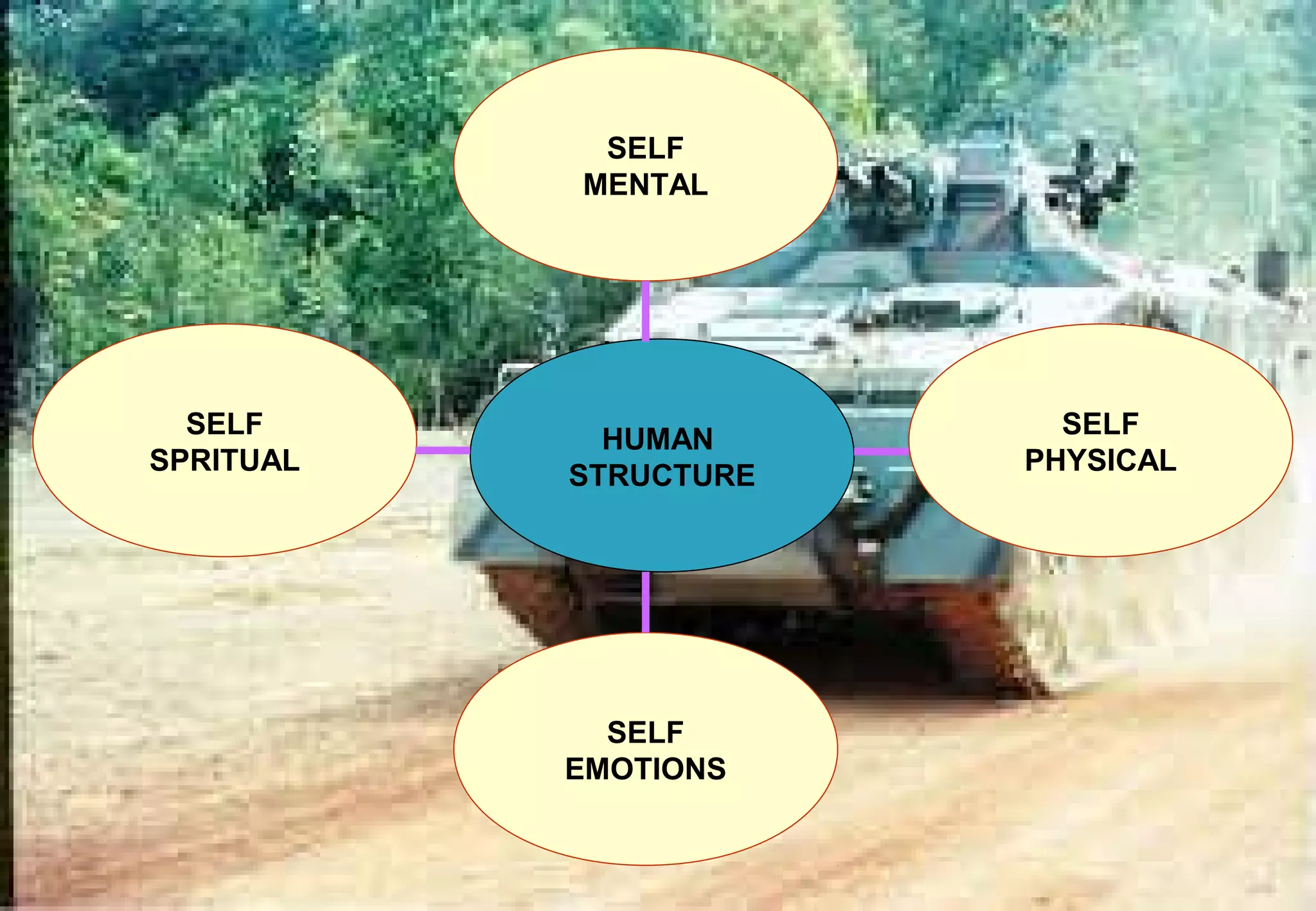
SELF
           MENTAL


  SELF                   SELF
             HUMAN
SPRITUAL               PHYSICAL
           STRUCTURE


             SELF
           EMOTIONS
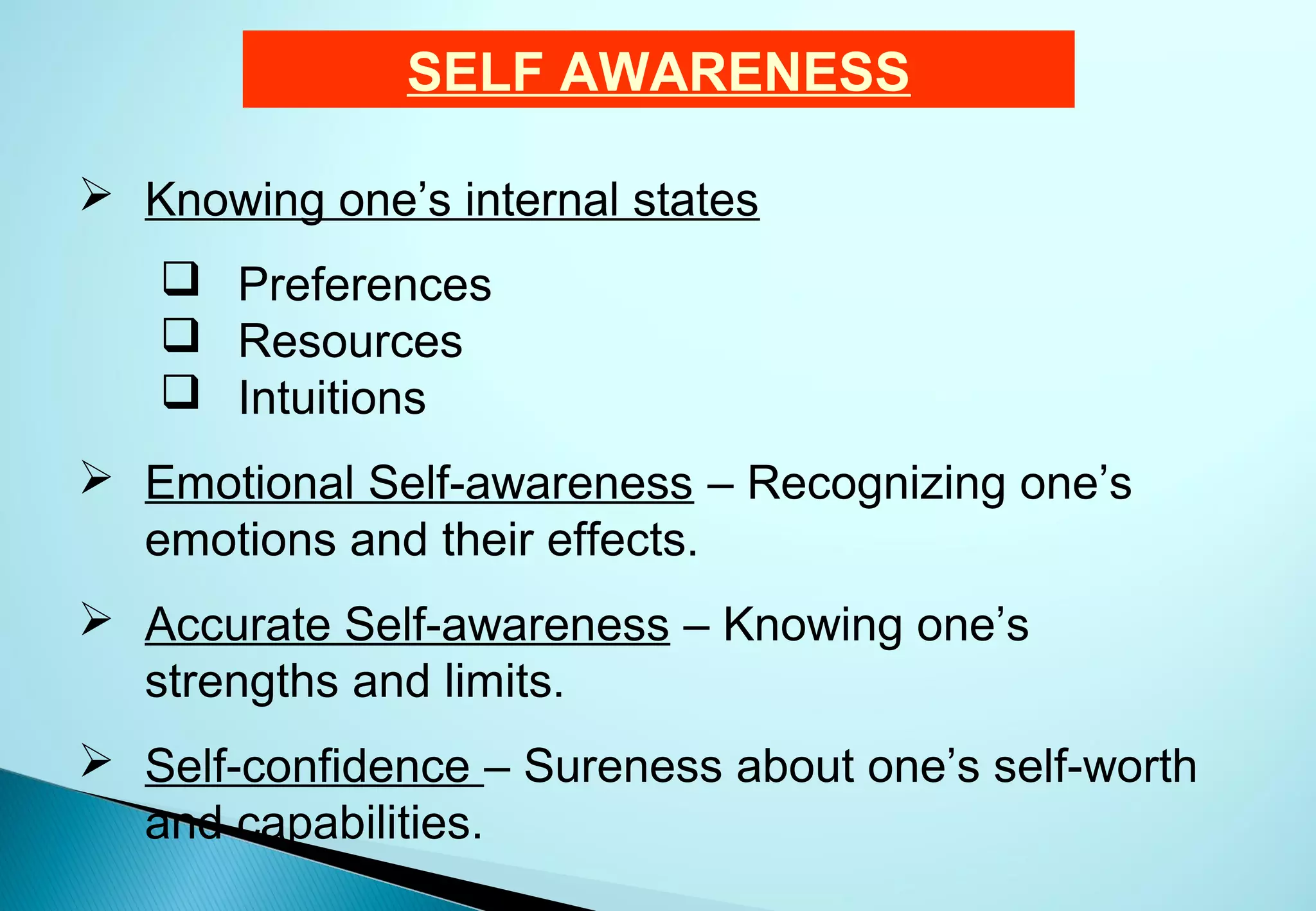
SELF AWARENESS

 Knowing one’s internal states
    Preferences
    Resources
    Intuitions
 Emotional Self-awareness – Recognizing one’s
  emotions and their effects.
 Accurate Self-awareness – Knowing one’s
  strengths and limits.
 Self-confidence – Sureness about one’s self-worth
  and capabilities.
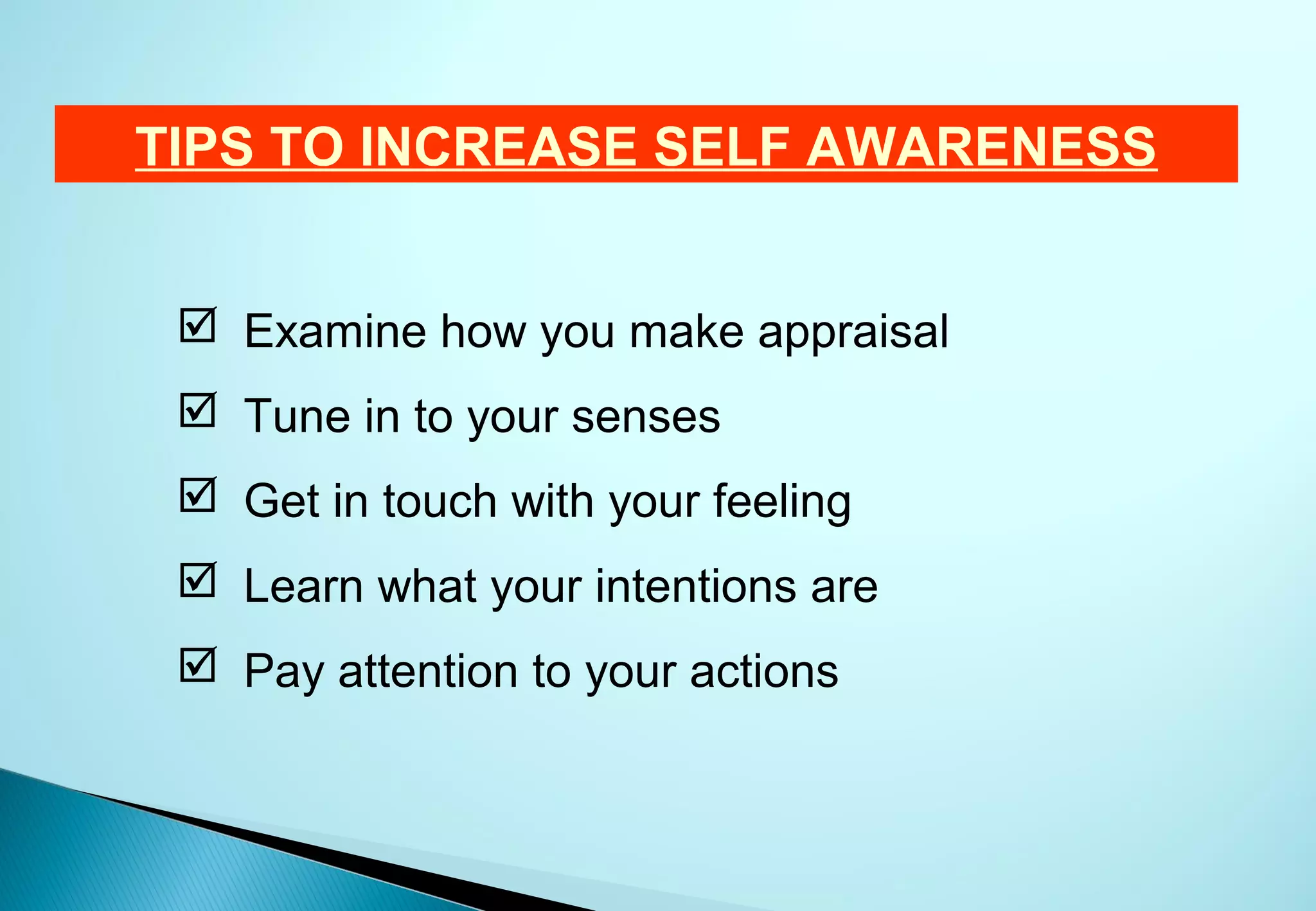
TIPS TO INCREASE SELF AWARENESS


  Examine how you make appraisal
  Tune in to your senses
  Get in touch with your feeling
  Learn what your intentions are
  Pay attention to your actions
SELF MANAGEMENT
 Managing one’s internal states, impulses and
  resources.
 Self-control: Managing disruptive emotions and
  impulses.
 Conscientiousness and integrity: taking responsibility.
 Adaptability: Flexibility in handling change.
 Initiative and innovation: Readiness to act on
  opportunities and openness to new ideas.
 Achievement Drive: Striving to improve or meet a
  standard of excellence.
SOCIAL AWARENESS

 Awareness: Other’s feeling, needs and concerns.
 Empathy: Sensing other’s feeling and perspective.
 Service Orientation: Anticipate, recognize and meet
  customers needs.
 Developing others: Sensing what others need to
  develop.
 Political Awareness: Understand group emotional and
  power relationship.
UNDERSTANDING OTHERS


 What is the person’s feeling?
 Will his feelings effect his thinking?
 Will his feelings effect his behavior
 Will his emotions hamper his ability to be rational?
 List the emotions he is feeling
DEVELOP ABILITY TO
        USE EMOTIONS
Understand how feelings effects
thinking.
   Happy.
   Fear.
   Surprise.
   Sadness.
   Anger.
FEAR of UNCERTAINITY
        False

        Emotions

        Appearing

        Real
SOCIAL MANAGEMENT

Adaptability to Organisational environment.
     Leadership: Inspires and guiding Other, influence, effective
      persuasion.
     Comms: Clear and convincing msg.
     Change Catalyst: Initiate and manage change.
     Conflict Environment: Negotiating disagreements.
     Collaboration and building bonds: coop with others and
      strengthening relationship.
     Team capabilities: Create gp synergy in pursuing collective
      goals.
NO ONE IS RICH ENOUGH TO
DO WITHOUT A NEIGHBOUR

            - DANISH PROVERB -
“Those who possess the rare skill to
be angry with the right person, to the
right degree, at the right time, for the
right purpose and in the right way are
at an advantage in any domain in life”
ARISTOTLE
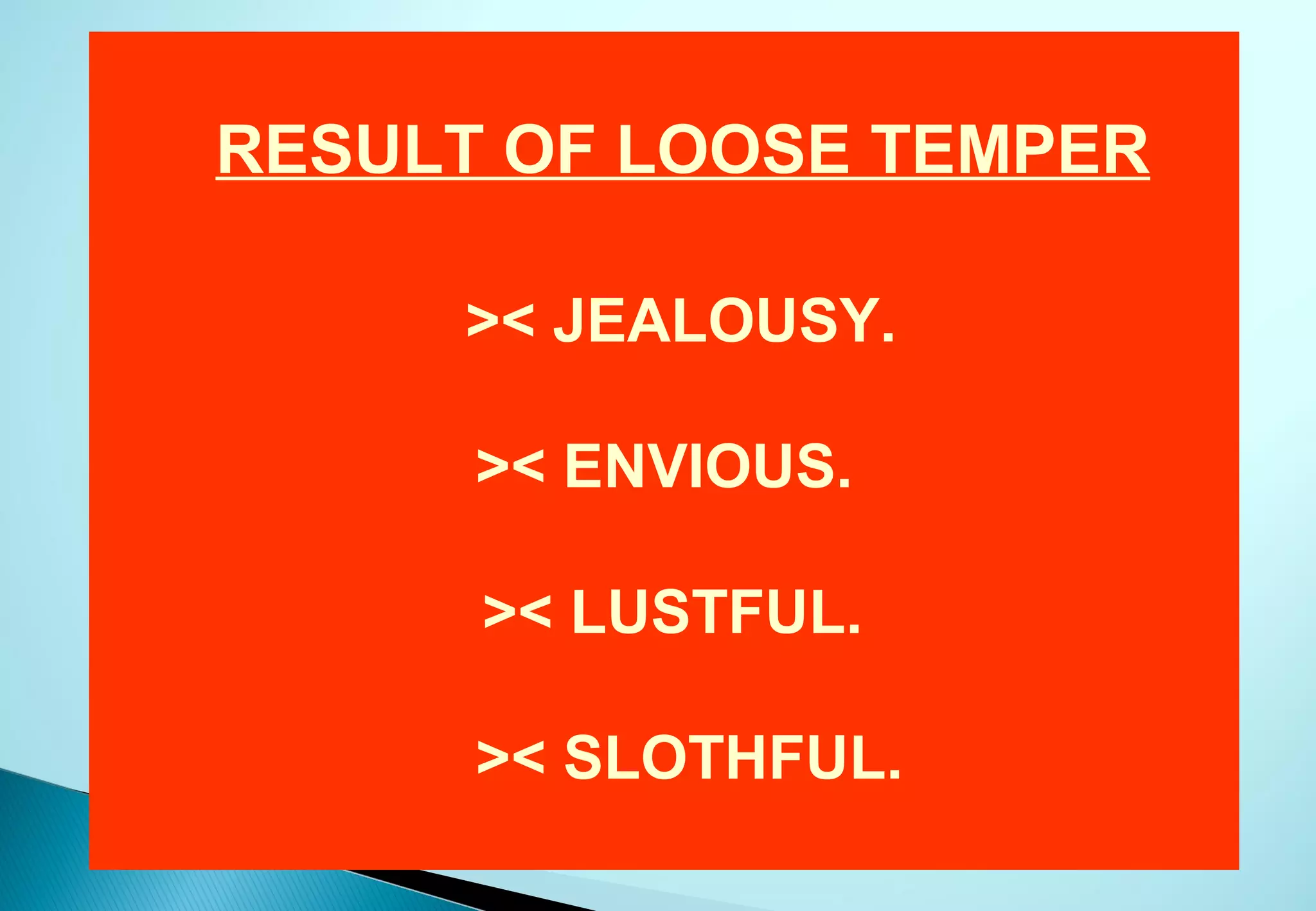
RESULT OF LOOSE TEMPER

     >< JEALOUSY.

      >< ENVIOUS.

      >< LUSTFUL.

      >< SLOTHFUL.
WAYS TO SPARK MORALE
   Encourage soldiers to grow.

   Hear their speeches.

   Be consistent.

   Communicate skillfully

   Reward & recognize

   Build relationship constantly.
SEVEN HABIT OF UNIQUE HUMAN
            ENDOWMENTS

1.    Be proactive.
                                Primary human
2.    Begin with an end in         Endowment.
      mind.                    (Private Victory)
3.    Put first thing first.
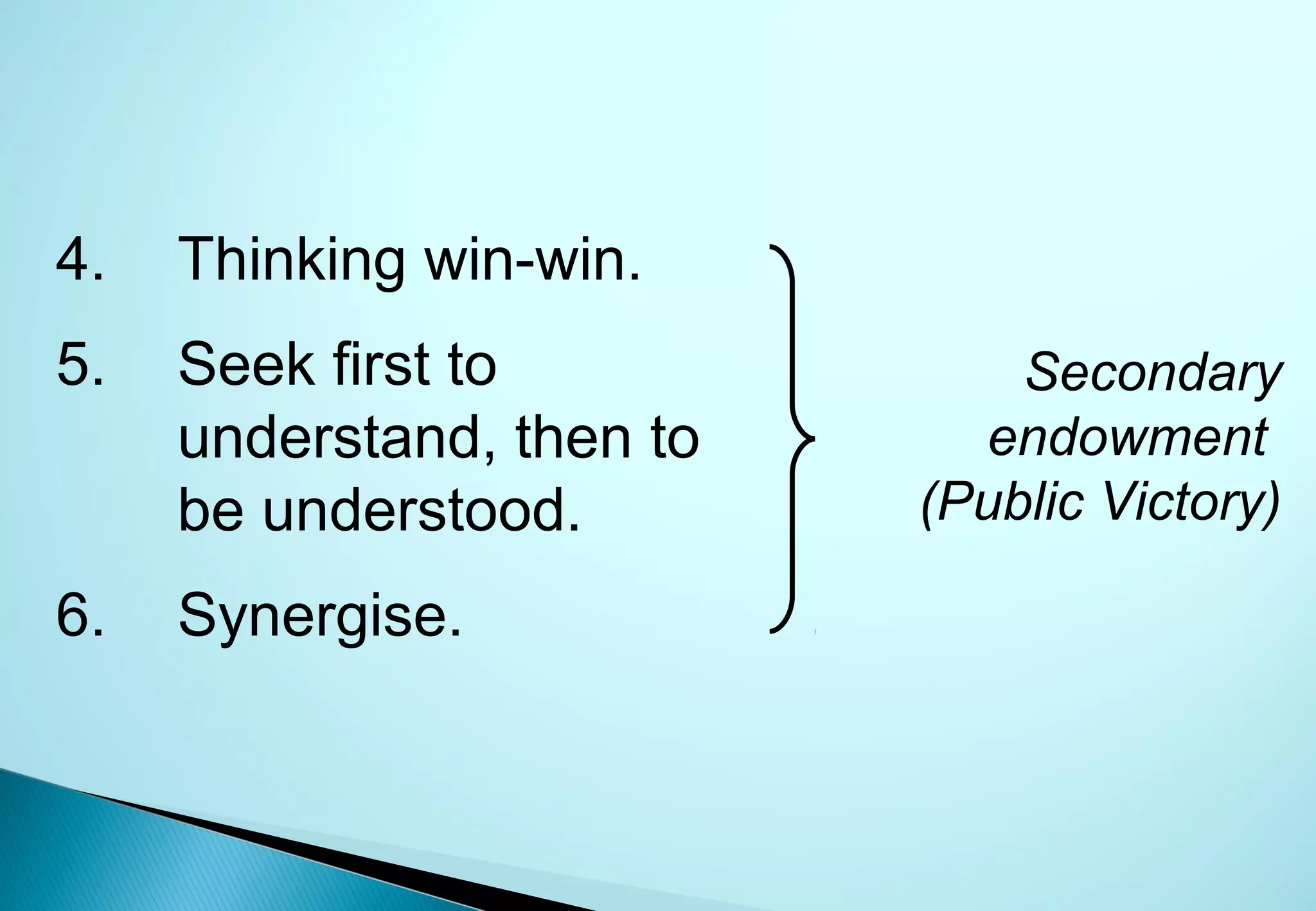
4.   Thinking win-win.
5.   Seek first to             Secondary
     understand, then to     endowment
     be understood.        (Public Victory)

6.   Synergise.
7. Sharpen the saw – Self renewal.
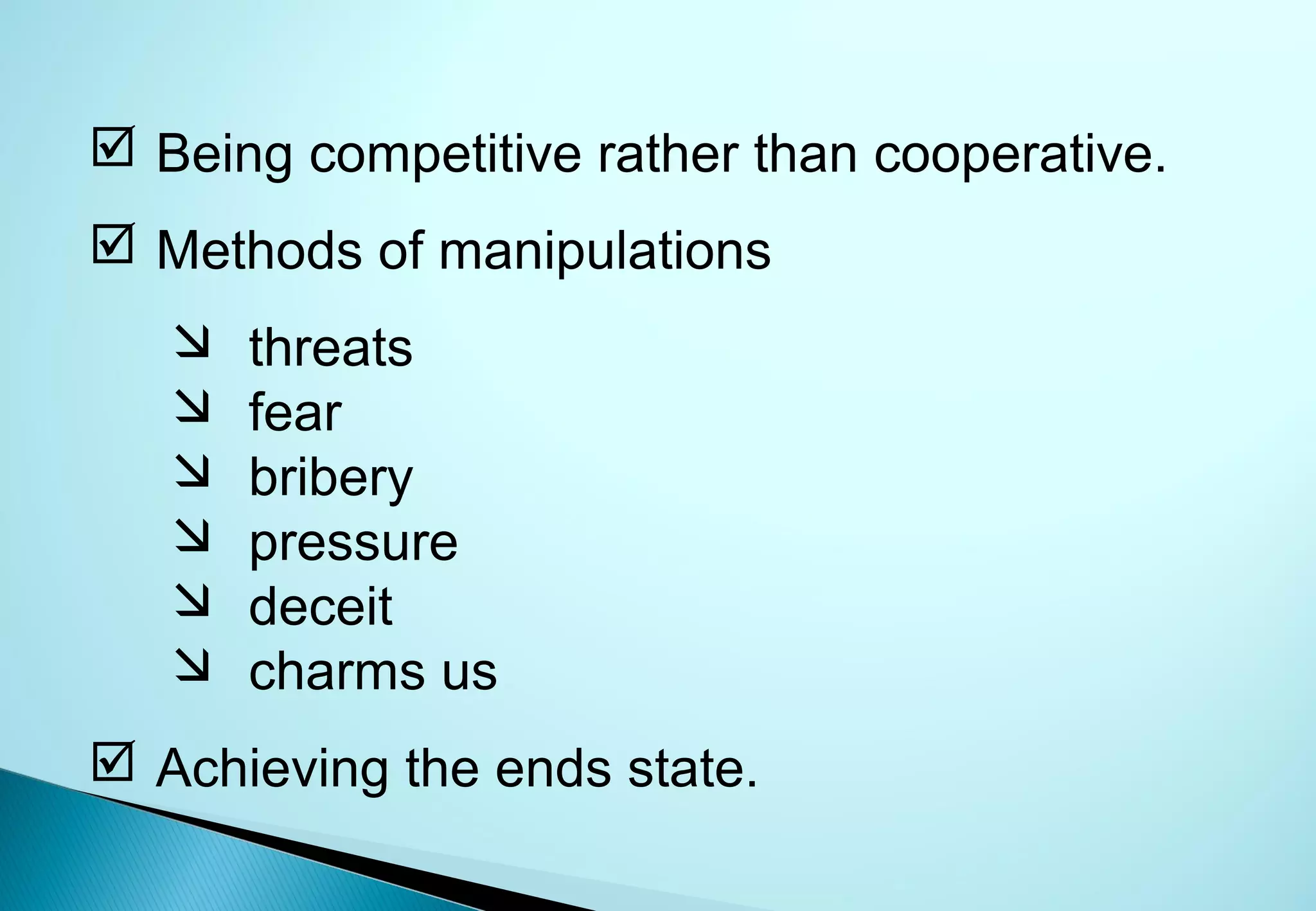
 Being competitive rather than cooperative.
 Methods of manipulations
      threats
      fear
      bribery
      pressure
      deceit
      charms us
 Achieving the ends state.
A MILITARY LEADER IS CALL A


COMMANDER
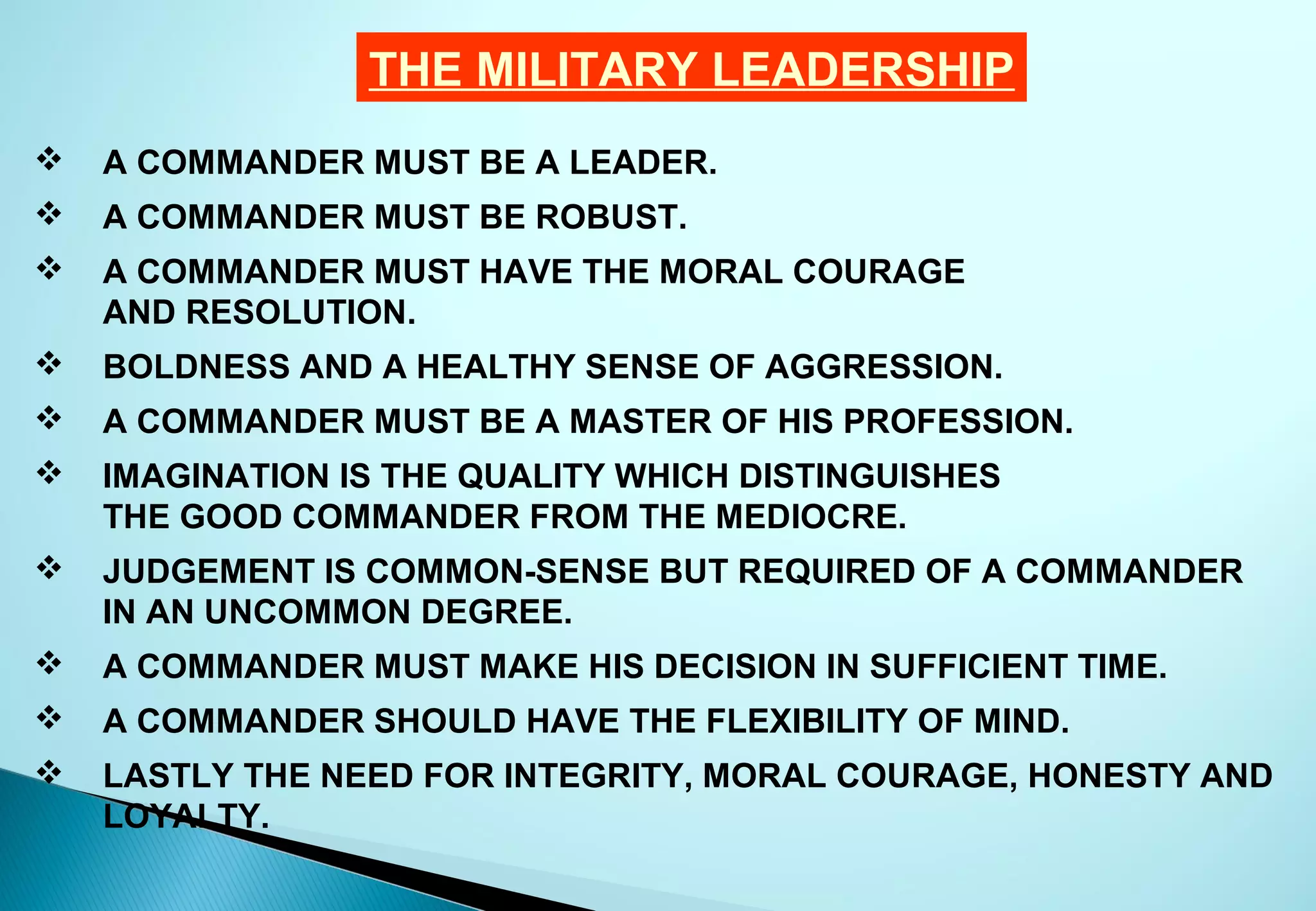
THE MILITARY LEADERSHIP
   A COMMANDER MUST BE A LEADER.
   A COMMANDER MUST BE ROBUST.
   A COMMANDER MUST HAVE THE MORAL COURAGE
    AND RESOLUTION.
   BOLDNESS AND A HEALTHY SENSE OF AGGRESSION.
   A COMMANDER MUST BE A MASTER OF HIS PROFESSION.
   IMAGINATION IS THE QUALITY WHICH DISTINGUISHES
    THE GOOD COMMANDER FROM THE MEDIOCRE.
   JUDGEMENT IS COMMON-SENSE BUT REQUIRED OF A COMMANDER
    IN AN UNCOMMON DEGREE.
   A COMMANDER MUST MAKE HIS DECISION IN SUFFICIENT TIME.
   A COMMANDER SHOULD HAVE THE FLEXIBILITY OF MIND.
   LASTLY THE NEED FOR INTEGRITY, MORAL COURAGE, HONESTY AND
    LOYALTY.
THE POLITICAL OBJECT IS THE GOAL,
WAR IS THE MEANS OF REACHING IT,
AND THE MEANS CAN NEVER BE
CONSIDERED IN ISOLATION FROM
THEIR PURPOSE
                  Clausewitz
Introduction to military leadership

Introduction to military leadership

  • 1.
    Semester 2 2012/2013 “INTRODUCTIONTO MILITARY LEADRDESHIP” LECTURER: LT KOL UNGKU AZLY BIN UNGKU ZAHAR - FPPP NATIONAL DEFENCE UNIVERSITY of MALAYSIA Sungai Besi Camp, 57000 Kuala Lumpur
  • 2.
  • 3.
  • 4.
    SCOPE  INTRODUCTION.  MILITARYLEADRESHIP – A LEADER & A MANAGER.  MILITARY LEADERSHIP CONCEPT.  PROCESS OF EFFECTIVE MILITARY LEADER.  MILITARY LEADERSHIP QUALITIES.  HUMAN & MOTIVATION.  CONCLUSION.
  • 5.
    MILITARY LEADER LEADERSHIP MANAGER (COMMANDER)
  • 6.
    COMMAND THEAUTHORITY A MEMBER OF THE ARMED FORCES LAWFULLY EXERTS OVER SUBORDINATES BY VIRTUE OF HIS RANK OR ASSIGNMENT.
  • 7.
    LEADER A PERSON WHOINFLUENCES AND DIRECTS OTHERS.
  • 8.
    MANAGEMENT THE PROCESS WHEREBY THE RESOURCES OF MEN, MONEY, MATERIAL AND FACILITIES ARE UTILIZED TO ACCOMPLISH THE MISSIONS AND TASKS OF THE ORGANISATION. THE FUNCTION OF MANAGEMENT ARE PLANNING, ORGANIZING, DIRECTING, CO- ORDINATING AND CONTROLLING.
  • 9.
    MILITARY LEADERSHIP THE ART OF INFLUENCING AND DIRECTING MAN IN SUCH A WAY AS TO OBTAIN THEIR WILLING OBEDIENCE, CONFIDENCE, RESPECT AND LOYAL COOPERATION IN ORDER TO ACCOMPLISH THE MISSION.
  • 10.
    IN WAR THECHIEF INCALCULABLE IS THE. HUMAN WILL LIDDELL HART
  • 11.
    LEADERSHIP TRAITS PERSONAL QUALITIES OF DIRECT VALUE TO THE LEADER IN GAINING THE WILLING OBEDIENCE, RESPECT AND LOYAL COOPERATION OF HIS MEN IN ACCOMPLISHING HIS MISSION.
  • 12.
    LEADERSHIP PRINCIPLES FUNDAMENTALGUIDELINES FOR THE SELECTION OF APPROPRIATE ACTIONS AND ORDER IN THE PROPER EXERCISE OF COMMAND.
  • 13.
    “The ability tokeep a cool head in an emergency, maintain poise in the midst of excitement and refuse to be stampeded are true marks of leadership” - R.SHAHNON -
  • 14.
    FIVE DISTINCT ASPECTOF AN EFFECTIVE LEADER  Provide direction  Team building  Develop commitment  Sets example  Being accepted
  • 15.
    LEADERSHIP CONCEPT  QUALITIESCONCEPT - THOSE ASPECTS OF CHARACTER  SITUATIONAL CONCEPT – INDIVIDUAL BEST EQUIPPED WITH THE SKILLS TO DEAL WITH PARTICULAR SITUATION  FUNCTIONAL CONCEPT – RECOGNISES THE INTERACTION BETWEEN THE LEADER, THE GROUP AND THE SITUATION
  • 16.
    LEADER Vs MANAGER  Innovates Administer  Original Copy  Develops Maintains  Focuses on People Focuses on System  Inspires Trust Relies on Control  Long Range Perspective Short Range View  Asks What/why Asks How/when  Eyes on Horizon Eyes on Bottom Line  Originates Imitates  Challenges It Accepts Status Quo  His Own Person Classic Good Soldier  Does the Right Things Does good soldier  Sits in his office Play GOLF
  • 17.
    PROCESS OF EFFECTIVELEADER  CREATING A VISION OF SOME FUTURE DESIRED STATE – BY ASSESSING WHERE YOU ARE, AND ENVISIONING WHERE YOU WANT TO BE.  CREATING A DECISION ON SOME STRATEGY FOR ACCOMPLISHING THAT DESIRED STATE – BY FORMULATING THE DECISION PROBLEM, AND DECIDING BETWEEN THE ALTERNATIVE STRATEGIES.  CREATING ACTION FOR PUTTING THAT STRATEGY INTO EFFECT – BY COMMUNICATING THE CHOSEN STRATEGY AND IMPLEMENTING THE STRATEGY BY EMPOWERING YOUR FOLLOWERS.
  • 18.
    “Treat a manas he is, and he will remain as he is, treat a man as he can and should be, and he will become as he can and should be” - Goethe -
  • 19.
    LEADERSHIP TRAITS  LOYALTY.  COURAGE.  WILL POWER.  PROFESSIONAL KNOWLEDGE.  INITIATIVE.  JUDGEMENT.  INTEGRITY.  SELF CONFIDENCE.  ENTHUSIUM.  ABILITY TO COMMUNICATE  COMPETENCE.  LOOKING FORWARD.  ENDURANCE.  EMPATHY.
  • 20.
    1. Integrity value we place in 2. Maturity courage and consideration 3. Abundance deep sense of Mentality personal worth and security
  • 21.
    Tries to please everybodyeventually become nothing to everyone.
  • 22.
     being competitiverather than cooperative.  Methods of manipulations  threats  fear  bribery  pressure  deceit  charms us  Achieving the ends state.
  • 23.
    ACT Analyze your situationChoose the best strategy Track your choice.
  • 24.
  • 25.
    SELF MENTAL SELF SELF HUMAN SPRITUAL PHYSICAL STRUCTURE SELF EMOTIONS
  • 26.
    SELF AWARENESS  Knowingone’s internal states  Preferences  Resources  Intuitions  Emotional Self-awareness – Recognizing one’s emotions and their effects.  Accurate Self-awareness – Knowing one’s strengths and limits.  Self-confidence – Sureness about one’s self-worth and capabilities.
  • 27.
    TIPS TO INCREASESELF AWARENESS  Examine how you make appraisal  Tune in to your senses  Get in touch with your feeling  Learn what your intentions are  Pay attention to your actions
  • 28.
    SELF MANAGEMENT  Managingone’s internal states, impulses and resources.  Self-control: Managing disruptive emotions and impulses.  Conscientiousness and integrity: taking responsibility.  Adaptability: Flexibility in handling change.  Initiative and innovation: Readiness to act on opportunities and openness to new ideas.  Achievement Drive: Striving to improve or meet a standard of excellence.
  • 29.
    SOCIAL AWARENESS  Awareness:Other’s feeling, needs and concerns.  Empathy: Sensing other’s feeling and perspective.  Service Orientation: Anticipate, recognize and meet customers needs.  Developing others: Sensing what others need to develop.  Political Awareness: Understand group emotional and power relationship.
  • 30.
    UNDERSTANDING OTHERS  Whatis the person’s feeling?  Will his feelings effect his thinking?  Will his feelings effect his behavior  Will his emotions hamper his ability to be rational?  List the emotions he is feeling
  • 31.
    DEVELOP ABILITY TO USE EMOTIONS Understand how feelings effects thinking.  Happy.  Fear.  Surprise.  Sadness.  Anger.
  • 32.
    FEAR of UNCERTAINITY  False  Emotions  Appearing  Real
  • 33.
    SOCIAL MANAGEMENT Adaptability toOrganisational environment.  Leadership: Inspires and guiding Other, influence, effective persuasion.  Comms: Clear and convincing msg.  Change Catalyst: Initiate and manage change.  Conflict Environment: Negotiating disagreements.  Collaboration and building bonds: coop with others and strengthening relationship.  Team capabilities: Create gp synergy in pursuing collective goals.
  • 34.
    NO ONE ISRICH ENOUGH TO DO WITHOUT A NEIGHBOUR - DANISH PROVERB -
  • 35.
    “Those who possessthe rare skill to be angry with the right person, to the right degree, at the right time, for the right purpose and in the right way are at an advantage in any domain in life”
  • 36.
  • 37.
    RESULT OF LOOSETEMPER >< JEALOUSY. >< ENVIOUS. >< LUSTFUL. >< SLOTHFUL.
  • 38.
    WAYS TO SPARKMORALE  Encourage soldiers to grow.  Hear their speeches.  Be consistent.  Communicate skillfully  Reward & recognize  Build relationship constantly.
  • 39.
    SEVEN HABIT OFUNIQUE HUMAN ENDOWMENTS 1. Be proactive. Primary human 2. Begin with an end in Endowment. mind. (Private Victory) 3. Put first thing first.
  • 40.
    4. Thinking win-win. 5. Seek first to Secondary understand, then to endowment be understood. (Public Victory) 6. Synergise.
  • 41.
    7. Sharpen thesaw – Self renewal.
  • 42.
     Being competitiverather than cooperative.  Methods of manipulations  threats  fear  bribery  pressure  deceit  charms us  Achieving the ends state.
  • 43.
    A MILITARY LEADERIS CALL A COMMANDER
  • 44.
    THE MILITARY LEADERSHIP  A COMMANDER MUST BE A LEADER.  A COMMANDER MUST BE ROBUST.  A COMMANDER MUST HAVE THE MORAL COURAGE AND RESOLUTION.  BOLDNESS AND A HEALTHY SENSE OF AGGRESSION.  A COMMANDER MUST BE A MASTER OF HIS PROFESSION.  IMAGINATION IS THE QUALITY WHICH DISTINGUISHES THE GOOD COMMANDER FROM THE MEDIOCRE.  JUDGEMENT IS COMMON-SENSE BUT REQUIRED OF A COMMANDER IN AN UNCOMMON DEGREE.  A COMMANDER MUST MAKE HIS DECISION IN SUFFICIENT TIME.  A COMMANDER SHOULD HAVE THE FLEXIBILITY OF MIND.  LASTLY THE NEED FOR INTEGRITY, MORAL COURAGE, HONESTY AND LOYALTY.
  • 45.
    THE POLITICAL OBJECTIS THE GOAL, WAR IS THE MEANS OF REACHING IT, AND THE MEANS CAN NEVER BE CONSIDERED IN ISOLATION FROM THEIR PURPOSE Clausewitz