What is Design?
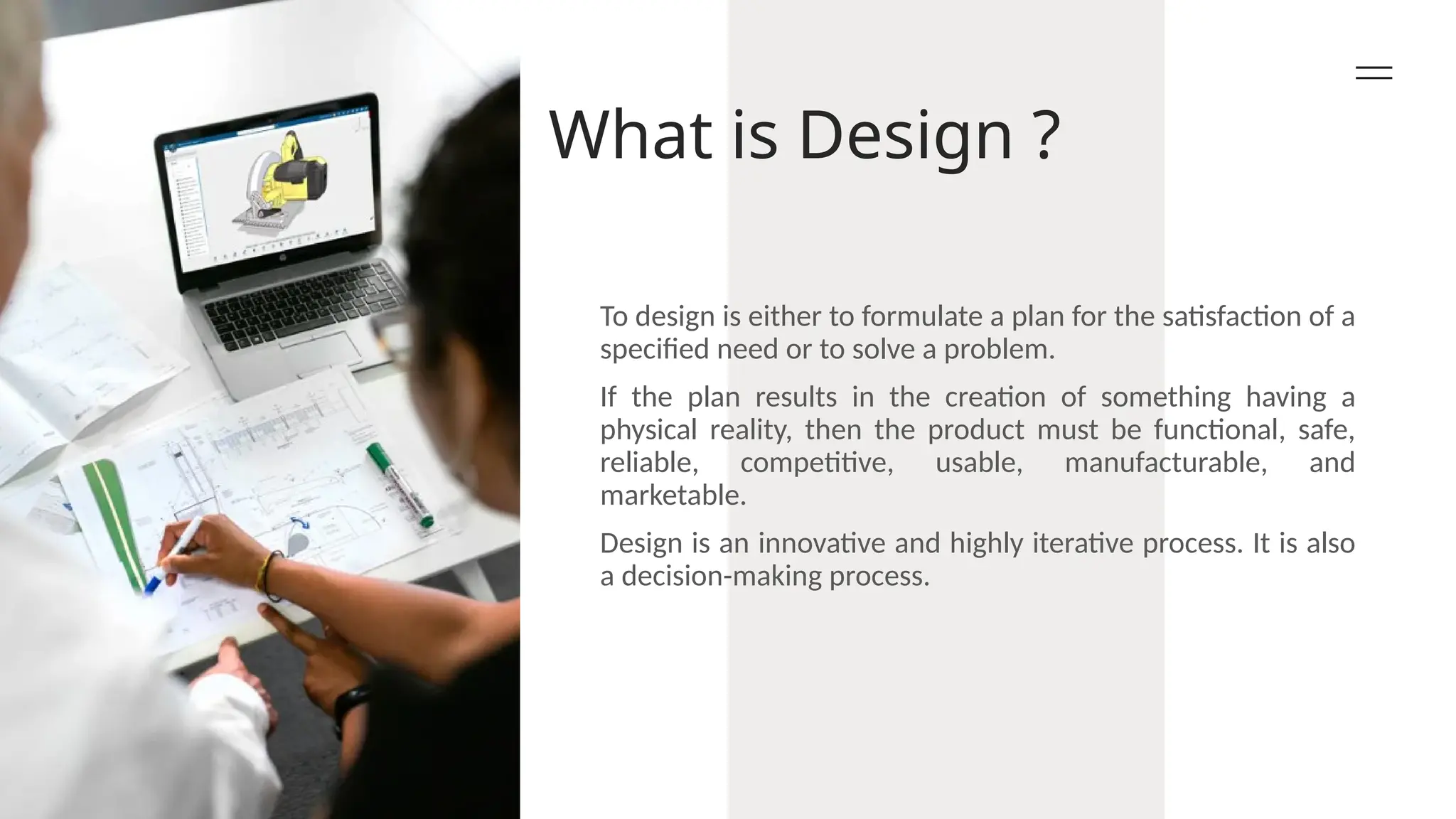
To design is either to formulate a plan for the satisfaction of a
specified need or to solve a problem.
If the plan results in the creation of something having a
physical reality, then the product must be functional, safe,
reliable, competitive, usable, manufacturable, and
marketable.
Design is an innovative and highly iterative process. It is also
a decision-making process.
5.
What is Design?
Decisions sometimes have to be made with too little
information, occasionally with just the right amount of
information, or with an excess of partially contradictory
information.
Decisions are sometimes made tentatively, with the right
reserved to adjust as more becomes known.
The point is that the engineering designer has to be
personally comfortable with a decision-making, problem-
solving role.
6.
What is Mechanical
Design
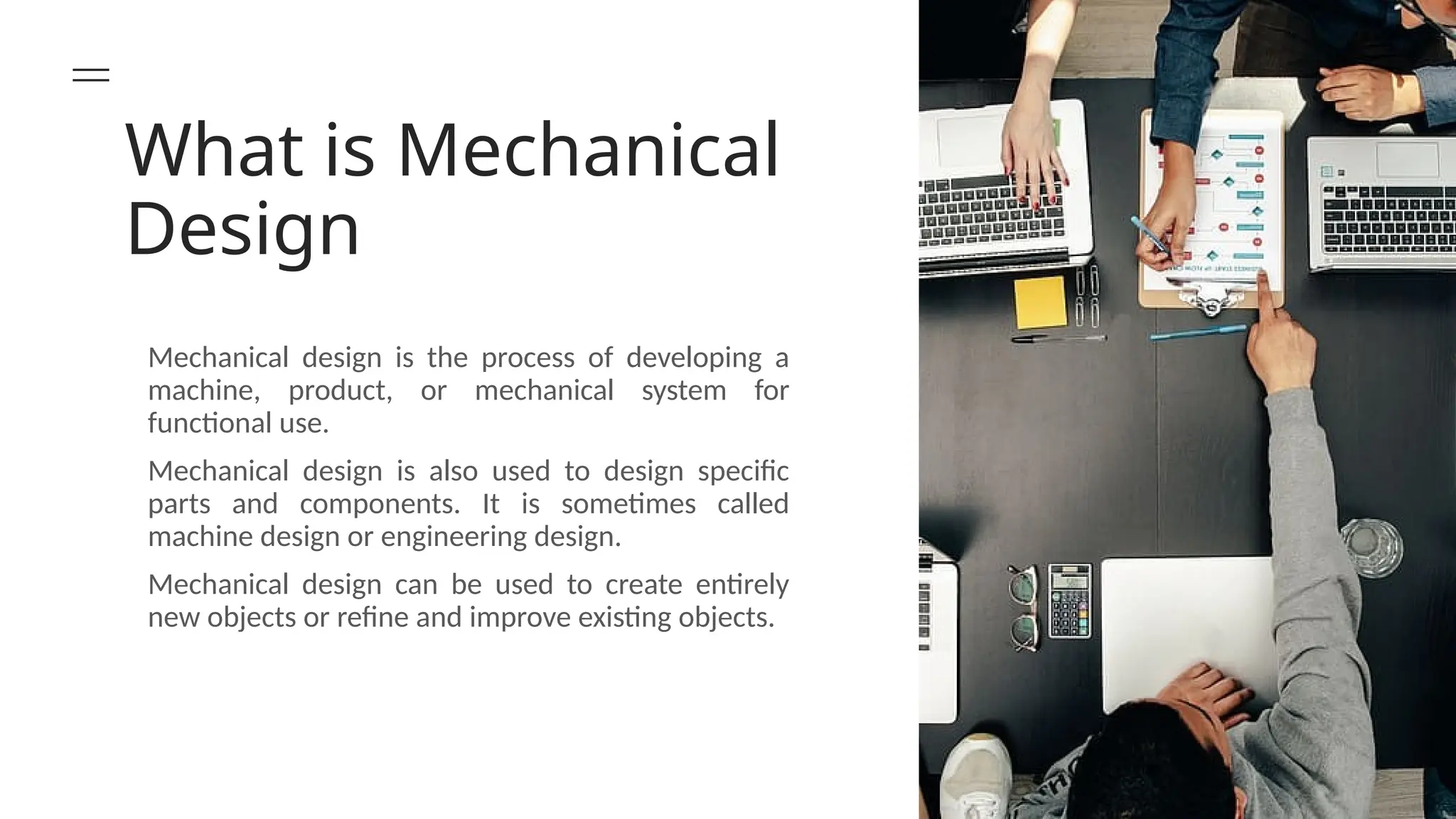
Mechanicaldesign is the process of developing a
machine, product, or mechanical system for
functional use.
Mechanical design is also used to design specific
parts and components. It is sometimes called
machine design or engineering design.
Mechanical design can be used to create entirely
new objects or refine and improve existing objects.
7.
Why is mechanical
designimportant?
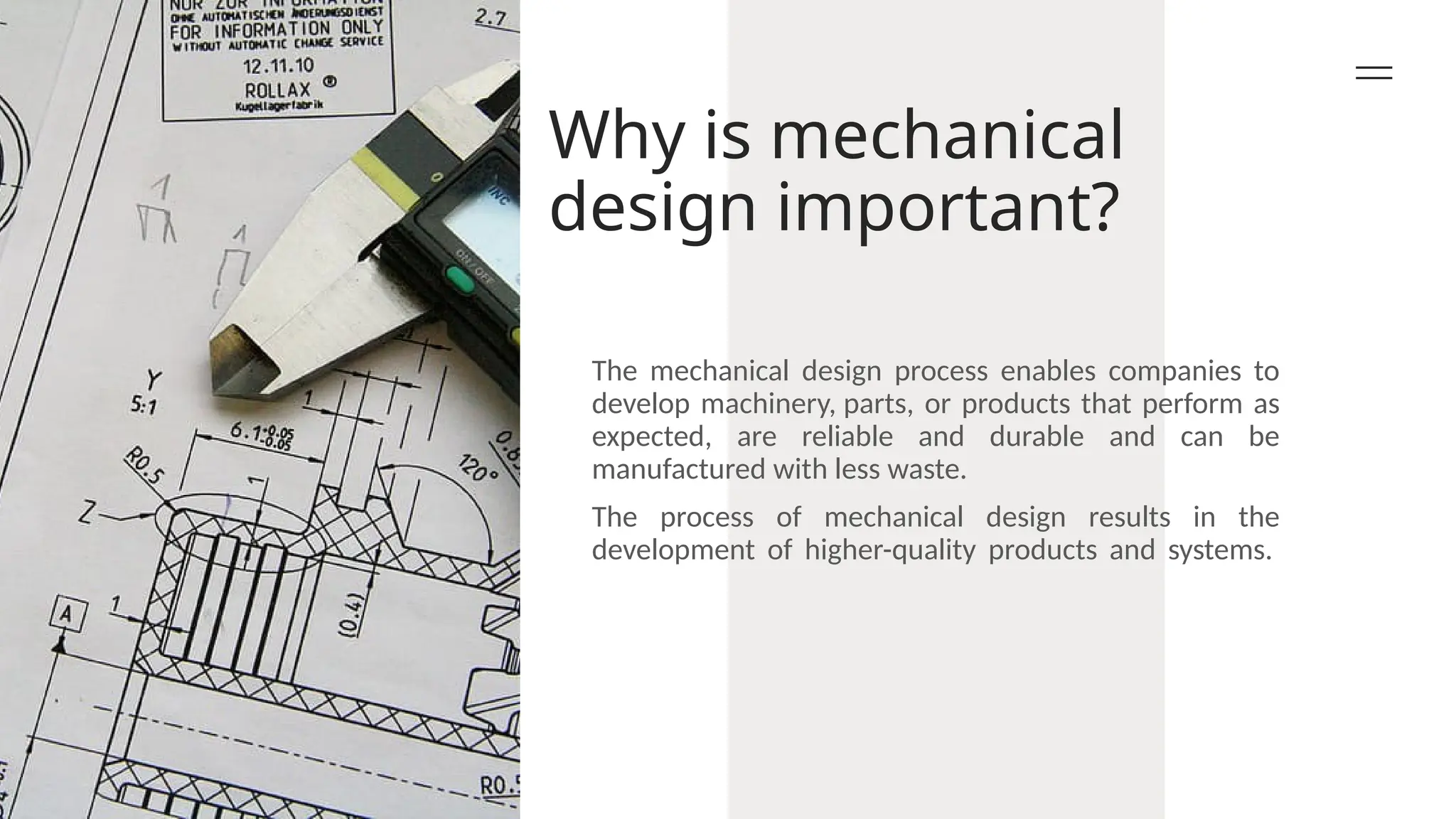
The mechanical design process enables companies to
develop machinery, parts, or products that perform as
expected, are reliable and durable and can be
manufactured with less waste.
The process of mechanical design results in the
development of higher-quality products and systems.
8.
Why is mechanical
designimportant?
Using specialized CAD mechanical engineering
software, a mechanical design engineer can test
different combinations of components or materials,
apply real-world stress tests to products, and change
designs without the need to constantly produce
physical prototypes.
Time-to-market is reduced, error and fault rates are
diminished, and development costs are greatly
decreased.
9.
What are theIndustries in Which Mechanical
Design are Commonly Used?
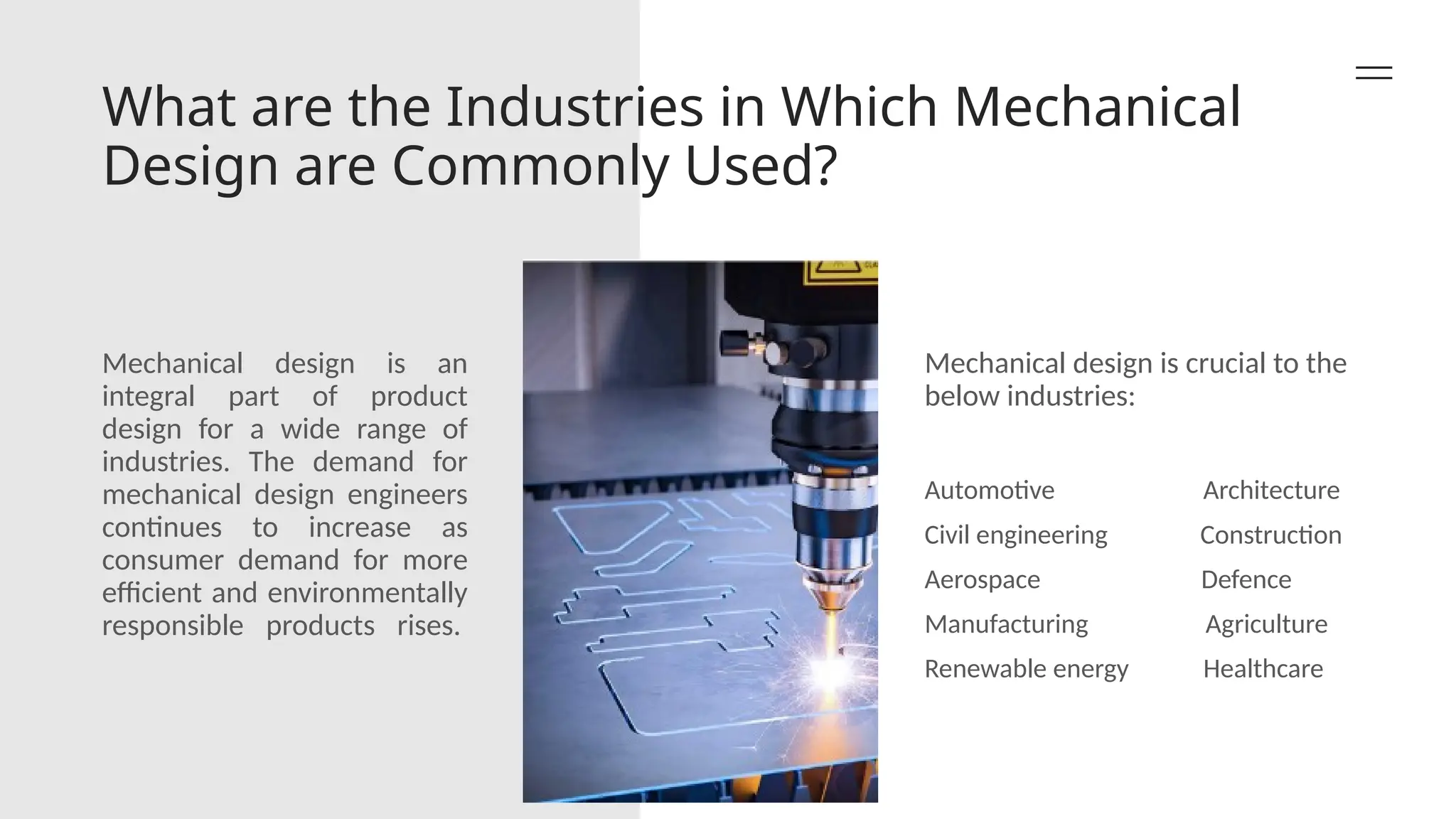
Mechanical design is an
integral part of product
design for a wide range of
industries. The demand for
mechanical design engineers
continues to increase as
consumer demand for more
efficient and environmentally
responsible products rises.
Mechanical design is crucial to the
below industries:
Automotive Architecture
Civil engineering Construction
Aerospace Defence
Manufacturing Agriculture
Renewable energy Healthcare
10.
Roles and responsibilitiesof
a mechanical design
engineer
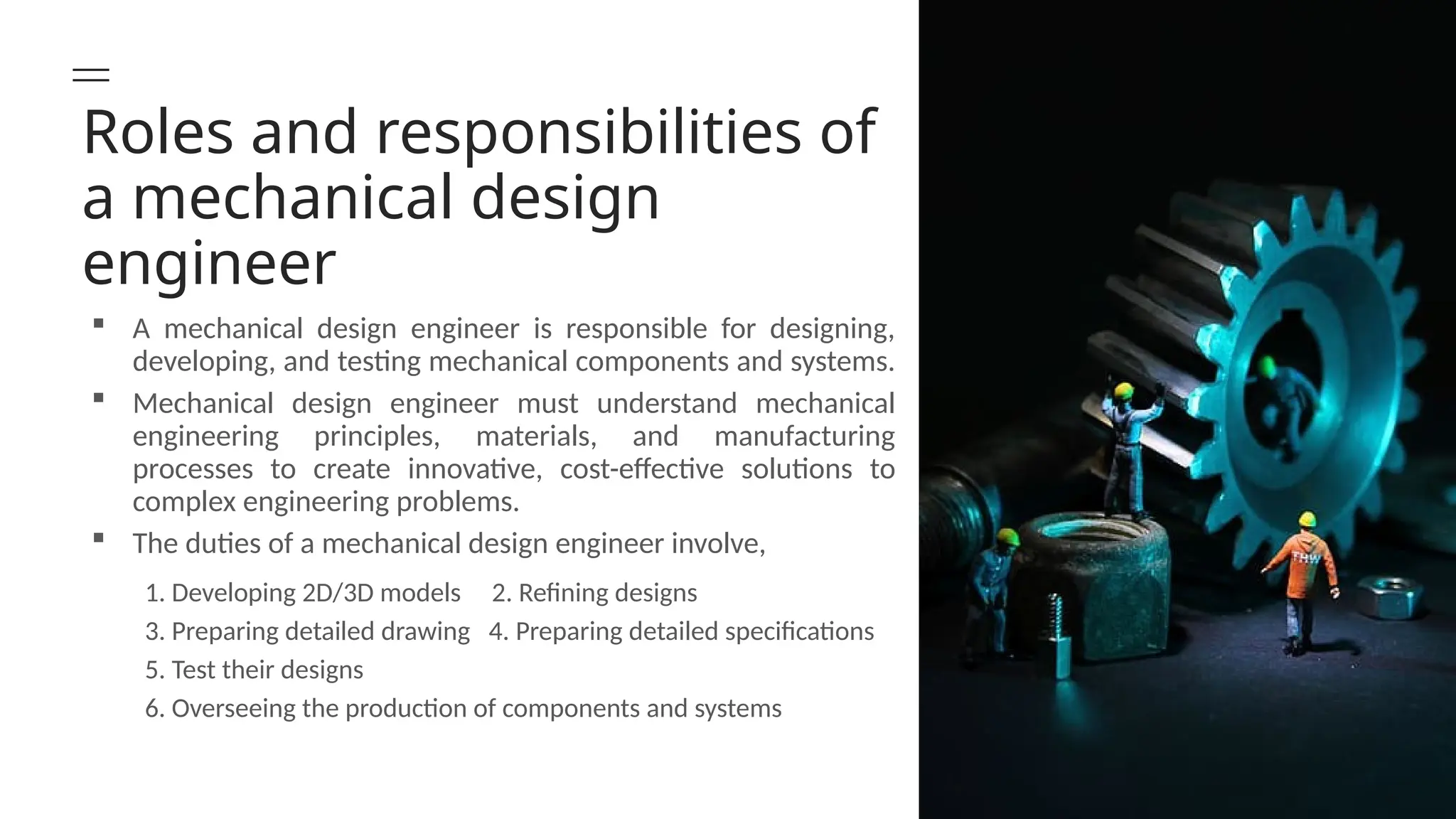
A mechanical design engineer is responsible for designing,
developing, and testing mechanical components and systems.
Mechanical design engineer must understand mechanical
engineering principles, materials, and manufacturing
processes to create innovative, cost-effective solutions to
complex engineering problems.
The duties of a mechanical design engineer involve,
1. Developing 2D/3D models 2. Refining designs
3. Preparing detailed drawing 4. Preparing detailed specifications
5. Test their designs
6. Overseeing the production of components and systems
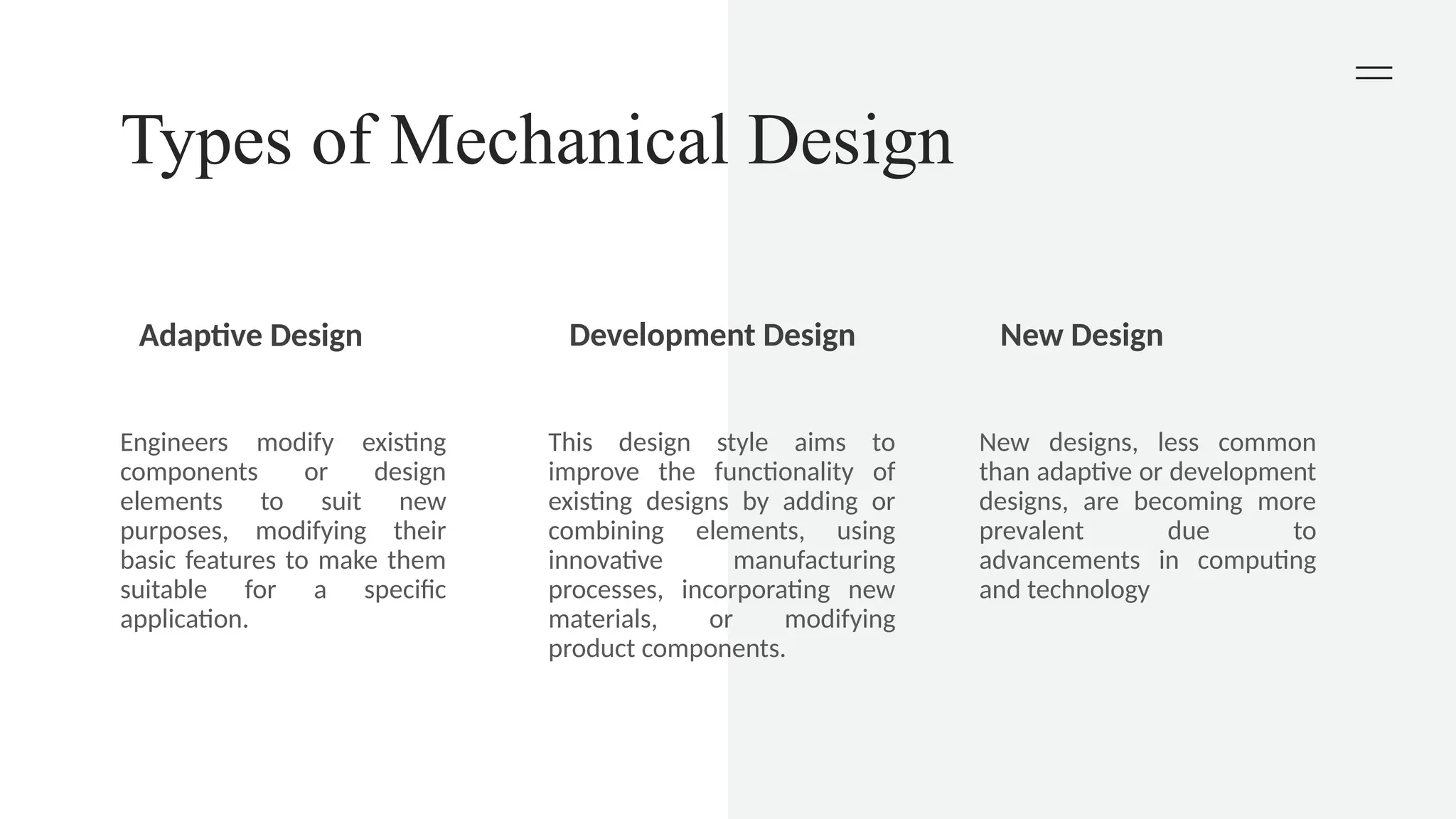
Types of MechanicalDesign
Adaptive Design Development Design New Design
Engineers modify existing
components or design
elements to suit new
purposes, modifying their
basic features to make them
suitable for a specific
application.
This design style aims to
improve the functionality of
existing designs by adding or
combining elements, using
innovative manufacturing
processes, incorporating new
materials, or modifying
product components.
New designs, less common
than adaptive or development
designs, are becoming more
prevalent due to
advancements in computing
and technology
13.
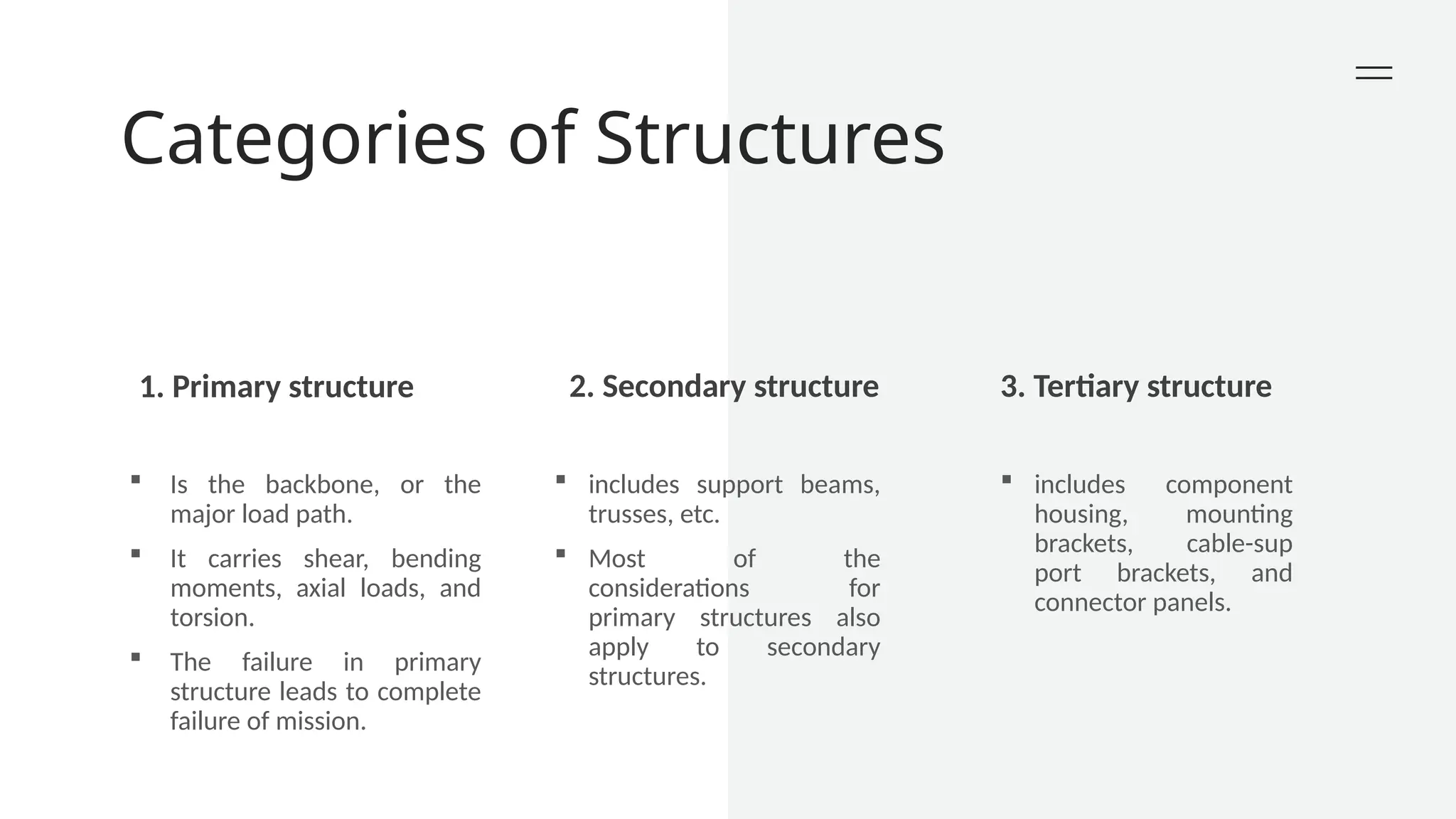
Categories of Structures
1.Primary structure 2. Secondary structure 3. Tertiary structure
Is the backbone, or the
major load path.
It carries shear, bending
moments, axial loads, and
torsion.
The failure in primary
structure leads to complete
failure of mission.
includes support beams,
trusses, etc.
Most of the
considerations for
primary structures also
apply to secondary
structures.
includes component
housing, mounting
brackets, cable-sup
port brackets, and
connector panels.
Structural Requirements
and Constraints
1.Minimum mass requirements
2. Volume requirements
3. Strength requirements
4. Stiffness requirements
5. Requirements for dimensional accuracy and
stability
6. Requirements for Production and
Processing Facility
7. Unification requirements
16.
Structural Design Phases
1.Conceptual design 2. Preliminary design 3. Detailed design
The phase of establishing feasibility
and estimate cost and risk.
Support system trade studies or
proposals.
It also contains deriving requirements,
identifying candidate types of
structures, materials, and
attachments.
Develops the designs far enough to
estimate and compare weight, cost,
and risk; and select from options.
Identifying the best
arrangement, shape, and sizes of
structural members of the
winning candidates.
Types and forms of materials are
selected
Design of attachments is also
developed
The beginning of manufacturing
plan, and development of
testing.
Final dimensions and manufacturing
tolerances, identifying fastener sizes
and installation torques and designing
tertiary structures.
Doing all analyses necessary to justify
decisions.
The product team develops
manufacturing processes and plans
verification tests.
Detailed design ends when the last
engineering drawing for
manufacturing is released.
17.
Mechanical Design
Process
The processbegins with an identification of a need and a
decision to do something about it. After many iterations,
the process ends with the presentation of the plans for
satisfying the need.
Depending on the nature of the design task, several design
phases may be repeated throughout the life of the
product, from inception to termination.
18.
Mechanical Design
Process
In thetypical mechanical design process, there are 6 steps
involved:
1. Problem Definition
2. Conceptual Design
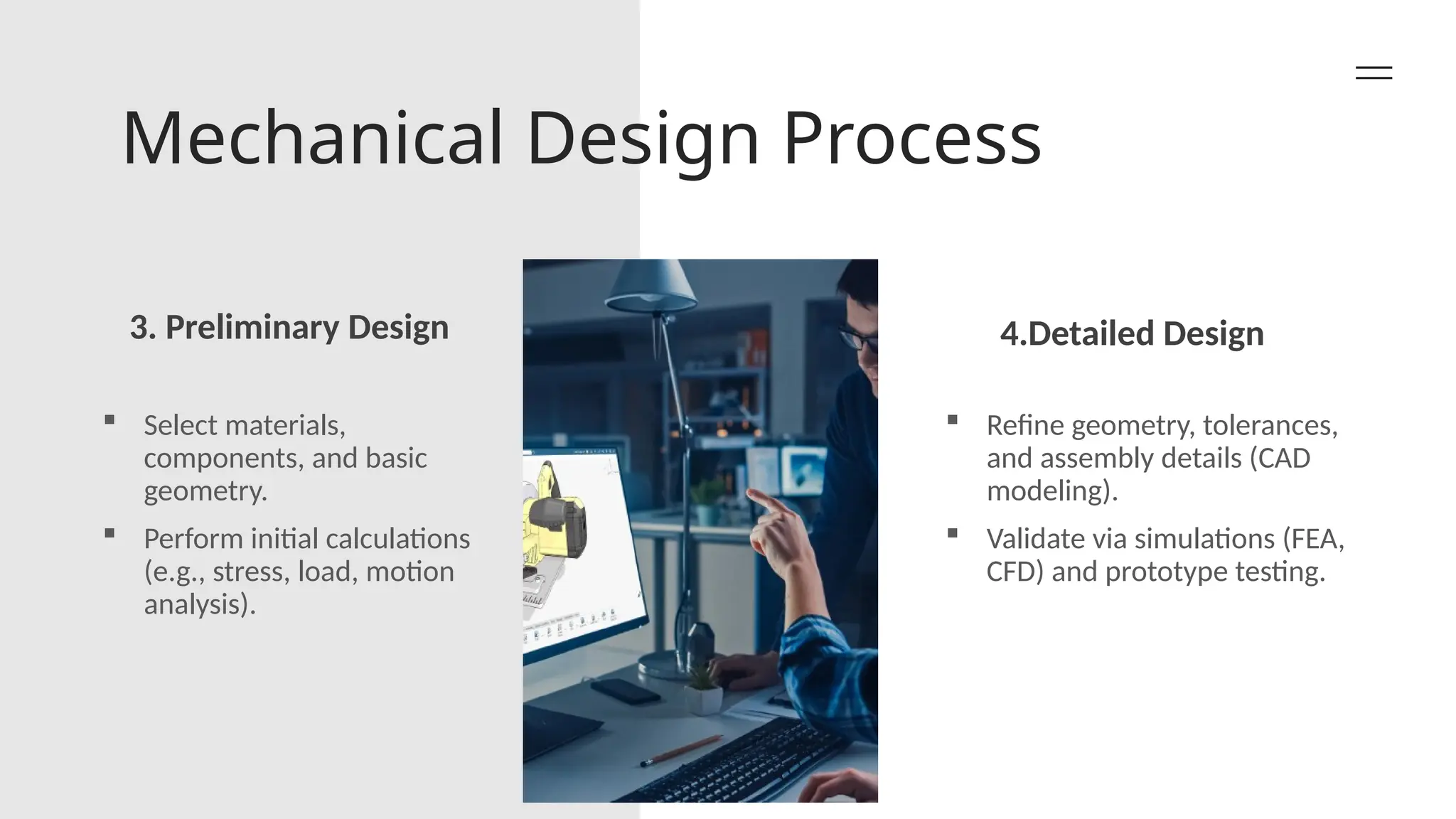
3. Preliminary Design
4. Detailed Design
5. Testing & Validation
6. Production & Implementation
19.
Mechanical Design Process
1.ProblemDefinition 2. Conceptual Design
Identify needs, constraints,
and stakeholder
requirements (e.g., design
brief).
Define performance metrics
and success criteria.
Brainstorming and ideation
(e.g., sketches, mind
maps).
Evaluate concepts using
feasibility, cost, and
performance criteria.
20.
Mechanical Design Process
3.Preliminary Design 4.Detailed Design
Select materials,
components, and basic
geometry.
Perform initial calculations
(e.g., stress, load, motion
analysis).
Refine geometry, tolerances,
and assembly details (CAD
modeling).
Validate via simulations (FEA,
CFD) and prototype testing.
21.
Mechanical Design Process
5.Testing & Validation
6. Production &
Implementation
Prototype testing under
real-world conditions.
Iterate based on feedback
(e.g., durability, usability).
Finalize manufacturing plans
(e.g., tooling, assembly lines).
Transition to mass production
or deployment.
22.
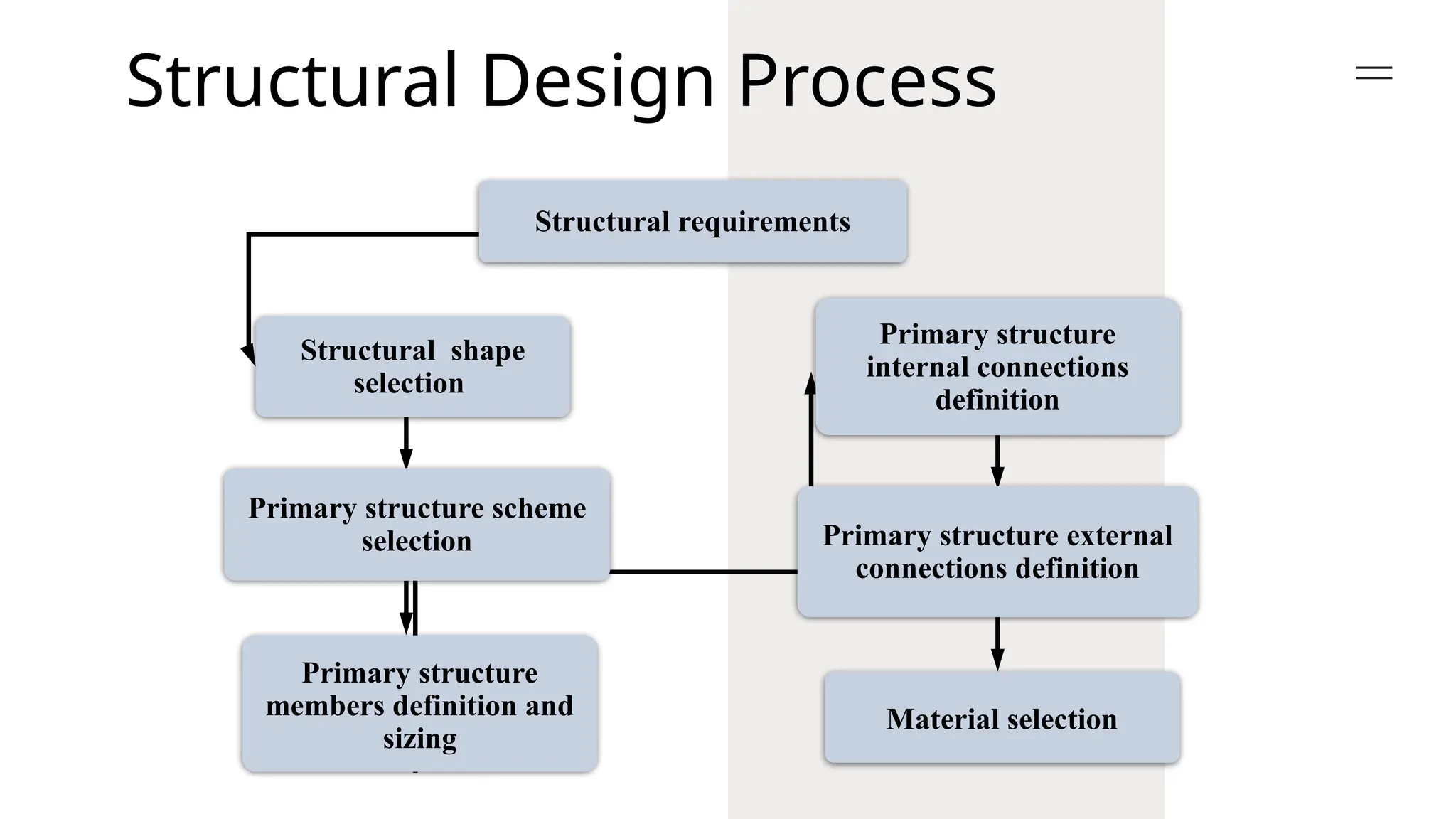
Structural Design Process
Structuralshape
selection
Primary structure scheme
selection
Structural requirements
Primary structure
members definition and
sizing
Primary structure external
connections definition
Material selection
Primary structure
internal connections
definition
Key considerations inmechanical
design
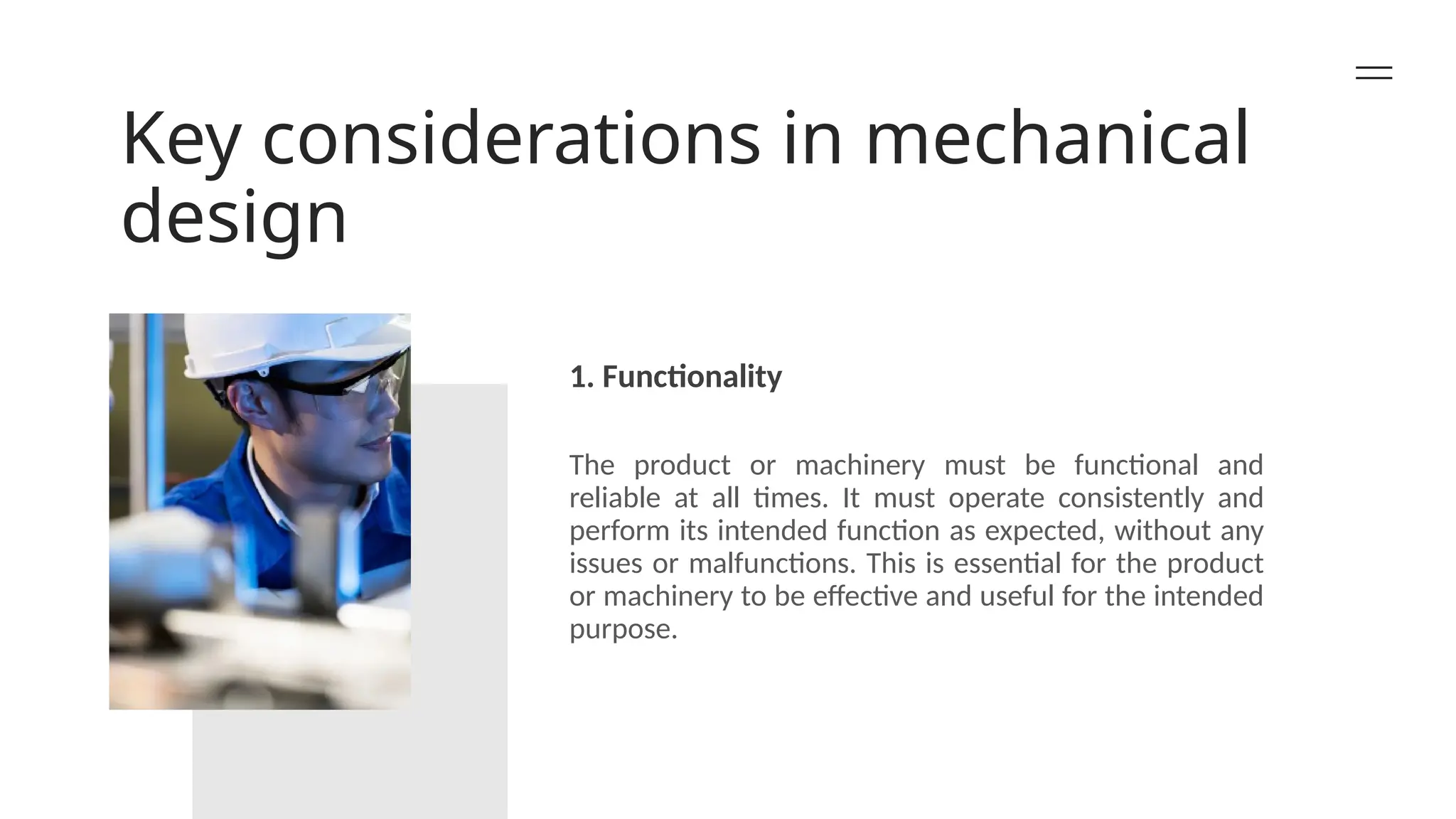
1. Functionality
The product or machinery must be functional and
reliable at all times. It must operate consistently and
perform its intended function as expected, without any
issues or malfunctions. This is essential for the product
or machinery to be effective and useful for the intended
purpose.
25.
Key considerations inmechanical
design
2. Safety 3. Cost
The product or machinery
must be safe to use or
perform its functions safely.
When in use, it must not
endanger the operator or
any persons in its vicinity.
The product or machinery
must conform to all
relevant safety standards.
The total cost of producing
the component or product
needs to be considered. The
optimal mechanical design
will deliver the highest levels
of safety and functionality for
the lowest overall cost.
26.
Key considerations inmechanical
design
4. Manufacturability
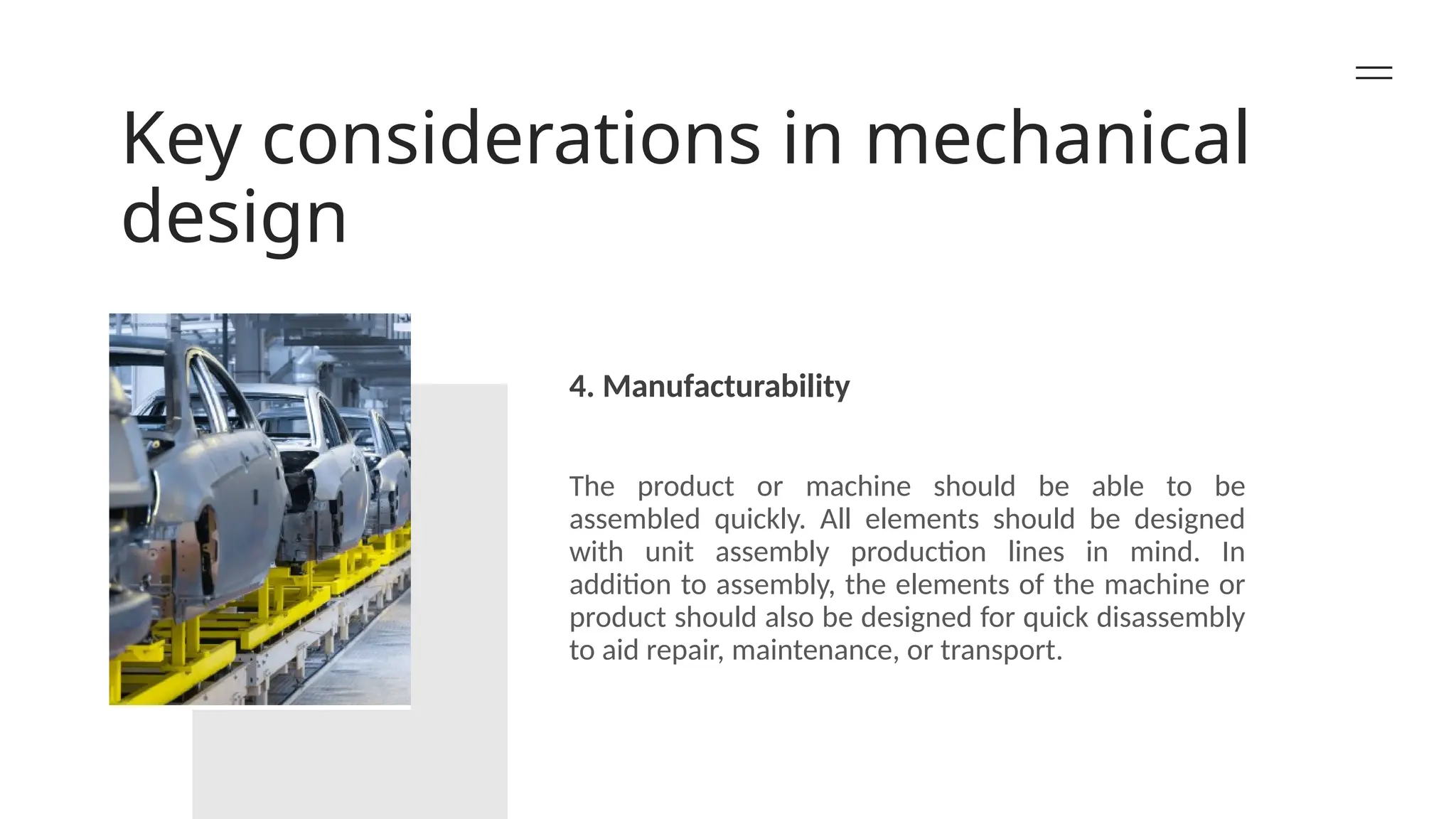
The product or machine should be able to be
assembled quickly. All elements should be designed
with unit assembly production lines in mind. In
addition to assembly, the elements of the machine or
product should also be designed for quick disassembly
to aid repair, maintenance, or transport.
27.
Key considerations inmechanical
design
5. Strength Criteria 6. Material Selection
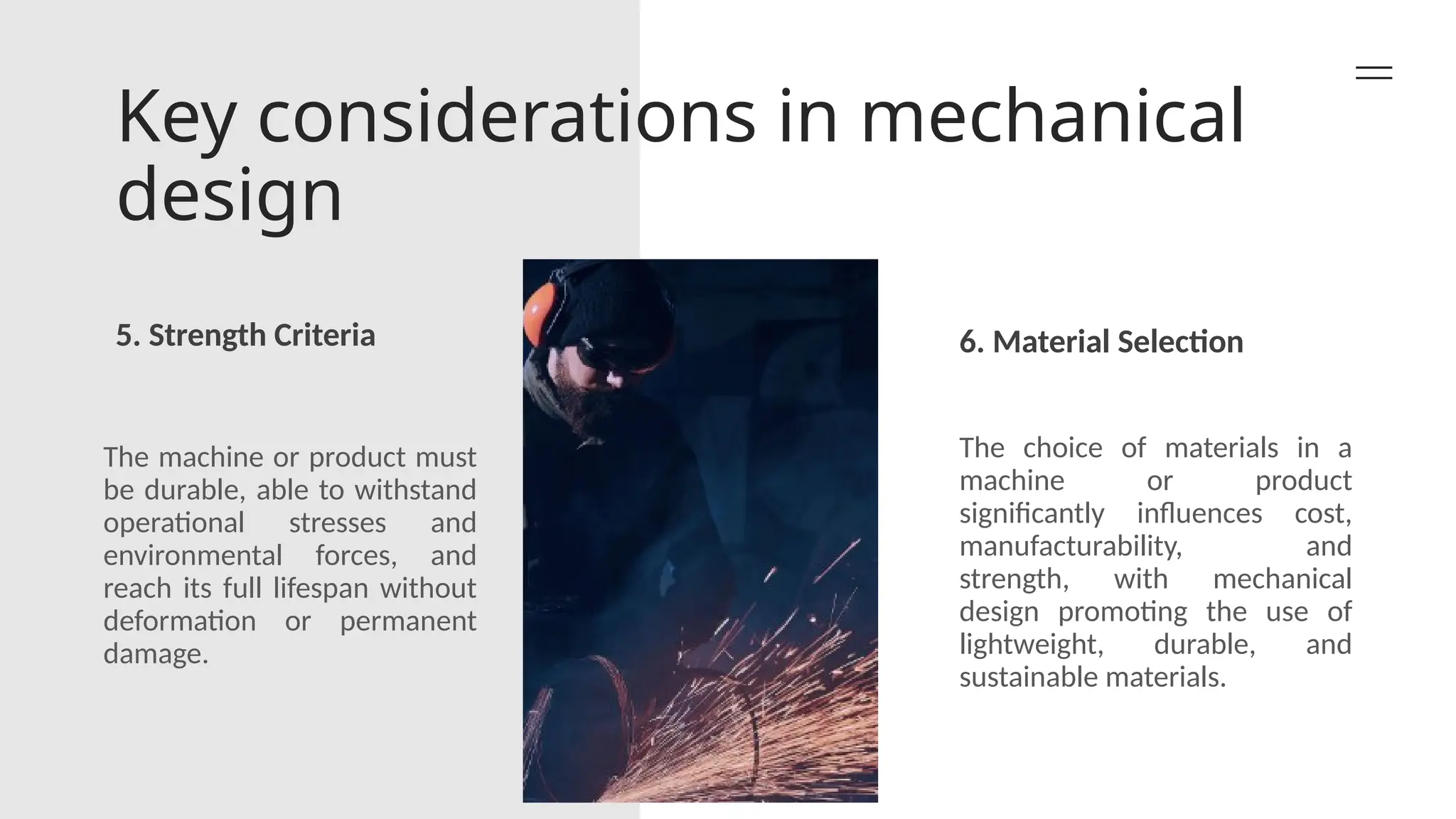
The machine or product must
be durable, able to withstand
operational stresses and
environmental forces, and
reach its full lifespan without
deformation or permanent
damage.
The choice of materials in a
machine or product
significantly influences cost,
manufacturability, and
strength, with mechanical
design promoting the use of
lightweight, durable, and
sustainable materials.
28.
Key considerations inmechanical
design
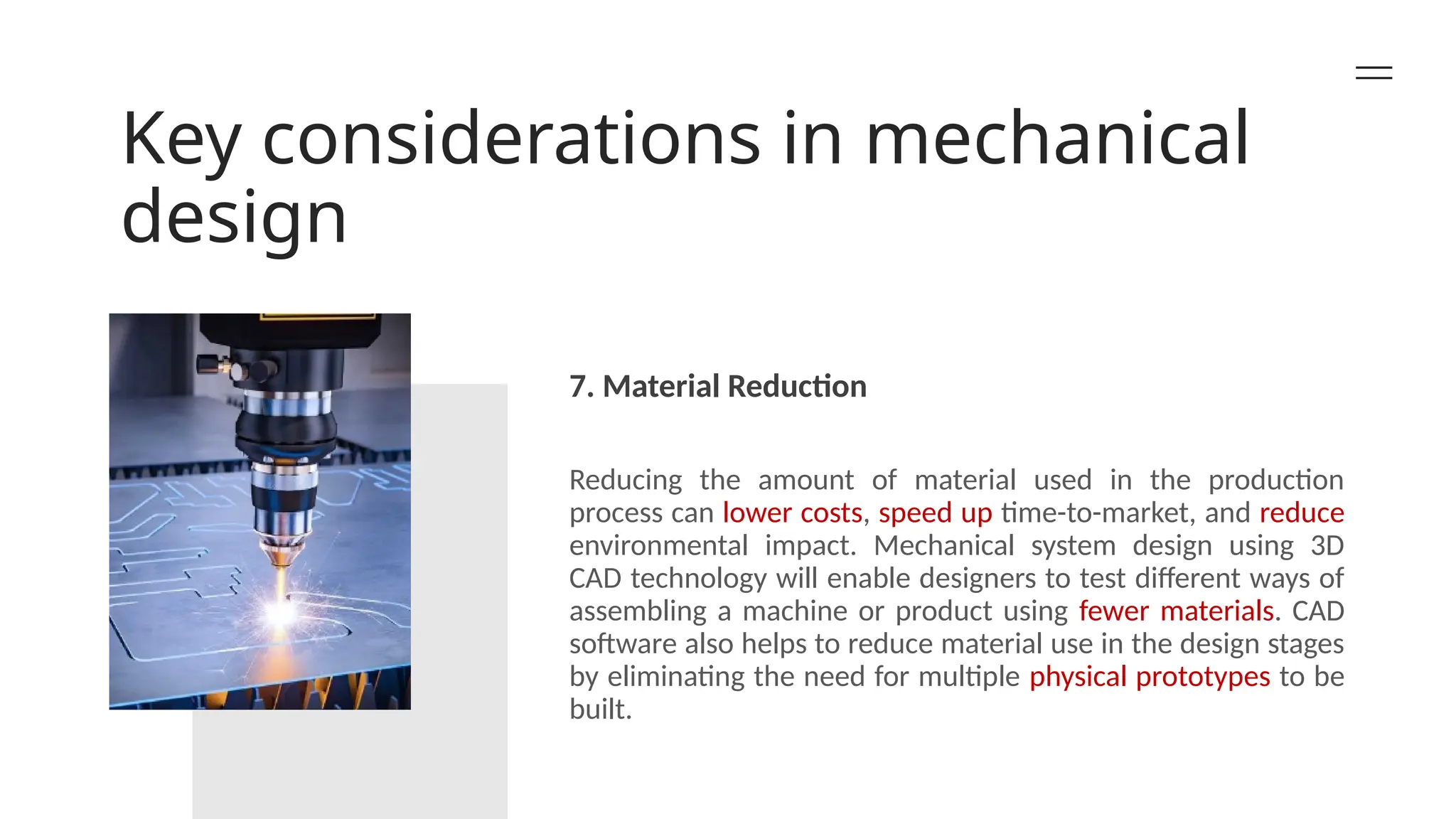
7. Material Reduction
Reducing the amount of material used in the production
process can lower costs, speed up time-to-market, and reduce
environmental impact. Mechanical system design using 3D
CAD technology will enable designers to test different ways of
assembling a machine or product using fewer materials. CAD
software also helps to reduce material use in the design stages
by eliminating the need for multiple physical prototypes to be
built.
29.
Key considerations inmechanical
design
8. Kinematics of
Mechanisms 9. Total Optimization
All mechanisms in a machine
or product should move
smoothly, without stiffness.
Proper lubrication may be
needed to prevent wear. The
kinematic design must ensure
long-term durability, avoiding
self-damage or harm to the
machine over time.
The machine or product should
be optimized in such a way that
all the above considerations are
accounted for. No one factor
should impede the
functionality or efficiency of
another. For example, choosing
a more lightweight material
may increase costs or decrease
strength.