INTRODUCTION TO MACROECONOMICS 
 Macroeconomics is a branch of economics that deals with the performance, structure, and behavior of a 
national economy as a whole. The variables of interest change from the price, demand or supply of a particular 
product to the economy-wide price level, aggregate demand and aggregate supply. 
 Aggregate demand (AD) is the total planned or desired spending (expenditure) in the economy during a given 
period. AD is the sum of consumption, investment, government spending and net exports (i.e. exports minus 
imports), and is inversely related to the aggregate price level through the wealth, interest rate and international 
purchasing power effects. 
 Aggregate supply (AS) is the total value of goods and services that all the firms in the economy would and can 
willingly produce in a given time period. Aggregate supply is a function of available inputs, technology and the 
price level. It slopes upward in P-Output space but the exact slope depends whether the economy is operating at 
below full employment (flat) or full employment (steep). 
 Classical economics is widely regarded as the first modern school of economic thought. Its major developers 
include Adam Smith, David Ricardo, Thomas Malthus and John Stuart Mill. 
1. National Income Accounting 
1.1 Measurement 
National income accounting is measured in order to assess the performance of an economy over a period of time, usually 
a year. 
The accounting needed to measure national income is very complex. Measurement is done in three ways: 
_ national output; (Value-added approach) 
_ national income; (Income/Revenue approach) 
_ national expenditure. (Expenditure approach) 
Note: Each method is subject to error, so final figures need adjustments in order to tally. When goods and 
services are produced, people receive incomes, and thus in theory the addition of the prices of all the 
goods and services should equal the sum of all the income of the population. 
When we wish to measure the productivity of an economy the appropriate measure of national income is gross 
domestic product (GDP). When we wish to measure the standard of living in an economy the appropriate measure is 
gross national product (GNP). 
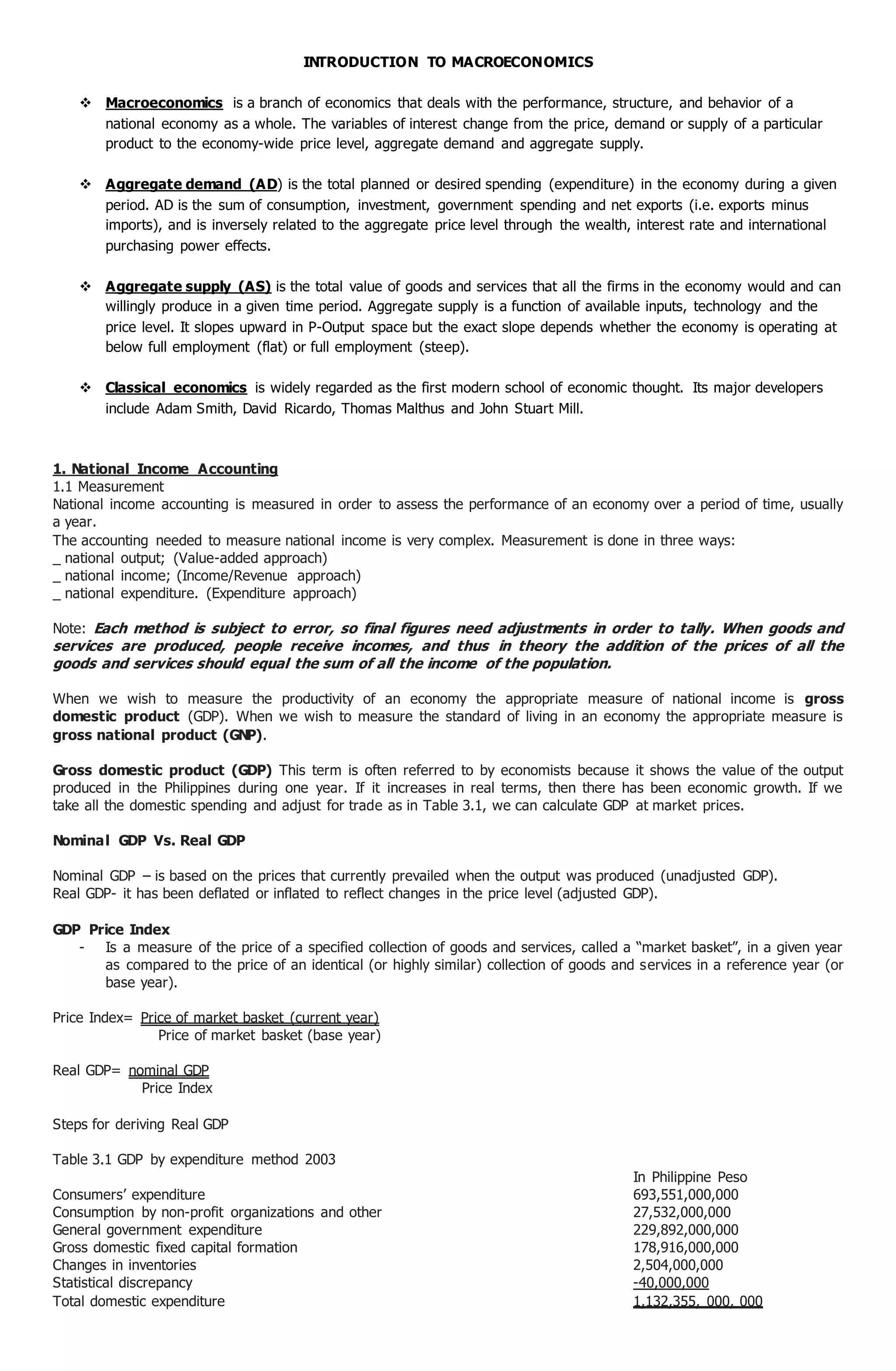
Gross domestic product (GDP) This term is often referred to by economists because it shows the value of the output 
produced in the Philippines during one year. If it increases in real terms, then there has been economic growth. If we 
take all the domestic spending and adjust for trade as in Table 3.1, we can calculate GDP at market prices. 
Nominal GDP Vs. Real GDP 
Nominal GDP – is based on the prices that currently prevailed when the output was produced (unadjusted GDP). 
Real GDP- it has been deflated or inflated to reflect changes in the price level (adjusted GDP). 
GDP Price Index 
- Is a measure of the price of a specified collection of goods and services, called a “market basket”, in a given year 
as compared to the price of an identical (or highly similar) collection of goods and services in a reference year (or 
base year). 
Price Index= Price of market basket (current year) 
Price of market basket (base year) 
Real GDP= nominal GDP 
Price Index 
Steps for deriving Real GDP 
Table 3.1 GDP by expenditure method 2003 
In Philippine Peso 
Consumers’ expenditure 693,551,000,000 
Consumption by non-profit organizations and other 27,532,000,000 
General government expenditure 229,892,000,000 
Gross domestic fixed capital formation 178,916,000,000 
Changes in inventories 2,504,000,000 
Statistical discrepancy -40,000,000 
Total domestic expenditure 1,132,355, 000, 000
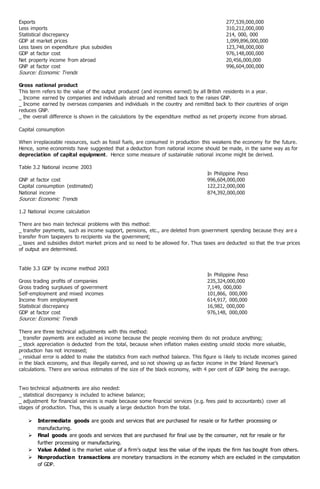
Exports 277,539,000,000 
Less imports 310,212,000,000 
Statistical discrepancy 214, 000, 000 
GDP at market prices 1,099,896,000,000 
Less taxes on expenditure plus subsidies 123,748,000,000 
GDP at factor cost 976,148,000,000 
Net property income from abroad 20,456,000,000 
GNP at factor cost 996,604,000,000 
Source: Economic Trends 
Gross national product 
This term refers to the value of the output produced (and incomes earned) by all British residents in a year. 
_ Income earned by companies and individuals abroad and remitted back to the raises GNP. 
_ Income earned by overseas companies and individuals in the country and remitted back to their countries of origin 
reduces GNP. 
_ the overall difference is shown in the calculations by the expenditure method as net property income from abroad. 
Capital consumption 
When irreplaceable resources, such as fossil fuels, are consumed in production this weakens the economy for the future. 
Hence, some economists have suggested that a deduction from national income should be made, in the same way as for 
depreciation of capital equipment. Hence some measure of sustainable national income might be derived. 
Table 3.2 National income 2003 
In Philippine Peso 
GNP at factor cost 996,604,000,000 
Capital consumption (estimated) 122,212,000,000 
National income 874,392,000,000 
Source: Economic Trends 
1.2 National income calculation 
There are two main technical problems with this method: 
_ transfer payments, such as income support, pensions, etc., are deleted from government spending because they are a 
transfer from taxpayers to recipients via the government; 
_ taxes and subsidies distort market prices and so need to be allowed for. Thus taxes are deducted so that the true prices 
of output are determined. 
Table 3.3 GDP by income method 2003 
In Philippine Peso 
Gross trading profits of companies 235,324,000,000 
Gross trading surpluses of government 7,149, 000,000 
Self-employment and mixed incomes 101,866, 000,000 
Income from employment 614,917, 000,000 
Statistical discrepancy 16,982, 000,000 
GDP at factor cost 976,148, 000,000 
Source: Economic Trends 
There are three technical adjustments with this method: 
_ transfer payments are excluded as income because the people receiving them do not produce anything; 
_ stock appreciation is deducted from the total, because when inflation makes existing unsold stocks more valuable, 
production has not increased; 
_ residual error is added to make the statistics from each method balance. This figure is l ikely to include incomes gained 
in the black economy, and thus illegally earned, and so not showing up as factor income in the Inland Revenue’s 
calculations. There are various estimates of the size of the black economy, with 4 per cent of GDP being the average. 
Two technical adjustments are also needed: 
_ statistical discrepancy is included to achieve balance; 
_ adjustment for financial services is made because some financial services (e.g. fees paid to accountants) cover all 
stages of production. Thus, this is usually a large deduction from the total. 
 Intermediate goods are goods and services that are purchased for resale or for further processing or 
manufacturing. 
 Final goods are goods and services that are purchased for final use by the consumer, not for resale or for 
further processing or manufacturing. 
 Value Added is the market value of a firm’s output less the value of the inputs the firm has bought from others. 
 Nonproduction transactions are monetary transactions in the economy which are excluded in the computation 
of GDP.

Introduction to macroeconomics

  • 1.
    INTRODUCTION TO MACROECONOMICS  Macroeconomics is a branch of economics that deals with the performance, structure, and behavior of a national economy as a whole. The variables of interest change from the price, demand or supply of a particular product to the economy-wide price level, aggregate demand and aggregate supply.  Aggregate demand (AD) is the total planned or desired spending (expenditure) in the economy during a given period. AD is the sum of consumption, investment, government spending and net exports (i.e. exports minus imports), and is inversely related to the aggregate price level through the wealth, interest rate and international purchasing power effects.  Aggregate supply (AS) is the total value of goods and services that all the firms in the economy would and can willingly produce in a given time period. Aggregate supply is a function of available inputs, technology and the price level. It slopes upward in P-Output space but the exact slope depends whether the economy is operating at below full employment (flat) or full employment (steep).  Classical economics is widely regarded as the first modern school of economic thought. Its major developers include Adam Smith, David Ricardo, Thomas Malthus and John Stuart Mill. 1. National Income Accounting 1.1 Measurement National income accounting is measured in order to assess the performance of an economy over a period of time, usually a year. The accounting needed to measure national income is very complex. Measurement is done in three ways: _ national output; (Value-added approach) _ national income; (Income/Revenue approach) _ national expenditure. (Expenditure approach) Note: Each method is subject to error, so final figures need adjustments in order to tally. When goods and services are produced, people receive incomes, and thus in theory the addition of the prices of all the goods and services should equal the sum of all the income of the population. When we wish to measure the productivity of an economy the appropriate measure of national income is gross domestic product (GDP). When we wish to measure the standard of living in an economy the appropriate measure is gross national product (GNP). Gross domestic product (GDP) This term is often referred to by economists because it shows the value of the output produced in the Philippines during one year. If it increases in real terms, then there has been economic growth. If we take all the domestic spending and adjust for trade as in Table 3.1, we can calculate GDP at market prices. Nominal GDP Vs. Real GDP Nominal GDP – is based on the prices that currently prevailed when the output was produced (unadjusted GDP). Real GDP- it has been deflated or inflated to reflect changes in the price level (adjusted GDP). GDP Price Index - Is a measure of the price of a specified collection of goods and services, called a “market basket”, in a given year as compared to the price of an identical (or highly similar) collection of goods and services in a reference year (or base year). Price Index= Price of market basket (current year) Price of market basket (base year) Real GDP= nominal GDP Price Index Steps for deriving Real GDP Table 3.1 GDP by expenditure method 2003 In Philippine Peso Consumers’ expenditure 693,551,000,000 Consumption by non-profit organizations and other 27,532,000,000 General government expenditure 229,892,000,000 Gross domestic fixed capital formation 178,916,000,000 Changes in inventories 2,504,000,000 Statistical discrepancy -40,000,000 Total domestic expenditure 1,132,355, 000, 000
  • 2.
    Exports 277,539,000,000 Lessimports 310,212,000,000 Statistical discrepancy 214, 000, 000 GDP at market prices 1,099,896,000,000 Less taxes on expenditure plus subsidies 123,748,000,000 GDP at factor cost 976,148,000,000 Net property income from abroad 20,456,000,000 GNP at factor cost 996,604,000,000 Source: Economic Trends Gross national product This term refers to the value of the output produced (and incomes earned) by all British residents in a year. _ Income earned by companies and individuals abroad and remitted back to the raises GNP. _ Income earned by overseas companies and individuals in the country and remitted back to their countries of origin reduces GNP. _ the overall difference is shown in the calculations by the expenditure method as net property income from abroad. Capital consumption When irreplaceable resources, such as fossil fuels, are consumed in production this weakens the economy for the future. Hence, some economists have suggested that a deduction from national income should be made, in the same way as for depreciation of capital equipment. Hence some measure of sustainable national income might be derived. Table 3.2 National income 2003 In Philippine Peso GNP at factor cost 996,604,000,000 Capital consumption (estimated) 122,212,000,000 National income 874,392,000,000 Source: Economic Trends 1.2 National income calculation There are two main technical problems with this method: _ transfer payments, such as income support, pensions, etc., are deleted from government spending because they are a transfer from taxpayers to recipients via the government; _ taxes and subsidies distort market prices and so need to be allowed for. Thus taxes are deducted so that the true prices of output are determined. Table 3.3 GDP by income method 2003 In Philippine Peso Gross trading profits of companies 235,324,000,000 Gross trading surpluses of government 7,149, 000,000 Self-employment and mixed incomes 101,866, 000,000 Income from employment 614,917, 000,000 Statistical discrepancy 16,982, 000,000 GDP at factor cost 976,148, 000,000 Source: Economic Trends There are three technical adjustments with this method: _ transfer payments are excluded as income because the people receiving them do not produce anything; _ stock appreciation is deducted from the total, because when inflation makes existing unsold stocks more valuable, production has not increased; _ residual error is added to make the statistics from each method balance. This figure is l ikely to include incomes gained in the black economy, and thus illegally earned, and so not showing up as factor income in the Inland Revenue’s calculations. There are various estimates of the size of the black economy, with 4 per cent of GDP being the average. Two technical adjustments are also needed: _ statistical discrepancy is included to achieve balance; _ adjustment for financial services is made because some financial services (e.g. fees paid to accountants) cover all stages of production. Thus, this is usually a large deduction from the total.  Intermediate goods are goods and services that are purchased for resale or for further processing or manufacturing.  Final goods are goods and services that are purchased for final use by the consumer, not for resale or for further processing or manufacturing.  Value Added is the market value of a firm’s output less the value of the inputs the firm has bought from others.  Nonproduction transactions are monetary transactions in the economy which are excluded in the computation of GDP.