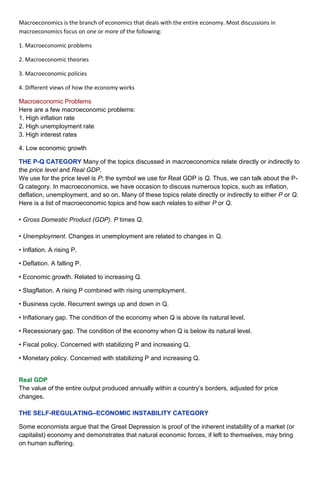
Macroeconomics is the branch of economics that deals with the entire economy. Most discussions in 
macroeconomics focus on one or more of the following: 
1. Macroeconomic problems 
2. Macroeconomic theories 
3. Macroeconomic policies 
4. Different views of how the economy works 
Macroeconomic Problems 
Here are a few macroeconomic problems: 
1. High inflation rate 
2. High unemployment rate 
3. High interest rates 
4. Low economic growth 
THE P-Q CATEGORY Many of the topics discussed in macroeconomics relate directly or indirectly to 
the price level and Real GDP. 
We use for the price level is P; the symbol we use for Real GDP is Q. Thus, we can talk about the P-Q 
category. In macroeconomics, we have occasion to discuss numerous topics, such as inflation, 
deflation, unemployment, and so on. Many of these topics relate directly or indirectly to either P or Q. 
Here is a list of macroeconomic topics and how each relates to either P or Q. 
• Gross Domestic Product (GDP). P times Q. 
• Unemployment. Changes in unemployment are related to changes in Q. 
• Inflation. A rising P. 
• Deflation. A falling P. 
• Economic growth. Related to increasing Q. 
• Stagflation. A rising P combined with rising unemployment. 
• Business cycle. Recurrent swings up and down in Q. 
• Inflationary gap. The condition of the economy when Q is above its natural level. 
• Recessionary gap. The condition of the economy when Q is below its natural level. 
• Fiscal policy. Concerned with stabilizing P and increasing Q. 
• Monetary policy. Concerned with stabilizing P and increasing Q. 
Real GDP 
The value of the entire output produced annually within a country’s borders, adjusted for price 
changes. 
THE SELF-REGULATING–ECONOMIC INSTABILITY CATEGORY 
Some economists argue that the Great Depression is proof of the inherent instability of a market (or 
capitalist) economy and demonstrates that natural economic forces, if left to themselves, may bring 
on human suffering.
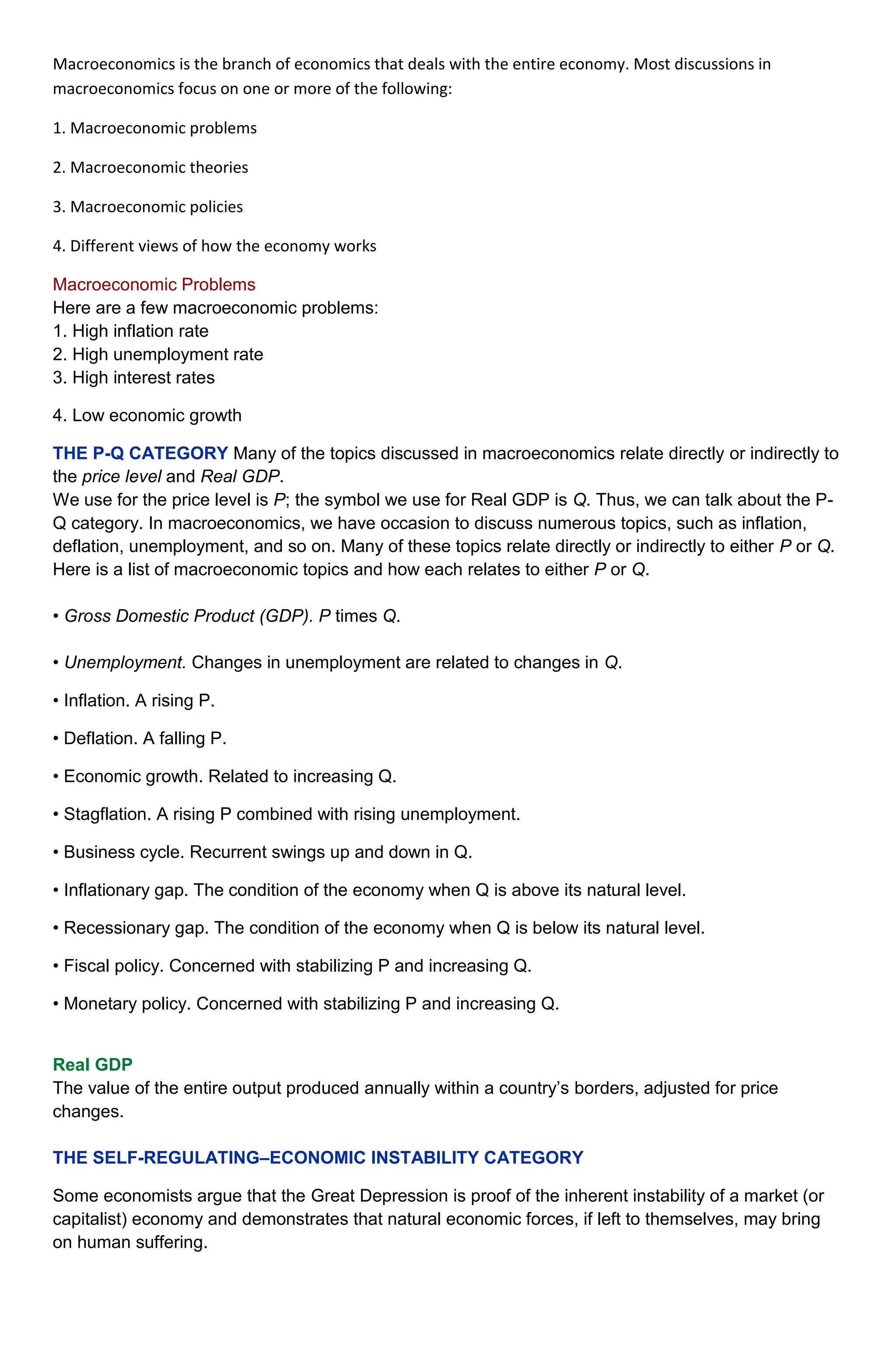
Other economists argue that the economy is inherently stable or self-regulating. The Great 
Depression, they believe, was largely caused and made worse by government tampering with the 
self-regulating and wealth-producing properties of a market economy. 
Economist Axel Leijonhufvud notes: 
The central issue in macroeconomic theory is—once again—the extent to which the economy, or at 
least its market sectors, may properly be regarded as a self-regulating system. . . .How well or badly 
do its “automatic” mechanisms perform? 
THE EFFECTIVE-INEFFECTIVE CATEGORY Here the words effective and ineffective describe fiscal 
policy and monetary policy. 
Fiscal policy refers to changes in government expenditures and/or changes in taxes to achieve 
particular macroeconomic goals (e.g., low unemployment, stable prices). 
Monetary policy refers to changes in the money supply, or the rate of growth of the money supply, 
to achieve particular macroeconomic goals. 
Measuring Prices Using the CPI 
The price level is a weighted average of the prices of all goods and services. 
Economists measure the price level by constructing a price index. One major price index is the 
consumer price index (CPI). 
CPI is a widely cited index number for the price level; the weighted average of prices of a specific set 
of goods and services purchased by a typical household. 
Base Year 
Is the year chosen as a point of reference or basis of comparison for prices in other years; a 
benchmark year. 
CPI= (Total dollar expenditure on market basket in current year/ Total dollar expenditure on market 
basket in base year) x100 
%change in P= CPI(current)- CPI(base) X 100 
CPI(base) 
Inflation and the CPI 
Inflation is an increase in the price level and is usually measured on an annual basis. The inflation 
rate is the positive percentage change in the price level on an annual basis. 
Real Income 
Nominal income adjusted for price changes. 
Nominal Income 
The current-peso amount of a person’s income. 
MEASURING UNEMPLOYMENT 
Who Are the Unemployed? 
The total population can be divided into two broad groups: 
 One group consists of persons who are (1) under 16 years of age, (2) in the armed forces, or 
(3) institutionalized—that is, they are in a prison, mental institution, or home for the aged. 
 The second group, which consists of all others in the total population, is called the civilian 
noninstitutional population. The civilian noninstitutional population, in turn, can be divided into 
two groups: persons not in the labor force and persons in the civilian labor force 
Civilian noninstitutional population = Persons not in the labor force + Persons in the labor force 
Civilian labor force = Employed persons + Unemployed persons
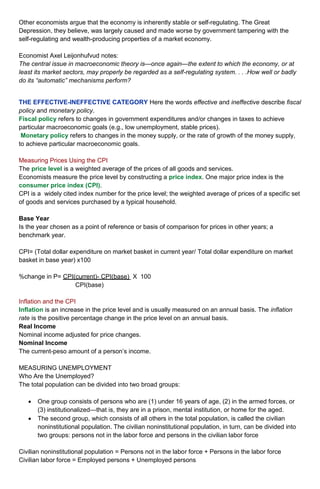
Unemployment rate (U )= No. of Unemployed persons 
Civilian labor force 
Employment rate (E )= No. of Employed persons 
Civilian noninstitutional population 
Labor force participation rate (LFPR)= Civilian Labor Force 
Civilian Noninstitutional Population 
Reasons for Unemployment 
Usually, we think of an unemployed person as someone who has been fired or laid off from his or her 
job. Certainly, some unemployed persons fit this description, but not all of them do. According to the 
BLS, an unemployed person may fall into one of four categories. 
1. Job loser. This is a person who was employed in the civilian labor force and was either fired or laid 
off. Most unemployed persons fall into this category. 
2. Job leaver. This is a person employed in the civilian labor force who quits his or her job. For 
example, if Jim quit his job with company X and is looking for a better job, then he is a job leaver. 
3. Reentrant. This is a person who was previously employed, hasn’t worked for some time, and is 
currently reentering the labor force. 
4. New entrant. This is a person who has never held a full-time job for two weeks or longer and is now 
in the civilian labor force looking for a job. 
Unemployed persons = Job losers + Job leavers + Reentrants + New entrants 
Discouraged Workers=Those who are currently not working but no longer actively looking or seeking 
for jobs. They are not included in the calculation for the unemployment rate by the BLS. 
Types of Unemployment 
1. Frictional Unemployment 
-Unemployment due to the natural “friction” of the economy, which is caused by changing market 
conditions and is represented by qualified individuals with transferable skills who change jobs. 
2. Structural Unemployment 
-Unemployment due to structural changes in the economy that eliminate some jobs and create other 
jobs for which the unemployed are unqualified. 
3. Natural Unemployment 
-Unemployment caused by frictional and structural factors in the economy. Natural unemployment 
rate =Frictional unemployment rate + Structural unemployment rate. 
4. Cyclical Unemployment Rate 
-The difference between the unemployment rate and the natural unemployment rate. 
Full Employment 
-The condition that exists when the unemployment rate is equal to the natural unemployment rate. 
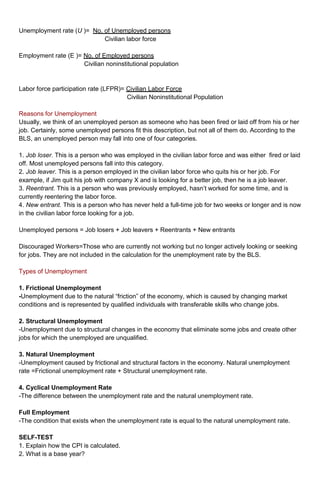
SELF-TEST 
1. Explain how the CPI is calculated. 
2. What is a base year?
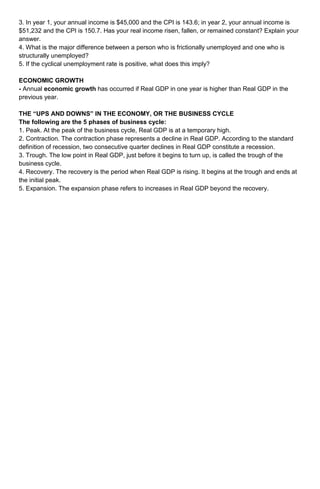
3. In year 1, your annual income is $45,000 and the CPI is 143.6; in year 2, your annual income is 
$51,232 and the CPI is 150.7. Has your real income risen, fallen, or remained constant? Explain your 
answer. 
4. What is the major difference between a person who is frictionally unemployed and one who is 
structurally unemployed? 
5. If the cyclical unemployment rate is positive, what does this imply? 
ECONOMIC GROWTH 
- Annual economic growth has occurred if Real GDP in one year is higher than Real GDP in the 
previous year. 
THE “UPS AND DOWNS” IN THE ECONOMY, OR THE BUSINESS CYCLE 
The following are the 5 phases of business cycle: 
1. Peak. At the peak of the business cycle, Real GDP is at a temporary high. 
2. Contraction. The contraction phase represents a decline in Real GDP. According to the standard 
definition of recession, two consecutive quarter declines in Real GDP constitute a recession. 
3. Trough. The low point in Real GDP, just before it begins to turn up, is called the trough of the 
business cycle. 
4. Recovery. The recovery is the period when Real GDP is rising. It begins at the trough and ends at 
the initial peak. 
5. Expansion. The expansion phase refers to increases in Real GDP beyond the recovery.

Macroeconomic problems,theories, policies and views

  • 1.
    Macroeconomics is thebranch of economics that deals with the entire economy. Most discussions in macroeconomics focus on one or more of the following: 1. Macroeconomic problems 2. Macroeconomic theories 3. Macroeconomic policies 4. Different views of how the economy works Macroeconomic Problems Here are a few macroeconomic problems: 1. High inflation rate 2. High unemployment rate 3. High interest rates 4. Low economic growth THE P-Q CATEGORY Many of the topics discussed in macroeconomics relate directly or indirectly to the price level and Real GDP. We use for the price level is P; the symbol we use for Real GDP is Q. Thus, we can talk about the P-Q category. In macroeconomics, we have occasion to discuss numerous topics, such as inflation, deflation, unemployment, and so on. Many of these topics relate directly or indirectly to either P or Q. Here is a list of macroeconomic topics and how each relates to either P or Q. • Gross Domestic Product (GDP). P times Q. • Unemployment. Changes in unemployment are related to changes in Q. • Inflation. A rising P. • Deflation. A falling P. • Economic growth. Related to increasing Q. • Stagflation. A rising P combined with rising unemployment. • Business cycle. Recurrent swings up and down in Q. • Inflationary gap. The condition of the economy when Q is above its natural level. • Recessionary gap. The condition of the economy when Q is below its natural level. • Fiscal policy. Concerned with stabilizing P and increasing Q. • Monetary policy. Concerned with stabilizing P and increasing Q. Real GDP The value of the entire output produced annually within a country’s borders, adjusted for price changes. THE SELF-REGULATING–ECONOMIC INSTABILITY CATEGORY Some economists argue that the Great Depression is proof of the inherent instability of a market (or capitalist) economy and demonstrates that natural economic forces, if left to themselves, may bring on human suffering.
  • 2.
    Other economists arguethat the economy is inherently stable or self-regulating. The Great Depression, they believe, was largely caused and made worse by government tampering with the self-regulating and wealth-producing properties of a market economy. Economist Axel Leijonhufvud notes: The central issue in macroeconomic theory is—once again—the extent to which the economy, or at least its market sectors, may properly be regarded as a self-regulating system. . . .How well or badly do its “automatic” mechanisms perform? THE EFFECTIVE-INEFFECTIVE CATEGORY Here the words effective and ineffective describe fiscal policy and monetary policy. Fiscal policy refers to changes in government expenditures and/or changes in taxes to achieve particular macroeconomic goals (e.g., low unemployment, stable prices). Monetary policy refers to changes in the money supply, or the rate of growth of the money supply, to achieve particular macroeconomic goals. Measuring Prices Using the CPI The price level is a weighted average of the prices of all goods and services. Economists measure the price level by constructing a price index. One major price index is the consumer price index (CPI). CPI is a widely cited index number for the price level; the weighted average of prices of a specific set of goods and services purchased by a typical household. Base Year Is the year chosen as a point of reference or basis of comparison for prices in other years; a benchmark year. CPI= (Total dollar expenditure on market basket in current year/ Total dollar expenditure on market basket in base year) x100 %change in P= CPI(current)- CPI(base) X 100 CPI(base) Inflation and the CPI Inflation is an increase in the price level and is usually measured on an annual basis. The inflation rate is the positive percentage change in the price level on an annual basis. Real Income Nominal income adjusted for price changes. Nominal Income The current-peso amount of a person’s income. MEASURING UNEMPLOYMENT Who Are the Unemployed? The total population can be divided into two broad groups:  One group consists of persons who are (1) under 16 years of age, (2) in the armed forces, or (3) institutionalized—that is, they are in a prison, mental institution, or home for the aged.  The second group, which consists of all others in the total population, is called the civilian noninstitutional population. The civilian noninstitutional population, in turn, can be divided into two groups: persons not in the labor force and persons in the civilian labor force Civilian noninstitutional population = Persons not in the labor force + Persons in the labor force Civilian labor force = Employed persons + Unemployed persons
  • 3.
    Unemployment rate (U)= No. of Unemployed persons Civilian labor force Employment rate (E )= No. of Employed persons Civilian noninstitutional population Labor force participation rate (LFPR)= Civilian Labor Force Civilian Noninstitutional Population Reasons for Unemployment Usually, we think of an unemployed person as someone who has been fired or laid off from his or her job. Certainly, some unemployed persons fit this description, but not all of them do. According to the BLS, an unemployed person may fall into one of four categories. 1. Job loser. This is a person who was employed in the civilian labor force and was either fired or laid off. Most unemployed persons fall into this category. 2. Job leaver. This is a person employed in the civilian labor force who quits his or her job. For example, if Jim quit his job with company X and is looking for a better job, then he is a job leaver. 3. Reentrant. This is a person who was previously employed, hasn’t worked for some time, and is currently reentering the labor force. 4. New entrant. This is a person who has never held a full-time job for two weeks or longer and is now in the civilian labor force looking for a job. Unemployed persons = Job losers + Job leavers + Reentrants + New entrants Discouraged Workers=Those who are currently not working but no longer actively looking or seeking for jobs. They are not included in the calculation for the unemployment rate by the BLS. Types of Unemployment 1. Frictional Unemployment -Unemployment due to the natural “friction” of the economy, which is caused by changing market conditions and is represented by qualified individuals with transferable skills who change jobs. 2. Structural Unemployment -Unemployment due to structural changes in the economy that eliminate some jobs and create other jobs for which the unemployed are unqualified. 3. Natural Unemployment -Unemployment caused by frictional and structural factors in the economy. Natural unemployment rate =Frictional unemployment rate + Structural unemployment rate. 4. Cyclical Unemployment Rate -The difference between the unemployment rate and the natural unemployment rate. Full Employment -The condition that exists when the unemployment rate is equal to the natural unemployment rate. SELF-TEST 1. Explain how the CPI is calculated. 2. What is a base year?
  • 4.
    3. In year1, your annual income is $45,000 and the CPI is 143.6; in year 2, your annual income is $51,232 and the CPI is 150.7. Has your real income risen, fallen, or remained constant? Explain your answer. 4. What is the major difference between a person who is frictionally unemployed and one who is structurally unemployed? 5. If the cyclical unemployment rate is positive, what does this imply? ECONOMIC GROWTH - Annual economic growth has occurred if Real GDP in one year is higher than Real GDP in the previous year. THE “UPS AND DOWNS” IN THE ECONOMY, OR THE BUSINESS CYCLE The following are the 5 phases of business cycle: 1. Peak. At the peak of the business cycle, Real GDP is at a temporary high. 2. Contraction. The contraction phase represents a decline in Real GDP. According to the standard definition of recession, two consecutive quarter declines in Real GDP constitute a recession. 3. Trough. The low point in Real GDP, just before it begins to turn up, is called the trough of the business cycle. 4. Recovery. The recovery is the period when Real GDP is rising. It begins at the trough and ends at the initial peak. 5. Expansion. The expansion phase refers to increases in Real GDP beyond the recovery.