Measuring Economic Performance (The Bigger Picture)
Importance of Economic Measurement: To identify the state of the economy at a specific point in time.  To compare economic conditions over periods of time To provide a basis for establishing public policy in order to maintain stable economic performance
Macroeconomic Goals Economic Growth - measured by GDP Price Stability - measured by inflation Full Employment - measured by the level of unemployment
GDP & GNP GDP ( Gross Domestic Product) the total output produce inside a country during a given year consists of the total output produced within the Philippines, whether it uses domestic or foreign owned resources.
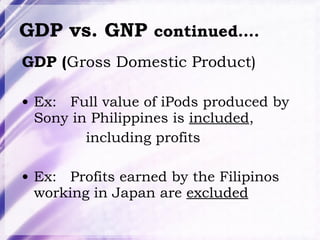
GDP vs. GNP  continued…. GDP ( Gross Domestic Product) Ex:  Full value of iPods produced by Sony in Philippines is  included ,  including profits Ex:  Profits earned by the Filipinos working in Japan are  excluded
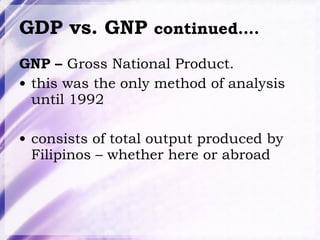
GDP vs. GNP  continued…. GNP –  Gross National Product.  this was the only method of analysis until 1992 consists of total output produced by Filipinos – whether here or abroad
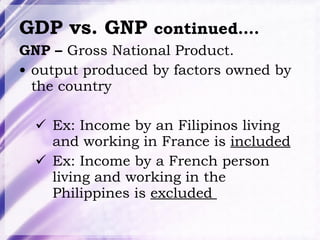
GDP vs. GNP  continued…. GNP –  Gross National Product.  output produced by factors owned by the country Ex: Income by an Filipinos living and working in France is  included Ex: Income by a French person living and working in the Philippines is  excluded
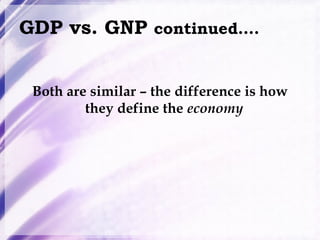
GDP vs. GNP  continued…. Both are similar – the difference is how they define the  economy
Gross Domestic Product Sale of final goods is  included Sale of intermediate goods  excluded Avoids double counting
Final and Intermediate Goods Final  Goods and Services Are not used as inputs into the production of another good or service Are bought by their final users
Final and Intermediate Goods Intermediate  goods Are used as inputs into the production of another good or service Examples Intermediate goods – windshields, gearboxes, batteries Intermediate services – banking and insurance services bought by a car producer
Final and Intermediate Goods How to tell Look at who buys it and for what purpose Example: electric power Intermediate when bought by car producer Final when bought for your home
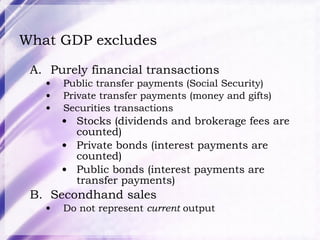
What GDP excludes Purely financial transactions Public transfer payments (Social Security) Private transfer payments (money and gifts) Securities transactions Stocks (dividends and brokerage fees are counted) Private bonds (interest payments are counted) Public bonds (interest payments are transfer payments) Secondhand sales Do not represent  current  output
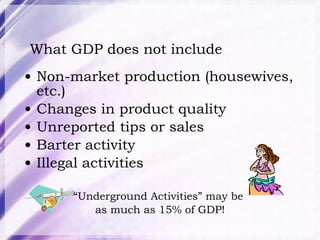
What GDP does not include Non-market production (housewives, etc.) Changes in product quality Unreported tips or sales Barter activity Illegal activities “ Underground Activities” may be  as much as 15% of GDP!
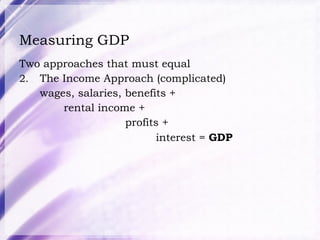
Measuring GDP Two approaches that must equal The Income Approach (complicated) wages, salaries, benefits +   rental income +   profits +   interest =  GDP
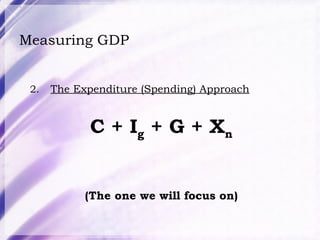
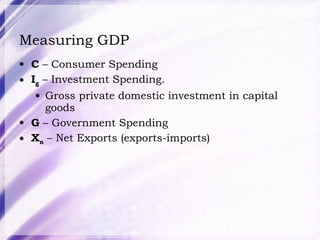
Measuring GDP The Expenditure (Spending) Approach C + I g  + G + X n (The one we will focus on)
Measuring GDP C  – Consumer Spending I g  – Investment Spending.  Gross private domestic investment in capital goods G  – Government Spending  X n  – Net Exports (exports-imports)
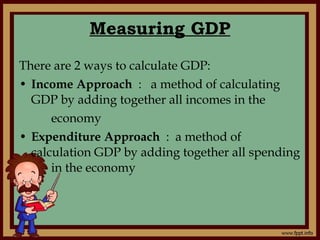
Measuring GDP There are 2 ways to calculate GDP: Income Approach   :  a method of calculating GDP by adding together all incomes in the  economy Expenditure Approach  :  a method of calculation GDP by adding together all spending  in the economy
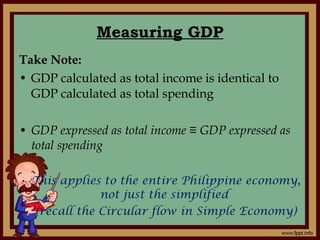
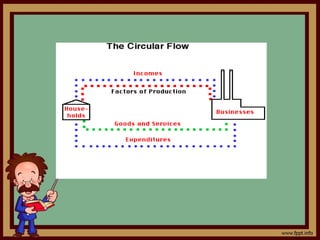
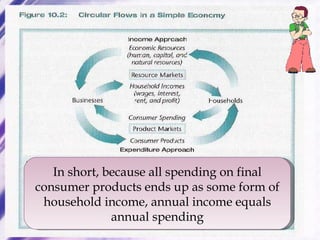
Measuring GDP Take Note: GDP calculated as total income is identical to GDP calculated as total spending GDP expressed as total income ≡ GDP expressed as total spending This applies to the entire Philippine economy, not just the simplified  (recall the Circular flow in Simple Economy)
 
In short, because all spending on final consumer products ends up as some form of household income, annual income equals annual spending
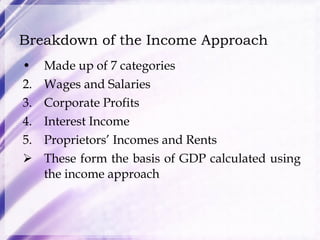
Breakdown of the Income Approach Made up of 7 categories Wages and Salaries Corporate Profits Interest Income Proprietors’ Incomes and Rents These form the basis of GDP calculated using the income approach
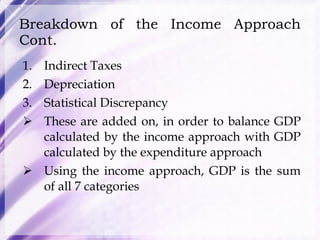
Breakdown of the Income Approach Cont. Indirect Taxes Depreciation Statistical Discrepancy These are added on, in order to balance GDP calculated by the income approach with GDP calculated by the expenditure approach  Using the income approach, GDP is the sum of all 7 categories
Wages and Salaries Largest income category Includes direct payments to workers in both businesses and government as well as employee benefits such as contributions to employee pension funds
Corporate Profits Includes all of the profits declared to the government by corporate businesses such as the profits paid as corporate income tax, the profits paid out to corporate shareholders as dividends and retained earnings Retained Earnings:  profits kept by businesses for new investment
Interest Income  Includes interest paid on business loans and bonds and income such as royalty payments (the latter occurring less frequently) Includes adjustments to the value of businesses’ unsold products Does not include interest payments made by consumers and government because these are viewed as transfers of purchasing power
Proprietors’ Incomes and Rents This includes the earnings made by sole proprietorships, partnerships, self-employed professionals, farmers as well as the income to landlords from renting property Recall that incomes are received by owners of proprietorships for supplying various types  of resources to their business
Indirect Taxes Taxes that are charged on products rather then be applied to households or businesses  Not included in the GDP with the income approach, but rather with the expenditure approach To balance the results from the 2 approaches, taxes -- subsidies that businesses receive are  added  to income-based GDP
Depreciation Like indirect taxes, must also be  added  to the income approach Includes durable assets such as buildings, equipment and tools that eventually wear out and need to be replaced Considered a cost of business and shows up in the expenditure approach
Statistical Discrepancy GDP figures are actually estimates due to businesses/persons records being faulty or missing The discrepancy between  the two approaches is known as the statistical discrepancy
 
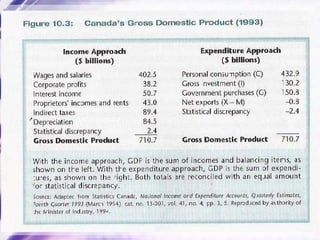
Breakdown of Figure 10.3 To balance the two figures, Statistics Canada divides the difference between the two approaches Discrepancy was $4.8 billion. Half the amount ($2.4 billion) is added to the lower figure (income-based estimate of GDP), and half is deducted from the higher figure (expenditure-based estimate of GDP)
 
Value Added In order to prevent double counting, the concept of  value added  is applied to the GDP Value Added:  the extra worth of product at each stage in its production; a concept used to avoid double counting in calculating GDP Figure 10. 4 uses a pad of paper at each level of production, the results of double counting and how the concept of vales added deals with it
Categories of Purchases Recall that expenditure -based GDP is calculated on the basis of almost all purchases in the Philippines economy Few products are excluded Those that are included, fall under 4 distinct categories
Excluded Purchases There are two types of excluded purchases: financial exchanges and second-hand purchases These are excluded because they are not related to current production
Financial Exchanges This includes a gift of money between family members and is not included in the GDP This is a transfer of of purchasing power from one party to another Also excluded are bank deposits and purchases of stock
Second-Hand Purchases A.K.A, used goods Excluded from GDP because they have been accounted for previously in their very first transaction to their original owner (first consumer)  In brief, if they were included, GDP would  double count  and thus overestimate
Included Purchases Included in the GDP calculations Personal consumption (C) Gross investment (I) Government purchases (G) Net exports (X-M) Each contribute to the the economy
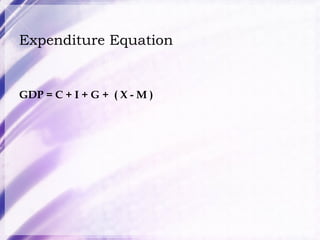
Expenditure Equation GDP = C + I + G +  ( X - M )
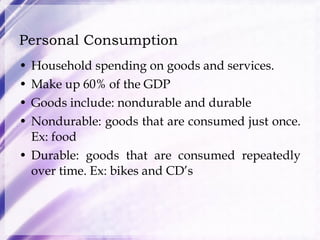
Personal Consumption Household spending on goods and services. Make up 60% of the GDP Goods include: nondurable and durable Nondurable: goods that are consumed just once. Ex: food Durable: goods that are consumed repeatedly over time. Ex: bikes and CD’s
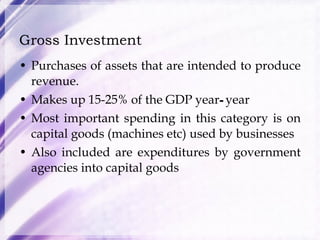
Gross Investment Purchases of assets that are intended to produce revenue. Makes up 15-25% of the GDP year - year Most important spending in this category is on capital goods (machines etc) used by businesses Also included are expenditures by government agencies into capital goods
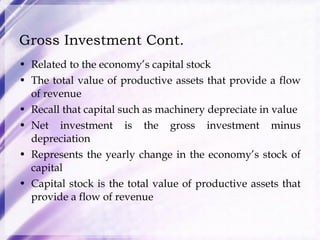
Gross Investment Cont. Related to the economy’s capital stock The total value of productive assets that provide a flow of revenue Recall that capital such as machinery depreciate in value Net investment is the gross investment minus depreciation Represents the yearly change in the economy’s stock of capital Capital stock is the total value of productive assets that provide a flow of revenue
 
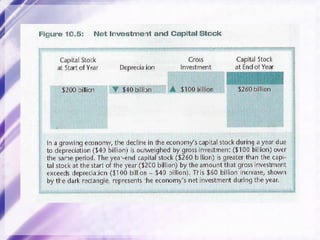
Breakdown of Fig. 10.5 An economy has $200 billion of capital stock at the beginning of the year It depreciates by $40 billion during  the year Gross investment during the same period is $100 billion thus the net investment is $60 billion (100-40) The $60 billion represents the amount that the capital stock expanded during the year Thus by the end of the year, the economy’s capital stock is $260 billion (200+60)
Gross Investment Cont.  Also includes:  inventories of different companies   stocks of unsold goods and materials Building construction with owner-occupied housing  Included here instead of personal consumption because the owner could rent it out for a profit
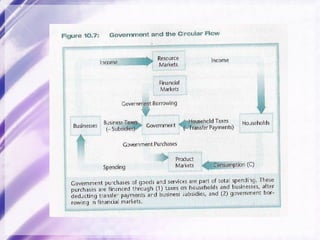
Government Purchases Include current spending by all levels of government on goods and services Ex: The federal government buying a battleship for the Navy, or a municipality hiring a paving company to repair roads Fig. 10.7 shows the role of government in the economy’s circular flow of money
 
Net Exports Final category of purchase and includes the purchases of Canadian goods and services by foreigners, or exports This is calculated via the exports -- imports This is done because while exports include an American furniture store buying Canadian softwood, imports include a Canadian paintball player buying an American paintball gun Represented as net exports, they make up a small % of GDP, yet viewed independently of each other, they each make up about 25% of the GDP
 
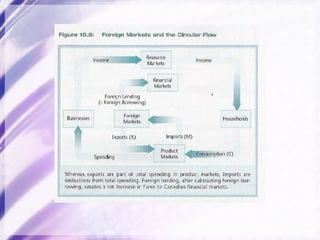
Breakdown of Fig. 10.8 Shows the roles of exports and imports in the economy Foreigners also play a part in the economy by lending/borrowing from financial markets Foreign involvement tends to create a net increase in the economy Foreign loans to the Philippines economy > Canadian loans to foreigners
GDP and Living Standards GDP can be used to determine our standard of living via per capita GDP This is  the GDP per person and is calculated as GDP/population In short, per capita GDP is the total $ value of output per person Ex: in 1993 our GDP was $710 723 million and our population was 28.753 million.    our per capita GDP was $24, 718 per person


Measuring economicperformance

  • 1.
    Measuring Economic Performance(The Bigger Picture)
  • 2.
    Importance of EconomicMeasurement: To identify the state of the economy at a specific point in time. To compare economic conditions over periods of time To provide a basis for establishing public policy in order to maintain stable economic performance
  • 3.
    Macroeconomic Goals EconomicGrowth - measured by GDP Price Stability - measured by inflation Full Employment - measured by the level of unemployment
  • 4.
    GDP & GNPGDP ( Gross Domestic Product) the total output produce inside a country during a given year consists of the total output produced within the Philippines, whether it uses domestic or foreign owned resources.
  • 5.
    GDP vs. GNP continued…. GDP ( Gross Domestic Product) Ex: Full value of iPods produced by Sony in Philippines is included , including profits Ex: Profits earned by the Filipinos working in Japan are excluded
  • 6.
    GDP vs. GNP continued…. GNP – Gross National Product. this was the only method of analysis until 1992 consists of total output produced by Filipinos – whether here or abroad
  • 7.
    GDP vs. GNP continued…. GNP – Gross National Product. output produced by factors owned by the country Ex: Income by an Filipinos living and working in France is included Ex: Income by a French person living and working in the Philippines is excluded
  • 8.
    GDP vs. GNP continued…. Both are similar – the difference is how they define the economy
  • 9.
    Gross Domestic ProductSale of final goods is included Sale of intermediate goods excluded Avoids double counting
  • 10.
    Final and IntermediateGoods Final Goods and Services Are not used as inputs into the production of another good or service Are bought by their final users
  • 11.
    Final and IntermediateGoods Intermediate goods Are used as inputs into the production of another good or service Examples Intermediate goods – windshields, gearboxes, batteries Intermediate services – banking and insurance services bought by a car producer
  • 12.
    Final and IntermediateGoods How to tell Look at who buys it and for what purpose Example: electric power Intermediate when bought by car producer Final when bought for your home
  • 13.
    What GDP excludesPurely financial transactions Public transfer payments (Social Security) Private transfer payments (money and gifts) Securities transactions Stocks (dividends and brokerage fees are counted) Private bonds (interest payments are counted) Public bonds (interest payments are transfer payments) Secondhand sales Do not represent current output
  • 14.
    What GDP doesnot include Non-market production (housewives, etc.) Changes in product quality Unreported tips or sales Barter activity Illegal activities “ Underground Activities” may be as much as 15% of GDP!
  • 15.
    Measuring GDP Twoapproaches that must equal The Income Approach (complicated) wages, salaries, benefits + rental income + profits + interest = GDP
  • 16.
    Measuring GDP TheExpenditure (Spending) Approach C + I g + G + X n (The one we will focus on)
  • 17.
    Measuring GDP C – Consumer Spending I g – Investment Spending. Gross private domestic investment in capital goods G – Government Spending X n – Net Exports (exports-imports)
  • 18.
    Measuring GDP Thereare 2 ways to calculate GDP: Income Approach : a method of calculating GDP by adding together all incomes in the economy Expenditure Approach : a method of calculation GDP by adding together all spending in the economy
  • 19.
    Measuring GDP TakeNote: GDP calculated as total income is identical to GDP calculated as total spending GDP expressed as total income ≡ GDP expressed as total spending This applies to the entire Philippine economy, not just the simplified (recall the Circular flow in Simple Economy)
  • 20.
  • 21.
    In short, becauseall spending on final consumer products ends up as some form of household income, annual income equals annual spending
  • 22.
    Breakdown of theIncome Approach Made up of 7 categories Wages and Salaries Corporate Profits Interest Income Proprietors’ Incomes and Rents These form the basis of GDP calculated using the income approach
  • 23.
    Breakdown of theIncome Approach Cont. Indirect Taxes Depreciation Statistical Discrepancy These are added on, in order to balance GDP calculated by the income approach with GDP calculated by the expenditure approach Using the income approach, GDP is the sum of all 7 categories
  • 24.
    Wages and SalariesLargest income category Includes direct payments to workers in both businesses and government as well as employee benefits such as contributions to employee pension funds
  • 25.
    Corporate Profits Includesall of the profits declared to the government by corporate businesses such as the profits paid as corporate income tax, the profits paid out to corporate shareholders as dividends and retained earnings Retained Earnings: profits kept by businesses for new investment
  • 26.
    Interest Income Includes interest paid on business loans and bonds and income such as royalty payments (the latter occurring less frequently) Includes adjustments to the value of businesses’ unsold products Does not include interest payments made by consumers and government because these are viewed as transfers of purchasing power
  • 27.
    Proprietors’ Incomes andRents This includes the earnings made by sole proprietorships, partnerships, self-employed professionals, farmers as well as the income to landlords from renting property Recall that incomes are received by owners of proprietorships for supplying various types of resources to their business
  • 28.
    Indirect Taxes Taxesthat are charged on products rather then be applied to households or businesses Not included in the GDP with the income approach, but rather with the expenditure approach To balance the results from the 2 approaches, taxes -- subsidies that businesses receive are added to income-based GDP
  • 29.
    Depreciation Like indirecttaxes, must also be added to the income approach Includes durable assets such as buildings, equipment and tools that eventually wear out and need to be replaced Considered a cost of business and shows up in the expenditure approach
  • 30.
    Statistical Discrepancy GDPfigures are actually estimates due to businesses/persons records being faulty or missing The discrepancy between the two approaches is known as the statistical discrepancy
  • 31.
  • 32.
    Breakdown of Figure10.3 To balance the two figures, Statistics Canada divides the difference between the two approaches Discrepancy was $4.8 billion. Half the amount ($2.4 billion) is added to the lower figure (income-based estimate of GDP), and half is deducted from the higher figure (expenditure-based estimate of GDP)
  • 33.
  • 34.
    Value Added Inorder to prevent double counting, the concept of value added is applied to the GDP Value Added: the extra worth of product at each stage in its production; a concept used to avoid double counting in calculating GDP Figure 10. 4 uses a pad of paper at each level of production, the results of double counting and how the concept of vales added deals with it
  • 35.
    Categories of PurchasesRecall that expenditure -based GDP is calculated on the basis of almost all purchases in the Philippines economy Few products are excluded Those that are included, fall under 4 distinct categories
  • 36.
    Excluded Purchases Thereare two types of excluded purchases: financial exchanges and second-hand purchases These are excluded because they are not related to current production
  • 37.
    Financial Exchanges Thisincludes a gift of money between family members and is not included in the GDP This is a transfer of of purchasing power from one party to another Also excluded are bank deposits and purchases of stock
  • 38.
    Second-Hand Purchases A.K.A,used goods Excluded from GDP because they have been accounted for previously in their very first transaction to their original owner (first consumer) In brief, if they were included, GDP would double count and thus overestimate
  • 39.
    Included Purchases Includedin the GDP calculations Personal consumption (C) Gross investment (I) Government purchases (G) Net exports (X-M) Each contribute to the the economy
  • 40.
    Expenditure Equation GDP= C + I + G + ( X - M )
  • 41.
    Personal Consumption Householdspending on goods and services. Make up 60% of the GDP Goods include: nondurable and durable Nondurable: goods that are consumed just once. Ex: food Durable: goods that are consumed repeatedly over time. Ex: bikes and CD’s
  • 42.
    Gross Investment Purchasesof assets that are intended to produce revenue. Makes up 15-25% of the GDP year - year Most important spending in this category is on capital goods (machines etc) used by businesses Also included are expenditures by government agencies into capital goods
  • 43.
    Gross Investment Cont.Related to the economy’s capital stock The total value of productive assets that provide a flow of revenue Recall that capital such as machinery depreciate in value Net investment is the gross investment minus depreciation Represents the yearly change in the economy’s stock of capital Capital stock is the total value of productive assets that provide a flow of revenue
  • 44.
  • 45.
    Breakdown of Fig.10.5 An economy has $200 billion of capital stock at the beginning of the year It depreciates by $40 billion during the year Gross investment during the same period is $100 billion thus the net investment is $60 billion (100-40) The $60 billion represents the amount that the capital stock expanded during the year Thus by the end of the year, the economy’s capital stock is $260 billion (200+60)
  • 46.
    Gross Investment Cont. Also includes: inventories of different companies  stocks of unsold goods and materials Building construction with owner-occupied housing Included here instead of personal consumption because the owner could rent it out for a profit
  • 47.
    Government Purchases Includecurrent spending by all levels of government on goods and services Ex: The federal government buying a battleship for the Navy, or a municipality hiring a paving company to repair roads Fig. 10.7 shows the role of government in the economy’s circular flow of money
  • 48.
  • 49.
    Net Exports Finalcategory of purchase and includes the purchases of Canadian goods and services by foreigners, or exports This is calculated via the exports -- imports This is done because while exports include an American furniture store buying Canadian softwood, imports include a Canadian paintball player buying an American paintball gun Represented as net exports, they make up a small % of GDP, yet viewed independently of each other, they each make up about 25% of the GDP
  • 50.
  • 51.
    Breakdown of Fig.10.8 Shows the roles of exports and imports in the economy Foreigners also play a part in the economy by lending/borrowing from financial markets Foreign involvement tends to create a net increase in the economy Foreign loans to the Philippines economy > Canadian loans to foreigners
  • 52.
    GDP and LivingStandards GDP can be used to determine our standard of living via per capita GDP This is the GDP per person and is calculated as GDP/population In short, per capita GDP is the total $ value of output per person Ex: in 1993 our GDP was $710 723 million and our population was 28.753 million.  our per capita GDP was $24, 718 per person
  • 53.
  • 54.
  • 55.
  • 56.
  • 57.
  • 58.
  • 59.
  • 60.