Macroeconomics Issues and
Measurement
Chapter 15
Learning Outcomes
 Macroeconomics looks at the economy as a whole,
dealing with such aggregate phenomena as growth
in total output and living standards, commonly
called ‘economic growth’, business cycles, inflation,
unemployment, and the balance of payments.
 Macroeconomics focuses on the cycle in activity,
whereas growth theory focuses on determinants of
the long-run trend in output.
Learning Outcomes
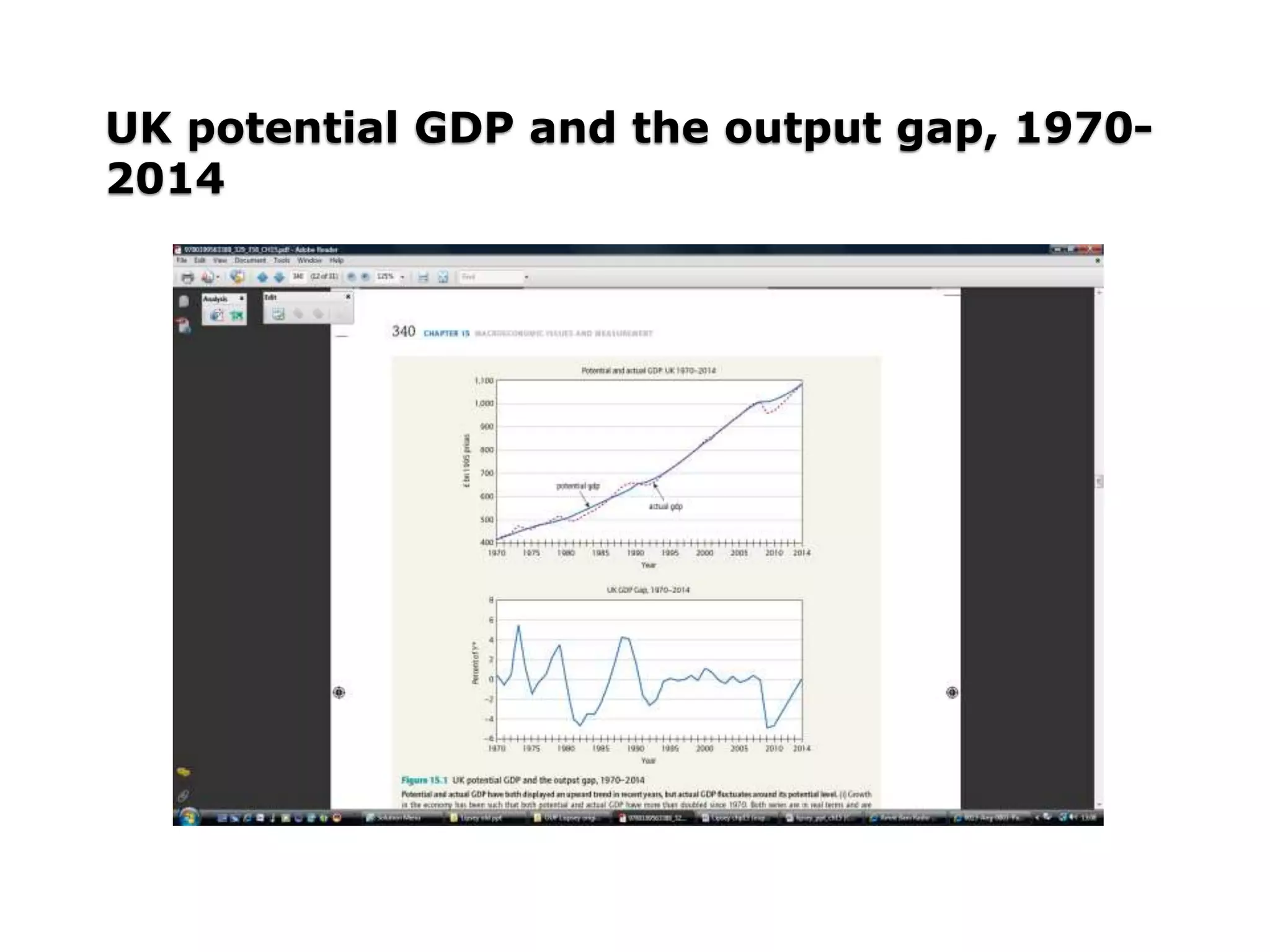
 The GDP gap is the difference between actual real
GDP and its potential or trend value.
 The total output of the economy as a whole is the
sum of the value added by each firm or enterprise.
Learning Outcomes
 GDP can be measured as the
 sum of value added by all producers,
 as the sum of income claims generated in producing goods
and services,
 or as the spending on all final goods and services produced.
 GDP measures the value of what is produced in this
country, while GNI (or GNP) measures the income
accruing to UK residents, including net income from
overseas.
 GDP is a specific measure of output in the market
economy, and is not a measure of welfare or happiness.
INTRODUCTION - MACROECONOMIC ISSUES AND
MEASUREMENT
What is Macroeconomics
 Macroeconomics is about the economy as a whole. It
studies aggregate phenomena, such as business
cycles, living standards, inflation, unemployment, and
the balance of payments. It also asks how
governments can use their monetary and fiscal policy
instruments to help stabilize the economy.
INTRODUCTION - MACROECONOMIC ISSUES AND
MEASUREMENT
Why do We Need Macroeconomics
 Macroeconomics is useful because it enables us
to study events that affect the economy as a
whole without getting into too much detail about
specific products and sectors.
The GDP gap
 Potential GDP is the level of national output that
would be produced if the economy were operating
at its normal capacity, of full-employment level.
 The GDP gap is the difference between actual GDP
and its potential level.
INTRODUCTION - MACROECONOMIC ISSUES AND
MEASUREMENT
Measurement of National Output
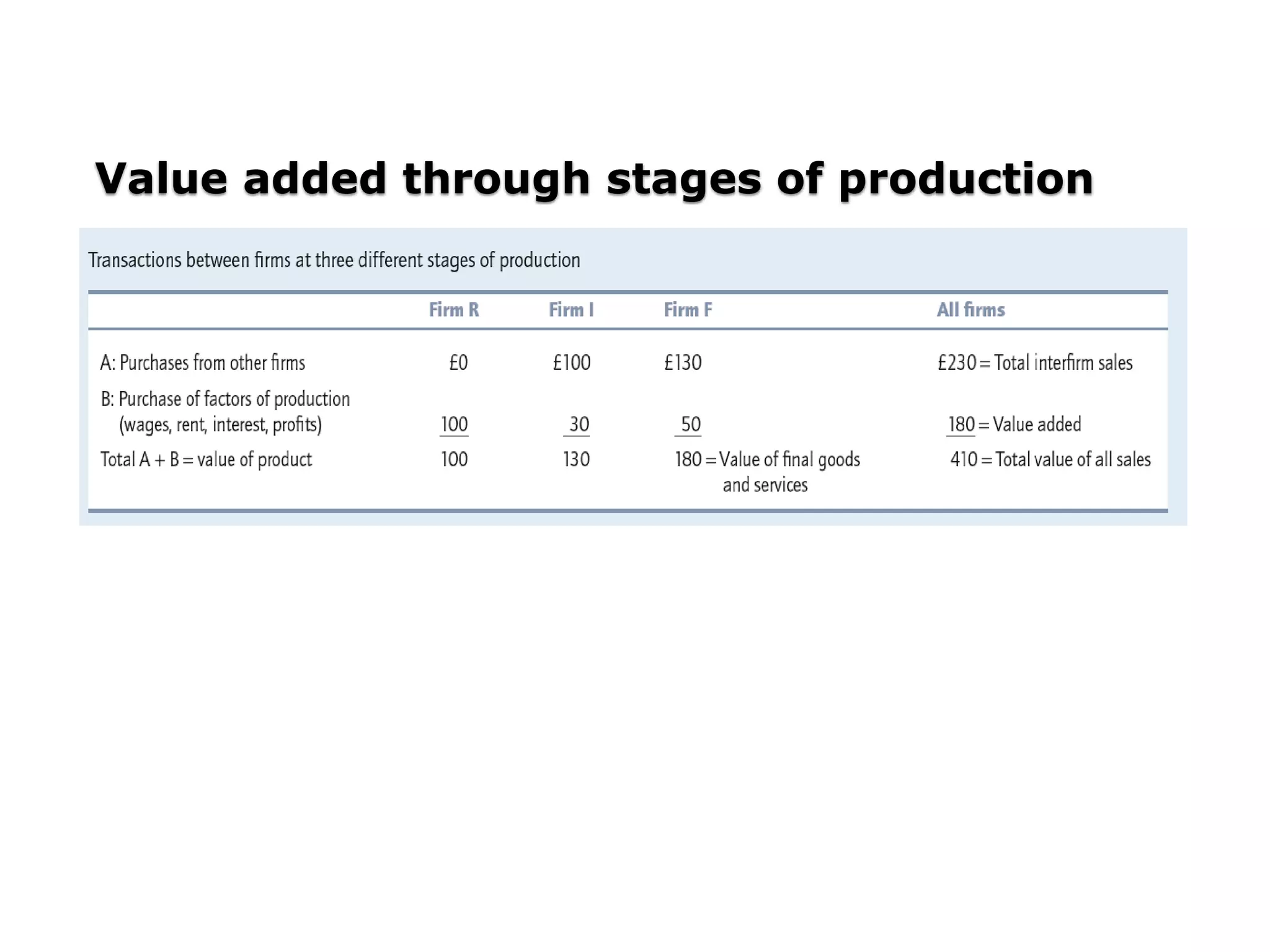
 Each firm’s contribution to total output is equal to
its value added, which is the gross value of the
firm’s output minus the value of all intermediate
goods and services - that is, the outputs of other
firms - that it uses.
 Goods that count as part of the economy’s output
are called final goods; all others are called
intermediate goods. The sum of all the values
added produced in an economy is called gross
value added at basic prices.
INTRODUCTION - MACROECONOMIC ISSUES AND
MEASUREMENT
Measurement of National Output
 Goods that count as part of the economy’s output
are called final goods; all others are called
intermediate goods.
 The sum of all the values added produced in an
economy is called gross value added at basic
prices. Basic prices are the prices received by
producers net of taxes on products [plus
subsidies].
INTRODUCTION - MACROECONOMIC ISSUES AND
MEASUREMENT
The circular flow of income, output and
spending
 The determination of GDP and national
income can be represented as a circular
flow of income and spending.
INTRODUCTION - MACROECONOMIC ISSUES AND
MEASUREMENT
The circular flow of income, output, and
spending
 Withdrawals of spending arise when
income received is not spent on the
domestic economy.
 Injections of spending are those that are
not the result of domestic income receipts,
but rather come from sources other than
domestic income recipients.
INTRODUCTION - MACROECONOMIC ISSUES AND
MEASUREMENT
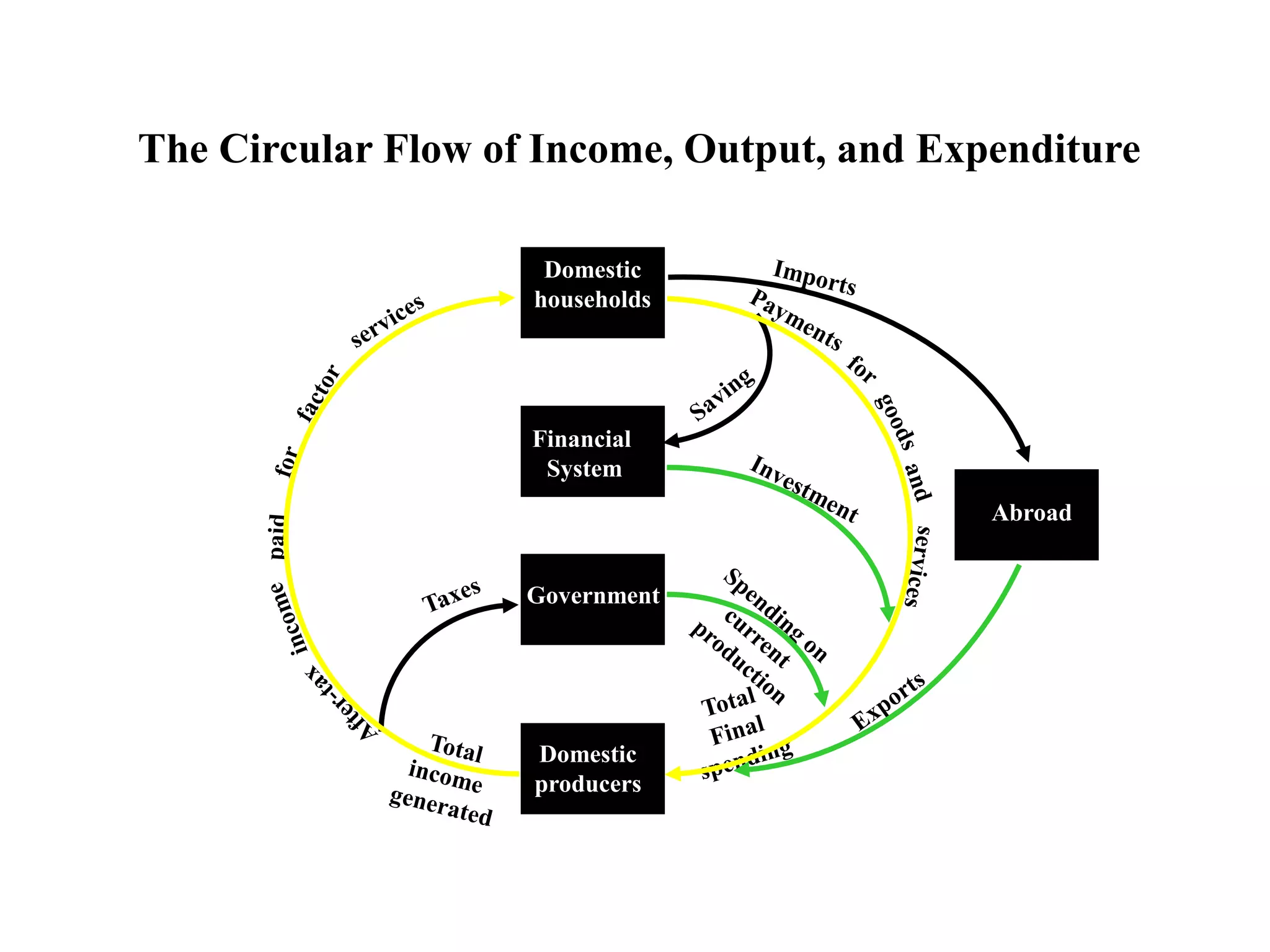
Domestic
households
Financial
System
Government
Domestic
producers
Abroad
The Circular Flow of Income, Output, and Expenditure
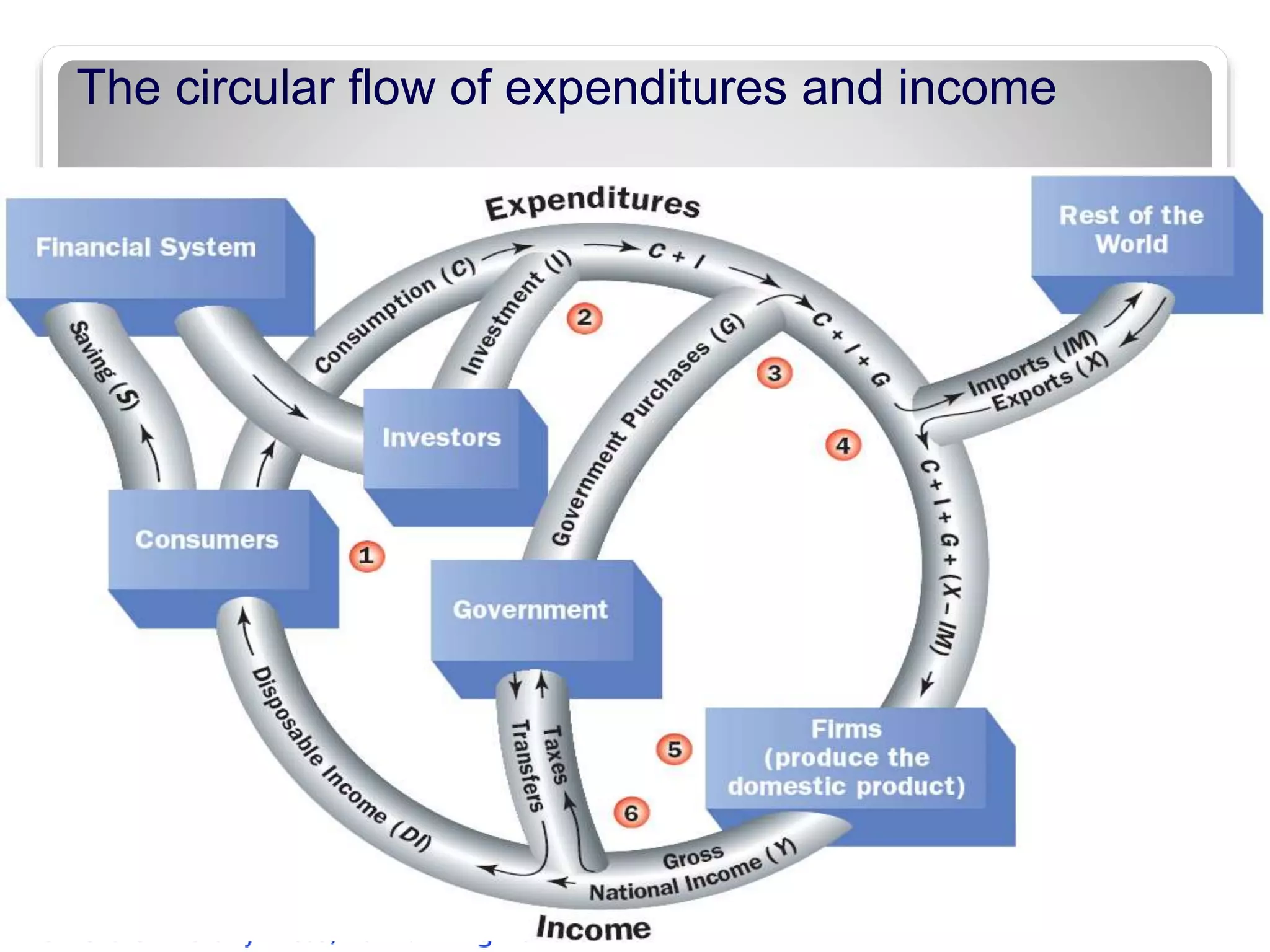
The circular flow of expenditures and income
13
 Individuals provide labour to firms and they
buy the firms’ output.
 National output or income can be measured
from the expenditure side in terms of
expenditure on the final output, or on the
income side in terms of value added and
factor incomes generated.
 Saving, taxes and imports represent a leakage
from the circular flow.
The Circular Flow of Income, Output, and Expenditure
 Investment, government consumption and
exports represent injections into the circular
flow.
 For any equilibrium level of national activity
(GDP) injections must equal leakages.
 So saving plus taxes plus imports must equal
investment plus government consumption plus
exports.
The Circular Flow of Income, Output, and Expenditure
GDP, GNI, and GNP
 Gross domestic product, [GDP] can be calculated
in three different ways:
◦ [1] as the sum of all values added by all producers of both
intermediate and final goods
◦ [2] as the income claims generated by the total production
of goods and services; and
◦ [3] as the expenditure needed to purchase all final goods
and services produced during the period.
INTRODUCTION - MACROECONOMIC ISSUES AND
MEASUREMENT
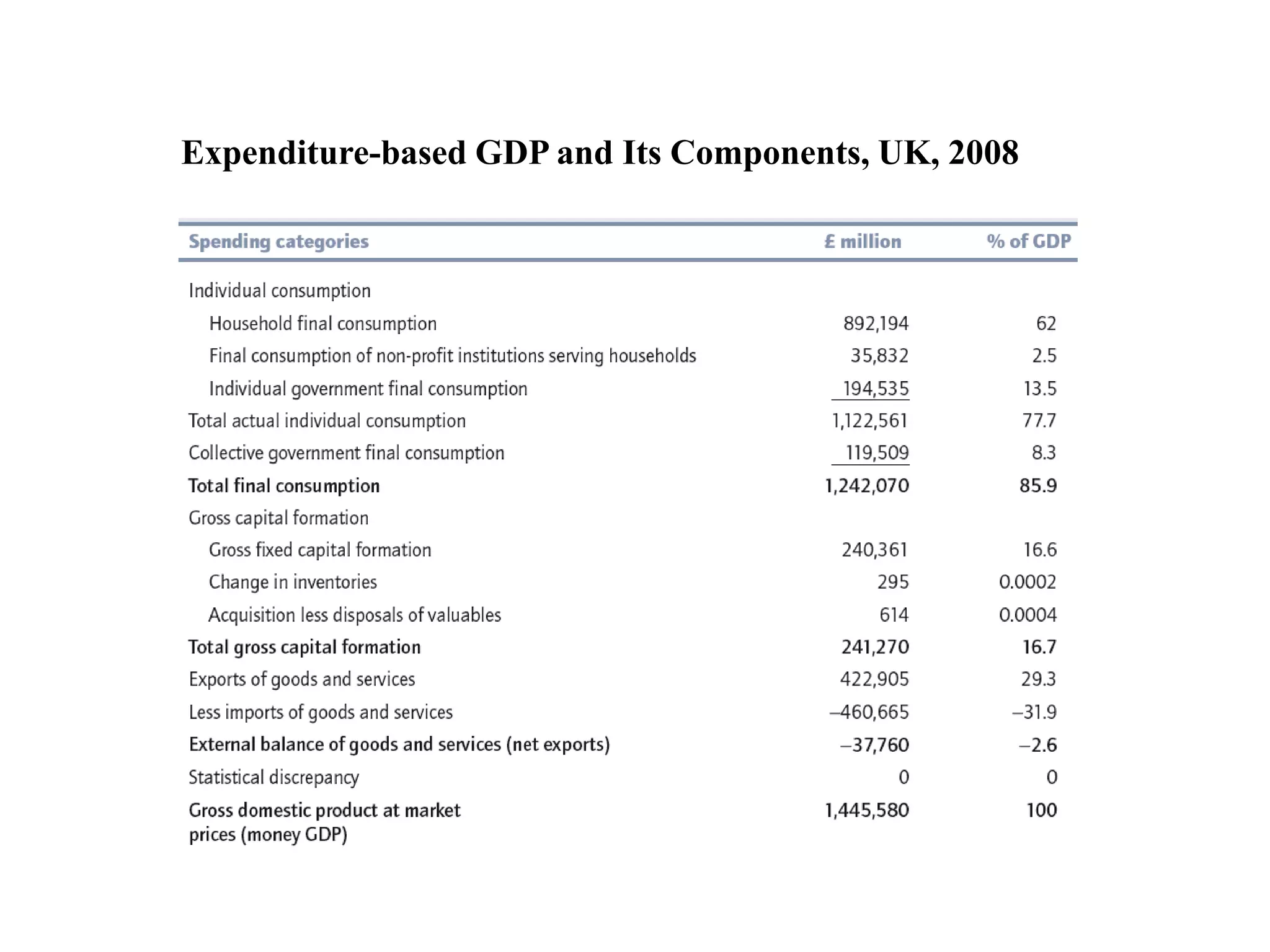
 From the expenditure side of the national
accounts GDP = Ca + Ia + Ga + [Xa - Ima].
 Ca comprises private consumption expenditures.
 Ia is investment in fixed capital [including
residential construction], inventories, and
valuables (jewellery, art etc).
 Gross investment can be split into replacement
investment [necessary to keep the stock of capital
intact] and net investment [net additions to the
stock of capital].
 Ga is government consumption. [Xa -IMa]
represents net exports, or exports minus imports;
it will be negative if imports exceed exports.
INTRODUCTION - MACROECONOMIC ISSUES AND
MEASUREMENT
 GDP income-based adds up all factor rewards in
production.
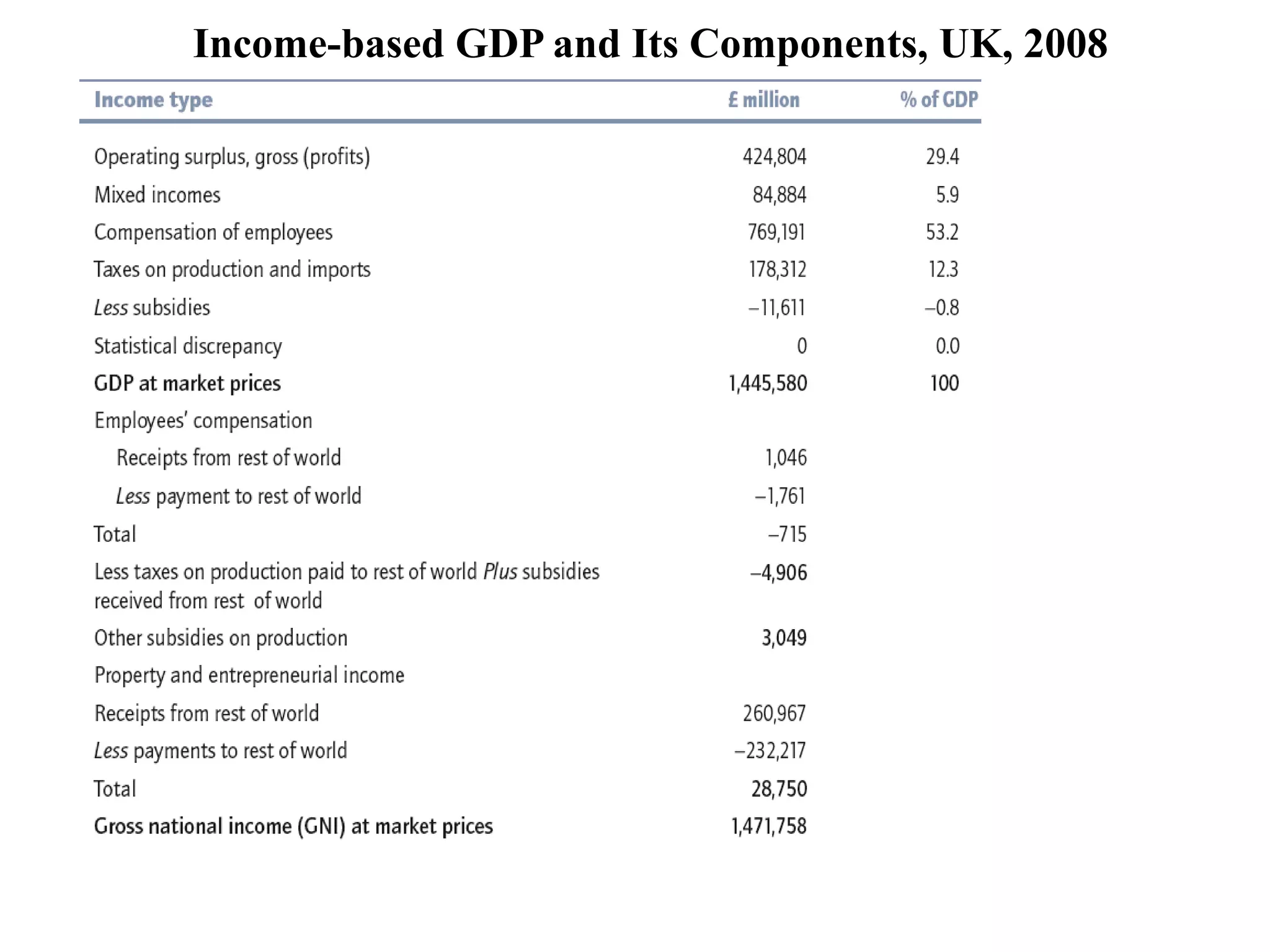
 The main income categories making up GDP are
operating surplus, mixed incomes and
compensation of employees.
 Operating surplus is net business income after
deduction of payment made to employees and for
material input but before direct taxes ie corporate
tax etc. Operating surplus is largely the firm’s
profit ie both distributed (dividends) and retained
earnings.
 Mixed income is income earned by self employed
individuals and consists both of wage and salary
of the self employed and profit or surplus of the
business operated by them.
INTRODUCTION - MACROECONOMIC ISSUES AND
MEASUREMENT
 Compensation of employees is the payment for
the services of labor inclusive of net salary, taxes
withheld and other deductions made for pension
etc ie wages are measured gross.
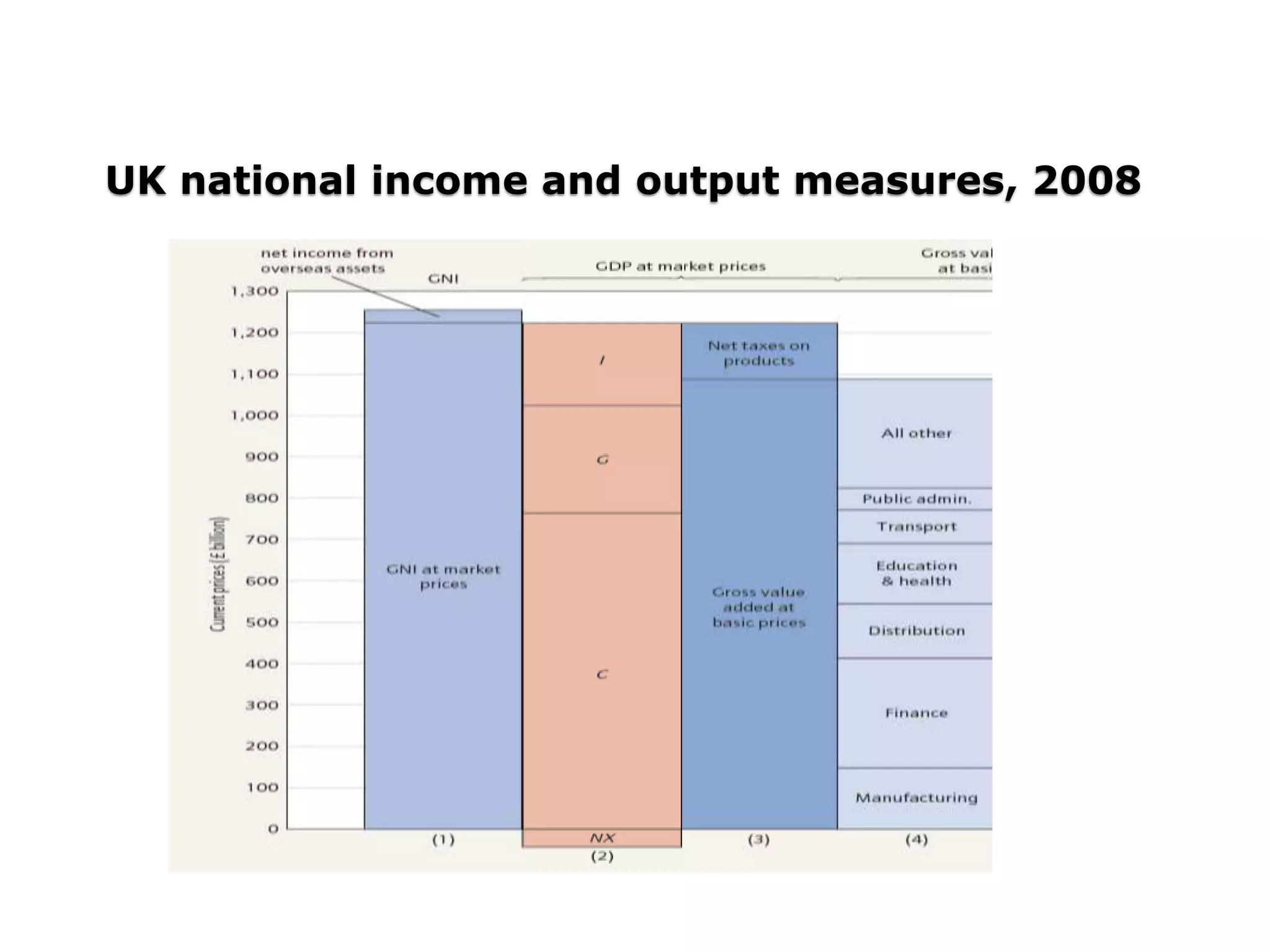
 UK GDP measures production that is located in
the United kingdom, and UK gross national
income [GNI] measures income accruing to UK
residents.
 The difference is due to net income from abroad.
 GNI is the same thing as what used to be called
gross national product [GNP].
INTRODUCTION - MACROECONOMIC ISSUES AND
MEASUREMENT
Income-based GDP and Its Components, UK, 2008
GDP
Plus: Receipts of factor income from the rest of the
world
Less: Payments of factor income to the rest of the
world
Equals: GNP
Less: Depreciation
Equals: Net national product (NNP)
Less: Statistical discrepancy
Equals: National income
GDP at Factor Cost vs GVA at Basic Prices
 In place of GDP at factor cost, gross value added (GVA) at
basic prices will be used now.
 For a producer, GDP at factor cost represents what he gets
from the industrial activity. This can be broken down into
various components — wages, profits, rents and capital —
also commonly known factors of production.
 Aside from these costs, producers may also incur other
expenses such as property tax, stamp duties and
registration fees, among others. Similarly, producers may
also receive subsidies (production related) such as input
subsidies to farmers and to small industries. It is only taxes
and subsidies on intermediate inputs are adjusted.
 For arriving at the new gross value added (GVA) at basic
prices, production taxes, such as property tax, are added
and subsidies are subtracted from GDP at factor cost.
GDP at Factor Cost vs GVA at Basic
Prices
 Put simply, GVA at basic price represents what accrues
to the producer, before the product is sold.
 The price paid by the consumer is not the same as the
revenue received by the producer. This is because of
the taxes that are paid to the government in the form of
indirect taxes.
 GVA at basic prices will include production taxes and
exclude production subsidies available on the
commodity.
 GVA at factor cost includes no taxes and excludes no
subsidies.
 GDP at market prices include both production and
product taxes and excludes both production and product
subsidies.
Production taxes vs Product taxes
 Production taxes/subsidies are independent of
the quantity (volume) of production. It is often imposed
even if the products are not produced (Eg: tax —land
revenues, stamps fees, registration fees tax on the
profession; subsidies —subsidies to Railways, input
subsidies to farmers, subsidies to the village and small
industries, administrative subsidies to corporations or
cooperatives, etc.).
 Product taxes/subsidies depend on quantity produced.
Product taxes or subsidies are paid or received on per
unit of product (Eg: tax —excise tax, sales tax, service
tax and import and export duties; subsidies — food,
petroleum and fertiliser subsidies, interest subsidies
given to farmers, households, etc)
 Real GDP is calculated to reflect changes in real
volumes of output and real income.
 Nominal GDP reflects changes in both prices and
quantities.
 Any change in nominal GDP [or GNI] can be split
into a change in real GDP and a change due to
prices.
INTRODUCTION - MACROECONOMIC ISSUES AND
MEASUREMENT
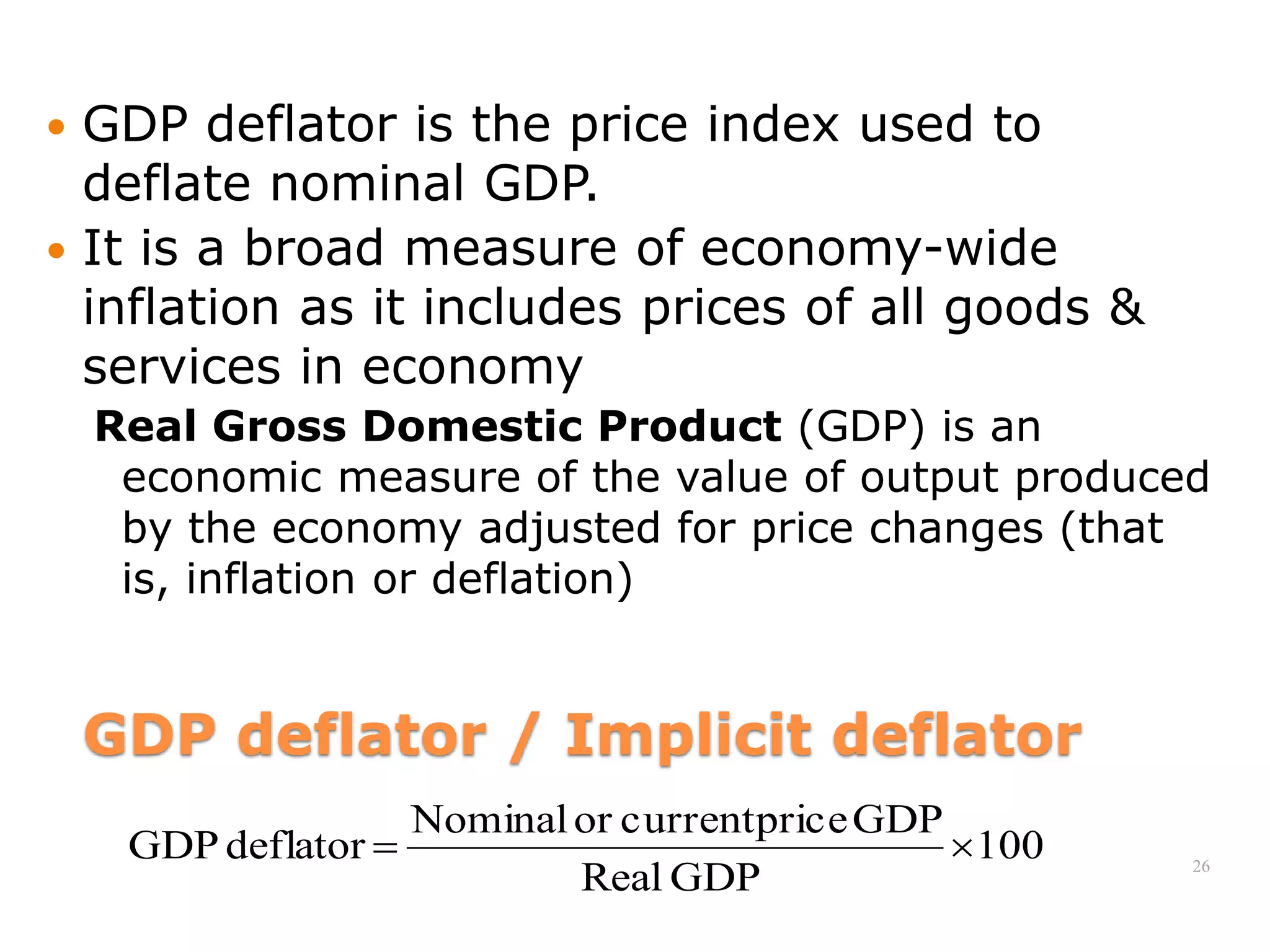
GDP deflator / Implicit deflator
 GDP deflator is the price index used to
deflate nominal GDP.
 It is a broad measure of economy-wide
inflation as it includes prices of all goods &
services in economy
Real Gross Domestic Product (GDP) is an
economic measure of the value of output produced
by the economy adjusted for price changes (that
is, inflation or deflation)
26
100
GDP
Real
GDP
price
current
or
Nominal
deflator
GDP 

 Personal income is income received by individuals
before any allowance for personal taxes.
 Personal disposable income is the amount
actually available for individuals to spend or to
save, that is, income minus taxes.
INTRODUCTION - MACROECONOMIC ISSUES AND
MEASUREMENT
Interpreting National Income and Output
 GDP and related measures of national income
and output must be interpreted with their
limitations in mind.
 GDP excludes production that takes place in the
underground economy or that does not pass
through markets.
 It excludes services of housewives, work done by
self etc
 It also excludes economic bads such as damage
done to environment etc.
INTRODUCTION - MACROECONOMIC ISSUES AND
MEASUREMENT
Interpreting National Income and Output
 Moreover, GDP does not measure everything that
contributes to human welfare.
 GDP is one of the best measures available of the
total economic activity within a country.
 It is particularly valuable when changes in GDP
are used to indicate how economic activity has
changed over time.
INTRODUCTION - MACROECONOMIC ISSUES AND
MEASUREMENT
UK potential GDP and the output gap, 1970-
2014
UK potential GDP and the output gap, 1970-
2014
Value added through stages of production
Gross Value Added at Current Basic Prices, by Sector, UK 2008
Expenditure-based GDP and Its Components, UK, 2008
UK national income and output measures, 2008
Nominal and real GDP at market prices (1900-
2008)
International comparisons of living standards
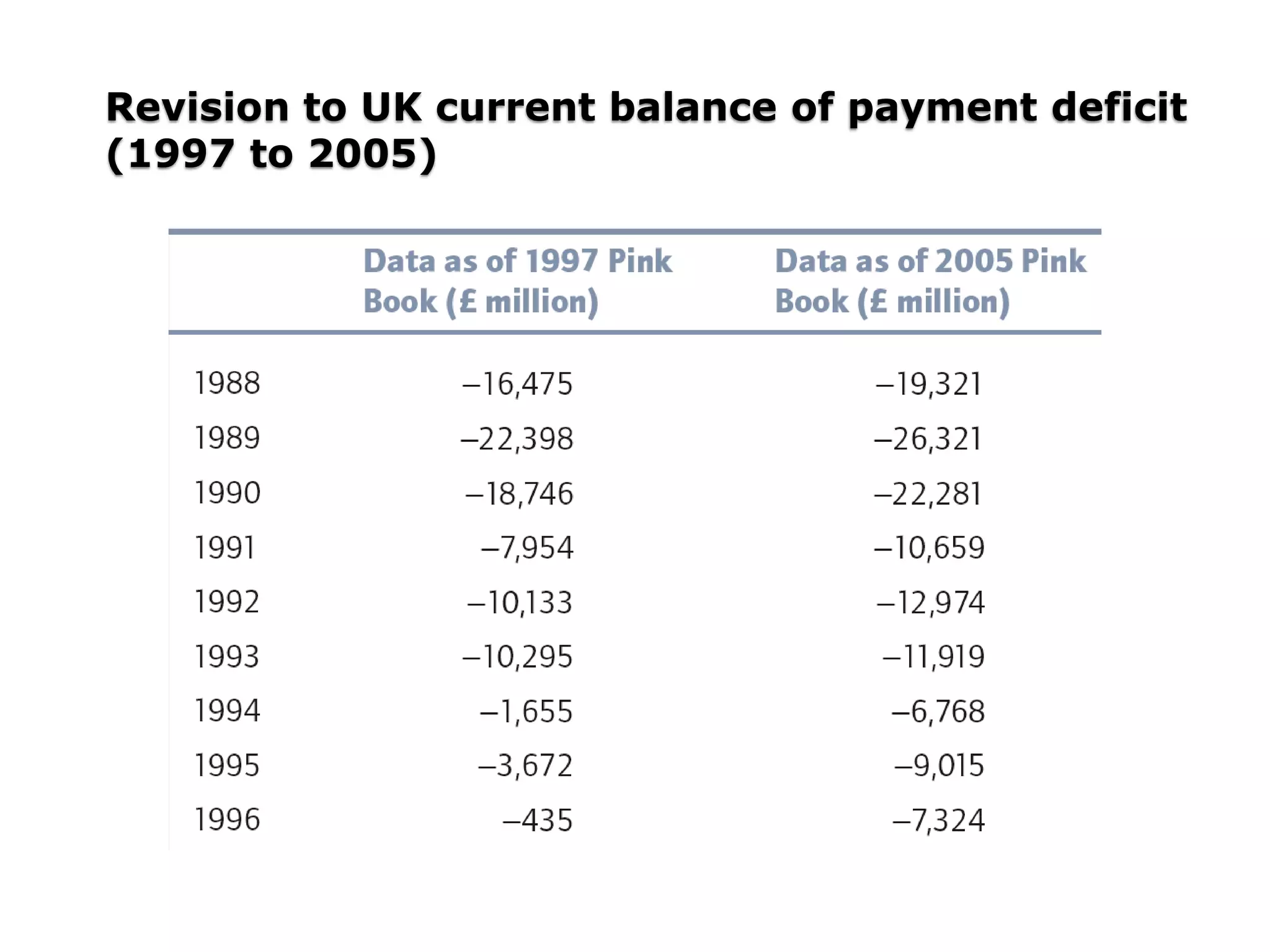
Revision to UK current balance of payment deficit
(1997 to 2005)

Macroeconomic issues and measurement

  • 1.
  • 2.
    Learning Outcomes  Macroeconomicslooks at the economy as a whole, dealing with such aggregate phenomena as growth in total output and living standards, commonly called ‘economic growth’, business cycles, inflation, unemployment, and the balance of payments.  Macroeconomics focuses on the cycle in activity, whereas growth theory focuses on determinants of the long-run trend in output.
  • 3.
    Learning Outcomes  TheGDP gap is the difference between actual real GDP and its potential or trend value.  The total output of the economy as a whole is the sum of the value added by each firm or enterprise.
  • 4.
    Learning Outcomes  GDPcan be measured as the  sum of value added by all producers,  as the sum of income claims generated in producing goods and services,  or as the spending on all final goods and services produced.  GDP measures the value of what is produced in this country, while GNI (or GNP) measures the income accruing to UK residents, including net income from overseas.  GDP is a specific measure of output in the market economy, and is not a measure of welfare or happiness.
  • 5.
    INTRODUCTION - MACROECONOMICISSUES AND MEASUREMENT What is Macroeconomics  Macroeconomics is about the economy as a whole. It studies aggregate phenomena, such as business cycles, living standards, inflation, unemployment, and the balance of payments. It also asks how governments can use their monetary and fiscal policy instruments to help stabilize the economy.
  • 6.
    INTRODUCTION - MACROECONOMICISSUES AND MEASUREMENT Why do We Need Macroeconomics  Macroeconomics is useful because it enables us to study events that affect the economy as a whole without getting into too much detail about specific products and sectors.
  • 7.
    The GDP gap Potential GDP is the level of national output that would be produced if the economy were operating at its normal capacity, of full-employment level.  The GDP gap is the difference between actual GDP and its potential level. INTRODUCTION - MACROECONOMIC ISSUES AND MEASUREMENT
  • 8.
    Measurement of NationalOutput  Each firm’s contribution to total output is equal to its value added, which is the gross value of the firm’s output minus the value of all intermediate goods and services - that is, the outputs of other firms - that it uses.  Goods that count as part of the economy’s output are called final goods; all others are called intermediate goods. The sum of all the values added produced in an economy is called gross value added at basic prices. INTRODUCTION - MACROECONOMIC ISSUES AND MEASUREMENT
  • 9.
    Measurement of NationalOutput  Goods that count as part of the economy’s output are called final goods; all others are called intermediate goods.  The sum of all the values added produced in an economy is called gross value added at basic prices. Basic prices are the prices received by producers net of taxes on products [plus subsidies]. INTRODUCTION - MACROECONOMIC ISSUES AND MEASUREMENT
  • 10.
    The circular flowof income, output and spending  The determination of GDP and national income can be represented as a circular flow of income and spending. INTRODUCTION - MACROECONOMIC ISSUES AND MEASUREMENT
  • 11.
    The circular flowof income, output, and spending  Withdrawals of spending arise when income received is not spent on the domestic economy.  Injections of spending are those that are not the result of domestic income receipts, but rather come from sources other than domestic income recipients. INTRODUCTION - MACROECONOMIC ISSUES AND MEASUREMENT
  • 12.
  • 13.
    The circular flowof expenditures and income 13
  • 14.
     Individuals providelabour to firms and they buy the firms’ output.  National output or income can be measured from the expenditure side in terms of expenditure on the final output, or on the income side in terms of value added and factor incomes generated.  Saving, taxes and imports represent a leakage from the circular flow. The Circular Flow of Income, Output, and Expenditure
  • 15.
     Investment, governmentconsumption and exports represent injections into the circular flow.  For any equilibrium level of national activity (GDP) injections must equal leakages.  So saving plus taxes plus imports must equal investment plus government consumption plus exports. The Circular Flow of Income, Output, and Expenditure
  • 16.
    GDP, GNI, andGNP  Gross domestic product, [GDP] can be calculated in three different ways: ◦ [1] as the sum of all values added by all producers of both intermediate and final goods ◦ [2] as the income claims generated by the total production of goods and services; and ◦ [3] as the expenditure needed to purchase all final goods and services produced during the period. INTRODUCTION - MACROECONOMIC ISSUES AND MEASUREMENT
  • 17.
     From theexpenditure side of the national accounts GDP = Ca + Ia + Ga + [Xa - Ima].  Ca comprises private consumption expenditures.  Ia is investment in fixed capital [including residential construction], inventories, and valuables (jewellery, art etc).  Gross investment can be split into replacement investment [necessary to keep the stock of capital intact] and net investment [net additions to the stock of capital].  Ga is government consumption. [Xa -IMa] represents net exports, or exports minus imports; it will be negative if imports exceed exports. INTRODUCTION - MACROECONOMIC ISSUES AND MEASUREMENT
  • 18.
     GDP income-basedadds up all factor rewards in production.  The main income categories making up GDP are operating surplus, mixed incomes and compensation of employees.  Operating surplus is net business income after deduction of payment made to employees and for material input but before direct taxes ie corporate tax etc. Operating surplus is largely the firm’s profit ie both distributed (dividends) and retained earnings.  Mixed income is income earned by self employed individuals and consists both of wage and salary of the self employed and profit or surplus of the business operated by them. INTRODUCTION - MACROECONOMIC ISSUES AND MEASUREMENT
  • 19.
     Compensation ofemployees is the payment for the services of labor inclusive of net salary, taxes withheld and other deductions made for pension etc ie wages are measured gross.  UK GDP measures production that is located in the United kingdom, and UK gross national income [GNI] measures income accruing to UK residents.  The difference is due to net income from abroad.  GNI is the same thing as what used to be called gross national product [GNP]. INTRODUCTION - MACROECONOMIC ISSUES AND MEASUREMENT
  • 20.
    Income-based GDP andIts Components, UK, 2008
  • 21.
    GDP Plus: Receipts offactor income from the rest of the world Less: Payments of factor income to the rest of the world Equals: GNP Less: Depreciation Equals: Net national product (NNP) Less: Statistical discrepancy Equals: National income
  • 22.
    GDP at FactorCost vs GVA at Basic Prices  In place of GDP at factor cost, gross value added (GVA) at basic prices will be used now.  For a producer, GDP at factor cost represents what he gets from the industrial activity. This can be broken down into various components — wages, profits, rents and capital — also commonly known factors of production.  Aside from these costs, producers may also incur other expenses such as property tax, stamp duties and registration fees, among others. Similarly, producers may also receive subsidies (production related) such as input subsidies to farmers and to small industries. It is only taxes and subsidies on intermediate inputs are adjusted.  For arriving at the new gross value added (GVA) at basic prices, production taxes, such as property tax, are added and subsidies are subtracted from GDP at factor cost.
  • 23.
    GDP at FactorCost vs GVA at Basic Prices  Put simply, GVA at basic price represents what accrues to the producer, before the product is sold.  The price paid by the consumer is not the same as the revenue received by the producer. This is because of the taxes that are paid to the government in the form of indirect taxes.  GVA at basic prices will include production taxes and exclude production subsidies available on the commodity.  GVA at factor cost includes no taxes and excludes no subsidies.  GDP at market prices include both production and product taxes and excludes both production and product subsidies.
  • 24.
    Production taxes vsProduct taxes  Production taxes/subsidies are independent of the quantity (volume) of production. It is often imposed even if the products are not produced (Eg: tax —land revenues, stamps fees, registration fees tax on the profession; subsidies —subsidies to Railways, input subsidies to farmers, subsidies to the village and small industries, administrative subsidies to corporations or cooperatives, etc.).  Product taxes/subsidies depend on quantity produced. Product taxes or subsidies are paid or received on per unit of product (Eg: tax —excise tax, sales tax, service tax and import and export duties; subsidies — food, petroleum and fertiliser subsidies, interest subsidies given to farmers, households, etc)
  • 25.
     Real GDPis calculated to reflect changes in real volumes of output and real income.  Nominal GDP reflects changes in both prices and quantities.  Any change in nominal GDP [or GNI] can be split into a change in real GDP and a change due to prices. INTRODUCTION - MACROECONOMIC ISSUES AND MEASUREMENT
  • 26.
    GDP deflator /Implicit deflator  GDP deflator is the price index used to deflate nominal GDP.  It is a broad measure of economy-wide inflation as it includes prices of all goods & services in economy Real Gross Domestic Product (GDP) is an economic measure of the value of output produced by the economy adjusted for price changes (that is, inflation or deflation) 26 100 GDP Real GDP price current or Nominal deflator GDP  
  • 27.
     Personal incomeis income received by individuals before any allowance for personal taxes.  Personal disposable income is the amount actually available for individuals to spend or to save, that is, income minus taxes. INTRODUCTION - MACROECONOMIC ISSUES AND MEASUREMENT
  • 28.
    Interpreting National Incomeand Output  GDP and related measures of national income and output must be interpreted with their limitations in mind.  GDP excludes production that takes place in the underground economy or that does not pass through markets.  It excludes services of housewives, work done by self etc  It also excludes economic bads such as damage done to environment etc. INTRODUCTION - MACROECONOMIC ISSUES AND MEASUREMENT
  • 29.
    Interpreting National Incomeand Output  Moreover, GDP does not measure everything that contributes to human welfare.  GDP is one of the best measures available of the total economic activity within a country.  It is particularly valuable when changes in GDP are used to indicate how economic activity has changed over time. INTRODUCTION - MACROECONOMIC ISSUES AND MEASUREMENT
  • 30.
    UK potential GDPand the output gap, 1970- 2014
  • 31.
    UK potential GDPand the output gap, 1970- 2014
  • 32.
    Value added throughstages of production
  • 33.
    Gross Value Addedat Current Basic Prices, by Sector, UK 2008
  • 34.
    Expenditure-based GDP andIts Components, UK, 2008
  • 35.
    UK national incomeand output measures, 2008
  • 36.
    Nominal and realGDP at market prices (1900- 2008)
  • 37.
  • 38.
    Revision to UKcurrent balance of payment deficit (1997 to 2005)