Macro Measurements
Assessing the Economy’s
               Performance
Who does it? The Bureau of Economic Analysis
What do they do?
  1. assess the health of the econ by comparing
     levels of production at regular intervals
  2. Track the long-run course of the economy to see
     whether it has grown, been constant, or declined
  3. Formulate policies that will safeguard and
     improve the economy’s health
The Gross Domestic Product
             (GDP)
► The total output of goods and services
  (aggregate output) for a year- the market
  value (monetary measure) of the final
  goods= GDP
► Does not include:
   Intermediate goods (no multiple counting)
   Financial transactions
   Secondhand sales

             2009 GDP $14,258.7 Billion
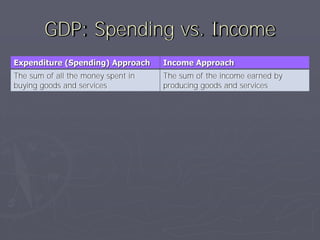
GDP: Spending vs. Income
Expenditure (Spending) Approach     Income Approach
The sum of all the money spent in   The sum of the income earned by
buying goods and services           producing goods and services
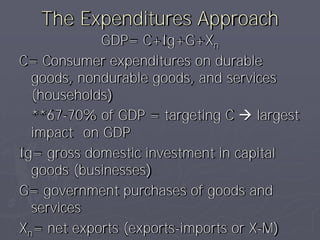
The Expenditures Approach
            GDP= C+Ig+G+Xn
C= Consumer expenditures on durable
  goods, nondurable goods, and services
  (households)
  **67-70% of GDP = targeting C  largest
  impact on GDP
Ig= gross domestic investment in capital
  goods (businesses)
G= government purchases of goods and
  services
Xn= net exports (exports-imports or X-M)
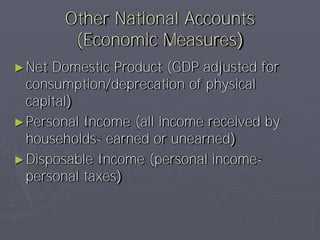
Other National Accounts
         (Economic Measures)
► Net Domestic Product (GDP adjusted for
  consumption/deprecation of physical
  capital)
► Personal Income (all income received by
  households- earned or unearned)
► Disposable Income (personal income-
  personal taxes)
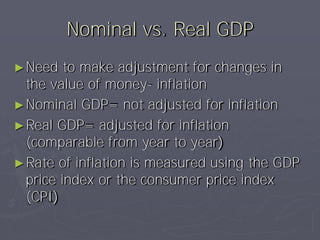
Nominal vs. Real GDP
► Need   to make adjustment for changes in
  the value of money- inflation
► Nominal GDP= not adjusted for inflation
► Real GDP= adjusted for inflation
  (comparable from year to year)
► Rate of inflation is measured using the GDP
  price index or the consumer price index
  (CPI)
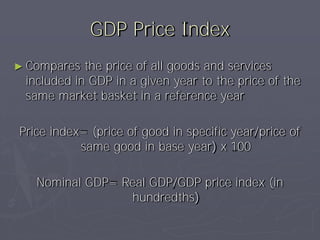
GDP Price Index
► Compares  the price of all goods and services
 included in GDP in a given year to the price of the
 same market basket in a reference year

Price index= (price of good in specific year/price of
           same good in base year) x 100

   Nominal GDP= Real GDP/GDP price index (in
                 hundredths)
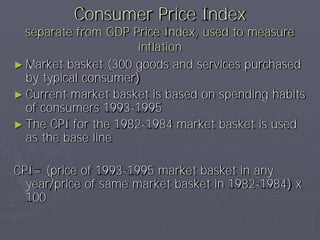
Consumer Price Index
  separate from GDP Price Index, used to measure
                      inflation
► Market basket (300 goods and services purchased
  by typical consumer)
► Current market basket is based on spending habits
  of consumers 1993-1995
► The CPI for the 1982-1984 market basket is used
  as the base line

CPI= (price of 1993-1995 market basket in any
  year/price of same market basket in 1982-1984) x
  100
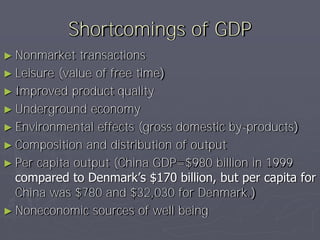
Shortcomings of GDP
► Nonmarket   transactions
► Leisure (value of free time)
► Improved product quality
► Underground economy
► Environmental effects (gross domestic by-products)
► Composition and distribution of output
► Per capita output (China GDP=$980 billion in 1999
  compared to Denmark’s $170 billion, but per capita for
  China was $780 and $32,030 for Denmark.)
► Noneconomic sources of well being
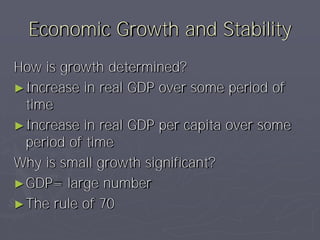
Economic Growth and Stability
How is growth determined?
► Increase in real GDP over some period of
  time
► Increase in real GDP per capita over some
  period of time
Why is small growth significant?
► GDP= large number
► The rule of 70
Sources of Growth
► Increase inputs of resources
► Increase productivity of inputs


                GDP= C+Ig+G+Xn
**67-70% of GDP= targeting C largest impact on GDP
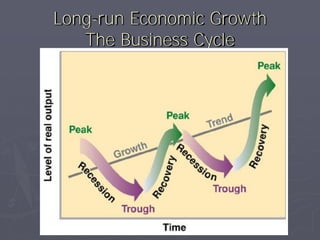
Long-run Economic Growth
   The Business Cycle


                      bluecollarinvest.com
Effects of the Business Cycle
► Downturns   affect firms producing capital
  goods and consumer durables most
► Service industries and industries that
  produce nondurable consumer goods are
  affected least
Unemployment
Unemployment rate= (unemployed/labor force) x100
► Not included in unemployment rate- those who are
  unemployable or not looking for a job
► Issues with employment rate= part time
  employment and discouraged workers
► Types of unemployment
   Frictional
   Structural
   Cyclical
Unemployment
► Fullemployment= when there is no cyclical
  unemployment (structural and frictional are
  unavoidable)
► When rate of unemployment = full
  employment, we are at the natural rate of
  unemployment (NRU) and the economy is
  producing at potential output (5%= NRU)
► NRU= when the number of job seekers =
  the number of job vacancies
Cost of Unemployment
Economic
► GDP gap (difference between actual GDP and
  potential GDP)
► Unequal distribution of burdens
Noneconomic
► Loss of skills, family stress, loss of self-respect
► Pressure for political change
► Social unrest
Inflation
► Inflation=   rise in the general level of prices
  (CPI)
► Demand pull inflation= total spending >
  output (total spending pulls the price up
  because we demand more than is supplied)
► Cost push inflation= cost of input increases
   pushes price up (supply shocks= major
  cause, usually unexpected)
Inflation
Inflation does not affect everyone the same way.
  It leads to a redistribution of real income.
► Nominal income= number of $ received as
  wages, rent, interest, or profit
► Real income= measure of the amount of goods
  and services nominal income can buy
  (purchasing power), adjusted for inflation
Real income= nominal income/ price index
Who is hurt by inflation?
 ► Fixed income receivers
 ► Savers
 ► Creditors


      Who is unhurt by inflation?
► Flexible   income receivers
► Debtors


  Effects of anticipated inflation are less severe.
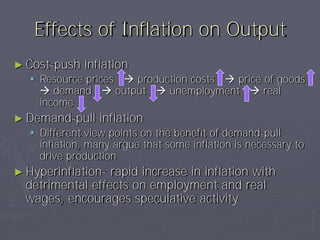
Effects of Inflation on Output
► Cost-push   inflation
   Resource prices  production costs  price of goods
     demand  output  unemployment  real
    income
► Demand-pull    inflation
   Different view points on the benefit of demand-pull
    inflation, many argue that some inflation is necessary to
    drive production
► Hyperinflation- rapid increase in inflation with
  detrimental effects on employment and real
  wages, encourages speculative activity

Economic measures1 (1)

  • 1.
  • 2.
    Assessing the Economy’s Performance Who does it? The Bureau of Economic Analysis What do they do? 1. assess the health of the econ by comparing levels of production at regular intervals 2. Track the long-run course of the economy to see whether it has grown, been constant, or declined 3. Formulate policies that will safeguard and improve the economy’s health
  • 3.
    The Gross DomesticProduct (GDP) ► The total output of goods and services (aggregate output) for a year- the market value (monetary measure) of the final goods= GDP ► Does not include:  Intermediate goods (no multiple counting)  Financial transactions  Secondhand sales 2009 GDP $14,258.7 Billion
  • 4.
    GDP: Spending vs.Income Expenditure (Spending) Approach Income Approach The sum of all the money spent in The sum of the income earned by buying goods and services producing goods and services
  • 5.
    The Expenditures Approach GDP= C+Ig+G+Xn C= Consumer expenditures on durable goods, nondurable goods, and services (households) **67-70% of GDP = targeting C  largest impact on GDP Ig= gross domestic investment in capital goods (businesses) G= government purchases of goods and services Xn= net exports (exports-imports or X-M)
  • 6.
    Other National Accounts (Economic Measures) ► Net Domestic Product (GDP adjusted for consumption/deprecation of physical capital) ► Personal Income (all income received by households- earned or unearned) ► Disposable Income (personal income- personal taxes)
  • 7.
    Nominal vs. RealGDP ► Need to make adjustment for changes in the value of money- inflation ► Nominal GDP= not adjusted for inflation ► Real GDP= adjusted for inflation (comparable from year to year) ► Rate of inflation is measured using the GDP price index or the consumer price index (CPI)
  • 8.
    GDP Price Index ►Compares the price of all goods and services included in GDP in a given year to the price of the same market basket in a reference year Price index= (price of good in specific year/price of same good in base year) x 100 Nominal GDP= Real GDP/GDP price index (in hundredths)
  • 9.
    Consumer Price Index separate from GDP Price Index, used to measure inflation ► Market basket (300 goods and services purchased by typical consumer) ► Current market basket is based on spending habits of consumers 1993-1995 ► The CPI for the 1982-1984 market basket is used as the base line CPI= (price of 1993-1995 market basket in any year/price of same market basket in 1982-1984) x 100
  • 10.
    Shortcomings of GDP ►Nonmarket transactions ► Leisure (value of free time) ► Improved product quality ► Underground economy ► Environmental effects (gross domestic by-products) ► Composition and distribution of output ► Per capita output (China GDP=$980 billion in 1999 compared to Denmark’s $170 billion, but per capita for China was $780 and $32,030 for Denmark.) ► Noneconomic sources of well being
  • 11.
    Economic Growth andStability How is growth determined? ► Increase in real GDP over some period of time ► Increase in real GDP per capita over some period of time Why is small growth significant? ► GDP= large number ► The rule of 70
  • 12.
    Sources of Growth ►Increase inputs of resources ► Increase productivity of inputs GDP= C+Ig+G+Xn **67-70% of GDP= targeting C largest impact on GDP
  • 13.
    Long-run Economic Growth The Business Cycle bluecollarinvest.com
  • 14.
    Effects of theBusiness Cycle ► Downturns affect firms producing capital goods and consumer durables most ► Service industries and industries that produce nondurable consumer goods are affected least
  • 15.
    Unemployment Unemployment rate= (unemployed/laborforce) x100 ► Not included in unemployment rate- those who are unemployable or not looking for a job ► Issues with employment rate= part time employment and discouraged workers ► Types of unemployment  Frictional  Structural  Cyclical
  • 16.
    Unemployment ► Fullemployment= whenthere is no cyclical unemployment (structural and frictional are unavoidable) ► When rate of unemployment = full employment, we are at the natural rate of unemployment (NRU) and the economy is producing at potential output (5%= NRU) ► NRU= when the number of job seekers = the number of job vacancies
  • 17.
    Cost of Unemployment Economic ►GDP gap (difference between actual GDP and potential GDP) ► Unequal distribution of burdens Noneconomic ► Loss of skills, family stress, loss of self-respect ► Pressure for political change ► Social unrest
  • 18.
    Inflation ► Inflation= rise in the general level of prices (CPI) ► Demand pull inflation= total spending > output (total spending pulls the price up because we demand more than is supplied) ► Cost push inflation= cost of input increases  pushes price up (supply shocks= major cause, usually unexpected)
  • 19.
    Inflation Inflation does notaffect everyone the same way. It leads to a redistribution of real income. ► Nominal income= number of $ received as wages, rent, interest, or profit ► Real income= measure of the amount of goods and services nominal income can buy (purchasing power), adjusted for inflation Real income= nominal income/ price index
  • 20.
    Who is hurtby inflation? ► Fixed income receivers ► Savers ► Creditors Who is unhurt by inflation? ► Flexible income receivers ► Debtors Effects of anticipated inflation are less severe.
  • 21.
    Effects of Inflationon Output ► Cost-push inflation  Resource prices  production costs  price of goods  demand  output  unemployment  real income ► Demand-pull inflation  Different view points on the benefit of demand-pull inflation, many argue that some inflation is necessary to drive production ► Hyperinflation- rapid increase in inflation with detrimental effects on employment and real wages, encourages speculative activity