INTRODUCTION TO LINGUISTICS
          SYNTAX


           Presented by Fifth Group: Atef Nur M Zahri
                                            Rohmah
                                           Nurhayati


      ENGLISH DEPARTMENT
   MATHLA’UL ANWAR UNIVERSITY
            2011-2012
What is Syntax ?

 The study of the principles and processes by
  which sentences are constructed in particular
  languages.

 the study of the rules that govern the ways in
  which words combine to form phrases,
  clauses, and sentences. Syntax is one of the
  major components of grammar.
Words categories

   Anepronym
   Antonym
   Eponym
   Heteronym
   Homonym
   Metonym
   Pseudonym
   Synonym
   Toponym
Phrase and Clause Structure

 Phrase structure is a group of words that has
  particular meaning when used together, or a
  rules is a type of phrase structure grammar.

 Clause structure is a smallest grammatical
  unit that can express a complete proposition
  and contains minimally a subject and a verb.
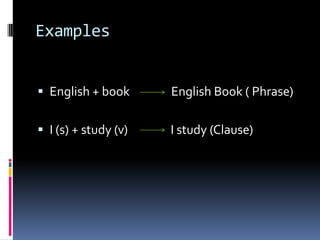
Examples


 English + book      English Book ( Phrase)

 I (s) + study (v)   I study (Clause)
Sentences Structure

 Sentence is a group of words that contains a
  subject and a verb, and express a complete
  idea.

 Sentence structure divided be four form
  sentences, such as simple sentence,
  compound sentence, complex sentence and
  compound-complex sentence.
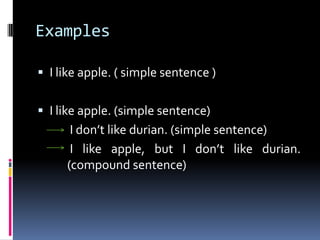
Examples

 I like apple. ( simple sentence )


 I like apple. (simple sentence)
      I don’t like durian. (simple sentence)
      I like apple, but I don’t like durian.
     (compound sentence)
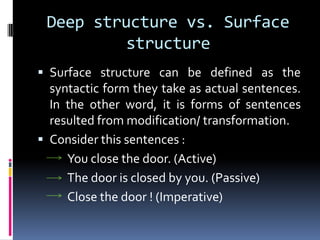
Deep structure vs. Surface
          structure
 Surface structure can be defined as the
  syntactic form they take as actual sentences.
  In the other word, it is forms of sentences
  resulted from modification/ transformation.
 Consider this sentences :
     You close the door. (Active)
     The door is closed by you. (Passive)
     Close the door ! (Imperative)
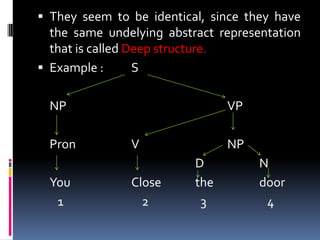
 They seem to be identical, since they have
  the same undelying abstract representation
  that is called Deep structure.
 Example :       S

  NP                            VP

  Pron         V                NP
                          D          N
  You          Close      the        door
   1             2         3          4
Introduction to lingistics

Introduction to lingistics

  • 1.
    INTRODUCTION TO LINGUISTICS SYNTAX Presented by Fifth Group: Atef Nur M Zahri Rohmah Nurhayati ENGLISH DEPARTMENT MATHLA’UL ANWAR UNIVERSITY 2011-2012
  • 2.
    What is Syntax?  The study of the principles and processes by which sentences are constructed in particular languages.  the study of the rules that govern the ways in which words combine to form phrases, clauses, and sentences. Syntax is one of the major components of grammar.
  • 3.
    Words categories  Anepronym  Antonym  Eponym  Heteronym  Homonym  Metonym  Pseudonym  Synonym  Toponym
  • 4.
    Phrase and ClauseStructure  Phrase structure is a group of words that has particular meaning when used together, or a rules is a type of phrase structure grammar.  Clause structure is a smallest grammatical unit that can express a complete proposition and contains minimally a subject and a verb.
  • 5.
    Examples  English +book English Book ( Phrase)  I (s) + study (v) I study (Clause)
  • 6.
    Sentences Structure  Sentenceis a group of words that contains a subject and a verb, and express a complete idea.  Sentence structure divided be four form sentences, such as simple sentence, compound sentence, complex sentence and compound-complex sentence.
  • 7.
    Examples  I likeapple. ( simple sentence )  I like apple. (simple sentence) I don’t like durian. (simple sentence) I like apple, but I don’t like durian. (compound sentence)
  • 8.
    Deep structure vs.Surface structure  Surface structure can be defined as the syntactic form they take as actual sentences. In the other word, it is forms of sentences resulted from modification/ transformation.  Consider this sentences : You close the door. (Active) The door is closed by you. (Passive) Close the door ! (Imperative)
  • 9.
     They seemto be identical, since they have the same undelying abstract representation that is called Deep structure.  Example : S NP VP Pron V NP D N You Close the door 1 2 3 4