International
Relations: A
Comprehensive
Overview
International relations, in its broadest sense, encompasses the study of
interactions between states and other actors on the global stage. It delves
into the complexities of diplomacy, conflict, cooperation, and the dynamics
of power that shape the international system. From the intricacies of
international law to the impact of globalization, this field explores the
multifaceted relationships that define our interconnected world.
by Deepak Daksh
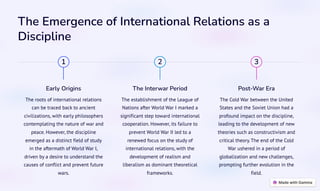
The Emergence of International Relations as a
Discipline
1
Early Origins
The roots of international relations
can be traced back to ancient
civilizations, with early philosophers
contemplating the nature of war and
peace. However, the discipline
emerged as a distinct field of study
in the aftermath of World War I,
driven by a desire to understand the
causes of conflict and prevent future
wars.
2
The Interwar Period
The establishment of the League of
Nations after World War I marked a
significant step toward international
cooperation. However, its failure to
prevent World War II led to a
renewed focus on the study of
international relations, with the
development of realism and
liberalism as dominant theoretical
frameworks.
3
Post-War Era
The Cold War between the United
States and the Soviet Union had a
profound impact on the discipline,
leading to the development of new
theories such as constructivism and
critical theory. The end of the Cold
War ushered in a period of
globalization and new challenges,
prompting further evolution in the
field.
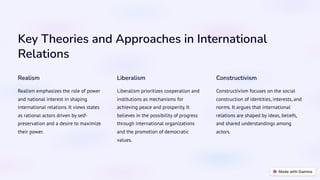
Key Theories and Approaches in International
Relations
Realism
Realism emphasizes the role of power
and national interest in shaping
international relations. It views states
as rational actors driven by self-
preservation and a desire to maximize
their power.
Liberalism
Liberalism prioritizes cooperation and
institutions as mechanisms for
achieving peace and prosperity. It
believes in the possibility of progress
through international organizations
and the promotion of democratic
values.
Constructivism
Constructivism focuses on the social
construction of identities, interests, and
norms. It argues that international
relations are shaped by ideas, beliefs,
and shared understandings among
actors.
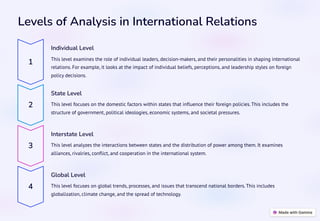
Levels of Analysis in International Relations
1
Individual Level
This level examines the role of individual leaders, decision-makers, and their personalities in shaping international
relations. For example, it looks at the impact of individual beliefs, perceptions, and leadership styles on foreign
policy decisions.
2
State Level
This level focuses on the domestic factors within states that influence their foreign policies. This includes the
structure of government, political ideologies, economic systems, and societal pressures.
3
Interstate Level
This level analyzes the interactions between states and the distribution of power among them. It examines
alliances, rivalries, conflict, and cooperation in the international system.
4
Global Level
This level focuses on global trends, processes, and issues that transcend national borders. This includes
globalization, climate change, and the spread of technology.
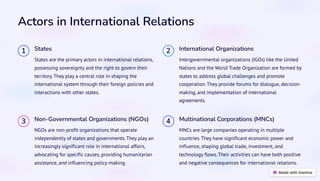
Actors in International Relations
1 States
States are the primary actors in international relations,
possessing sovereignty and the right to govern their
territory. They play a central role in shaping the
international system through their foreign policies and
interactions with other states.
2 International Organizations
Intergovernmental organizations (IGOs) like the United
Nations and the World Trade Organization are formed by
states to address global challenges and promote
cooperation. They provide forums for dialogue, decision-
making, and implementation of international
agreements.
3 Non-Governmental Organizations (NGOs)
NGOs are non-profit organizations that operate
independently of states and governments. They play an
increasingly significant role in international affairs,
advocating for specific causes, providing humanitarian
assistance, and influencing policy-making.
4 Multinational Corporations (MNCs)
MNCs are large companies operating in multiple
countries. They have significant economic power and
influence, shaping global trade, investment, and
technology flows. Their activities can have both positive
and negative consequences for international relations.
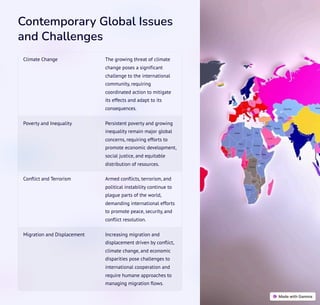
Contemporary Global Issues
and Challenges
Climate Change The growing threat of climate
change poses a significant
challenge to the international
community, requiring
coordinated action to mitigate
its effects and adapt to its
consequences.
Poverty and Inequality Persistent poverty and growing
inequality remain major global
concerns, requiring efforts to
promote economic development,
social justice, and equitable
distribution of resources.
Conflict and Terrorism Armed conflicts, terrorism, and
political instability continue to
plague parts of the world,
demanding international efforts
to promote peace, security, and
conflict resolution.
Migration and Displacement Increasing migration and
displacement driven by conflict,
climate change, and economic
disparities pose challenges to
international cooperation and
require humane approaches to
managing migration flows.
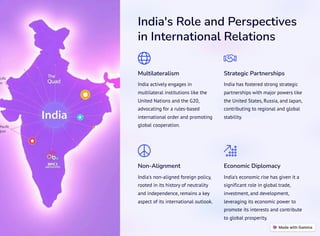
India's Role and Perspectives
in International Relations
Multilateralism
India actively engages in
multilateral institutions like the
United Nations and the G20,
advocating for a rules-based
international order and promoting
global cooperation.
Strategic Partnerships
India has fostered strong strategic
partnerships with major powers like
the United States, Russia, and Japan,
contributing to regional and global
stability.
Non-Alignment
India's non-aligned foreign policy,
rooted in its history of neutrality
and independence, remains a key
aspect of its international outlook.
Economic Diplomacy
India's economic rise has given it a
significant role in global trade,
investment, and development,
leveraging its economic power to
promote its interests and contribute
to global prosperity.
Career Opportunities in
International Relations
Diplomacy and Foreign
Service
Working in embassies,
consulates, or international
organizations, diplomats
represent their countries'
interests abroad, negotiate
treaties, and promote
international cooperation.
Research and Academia
International relations scholars
conduct research, publish
articles, and teach at
universities and think tanks,
contributing to our
understanding of the
international system and
policy-making.
Journalism and Media
International affairs journalists
report on global events,
analyze current issues, and
inform the public about
international relations, shaping
public opinion and influencing
policy debates.
Policy and Advocacy
Policy analysts and advocates
work for governments, NGOs,
or think tanks, developing
policy recommendations,
conducting research, and
lobbying for specific causes.
Conclusion
International relations is a complex and ever-evolving field that offers a
fascinating window into the workings of our interconnected world. By
understanding the key theories, actors, and issues that shape global
interactions, we can gain valuable insights into the challenges and
opportunities facing the international community. From diplomacy to
conflict resolution, from globalization to climate change, this field plays a
crucial role in shaping the future of our planet.

International-Relations-A-Comprehensive-Overview.pdf

  • 1.
    International Relations: A Comprehensive Overview International relations,in its broadest sense, encompasses the study of interactions between states and other actors on the global stage. It delves into the complexities of diplomacy, conflict, cooperation, and the dynamics of power that shape the international system. From the intricacies of international law to the impact of globalization, this field explores the multifaceted relationships that define our interconnected world. by Deepak Daksh
  • 2.
    The Emergence ofInternational Relations as a Discipline 1 Early Origins The roots of international relations can be traced back to ancient civilizations, with early philosophers contemplating the nature of war and peace. However, the discipline emerged as a distinct field of study in the aftermath of World War I, driven by a desire to understand the causes of conflict and prevent future wars. 2 The Interwar Period The establishment of the League of Nations after World War I marked a significant step toward international cooperation. However, its failure to prevent World War II led to a renewed focus on the study of international relations, with the development of realism and liberalism as dominant theoretical frameworks. 3 Post-War Era The Cold War between the United States and the Soviet Union had a profound impact on the discipline, leading to the development of new theories such as constructivism and critical theory. The end of the Cold War ushered in a period of globalization and new challenges, prompting further evolution in the field.
  • 3.
    Key Theories andApproaches in International Relations Realism Realism emphasizes the role of power and national interest in shaping international relations. It views states as rational actors driven by self- preservation and a desire to maximize their power. Liberalism Liberalism prioritizes cooperation and institutions as mechanisms for achieving peace and prosperity. It believes in the possibility of progress through international organizations and the promotion of democratic values. Constructivism Constructivism focuses on the social construction of identities, interests, and norms. It argues that international relations are shaped by ideas, beliefs, and shared understandings among actors.
  • 4.
    Levels of Analysisin International Relations 1 Individual Level This level examines the role of individual leaders, decision-makers, and their personalities in shaping international relations. For example, it looks at the impact of individual beliefs, perceptions, and leadership styles on foreign policy decisions. 2 State Level This level focuses on the domestic factors within states that influence their foreign policies. This includes the structure of government, political ideologies, economic systems, and societal pressures. 3 Interstate Level This level analyzes the interactions between states and the distribution of power among them. It examines alliances, rivalries, conflict, and cooperation in the international system. 4 Global Level This level focuses on global trends, processes, and issues that transcend national borders. This includes globalization, climate change, and the spread of technology.
  • 5.
    Actors in InternationalRelations 1 States States are the primary actors in international relations, possessing sovereignty and the right to govern their territory. They play a central role in shaping the international system through their foreign policies and interactions with other states. 2 International Organizations Intergovernmental organizations (IGOs) like the United Nations and the World Trade Organization are formed by states to address global challenges and promote cooperation. They provide forums for dialogue, decision- making, and implementation of international agreements. 3 Non-Governmental Organizations (NGOs) NGOs are non-profit organizations that operate independently of states and governments. They play an increasingly significant role in international affairs, advocating for specific causes, providing humanitarian assistance, and influencing policy-making. 4 Multinational Corporations (MNCs) MNCs are large companies operating in multiple countries. They have significant economic power and influence, shaping global trade, investment, and technology flows. Their activities can have both positive and negative consequences for international relations.
  • 6.
    Contemporary Global Issues andChallenges Climate Change The growing threat of climate change poses a significant challenge to the international community, requiring coordinated action to mitigate its effects and adapt to its consequences. Poverty and Inequality Persistent poverty and growing inequality remain major global concerns, requiring efforts to promote economic development, social justice, and equitable distribution of resources. Conflict and Terrorism Armed conflicts, terrorism, and political instability continue to plague parts of the world, demanding international efforts to promote peace, security, and conflict resolution. Migration and Displacement Increasing migration and displacement driven by conflict, climate change, and economic disparities pose challenges to international cooperation and require humane approaches to managing migration flows.
  • 7.
    India's Role andPerspectives in International Relations Multilateralism India actively engages in multilateral institutions like the United Nations and the G20, advocating for a rules-based international order and promoting global cooperation. Strategic Partnerships India has fostered strong strategic partnerships with major powers like the United States, Russia, and Japan, contributing to regional and global stability. Non-Alignment India's non-aligned foreign policy, rooted in its history of neutrality and independence, remains a key aspect of its international outlook. Economic Diplomacy India's economic rise has given it a significant role in global trade, investment, and development, leveraging its economic power to promote its interests and contribute to global prosperity.
  • 8.
    Career Opportunities in InternationalRelations Diplomacy and Foreign Service Working in embassies, consulates, or international organizations, diplomats represent their countries' interests abroad, negotiate treaties, and promote international cooperation. Research and Academia International relations scholars conduct research, publish articles, and teach at universities and think tanks, contributing to our understanding of the international system and policy-making. Journalism and Media International affairs journalists report on global events, analyze current issues, and inform the public about international relations, shaping public opinion and influencing policy debates. Policy and Advocacy Policy analysts and advocates work for governments, NGOs, or think tanks, developing policy recommendations, conducting research, and lobbying for specific causes.
  • 9.
    Conclusion International relations isa complex and ever-evolving field that offers a fascinating window into the workings of our interconnected world. By understanding the key theories, actors, and issues that shape global interactions, we can gain valuable insights into the challenges and opportunities facing the international community. From diplomacy to conflict resolution, from globalization to climate change, this field plays a crucial role in shaping the future of our planet.