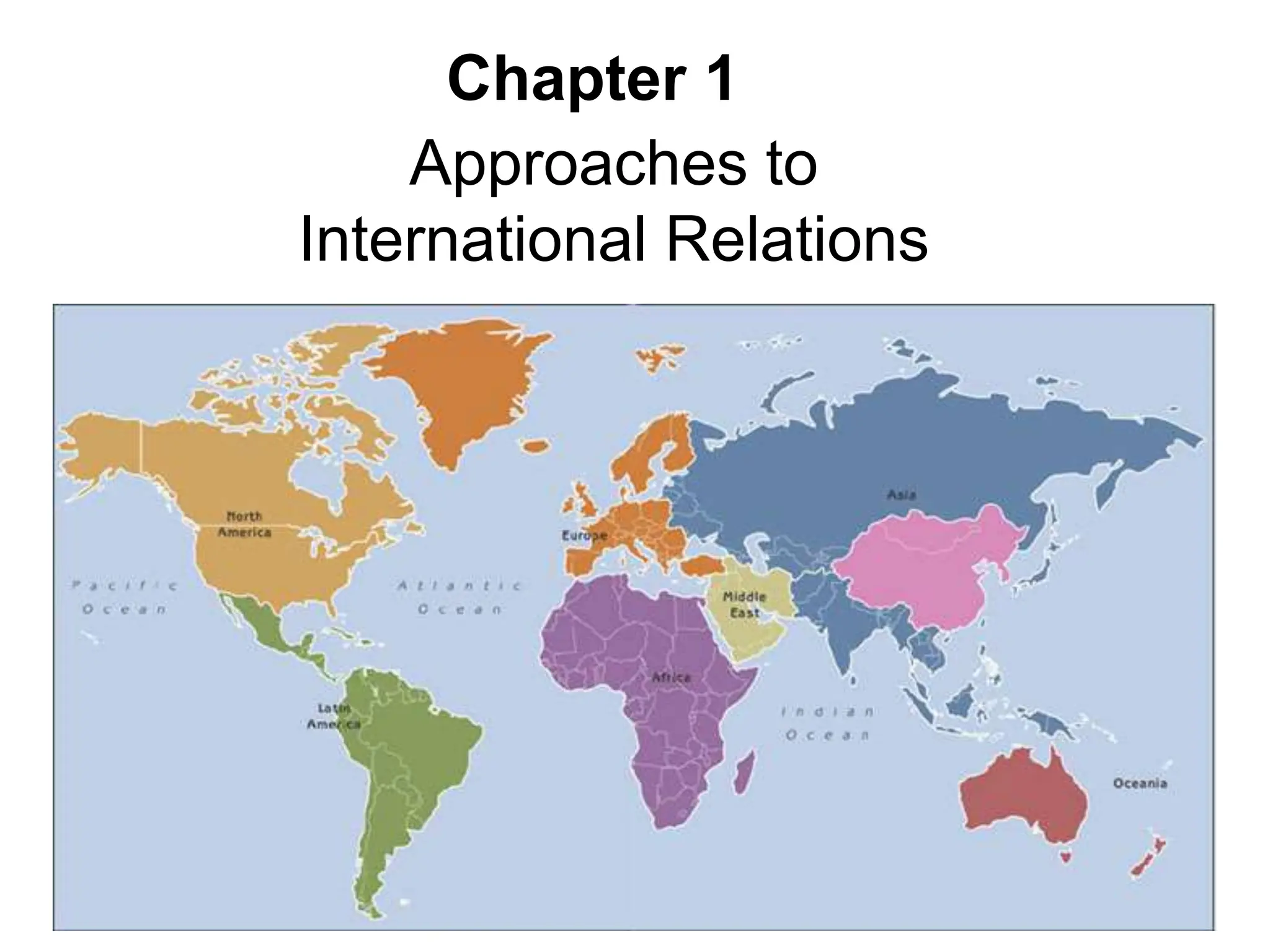
Chapter 1
Approaches to
International Relations
• International Relations (IR) =
study of interactions among various actors
(states, international organizations (e.g.,
IGOs, MNCs), nongovernmental
organizations (NGOs), and subnational
entities like bureaucracies, local
governments, and individuals) that
participate in international politics
• Branch of political science; academic and
public policy; positive and/or normative
• Develop theories to understand causes of
events in IR and to answer foundational
questions
• Principle functions of theory are to:
– describe what is happening
– explain why it is happening
– predict what will happen in the future
• Liberalism, Realism, Radicalism (and
Constructivism)
Thinking Theoretically in IR
Main Theories in Brief
• Liberalism
– States generally cooperate, follow international mutually-
agreed upon international norms
• Realism
– States exist in anarchic international system; policy based on
national interest defined in terms of power; structure of
international system determined by distribution of power
among states
• Radical theory
– State agent of international capitalism; system dominated by
highly-stratified capitalist system
• Postmodernism and Constructivism
– Theory is situated, contextual, conditional (general theory
impossible)
– No single objective reality
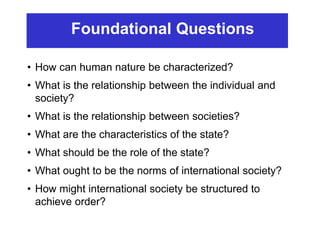
Foundational Questions
• How can human nature be characterized?
• What is the relationship between the individual and
society?
• What is the relationship between societies?
• What are the characteristics of the state?
• What should be the role of the state?
• What ought to be the norms of international society?
• How might international society be structured to
achieve order?
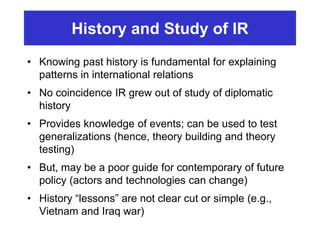
History and Study of IR
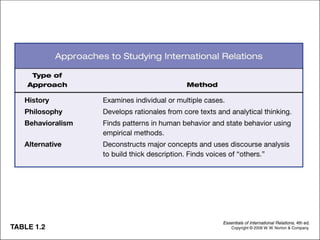
• Knowing past history is fundamental for explaining
patterns in international relations
• No coincidence IR grew out of study of diplomatic
history
• Provides knowledge of events; can be used to test
generalizations (hence, theory building and theory
testing)
• But, may be a poor guide for contemporary of future
policy (actors and technologies can change)
• History “lessons” are not clear cut or simple (e.g.,
Vietnam and Iraq war)
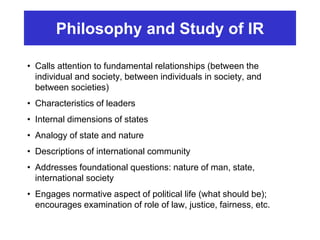
Philosophy and Study of IR
• Calls attention to fundamental relationships (between the
individual and society, between individuals in society, and
between societies)
• Characteristics of leaders
• Internal dimensions of states
• Analogy of state and nature
• Descriptions of international community
• Addresses foundational questions: nature of man, state,
international society
• Engages normative aspect of political life (what should be);
encourages examination of role of law, justice, fairness, etc.
Behavioralism
• Behavioral revolution, 1950s-1960s; grew out of
dissatisfaction with traditional (philosophical,
historical) approaches
• Behavioralism = an approach to the study of social
science and IR that posits that individuals and units
like states act in regularized ways; leads to a belief
that behaviors can be described, explained, and
predicted
• Task: to suggest plausible hypotheses regarding
patterned actions and to systematically and
empirically test those hypotheses (description,
explanation, prediction using the scientific method)
Correlates of War Project
• Why is there war?
• History and behavioral approaches
• Coding historical data on wars, 1865-1965: deaths,
magnitude, severity, intensity
• Developed hypotheses for outbreak by examining
correlations between number of wars and severity,
presence of alliances and war
• If we can describe/identify correlates of war, we have
taken step toward explaining why war breaks out, and
then may be able to predict/prevent war in future
(presumably, then, create conditions for peace)
• Results provocative, but ultimately inconclusive
Discussion Questions
1. Which theoretical approach (Liberalism, Realism,
Radicalism, Constructivism) do you find most appealing
and why? What are its strengths, weaknesses? What
make the others less appealing? What are their key
shortcomings?
2. How valuable are large behavioral studies such as the
Correlates of War project? Explain your answer. Do you
think behavioralism (i.e., the scientific method), is the best
way to study IR? Why or why not?
3. Select one of the three more prominent theoretical
approaches to the study of IR and apply it to a current
international issue/event. Briefly describe the issue/event
and the important questions you think it raises, and then
explain how your chosen approach might address these
questions and help us better understand the issue/event.

Chapter 1, Approaches to International Relations.ppt

  • 1.
  • 2.
    International Relations • InternationalRelations (IR) = study of interactions among various actors (states, international organizations (e.g., IGOs, MNCs), nongovernmental organizations (NGOs), and subnational entities like bureaucracies, local governments, and individuals) that participate in international politics • Branch of political science; academic and public policy; positive and/or normative
  • 3.
    • Develop theoriesto understand causes of events in IR and to answer foundational questions • Principle functions of theory are to: – describe what is happening – explain why it is happening – predict what will happen in the future • Liberalism, Realism, Radicalism (and Constructivism) Thinking Theoretically in IR
  • 4.
    Main Theories inBrief • Liberalism – States generally cooperate, follow international mutually- agreed upon international norms • Realism – States exist in anarchic international system; policy based on national interest defined in terms of power; structure of international system determined by distribution of power among states • Radical theory – State agent of international capitalism; system dominated by highly-stratified capitalist system • Postmodernism and Constructivism – Theory is situated, contextual, conditional (general theory impossible) – No single objective reality
  • 5.
    Foundational Questions • Howcan human nature be characterized? • What is the relationship between the individual and society? • What is the relationship between societies? • What are the characteristics of the state? • What should be the role of the state? • What ought to be the norms of international society? • How might international society be structured to achieve order?
  • 6.
    History and Studyof IR • Knowing past history is fundamental for explaining patterns in international relations • No coincidence IR grew out of study of diplomatic history • Provides knowledge of events; can be used to test generalizations (hence, theory building and theory testing) • But, may be a poor guide for contemporary of future policy (actors and technologies can change) • History “lessons” are not clear cut or simple (e.g., Vietnam and Iraq war)
  • 7.
    Philosophy and Studyof IR • Calls attention to fundamental relationships (between the individual and society, between individuals in society, and between societies) • Characteristics of leaders • Internal dimensions of states • Analogy of state and nature • Descriptions of international community • Addresses foundational questions: nature of man, state, international society • Engages normative aspect of political life (what should be); encourages examination of role of law, justice, fairness, etc.
  • 9.
    Behavioralism • Behavioral revolution,1950s-1960s; grew out of dissatisfaction with traditional (philosophical, historical) approaches • Behavioralism = an approach to the study of social science and IR that posits that individuals and units like states act in regularized ways; leads to a belief that behaviors can be described, explained, and predicted • Task: to suggest plausible hypotheses regarding patterned actions and to systematically and empirically test those hypotheses (description, explanation, prediction using the scientific method)
  • 10.
    Correlates of WarProject • Why is there war? • History and behavioral approaches • Coding historical data on wars, 1865-1965: deaths, magnitude, severity, intensity • Developed hypotheses for outbreak by examining correlations between number of wars and severity, presence of alliances and war • If we can describe/identify correlates of war, we have taken step toward explaining why war breaks out, and then may be able to predict/prevent war in future (presumably, then, create conditions for peace) • Results provocative, but ultimately inconclusive
  • 12.
    Discussion Questions 1. Whichtheoretical approach (Liberalism, Realism, Radicalism, Constructivism) do you find most appealing and why? What are its strengths, weaknesses? What make the others less appealing? What are their key shortcomings? 2. How valuable are large behavioral studies such as the Correlates of War project? Explain your answer. Do you think behavioralism (i.e., the scientific method), is the best way to study IR? Why or why not? 3. Select one of the three more prominent theoretical approaches to the study of IR and apply it to a current international issue/event. Briefly describe the issue/event and the important questions you think it raises, and then explain how your chosen approach might address these questions and help us better understand the issue/event.