Introduction	to	Information	
Channel
Akhil	Nadh	PC
17203101
MTech (	IS	)
Submitted	To
Mr.	D	K	Gupta
Topics	Discussed
q Definition	Of	Information	Channel
q How	to	Represent	Information	Channel
qCalculation	Of	Various	Probabilities	associated	with	Information	Channel
Information	Channel
v Defined	by
§ Input	Alphabet			A		,		defined	 as	A=	{	𝑎"}		for	i ={1,2,3…..,	r	}		,	where	r		is	the	size	of	input	
alphabet
§ Output	Alphabet			B	,		defined	as	B=	{	𝑏% }		for	j	={1,2,3…..,	s	}		,	where	s		is	the	size	of	output	
alphabet
§ r ≠	s			(	need	not	be)
§ 𝑃(	
()
*+
	) ∀𝑖	, 𝑗 Probability	of	output	symbol	 𝑏% is	received	if	𝑎" is	send
Information	Channel
q Information	Channel	does	not	produce	information	
q Used	to	transit	information	from	source	to	destination
Zero	Memory	Information	Channel
q Output	symbol	𝑏% is	depended		upon	the	input	symbol		𝑎"
qIf	output	symbol	𝑏% depended	upon	several	preceding	input	symbols	then	the	channel	is	called	
Channel	with	Memory
Conventional	ways	of	describing	
Informational	Channel
qArranging	conditional	probability	of	output	in	matrix	form
q
𝑏0 𝑏1
𝑎0 𝑃(	
(2
*2
	)
𝑎1 𝑃(	
(2
*3
	)
𝑏4
𝑃(	
(5
*2
	) ⃗ corresponds	to	probability	for	fixed	input	is	send
𝑎7 𝑃(	
(2
*8
	)
𝑎9 𝑃(	
(2
*:
	) 𝑃(	
(5
*:
	)
Concise	Representation	
q 𝑃"% = 𝑃
()
*+
							→ 		 1
q𝑃 =
𝑃00
𝑃10
𝑃90
𝑃04
𝑃04
𝑃94
qIf	sum	=1	=>	Markov’s	Matrix	
q∑ 𝑃"% = 1	∀	𝑖 = 1,2,…, 4	4
%C0
Sum	=1
Nth	Extension	of	the	Channel	Information
qInput	Symbol							𝐴E = {𝛼"} ∀ 𝑖 = 1,2,3… , 𝑟E
qOutput	Symbol			𝐵E = {𝛽%} ∀ 𝑗 = 1,2,3… , 𝑠E
qChannel	Matrix
∏ =
∏00
∏10
∏90
∏04N
∏04N
∏9N4N
q∏"% = 𝑃(
P)
Q+
)
Amount	Of	Information	A	channel	can	
Transmitted
qConsider	channel	with
q 𝑟 input	symbols
q 𝑠 output	symbols
q Defined	by	conditional	probability	P
𝑃00 	−> probability	of	occurrence	of	𝑏0 when	𝑎0	is	sent
qProbability	of	various	output	symbols	given	probability	of	some	input	symbol	is	given	by
𝑃 𝑎0 𝑃00 + 𝑃 𝑎1 𝑃10 + ⋯+ 𝑃 𝑎9 𝑃90 = 𝑃 𝑏0
𝑃 𝑎0 𝑃01 + 𝑃 𝑎1 𝑃11 + ⋯+ 𝑃 𝑎9 𝑃91 = 𝑃 𝑏1
𝑃 𝑎0 𝑃04 + 𝑃 𝑎1 𝑃14 + ⋯+ 𝑃 𝑎9 𝑃94 = 𝑃 𝑏4
𝑃00
Amount	Of	Information	A	channel	can	
Transmitted
q𝑃00 	→ 𝑃 𝑎" = 	𝑃
()
*+
qAccording	to	Bayes	theorem	
q𝑃
*)
(+
=
V
W)
X+
∗V *+
V ()
=	
V
W)
X+
∗V *+
∑ V
W)
X+
∗V *+
:
+Z2
Input	probability
Channel	matrix	probability
Backward	probability
Amount	Of	Information	A	channel	can	
Transmitted
qJoint	probability	is	given	by
𝑃 𝑎"	, 𝑏" = 				𝑃
𝑏%
𝑎"
∗ 𝑃 𝑎"
= 				𝑃
*+
()
∗ 𝑃 𝑏%
Binary	Symmetric	Channel
qSymmetric	iff:	
𝑃
0
[
=	𝑃
[
0
Receiving	
Sending
Binary	Symmetric	Channel
q input	size	=	output	size	=	2
q		𝑝 = 1 − 𝑝
q p	=	probability	that	error	will	occur
qSymmetric	if	probability	of	error	is	same	while
transmitting	the	symbols
Binary	Symmetric	Channel
qChannel	Matrix	Form	:
𝑃]^_ =
𝑝⃑ 𝑝
𝑝 𝑝⃑
q 2nd	– Extension	of	Binary	Symmetric	Channel	
∏=
𝑝⃑1
𝑝⃑ 𝑝
𝑝𝑝⃑
		𝑝1
𝑝⃑ 𝑝
					𝑝⃑1
		𝑝1
𝑝𝑝⃑
𝑝𝑝⃑
		𝑝1
			𝑝⃑1
𝑝⃑ 𝑝
		𝑝1
𝑝𝑝⃑
𝑝⃑ 𝑝
𝑝⃑1
Binary	Symmetric	Channel
qConcise	Form
∏ =
𝑝⃑ 𝑃 𝑝𝑃
𝑝𝑃 𝑝⃑ 𝑃
qP		be	channel	matrix	of	Binary	Symmetric	Channel
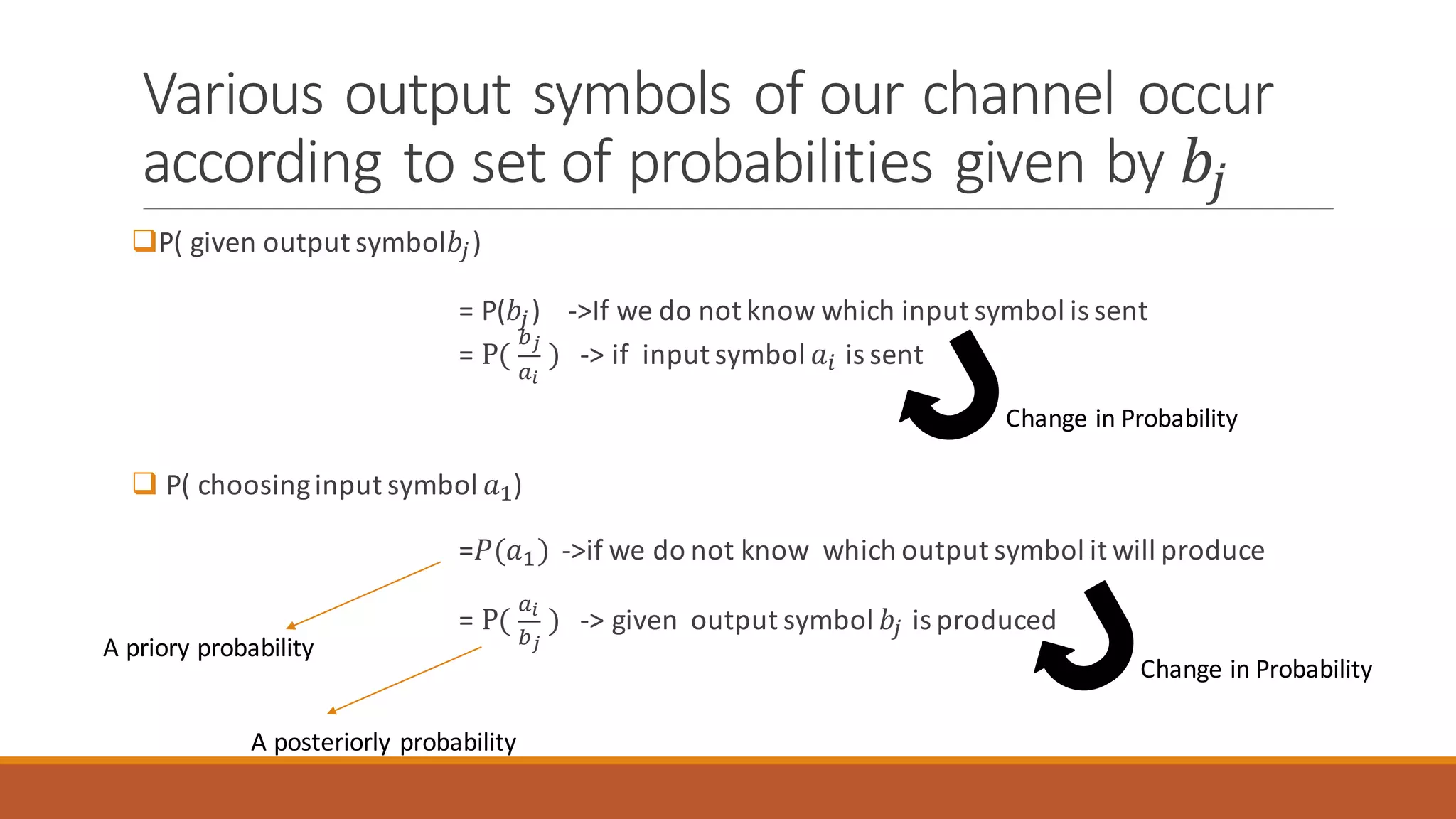
Various	output	symbols	of	our	channel	occur	
according	to	set	of	probabilities	given	by	𝑏%
qP(	given	output	symbol𝑏%)
=	P(𝑏%)				->If	we	do	not	know	which	input	symbol	is	sent
=	P(	
()
*+
	) ->	if		input	symbol	𝑎" is	sent	
q P(	choosing	input	symbol	𝑎0)
=𝑃(𝑎0) ->if	we	do	not	know		which	output	symbol	it	will	produce
= P(	
*+
()
	) ->	given		output	symbol	𝑏% is	produced
Change	in	Probability
A	priory	probability
A	posteriorly	probability
Entropy	of	source	A	
qA	priory	Entropy	of	source	A	
𝐻 𝐴 = ∑ 𝑃 𝑎" 𝑙𝑜𝑔
0
V(*+)f ->	avg #	binits need	to	represent	a	symbol	from	
source	with	a	priority	probability	i=1,2,…,r		
qA	posteriorly	Entropy	of	Source	A	when	𝑏% is	received
H(f
()h ) = ∑ 𝑃 *+
()h 𝑙𝑜𝑔
0
V
X+
W)
h
f
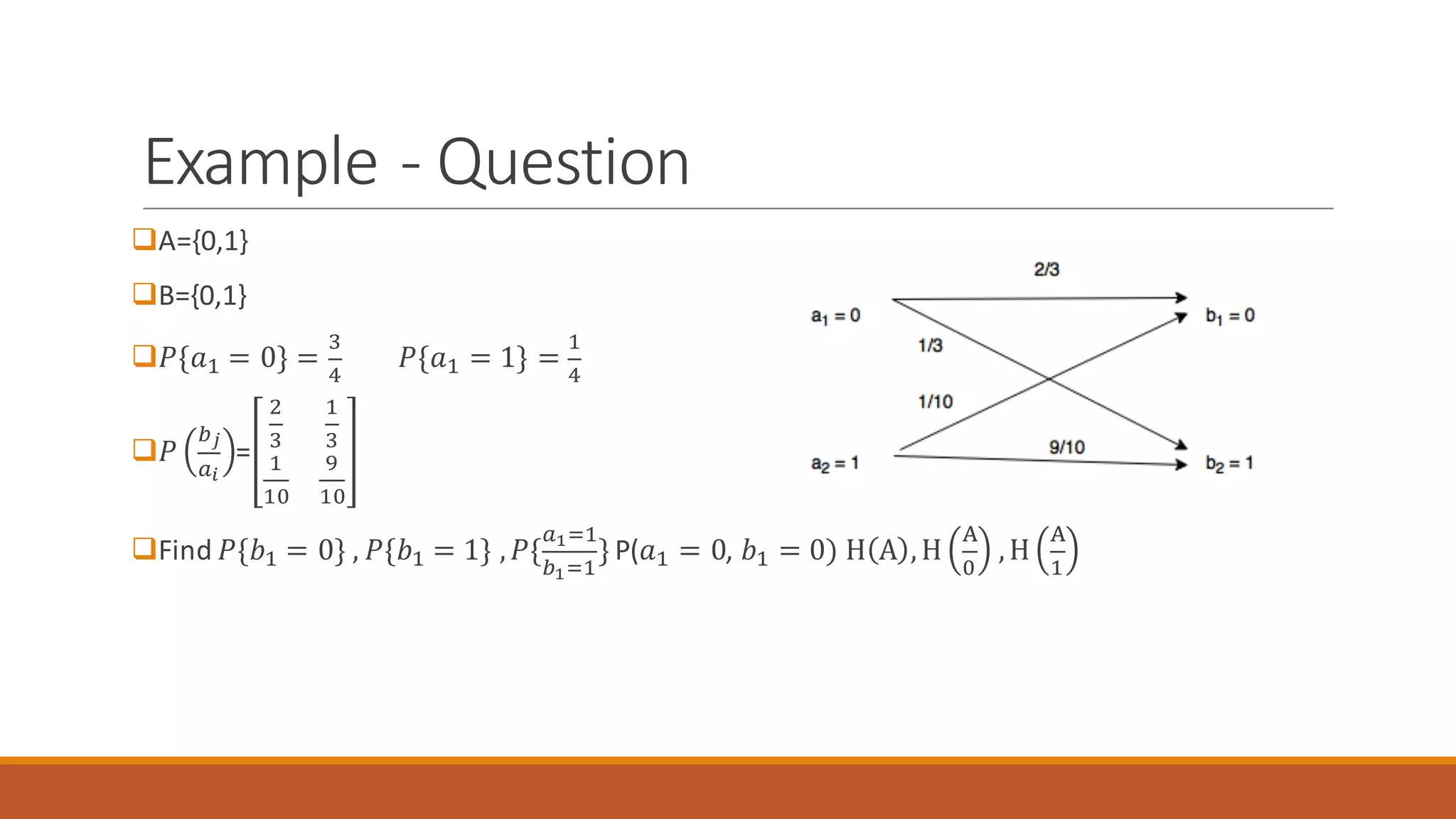
Example	- Question
qA={0,1}	
qB={0,1}
q𝑃{𝑎0 = 0} =
7
j
								𝑃{𝑎0 = 1} =
0
j
q𝑃
()
*+
=
1
7
0
7
0
0[
k
0[
qFind	𝑃{𝑏0 = 0}	, 𝑃{𝑏0 = 1}	, 𝑃{
*2C0
(2C0
} P(𝑎0 = 0, 𝑏0 = 0)	H A ,H
m
[
,H
m
0
Example	- Solution
qP(b=0)=
7
j
∗
1
7
		+ 	¼	 ∗
0
0[
		= 	
10
j[
qP(b=1)=
7
j
∗
0
7
		+ 	¼	 ∗
k
0[
		= 	
0k
j[
q P(a=1/b=1)	
2
o
∗
p
2q
2p
oq
	=
k
0k
q P(a=0/b=0)	
8
o
∗
3
8
32
oq
	=
1[
0k
qP(a=0	,	b=0	)	=	P(a=0/b=0)P(b=0)	=	
1[
10
∗
10
j[
=
0
1
Example	- Solution
qEntropy	of	source	
𝐻 𝐴 = 	
3
4
log
4
3
	+
1
4
log
4
1
	= 		0.811		bits/symbol
qA	posteriorly	Entropy	when	0	is	received	
𝐻
𝐴
0
	= 	
20
21
log
21
20
	+
1
21
log
21
1
	= 		0.267		bits/symbol
qA	posteriorly	Entropy	when	1is	received	
𝐻
𝐴
1
	= 	
9
19
log
19
9
	+
10
19
log
19
10
	= 		0.998		bits/symbol
More	Uncertainty
Shannon’s	First	Theorem
qEntropy	of	alphabet		may	be	interpreted	as	the	average	number	of																	
binary	digits			(binits)	necessary	to	represent	one	symbol	of	that	alphabet	
qDeals		only	with	coding	for	a	source	with	fixed	set	of	source	probabilities
qNot	with	coding	for	a	source	which	select	new	probabilities	after	each	output	
symbol
Generalization	of	Shannon’s	First	
Theorem
qWhat	is	the	most	efficient	method	of	coding	from	a	source	?
q here	,	source	is	input	alphabet	A	
statistics	of	code	change	from	symbol	to	symbol
which	source	we	need	to	pick	is	given	by	P(bj)	
compact	code	of	one	set	of	statistics	will	not	be	in	general	compact	code	of	other	statistics
q For	each	transmitted	symbol	we	construct	s	binary	codes	(	s	->	size	of	output	alphabet	)
qBuild	s	codes	one	for	each	of	possible	symbol	received	for	bj
input	symbol						code1					code	2					code3					… … code	s				
a1 l11 l12 l1s
a2 l21 l23 l2s
a3
…
…
ar lr1 lr2 lrs
l11	->	length	of	code	word	1	for	input	symbol	a1
Generalization	of	Shannon’s	First	
Theorem
Depending	 on	what	we	receive
q->	We	need	each	code	words	to	be	instantaneous	,	we	apply	Shannon’s	first	theorem		
𝐻
f
()
≤ 𝑃
*+
()
∗ 𝑙"% ->	avg length	of	jth code	
Generalization	of	Shannon’s	First	
Theorem
j th code	is	employed	only	when	𝑏%	 is	the	received	symbol
Generalization	of	Shannon’s	First	
Theorem
qGeneralized	Shannon’s	First	Theorem	
∑ 𝑃 𝑏 𝐻
f
(
≤ 	
Š
E
	 < ∑ 𝑃 𝑏 𝐻
f
(
+
0
E]f n->	Nth	extension		summed	over	input	and	
output	symbols
			𝐻 𝑆 ≤	
Š
E
	 < 	𝐻 𝑆 +
0
E
->				for	single	source	
->	valid	for	only	instantaneous	codes	which	are	uniquely	decodable	*
Avg #binits need	to	encoded	from	input	symbol	A	
if	we	already	have	corresponding	 out	put	symbol	b
Equivocation	of	A	wrt to	B
Channel	Equivocation
q𝐻
f
]
= ∑ ∑ 𝑃 𝑎, 𝑏 log
0
V
X
W
]f
Mutual	Information	Of	Channel
q 𝐼 𝐴, 𝐵 = H A − H
m
Ž
		
On	the	average	observation	of	single	output	symbol	provides	us	with	these	many	bits	of	information	
also	called	uncertainty	resolved	
q 𝐼 𝐴, 𝐵 =	∑ ∑ 𝑃 𝑎, 𝑏 log	(
V *,(
V * V(()] )f *
q𝐼 𝐴E
, 𝐵E
= 𝑛	𝐼 𝐴, 𝐵
Mutual	Information	Of	Channel
qCan	the	Mutual	Information	be	negative	?
H A − H
m
()
		 this	can	be	negative	as	we	have	seen	already	
q 𝐼 𝐴, 𝐵 ≥ 0	 iff 𝑃 𝑎", 𝑏% = 𝑃 𝑎" 𝑃(𝑏%) for	all	i,j proof
We	cannot	loose	information	on	average	on	observing	output	of	the	channel
Joint	Entropy
q	𝐻 𝐴, 𝐵 = ∑ ∑ 𝑃 𝑎, 𝑏 log	(
0
V *,(] )f
q𝐻 𝐴, 𝐵 = H(A)	+	H(B)	– I	(	A,B)
q𝐻 𝐴, 𝐵 = 𝐻 𝐴 + 𝐻
]
f
q𝐻 𝐴, 𝐵 = 𝐻 𝐵 + 𝐻
f
]
Example	– Binary	Symmetric	Channel
Given	Data
qChannel	Matrix
𝑃]^_ =
𝑝⃑ 𝑝
𝑝 𝑝⃑
where		𝑝⃑=1- 𝑝	
qProbability	of	transmitting	input	symbols		
1	 → 𝜔
	0	 → 𝜔’
Example	– Binary	Symmetric	Channel
𝐼 𝐴, 𝐵 = H B − H
B
A
		
= H B − (	p	log 	
0
”
	 + 𝑝⃑log
0
	•⃑	
	)	
P( 𝑏% =0)	= 𝜔𝑝⃑ + 𝜔’𝑝
P( 𝑏% =1)	= 𝜔𝑝 + 𝜔’𝑝⃑
𝐼 𝐴, 𝐵 =H( 𝜔𝑝 + 𝜔’𝑝⃑)-H(p)
Thank	You

Introduction to Information Channel