• What he look like to you the most……. ?
• Pirate….. ??
• Is he a HACKER ??
hat is HACKING …?
hy do people HACK…?
How Do We Secure……………….??
High Secure Password Authentication System
Akhil Nadh PC
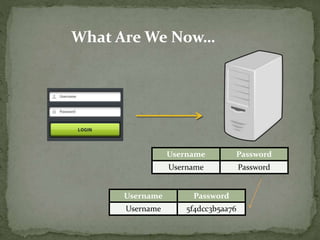
What Are We Now…
Username Password
Username Password
Username Password
Username 5f4dcc3b5aa76
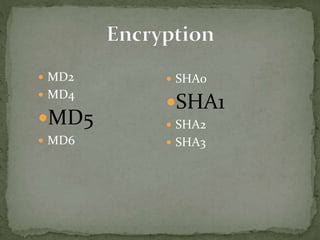
 MD2
 MD4
MD5
 MD6
 SHA0
SHA1
 SHA2
 SHA3
 Sql Injection
 Session Hijacking
 Brute force attacks
 Key loggers
 Single Server
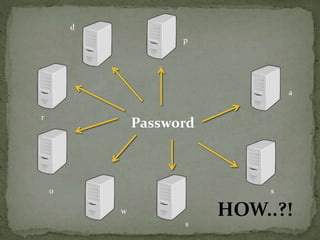
Password
w
s
a
p
s
r
o
d
HOW..?!
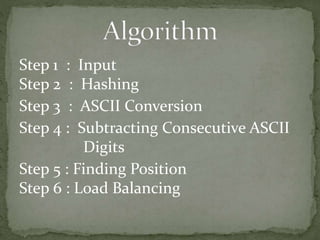
Step 1 : Input
Step 2 : Hashing
Step 3 : ASCII Conversion
Step 4 : Subtracting Consecutive ASCII
Digits
Step 5 : Finding Position
Step 6 : Load Balancing
Input :- ‘ password ’
Randomness ensure more security
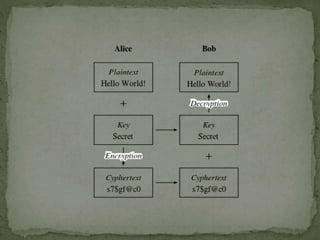
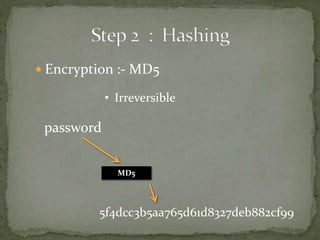
 Encryption :- MD5
• Irreversible
password
MD5
5f4dcc3b5aa765d61d8327deb882cf99
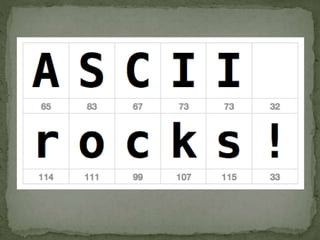
ASCII
is a character-encoding scheme
originally based on the English
alphabet
parts of hashed password are stored in different
servers.
each character in the hashed password should be
stored in the specific server at a specific position.
corresponding positions cannot be predetermined.
the positions can be generated only by using the
input string (the positions are of integer type).
ASCII conversion is used to map the hashed
characters to integers.
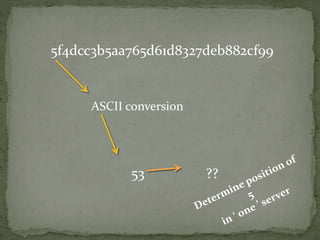
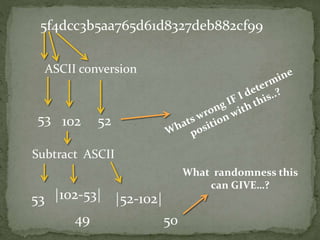
5f4dcc3b5aa765d61d8327deb882cf99
ASCII conversion
??53
 Subtract the consecutive ASCII Integers.
 the absolute value of the result is taken.
WHY… ??
HOW……. ??
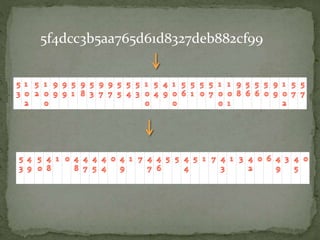
5f4dcc3b5aa765d61d8327deb882cf99
ASCII conversion
53 102 52
Subtract ASCII
53 |102-53| |52-102|
49 50
What randomness this
can GIVE…?
5f4dcc3b5aa765d61d8327deb882cf99
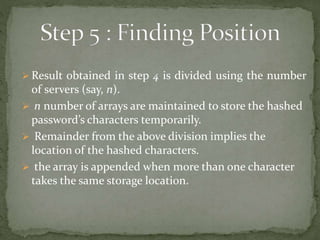
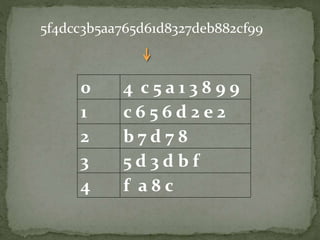
 Result obtained in step 4 is divided using the number
of servers (say, n).
 n number of arrays are maintained to store the hashed
password’s characters temporarily.
 Remainder from the above division implies the
location of the hashed characters.
 the array is appended when more than one character
takes the same storage location.
53
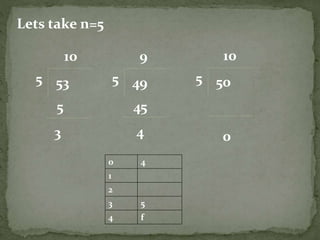
Lets take n=5
5
10
3
5
495
9
45
4
505
10
0
0 4
1
2
3 5
4 f
0 4 c 5 a 1 3 8 9 9
1 c 6 5 6 d 2 e 2
2 b 7 d 7 8
3 5 d 3 d b f
4 f a 8 c
5f4dcc3b5aa765d61d8327deb882cf99
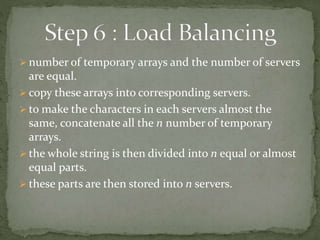
 number of temporary arrays and the number of servers
are equal.
 copy these arrays into corresponding servers.
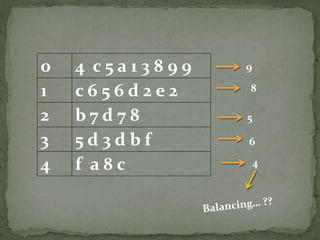
 to make the characters in each servers almost the
same, concatenate all the n number of temporary
arrays.
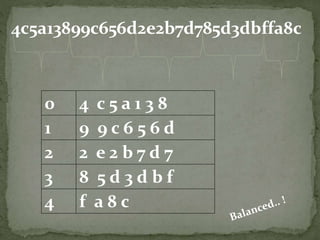
 the whole string is then divided into n equal or almost
equal parts.
 these parts are then stored into n servers.
0 4 c 5 a 1 3 8 9 9
1 c 6 5 6 d 2 e 2
2 b 7 d 7 8
3 5 d 3 d b f
4 f a 8 c
9
8
5
6
4
4c5a13899c656d2e2b7d785d3dbffa8c
0 4 c 5 a 1 3 8
1 9 9 c 6 5 6 d
2 2 e 2 b 7 d 7
3 8 5 d 3 d b f
4 f a 8 c
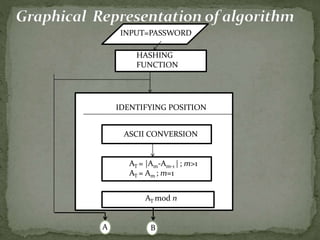
GGGAINPUT=PASSWORD
HASHING
FUNCTION
IDENTIFYING POSITION
ASCII CONVERSION
AT = |Am-Am-1 | ; m>1
AT = Am ; m=1
AT mod n
A B
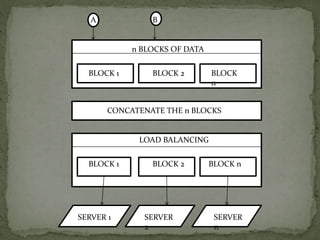
LOAD BALANCING
BLOCK 1 BLOCK 2 BLOCK n
CONCATENATE THE n BLOCKS
n BLOCKS OF DATA
BLOCK 1 BLOCK 2 BLOCK
n
SERVER 1 SERVER
2
SERVER
n
AA B
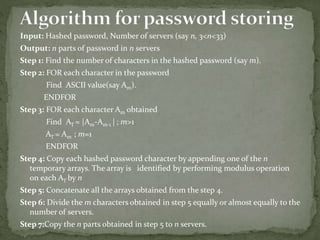
Input: Hashed password, Number of servers (say n, 3<n<33)
Output: n parts of password in n servers
Step 1: Find the number of characters in the hashed password (say m).
Step 2: FOR each character in the password
Find ASCII value(say Am).
ENDFOR
Step 3: FOR each character Am obtained
Find AT = |Am-Am-1 | ; m>1
AT = Am ; m=1
ENDFOR
Step 4: Copy each hashed password character by appending one of the n
temporary arrays. The array is identified by performing modulus operation
on each AT by n
Step 5: Concatenate all the arrays obtained from the step 4.
Step 6: Divide the m characters obtained in step 5 equally or almost equally to the
number of servers.
Step 7:Copy the n parts obtained in step 5 to n servers.
 The run time complexity of the proposed system
depends only on the number of the servers used.
The running time varies linearly with the number of
servers taken.
The length of the password is not considered as a
factor to determine the complexity.
Anirudhan Adukkathayar C
Sruthy S Menon
[1] NIST. Secure Hash Standard, FIPS PUB 180-2, 2002.
[2] A. K. Lenstra. Further Progress in Hashing Cryptanalysis (white paper).
http://cm.bell-labs.com/who/akl/hash.pdf, February 2005.
[3] R. Rivest. The MD5 Message-Digest Algorithm [rfc1321], 1992.
[4] Wang Xiaoyun, Chen Yin ru. Collision Analysis for Every Round Function of the
MD5, 1996.
[5] Wang Xiaoyun. How to Break MD5 and Other Hash Functions, 2005.
[6] Zhao Shaolan, Xing Guobo, Yang Yixian. The Analysis on Amelioration and Security
of MD5, 2005.
[7] L. Dadda, M. Macchetti, and J. Owen. An ASIC design for a high speed
implementation of the hash function SHA-256 (384,512). In ACM Great Lakes
Symposium on VLSI, pages 421–425. ACM, 2004.
[8] L. Dadda, M. Macchetti, and J. Owen. The design of a high speed ASIC unit for the
hash function SHA-256 (384, 512).In DATE 2004, pages 70–75. IEEE Computer
Society, 2004.
[9] R. Lien, T. Grembowski, and K. Gaj. A 1 Gbit/s partially unrolled architecture of
hash functions SHA-1 and SHA-512.In CT-RSA 2004, volume 2964 of LNCS, pages
324–338.Springer, 2004.
High Secure Password Authentication System

High Secure Password Authentication System

  • 1.
    • What helook like to you the most……. ? • Pirate….. ?? • Is he a HACKER ??
  • 2.
    hat is HACKING…? hy do people HACK…? How Do We Secure……………….??
  • 3.
    High Secure PasswordAuthentication System Akhil Nadh PC
  • 5.
    What Are WeNow… Username Password Username Password Username Password Username 5f4dcc3b5aa76
  • 7.
     MD2  MD4 MD5 MD6  SHA0 SHA1  SHA2  SHA3
  • 8.
     Sql Injection Session Hijacking  Brute force attacks  Key loggers  Single Server
  • 9.
  • 10.
    Step 1 :Input Step 2 : Hashing Step 3 : ASCII Conversion Step 4 : Subtracting Consecutive ASCII Digits Step 5 : Finding Position Step 6 : Load Balancing
  • 11.
    Input :- ‘password ’ Randomness ensure more security
  • 12.
     Encryption :-MD5 • Irreversible password MD5 5f4dcc3b5aa765d61d8327deb882cf99
  • 13.
    ASCII is a character-encodingscheme originally based on the English alphabet
  • 15.
    parts of hashedpassword are stored in different servers. each character in the hashed password should be stored in the specific server at a specific position. corresponding positions cannot be predetermined. the positions can be generated only by using the input string (the positions are of integer type). ASCII conversion is used to map the hashed characters to integers.
  • 16.
  • 17.
     Subtract theconsecutive ASCII Integers.  the absolute value of the result is taken. WHY… ?? HOW……. ??
  • 18.
    5f4dcc3b5aa765d61d8327deb882cf99 ASCII conversion 53 10252 Subtract ASCII 53 |102-53| |52-102| 49 50 What randomness this can GIVE…?
  • 19.
  • 20.
     Result obtainedin step 4 is divided using the number of servers (say, n).  n number of arrays are maintained to store the hashed password’s characters temporarily.  Remainder from the above division implies the location of the hashed characters.  the array is appended when more than one character takes the same storage location.
  • 21.
  • 22.
    0 4 c5 a 1 3 8 9 9 1 c 6 5 6 d 2 e 2 2 b 7 d 7 8 3 5 d 3 d b f 4 f a 8 c 5f4dcc3b5aa765d61d8327deb882cf99
  • 23.
     number oftemporary arrays and the number of servers are equal.  copy these arrays into corresponding servers.  to make the characters in each servers almost the same, concatenate all the n number of temporary arrays.  the whole string is then divided into n equal or almost equal parts.  these parts are then stored into n servers.
  • 24.
    0 4 c5 a 1 3 8 9 9 1 c 6 5 6 d 2 e 2 2 b 7 d 7 8 3 5 d 3 d b f 4 f a 8 c 9 8 5 6 4
  • 25.
    4c5a13899c656d2e2b7d785d3dbffa8c 0 4 c5 a 1 3 8 1 9 9 c 6 5 6 d 2 2 e 2 b 7 d 7 3 8 5 d 3 d b f 4 f a 8 c
  • 26.
  • 27.
    LOAD BALANCING BLOCK 1BLOCK 2 BLOCK n CONCATENATE THE n BLOCKS n BLOCKS OF DATA BLOCK 1 BLOCK 2 BLOCK n SERVER 1 SERVER 2 SERVER n AA B
  • 28.
    Input: Hashed password,Number of servers (say n, 3<n<33) Output: n parts of password in n servers Step 1: Find the number of characters in the hashed password (say m). Step 2: FOR each character in the password Find ASCII value(say Am). ENDFOR Step 3: FOR each character Am obtained Find AT = |Am-Am-1 | ; m>1 AT = Am ; m=1 ENDFOR Step 4: Copy each hashed password character by appending one of the n temporary arrays. The array is identified by performing modulus operation on each AT by n Step 5: Concatenate all the arrays obtained from the step 4. Step 6: Divide the m characters obtained in step 5 equally or almost equally to the number of servers. Step 7:Copy the n parts obtained in step 5 to n servers.
  • 29.
     The runtime complexity of the proposed system depends only on the number of the servers used. The running time varies linearly with the number of servers taken. The length of the password is not considered as a factor to determine the complexity.
  • 31.
  • 32.
    [1] NIST. SecureHash Standard, FIPS PUB 180-2, 2002. [2] A. K. Lenstra. Further Progress in Hashing Cryptanalysis (white paper). http://cm.bell-labs.com/who/akl/hash.pdf, February 2005. [3] R. Rivest. The MD5 Message-Digest Algorithm [rfc1321], 1992. [4] Wang Xiaoyun, Chen Yin ru. Collision Analysis for Every Round Function of the MD5, 1996. [5] Wang Xiaoyun. How to Break MD5 and Other Hash Functions, 2005. [6] Zhao Shaolan, Xing Guobo, Yang Yixian. The Analysis on Amelioration and Security of MD5, 2005. [7] L. Dadda, M. Macchetti, and J. Owen. An ASIC design for a high speed implementation of the hash function SHA-256 (384,512). In ACM Great Lakes Symposium on VLSI, pages 421–425. ACM, 2004. [8] L. Dadda, M. Macchetti, and J. Owen. The design of a high speed ASIC unit for the hash function SHA-256 (384, 512).In DATE 2004, pages 70–75. IEEE Computer Society, 2004. [9] R. Lien, T. Grembowski, and K. Gaj. A 1 Gbit/s partially unrolled architecture of hash functions SHA-1 and SHA-512.In CT-RSA 2004, volume 2964 of LNCS, pages 324–338.Springer, 2004.