1
Convention on International Trade in Endangered
Species of Wild Fauna and Flora
www.CITES.org
Introduction to species
identification
2
Why be concerned about identification?
• CITES is a mechanism for the regulation of
international trade in wild species
– It is a body of agreed rules and procedures that is
guided by science
– CITES is implemented by governments
– CITES is enforced by various government
agencies (police, customs etc.)
3
Why be concerned about identification?
• CITES is a specialist Convention largely applied by
non-specialists
• Governments must apply the Convention to all listed
species
– NGOs often focus on one or a few species only
• The bulk of implementing CITES falls on
administrators (Management Authorities) and law
enforcement
4
Why be concerned about identification?
• Traders, administrators, scientists, enforcement officers
and buyers must be able to tell species apart
– NGOs have little need for identification skills (except some
market monitoring)
– Scientists may be the only ones who receive any kind of
zoological or botanical training
– Traders and buyers may be knowledgeable out of necessity
and through experience
– This leaves administrators and law enforcement with the least
knowledge about identification and who are ironically the main
implementers...
5
Specimen identification
6
Issuing and verifying the necessary permits, inspecting goods,
caring for live animals and conserving perishable derivative
products all require qualified, concerned personnel. None of the
signatories of the Convention has allocated sufficient human
and financial resources to ensure perfect control of its borders.
Each CITES administrative body must work together with other
organizations to achieve the objectives of the Convention
Environment Canada, in the Preface to their CITES bird
identification guide
7
Introduction (and first lesson)
• What is identification?
– Identification is establishing the identity of the
specimen
What is it?
– The identity of the specimen is one of many
pieces of information that you need to regulate
trade in species in accordance with CITES, but it
is also the FIRST one
8
Why identify?
• There are different
reasons why you need
to identify CITES
specimens
– Administrative
– Legal
– Scientific
9
Identification as a skill
• The recognition and naming of a CITES-listed plant or
animal is a subtle and sophisticated ability that
requires judgement that a machine cannot provide
• Some computerized identification systems exist for
certain species, but these are not yet useful for CITES
• Databases can hold more information than we can, but
computers cannot duplicate personal experience
• There are tools that can help you identify specimens:
– Online image databases
– On-line and stand-alone computerized keys
– Guides, posters
10
Identification as a skill
• Guides and tools can’t make the decisions for you but
they can help, and for identification of CITES species,
you need all the help you can get
11
Identification as a skill
• With identification, what appears easy is not,
and what appears hard is usually harder still
• You can know a certain number of species,
but this will never be enough to consistently
and accurately identify species
… but intuition can be very important
12
Motivation
• People generally identify things for one of two
reasons:
– Necessary for work
– Personal interest
• The same applies for identification of CITES
specimens
13
Exercise
• What make of car is this?
• Are you guessing, or do you know?
14
Exercise
• What make of car is this?
• Are you guessing, or do you know?
15
Exercise
• What make of car is this?
• Are you guessing, or do you know?
16
Exercise
• If you don’t know or recognize the make of
car, how would you go about finding the
answer?
• Would you be ready to defend your
identification in a court of law?
17
Exercise
• For some identification tasks, you already
know the answer (personal experience)
• For some identification tasks, a colleague
knows the answer (local knowledge)
• For some identification tasks, you have to go
through a process to narrow your search and
determine what it is
• A guess can be a good place to start, but it
can also be the wrong place to finish
18
Approaches to identification
• To consistently and accurately identify
species, you need a methodology, an
approach
• Consider identification as problem solving or
solving a puzzle
19
Taxonomy
• To be able to consistently identify CITES
specimens, you need to be familiar with
taxonomy
20
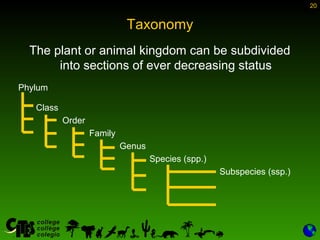
Taxonomy
Class
Order
Family
Genus
Species (spp.)
Subspecies (ssp.)
Phylum
20
The plant or animal kingdom can be subdivided
into sections of ever decreasing status
21
A 7-step approach to species
identification
22
Methodology
• Step 1 - Prepare
– Reference materials
– Equipment
– Species knowledge
– Safety
23
Methodology
• Step 2 - Determine what you already know,
and look for clues
– Personal knowledge of the species or similar
species
– Type of specimen
– Label, documentation
– Sex, age, condition
– Obvious characteristics
– Origin
24
Be aware
• Identifying a specimen in the
hand is harder than identifying
a live specimen in the wild
– In the wild you have location, habitat, behaviour,
and usually healthy specimens to help
– In captivity, you have none of these factors to
help, plus you must cope with hybrids, man-made
varieties etc.
– Identification materials may not cover both sexes,
age variations, and natural colour variations
25
Methodology
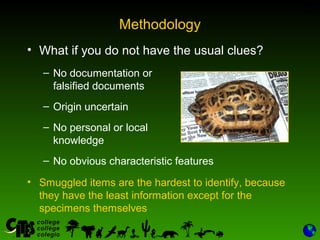
• What if you do not have the usual clues?
– No documentation or
falsified documents
– Origin uncertain
– No personal or local
knowledge
– No obvious characteristic features
• Smuggled items are the hardest to identify, because
they have the least information except for the
specimens themselves
26
Methodology
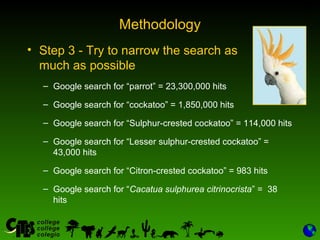
• Step 3 - Try to narrow the search as
much as possible
– Google search for “parrot” = 23,300,000 hits
– Google search for “cockatoo” = 1,850,000 hits
– Google search for “Sulphur-crested cockatoo” = 114,000 hits
– Google search for “Lesser sulphur-crested cockatoo” =
43,000 hits
– Google search for “Citron-crested cockatoo” = 983 hits
– Google search for “Cacatua sulphurea citrinocrista” = 38
hits
27
Methodology
• Species identification is detective work!
– Be prepared and equipped
– Be conscious of what you know
– Be aware of what you need to know
28
Methodology
• Step 4 - Decide on what reference tools to use
– Identification manuals and guides
– You may need other equipment and resources
29
Methodology
• Take your time – a wrong identification will
waste much time and effort
• Accuracy is more important than immediacy
Would you want a court case
dependant on a guess?
30
Methodology
• Step 5 – Identify the specimen
– Take notes
– Go through the manuals
– Get your result
31
Methodology
• You may be able to determine the species, or
reduce the possibility to one of several species,
or to a group
• Try to find out something about the species
– Is it widely traded?
– Is it known to be traded from the country of origin?
– Is it rare or common?
– Can you find images or other information that corroborates
your finding?
32
Methodology
• Step 6 – Self-questioning
– Step back and think about whether your
identification makes sense
(apply the common sense principle)
33
Methodology
• Step 7 – Practice…!
– Identification is a skill that improves with practice
34
Summary
• Step 1 – Prepare (tools, equipment, location, resources)
• Step 2 – Determine what you already know, and look
for clues
• Step 3 – Try to narrow the search as much as
possible
• Step 4 – Decide on what reference tools to use
• Step 5 – Identify the specimen
• Step 6 – Self-questioning
• Step 7 – Practice
35
Summary
• It is important to:
– Recognize the importance of specimen
identification
– Understand different approaches to identification
– Learn about identification tools
– Become familiar with the Canadian CITES
identification manuals (approach and content)
– Practice identification skills
– Recognize the challenge of specimen
identification
36
Resources
• The Secretariat's species identification training
modules aim to help CITES administrators and law
enforcement officers cope with species identification
– Focus on main types of trade
– Focus on main species in trade
– Focus on key identification tips for
species and items in trade
– Raise awareness of tools and resources
– Mix theory and practice for effective
training
37
CITES Secretariat
Geneva

Introduction to Identification

  • 1.
    1 Convention on InternationalTrade in Endangered Species of Wild Fauna and Flora www.CITES.org Introduction to species identification
  • 2.
    2 Why be concernedabout identification? • CITES is a mechanism for the regulation of international trade in wild species – It is a body of agreed rules and procedures that is guided by science – CITES is implemented by governments – CITES is enforced by various government agencies (police, customs etc.)
  • 3.
    3 Why be concernedabout identification? • CITES is a specialist Convention largely applied by non-specialists • Governments must apply the Convention to all listed species – NGOs often focus on one or a few species only • The bulk of implementing CITES falls on administrators (Management Authorities) and law enforcement
  • 4.
    4 Why be concernedabout identification? • Traders, administrators, scientists, enforcement officers and buyers must be able to tell species apart – NGOs have little need for identification skills (except some market monitoring) – Scientists may be the only ones who receive any kind of zoological or botanical training – Traders and buyers may be knowledgeable out of necessity and through experience – This leaves administrators and law enforcement with the least knowledge about identification and who are ironically the main implementers...
  • 5.
  • 6.
    6 Issuing and verifyingthe necessary permits, inspecting goods, caring for live animals and conserving perishable derivative products all require qualified, concerned personnel. None of the signatories of the Convention has allocated sufficient human and financial resources to ensure perfect control of its borders. Each CITES administrative body must work together with other organizations to achieve the objectives of the Convention Environment Canada, in the Preface to their CITES bird identification guide
  • 7.
    7 Introduction (and firstlesson) • What is identification? – Identification is establishing the identity of the specimen What is it? – The identity of the specimen is one of many pieces of information that you need to regulate trade in species in accordance with CITES, but it is also the FIRST one
  • 8.
    8 Why identify? • Thereare different reasons why you need to identify CITES specimens – Administrative – Legal – Scientific
  • 9.
    9 Identification as askill • The recognition and naming of a CITES-listed plant or animal is a subtle and sophisticated ability that requires judgement that a machine cannot provide • Some computerized identification systems exist for certain species, but these are not yet useful for CITES • Databases can hold more information than we can, but computers cannot duplicate personal experience • There are tools that can help you identify specimens: – Online image databases – On-line and stand-alone computerized keys – Guides, posters
  • 10.
    10 Identification as askill • Guides and tools can’t make the decisions for you but they can help, and for identification of CITES species, you need all the help you can get
  • 11.
    11 Identification as askill • With identification, what appears easy is not, and what appears hard is usually harder still • You can know a certain number of species, but this will never be enough to consistently and accurately identify species … but intuition can be very important
  • 12.
    12 Motivation • People generallyidentify things for one of two reasons: – Necessary for work – Personal interest • The same applies for identification of CITES specimens
  • 13.
    13 Exercise • What makeof car is this? • Are you guessing, or do you know?
  • 14.
    14 Exercise • What makeof car is this? • Are you guessing, or do you know?
  • 15.
    15 Exercise • What makeof car is this? • Are you guessing, or do you know?
  • 16.
    16 Exercise • If youdon’t know or recognize the make of car, how would you go about finding the answer? • Would you be ready to defend your identification in a court of law?
  • 17.
    17 Exercise • For someidentification tasks, you already know the answer (personal experience) • For some identification tasks, a colleague knows the answer (local knowledge) • For some identification tasks, you have to go through a process to narrow your search and determine what it is • A guess can be a good place to start, but it can also be the wrong place to finish
  • 18.
    18 Approaches to identification •To consistently and accurately identify species, you need a methodology, an approach • Consider identification as problem solving or solving a puzzle
  • 19.
    19 Taxonomy • To beable to consistently identify CITES specimens, you need to be familiar with taxonomy
  • 20.
    20 Taxonomy Class Order Family Genus Species (spp.) Subspecies (ssp.) Phylum 20 Theplant or animal kingdom can be subdivided into sections of ever decreasing status
  • 21.
    21 A 7-step approachto species identification
  • 22.
    22 Methodology • Step 1- Prepare – Reference materials – Equipment – Species knowledge – Safety
  • 23.
    23 Methodology • Step 2- Determine what you already know, and look for clues – Personal knowledge of the species or similar species – Type of specimen – Label, documentation – Sex, age, condition – Obvious characteristics – Origin
  • 24.
    24 Be aware • Identifyinga specimen in the hand is harder than identifying a live specimen in the wild – In the wild you have location, habitat, behaviour, and usually healthy specimens to help – In captivity, you have none of these factors to help, plus you must cope with hybrids, man-made varieties etc. – Identification materials may not cover both sexes, age variations, and natural colour variations
  • 25.
    25 Methodology • What ifyou do not have the usual clues? – No documentation or falsified documents – Origin uncertain – No personal or local knowledge – No obvious characteristic features • Smuggled items are the hardest to identify, because they have the least information except for the specimens themselves
  • 26.
    26 Methodology • Step 3- Try to narrow the search as much as possible – Google search for “parrot” = 23,300,000 hits – Google search for “cockatoo” = 1,850,000 hits – Google search for “Sulphur-crested cockatoo” = 114,000 hits – Google search for “Lesser sulphur-crested cockatoo” = 43,000 hits – Google search for “Citron-crested cockatoo” = 983 hits – Google search for “Cacatua sulphurea citrinocrista” = 38 hits
  • 27.
    27 Methodology • Species identificationis detective work! – Be prepared and equipped – Be conscious of what you know – Be aware of what you need to know
  • 28.
    28 Methodology • Step 4- Decide on what reference tools to use – Identification manuals and guides – You may need other equipment and resources
  • 29.
    29 Methodology • Take yourtime – a wrong identification will waste much time and effort • Accuracy is more important than immediacy Would you want a court case dependant on a guess?
  • 30.
    30 Methodology • Step 5– Identify the specimen – Take notes – Go through the manuals – Get your result
  • 31.
    31 Methodology • You maybe able to determine the species, or reduce the possibility to one of several species, or to a group • Try to find out something about the species – Is it widely traded? – Is it known to be traded from the country of origin? – Is it rare or common? – Can you find images or other information that corroborates your finding?
  • 32.
    32 Methodology • Step 6– Self-questioning – Step back and think about whether your identification makes sense (apply the common sense principle)
  • 33.
    33 Methodology • Step 7– Practice…! – Identification is a skill that improves with practice
  • 34.
    34 Summary • Step 1– Prepare (tools, equipment, location, resources) • Step 2 – Determine what you already know, and look for clues • Step 3 – Try to narrow the search as much as possible • Step 4 – Decide on what reference tools to use • Step 5 – Identify the specimen • Step 6 – Self-questioning • Step 7 – Practice
  • 35.
    35 Summary • It isimportant to: – Recognize the importance of specimen identification – Understand different approaches to identification – Learn about identification tools – Become familiar with the Canadian CITES identification manuals (approach and content) – Practice identification skills – Recognize the challenge of specimen identification
  • 36.
    36 Resources • The Secretariat'sspecies identification training modules aim to help CITES administrators and law enforcement officers cope with species identification – Focus on main types of trade – Focus on main species in trade – Focus on key identification tips for species and items in trade – Raise awareness of tools and resources – Mix theory and practice for effective training
  • 37.