1
Convention on International Trade in Endangered
Species of Wild Fauna and Flora
Important CITES
definitions
www.CITES.org
© Copyright CITES Secretariat 2005
2
Overview
• Article I of the text of the Convention defines
a number of terms used in CITES:
– species
– specimen
– trade
• Attention will also be given to the terms "parts
and derivatives", "readily recognizable", and
"split-listing"
3
Definitions
Species =
– Species
or
– a subspecies
or
– a geographically separate population
4
Example
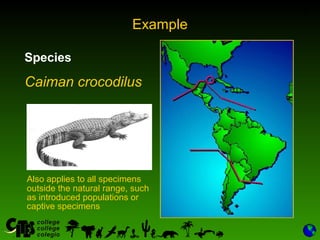
Species
Also applies to all specimens
outside the natural range, such
as introduced populations or
captive specimens
Caiman crocodilus
5
Example
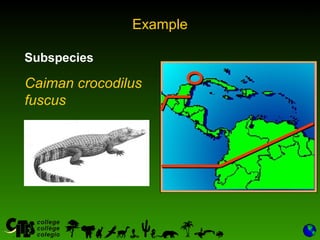
Subspecies
Caiman crocodilus
fuscus
6
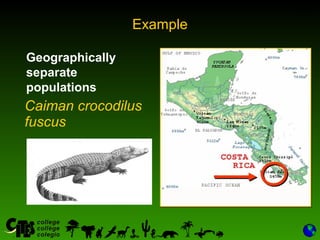
Geographically
separate
populations
Example
Caiman crocodilus
fuscus
7
Definitions
Split-listing
– Listing of a species in
more than one Appendix
should generally be
avoided in view of the
enforcement problems it
creates
– When split-listing does
occur, it should generally
be on the basis of
national or continental
populations, rather than
subspecies
Resolution Conf. 9.24 (Rev. CoP14)
Example:
Ostrich (Struthio camelus)
Only the populations of
Algeria, Burkina Faso,
Cameroon, the Central
African Republic, Chad, Mali,
Mauritania, Morocco, the
Niger, Nigeria, Senegal and
the Sudan are included in
Appendix I
All other populations are not
included in the Appendices
8
A specimen is:
Animal or plant, alive or dead
or
Any readily recognizable parts or derivatives of
plant or animal species
Specific parts of Appendix-II plants or Appendix-III
animals and plants may be included or excluded
Definitions
9
Skins or parts thereof
Skeleton or bones
Shells
Horn, tusks or teeth
Feathers
Eggs
Roots/leaves
Meat
Wood
Definitions
Parts
10
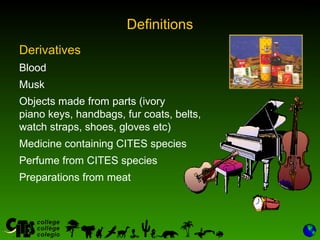
Derivatives
Blood
Musk
Objects made from parts (ivory
piano keys, handbags, fur coats, belts,
watch straps, shoes, gloves etc)
Medicine containing CITES species
Perfume from CITES species
Preparations from meat
Definitions
11
Definitions
Readily recognizable part or derivative
- The term 'readily recognizable part or derivative'
includes any specimen which appears from an
accompanying document, the packaging or a mark or
label, or from any other circumstances, to be a part or
derivative of an animal or plant of a species included
in the Appendices, unless such part or derivative is
specifically exempted from the provisions of the
Convention
Resolution Conf. 9.6 (Rev.)
12
Definitions
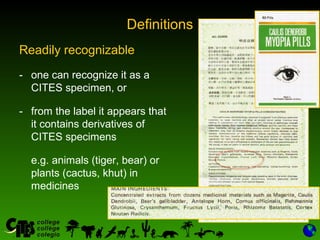
Readily recognizable
- one can recognize it as a
CITES specimen, or
- from the label it appears that
it contains derivatives of
CITES specimens
e.g. animals (tiger, bear) or
plants (cactus, khut) in
medicines
13
Definitions
Trade
- Trade is defined as:
export
re-export
import, and
introduction from the sea
= export of any specimen that
has previously been imported
14
Definitions
• "Introduction from the sea" means transportation into
a State of specimens of any species which were
taken in the marine environment not under the
jurisdiction of any State
Article I
• "The marine environment not under the jurisdiction of
any State" means those marine areas beyond the
areas subject to the sovereignty or sovereign rights of
a State consistent with international law, as reflected
in the United Nations Convention on the Law of the
Sea
Resolution Conf. 14.6
15
CITES Secretariat
Geneva

CITES Definitions

  • 1.
    1 Convention on InternationalTrade in Endangered Species of Wild Fauna and Flora Important CITES definitions www.CITES.org © Copyright CITES Secretariat 2005
  • 2.
    2 Overview • Article Iof the text of the Convention defines a number of terms used in CITES: – species – specimen – trade • Attention will also be given to the terms "parts and derivatives", "readily recognizable", and "split-listing"
  • 3.
    3 Definitions Species = – Species or –a subspecies or – a geographically separate population
  • 4.
    4 Example Species Also applies toall specimens outside the natural range, such as introduced populations or captive specimens Caiman crocodilus
  • 5.
  • 6.
  • 7.
    7 Definitions Split-listing – Listing ofa species in more than one Appendix should generally be avoided in view of the enforcement problems it creates – When split-listing does occur, it should generally be on the basis of national or continental populations, rather than subspecies Resolution Conf. 9.24 (Rev. CoP14) Example: Ostrich (Struthio camelus) Only the populations of Algeria, Burkina Faso, Cameroon, the Central African Republic, Chad, Mali, Mauritania, Morocco, the Niger, Nigeria, Senegal and the Sudan are included in Appendix I All other populations are not included in the Appendices
  • 8.
    8 A specimen is: Animalor plant, alive or dead or Any readily recognizable parts or derivatives of plant or animal species Specific parts of Appendix-II plants or Appendix-III animals and plants may be included or excluded Definitions
  • 9.
    9 Skins or partsthereof Skeleton or bones Shells Horn, tusks or teeth Feathers Eggs Roots/leaves Meat Wood Definitions Parts
  • 10.
    10 Derivatives Blood Musk Objects made fromparts (ivory piano keys, handbags, fur coats, belts, watch straps, shoes, gloves etc) Medicine containing CITES species Perfume from CITES species Preparations from meat Definitions
  • 11.
    11 Definitions Readily recognizable partor derivative - The term 'readily recognizable part or derivative' includes any specimen which appears from an accompanying document, the packaging or a mark or label, or from any other circumstances, to be a part or derivative of an animal or plant of a species included in the Appendices, unless such part or derivative is specifically exempted from the provisions of the Convention Resolution Conf. 9.6 (Rev.)
  • 12.
    12 Definitions Readily recognizable - onecan recognize it as a CITES specimen, or - from the label it appears that it contains derivatives of CITES specimens e.g. animals (tiger, bear) or plants (cactus, khut) in medicines
  • 13.
    13 Definitions Trade - Trade isdefined as: export re-export import, and introduction from the sea = export of any specimen that has previously been imported
  • 14.
    14 Definitions • "Introduction fromthe sea" means transportation into a State of specimens of any species which were taken in the marine environment not under the jurisdiction of any State Article I • "The marine environment not under the jurisdiction of any State" means those marine areas beyond the areas subject to the sovereignty or sovereign rights of a State consistent with international law, as reflected in the United Nations Convention on the Law of the Sea Resolution Conf. 14.6
  • 15.