1
Understanding non-detriment
findings
Ministry of Tourism, Wildlife and
Antiquities
Akankwasah Barirega, PhD
2
Overview
• Concepts and terminology relating to Non-
detriment Findings
• The Non-detriment Finding as a decision
• Roles and responsibilities of CITES
Authorities
• Different 'forms' of Non-detriment Findings
• How to do a Non-detriment Finding
• The NDF Checklist
3
Concepts and terminology
• There are a number of terms and concepts in the text of
the Convention that relate to the impacts of trade on
species
– Over-exploitation (Preamble)
– Threatened with extinction (Art. II)
– Utilization incompatible with their survival (Art. II)
– [Export/introduction] ...not detrimental to the survival of that
species (Art. III, IV)
– Purposes ...not detrimental to the survival of the species (Art. III)
– Export of specimens … limited to maintain that species
throughout its range at a level consistent with its role in the
ecosystems in which it occurs (Art. IV)
– Being affected adversely by trade (Art. XIII)
4
The non-detriment finding
• Requiring the advice of a Scientific Authority that a
proposed action will not be detrimental to the survival
of a species is a concept found in Articles III and IV of
CITES
• This advice is effectively a decision that must be
made by the Scientific Authority
5
• Article III (Appendix I)
– An export permit shall only be granted when … a Scientific
Authority of the State of export has advised that such export
will not be detrimental to the survival of that species
– An import permit shall only be granted when … a Scientific
Authority of the State of import has advised that the import
will be for purposes which are not detrimental to the survival
of the species involved
– A [introduction from the sea] certificate shall only be granted
when … a Scientific Authority of the State of introduction
advises that the introduction will not be detrimental to the
survival of the species involved
The non-detriment finding
6
The non-detriment finding
• Article IV (Appendix II)
– An export permit shall only be granted when … a Scientific
Authority of the State of export has advised that such export
will not be detrimental to the survival of that species
– A [introduction from the sea ] certificate shall only be granted
when … a Scientific Authority of the State of introduction
advises that the introduction will not be detrimental to the
survival of the species involved
7
The non-detriment finding
• Article V (Appendix III)
– There is no non-detriment requirement for Appendix III-listed
species
(This is worth remembering when proposing species for
inclusion in Appendix III)
8
The non-detriment finding
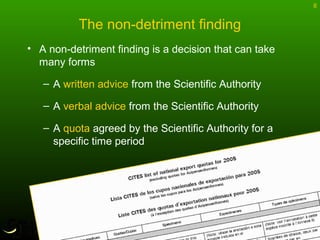
• A non-detriment finding is a decision that can take
many forms
– A written advice from the Scientific Authority
– A verbal advice from the Scientific Authority
– A quota agreed by the Scientific Authority for a
specific time period
9
Conf. 9.10 (Rev. CoP14) Disposal of illegally traded,
confiscated and accumulated specimens
• There is only one instance where a non-detriment
finding may be made by a Management Authority,
and it concerns the disposal of illegally traded,
confiscated and accumulated specimens
– “…the Management Authority is satisfied that the sale of
confiscated Appendix II specimens would not be detrimental to the
survival of the species, the specimens are deemed to have been
obtained in accordance with the provisions of the Convention and
with the laws of the State for the protection of fauna and flora for
the purposes of issuing export permits or re-export certificates”
10
CoP advice on non-detriment findings
• Acceptance of a non-detriment finding can also be
“agreed” by the Conference of the Parties, based on
quotas adopted by the CoP
– Annual export quotas for live specimens and hunting
trophies of cheetah in the Appendices
– Recommendations that quotas for Appendix I species set by
the CoP be interpreted as fulfilling non-detriment
requirements by exporting and importing countries (Conf.
9.21 (Rev. CoP13)
– Recommendations to accept the non-detriment findings of
exporting countries for non-commercial imports of hunting
trophies in general (Conf. 2.11 (Rev.), and for leopard,
markhor and black rhinoceros within specified quota limits
(Conf. 10.14 (Rev. CoP13), 10.15, (Rev. CoP12) 13.5)
11
CoP advice on non-detriment findings
• Proposals to establish or amend such quotas need to
be accompanied by supporting information including
details of the scientific basis for the proposed quota
• Precise guidance about this scientific basis for the
proposed quota is not provided but recent successful
proposals have included information on:
– species distribution
– population status
– population trends
– threats
– utilization and trade
– actual or potential trade impact
– population monitoring
– management and control
measures
12
CoP advice on non-detriment findings
• Res. Conf. 14.7 on Management of nationally
established quotas recognizes that such quotas:
– are a management tool, used to ensure that exports of
specimens of a certain species are maintained at a level that
has no detrimental effect on the population of the species
– advised by a Scientific Authority effectively meet the
requirement to make an NDF for Appendix I or II species
and, for Appendix II species, the requirement to ensure that
the species is maintained throughout its range at a level
consistent with its role in the ecosystems in which it occurs
13
CoP advice on non-detriment findings
…but..
– The export quotas should be established or
revised through an NDF by a Scientific Authority
and;
– They should be reviewed annually
14
How to do a non-detriment
finding
15
The non-detriment finding
• Resolution Conf. 10.3 recommends that the findings
and advice of the Scientific Authority of the country of
export be based on:
– population status
– distribution
– population trend
– harvest
– other biological and ecological factors
– trade information
16
The non-detriment finding
• Generally speaking, the most useful 'unit of
measurement' in determining whether exports
will not be detrimental to the survival of the
species is the national population of the
country involved
17
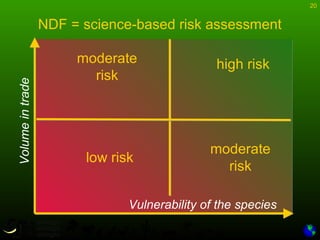
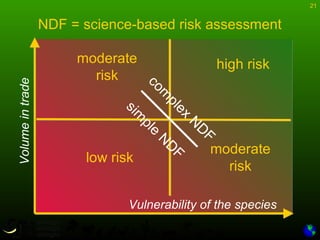
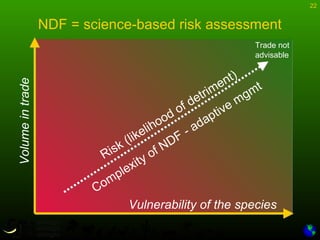
The non-detriment finding
• The non-detriment finding is essentially a
science-based risk assessment
• Therefore, the same approaches and thinking
that apply to making risk assessments apply
to making Non-detriment Findings
18
Risk assessment methodology
1. Analyze risks
– Analyze impacts, effects
– Estimate probability, risk, impact
– Manage risk, consider mitigating measures
1. Determine exposure
– Exposure = Risk + Impact
1. Take a decision
2. Monitor results
19
Risk assessment methodology
• Principles
– Data requirements should be proportionate to the
potential risks
– Assessment should be based on the best
information available
– If you need extra information and can get it, do so
– Experience helps
20
low risk
moderate
risk
moderate
risk
NDF = science-based risk assessment
Vulnerability of the species
Volumeintrade
high risk
21
low risk
moderate
risk
moderate
risk
NDF = science-based risk assessment
Vulnerability of the species
Volumeintrade
high risk
com
plex
N
D
F
sim
ple
N
D
F
22
NDF = science-based risk assessment
Vulnerability of the species
Volumeintrade
Risk (likelihood of detriment)
Complexity of NDF - adaptive mgmt
Trade not
advisable
23
Risk analysis
“The practical application of risk analysis is hindered
by the lack of an adequate framework with which to
approach the problem
Without such a systematic approach, it is difficult to
provide useful risk information to a decision maker”
US Government
• CITES does have a framework or systematic
approach with which non-detriment findings
can be made = the NDF checklist
24
A checklist for non-detriment findings
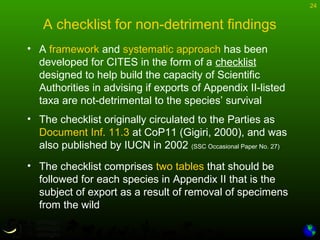
• A framework and systematic approach has been
developed for CITES in the form of a checklist
designed to help build the capacity of Scientific
Authorities in advising if exports of Appendix II-listed
taxa are not-detrimental to the species’ survival
• The checklist originally circulated to the Parties as
Document Inf. 11.3 at CoP11 (Gigiri, 2000), and was
also published by IUCN in 2002 (SSC Occasional Paper No. 27)
• The checklist comprises two tables that should be
followed for each species in Appendix II that is the
subject of export as a result of removal of specimens
from the wild
25
A checklist for non-detriment findings
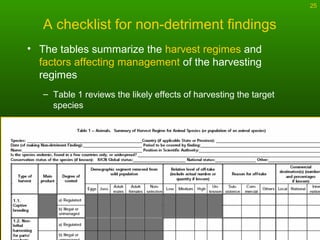
• The tables summarize the harvest regimes and
factors affecting management of the harvesting
regimes
– Table 1 reviews the likely effects of harvesting the target
species
– Table 2 reviews more general biological and management
information
26
A checklist for non-detriment findings
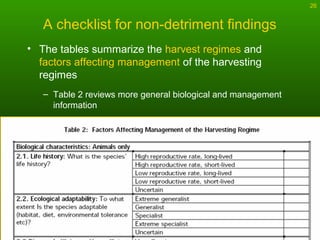
• The tables summarize the harvest regimes and
factors affecting management of the harvesting
regimes
– Table 2 reviews more general biological and management
information
27
A checklist for non-detriment findings
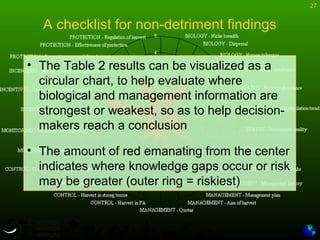
• The Table 2 results can be visualized as a
circular chart, to help evaluate where
biological and management information are
strongest or weakest, so as to help decision-
makers reach a conclusion
• The amount of red emanating from the center
indicates where knowledge gaps occur or risk
may be greater (outer ring = riskiest)
28
Similar processes in MEAs
• Lessons can be learnt from studying and linking with
other processes (especially MEAs) grappling with the
similar issues:
– CBD Voluntary guidelines on biodiversity-inclusive
environmental impact assessment
– Ramsar Guidelines for incorporating biodiversity-related
issues into environmental impact assessment legislation
and/or processes and in strategic environmental
assessment
– CMS Impact assessment and migratory species
– AEWA Guidelines on sustainable harvest of migratory
waterbirds
29
Summary
• Concepts and terminology relating to Non-detriment
Findings are found throughout CITES documents
• The NDF is a decision
• CITES Authorities have specific roles and
responsibilities that relate to NDFs
• NDFs may appear in different 'forms', and may also
be agreed by the CoP
• The NDF is a science-based risk-assessment
• The NDF Checklist offers a framework and
systematic approach when making NDFs
30
Thank you!

Non-detriment Findings

  • 1.
    1 Understanding non-detriment findings Ministry ofTourism, Wildlife and Antiquities Akankwasah Barirega, PhD
  • 2.
    2 Overview • Concepts andterminology relating to Non- detriment Findings • The Non-detriment Finding as a decision • Roles and responsibilities of CITES Authorities • Different 'forms' of Non-detriment Findings • How to do a Non-detriment Finding • The NDF Checklist
  • 3.
    3 Concepts and terminology •There are a number of terms and concepts in the text of the Convention that relate to the impacts of trade on species – Over-exploitation (Preamble) – Threatened with extinction (Art. II) – Utilization incompatible with their survival (Art. II) – [Export/introduction] ...not detrimental to the survival of that species (Art. III, IV) – Purposes ...not detrimental to the survival of the species (Art. III) – Export of specimens … limited to maintain that species throughout its range at a level consistent with its role in the ecosystems in which it occurs (Art. IV) – Being affected adversely by trade (Art. XIII)
  • 4.
    4 The non-detriment finding •Requiring the advice of a Scientific Authority that a proposed action will not be detrimental to the survival of a species is a concept found in Articles III and IV of CITES • This advice is effectively a decision that must be made by the Scientific Authority
  • 5.
    5 • Article III(Appendix I) – An export permit shall only be granted when … a Scientific Authority of the State of export has advised that such export will not be detrimental to the survival of that species – An import permit shall only be granted when … a Scientific Authority of the State of import has advised that the import will be for purposes which are not detrimental to the survival of the species involved – A [introduction from the sea] certificate shall only be granted when … a Scientific Authority of the State of introduction advises that the introduction will not be detrimental to the survival of the species involved The non-detriment finding
  • 6.
    6 The non-detriment finding •Article IV (Appendix II) – An export permit shall only be granted when … a Scientific Authority of the State of export has advised that such export will not be detrimental to the survival of that species – A [introduction from the sea ] certificate shall only be granted when … a Scientific Authority of the State of introduction advises that the introduction will not be detrimental to the survival of the species involved
  • 7.
    7 The non-detriment finding •Article V (Appendix III) – There is no non-detriment requirement for Appendix III-listed species (This is worth remembering when proposing species for inclusion in Appendix III)
  • 8.
    8 The non-detriment finding •A non-detriment finding is a decision that can take many forms – A written advice from the Scientific Authority – A verbal advice from the Scientific Authority – A quota agreed by the Scientific Authority for a specific time period
  • 9.
    9 Conf. 9.10 (Rev.CoP14) Disposal of illegally traded, confiscated and accumulated specimens • There is only one instance where a non-detriment finding may be made by a Management Authority, and it concerns the disposal of illegally traded, confiscated and accumulated specimens – “…the Management Authority is satisfied that the sale of confiscated Appendix II specimens would not be detrimental to the survival of the species, the specimens are deemed to have been obtained in accordance with the provisions of the Convention and with the laws of the State for the protection of fauna and flora for the purposes of issuing export permits or re-export certificates”
  • 10.
    10 CoP advice onnon-detriment findings • Acceptance of a non-detriment finding can also be “agreed” by the Conference of the Parties, based on quotas adopted by the CoP – Annual export quotas for live specimens and hunting trophies of cheetah in the Appendices – Recommendations that quotas for Appendix I species set by the CoP be interpreted as fulfilling non-detriment requirements by exporting and importing countries (Conf. 9.21 (Rev. CoP13) – Recommendations to accept the non-detriment findings of exporting countries for non-commercial imports of hunting trophies in general (Conf. 2.11 (Rev.), and for leopard, markhor and black rhinoceros within specified quota limits (Conf. 10.14 (Rev. CoP13), 10.15, (Rev. CoP12) 13.5)
  • 11.
    11 CoP advice onnon-detriment findings • Proposals to establish or amend such quotas need to be accompanied by supporting information including details of the scientific basis for the proposed quota • Precise guidance about this scientific basis for the proposed quota is not provided but recent successful proposals have included information on: – species distribution – population status – population trends – threats – utilization and trade – actual or potential trade impact – population monitoring – management and control measures
  • 12.
    12 CoP advice onnon-detriment findings • Res. Conf. 14.7 on Management of nationally established quotas recognizes that such quotas: – are a management tool, used to ensure that exports of specimens of a certain species are maintained at a level that has no detrimental effect on the population of the species – advised by a Scientific Authority effectively meet the requirement to make an NDF for Appendix I or II species and, for Appendix II species, the requirement to ensure that the species is maintained throughout its range at a level consistent with its role in the ecosystems in which it occurs
  • 13.
    13 CoP advice onnon-detriment findings …but.. – The export quotas should be established or revised through an NDF by a Scientific Authority and; – They should be reviewed annually
  • 14.
    14 How to doa non-detriment finding
  • 15.
    15 The non-detriment finding •Resolution Conf. 10.3 recommends that the findings and advice of the Scientific Authority of the country of export be based on: – population status – distribution – population trend – harvest – other biological and ecological factors – trade information
  • 16.
    16 The non-detriment finding •Generally speaking, the most useful 'unit of measurement' in determining whether exports will not be detrimental to the survival of the species is the national population of the country involved
  • 17.
    17 The non-detriment finding •The non-detriment finding is essentially a science-based risk assessment • Therefore, the same approaches and thinking that apply to making risk assessments apply to making Non-detriment Findings
  • 18.
    18 Risk assessment methodology 1.Analyze risks – Analyze impacts, effects – Estimate probability, risk, impact – Manage risk, consider mitigating measures 1. Determine exposure – Exposure = Risk + Impact 1. Take a decision 2. Monitor results
  • 19.
    19 Risk assessment methodology •Principles – Data requirements should be proportionate to the potential risks – Assessment should be based on the best information available – If you need extra information and can get it, do so – Experience helps
  • 20.
    20 low risk moderate risk moderate risk NDF =science-based risk assessment Vulnerability of the species Volumeintrade high risk
  • 21.
    21 low risk moderate risk moderate risk NDF =science-based risk assessment Vulnerability of the species Volumeintrade high risk com plex N D F sim ple N D F
  • 22.
    22 NDF = science-basedrisk assessment Vulnerability of the species Volumeintrade Risk (likelihood of detriment) Complexity of NDF - adaptive mgmt Trade not advisable
  • 23.
    23 Risk analysis “The practicalapplication of risk analysis is hindered by the lack of an adequate framework with which to approach the problem Without such a systematic approach, it is difficult to provide useful risk information to a decision maker” US Government • CITES does have a framework or systematic approach with which non-detriment findings can be made = the NDF checklist
  • 24.
    24 A checklist fornon-detriment findings • A framework and systematic approach has been developed for CITES in the form of a checklist designed to help build the capacity of Scientific Authorities in advising if exports of Appendix II-listed taxa are not-detrimental to the species’ survival • The checklist originally circulated to the Parties as Document Inf. 11.3 at CoP11 (Gigiri, 2000), and was also published by IUCN in 2002 (SSC Occasional Paper No. 27) • The checklist comprises two tables that should be followed for each species in Appendix II that is the subject of export as a result of removal of specimens from the wild
  • 25.
    25 A checklist fornon-detriment findings • The tables summarize the harvest regimes and factors affecting management of the harvesting regimes – Table 1 reviews the likely effects of harvesting the target species – Table 2 reviews more general biological and management information
  • 26.
    26 A checklist fornon-detriment findings • The tables summarize the harvest regimes and factors affecting management of the harvesting regimes – Table 2 reviews more general biological and management information
  • 27.
    27 A checklist fornon-detriment findings • The Table 2 results can be visualized as a circular chart, to help evaluate where biological and management information are strongest or weakest, so as to help decision- makers reach a conclusion • The amount of red emanating from the center indicates where knowledge gaps occur or risk may be greater (outer ring = riskiest)
  • 28.
    28 Similar processes inMEAs • Lessons can be learnt from studying and linking with other processes (especially MEAs) grappling with the similar issues: – CBD Voluntary guidelines on biodiversity-inclusive environmental impact assessment – Ramsar Guidelines for incorporating biodiversity-related issues into environmental impact assessment legislation and/or processes and in strategic environmental assessment – CMS Impact assessment and migratory species – AEWA Guidelines on sustainable harvest of migratory waterbirds
  • 29.
    29 Summary • Concepts andterminology relating to Non-detriment Findings are found throughout CITES documents • The NDF is a decision • CITES Authorities have specific roles and responsibilities that relate to NDFs • NDFs may appear in different 'forms', and may also be agreed by the CoP • The NDF is a science-based risk-assessment • The NDF Checklist offers a framework and systematic approach when making NDFs
  • 30.