1
Permits and certificates
Convention on International Trade in Endangered
Species of Wild Fauna and Flora
www.CITES.org
© Copyright Secrétariat CITES 2005
2
Overview
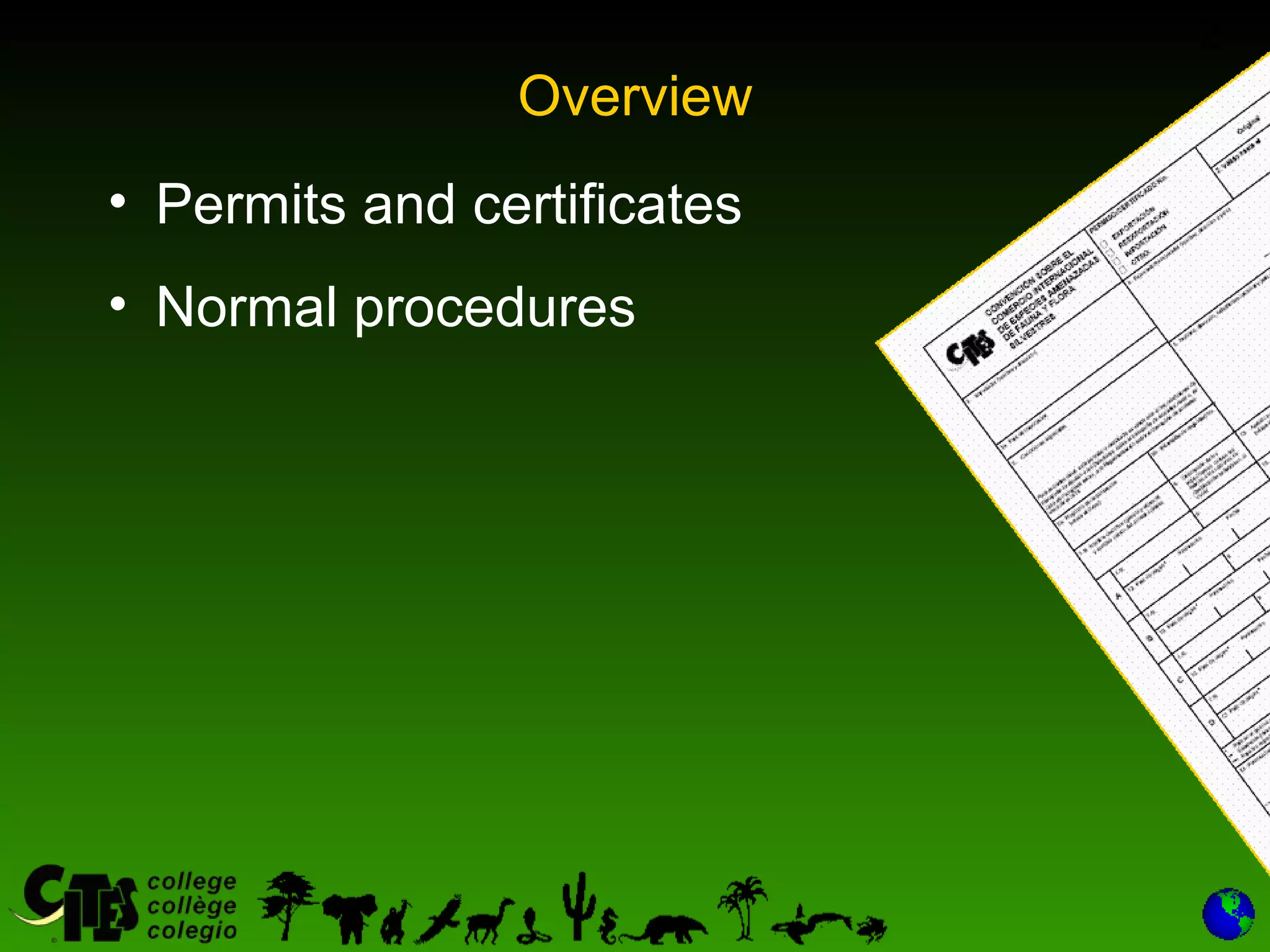
• Permits and certificates
• Normal procedures
3
Permits and certificates
4
CITES permits and certificates
• CITES regulates international trade in specimens of
species of wild fauna and flora listed in its
Appendices on the basis of a system of permits and
certificates which are issued only when certain
conditions are met, and which must be presented
when leaving and entering a country
– For Appendix-I listed species, international trade is
generally prohibited
– For Appendix-II and –III listed species,
international trade is permitted but regulated
5
CITES permits and certificates
• What is a permit?
– A conditional authorization
– A tangible product, a result of decision-making
– A means to deliver information
– A record of trade
– A conservation tool (the permit system)
– A bureaucratic headache
6
CITES permits and certificates
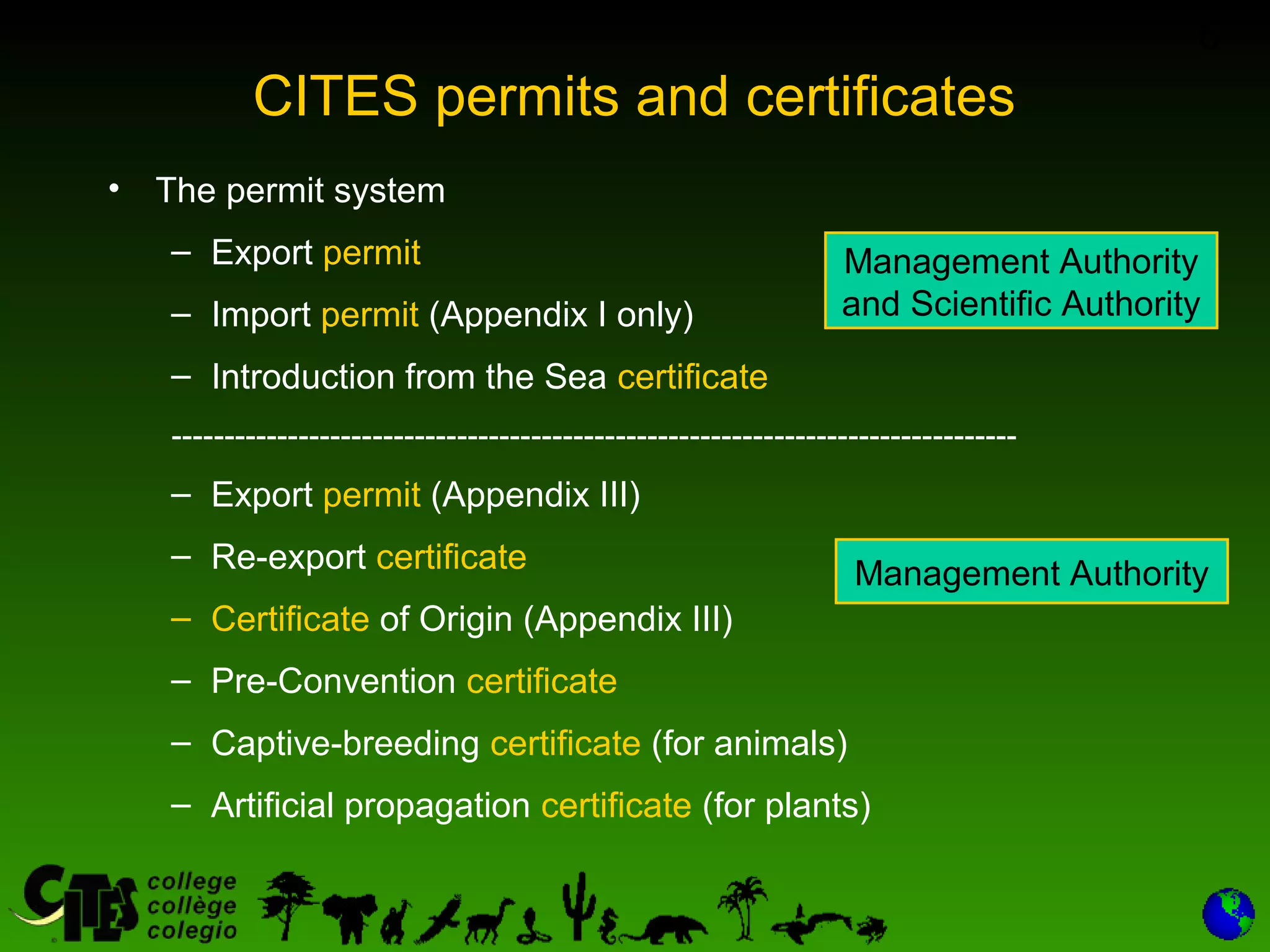
• The permit system
– Export permit
– Import permit (Appendix I only)
– Introduction from the Sea certificate
--------------------------------------------------------------------------------
– Export permit (Appendix III)
– Re-export certificate
– Certificate of Origin (Appendix III)
– Pre-Convention certificate
– Captive-breeding certificate (for animals)
– Artificial propagation certificate (for plants)
Management Authority
and Scientific Authority
Management Authority
7
Normal procedures
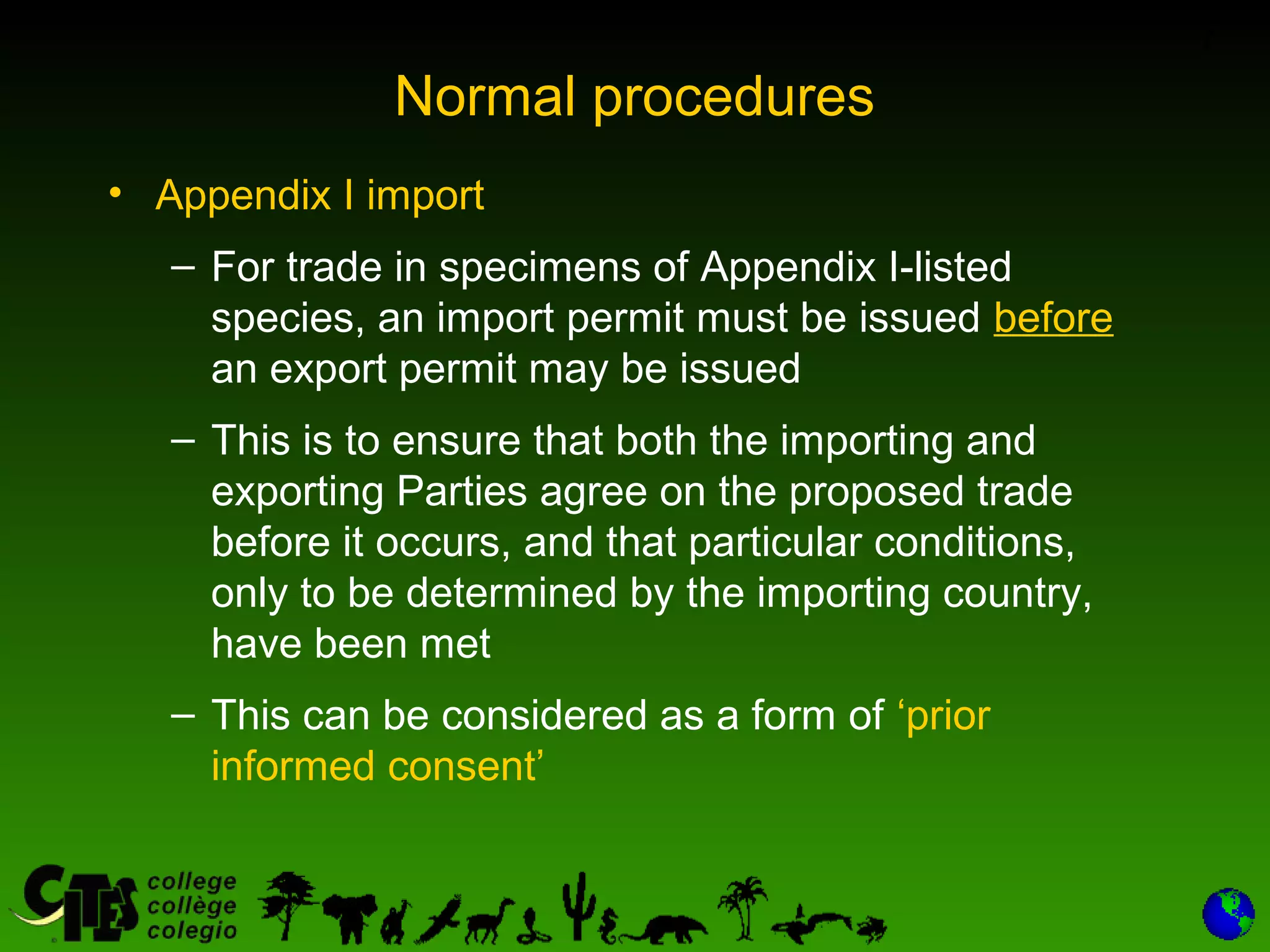
• Appendix I import
– For trade in specimens of Appendix I-listed
species, an import permit must be issued before
an export permit may be issued
– This is to ensure that both the importing and
exporting Parties agree on the proposed trade
before it occurs, and that particular conditions,
only to be determined by the importing country,
have been met
– This can be considered as a form of ‘prior
informed consent’
8
Normal procedures
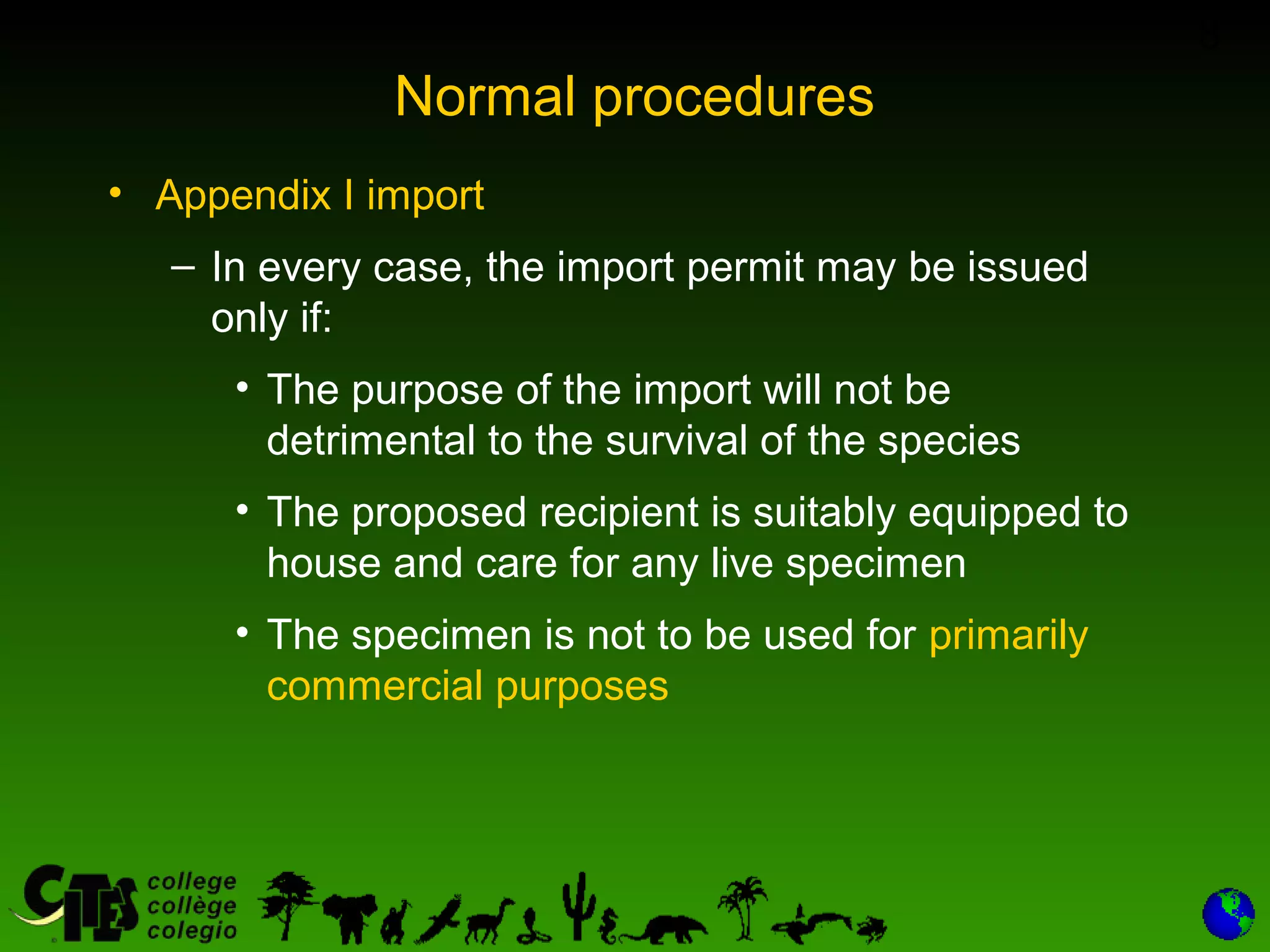
• Appendix I import
– In every case, the import permit may be issued
only if:
• The purpose of the import will not be
detrimental to the survival of the species
• The proposed recipient is suitably equipped to
house and care for any live specimen
• The specimen is not to be used for primarily
commercial purposes
9
Normal procedures
• The determination whether trade in Appendix-I specimens is for
‘primarily commercial purposes’ ONLY has to be made for
imports
• Consequently, the purpose of the export can still be commercial
• Examples of primarily
commercial purposes are:
– profitable scientific or
biomedical research
– commercial captive
breeding
– professional traders
– circuses
• Examples of non-commercial
purposes are:
– non-profit scientific or medical
research
– bona-fide captive breeding
programmes
– non-profit teaching & training
– personal hunting trophies
– non-profit exhibitions
– non-profit zoological gardens
10
Normal procedures
• Appendix I import
– In every case, the import permit may be issued
only if:
• The purpose of the import will not be
detrimental to the survival of the species
• The proposed recipient is suitably equipped to
house and care for any live specimen
• The specimen is not to be used
for primarily commercial purposes
11
Normal procedures
• The determination whether trade in Appendix-I
specimens is for ‘primarily commercial purposes’
ONLY has to be made for imports (the purpose of the
export can still be commercial)
• Examples of primarily
commercial purposes are:
– profitable scientific or
biomedical research
– commercial captive
breeding
– professional traders
– circuses
• Examples of non-commercial
purposes are:
– non-profit scientific or medical
research
– bona-fide captive breeding
programmes
– non-profit teaching & training
– personal hunting trophies
– non-profit exhibitions
– non-profit zoological gardens
12
Normal procedures
• Appendix I export
– Once an import permit is obtained from the
Management Authority of the country of import, only
then may an export permit be issued by the
Management Authority of the country of export
– In every case, the export permit may be issued only
upon presentation of the import permit, and only if:
• the export will not be detrimental to the survival of the species
• the specimen was acquired in accordance with national wildlife
protection laws
• any live specimen will be shipped in a manner which will minimize
the risk of injury, damage to health or cruel treatment
13
Normal procedures
• Appendix I re-export
– The re-export certificate may be issued only if the
specimen was imported in accordance with the
Convention
– In the case of live specimens:
• the preparation and shipment will minimize the risk of
injury, damage to health or cruel treatment
• a valid import permit was granted
by the country of destination
14
Normal procedures
• Appendix II export
– For export of Appendix II specimens, the Convention
requires an export permit only
– The Convention does not require an import permit,
and any requirement by a Party for an import permit
for Appendix II specimens is a stricter domestic
measure, allowed under the provisions of Article XIV
– In every case, an export permit may be issued only if:
• The export will not be detrimental to the survival of the species
• The specimen was acquired in accordance with the national wildlife
legislation
• Any live specimen will be shipped in a manner which will minimize
the risk of injury, damage to health or cruel treatment
15
Normal procedures
• Appendix II re-export
– A re-export certificate may be issued only if:
• The Management Authority of the country of re-export is
satisfied that the specimen was imported in accordance
with the Convention
• Any live specimen will be shipped in a manner which will
minimize the risk of injury, damage to health or cruel
treatment
16
Normal procedures
• Appendix III export
– For export from the country that included the
species in Appendix III, an export permit is
required and may be issued only if:
• The Management Authority is satisfied that the specimen was
acquired in accordance with national wildlife laws
• Any live specimen will be shipped in a manner which will
minimize the risk of injury, damage to health or cruel treatment
– For export from countries that did not include the
species in Appendix III a certificate of origin is
required
• This may only be issued by a Management Authority of the
country of origin
17
Normal procedures
• Appendix III re-export
– A re-export certificate may be issued only if:
• The Management Authority is in possession of the valid original
of the export permit or certificate of origin, or the previous re-
export certificate
• The import was in accordance with the Convention
• The re-export certificate must clearly indicate whether the
specimen was processed in the State which is issuing the
document
18
Normal procedures
• Introduction from the sea
– The introduction from the sea of any specimen of a
species included in Appendix I shall require the prior
grant of a certificate from a Management Authority of
the State of introduction
– A certificate shall only be granted when the following
conditions have been met:
• a Scientific Authority of the State of introduction advises that the introduction
will not be detrimental to the survival of the species involved;
• a Management Authority of the State of introduction is satisfied that the
proposed recipient of a living specimen is suitably equipped to house and
care for it; and
• a Management Authority of the State of introduction is satisfied that the
specimen is not to be used for primarily commercial purposes.
19
Normal procedures
• Introduction from the sea
– The introduction from the sea of any specimen of a
species included in Appendix II shall require the prior
grant of a certificate from a Management Authority of
the State of introduction
– A certificate shall only be granted when the following
conditions have been met:
• a Scientific Authority of the State of introduction advises that the
introduction will not be detrimental to the survival of the species
involved; and
• a Management Authority of the State of introduction is satisfied that
any living specimen will be so handled as to minimize the risk of
injury, damage to health or cruel treatment.
20
Normal procedures
• Introduction from the sea
– Introduction from the sea certificates may be granted
on the advice of a Scientific Authority, in consultation
with other national scientific authorities or, when
appropriate, international scientific authorities, in
respect of periods not exceeding one year for total
numbers of specimens to be introduced in such
periods
21
Normal procedures
• Introduction from the sea
"Introduction from the sea" means transportation into a State
of specimens of any species which were taken in the marine
environment not under the jurisdiction of any State
Article I of the Convention
The Conference of the Parties to the Convention AGREES
that ‘the marine environment not under the jurisdiction of any
State’ means those marine areas beyond the areas subject
to the sovereignty or sovereign rights of a State consistent
with international law, as reflected in the United Nations
Convention on the Law of the Sea
Resolution Conf. 14.6, Introduction from the sea
22
Normal procedures
• Introduction from the sea
– The term “Transportation into a State” still needs
to be defined by the Parties
23
CITES Secretariat
Geneva

Permit Procedures

  • 1.
    1 Permits and certificates Conventionon International Trade in Endangered Species of Wild Fauna and Flora www.CITES.org © Copyright Secrétariat CITES 2005
  • 2.
    2 Overview • Permits andcertificates • Normal procedures
  • 3.
  • 4.
    4 CITES permits andcertificates • CITES regulates international trade in specimens of species of wild fauna and flora listed in its Appendices on the basis of a system of permits and certificates which are issued only when certain conditions are met, and which must be presented when leaving and entering a country – For Appendix-I listed species, international trade is generally prohibited – For Appendix-II and –III listed species, international trade is permitted but regulated
  • 5.
    5 CITES permits andcertificates • What is a permit? – A conditional authorization – A tangible product, a result of decision-making – A means to deliver information – A record of trade – A conservation tool (the permit system) – A bureaucratic headache
  • 6.
    6 CITES permits andcertificates • The permit system – Export permit – Import permit (Appendix I only) – Introduction from the Sea certificate -------------------------------------------------------------------------------- – Export permit (Appendix III) – Re-export certificate – Certificate of Origin (Appendix III) – Pre-Convention certificate – Captive-breeding certificate (for animals) – Artificial propagation certificate (for plants) Management Authority and Scientific Authority Management Authority
  • 7.
    7 Normal procedures • AppendixI import – For trade in specimens of Appendix I-listed species, an import permit must be issued before an export permit may be issued – This is to ensure that both the importing and exporting Parties agree on the proposed trade before it occurs, and that particular conditions, only to be determined by the importing country, have been met – This can be considered as a form of ‘prior informed consent’
  • 8.
    8 Normal procedures • AppendixI import – In every case, the import permit may be issued only if: • The purpose of the import will not be detrimental to the survival of the species • The proposed recipient is suitably equipped to house and care for any live specimen • The specimen is not to be used for primarily commercial purposes
  • 9.
    9 Normal procedures • Thedetermination whether trade in Appendix-I specimens is for ‘primarily commercial purposes’ ONLY has to be made for imports • Consequently, the purpose of the export can still be commercial • Examples of primarily commercial purposes are: – profitable scientific or biomedical research – commercial captive breeding – professional traders – circuses • Examples of non-commercial purposes are: – non-profit scientific or medical research – bona-fide captive breeding programmes – non-profit teaching & training – personal hunting trophies – non-profit exhibitions – non-profit zoological gardens
  • 10.
    10 Normal procedures • AppendixI import – In every case, the import permit may be issued only if: • The purpose of the import will not be detrimental to the survival of the species • The proposed recipient is suitably equipped to house and care for any live specimen • The specimen is not to be used for primarily commercial purposes
  • 11.
    11 Normal procedures • Thedetermination whether trade in Appendix-I specimens is for ‘primarily commercial purposes’ ONLY has to be made for imports (the purpose of the export can still be commercial) • Examples of primarily commercial purposes are: – profitable scientific or biomedical research – commercial captive breeding – professional traders – circuses • Examples of non-commercial purposes are: – non-profit scientific or medical research – bona-fide captive breeding programmes – non-profit teaching & training – personal hunting trophies – non-profit exhibitions – non-profit zoological gardens
  • 12.
    12 Normal procedures • AppendixI export – Once an import permit is obtained from the Management Authority of the country of import, only then may an export permit be issued by the Management Authority of the country of export – In every case, the export permit may be issued only upon presentation of the import permit, and only if: • the export will not be detrimental to the survival of the species • the specimen was acquired in accordance with national wildlife protection laws • any live specimen will be shipped in a manner which will minimize the risk of injury, damage to health or cruel treatment
  • 13.
    13 Normal procedures • AppendixI re-export – The re-export certificate may be issued only if the specimen was imported in accordance with the Convention – In the case of live specimens: • the preparation and shipment will minimize the risk of injury, damage to health or cruel treatment • a valid import permit was granted by the country of destination
  • 14.
    14 Normal procedures • AppendixII export – For export of Appendix II specimens, the Convention requires an export permit only – The Convention does not require an import permit, and any requirement by a Party for an import permit for Appendix II specimens is a stricter domestic measure, allowed under the provisions of Article XIV – In every case, an export permit may be issued only if: • The export will not be detrimental to the survival of the species • The specimen was acquired in accordance with the national wildlife legislation • Any live specimen will be shipped in a manner which will minimize the risk of injury, damage to health or cruel treatment
  • 15.
    15 Normal procedures • AppendixII re-export – A re-export certificate may be issued only if: • The Management Authority of the country of re-export is satisfied that the specimen was imported in accordance with the Convention • Any live specimen will be shipped in a manner which will minimize the risk of injury, damage to health or cruel treatment
  • 16.
    16 Normal procedures • AppendixIII export – For export from the country that included the species in Appendix III, an export permit is required and may be issued only if: • The Management Authority is satisfied that the specimen was acquired in accordance with national wildlife laws • Any live specimen will be shipped in a manner which will minimize the risk of injury, damage to health or cruel treatment – For export from countries that did not include the species in Appendix III a certificate of origin is required • This may only be issued by a Management Authority of the country of origin
  • 17.
    17 Normal procedures • AppendixIII re-export – A re-export certificate may be issued only if: • The Management Authority is in possession of the valid original of the export permit or certificate of origin, or the previous re- export certificate • The import was in accordance with the Convention • The re-export certificate must clearly indicate whether the specimen was processed in the State which is issuing the document
  • 18.
    18 Normal procedures • Introductionfrom the sea – The introduction from the sea of any specimen of a species included in Appendix I shall require the prior grant of a certificate from a Management Authority of the State of introduction – A certificate shall only be granted when the following conditions have been met: • a Scientific Authority of the State of introduction advises that the introduction will not be detrimental to the survival of the species involved; • a Management Authority of the State of introduction is satisfied that the proposed recipient of a living specimen is suitably equipped to house and care for it; and • a Management Authority of the State of introduction is satisfied that the specimen is not to be used for primarily commercial purposes.
  • 19.
    19 Normal procedures • Introductionfrom the sea – The introduction from the sea of any specimen of a species included in Appendix II shall require the prior grant of a certificate from a Management Authority of the State of introduction – A certificate shall only be granted when the following conditions have been met: • a Scientific Authority of the State of introduction advises that the introduction will not be detrimental to the survival of the species involved; and • a Management Authority of the State of introduction is satisfied that any living specimen will be so handled as to minimize the risk of injury, damage to health or cruel treatment.
  • 20.
    20 Normal procedures • Introductionfrom the sea – Introduction from the sea certificates may be granted on the advice of a Scientific Authority, in consultation with other national scientific authorities or, when appropriate, international scientific authorities, in respect of periods not exceeding one year for total numbers of specimens to be introduced in such periods
  • 21.
    21 Normal procedures • Introductionfrom the sea "Introduction from the sea" means transportation into a State of specimens of any species which were taken in the marine environment not under the jurisdiction of any State Article I of the Convention The Conference of the Parties to the Convention AGREES that ‘the marine environment not under the jurisdiction of any State’ means those marine areas beyond the areas subject to the sovereignty or sovereign rights of a State consistent with international law, as reflected in the United Nations Convention on the Law of the Sea Resolution Conf. 14.6, Introduction from the sea
  • 22.
    22 Normal procedures • Introductionfrom the sea – The term “Transportation into a State” still needs to be defined by the Parties
  • 23.