1
University of the
Central Punjab
Final Project
Financial Accounting
Presented to :
Prof. Abu Bakar Siddiq
Group Members
Ahsin Yousaf S1F17MSCT0047
Tahir Zaman S1F17MSCT0047
Adnan Ahmad S1F17MSCT0047
Sawera S1F17MSCT0047
Iqra S1F17MSCT0047
Financial Statement
Preparation: A Tutorial
Prepared by – Dr. Angela H. Sandberg
Professor of Accounting – Jacksonville State University
Financial Statements
 This tutorial illustrates how to prepare
three basic financial statements
The Income Statement
The Statement of Retained Earnings
The Balance Sheet
The purpose of these statements is
to help users make better decisions.
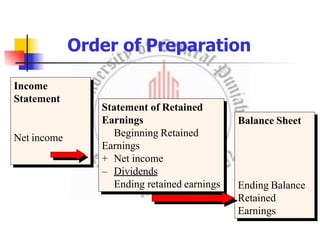
Income
Statement
Net income
Statement of Retained
Earnings
Beginning Retained
Earnings
+ Net income
– Dividends
Ending retained earnings
Balance Sheet
Ending Balance
Retained
Earnings
Order of Preparation
The Income Statement
Income Statement


The first statement prepared is the
Income Statement.
The Income Statement reports a
business’ performance for the period.
Income Statement
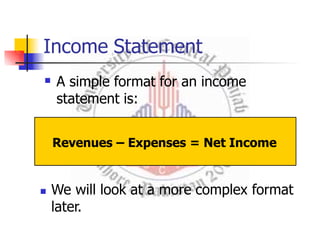
 A simple format for an income
statement is:
Revenues – Expenses = Net Income
 We will look at a more complex format
later.
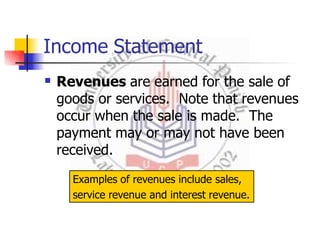
Income Statement
 Revenues are earned for the sale of
goods or services. Note that revenues
occur when the sale is made. The
payment may or may not have been
received.
Examples of revenues include sales,
service revenue and interest revenue.
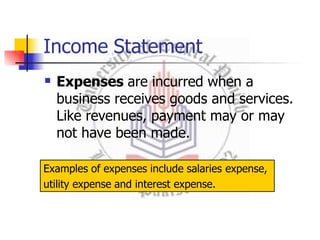
Income Statement
 Expenses are incurred when a
business receives goods and services.
Like revenues, payment may or may
not have been made.
Examples of expenses include salaries expense,
utility expense and interest expense.
Income Statement


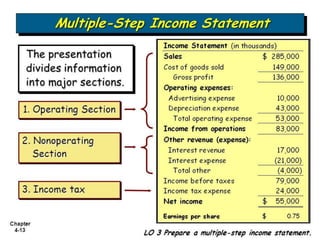
Most businesses require more
information from their businesses than
a simple income statement can provide.
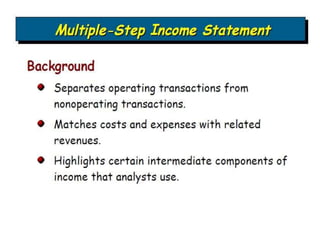
Therefore, they use a multi-step
income statement format.
A format for a multi-step income
statement is:
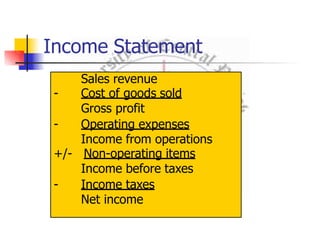
Income Statement
Sales revenue
- Cost of goods sold
Gross profit
- Operating expenses
Income from operations
+/- Non-operating items
Income before taxes
- Income taxes
Net income
Income Statement
 Cost of goods sold represents the
expense a business incurred to buy or
make a product for resale.
Example - a book store buys a book
for $25 and then sells it for $32. The
cost of goods sold is $25.
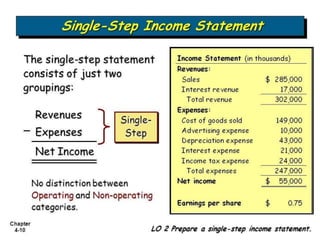
Single Step Income Statement
The single-step income statement format
uses a single subtotal for all revenue line items
and a single subtotal for all expense line items,
with a net gain or loss appearing at the bottom
of the report. This format is most commonly
used by businesses that have relatively simple
operations, with few line items reported.
The Statement of Retained
Earnings
Statement of Retained
Earnings
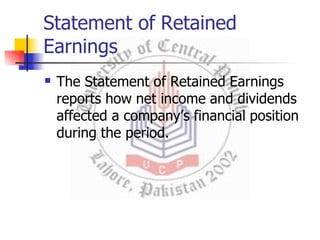
 The Statement of Retained Earnings
reports how net income and dividends
affected a company’s financial position
during the period.
Statement of Retained
Earnings
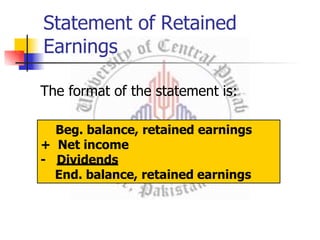
The format of the statement is:
Beg. balance, retained earnings
+ Net income
- Dividends
End. balance, retained earnings
Statement of Retained
Earnings


Note that the Income Statement must
be prepared before the Statement of
Retained Earnings.
This is because you have to know the
amount of net income in order to
compute the ending balance of retained
earnings.
The Balance Sheet
Balance Sheet
 The purpose of the balance sheet is to
report the financial position of an
accounting entity at a particular point in
time.
The basic format for the balance sheet
is:
Assets = Liabilities + Equity
Balance Sheet
 Assets are economic resources owned
by a company.
Examples include cash, accounts
receivable, supplies, buildings and
equipment.
Balance Sheet
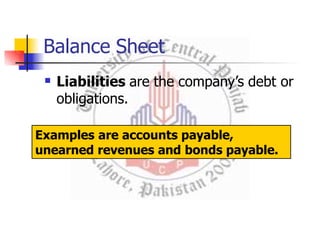
 Liabilities are the company’s debt or
obligations.
Examples are accounts payable,
unearned revenues and bonds payable.
Balance Sheet
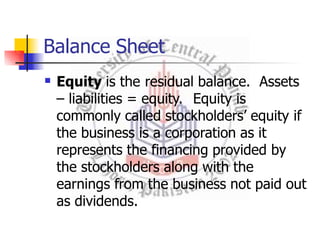
 Equity is the residual balance. Assets
– liabilities = equity. Equity is
commonly called stockholders’ equity if
the business is a corporation as it
represents the financing provided by
the stockholders along with the
earnings from the business not paid out
as dividends.
Balance Sheet
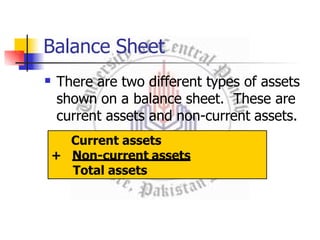
 There are two different types of assets
shown on a balance sheet. These are
current assets and non-current assets.
Current assets
+ Non-current assets
Total assets
Balance Sheet
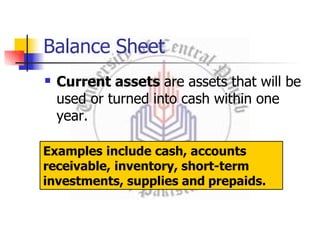
 Current assets are assets that will be
used or turned into cash within one
year.
Examples include cash, accounts
receivable, inventory, short-term
investments, supplies and prepaids.
Balance Sheet
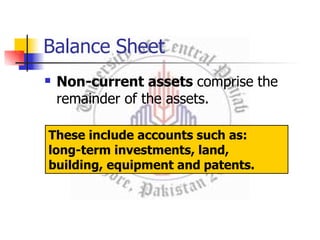
 Non-current assets comprise the
remainder of the assets.
These include accounts such as:
long-term investments, land,
building, equipment and patents.
Balance Sheet
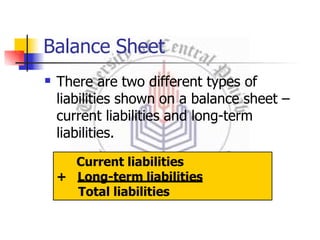
 There are two different types of
liabilities shown on a balance sheet –
current liabilities and long-term
liabilities.
Current liabilities
+ Long-term liabilities
Total liabilities
Balance Sheet
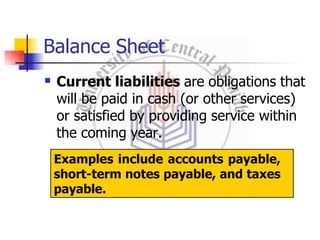
 Current liabilities are obligations that
will be paid in cash (or other services)
or satisfied by providing service within
the coming year.
Examples include accounts payable,
short-term notes payable, and taxes
payable.
Balance Sheet
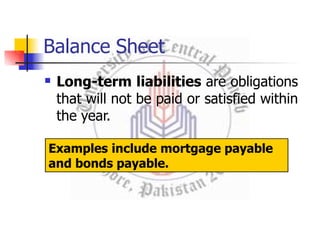
 Long-term liabilities are obligations
that will not be paid or satisfied within
the year.
Examples include mortgage payable
and bonds payable.
Balance Sheet
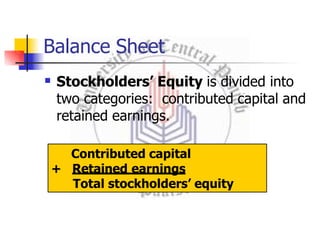
 Stockholders’ Equity is divided into
two categories: contributed capital and
retained earnings.
Contributed capital
+ Retained earnings
Total stockholders’ equity
Balance Sheet
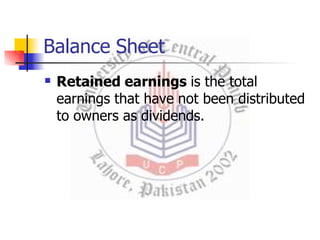
 Retained earnings is the total
earnings that have not been distributed
to owners as dividends.
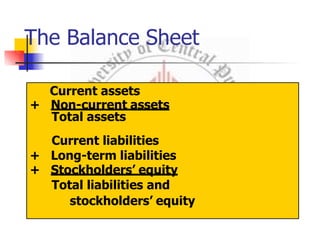
The Balance Sheet
Current assets
+ Non-current assets
Total assets
Current liabilities
+ Long-term liabilities
+ Stockholders’ equity
Total liabilities and
stockholders’ equity
Balance Sheet
 The Balance Sheet must be prepared
after the Statement of Retained
Earnings in order to have calculated the
ending balance of Retained Earnings.
 Income statement—A summary of the revenue
and expenses for a specific period of time.
 Statement of retained earnings – a summary
of the changes in the retained earnings that have
occurred during a specific period of time.
 Balance sheet—A list of the assets, liabilities,
and owner’s equity as of a specific date.
Review
The End

Financial Accounting presentation

  • 1.
  • 2.
    University of the CentralPunjab Final Project Financial Accounting Presented to : Prof. Abu Bakar Siddiq
  • 3.
    Group Members Ahsin YousafS1F17MSCT0047 Tahir Zaman S1F17MSCT0047 Adnan Ahmad S1F17MSCT0047 Sawera S1F17MSCT0047 Iqra S1F17MSCT0047
  • 4.
    Financial Statement Preparation: ATutorial Prepared by – Dr. Angela H. Sandberg Professor of Accounting – Jacksonville State University
  • 5.
    Financial Statements  Thistutorial illustrates how to prepare three basic financial statements The Income Statement The Statement of Retained Earnings The Balance Sheet The purpose of these statements is to help users make better decisions.
  • 6.
    Income Statement Net income Statement ofRetained Earnings Beginning Retained Earnings + Net income – Dividends Ending retained earnings Balance Sheet Ending Balance Retained Earnings Order of Preparation
  • 7.
  • 8.
    Income Statement   The firststatement prepared is the Income Statement. The Income Statement reports a business’ performance for the period.
  • 9.
    Income Statement  Asimple format for an income statement is: Revenues – Expenses = Net Income  We will look at a more complex format later.
  • 10.
    Income Statement  Revenuesare earned for the sale of goods or services. Note that revenues occur when the sale is made. The payment may or may not have been received. Examples of revenues include sales, service revenue and interest revenue.
  • 11.
    Income Statement  Expensesare incurred when a business receives goods and services. Like revenues, payment may or may not have been made. Examples of expenses include salaries expense, utility expense and interest expense.
  • 12.
    Income Statement   Most businessesrequire more information from their businesses than a simple income statement can provide. Therefore, they use a multi-step income statement format. A format for a multi-step income statement is:
  • 13.
    Income Statement Sales revenue -Cost of goods sold Gross profit - Operating expenses Income from operations +/- Non-operating items Income before taxes - Income taxes Net income
  • 14.
    Income Statement  Costof goods sold represents the expense a business incurred to buy or make a product for resale. Example - a book store buys a book for $25 and then sells it for $32. The cost of goods sold is $25.
  • 15.
    Single Step IncomeStatement The single-step income statement format uses a single subtotal for all revenue line items and a single subtotal for all expense line items, with a net gain or loss appearing at the bottom of the report. This format is most commonly used by businesses that have relatively simple operations, with few line items reported.
  • 19.
    The Statement ofRetained Earnings
  • 20.
    Statement of Retained Earnings The Statement of Retained Earnings reports how net income and dividends affected a company’s financial position during the period.
  • 21.
    Statement of Retained Earnings Theformat of the statement is: Beg. balance, retained earnings + Net income - Dividends End. balance, retained earnings
  • 22.
    Statement of Retained Earnings   Notethat the Income Statement must be prepared before the Statement of Retained Earnings. This is because you have to know the amount of net income in order to compute the ending balance of retained earnings.
  • 23.
  • 24.
    Balance Sheet  Thepurpose of the balance sheet is to report the financial position of an accounting entity at a particular point in time. The basic format for the balance sheet is: Assets = Liabilities + Equity
  • 25.
    Balance Sheet  Assetsare economic resources owned by a company. Examples include cash, accounts receivable, supplies, buildings and equipment.
  • 26.
    Balance Sheet  Liabilitiesare the company’s debt or obligations. Examples are accounts payable, unearned revenues and bonds payable.
  • 27.
    Balance Sheet  Equityis the residual balance. Assets – liabilities = equity. Equity is commonly called stockholders’ equity if the business is a corporation as it represents the financing provided by the stockholders along with the earnings from the business not paid out as dividends.
  • 28.
    Balance Sheet  Thereare two different types of assets shown on a balance sheet. These are current assets and non-current assets. Current assets + Non-current assets Total assets
  • 29.
    Balance Sheet  Currentassets are assets that will be used or turned into cash within one year. Examples include cash, accounts receivable, inventory, short-term investments, supplies and prepaids.
  • 30.
    Balance Sheet  Non-currentassets comprise the remainder of the assets. These include accounts such as: long-term investments, land, building, equipment and patents.
  • 31.
    Balance Sheet  Thereare two different types of liabilities shown on a balance sheet – current liabilities and long-term liabilities. Current liabilities + Long-term liabilities Total liabilities
  • 32.
    Balance Sheet  Currentliabilities are obligations that will be paid in cash (or other services) or satisfied by providing service within the coming year. Examples include accounts payable, short-term notes payable, and taxes payable.
  • 33.
    Balance Sheet  Long-termliabilities are obligations that will not be paid or satisfied within the year. Examples include mortgage payable and bonds payable.
  • 34.
    Balance Sheet  Stockholders’Equity is divided into two categories: contributed capital and retained earnings. Contributed capital + Retained earnings Total stockholders’ equity
  • 35.
    Balance Sheet  Retainedearnings is the total earnings that have not been distributed to owners as dividends.
  • 36.
    The Balance Sheet Currentassets + Non-current assets Total assets Current liabilities + Long-term liabilities + Stockholders’ equity Total liabilities and stockholders’ equity
  • 37.
    Balance Sheet  TheBalance Sheet must be prepared after the Statement of Retained Earnings in order to have calculated the ending balance of Retained Earnings.
  • 38.
     Income statement—Asummary of the revenue and expenses for a specific period of time.  Statement of retained earnings – a summary of the changes in the retained earnings that have occurred during a specific period of time.  Balance sheet—A list of the assets, liabilities, and owner’s equity as of a specific date. Review
  • 39.