Introduction to English
Language Teaching
(ELT)
English Language Teaching (ELT) encompasses the pedagogical practices
related to teaching English as a second or foreign language. It involves a range
of teaching-learning methods and assessment procedures tailored to the
specific needs and proficiency levels of learners. ELT aims to develop learners'
language skills, including speaking, listening, reading, and writing, as well as
their cultural awareness and communicative competence.
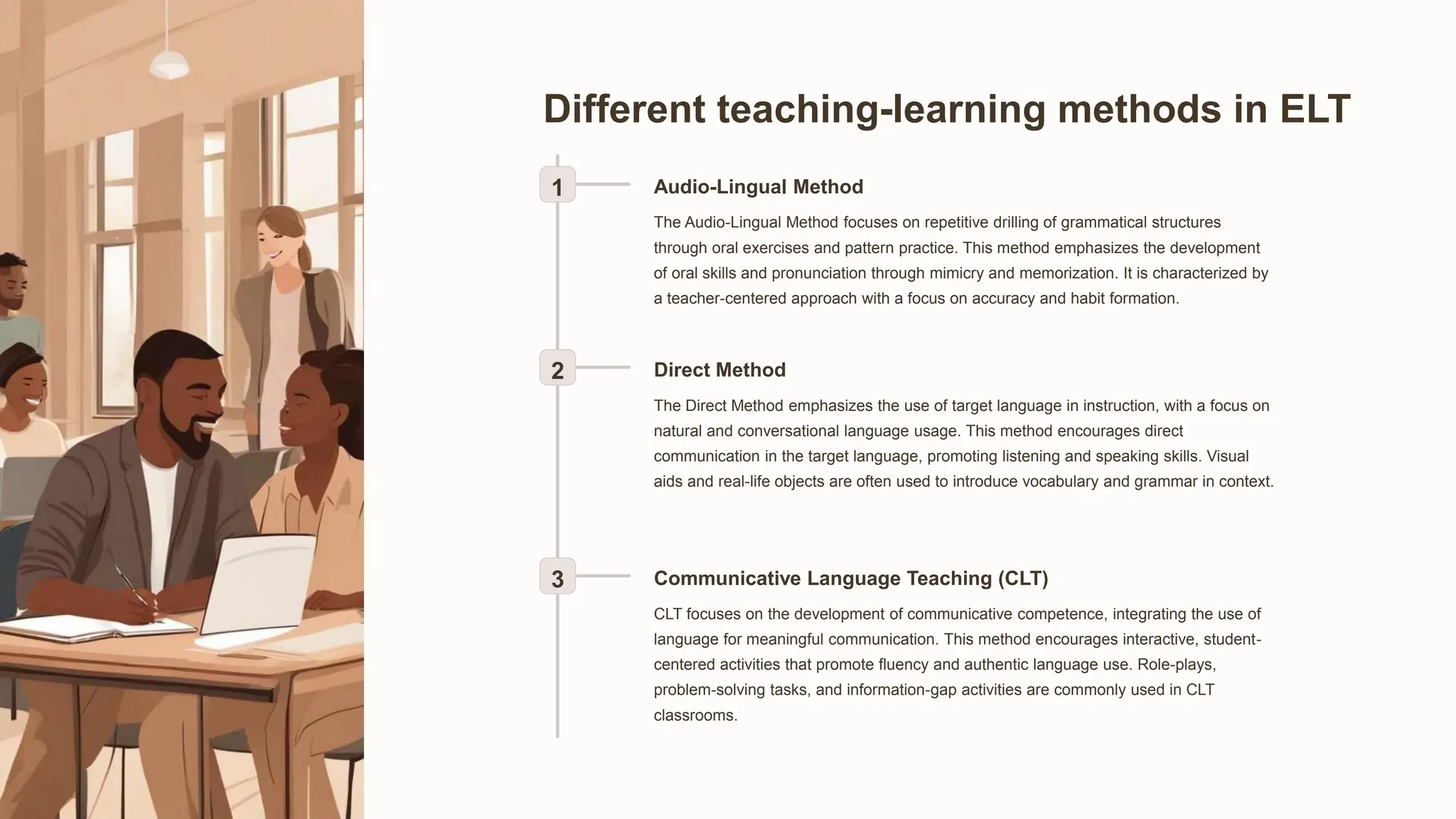
When envisioning ELT, imagine a diverse classroom setting with engaging
interactive activities, thoughtful instructor guidance, and a supportive learning
environment. The scene is brightly lit, fostering a sense of curiosity and
enthusiasm among students. The image showcases a group of students and an
instructor actively engaging in language learning, radiating positivity and a
sense of accomplishment.
Importance of determining teaching-
learning methods
• Effective Learning: Determining appropriate teaching-learning methods is crucial in ensuring
effective learning outcomes for students. By understanding the various methods and their
suitability to different learning styles, educators can tailor their approach to optimize
understanding and retention.
• Engagement and Motivation: The selection of teaching-learning methods directly impacts
student engagement and motivation. Varied and interactive methods can keep students interested
and actively involved in the learning process, enhancing their overall experience and knowledge
absorption.
• Personalized Learning: Different methods allow for personalized and differentiated instruction,
catering to the diverse needs and strengths of individual learners. By recognizing and utilizing a
range of methods, educators can address various learning preferences and abilities within the
classroom.
Factors to consider in determining
teaching-learning methods
Student Needs and
Preferences
Understanding the diverse
needs and preferences of
students is crucial in
determining teaching-
learning methods. This
includes considering different
learning styles, linguistic
backgrounds, and cultural
differences among students.
By acknowledging these
aspects, educators can tailor
their methods to better
accommodate and engage
all learners.
Furthermore, it's essential to
recognize students'
preferences in terms of
instructional approaches,
activities, and materials. This
can contribute to creating a
supportive and inclusive
learning environment where
Educational Objectives
Aligning teaching-learning
methods with specific
educational objectives is
vital. Whether the goal is to
enhance language fluency,
improve communication
skills, or develop critical
thinking, the chosen
methods should directly
contribute to achieving these
objectives.
Educators must also
consider the relevance of the
methods to the curriculum,
ensuring they support the
overall learning outcomes
and educational standards.
This involves assessing the
effectiveness of each
method in delivering the
intended knowledge and
skills.
Educator Expertise
and Resources
The expertise and resources
available to educators play a
significant role in
determining the most
suitable teaching methods.
Educators should assess
their own proficiency in
employing various
methodologies and identify
areas for professional
development.
Additionally, the availability
of technological resources,
teaching aids, and
supportive materials can
influence the choice of
methods. Educators should
consider how different
methods align with the
resources at their disposal
and how effectively they can
utilize them to enhance the
learning experience.
Different teaching-learning methods in ELT
1 Audio-Lingual Method
The Audio-Lingual Method focuses on repetitive drilling of grammatical structures
through oral exercises and pattern practice. This method emphasizes the development
of oral skills and pronunciation through mimicry and memorization. It is characterized by
a teacher-centered approach with a focus on accuracy and habit formation.
2 Direct Method
The Direct Method emphasizes the use of target language in instruction, with a focus on
natural and conversational language usage. This method encourages direct
communication in the target language, promoting listening and speaking skills. Visual
aids and real-life objects are often used to introduce vocabulary and grammar in context.
3 Communicative Language Teaching (CLT)
CLT focuses on the development of communicative competence, integrating the use of
language for meaningful communication. This method encourages interactive, student-
centered activities that promote fluency and authentic language use. Role-plays,
problem-solving tasks, and information-gap activities are commonly used in CLT
classrooms.
Advantages and Disadvantages of
Each Teaching-Learning Method
Advantages
One of the main advantages of using interactive
teaching methods in English Language
Teaching (ELT) is that it fosters active
engagement and participation from the
students. By incorporating activities such as
group discussions, role plays, and debates,
students are encouraged to communicate in
English, thereby improving their speaking and
listening skills. Furthermore, these methods
cater to different learning styles, allowing for a
more personalized learning experience.
Additionally, interactive methods often result in
a more enjoyable and motivating classroom
environment, leading to enhanced student
motivation and retention of knowledge.
Disadvantages
On the other hand, interactive teaching
methods may require more time and effort to
plan and execute effectively. Teachers need to
ensure that the activities are well-structured and
aligned with learning objectives. Moreover,
some students may feel uncomfortable or
Assessing Student Learning in ELT
Assessing student learning is a crucial aspect of English Language Teaching (ELT) as it allows
educators to monitor the progress of their students and ensure that the learning objectives are
being met. It involves evaluating students' language proficiency, comprehension skills, and their
ability to effectively communicate in English. This assessment process is designed to provide
valuable insights into individual student performance and inform instructional decisions.
Educators utilize various assessment methods such as formative assessments, summative
assessments, performance-based assessments, and self-assessments to gain a
comprehensive understanding of each student's language learning journey.
The assessment procedures are not only focused on gauging language proficiency but also on
fostering a supportive and inclusive learning environment. It is imperative to create assessments
that cater to diverse learning styles and linguistic backgrounds, ensuring that every student has
an equal opportunity to demonstrate their understanding of the English language. The
assessment process should be fair, transparent, and aligned with the learning objectives,
enabling educators to provide meaningful feedback that supports continued language
development.
Importance of assessment
in ELT
• Measuring student progress: Assessment in English Language
Teaching (ELT) is crucial for measuring students' progress in
language acquisition, comprehension, and usage. It provides
valuable insights into individual strengths and areas needing
improvement.
• Evaluating teaching effectiveness: Assessments help evaluate
the effectiveness of teaching methods, materials, and curriculum,
allowing educators to make necessary adjustments to enhance the
learning experience.
• Informing instructional decisions: The assessment results
inform instructional decisions and facilitate the implementation of
personalized learning strategies based on students' specific needs
and learning styles.
Different assessment procedures in ELT
Traditional
Assessment Methods
Traditional assessment
methods in English
Language Teaching (ELT)
include quizzes, tests, and
written assignments. These
methods are designed to
measure students'
knowledge and
understanding of the
language, including grammar,
vocabulary, and
comprehension. They are
usually conducted in a
controlled environment, such
as a classroom, and provide
a snapshot of students'
performance at a specific
point in time.
Performance-Based
Assessment
Performance-based
assessment evaluates
students' language skills
through real-world tasks and
activities, such as
presentations, role-plays, and
language projects. This
method focuses on students'
ability to apply language
knowledge in practical
contexts and assesses their
communication and language
production skills. It provides a
more authentic and holistic
view of students' language
proficiency.
Portfolio Assessment
Portfolio assessment involves
the collection of students'
work samples, such as
essays, projects, and creative
writing pieces, over a period
of time. This method allows
students to showcase their
progress and development in
language learning. It also
provides a comprehensive
view of students' language
skills, including their writing
abilities, creativity, and critical
thinking.
Advantages and disadvantages of
each assessment procedure
Advantages
Each assessment procedure in English
Language Teaching (ELT) comes with its own
set of advantages. For instance, formative
assessments, such as quizzes and discussions,
allow teachers to monitor student progress
continuously. They provide insight into areas
where students may be struggling and need
additional support. Additionally, formative
assessments promote active engagement and
participation among students, as they are
regularly involved in the learning process.
On the other hand, summative assessments,
like final exams and projects, offer a
comprehensive evaluation of a student's overall
learning outcomes. They provide a holistic view
of the student's knowledge and understanding
of the subject matter. Furthermore, summative
assessments can help in identifying the
effectiveness of the teaching methods and
curriculum as a whole.
Furthermore, alternative assessment methods,
such as portfolios and presentations, provide
Conclusion and Key Takeaways
Importance of Reflecting on
Teaching Methods
Reflecting on the teaching methods used in
English Language Teaching is crucial for
continuous improvement and adaptation to
the needs of students.
Embracing Diversity in Learning
Styles
Recognizing and accommodating diverse
learning styles ensures inclusive and
effective instruction in English Language
Teaching.
Balancing Traditional and
Innovative Approaches
Finding the balance between traditional and
innovative teaching methods is essential for
achieving engaging and effective English
Language Teaching.
Continuous Assessment for
Improved Learning Outcomes
Implementing ongoing assessment
procedures leads to enhanced learning
outcomes and student progress in English
Language Teaching.

INTRODUCTION TO ENGLISH LANGUAGE TEACHING NEW.pptx

  • 1.
    Introduction to English LanguageTeaching (ELT) English Language Teaching (ELT) encompasses the pedagogical practices related to teaching English as a second or foreign language. It involves a range of teaching-learning methods and assessment procedures tailored to the specific needs and proficiency levels of learners. ELT aims to develop learners' language skills, including speaking, listening, reading, and writing, as well as their cultural awareness and communicative competence. When envisioning ELT, imagine a diverse classroom setting with engaging interactive activities, thoughtful instructor guidance, and a supportive learning environment. The scene is brightly lit, fostering a sense of curiosity and enthusiasm among students. The image showcases a group of students and an instructor actively engaging in language learning, radiating positivity and a sense of accomplishment.
  • 2.
    Importance of determiningteaching- learning methods • Effective Learning: Determining appropriate teaching-learning methods is crucial in ensuring effective learning outcomes for students. By understanding the various methods and their suitability to different learning styles, educators can tailor their approach to optimize understanding and retention. • Engagement and Motivation: The selection of teaching-learning methods directly impacts student engagement and motivation. Varied and interactive methods can keep students interested and actively involved in the learning process, enhancing their overall experience and knowledge absorption. • Personalized Learning: Different methods allow for personalized and differentiated instruction, catering to the diverse needs and strengths of individual learners. By recognizing and utilizing a range of methods, educators can address various learning preferences and abilities within the classroom.
  • 3.
    Factors to considerin determining teaching-learning methods Student Needs and Preferences Understanding the diverse needs and preferences of students is crucial in determining teaching- learning methods. This includes considering different learning styles, linguistic backgrounds, and cultural differences among students. By acknowledging these aspects, educators can tailor their methods to better accommodate and engage all learners. Furthermore, it's essential to recognize students' preferences in terms of instructional approaches, activities, and materials. This can contribute to creating a supportive and inclusive learning environment where Educational Objectives Aligning teaching-learning methods with specific educational objectives is vital. Whether the goal is to enhance language fluency, improve communication skills, or develop critical thinking, the chosen methods should directly contribute to achieving these objectives. Educators must also consider the relevance of the methods to the curriculum, ensuring they support the overall learning outcomes and educational standards. This involves assessing the effectiveness of each method in delivering the intended knowledge and skills. Educator Expertise and Resources The expertise and resources available to educators play a significant role in determining the most suitable teaching methods. Educators should assess their own proficiency in employing various methodologies and identify areas for professional development. Additionally, the availability of technological resources, teaching aids, and supportive materials can influence the choice of methods. Educators should consider how different methods align with the resources at their disposal and how effectively they can utilize them to enhance the learning experience.
  • 4.
    Different teaching-learning methodsin ELT 1 Audio-Lingual Method The Audio-Lingual Method focuses on repetitive drilling of grammatical structures through oral exercises and pattern practice. This method emphasizes the development of oral skills and pronunciation through mimicry and memorization. It is characterized by a teacher-centered approach with a focus on accuracy and habit formation. 2 Direct Method The Direct Method emphasizes the use of target language in instruction, with a focus on natural and conversational language usage. This method encourages direct communication in the target language, promoting listening and speaking skills. Visual aids and real-life objects are often used to introduce vocabulary and grammar in context. 3 Communicative Language Teaching (CLT) CLT focuses on the development of communicative competence, integrating the use of language for meaningful communication. This method encourages interactive, student- centered activities that promote fluency and authentic language use. Role-plays, problem-solving tasks, and information-gap activities are commonly used in CLT classrooms.
  • 5.
    Advantages and Disadvantagesof Each Teaching-Learning Method Advantages One of the main advantages of using interactive teaching methods in English Language Teaching (ELT) is that it fosters active engagement and participation from the students. By incorporating activities such as group discussions, role plays, and debates, students are encouraged to communicate in English, thereby improving their speaking and listening skills. Furthermore, these methods cater to different learning styles, allowing for a more personalized learning experience. Additionally, interactive methods often result in a more enjoyable and motivating classroom environment, leading to enhanced student motivation and retention of knowledge. Disadvantages On the other hand, interactive teaching methods may require more time and effort to plan and execute effectively. Teachers need to ensure that the activities are well-structured and aligned with learning objectives. Moreover, some students may feel uncomfortable or
  • 6.
    Assessing Student Learningin ELT Assessing student learning is a crucial aspect of English Language Teaching (ELT) as it allows educators to monitor the progress of their students and ensure that the learning objectives are being met. It involves evaluating students' language proficiency, comprehension skills, and their ability to effectively communicate in English. This assessment process is designed to provide valuable insights into individual student performance and inform instructional decisions. Educators utilize various assessment methods such as formative assessments, summative assessments, performance-based assessments, and self-assessments to gain a comprehensive understanding of each student's language learning journey. The assessment procedures are not only focused on gauging language proficiency but also on fostering a supportive and inclusive learning environment. It is imperative to create assessments that cater to diverse learning styles and linguistic backgrounds, ensuring that every student has an equal opportunity to demonstrate their understanding of the English language. The assessment process should be fair, transparent, and aligned with the learning objectives, enabling educators to provide meaningful feedback that supports continued language development.
  • 7.
    Importance of assessment inELT • Measuring student progress: Assessment in English Language Teaching (ELT) is crucial for measuring students' progress in language acquisition, comprehension, and usage. It provides valuable insights into individual strengths and areas needing improvement. • Evaluating teaching effectiveness: Assessments help evaluate the effectiveness of teaching methods, materials, and curriculum, allowing educators to make necessary adjustments to enhance the learning experience. • Informing instructional decisions: The assessment results inform instructional decisions and facilitate the implementation of personalized learning strategies based on students' specific needs and learning styles.
  • 8.
    Different assessment proceduresin ELT Traditional Assessment Methods Traditional assessment methods in English Language Teaching (ELT) include quizzes, tests, and written assignments. These methods are designed to measure students' knowledge and understanding of the language, including grammar, vocabulary, and comprehension. They are usually conducted in a controlled environment, such as a classroom, and provide a snapshot of students' performance at a specific point in time. Performance-Based Assessment Performance-based assessment evaluates students' language skills through real-world tasks and activities, such as presentations, role-plays, and language projects. This method focuses on students' ability to apply language knowledge in practical contexts and assesses their communication and language production skills. It provides a more authentic and holistic view of students' language proficiency. Portfolio Assessment Portfolio assessment involves the collection of students' work samples, such as essays, projects, and creative writing pieces, over a period of time. This method allows students to showcase their progress and development in language learning. It also provides a comprehensive view of students' language skills, including their writing abilities, creativity, and critical thinking.
  • 9.
    Advantages and disadvantagesof each assessment procedure Advantages Each assessment procedure in English Language Teaching (ELT) comes with its own set of advantages. For instance, formative assessments, such as quizzes and discussions, allow teachers to monitor student progress continuously. They provide insight into areas where students may be struggling and need additional support. Additionally, formative assessments promote active engagement and participation among students, as they are regularly involved in the learning process. On the other hand, summative assessments, like final exams and projects, offer a comprehensive evaluation of a student's overall learning outcomes. They provide a holistic view of the student's knowledge and understanding of the subject matter. Furthermore, summative assessments can help in identifying the effectiveness of the teaching methods and curriculum as a whole. Furthermore, alternative assessment methods, such as portfolios and presentations, provide
  • 10.
    Conclusion and KeyTakeaways Importance of Reflecting on Teaching Methods Reflecting on the teaching methods used in English Language Teaching is crucial for continuous improvement and adaptation to the needs of students. Embracing Diversity in Learning Styles Recognizing and accommodating diverse learning styles ensures inclusive and effective instruction in English Language Teaching. Balancing Traditional and Innovative Approaches Finding the balance between traditional and innovative teaching methods is essential for achieving engaging and effective English Language Teaching. Continuous Assessment for Improved Learning Outcomes Implementing ongoing assessment procedures leads to enhanced learning outcomes and student progress in English Language Teaching.