

INTRODUCTION TO
EMBEDDED SYSTEMS
AN EMBEDDED SYSTEM
BY
BHARATH GK
SYSTEM
• A system is a way of working, organizing or
doing one or many tasks according to fixed
plan, program, or set of rules
• Example
– Time display system
– Automatic clothes-washing system
EMBEDDED SYSTEM
• Definition
– An embedded system is a system that has
embedded software and computer hardware, which
makes it a system dedicated for an application(s)
or specific part of an application or product or a
part of a larger system
• Various authors defines embedded system in
there own way
What is a computer?
• A computer is a system that has following or
more components
– A microprocessor
– A large memory
• Primary memory (Semiconductor memories)
• Secondary memory (Magnetic memory)
– I/O units
– Input units
– Output units
– Networking units
– An operating system
What is an embedded system?
• An embedded system is a system that has 3
main components embedded into it:
– It embeds hardware similar to a computer
– It embeds main application software
– It embeds a real-time operating system
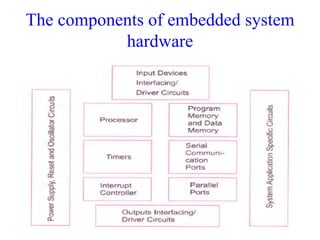
The components of embedded system
hardware
Characteristics of embedded system
• Real-time and multirate operation defines the
ways in which the system works, reacts to
events, interrupts and schedules the system’s
functioning in real time
• Complex algorithms
• Complex GUIs and other user interfaces
• Dedicated functions
Constraints of an Embedded system
• An embedded system is designed keeping in
view 3 constraints
– Available system memory
– Available processor speed
– The need to limit power dissipation
Classification of embedded system
• Small scale embedded system
– Designed with a single 8 or 16 bit microcontroller
– Little hardware & software complexities
– Board-level design
– Battery operated
– When developing embedded software, an editor,
assembler & cross assembler, an IDE are used
– C language is used for compilation
• Medium scale embedded system
– Designed with a single or a few 10 or 32 bit
microcontroller, DSPs or RICSs
– It has both hardware and software complexities
– For complex software design C/C++/Visual
C++/Java, RTOS are used
– It may employ readily available single purpose
processors and IPs
• Sophisticated embedded systems
– It has enormous hardware and software
complexities and may need IPs, ASIPs & PLAs
– Used for cutting edge applications
– Certain software functions such as encryption &
deciphering algorithms, discrete cosine
transformation & inverse transformation
algorithms, TCP/IP protocol stacking and network
driver functions are implemented in hardware to
obtain additional speed
Skills required for an embedded
system designer
• Skills for small scale embedded system designer
– Good knowledge of microcontrollers
– Computer architecture & organization
– Memories, Memory allocation, Interfacing memories &
Burning
– Use of decoders & demultiplexers
– DMA, timers, ports mechanism
– C programming elements
– Debugging bugs
• Skills for Medium scale embedded system
designer
– Knowledge of C/C++/Java programming, RTOS
programming & program modeling skills
– Tasks or threads & their scheduling by RTOS
– Cooperative & preemptive scheduling
– Inter process communication functions
– Use of shared data & re-entrant functions
– Use of semaphores
• Skills for Sophisticated embedded system
designer
– A team is needed to co-design & solve high level
complexities of hardware and software design
– Embedded system hardware engineers should have
skills in hardware units and basic knowledge of
C/C++ and Java, RTOS etc
– Software engineer should have basic knowledge in
hardware and thorough knowledge of C, RTOS &
other programming tools
THANK YOU
QUESTIONS

Introduction to embedded systems

  • 1.
    INTRODUCTION TO EMBEDDED SYSTEMS ANEMBEDDED SYSTEM BY BHARATH GK
  • 2.
    SYSTEM • A systemis a way of working, organizing or doing one or many tasks according to fixed plan, program, or set of rules • Example – Time display system – Automatic clothes-washing system
  • 3.
    EMBEDDED SYSTEM • Definition –An embedded system is a system that has embedded software and computer hardware, which makes it a system dedicated for an application(s) or specific part of an application or product or a part of a larger system • Various authors defines embedded system in there own way
  • 4.
    What is acomputer? • A computer is a system that has following or more components – A microprocessor – A large memory • Primary memory (Semiconductor memories) • Secondary memory (Magnetic memory) – I/O units – Input units – Output units – Networking units – An operating system
  • 5.
    What is anembedded system? • An embedded system is a system that has 3 main components embedded into it: – It embeds hardware similar to a computer – It embeds main application software – It embeds a real-time operating system
  • 6.
    The components ofembedded system hardware
  • 7.
    Characteristics of embeddedsystem • Real-time and multirate operation defines the ways in which the system works, reacts to events, interrupts and schedules the system’s functioning in real time • Complex algorithms • Complex GUIs and other user interfaces • Dedicated functions
  • 8.
    Constraints of anEmbedded system • An embedded system is designed keeping in view 3 constraints – Available system memory – Available processor speed – The need to limit power dissipation
  • 9.
    Classification of embeddedsystem • Small scale embedded system – Designed with a single 8 or 16 bit microcontroller – Little hardware & software complexities – Board-level design – Battery operated – When developing embedded software, an editor, assembler & cross assembler, an IDE are used – C language is used for compilation
  • 10.
    • Medium scaleembedded system – Designed with a single or a few 10 or 32 bit microcontroller, DSPs or RICSs – It has both hardware and software complexities – For complex software design C/C++/Visual C++/Java, RTOS are used – It may employ readily available single purpose processors and IPs
  • 11.
    • Sophisticated embeddedsystems – It has enormous hardware and software complexities and may need IPs, ASIPs & PLAs – Used for cutting edge applications – Certain software functions such as encryption & deciphering algorithms, discrete cosine transformation & inverse transformation algorithms, TCP/IP protocol stacking and network driver functions are implemented in hardware to obtain additional speed
  • 12.
    Skills required foran embedded system designer • Skills for small scale embedded system designer – Good knowledge of microcontrollers – Computer architecture & organization – Memories, Memory allocation, Interfacing memories & Burning – Use of decoders & demultiplexers – DMA, timers, ports mechanism – C programming elements – Debugging bugs
  • 13.
    • Skills forMedium scale embedded system designer – Knowledge of C/C++/Java programming, RTOS programming & program modeling skills – Tasks or threads & their scheduling by RTOS – Cooperative & preemptive scheduling – Inter process communication functions – Use of shared data & re-entrant functions – Use of semaphores
  • 14.
    • Skills forSophisticated embedded system designer – A team is needed to co-design & solve high level complexities of hardware and software design – Embedded system hardware engineers should have skills in hardware units and basic knowledge of C/C++ and Java, RTOS etc – Software engineer should have basic knowledge in hardware and thorough knowledge of C, RTOS & other programming tools
  • 15.
  • 16.