Directional Drilling 1
Introduction to Directional
Drilling and its Applications
Directional Drilling 2
Company: Sokono Engineering Servives
Facilitator: O. N. Ogbon
Directional Drilling 3
Main Topics
What is Directional Drilling
Directional Drilling Applications
Deviated Well Patterns(Profiles)
Directional Drilling 4
What is Directional Drilling
Directional Drilling 5
What is Directional Drilling?
Definition
The Science/Technology of DIRECTIONALLY DEVIATING a
Well From a VERTICAL POSITION Under the Rotary Table
Along a PLANNED COURSE to a SUBTARREAN TARGET
Located at a Given HORIZONTAL DISTANCE From the
Point of Drilling.
Directional Drilling 6
Directional Drilling Applications
Directional Drilling
Directional Drilling Applications
Directional drilling is applied mostly in
 Drilling requiring high azimuthal turn to avoid structural
impediment.
 River crossing
 Radial drilling requiring inclination exceeding 900
 Maximum production from structurally restricted reservoirs
such as:
 Fractured reservoirs
 Cavernous reservoirs
Directional Drilling 8
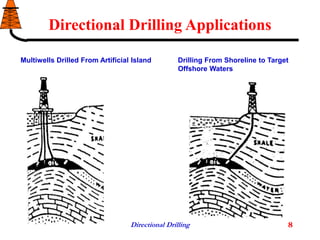
Directional Drilling Applications
Multiwells Drilled From Artificial Island Drilling From Shoreline to Target
Offshore Waters
Directional Drilling 9
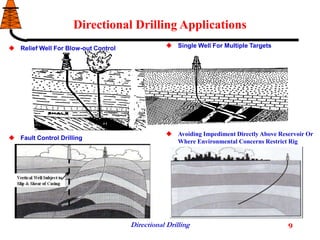
Directional Drilling Applications
 Relief Well For Blow-out Control
 Fault Control Drilling
 Single Well For Multiple Targets
 Avoiding Impediment Directly Above Reservoir Or
Where Environmental Concerns Restrict Rig
Location
Directional Drilling 10
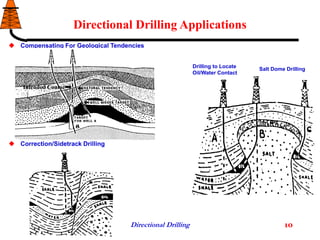
Directional Drilling Applications
 Compensating For Geological Tendencies
 Correction/Sidetrack Drilling
Salt Dome Drilling
Drilling to Locate
Oil/Water Contact
Intended Course
Intended Course
Intended Course
Intended Course
Directional Drilling 11
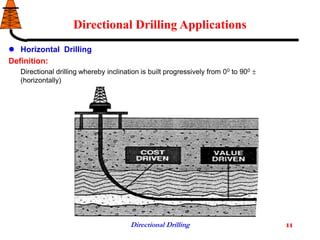
Directional Drilling Applications
 Horizontal Drilling
Definition:
Directional drilling whereby inclination is built progressively from 00 to 900 
(horizontally)
Directional Drilling 12
Directional Drilling Applications
 Horizontal Drilling
Definition:
 Reservoirs with oil zone sandwiched between aquifer and overlaying gas
cap
 Reservoir with gas and water coning problems
 Reservoirs with oil circulating vertical fractures
 Reservoirs with thin productive zones
 Reservoirs with thick productive zone of marginal permeability
 Reservoirs with thick and heavy oil requiring enhanced oil recovery
project.
 Old reservoirs with inadequate drive mechanism.
Directional Drilling 13
Directional Drilling Applications
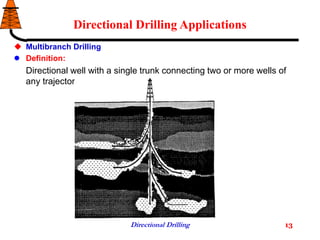
 Multibranch Drilling
 Definition:
Directional well with a single trunk connecting two or more wells of
any trajectory
Directional Drilling 14
Directional Drilling Applications
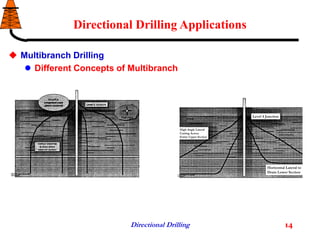
 Multibranch Drilling
 Different Concepts of Multibranch
Horizontal Lateral to
Drain Lower Section
High Angle Lateral
Cutting Across
Entire Upper Section
Level 4 Junction
Horizontal Lateral to
Drain Lower Section
High Angle Lateral
Cutting Across
Entire Upper Section
Level 4 Junction
Directional Drilling 15
Directional Drilling Applications
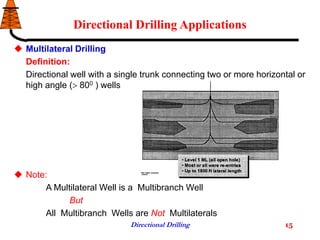
 Multilateral Drilling
Definition:
Directional well with a single trunk connecting two or more horizontal or
high angle ( 800 ) wells
 Note:
A Multilateral Well is a Multibranch Well
But
All Multibranch Wells are Not Multilaterals
Directional Drilling 16
Deviated Well Patterns
Directional Drilling 17
Deviated Well Patterns
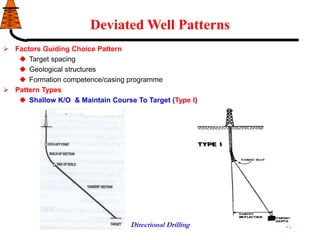
 Factors Guiding Choice Pattern
 Target spacing
 Geological structures
 Formation competence/casing programme
 Pattern Types
 Shallow K/O & Maintain Course To Target (Type I)
Directional Drilling 18
Deviated Well Patterns
 Pattern Types
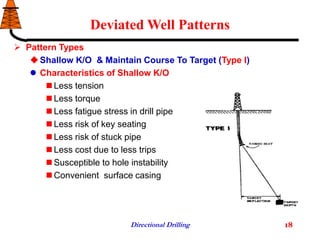
Shallow K/O & Maintain Course To Target (Type I)
 Characteristics of Shallow K/O
 Less tension
 Less torque
 Less fatigue stress in drill pipe
 Less risk of key seating
 Less risk of stuck pipe
 Less cost due to less trips
 Susceptible to hole instability
 Convenient surface casing
Directional Drilling 19
Deviated Well Patterns
 Pattern Types
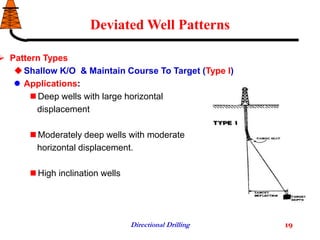
Shallow K/O & Maintain Course To Target (Type I)
 Applications:
 Deep wells with large horizontal
displacement
 Moderately deep wells with moderate
horizontal displacement.
 High inclination wells
Directional Drilling 20
Deviated Well Patterns
 Pattern Types
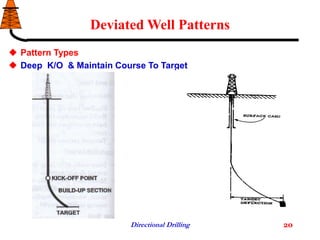
 Deep K/O & Maintain Course To Target
Directional Drilling 21
Deviated Well Patterns
 Pattern Types
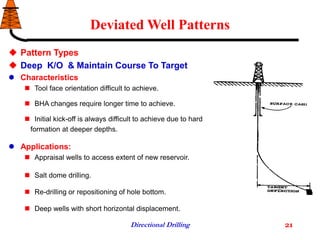
 Deep K/O & Maintain Course To Target
 Characteristics
 Tool face orientation difficult to achieve.
 BHA changes require longer time to achieve.
 Initial kick-off is always difficult to achieve due to harder
formation at deeper depths.
 Applications:
 Appraisal wells to access extent of new reservoir.
 Salt dome drilling.
 Re-drilling or repositioning of hole bottom.
 Deep wells with short horizontal displacement.
Directional Drilling 22
Deviated Well Patterns
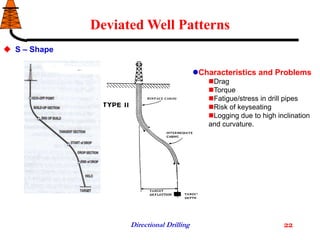
 S – Shape
Characteristics and Problems
Drag
Torque
Fatigue/stress in drill pipes
Risk of keyseating
Logging due to high inclination
and curvature.
Directional Drilling 23
Deviated Well Patterns
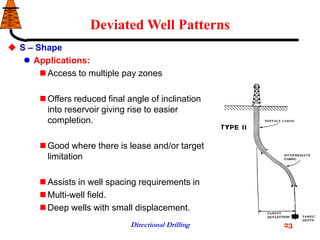
 S – Shape
 Applications:
 Access to multiple pay zones
 Offers reduced final angle of inclination
into reservoir giving rise to easier
completion.
 Good where there is lease and/or target
limitation
 Assists in well spacing requirements in
 Multi-well field.
 Deep wells with small displacement.
Directional Drilling 24
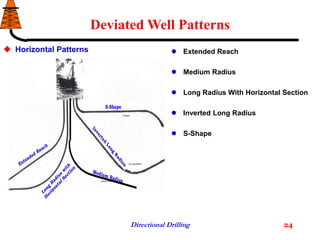
Deviated Well Patterns
 Horizontal Patterns  Extended Reach
 Medium Radius
 Long Radius With Horizontal Section
 Inverted Long Radius
 S-Shape
S-Shape
Inverted
Long
R
adius
Long
R
adius
w
ith
H
orizontal Section
Extended Reach
Medium Radius
S-Shape
Inverted
Long
R
adius
Long
R
adius
w
ith
H
orizontal Section
Extended Reach
S-Shape
Inverted
Long
R
adius
Long
R
adius
w
ith
H
orizontal Section
Extended Reach
Medium Radius

Introduction to directional drilling and its applications

  • 1.
    Directional Drilling 1 Introductionto Directional Drilling and its Applications
  • 2.
    Directional Drilling 2 Company:Sokono Engineering Servives Facilitator: O. N. Ogbon
  • 3.
    Directional Drilling 3 MainTopics What is Directional Drilling Directional Drilling Applications Deviated Well Patterns(Profiles)
  • 4.
    Directional Drilling 4 Whatis Directional Drilling
  • 5.
    Directional Drilling 5 Whatis Directional Drilling? Definition The Science/Technology of DIRECTIONALLY DEVIATING a Well From a VERTICAL POSITION Under the Rotary Table Along a PLANNED COURSE to a SUBTARREAN TARGET Located at a Given HORIZONTAL DISTANCE From the Point of Drilling.
  • 6.
  • 7.
    Directional Drilling Directional DrillingApplications Directional drilling is applied mostly in  Drilling requiring high azimuthal turn to avoid structural impediment.  River crossing  Radial drilling requiring inclination exceeding 900  Maximum production from structurally restricted reservoirs such as:  Fractured reservoirs  Cavernous reservoirs
  • 8.
    Directional Drilling 8 DirectionalDrilling Applications Multiwells Drilled From Artificial Island Drilling From Shoreline to Target Offshore Waters
  • 9.
    Directional Drilling 9 DirectionalDrilling Applications  Relief Well For Blow-out Control  Fault Control Drilling  Single Well For Multiple Targets  Avoiding Impediment Directly Above Reservoir Or Where Environmental Concerns Restrict Rig Location
  • 10.
    Directional Drilling 10 DirectionalDrilling Applications  Compensating For Geological Tendencies  Correction/Sidetrack Drilling Salt Dome Drilling Drilling to Locate Oil/Water Contact Intended Course Intended Course Intended Course Intended Course
  • 11.
    Directional Drilling 11 DirectionalDrilling Applications  Horizontal Drilling Definition: Directional drilling whereby inclination is built progressively from 00 to 900  (horizontally)
  • 12.
    Directional Drilling 12 DirectionalDrilling Applications  Horizontal Drilling Definition:  Reservoirs with oil zone sandwiched between aquifer and overlaying gas cap  Reservoir with gas and water coning problems  Reservoirs with oil circulating vertical fractures  Reservoirs with thin productive zones  Reservoirs with thick productive zone of marginal permeability  Reservoirs with thick and heavy oil requiring enhanced oil recovery project.  Old reservoirs with inadequate drive mechanism.
  • 13.
    Directional Drilling 13 DirectionalDrilling Applications  Multibranch Drilling  Definition: Directional well with a single trunk connecting two or more wells of any trajectory
  • 14.
    Directional Drilling 14 DirectionalDrilling Applications  Multibranch Drilling  Different Concepts of Multibranch Horizontal Lateral to Drain Lower Section High Angle Lateral Cutting Across Entire Upper Section Level 4 Junction Horizontal Lateral to Drain Lower Section High Angle Lateral Cutting Across Entire Upper Section Level 4 Junction
  • 15.
    Directional Drilling 15 DirectionalDrilling Applications  Multilateral Drilling Definition: Directional well with a single trunk connecting two or more horizontal or high angle ( 800 ) wells  Note: A Multilateral Well is a Multibranch Well But All Multibranch Wells are Not Multilaterals
  • 16.
  • 17.
    Directional Drilling 17 DeviatedWell Patterns  Factors Guiding Choice Pattern  Target spacing  Geological structures  Formation competence/casing programme  Pattern Types  Shallow K/O & Maintain Course To Target (Type I)
  • 18.
    Directional Drilling 18 DeviatedWell Patterns  Pattern Types Shallow K/O & Maintain Course To Target (Type I)  Characteristics of Shallow K/O  Less tension  Less torque  Less fatigue stress in drill pipe  Less risk of key seating  Less risk of stuck pipe  Less cost due to less trips  Susceptible to hole instability  Convenient surface casing
  • 19.
    Directional Drilling 19 DeviatedWell Patterns  Pattern Types Shallow K/O & Maintain Course To Target (Type I)  Applications:  Deep wells with large horizontal displacement  Moderately deep wells with moderate horizontal displacement.  High inclination wells
  • 20.
    Directional Drilling 20 DeviatedWell Patterns  Pattern Types  Deep K/O & Maintain Course To Target
  • 21.
    Directional Drilling 21 DeviatedWell Patterns  Pattern Types  Deep K/O & Maintain Course To Target  Characteristics  Tool face orientation difficult to achieve.  BHA changes require longer time to achieve.  Initial kick-off is always difficult to achieve due to harder formation at deeper depths.  Applications:  Appraisal wells to access extent of new reservoir.  Salt dome drilling.  Re-drilling or repositioning of hole bottom.  Deep wells with short horizontal displacement.
  • 22.
    Directional Drilling 22 DeviatedWell Patterns  S – Shape Characteristics and Problems Drag Torque Fatigue/stress in drill pipes Risk of keyseating Logging due to high inclination and curvature.
  • 23.
    Directional Drilling 23 DeviatedWell Patterns  S – Shape  Applications:  Access to multiple pay zones  Offers reduced final angle of inclination into reservoir giving rise to easier completion.  Good where there is lease and/or target limitation  Assists in well spacing requirements in  Multi-well field.  Deep wells with small displacement.
  • 24.
    Directional Drilling 24 DeviatedWell Patterns  Horizontal Patterns  Extended Reach  Medium Radius  Long Radius With Horizontal Section  Inverted Long Radius  S-Shape S-Shape Inverted Long R adius Long R adius w ith H orizontal Section Extended Reach Medium Radius S-Shape Inverted Long R adius Long R adius w ith H orizontal Section Extended Reach S-Shape Inverted Long R adius Long R adius w ith H orizontal Section Extended Reach Medium Radius