Introduction to Data
Management
Cunera Buys
RRF 2016
https://www.flickr.com/photos/hellocatfood/7957989238/ (CC BY-NC-SA 2.0)
• Background on data management
• Why data management is important
• Intro to best practices for data management
• Library resources for data management.
Photo by Carl Vogtmann
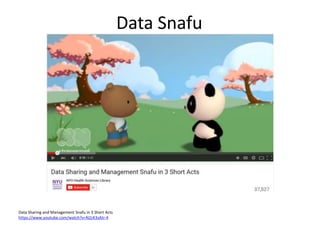
Data Snafu
Data Sharing and Management Snafu in 3 Short Acts
https://www.youtube.com/watch?v=N2zK3sAtr-4
What are data?
://www.flickr.com/photos/rh2ox/9990024683/ (CC BY-SA 2.0)
Data- Some Definitions
Digital Curation Center (UK): “Data, any information in binary digital form, is at
the centre of the Curation Lifecycle.”
Office of Management and Budget: “Research data means the recorded factual
material commonly accepted in the scientific community as necessary to
validate research findings”
The Oxford English Dictionary (OED)defines “data” as:
Related items of (chiefly numerical) information considered collectively,
typically obtained by scientific work and used for reference, analysis, or
calculation.
Data can be both analogue and digital materials.
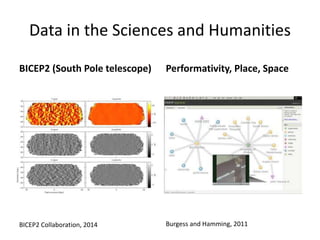
Data in the Sciences and Humanities
BICEP2 (South Pole telescope) Performativity, Place, Space
Burgess and Hamming, 2011BICEP2 Collaboration, 2014
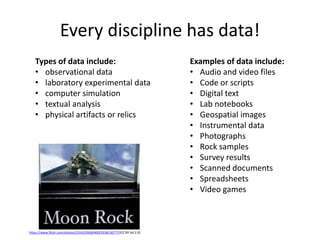
Every discipline has data!
Types of data include:
• observational data
• laboratory experimental data
• computer simulation
• textual analysis
• physical artifacts or relics
Examples of data include:
• Audio and video files
• Code or scripts
• Digital text
• Lab notebooks
• Geospatial images
• Instrumental data
• Photographs
• Rock samples
• Survey results
• Scanned documents
• Spreadsheets
• Video games
https://www.flickr.com/photos/23165290@N00/9338136777/(CC BY-SA 2.0)
Why do funders and broader science
community want to share and preserve
data?
https://www.flickr.com/photos/uwe_schubert/3931638785/ (CC BY-SA 2.0)
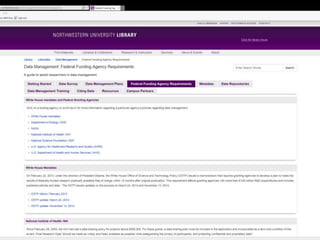
Brief History of Federal Data Sharing Requirements
• February 26, 2003 - NIH requires a Data Sharing Policy for projects
above $500K.
• January 18, 2011- NSF requires Data Management Plans (DMPs) to
be submitted with all new grant proposals.
• February 22, 2013- Memo issued by White House Office of Science
and Technology Policy (OSTP).
http://www.whitehouse.gov/sites/default/files/microsites/ostp/ost
p_public_access_memo_2013.pdf
Funding agency responses
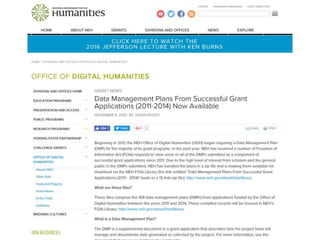
• Require Data Management Plans (DMPs)
• Publications to be available to public within 12
months (Open Access)
• Data supporting publications must be
available in a public repository
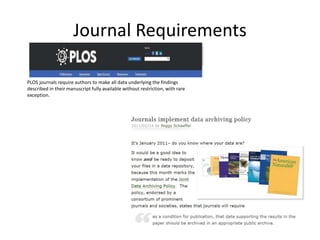
Journal Requirements
PLOS journals require authors to make all data underlying the findings
described in their manuscript fully available without restriction, with rare
exception.
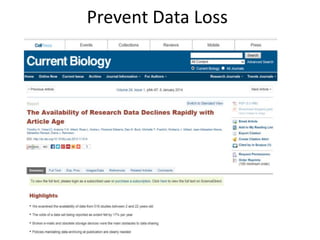
Prevent Data Loss
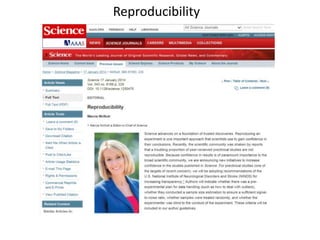
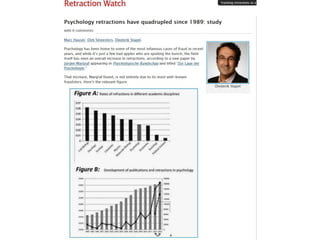
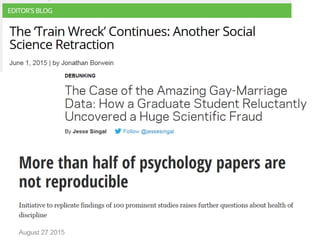
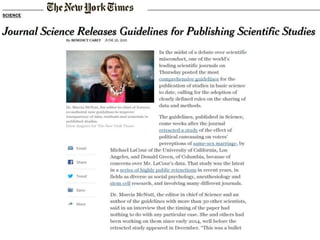
Reproducibility
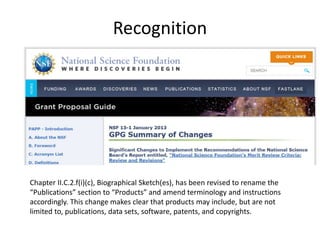
Recognition
Chapter II.C.2.f(i)(c), Biographical Sketch(es), has been revised to rename the
“Publications” section to “Products” and amend terminology and instructions
accordingly. This change makes clear that products may include, but are not
limited to, publications, data sets, software, patents, and copyrights.
Benefits of Sharing Data
• Clearly documents and provides evidence for research in conjunction with
published results.
• Meet copyright and ethical compliance (i.e. HIPAA).
• Increases the impact of research through data citation.
• Preserves data for long-term access and prevents loss of data.
• Describes and shares data with others to further new discoveries and research.
• Prevent duplication of research.
• Accelerates the pace of research.
• Promotes reproducibility of research.
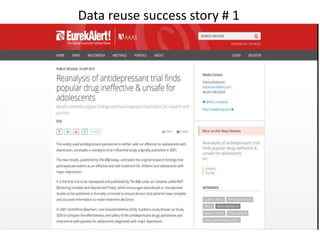
Data reuse success story # 1
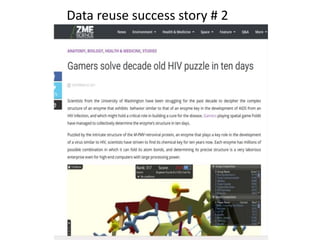
Data reuse success story # 2
• Background on data management
• Why data management is important
• Intro to best practices for data management
• Library resources for data management.
Photo by Carl Vogtmann
Data Management
• Managing data effectively across the data lifecycle is critical for the
success of a research project
– Make a data management plan
• Data management refers to all aspects of creating, housing,
delivering, maintaining, and archiving and preserving data
• It is one of the essential areas of responsible conduct of research
• All subject areas (humanities, social science, and hard sciences)
engage with data in many formats.
• Absence of data documentation and management will limit the
potential use of that data.
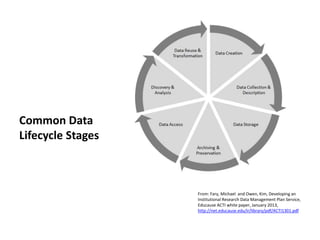
From: Fary, Michael and Owen, Kim, Developing an
Institutional Research Data Management Plan Service,
Educause ACTI white paper, January 2013,
http://net.educause.edu/ir/library/pdf/ACTI1301.pdf
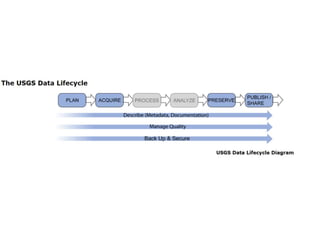
Common Data
Lifecycle Stages
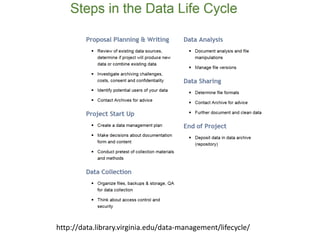
http://data.library.virginia.edu/data-management/lifecycle/
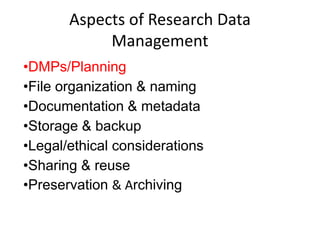
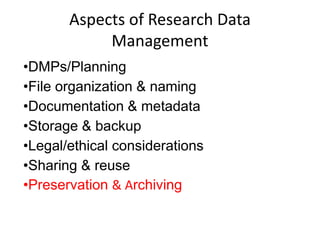
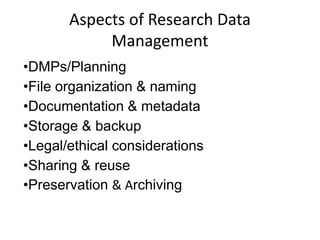
Aspects of Research Data
Management
•DMPs/Planning
•File organization & naming
•Documentation & metadata
•Storage & backup
•Legal/ethical considerations
•Sharing & reuse
•Preservation & Archiving
Start with a plan…
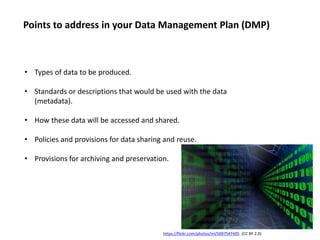
• Types of data to be produced.
• Standards or descriptions that would be used with the data
(metadata).
• How these data will be accessed and shared.
• Policies and provisions for data sharing and reuse.
• Provisions for archiving and preservation.
https://flickr.com/photos/inl/5097547405 (CC BY 2.0)
Points to address in your Data Management Plan (DMP)
Aspects of Research Data
Management
•DMPs/Planning
•File organization & naming
•Documentation & metadata
•Storage & backup
•Legal/ethical considerations
•Sharing & reuse
•Preservation & Archiving
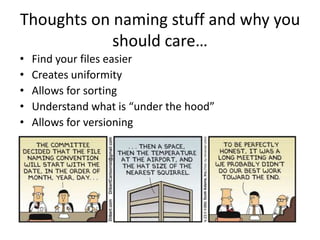
Thoughts on naming stuff and why you
should care…
• Find your files easier
• Creates uniformity
• Allows for sorting
• Understand what is “under the hood”
• Allows for versioning
Directories
• Folders should be major functions/activities
• Subfolders by year
• Make folder names explanatory
• Avoid personal names
• Avoid duplication
• Simple and simplistic
Source: http://bentley.umich.edu/dchome/resources/filenaming.php
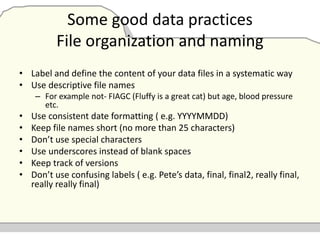
Some good data practices
File organization and naming
• Label and define the content of your data files in a systematic way
• Use descriptive file names
– For example not- FIAGC (Fluffy is a great cat) but age, blood pressure
etc.
• Use consistent date formatting ( e.g. YYYYMMDD)
• Keep file names short (no more than 25 characters)
• Don’t use special characters
• Use underscores instead of blank spaces
• Keep track of versions
• Don’t use confusing labels ( e.g. Pete’s data, final, final2, really final,
really really final)
Aspects of Research Data
Management
•DMPs/Planning
•File organization & naming
•Documentation & metadata
•Storage & backup
•Legal/ethical considerations
•Sharing & reuse
•Preservation & Archiving
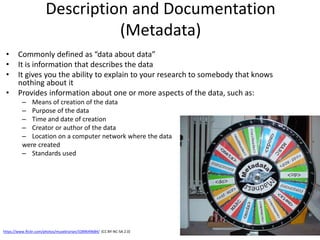
Description and Documentation
(Metadata)
• Commonly defined as “data about data”
• It is information that describes the data
• It gives you the ability to explain to your research to somebody that knows
nothing about it
• Provides information about one or more aspects of the data, such as:
– Means of creation of the data
– Purpose of the data
– Time and date of creation
– Creator or author of the data
– Location on a computer network where the data
were created
– Standards used
https://www.flickr.com/photos/musebrarian/3289649684/ (CC BY-NC-SA 2.0)
Metadata according to ICPSR…
• A number of elements should be included in metadata, including, but not
limited to:
• Principal investigator
• Funding sources
• Data collector/producer
• Project description
• Sample and sampling procedures
• Weighting
• Substantive, temporal, and geographic coverage of the data collection
• Data source(s)
• Unit(s) of analysis/observation
• Variables
• Technical information on files
• Data collection instruments
Aspects of Research Data
Management
•DMPs/Planning
•File organization & naming
•Documentation & metadata
•Storage & backup
•Legal/ethical considerations
•Sharing & reuse
•Preservation & Archiving
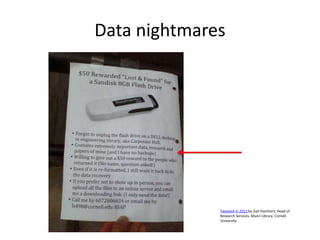
Data nightmares
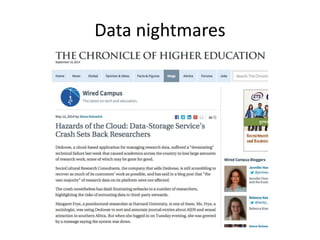
Data nightmares
Tweeted in 2012 by Gail Steinhart, Head of
Research Services, Mann Library, Cornell
University
Data nightmares
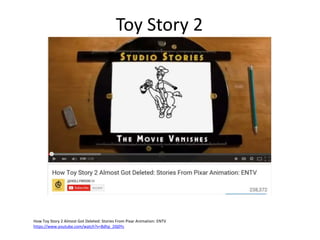
Toy Story 2
How Toy Story 2 Almost Got Deleted: Stories From Pixar Animation: ENTV
https://www.youtube.com/watch?v=8dhp_20j0Ys
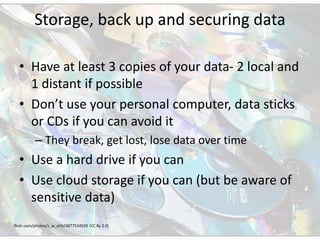
Storage, back up and securing data
• Have at least 3 copies of your data- 2 local and
1 distant if possible
• Don’t use your personal computer, data sticks
or CDs if you can avoid it
– They break, get lost, lose data over time
• Use a hard drive if you can
• Use cloud storage if you can (but be aware of
sensitive data)
flickr.com/photos/s_w_ellis/3877534599 (CC By 2.0)
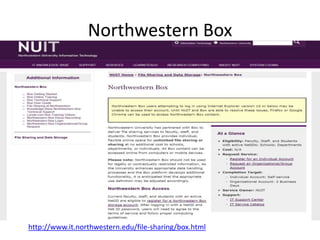
Northwestern Box
http://www.it.northwestern.edu/file-sharing/box.html
Aspects of Research Data
Management
•DMPs/Planning
•File organization & naming
•Documentation & metadata
•Storage & backup
•Legal/ethical considerations
•Sharing & reuse
•Preservation & Archiving
Legal Concerns
• Intellectual property rights
• Copyright- see the NU policy on copyright
http://invo.northwestern.edu/policies/copyright-policy
• Patents
• Trade secrets
• Licensing
• Creative Commons
• Monetary charges for data usage
• Open source versus proprietary software
• Data retention
Aspects of Research Data
Management
•DMPs/Planning
•File organization & naming
•Documentation & metadata
•Storage & backup
•Legal/ethical considerations
•Sharing & reuse
•Preservation & Archiving
Preservation and Sharing data
• Some options for preserving and sharing data
– Self-archive
– Institutional repository
– Open data repository
– National or international data archive or
repository
By Florian Hirzinger - www.fh-ap.com (Own work (Florian Hirzinger)) [CC BY-SA 3.0 (http://creativecommons.org/licenses/by-sa/3.0) or GFDL (http://www.gnu.org/copyleft/fdl.html)], via Wikimedia Commons
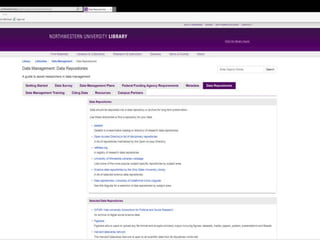
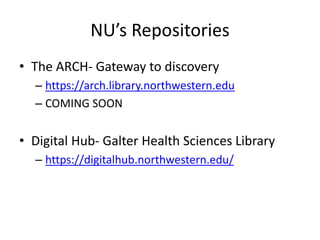
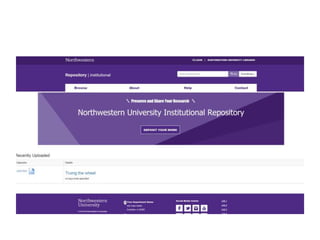
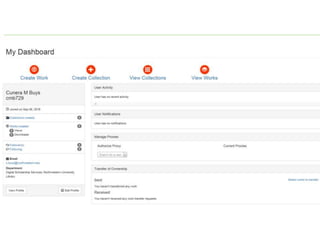
NU’s Repositories
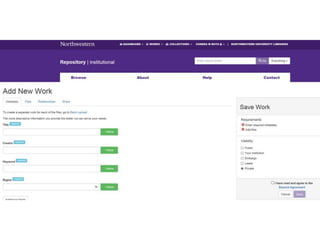
• The ARCH- Gateway to discovery
– https://arch.library.northwestern.edu
– COMING SOON
• Digital Hub- Galter Health Sciences Library
– https://digitalhub.northwestern.edu/
• Background on data management
• Why data management is important
• Intro to best practices for data management
• Library resources for data management.
Photo by Carl Vogtmann
Aspects of Research Data
Management
•DMPs/Planning
•File organization & naming
•Documentation & metadata
•Storage & backup
•Legal/ethical considerations
•Sharing & reuse
•Preservation & Archiving
RESOURCES:
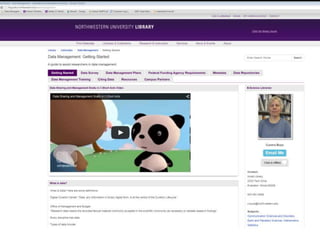
Northwestern University Library Data Management LibGuide:
http://libguides.northwestern.edu/datamanagement
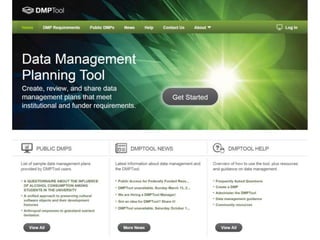
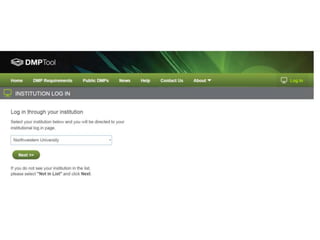
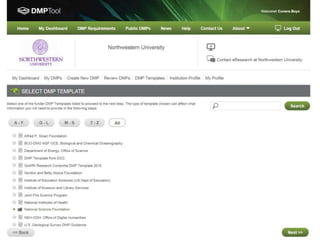
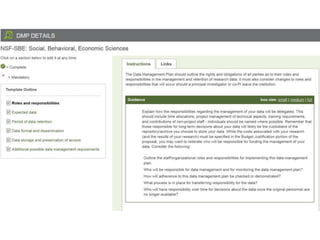
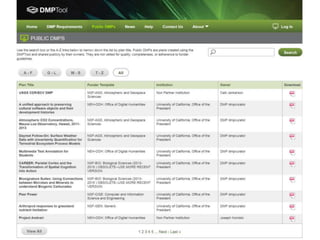
DMPTool: https://dmp.org/
Northwestern University's Research Data: Ownership, Retention and Access Policy:
http://www.research.northwestern.edu/policies/documents/research_data.pdf
Cunera Buys- Data mangement librarian: c-buys@northwestern.edu

Introduction to data management

  • 1.
    Introduction to Data Management CuneraBuys RRF 2016 https://www.flickr.com/photos/hellocatfood/7957989238/ (CC BY-NC-SA 2.0)
  • 2.
    • Background ondata management • Why data management is important • Intro to best practices for data management • Library resources for data management. Photo by Carl Vogtmann
  • 3.
    Data Snafu Data Sharingand Management Snafu in 3 Short Acts https://www.youtube.com/watch?v=N2zK3sAtr-4
  • 4.
  • 5.
    Data- Some Definitions DigitalCuration Center (UK): “Data, any information in binary digital form, is at the centre of the Curation Lifecycle.” Office of Management and Budget: “Research data means the recorded factual material commonly accepted in the scientific community as necessary to validate research findings” The Oxford English Dictionary (OED)defines “data” as: Related items of (chiefly numerical) information considered collectively, typically obtained by scientific work and used for reference, analysis, or calculation. Data can be both analogue and digital materials.
  • 6.
    Data in theSciences and Humanities BICEP2 (South Pole telescope) Performativity, Place, Space Burgess and Hamming, 2011BICEP2 Collaboration, 2014
  • 7.
    Every discipline hasdata! Types of data include: • observational data • laboratory experimental data • computer simulation • textual analysis • physical artifacts or relics Examples of data include: • Audio and video files • Code or scripts • Digital text • Lab notebooks • Geospatial images • Instrumental data • Photographs • Rock samples • Survey results • Scanned documents • Spreadsheets • Video games https://www.flickr.com/photos/23165290@N00/9338136777/(CC BY-SA 2.0)
  • 8.
    Why do fundersand broader science community want to share and preserve data? https://www.flickr.com/photos/uwe_schubert/3931638785/ (CC BY-SA 2.0)
  • 9.
    Brief History ofFederal Data Sharing Requirements • February 26, 2003 - NIH requires a Data Sharing Policy for projects above $500K. • January 18, 2011- NSF requires Data Management Plans (DMPs) to be submitted with all new grant proposals. • February 22, 2013- Memo issued by White House Office of Science and Technology Policy (OSTP). http://www.whitehouse.gov/sites/default/files/microsites/ostp/ost p_public_access_memo_2013.pdf
  • 10.
    Funding agency responses •Require Data Management Plans (DMPs) • Publications to be available to public within 12 months (Open Access) • Data supporting publications must be available in a public repository
  • 11.
    Journal Requirements PLOS journalsrequire authors to make all data underlying the findings described in their manuscript fully available without restriction, with rare exception.
  • 12.
  • 13.
  • 17.
    Recognition Chapter II.C.2.f(i)(c), BiographicalSketch(es), has been revised to rename the “Publications” section to “Products” and amend terminology and instructions accordingly. This change makes clear that products may include, but are not limited to, publications, data sets, software, patents, and copyrights.
  • 18.
    Benefits of SharingData • Clearly documents and provides evidence for research in conjunction with published results. • Meet copyright and ethical compliance (i.e. HIPAA). • Increases the impact of research through data citation. • Preserves data for long-term access and prevents loss of data. • Describes and shares data with others to further new discoveries and research. • Prevent duplication of research. • Accelerates the pace of research. • Promotes reproducibility of research.
  • 19.
  • 20.
  • 21.
    • Background ondata management • Why data management is important • Intro to best practices for data management • Library resources for data management. Photo by Carl Vogtmann
  • 22.
    Data Management • Managingdata effectively across the data lifecycle is critical for the success of a research project – Make a data management plan • Data management refers to all aspects of creating, housing, delivering, maintaining, and archiving and preserving data • It is one of the essential areas of responsible conduct of research • All subject areas (humanities, social science, and hard sciences) engage with data in many formats. • Absence of data documentation and management will limit the potential use of that data.
  • 23.
    From: Fary, Michaeland Owen, Kim, Developing an Institutional Research Data Management Plan Service, Educause ACTI white paper, January 2013, http://net.educause.edu/ir/library/pdf/ACTI1301.pdf Common Data Lifecycle Stages
  • 24.
  • 26.
    Aspects of ResearchData Management •DMPs/Planning •File organization & naming •Documentation & metadata •Storage & backup •Legal/ethical considerations •Sharing & reuse •Preservation & Archiving
  • 27.
    Start with aplan…
  • 28.
    • Types ofdata to be produced. • Standards or descriptions that would be used with the data (metadata). • How these data will be accessed and shared. • Policies and provisions for data sharing and reuse. • Provisions for archiving and preservation. https://flickr.com/photos/inl/5097547405 (CC BY 2.0) Points to address in your Data Management Plan (DMP)
  • 35.
    Aspects of ResearchData Management •DMPs/Planning •File organization & naming •Documentation & metadata •Storage & backup •Legal/ethical considerations •Sharing & reuse •Preservation & Archiving
  • 36.
    Thoughts on namingstuff and why you should care… • Find your files easier • Creates uniformity • Allows for sorting • Understand what is “under the hood” • Allows for versioning
  • 37.
    Directories • Folders shouldbe major functions/activities • Subfolders by year • Make folder names explanatory • Avoid personal names • Avoid duplication • Simple and simplistic Source: http://bentley.umich.edu/dchome/resources/filenaming.php
  • 38.
    Some good datapractices File organization and naming • Label and define the content of your data files in a systematic way • Use descriptive file names – For example not- FIAGC (Fluffy is a great cat) but age, blood pressure etc. • Use consistent date formatting ( e.g. YYYYMMDD) • Keep file names short (no more than 25 characters) • Don’t use special characters • Use underscores instead of blank spaces • Keep track of versions • Don’t use confusing labels ( e.g. Pete’s data, final, final2, really final, really really final)
  • 39.
    Aspects of ResearchData Management •DMPs/Planning •File organization & naming •Documentation & metadata •Storage & backup •Legal/ethical considerations •Sharing & reuse •Preservation & Archiving
  • 40.
    Description and Documentation (Metadata) •Commonly defined as “data about data” • It is information that describes the data • It gives you the ability to explain to your research to somebody that knows nothing about it • Provides information about one or more aspects of the data, such as: – Means of creation of the data – Purpose of the data – Time and date of creation – Creator or author of the data – Location on a computer network where the data were created – Standards used https://www.flickr.com/photos/musebrarian/3289649684/ (CC BY-NC-SA 2.0)
  • 41.
    Metadata according toICPSR… • A number of elements should be included in metadata, including, but not limited to: • Principal investigator • Funding sources • Data collector/producer • Project description • Sample and sampling procedures • Weighting • Substantive, temporal, and geographic coverage of the data collection • Data source(s) • Unit(s) of analysis/observation • Variables • Technical information on files • Data collection instruments
  • 42.
    Aspects of ResearchData Management •DMPs/Planning •File organization & naming •Documentation & metadata •Storage & backup •Legal/ethical considerations •Sharing & reuse •Preservation & Archiving
  • 43.
  • 44.
    Data nightmares Tweeted in2012 by Gail Steinhart, Head of Research Services, Mann Library, Cornell University
  • 45.
  • 46.
    Toy Story 2 HowToy Story 2 Almost Got Deleted: Stories From Pixar Animation: ENTV https://www.youtube.com/watch?v=8dhp_20j0Ys
  • 47.
    Storage, back upand securing data • Have at least 3 copies of your data- 2 local and 1 distant if possible • Don’t use your personal computer, data sticks or CDs if you can avoid it – They break, get lost, lose data over time • Use a hard drive if you can • Use cloud storage if you can (but be aware of sensitive data) flickr.com/photos/s_w_ellis/3877534599 (CC By 2.0)
  • 48.
  • 49.
    Aspects of ResearchData Management •DMPs/Planning •File organization & naming •Documentation & metadata •Storage & backup •Legal/ethical considerations •Sharing & reuse •Preservation & Archiving
  • 50.
    Legal Concerns • Intellectualproperty rights • Copyright- see the NU policy on copyright http://invo.northwestern.edu/policies/copyright-policy • Patents • Trade secrets • Licensing • Creative Commons • Monetary charges for data usage • Open source versus proprietary software • Data retention
  • 51.
    Aspects of ResearchData Management •DMPs/Planning •File organization & naming •Documentation & metadata •Storage & backup •Legal/ethical considerations •Sharing & reuse •Preservation & Archiving
  • 52.
    Preservation and Sharingdata • Some options for preserving and sharing data – Self-archive – Institutional repository – Open data repository – National or international data archive or repository By Florian Hirzinger - www.fh-ap.com (Own work (Florian Hirzinger)) [CC BY-SA 3.0 (http://creativecommons.org/licenses/by-sa/3.0) or GFDL (http://www.gnu.org/copyleft/fdl.html)], via Wikimedia Commons
  • 56.
    NU’s Repositories • TheARCH- Gateway to discovery – https://arch.library.northwestern.edu – COMING SOON • Digital Hub- Galter Health Sciences Library – https://digitalhub.northwestern.edu/
  • 61.
    • Background ondata management • Why data management is important • Intro to best practices for data management • Library resources for data management. Photo by Carl Vogtmann
  • 62.
    Aspects of ResearchData Management •DMPs/Planning •File organization & naming •Documentation & metadata •Storage & backup •Legal/ethical considerations •Sharing & reuse •Preservation & Archiving
  • 63.
    RESOURCES: Northwestern University LibraryData Management LibGuide: http://libguides.northwestern.edu/datamanagement DMPTool: https://dmp.org/ Northwestern University's Research Data: Ownership, Retention and Access Policy: http://www.research.northwestern.edu/policies/documents/research_data.pdf Cunera Buys- Data mangement librarian: c-buys@northwestern.edu