Managing and Sharing Data and
Achieving Research Transparency
…………………………………………………………………………………………………………………
Professor
Course Name
Date
Drawing on materials assembled by the Qualitative Data Repository
Center for Qualitative and Multi-Method Inquiry | Maxwell School | Syracuse University
Some slides come from a course co-taught by QDR and the UK Data Service. All materials provided under a CC-BY license
Overview of the Module
………………………………………………………………………….……………………………………….
Part 1
Managing Research Data through the Data Lifecycle
Part 2
Sharing Research Data: Benefits and Challenges
Part 3
Achieving Research Transparency
Data Management – Processes
………………………………………………………………………….……………………………………….
• Data management involves:
→ Deciding what data standards to follow
→ Formatting data
→ Transcribing and/or translating data
→ Anonymizing (if needed)
→ Writing documentation / providing context
→ Creating metadata
→ Backing up / storing data
→ Securing data
Data Management – Considerations
………………………………………………………………………….……………………………………….
• Data management should:
→ Be planned
→ Be designed according to needs and purpose of
research and the type of data
→ Be reviewed and implemented regularly throughout
project
→ Entail standardized and consistent procedures for things
that will be done more than once or by more than one
person (e.g., rules, templates, version control)
→ Be consistently mindful of ethical and legal issues and
employ specific measures to address them
Data Management – Formatting Data
………………………………………………………………………….……………………………………….
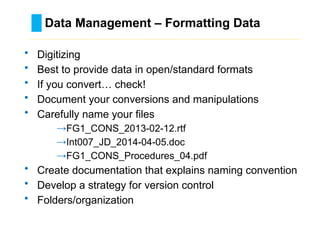
• Digitizing
• Best to provide data in open/standard formats
• If you convert… check!
• Document your conversions and manipulations
• Carefully name your files
→FG1_CONS_2013-02-12.rtf
→Int007_JD_2014-04-05.doc
→FG1_CONS_Procedures_04.pdf
• Create documentation that explains naming convention
• Develop a strategy for version control
• Folders/organization
Data Management – Transcribing Interviews
………………………………………………………………………….……………………………………….
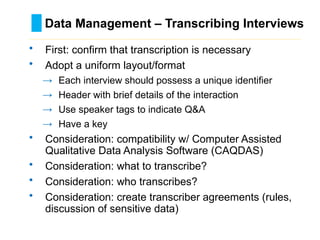
• First: confirm that transcription is necessary
• Adopt a uniform layout/format
→ Each interview should possess a unique identifier
→ Header with brief details of the interaction
→ Use speaker tags to indicate Q&A
→ Have a key
• Consideration: compatibility w/ Computer Assisted
Qualitative Data Analysis Software (CAQDAS)
• Consideration: what to transcribe?
• Consideration: who transcribes?
• Consideration: create transcriber agreements (rules,
discussion of sensitive data)
Documenting Data
………………………………………………………………………….……………………………………….
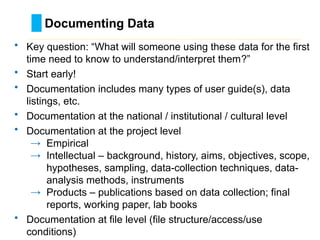
• Key question: “What will someone using these data for the first
time need to know to understand/interpret them?”
• Start early!
• Documentation includes many types of user guide(s), data
listings, etc.
• Documentation at the national / institutional / cultural level
• Documentation at the project level
→ Empirical
→ Intellectual – background, history, aims, objectives, scope,
hypotheses, sampling, data-collection techniques, data-
analysis methods, instruments
→ Products – publications based on data collection; final
reports, working paper, lab books
• Documentation at file level (file structure/access/use
conditions)
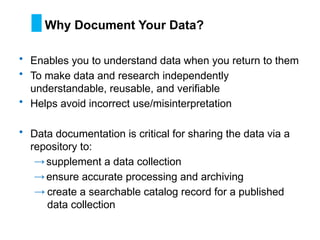
• Enables you to understand data when you return to them
• To make data and research independently
understandable, reusable, and verifiable
• Helps avoid incorrect use/misinterpretation
• Data documentation is critical for sharing the data via a
repository to:
→supplement a data collection
→ensure accurate processing and archiving
→ create a searchable catalog record for a published
data collection
Why Document Your Data?
Metadata
………………………………………………………………………….……………………………………….
• Metadata are “data about data.”
→ A subset of the information that you provide in your
documentation.
• They might be assigned at various levels and there are
various types (descriptive, administrative, structural)
• Metadata’s functions
→ Help individuals and institutions to discover/ cite data
→ Help repository staff administer data
→ Enable the faithful exchange of precise meaning among
different machines/ between machines and people
→ Aid the public dissemination of data
• Researcher provides some / professional repositories
extract some.
Securing Data
………………………………………………………………………….……………………………………….
• Strategies to keep your data secure
• Employ on all of your devices, everywhere you work
• Max. precautions with personal data/sensitive materials
• Transferring data
→ Don’t email if at all sensitive!
→ Content management systems
→ Secure file transfer protocol (ftp)
→ Commercial systems
→ Consider encryption
• Pretty Good Privacy (PGP)
• BitLocker
• Data/ equipment (beware of and resist mandates to
destroy your data!)
Backing Up and Storing Data
………………………………………………………………………….……………………………………….
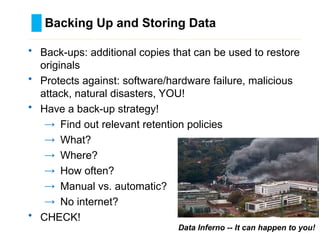
Data Inferno -- It can happen to you!
• Back-ups: additional copies that can be used to restore
originals
• Protects against: software/hardware failure, malicious
attack, natural disasters, YOU!
• Have a back-up strategy!
→ Find out relevant retention policies
→ What?
→ Where?
→ How often?
→ Manual vs. automatic?
→ No internet?
• CHECK!
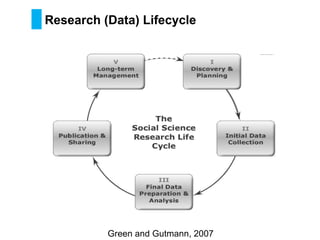
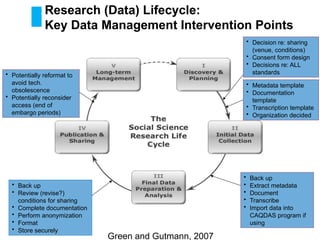
Research (Data) Lifecycle
Green and Gutmann, 2007
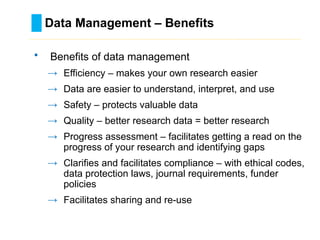
Research (Data) Lifecycle:
Key Data Management Intervention Points
Green and Gutmann, 2007
• Decision re: sharing
(venue, conditions)
• Consent form design
• Decisions re: ALL
standards
• Metadata template
• Documentation
template
• Transcription template
• Organization decided
• Back up
• Extract metadata
• Document
• Transcribe
• Import data into
CAQDAS program if
using
• Back up
• Review (revise?)
conditions for sharing
• Complete documentation
• Perform anonymization
• Format
• Store securely
• Potentially reformat to
avoid tech.
obsolescence
• Potentially reconsider
access (end of
embargo periods)
Data Management – Benefits
………………………………………………………………………….……………………………………….
• Benefits of data management
→ Efficiency – makes your own research easier
→ Data are easier to understand, interpret, and use
→ Safety – protects valuable data
→ Quality – better research data = better research
→ Progress assessment – facilitates getting a read on the
progress of your research and identifying gaps
→ Clarifies and facilitates compliance – with ethical codes,
data protection laws, journal requirements, funder
policies
→ Facilitates sharing and re-use
Data Management Planning
………………………………………………………………………….……………………………………….
• Elements of a Data Management Plan
→ Details about data you expect to generate
 types of data to be produced and retained
 how data are to be managed and maintained until shared
 mechanism for sharing
 possible impediments to sharing + ways to address
 other types of information regarding data (documentation)
→ Period of data retention pre-sharing
→ Data formats and dissemination
 policies for public access / sharing
→ Data back-up, storage, preservation of access
→ Additional data management requirements
• Include RDM costs into research applications / research
budgets / DMPs
• List / ID resources needed to make research data
shareable - beyond planned standard research
procedures and practices
• Resources = people, skills, equipment, infrastructure,
tools to manage, document, organize, store and provide
access to data
• Early planning can reduce time and cost!
• No ‘easy rules’
• Budget for the duration of research project
• Overhead costs – institutional infrastructure
Budget for Research Data Management
………………………………………………………………………….……………………………………….
Data Management Planning (Exercise)
………………………………………………………………………….……………………………………….
• Consider the elements expected from a DMP in the
context of what you know about your project today.
• Which elements seem particularly hard to know
before you carry out the project?
• How will you figure out / find the info. you need?
• Think about it a bit, then consult with your group.
Report to the rest of the class.
Data Management – Resources
………………………………………………………………………….……………………………………….
• NSF information on data management:
→ Dissemination and Sharing of Research Results:
www.nsf.gov/bfa/dias/policy/dmp.jsp
→ Guidance:
http://www.nsf.gov/pubs/policydocs/pappguide/nsf13001/gpg
_2.jsp#dmp
→ FAQs: http://www.nsf.gov/bfa/dias/policy/dmpfaqs.jsp
→ NSF Social and Behavioral Sciences Directorate
Props/Awards:
http://www.nsf.gov/sbe/SBE_DataMgmtPlanPolicy.pdf
• OpenMetadata’s DMP editor:
→ http://www.openmetadata.org/site/?page_id=373
• DMPTool
→ https://dmptool.org
To Share or Not To Share
………………………………………………………………………….……………………………………….
• What are the benefits of sharing data?
• Who does sharing data benefit?
• How does sharing data benefit these individuals and
groups?
• What are some reasons not to share data?
→ What are the downsides of sharing data?
→ What are the impediments to sharing data?
→ What are the concerns associated with sharing
data?
• Benefits to the scholarly community
→ Allows data to accumulate and be used for secondary
analysis
 Collaboration!
→ Promotes research transparency
→ Encourages and allows for better instruction
Why Share Data?
………………………………………………………………………….……………………………………….
• Benefits to researcher who generated data
→ Provides long-term safe storage for data
→ Helps in implementing data-management policies
→ Increases visibility of scholarly work
→ Enables collaboration on related themes / new topics
• Benefits to research participants
→ Maximizes use of their contributed data / information
→ Minimizes effects of data collection on populations
→ Optimizes over-time data collection
Why Share Data?
………………………………………………………………………….……………………………………….
• External Mandates
→ Scholarly association standards (e.g., APSA’s “DA-RT”)
 Data access + Research transparency (production
transparency + analytic transparency)
 Section 6 of APSA’s Guide to Professional Ethics,
Rights and Freedoms (as amended in October 2012)
→ Funders’ mandates
 Improves use of publicly funded data/research
 Avoids duplication of data collection
 Maximizes return for investment
→ Publishers’ data access policies / open access
publishing
`
Why Share Data?
………………………………………………………………………….……………………………………….
• First use
• Epistemological differences
• Questions about interest in data
• Concerns about data in a foreign language
• Copyright / licensing concerns
• Human participant concerns
• Resource concerns
• Destruction promises
• No incentives / rewards
Why NOT Share Data?
………………………………………………………………………….……………………………………….
Data Sharing and Ethical Concerns
………………………………………………………………………….……………………………………….
• Research should be designed, reviewed and
undertaken to ensure integrity, quality and
transparency.
• Participants (and staff) must normally be fully
informed about the purposes, methods and intended
possible uses of the research, what their participation
entails and what risks, if any, are involved.
• The confidentiality of information supplied by research
participants and the anonymity of respondents must
be respected.
• Research participants must take part voluntarily, free
of any coercion.
• Harm to participants must be avoided in all instances.
• Any conflicts of interest must be explicit.
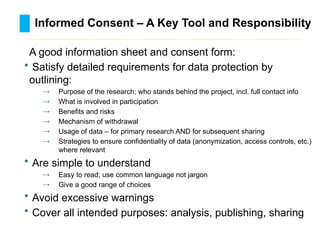
Informed Consent – A Key Tool and Responsibility
………………………………………………………………………….……………………………………….
A good information sheet and consent form:
• Satisfy detailed requirements for data protection by
outlining:
→ Purpose of the research; who stands behind the project, incl. full contact info
→ What is involved in participation
→ Benefits and risks
→ Mechanism of withdrawal
→ Usage of data – for primary research AND for subsequent sharing
→ Strategies to ensure confidentiality of data (anonymization, access controls, etc.)
where relevant
• Are simple to understand
→ Easy to read; use common language not jargon
→ Give a good range of choices
• Avoid excessive warnings
• Cover all intended purposes: analysis, publishing, sharing
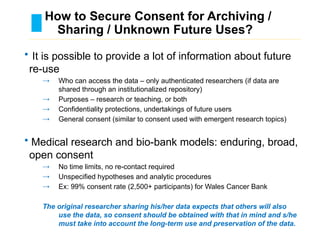
How to Secure Consent for Archiving /
Sharing / Unknown Future Uses?
………………………………………………………………………….……………………………………….
• It is possible to provide a lot of information about future
re-use
→ Who can access the data – only authenticated researchers (if data are
shared through an institutionalized repository)
→ Purposes – research or teaching, or both
→ Confidentiality protections, undertakings of future users
→ General consent (similar to consent used with emergent research topics)
• Medical research and bio-bank models: enduring, broad,
open consent
→ No time limits, no re-contact required
→ Unspecified hypotheses and analytic procedures
→ Ex: 99% consent rate (2,500+ participants) for Wales Cancer Bank
The original researcher sharing his/her data expects that others will also
use the data, so consent should be obtained with that in mind and s/he
must take into account the long-term use and preservation of the data.
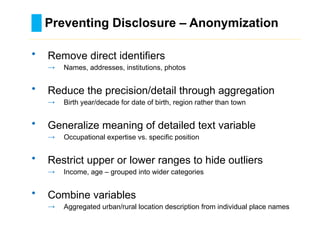
Preventing Disclosure – Anonymization
………………………………………………………………………….……………………………………….
• Remove direct identifiers
→ Names, addresses, institutions, photos
• Reduce the precision/detail through aggregation
→ Birth year/decade for date of birth, region rather than town
• Generalize meaning of detailed text variable
→ Occupational expertise vs. specific position
• Restrict upper or lower ranges to hide outliers
→ Income, age – grouped into wider categories
• Combine variables
→ Aggregated urban/rural location description from individual place names
Preventing Disclosure – Tips for QUAL DATA
………………………………………………………………………….……………………………………….
• Avoid blanking out: use pseudonyms or replacements
→ Identify where you have used replacements, for example with [brackets]
• Avoid over-anonymization
→ Removing / aggregating information can make the data more difficult to
interpret, distort them, or make them misleading or unusable
• Exercise additional care if working as a team
→ Maintain consistency within the team and throughout the project
• Keep master log of ALL replacements/ aggregations/
removals made and keep in a secure location
separate from the anonymized data files
→ This is part of your documentation.
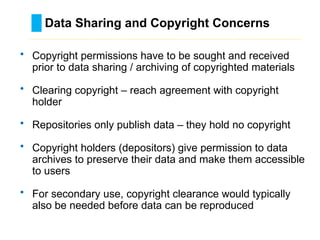
Data Sharing and Copyright Concerns
………………………………………………………………………….……………………………………….
• Copyright permissions have to be sought and received
prior to data sharing / archiving of copyrighted materials
• Clearing copyright – reach agreement with copyright
holder
• Repositories only publish data – they hold no copyright
• Copyright holders (depositors) give permission to data
archives to preserve their data and make them accessible
to users
• For secondary use, copyright clearance would typically
also be needed before data can be reproduced
• The creator of an original work in any format
→ Contracts can transfer intellectual products to employers
• If a work has two+ authors  joint copyright for both+
• If a research project entails multiple researchers’ institutions -
joint copyright for all researchers / institutions
• Research materials derived from existing data – free or
purchased – joint copyright
→ existing data may have been purchased or ‘lent’ by
someone – still under copyright
→ also information ‘taken’ from public sources, e.g.,
websites, are under copyright to the creator
• Interviews in research – individual interviewees have
copyright in the words of their particular interview (ask for
transfer in consent form)
Who Has Copyright?
………………………………………………………………………….……………………………………….
 Fair use exemption = key part of copyright law that
permits the unlicensed use of copyrighted material
under some circumstances (study, teaching,
quotations, criticisms, review)
 Fair use claims in research/scholarship because of
the way in which data are used
→Transformative
→Not involving a large amount
→Not likely to affect the potential market value of
items
→Is used for academic / non-commercial purposes
Fair Use
………………………………………………………………………….……………………………………….
Where to Share Data
………………………………………………………………………….……………………………………….
What are some options for sharing data?
• By request only
• Freely on a personal website
• On departmental website
• Via library data unit
• In an institutionalized archive or domain repository
What are some upsides and downsides of each option?
Where to Share Data
………………………………………………………………………….……………………………………….
Are there benefits of sharing data in an institutionalized venue?
• Meets data-management requirements
• Stability / security over time
• Makes your data more visible
• Such venues require documentation
• Can offer curation expertise that adds value to data
• Facilitates data discovery and reuse through the
development and standardization of metadata
• Achieves interoperability across scientific communities
• Authenticated online access to data / user access
controls /licensing agreements
• Fully searchable
• Many assign unique persistent DOIs to files or collections
Making research transparent requires:
• Data access [DATA]
→ What data were used, where are they, are they
available?
• Production transparency [INFO GATHERING / MEASUREMENT]
→ If authors’ own data, how were they produced?
→ Requires providing documentation describing how the
data were generated / collected
• Analytic transparency [ANALYSIS]
→ How were data analyzed to arrive at conclusions?
→ How are evidence and claims connected?
Making Research Transparent
………………………………………………………………………….……………………………………….
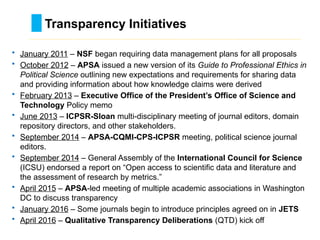
• January 2011 – NSF began requiring data management plans for all proposals
• October 2012 – APSA issued a new version of its Guide to Professional Ethics in
Political Science outlining new expectations and requirements for sharing data
and providing information about how knowledge claims were derived
• February 2013 – Executive Office of the President’s Office of Science and
Technology Policy memo
• June 2013 – ICPSR-Sloan multi-disciplinary meeting of journal editors, domain
repository directors, and other stakeholders.
• September 2014 – APSA-CQMI-CPS-ICPSR meeting, political science journal
editors.
• September 2014 – General Assembly of the International Council for Science
(ICSU) endorsed a report on “Open access to scientific data and literature and
the assessment of research by metrics.”
• April 2015 – APSA-led meeting of multiple academic associations in Washington
DC to discuss transparency
• January 2016 – Some journals begin to introduce principles agreed on in JETS
• April 2016 – Qualitative Transparency Deliberations (QTD) kick off
Transparency Initiatives
………………………………………………………………………….……………………………………….
• Makes research procedures clear
• Facilitates more and deeper collaboration
• Allows scholars to demonstrate the rigor and power of their
work
• Acts as an incentive to do good work
• Facilitates learning of methodological lessons and teaching
• Makes it more likely that research will be more useful to
others
• SUMMING UP: more accessible, honest, rigorous,
relevant, and useful research!
• QUESTION: Can you think of any other benefits?
Benefits of Transparency
………………………………………………………………………….……………………………………….
• Fewer than all, more than none
• Just those that were cited?
• Just those that were used in the analysis (replication
dataset v. study dataset)?
• The data that underlie the central claims? Or that underlie
potentially controversial conclusions?
• Depends on
→ Form of the data – aggregated or single-source?
→ Analytic methods
Which Data Need to be Shared to
Achieve Transparency?
………………………………………………………………………….……………………………………….
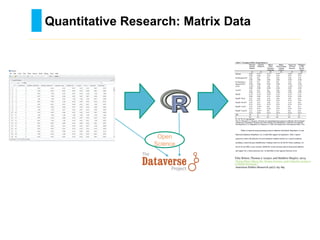
Quantitative Research: Matrix Data
Toby Bolsen, Thomas J. Leeper, and Matthew Shapiro. 2014.
“Doing What Others Do: Norms, Science, and Collective Action o
n Global Warming.”
American Politics Research 42(1): 65–89.
Open
Science
………………………………………………………………………….……………………………………….
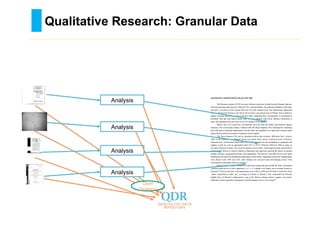
Qualitative Research: Granular Data
Analysis
Analysis
Analysis
Analysis
Open
Science
………………………………………………………………………….……………………………………….
• Responsibility
• Incentivizing
• Accommodating heterogeneity
• Identifying exceptions
• Timing
• Enforcement
• What other challenges and questions do you see?
Ongoing Questions and Challenges
………………………………………………………………………….……………………………………….

Impressive Data Management and Sharing - presentation.pptx

  • 1.
    Managing and SharingData and Achieving Research Transparency ………………………………………………………………………………………………………………… Professor Course Name Date Drawing on materials assembled by the Qualitative Data Repository Center for Qualitative and Multi-Method Inquiry | Maxwell School | Syracuse University Some slides come from a course co-taught by QDR and the UK Data Service. All materials provided under a CC-BY license
  • 2.
    Overview of theModule ………………………………………………………………………….………………………………………. Part 1 Managing Research Data through the Data Lifecycle Part 2 Sharing Research Data: Benefits and Challenges Part 3 Achieving Research Transparency
  • 3.
    Data Management –Processes ………………………………………………………………………….………………………………………. • Data management involves: → Deciding what data standards to follow → Formatting data → Transcribing and/or translating data → Anonymizing (if needed) → Writing documentation / providing context → Creating metadata → Backing up / storing data → Securing data
  • 4.
    Data Management –Considerations ………………………………………………………………………….………………………………………. • Data management should: → Be planned → Be designed according to needs and purpose of research and the type of data → Be reviewed and implemented regularly throughout project → Entail standardized and consistent procedures for things that will be done more than once or by more than one person (e.g., rules, templates, version control) → Be consistently mindful of ethical and legal issues and employ specific measures to address them
  • 5.
    Data Management –Formatting Data ………………………………………………………………………….………………………………………. • Digitizing • Best to provide data in open/standard formats • If you convert… check! • Document your conversions and manipulations • Carefully name your files →FG1_CONS_2013-02-12.rtf →Int007_JD_2014-04-05.doc →FG1_CONS_Procedures_04.pdf • Create documentation that explains naming convention • Develop a strategy for version control • Folders/organization
  • 6.
    Data Management –Transcribing Interviews ………………………………………………………………………….………………………………………. • First: confirm that transcription is necessary • Adopt a uniform layout/format → Each interview should possess a unique identifier → Header with brief details of the interaction → Use speaker tags to indicate Q&A → Have a key • Consideration: compatibility w/ Computer Assisted Qualitative Data Analysis Software (CAQDAS) • Consideration: what to transcribe? • Consideration: who transcribes? • Consideration: create transcriber agreements (rules, discussion of sensitive data)
  • 7.
    Documenting Data ………………………………………………………………………….………………………………………. • Keyquestion: “What will someone using these data for the first time need to know to understand/interpret them?” • Start early! • Documentation includes many types of user guide(s), data listings, etc. • Documentation at the national / institutional / cultural level • Documentation at the project level → Empirical → Intellectual – background, history, aims, objectives, scope, hypotheses, sampling, data-collection techniques, data- analysis methods, instruments → Products – publications based on data collection; final reports, working paper, lab books • Documentation at file level (file structure/access/use conditions)
  • 8.
    • Enables youto understand data when you return to them • To make data and research independently understandable, reusable, and verifiable • Helps avoid incorrect use/misinterpretation • Data documentation is critical for sharing the data via a repository to: →supplement a data collection →ensure accurate processing and archiving → create a searchable catalog record for a published data collection Why Document Your Data?
  • 9.
    Metadata ………………………………………………………………………….………………………………………. • Metadata are“data about data.” → A subset of the information that you provide in your documentation. • They might be assigned at various levels and there are various types (descriptive, administrative, structural) • Metadata’s functions → Help individuals and institutions to discover/ cite data → Help repository staff administer data → Enable the faithful exchange of precise meaning among different machines/ between machines and people → Aid the public dissemination of data • Researcher provides some / professional repositories extract some.
  • 10.
    Securing Data ………………………………………………………………………….………………………………………. • Strategiesto keep your data secure • Employ on all of your devices, everywhere you work • Max. precautions with personal data/sensitive materials • Transferring data → Don’t email if at all sensitive! → Content management systems → Secure file transfer protocol (ftp) → Commercial systems → Consider encryption • Pretty Good Privacy (PGP) • BitLocker • Data/ equipment (beware of and resist mandates to destroy your data!)
  • 11.
    Backing Up andStoring Data ………………………………………………………………………….………………………………………. Data Inferno -- It can happen to you! • Back-ups: additional copies that can be used to restore originals • Protects against: software/hardware failure, malicious attack, natural disasters, YOU! • Have a back-up strategy! → Find out relevant retention policies → What? → Where? → How often? → Manual vs. automatic? → No internet? • CHECK!
  • 12.
  • 13.
    Research (Data) Lifecycle: KeyData Management Intervention Points Green and Gutmann, 2007 • Decision re: sharing (venue, conditions) • Consent form design • Decisions re: ALL standards • Metadata template • Documentation template • Transcription template • Organization decided • Back up • Extract metadata • Document • Transcribe • Import data into CAQDAS program if using • Back up • Review (revise?) conditions for sharing • Complete documentation • Perform anonymization • Format • Store securely • Potentially reformat to avoid tech. obsolescence • Potentially reconsider access (end of embargo periods)
  • 14.
    Data Management –Benefits ………………………………………………………………………….………………………………………. • Benefits of data management → Efficiency – makes your own research easier → Data are easier to understand, interpret, and use → Safety – protects valuable data → Quality – better research data = better research → Progress assessment – facilitates getting a read on the progress of your research and identifying gaps → Clarifies and facilitates compliance – with ethical codes, data protection laws, journal requirements, funder policies → Facilitates sharing and re-use
  • 15.
    Data Management Planning ………………………………………………………………………….………………………………………. •Elements of a Data Management Plan → Details about data you expect to generate  types of data to be produced and retained  how data are to be managed and maintained until shared  mechanism for sharing  possible impediments to sharing + ways to address  other types of information regarding data (documentation) → Period of data retention pre-sharing → Data formats and dissemination  policies for public access / sharing → Data back-up, storage, preservation of access → Additional data management requirements
  • 16.
    • Include RDMcosts into research applications / research budgets / DMPs • List / ID resources needed to make research data shareable - beyond planned standard research procedures and practices • Resources = people, skills, equipment, infrastructure, tools to manage, document, organize, store and provide access to data • Early planning can reduce time and cost! • No ‘easy rules’ • Budget for the duration of research project • Overhead costs – institutional infrastructure Budget for Research Data Management ………………………………………………………………………….……………………………………….
  • 17.
    Data Management Planning(Exercise) ………………………………………………………………………….………………………………………. • Consider the elements expected from a DMP in the context of what you know about your project today. • Which elements seem particularly hard to know before you carry out the project? • How will you figure out / find the info. you need? • Think about it a bit, then consult with your group. Report to the rest of the class.
  • 18.
    Data Management –Resources ………………………………………………………………………….………………………………………. • NSF information on data management: → Dissemination and Sharing of Research Results: www.nsf.gov/bfa/dias/policy/dmp.jsp → Guidance: http://www.nsf.gov/pubs/policydocs/pappguide/nsf13001/gpg _2.jsp#dmp → FAQs: http://www.nsf.gov/bfa/dias/policy/dmpfaqs.jsp → NSF Social and Behavioral Sciences Directorate Props/Awards: http://www.nsf.gov/sbe/SBE_DataMgmtPlanPolicy.pdf • OpenMetadata’s DMP editor: → http://www.openmetadata.org/site/?page_id=373 • DMPTool → https://dmptool.org
  • 19.
    To Share orNot To Share ………………………………………………………………………….………………………………………. • What are the benefits of sharing data? • Who does sharing data benefit? • How does sharing data benefit these individuals and groups? • What are some reasons not to share data? → What are the downsides of sharing data? → What are the impediments to sharing data? → What are the concerns associated with sharing data?
  • 20.
    • Benefits tothe scholarly community → Allows data to accumulate and be used for secondary analysis  Collaboration! → Promotes research transparency → Encourages and allows for better instruction Why Share Data? ………………………………………………………………………….……………………………………….
  • 21.
    • Benefits toresearcher who generated data → Provides long-term safe storage for data → Helps in implementing data-management policies → Increases visibility of scholarly work → Enables collaboration on related themes / new topics • Benefits to research participants → Maximizes use of their contributed data / information → Minimizes effects of data collection on populations → Optimizes over-time data collection Why Share Data? ………………………………………………………………………….……………………………………….
  • 22.
    • External Mandates →Scholarly association standards (e.g., APSA’s “DA-RT”)  Data access + Research transparency (production transparency + analytic transparency)  Section 6 of APSA’s Guide to Professional Ethics, Rights and Freedoms (as amended in October 2012) → Funders’ mandates  Improves use of publicly funded data/research  Avoids duplication of data collection  Maximizes return for investment → Publishers’ data access policies / open access publishing ` Why Share Data? ………………………………………………………………………….……………………………………….
  • 23.
    • First use •Epistemological differences • Questions about interest in data • Concerns about data in a foreign language • Copyright / licensing concerns • Human participant concerns • Resource concerns • Destruction promises • No incentives / rewards Why NOT Share Data? ………………………………………………………………………….……………………………………….
  • 24.
    Data Sharing andEthical Concerns ………………………………………………………………………….………………………………………. • Research should be designed, reviewed and undertaken to ensure integrity, quality and transparency. • Participants (and staff) must normally be fully informed about the purposes, methods and intended possible uses of the research, what their participation entails and what risks, if any, are involved. • The confidentiality of information supplied by research participants and the anonymity of respondents must be respected. • Research participants must take part voluntarily, free of any coercion. • Harm to participants must be avoided in all instances. • Any conflicts of interest must be explicit.
  • 25.
    Informed Consent –A Key Tool and Responsibility ………………………………………………………………………….………………………………………. A good information sheet and consent form: • Satisfy detailed requirements for data protection by outlining: → Purpose of the research; who stands behind the project, incl. full contact info → What is involved in participation → Benefits and risks → Mechanism of withdrawal → Usage of data – for primary research AND for subsequent sharing → Strategies to ensure confidentiality of data (anonymization, access controls, etc.) where relevant • Are simple to understand → Easy to read; use common language not jargon → Give a good range of choices • Avoid excessive warnings • Cover all intended purposes: analysis, publishing, sharing
  • 26.
    How to SecureConsent for Archiving / Sharing / Unknown Future Uses? ………………………………………………………………………….………………………………………. • It is possible to provide a lot of information about future re-use → Who can access the data – only authenticated researchers (if data are shared through an institutionalized repository) → Purposes – research or teaching, or both → Confidentiality protections, undertakings of future users → General consent (similar to consent used with emergent research topics) • Medical research and bio-bank models: enduring, broad, open consent → No time limits, no re-contact required → Unspecified hypotheses and analytic procedures → Ex: 99% consent rate (2,500+ participants) for Wales Cancer Bank The original researcher sharing his/her data expects that others will also use the data, so consent should be obtained with that in mind and s/he must take into account the long-term use and preservation of the data.
  • 27.
    Preventing Disclosure –Anonymization ………………………………………………………………………….………………………………………. • Remove direct identifiers → Names, addresses, institutions, photos • Reduce the precision/detail through aggregation → Birth year/decade for date of birth, region rather than town • Generalize meaning of detailed text variable → Occupational expertise vs. specific position • Restrict upper or lower ranges to hide outliers → Income, age – grouped into wider categories • Combine variables → Aggregated urban/rural location description from individual place names
  • 28.
    Preventing Disclosure –Tips for QUAL DATA ………………………………………………………………………….………………………………………. • Avoid blanking out: use pseudonyms or replacements → Identify where you have used replacements, for example with [brackets] • Avoid over-anonymization → Removing / aggregating information can make the data more difficult to interpret, distort them, or make them misleading or unusable • Exercise additional care if working as a team → Maintain consistency within the team and throughout the project • Keep master log of ALL replacements/ aggregations/ removals made and keep in a secure location separate from the anonymized data files → This is part of your documentation.
  • 29.
    Data Sharing andCopyright Concerns ………………………………………………………………………….………………………………………. • Copyright permissions have to be sought and received prior to data sharing / archiving of copyrighted materials • Clearing copyright – reach agreement with copyright holder • Repositories only publish data – they hold no copyright • Copyright holders (depositors) give permission to data archives to preserve their data and make them accessible to users • For secondary use, copyright clearance would typically also be needed before data can be reproduced
  • 30.
    • The creatorof an original work in any format → Contracts can transfer intellectual products to employers • If a work has two+ authors  joint copyright for both+ • If a research project entails multiple researchers’ institutions - joint copyright for all researchers / institutions • Research materials derived from existing data – free or purchased – joint copyright → existing data may have been purchased or ‘lent’ by someone – still under copyright → also information ‘taken’ from public sources, e.g., websites, are under copyright to the creator • Interviews in research – individual interviewees have copyright in the words of their particular interview (ask for transfer in consent form) Who Has Copyright? ………………………………………………………………………….……………………………………….
  • 31.
     Fair useexemption = key part of copyright law that permits the unlicensed use of copyrighted material under some circumstances (study, teaching, quotations, criticisms, review)  Fair use claims in research/scholarship because of the way in which data are used →Transformative →Not involving a large amount →Not likely to affect the potential market value of items →Is used for academic / non-commercial purposes Fair Use ………………………………………………………………………….……………………………………….
  • 32.
    Where to ShareData ………………………………………………………………………….………………………………………. What are some options for sharing data? • By request only • Freely on a personal website • On departmental website • Via library data unit • In an institutionalized archive or domain repository What are some upsides and downsides of each option?
  • 33.
    Where to ShareData ………………………………………………………………………….………………………………………. Are there benefits of sharing data in an institutionalized venue? • Meets data-management requirements • Stability / security over time • Makes your data more visible • Such venues require documentation • Can offer curation expertise that adds value to data • Facilitates data discovery and reuse through the development and standardization of metadata • Achieves interoperability across scientific communities • Authenticated online access to data / user access controls /licensing agreements • Fully searchable • Many assign unique persistent DOIs to files or collections
  • 34.
    Making research transparentrequires: • Data access [DATA] → What data were used, where are they, are they available? • Production transparency [INFO GATHERING / MEASUREMENT] → If authors’ own data, how were they produced? → Requires providing documentation describing how the data were generated / collected • Analytic transparency [ANALYSIS] → How were data analyzed to arrive at conclusions? → How are evidence and claims connected? Making Research Transparent ………………………………………………………………………….……………………………………….
  • 35.
    • January 2011– NSF began requiring data management plans for all proposals • October 2012 – APSA issued a new version of its Guide to Professional Ethics in Political Science outlining new expectations and requirements for sharing data and providing information about how knowledge claims were derived • February 2013 – Executive Office of the President’s Office of Science and Technology Policy memo • June 2013 – ICPSR-Sloan multi-disciplinary meeting of journal editors, domain repository directors, and other stakeholders. • September 2014 – APSA-CQMI-CPS-ICPSR meeting, political science journal editors. • September 2014 – General Assembly of the International Council for Science (ICSU) endorsed a report on “Open access to scientific data and literature and the assessment of research by metrics.” • April 2015 – APSA-led meeting of multiple academic associations in Washington DC to discuss transparency • January 2016 – Some journals begin to introduce principles agreed on in JETS • April 2016 – Qualitative Transparency Deliberations (QTD) kick off Transparency Initiatives ………………………………………………………………………….……………………………………….
  • 36.
    • Makes researchprocedures clear • Facilitates more and deeper collaboration • Allows scholars to demonstrate the rigor and power of their work • Acts as an incentive to do good work • Facilitates learning of methodological lessons and teaching • Makes it more likely that research will be more useful to others • SUMMING UP: more accessible, honest, rigorous, relevant, and useful research! • QUESTION: Can you think of any other benefits? Benefits of Transparency ………………………………………………………………………….……………………………………….
  • 37.
    • Fewer thanall, more than none • Just those that were cited? • Just those that were used in the analysis (replication dataset v. study dataset)? • The data that underlie the central claims? Or that underlie potentially controversial conclusions? • Depends on → Form of the data – aggregated or single-source? → Analytic methods Which Data Need to be Shared to Achieve Transparency? ………………………………………………………………………….……………………………………….
  • 38.
    Quantitative Research: MatrixData Toby Bolsen, Thomas J. Leeper, and Matthew Shapiro. 2014. “Doing What Others Do: Norms, Science, and Collective Action o n Global Warming.” American Politics Research 42(1): 65–89. Open Science ………………………………………………………………………….……………………………………….
  • 39.
    Qualitative Research: GranularData Analysis Analysis Analysis Analysis Open Science ………………………………………………………………………….……………………………………….
  • 40.
    • Responsibility • Incentivizing •Accommodating heterogeneity • Identifying exceptions • Timing • Enforcement • What other challenges and questions do you see? Ongoing Questions and Challenges ………………………………………………………………………….……………………………………….

Editor's Notes

  • #1 Teaching module prepared by the Qualitative Data Repository (2016) -- Includes: PPT presentation (including notes for the instructor on some slides) Syllabus insert with reading assignments Reading materials for inclusion on syllabus Suggestion for an in-class exercise and a homework exercise We ask that you please credit QDR and UK Data as source if you use the presentation in original or modified version. Please feel free to contact QDR (qdr@syr.edu) with any questions or feedback.
  • #2 The format envisioned for this presentation is a full class session in a graduate-level methods course. The presentation aims to generate discussion and debate about managing research data, sharing research data, and emerging expectations for openness in multiple domains and for making research transparent in political science in particular. We have sought to include some notes that we hope the instructor will find useful. The practical advice comprises recommendations based on best practices, but should of course be tailored to the specifics of individual research projects.
  • #3 The general goal is to make students aware of the need to think about the various aspects of data management early in the process of designing their study. The same general principles apply to both quantitative and qualitative data collections in most cases. The few instances where advice is provided specifically for qualitative data are designated as such in the slides below. Specific decisions will ultimately depend on the researcher and the context of each project. There is a lot of guidance on each of these points. We provide summaries of best practices and resources for further study in the recommended readings.
  • #6 THIS SLIDE ADDRESSES A CONCERN PARTICULAR TO QUALITATIVE DATA.
  • #10 Pretty Good Privacy (PGP) – http://cryptography.org/getpgp.htm BitLocker – http://windows.microsoft.com/en-us/windows7/products/features/bitlocker
  • #11 Image Source: BBC; University of Southampton, School of Electronics and Computer Science
  • #12 In-class exercise: With your own project in mind, jot down (on the handout that includes this figure) some data management activities that you might need to perform at the different phases in the cycle. When and how will you have to plan for these DM activities? What might differ in your plans if you are also explicitly planning for data sharing after the end of the project? Image source: Green, Ann G., and Myron P. Gutmann. (2007) "Building Partnerships Among Social Science Researchers, Institution-based Repositories, and Domain Specific Data Archives." OCLC Systems and Services: International Digital Library Perspectives. 23: 35-53. http://hdl.handle.net/2027.42/41214; http://dx.doi.org/10.1108/10650750710720757
  • #13 In-class exercise: Here we include some standard possibilities. The instructor might have students discuss their additional ideas; answers will depend on the different types of data they plan to use and whether they collect them first-hand or use an existing dataset/shared data. Image source: Green, Ann G., and Myron P. Gutmann. (2007) "Building Partnerships Among Social Science Researchers, Institution-based Repositories, and Domain Specific Data Archives." OCLC Systems and Services: International Digital Library Perspectives. 23: 35-53. http://hdl.handle.net/2027.42/41214; http://dx.doi.org/10.1108/10650750710720757
  • #15 Developing a DMP encourages researchers to document their decisions. It helps researchers to develop the data management processes to be followed during the research cycle. Template-based DMP resources researchers can use are located at www.dmptool.org/quickstartguide and www.dmponline.dcc.ac.uk
  • #17 In-class exercise to do in groups: Use the handout called Data Management Checklist, which is based on suggestions from several funding organizations regarding the content of a data management plan (DMP).
  • #18 The NSF links are included in the suggested syllabus insert. Some universities and some funders have accounts with DMPTool – researchers can log in and select from the available list of institutions, which helps to follow the required format.
  • #22 http://www.dartstatement.org: Full text of the DA-RT guidelines Most current list of journals that have signed, and put into practice, the Journal Editors Transparency Statement (JETS). http://www.nsf.gov/sbe/sbe_data_management_plan.jsp Brief version of Data Management Plan requirement for NSF SBE proposals (in force since January 18, 2011) http://www.nsf.gov/pubs/policydocs/pappguide/nsf11001/aag_6.jsp#VID4 - Detailed discussion of requirements for Dissemination and Sharing of Research Results (all NSF directorates)
  • #24 Consider data management and sharing during ethical review
  • #26 Difficult if using strict interpretations of “fully informed and explicit” One point that could be emphasized is that most of what people will care most about – ID protection, use for research only – CAN be promised. What CANNOT be specified are the specific research topics, or findings – although it is often hard for researchers to specify these things regarding their own research (i.e., current use).
  • #28 THIS SLIDE ADDRESSES A CONCERN PARTICULAR TO QUALITATIVE DATA. Digital manipulation of audio and image files can remove personal identifiers Voice alteration, image blurring (e.g., of faces) However, this is labor intensive, expensive and can damage research potential of data Better solution: Obtain consent to use and share unaltered data for research purposes (potentially with some access conditions) Avoid mentioning information that discloses identity during audio recording
  • #29 THIS SLIDE ADDRESSES A CONCERN MORE COMMON TO QUALITATIVE DATA (ESP. ARCHIVAL MATERIALS).
  • #30 THIS SLIDE ADDRESSES A CONCERN MORE COMMON TO QUALITATIVE DATA (ESP. ARCHIVAL MATERIALS).
  • #31 THIS SLIDE ADDRESSES A CONCERN MORE COMMON TO QUALITATIVE DATA (ESP. ARCHIVAL MATERIALS).
  • #35 IF USING MODULE IN THE FUTURE, THIS SLIDE MIGHT NEED UPDATING.
  • #41 The point of this exercise is to make students aware of the possibility of secondary data use and the ways in which every data collection should be made maximally useful to someone who was not involved in the original research and who will be interacting with the data after the fact. It is also useful for students to remember that they too will be “interacting with the data after the fact” (when they analyze them). Thus, good data management helps researchers themselves first and foremost.