Avoiding DATApocalypse!

        Laura Guy
       ENUG 2011
Overview
•   The What and Why of Research Data
•   A Data Sharing Revolution
•   Important Questions
•   Data Management
•   A Word (or Two) About Documentation
•   Avoiding DATApocalypse
THE WHAT AND WHY OF
RESEARCH DATA
Something’s happening here…

• Are you managing research data

OR...

• Should you be managing research data1
 1   Because the NSF told you so
What it is ain’t exactly clear…
• What’s this all about?
• What’s the best way to do it?
• Are you doing it properly?
What are Research Data?
“The recorded factual material commonly
accepted in the scientific community as
necessary to validate research findings."
(OMB Circular 110)
One Possible Definition
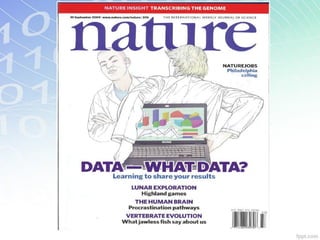
“Research data means data in the form of facts,
observations, images, computer program results,
recordings, measurements or experiences on
which an argument, theory, test or hypothesis, or
another research output is based. Data may be
numerical, descriptive, visual or tactile. It may be
raw, cleaned or processed, and may be held in
any format or media.” (The Queensland University
of Technology)
What aren’t Research Data?
•   Preliminary data amd analyses
•   Drafts of scientific papers
•   Plans for future research
•   Peer reviews
•   Communications with colleagues
•   Administrative data (treated independently)
•   Research publications (dealt with
    elsewhere)
Why Manage Research Data?
• Funding agency requirement (aka: NSF Data
  Management Plan)
• Cost effective
• Make things easier during the research project
• Data are fragile! Can be changed, corrupted, altered
• So it doesn’t go missing
• To avoid charges of fraud, bad science
• Share data with others
• Get proper credit for creating them
• Prevent chaos at the end of the project
A DATA SHARING REVOLUTION
The Times They Are a-Changin'

• Research data have always been valuable
• There has always been re-use (ICPSR,
  Census Bureau, etc.)
• The 2010 NSF Notice “Dissemination and
  Sharing of Research Results” upped the
  ante
• Other funders and sponsors are
  recognizing the importance of well-curated
  data and following suit
A (Digital) Revolution
• Advanced technologies make it easier, cheaper to share
  as do open data, open access, open source initiatives
• Publications are still important, but credit for producing
  data is also good!
• Cost effectiveness is the name of the game! (especially
  for the Feds, but private funders care, too)
• As funding money gets scarcer, reusable data become
  more and more valuable
• Besides, graduate students have always needed data for
  secondary analysis!
• Good data management habits at the start of a project
  will assist EVERYONE later
Data Sharing Rocks!
• Piwowar, Heather et al. "Sharing detailed
  research data is associated with increased
  citation rate.“
  http://www.plosone.org/article/info:doi%2F10.13
  71%2Fjournal.pone.0000308
• “Sharing of Data Leads to Progress on
  Alzheimer’s”
  http://www.nytimes.com/2010/08/13/health/resea
  rch/13alzheimer.html
• And then there's the Japan earthquake... (could
  prompt data sharing have helped?)
Data Sharing Sucks
• Recalcitrant Researchers
• Where’s the money going to come from for
  staff, technology?
• Need new policies, new procedures
• Who’s responsible?
• Shear volume (est: 1.2 zettabytes in 2010)
• How many of these data sets are actually
  going to be reused? (And should you care?)
IMPORTANT QUESTIONS
A Fistful of Questions
• What research data are being collected?
• How many active researchers are on your
  campus? How many research projects?
• How much data are out there? How fast are
  they growing?
• Who owns the data?
• What types of data are being collected
  (simulations? surveys? experiments?
  derived/data-mined? Etc.)?
• What file formats are being used?
And a Few Questions More…
• If those data were to be lost, how expensive
  would it be to recreate them (if even possible)?
• What infrastructure is in place to: protect data
  during research projects, and
  secure/archive/preserve them after?
• What infrastructure is in place to collect,
  organize, describe and provide access to
  research data?
Who’s the Audience?
•   The original researcher!
•   His/her colleagues?
•   Other researchers in the field?
•   Cross-disciplinary use?
•   Policy makers?
•   Students?
•   The Press?
•   "Concerned Citizens"?
What are the Responsibilities?
•   Funder?
•   Audience?
•   Respondents (Confidentiality, Sensitivity)?
•   Security?
•   Copyright?
•   Intellectual Property?
•   Embargo?
•   Forever Dark?
What About Retention?
•   How long do data need to be retained?
•   Three years?
•   Five years?
•   One hundred years?
•   Forever? (And BTW, what is “forever”?)
•   By definition retention includes the secure
    destruction of data
DATA MANAGEMENT
Data Management Planning
• Do you have policies in place?
• What about money? Staff? Tech?
• What are the current best practices?
• What tools/resources are available (there
  are loads of them! Maybe too many!)
• Planning is important…
• …but so is staying flexible and scalable
• “On-the-fly” is probably not a good thing
What’s a Data Management Plan?
• Many sponsors (like the NSF) require Data
  Management Plans (DMP)
• A good DMP enables data to retain their
  value during and after the research project
• A DMP describes the data that will be
  created and how they will be managed
  and made accessible throughout their
  entire lifetime
DMP During a Research Project
• Who’s responsible for the data? The
  documentation?
• How are they being stored?
• What about versioning? Backups?
• Protections? Encryption? Firewalls?
• Who’s responsible for preparing data for
  sharing?
LOCKSS!
• Lots Of Copies Keeps Stuff Safe
• Need multiple copies and offsite copies
• Need to store the copies securely
• If data contain confidential or sensitive
  information, security becomes even more
  critical
• Basic truth: the best way to protect data is
  to limit access to it
DMP After a Project Ends
• Preparation of data, metadata
• Long-term preservation and accessibility
• Curators, I.T. Professionals, and
  Researchers all work together
• Partners should be identified:
  – Library/Campus I.T., Institutional Repository
  – Disciplinary Data Repository where like data are
    stored together (e.g., ICPSR for social science
    data, GenBank for genetic sequencing,
    DataONE for Earth observational data)
Data Ownership
• Sharing involves making reuse rights
  clear. If they are ambiguous, who’d want
  to use them?
• Ownership, possession and right to
  publish can be complicated issues
• Many datasets aren’t copyrightable
• Europe does things differently!
• Get the details hashed out early
• Work with your legal folks
Durable Data
• When possible, use common formats,
  non-proprietary systems, migratable
  standards
• The best are open, standardized,
  documented, in wide use and easy to work
  with (analyze, transform, etc.)
• What is best for your potential audience?
• File formats can change!
• You need to think about storage media,
  too
A WORD (OR TWO) ABOUT
DOCUMENTATION
Data Documentation
• WHAT is required for someone to identify,
  evaluate, understand and reuse the data?
  – Data content (Codebook, Data Dictionary)
  – Data collection methods, frequency,
    instrumentation
  – Data limitations
  – Dataset provenance
  – Methods used for derived data creation
Minimal Metadata Requirements
• About the project:
   – Title, people, key dates, funders and grants
• About the data:
   – Title, key dates, creator(s), subjects, rights,
     included files, format(s), versions, checksums
• Interpretive aids:
   – Codebooks, data dictionaries, algorithms,
     code
Metadata Schema
There are many metadata schema already out there.
They'll save you time and effort!

•   Astronomy Visualization Metadata Standard
•   Content Standard for Digital Geospatial Metadata
•   Darwin Core
•   Data Documentation Initiative
•   Dublin Core
•   Ecological Metadata Language
•   Directory Interchange Format
AVOIDING DATAPOCALYPSE
Avoiding DATApocalyse
• Start Data Management Planning
  – Do it soon
  – Use Common Sense
  – Talk to and get buy-in from your stakeholders
  – Keep it simple
  – Keep it flexible and scalable
  – Lots of examples out there; You needn’t re-
    invent the wheel
  – Remember the “Virtual Team Model”
•   Definition of Research Data
•   Description of project (purpose of research, staff)
•   Description of data (type, format, methodology)
•   Applicable format, metadata, etc. standards
•   Short-term storage, backup, security plan
•   Legal and ethical issues (confidentiality,
    intellectual property, etc.)
•   Access policies and provisions (restrictions)
•   Long-term archiving and preservation
•   Retention period
•   Parties responsible for data management during
    the project, after the project ends, and who is
    responsible for disposing of the data if necessary
A Few Good Resources
•   ICPSR
•   CIESIN
•   ARL
•   DataONE
•   Digital Curation Centre
•   UK Data Archive
•   Australian National University / Data Service
•   MIT, Cornell, UCSD, etc.
NSF Dissemination and Access
“Investigators are expected to share with
other researchers, at no more than
incremental cost and within a reasonable
time, the primary data, samples, physical
collections and other supporting materials
created or gathered in the course of work
under NSF grants. Grantees are expected to
encourage and facilitate such sharing.”
Guy avoiding-dat apocalypse

Guy avoiding-dat apocalypse

  • 1.
    Avoiding DATApocalypse! Laura Guy ENUG 2011
  • 2.
    Overview • The What and Why of Research Data • A Data Sharing Revolution • Important Questions • Data Management • A Word (or Two) About Documentation • Avoiding DATApocalypse
  • 3.
    THE WHAT ANDWHY OF RESEARCH DATA
  • 4.
    Something’s happening here… •Are you managing research data OR... • Should you be managing research data1 1 Because the NSF told you so
  • 5.
    What it isain’t exactly clear… • What’s this all about? • What’s the best way to do it? • Are you doing it properly?
  • 6.
    What are ResearchData? “The recorded factual material commonly accepted in the scientific community as necessary to validate research findings." (OMB Circular 110)
  • 7.
    One Possible Definition “Researchdata means data in the form of facts, observations, images, computer program results, recordings, measurements or experiences on which an argument, theory, test or hypothesis, or another research output is based. Data may be numerical, descriptive, visual or tactile. It may be raw, cleaned or processed, and may be held in any format or media.” (The Queensland University of Technology)
  • 8.
    What aren’t ResearchData? • Preliminary data amd analyses • Drafts of scientific papers • Plans for future research • Peer reviews • Communications with colleagues • Administrative data (treated independently) • Research publications (dealt with elsewhere)
  • 9.
    Why Manage ResearchData? • Funding agency requirement (aka: NSF Data Management Plan) • Cost effective • Make things easier during the research project • Data are fragile! Can be changed, corrupted, altered • So it doesn’t go missing • To avoid charges of fraud, bad science • Share data with others • Get proper credit for creating them • Prevent chaos at the end of the project
  • 10.
    A DATA SHARINGREVOLUTION
  • 11.
    The Times TheyAre a-Changin' • Research data have always been valuable • There has always been re-use (ICPSR, Census Bureau, etc.) • The 2010 NSF Notice “Dissemination and Sharing of Research Results” upped the ante • Other funders and sponsors are recognizing the importance of well-curated data and following suit
  • 12.
    A (Digital) Revolution •Advanced technologies make it easier, cheaper to share as do open data, open access, open source initiatives • Publications are still important, but credit for producing data is also good! • Cost effectiveness is the name of the game! (especially for the Feds, but private funders care, too) • As funding money gets scarcer, reusable data become more and more valuable • Besides, graduate students have always needed data for secondary analysis! • Good data management habits at the start of a project will assist EVERYONE later
  • 13.
    Data Sharing Rocks! •Piwowar, Heather et al. "Sharing detailed research data is associated with increased citation rate.“ http://www.plosone.org/article/info:doi%2F10.13 71%2Fjournal.pone.0000308 • “Sharing of Data Leads to Progress on Alzheimer’s” http://www.nytimes.com/2010/08/13/health/resea rch/13alzheimer.html • And then there's the Japan earthquake... (could prompt data sharing have helped?)
  • 14.
    Data Sharing Sucks •Recalcitrant Researchers • Where’s the money going to come from for staff, technology? • Need new policies, new procedures • Who’s responsible? • Shear volume (est: 1.2 zettabytes in 2010) • How many of these data sets are actually going to be reused? (And should you care?)
  • 15.
  • 16.
    A Fistful ofQuestions • What research data are being collected? • How many active researchers are on your campus? How many research projects? • How much data are out there? How fast are they growing? • Who owns the data? • What types of data are being collected (simulations? surveys? experiments? derived/data-mined? Etc.)? • What file formats are being used?
  • 17.
    And a FewQuestions More… • If those data were to be lost, how expensive would it be to recreate them (if even possible)? • What infrastructure is in place to: protect data during research projects, and secure/archive/preserve them after? • What infrastructure is in place to collect, organize, describe and provide access to research data?
  • 18.
    Who’s the Audience? • The original researcher! • His/her colleagues? • Other researchers in the field? • Cross-disciplinary use? • Policy makers? • Students? • The Press? • "Concerned Citizens"?
  • 19.
    What are theResponsibilities? • Funder? • Audience? • Respondents (Confidentiality, Sensitivity)? • Security? • Copyright? • Intellectual Property? • Embargo? • Forever Dark?
  • 20.
    What About Retention? • How long do data need to be retained? • Three years? • Five years? • One hundred years? • Forever? (And BTW, what is “forever”?) • By definition retention includes the secure destruction of data
  • 21.
  • 22.
    Data Management Planning •Do you have policies in place? • What about money? Staff? Tech? • What are the current best practices? • What tools/resources are available (there are loads of them! Maybe too many!) • Planning is important… • …but so is staying flexible and scalable • “On-the-fly” is probably not a good thing
  • 23.
    What’s a DataManagement Plan? • Many sponsors (like the NSF) require Data Management Plans (DMP) • A good DMP enables data to retain their value during and after the research project • A DMP describes the data that will be created and how they will be managed and made accessible throughout their entire lifetime
  • 24.
    DMP During aResearch Project • Who’s responsible for the data? The documentation? • How are they being stored? • What about versioning? Backups? • Protections? Encryption? Firewalls? • Who’s responsible for preparing data for sharing?
  • 25.
    LOCKSS! • Lots OfCopies Keeps Stuff Safe • Need multiple copies and offsite copies • Need to store the copies securely • If data contain confidential or sensitive information, security becomes even more critical • Basic truth: the best way to protect data is to limit access to it
  • 26.
    DMP After aProject Ends • Preparation of data, metadata • Long-term preservation and accessibility • Curators, I.T. Professionals, and Researchers all work together • Partners should be identified: – Library/Campus I.T., Institutional Repository – Disciplinary Data Repository where like data are stored together (e.g., ICPSR for social science data, GenBank for genetic sequencing, DataONE for Earth observational data)
  • 27.
    Data Ownership • Sharinginvolves making reuse rights clear. If they are ambiguous, who’d want to use them? • Ownership, possession and right to publish can be complicated issues • Many datasets aren’t copyrightable • Europe does things differently! • Get the details hashed out early • Work with your legal folks
  • 28.
    Durable Data • Whenpossible, use common formats, non-proprietary systems, migratable standards • The best are open, standardized, documented, in wide use and easy to work with (analyze, transform, etc.) • What is best for your potential audience? • File formats can change! • You need to think about storage media, too
  • 29.
    A WORD (ORTWO) ABOUT DOCUMENTATION
  • 30.
    Data Documentation • WHATis required for someone to identify, evaluate, understand and reuse the data? – Data content (Codebook, Data Dictionary) – Data collection methods, frequency, instrumentation – Data limitations – Dataset provenance – Methods used for derived data creation
  • 31.
    Minimal Metadata Requirements •About the project: – Title, people, key dates, funders and grants • About the data: – Title, key dates, creator(s), subjects, rights, included files, format(s), versions, checksums • Interpretive aids: – Codebooks, data dictionaries, algorithms, code
  • 32.
    Metadata Schema There aremany metadata schema already out there. They'll save you time and effort! • Astronomy Visualization Metadata Standard • Content Standard for Digital Geospatial Metadata • Darwin Core • Data Documentation Initiative • Dublin Core • Ecological Metadata Language • Directory Interchange Format
  • 33.
  • 34.
    Avoiding DATApocalyse • StartData Management Planning – Do it soon – Use Common Sense – Talk to and get buy-in from your stakeholders – Keep it simple – Keep it flexible and scalable – Lots of examples out there; You needn’t re- invent the wheel – Remember the “Virtual Team Model”
  • 35.
    Definition of Research Data • Description of project (purpose of research, staff) • Description of data (type, format, methodology) • Applicable format, metadata, etc. standards • Short-term storage, backup, security plan • Legal and ethical issues (confidentiality, intellectual property, etc.) • Access policies and provisions (restrictions) • Long-term archiving and preservation • Retention period • Parties responsible for data management during the project, after the project ends, and who is responsible for disposing of the data if necessary
  • 36.
    A Few GoodResources • ICPSR • CIESIN • ARL • DataONE • Digital Curation Centre • UK Data Archive • Australian National University / Data Service • MIT, Cornell, UCSD, etc.
  • 37.
    NSF Dissemination andAccess “Investigators are expected to share with other researchers, at no more than incremental cost and within a reasonable time, the primary data, samples, physical collections and other supporting materials created or gathered in the course of work under NSF grants. Grantees are expected to encourage and facilitate such sharing.”