Chapter 1 2301373: Introduction 1
Introduction
Chapter 1 2301373: Introduction 2
What is a Compiler?
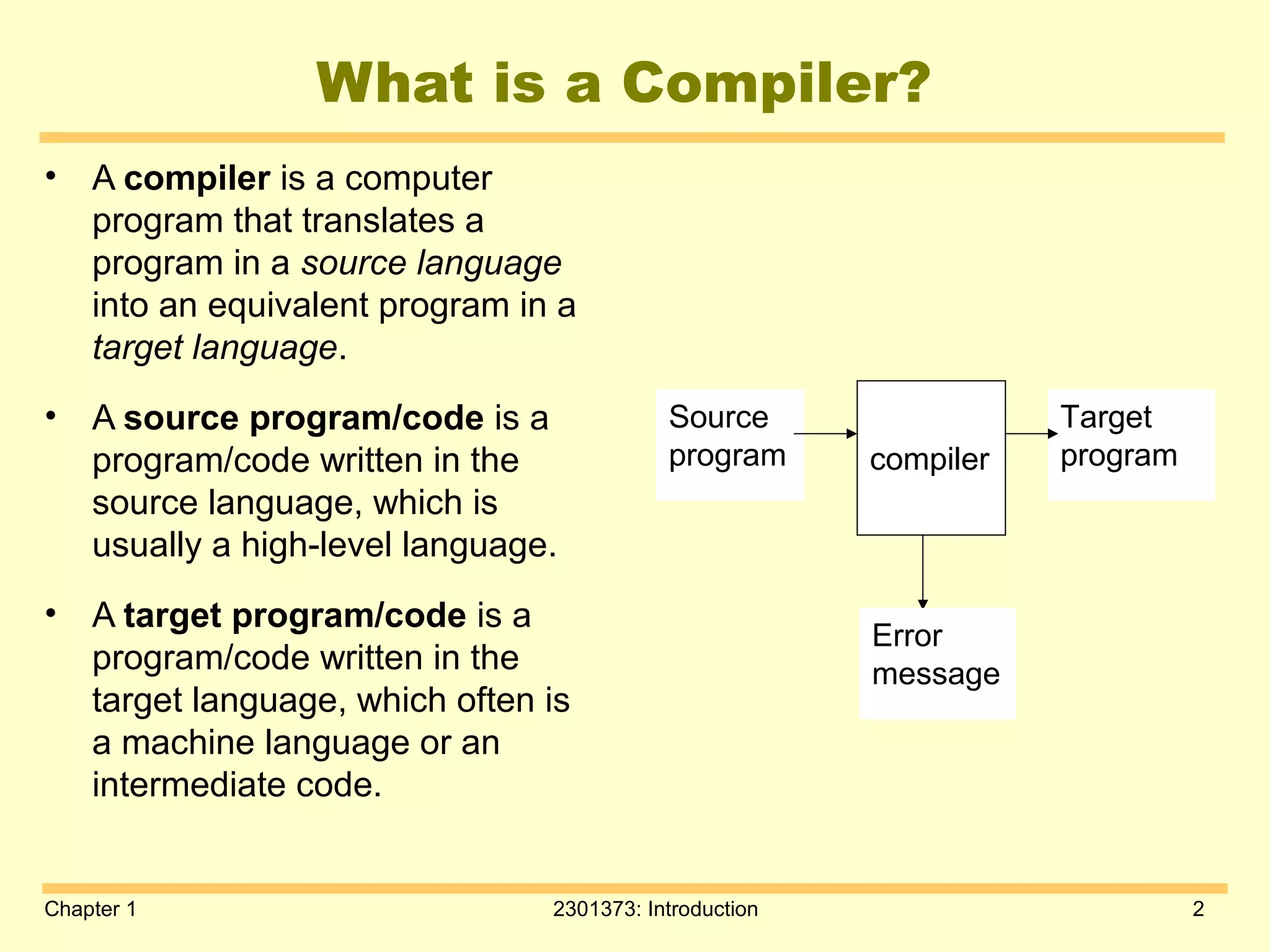
• A compiler is a computer
program that translates a
program in a source language
into an equivalent program in a
target language.
• A source program/code is a
program/code written in the
source language, which is
usually a high-level language.
• A target program/code is a
program/code written in the
target language, which often is
a machine language or an
intermediate code.
compiler
Source
program
Target
program
Error
message
Chapter 1 2301373: Introduction 3
Process of Compiling
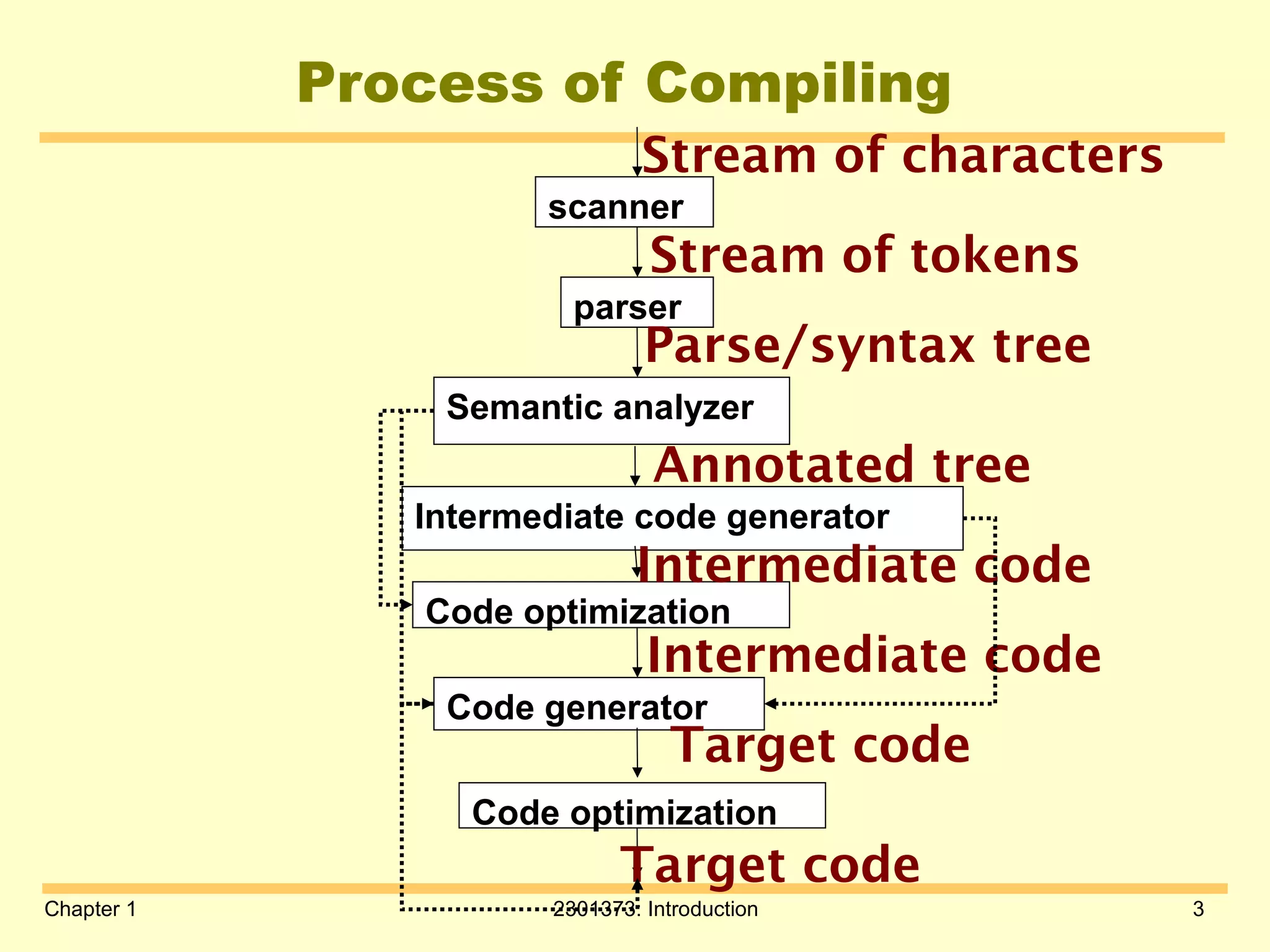
scanner
parser
Semantic analyzer
Intermediate code generator
Code optimization
Code generator
Code optimization
Stream of characters
Stream of tokens
Parse/syntax tree
Annotated tree
Intermediate code
Intermediate code
Target code
Target code
Chapter 1 2301373: Introduction 4
Some Data Structures
• Symbol table
• Literal table
• Parse tree
Chapter 1 2301373: Introduction 5
Symbol Table
• Identifiers are names of variables,
constants, functions, data types, etc.
• Store information associated with identifiers
– Information associated with different types of
identifiers can be different
• Information associated with variables are name, type,
address,size (for array), etc.
• Information associated with functions are name,type
of return value, parameters, address, etc.
Chapter 1 2301373: Introduction 6
Symbol Table (cont’d)
• Accessed in every phase of compilers
– The scanner, parser, and semantic analyzer put
names of identifiers in symbol table.
– The semantic analyzer stores more information
(e.g. data types) in the table.
– The intermediate code generator, code
optimizer and code generator use information in
symbol table to generate appropriate code.
• Mostly use hash table for efficiency.
Chapter 1 2301373: Introduction 7
Literal table
• Store constants and strings used in program
– reduce the memory size by reusing constants
and strings
• Can be combined with symbol table
Chapter 1 2301373: Introduction 8
Parse tree
• Dynamically-allocated, pointer-based
structure
• Information for different data types
related to parse trees need to be stored
somewhere.
– Nodes are variant records, storing
information for different types of data
– Nodes store pointers to information stored
in other data structure, e.g. symbol table
Chapter 1 2301373: Introduction 9
Scanning
• A scanner reads a stream of characters and
puts them together into some meaningful
(with respect to the source language) units
called tokens.
• It produces a stream of tokens for the next
phase of compiler.
Chapter 1 2301373: Introduction 10
Parsing
• A parser gets a stream of tokens from the
scanner, and determines if the syntax
(structure) of the program is correct
according to the (context-free) grammar of
the source language.
• Then, it produces a data structure, called a
parse tree or an abstract syntax tree, which
describes the syntactic structure of the
program.
Chapter 1 2301373: Introduction 11
Semantic analysis
• It gets the parse tree from the parser together with
information about some syntactic elements
• It determines if the semantics or meaning of the
program is correct.
• This part deals with static semantic.
– semantic of programs that can be checked by reading
off from the program only.
– syntax of the language which cannot be described in
context-free grammar.
• Mostly, a semantic analyzer does type checking.
• It modifies the parse tree in order to get that
(static) semantically correct code.
Chapter 1 2301373: Introduction 12
Intermediate code generation
• An intermediate code generator
– takes a parse tree from the semantic analyzer
– generates a program in the intermediate
language.
• In some compilers, a source program is
translated into an intermediate code first
and then the intermediate code is translated
into the target language.
• In other compilers, a source program is
translated directly into the target language.
Chapter 1 2301373: Introduction 13
Intermediate code generation (cont’d)
• Using intermediate code is beneficial when
compilers which translates a single source
language to many target languages are
required.
– The front-end of a compiler – scanner to
intermediate code generator – can be used for
every compilers.
– Different back-ends – code optimizer and code
generator– is required for each target language.
• One of the popular intermediate code is
three-address code. A three-address code
instruction is in the form of x = y op z.
Chapter 1 2301373: Introduction 14
Code optimization
• Replacing an inefficient sequence of
instructions with a better sequence of
instructions.
• Sometimes called code improvement.
• Code optimization can be done:
– after semantic analyzing
• performed on a parse tree
– after intermediate code generation
• performed on a intermediate code
– after code generation
• performed on a target code
Chapter 1 2301373: Introduction 15
Code generation
• A code generator
– takes either an intermediate code or a parse
tree
– produces a target program.
Chapter 1 2301373: Introduction 16
Error Handling
• Error can be found in every phase of
compilation.
– Errors found during compilation are called static
(or compile-time) errors.
– Errors found during execution are called
dynamic (or run-time) errors
• Compilers need to detect, report, and
recover from error found in source programs
• Error handlers are different in different
phases of compiler.
Chapter 1 2301373: Introduction 17
• a compiler which generates target code for
a different machine from one on which the c
ompiler runs.
• A host language is a language in which the
compiler is written.
– T-diagram
• Cross compilers are used very often in
practice.
Cross Compiler
S
H
T
Chapter 1 2301373: Introduction 18
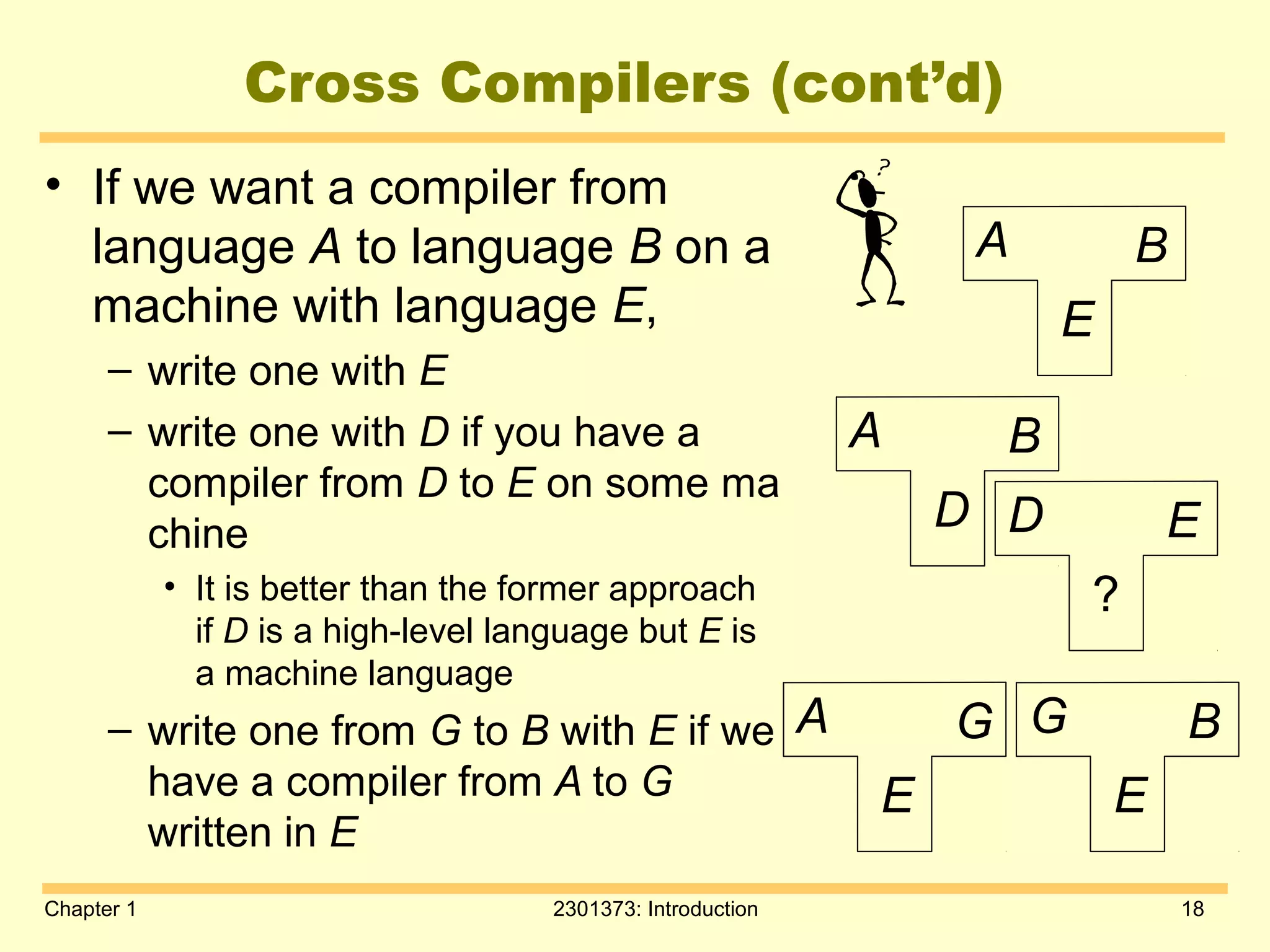
Cross Compilers (cont’d)
• If we want a compiler from
language A to language B on a
machine with language E,
– write one with E
– write one with D if you have a
compiler from D to E on some ma
chine
• It is better than the former approach
if D is a high-level language but E is
a machine language
– write one from G to B with E if we
have a compiler from A to G
written in E
A
E
B
D
?
E
A
D
B
G
E
BA
E
G
Chapter 1 2301373: Introduction 19
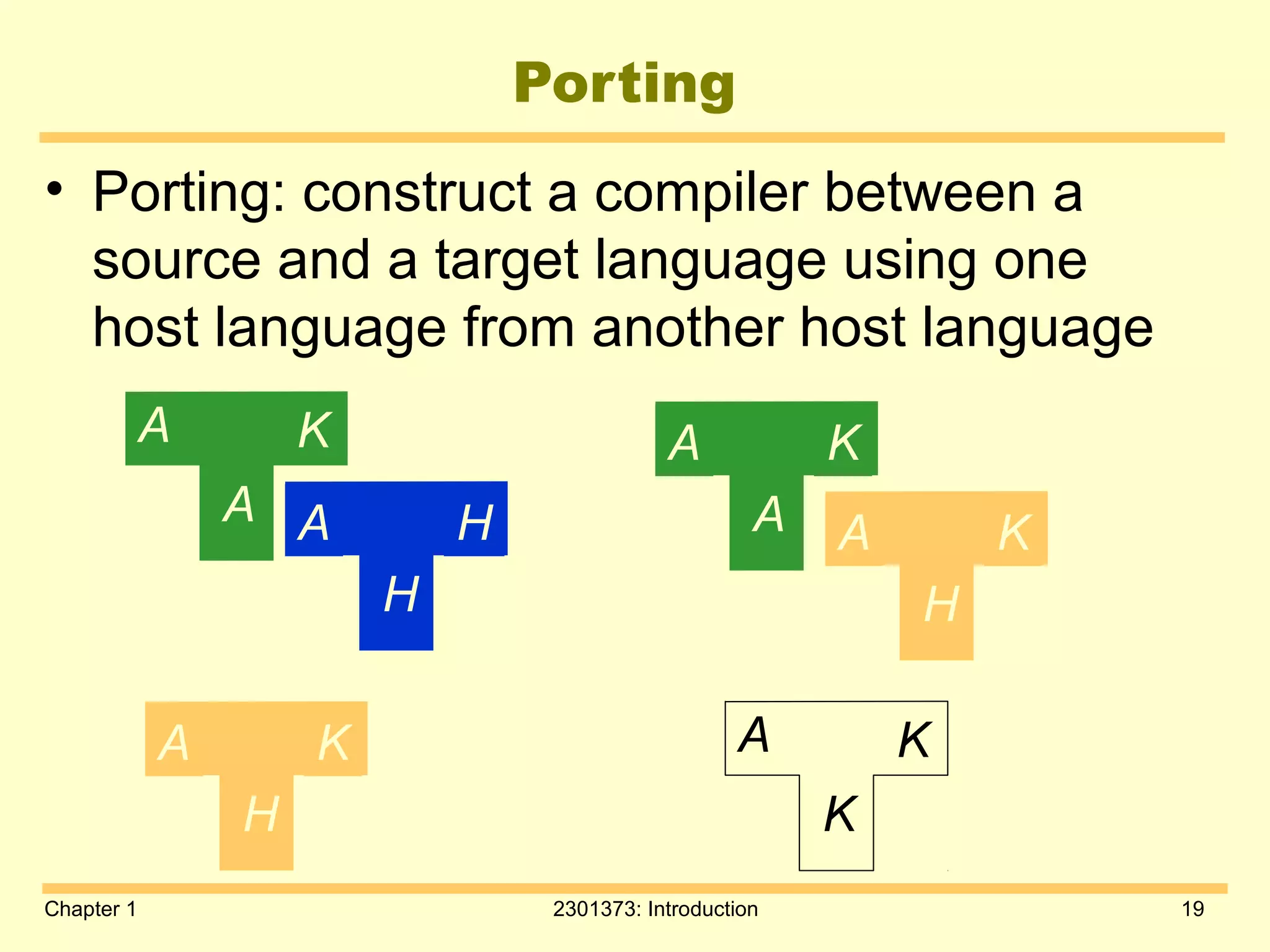
Porting
• Porting: construct a compiler between a
source and a target language using one
host language from another host language
A
A
K
A
H
H A
H
K
A
A
K
A
H
K A
K
K
Chapter 1 2301373: Introduction 20
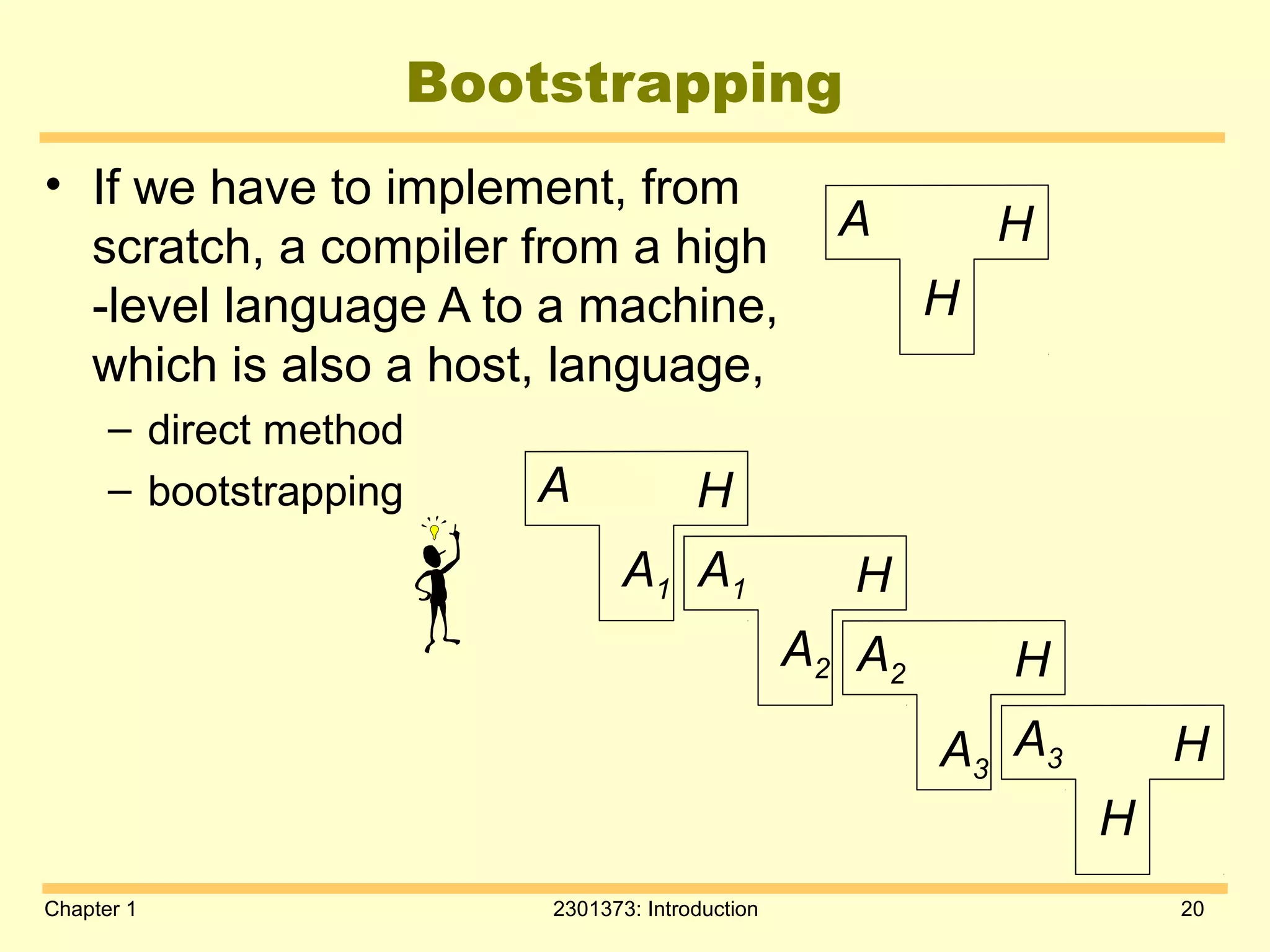
Bootstrapping
• If we have to implement, from
scratch, a compiler from a high
-level language A to a machine,
which is also a host, language,
– direct method
– bootstrapping
A
H
H
A
A1
H
A1
A2
H
A2
A3
H
A3
H
H
Chapter 1 2301373: Introduction 21
Cousins of Compilers
• Linkers
• Loaders
• Interpreters
• Assemblers
Chapter 1 2301373: Introduction 22
History (1930’s -40’s)
• 1930’s
– John von Neumann invented the concept of
stored-program computer.
– Alan Turing defined Turing machine and
computability.
• 1940’s
– Many electro-mechanic, stored-program
computers were constructed.
• ABC (Atanasoff Berry Computer) at Iowa
• Z1-4 (by Zuse) in Germany
• ENIAC (programmed by a plug board)
Chapter 1 2301373: Introduction 23
History : 1950
• Many electronic, stored-program computers were
designed.
– EDVAC (by von Neumann)
– ACE (by Turing)
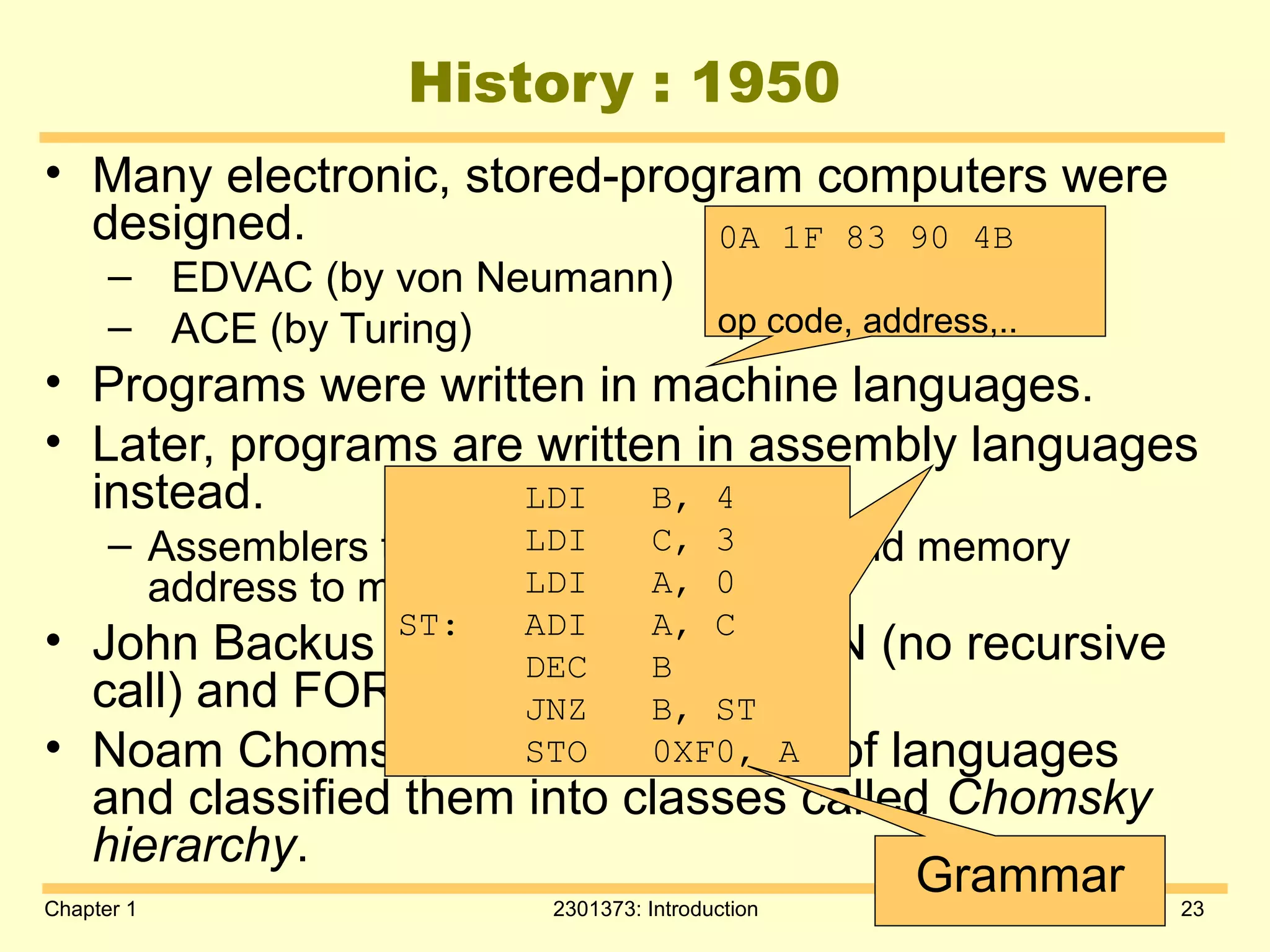
• Programs were written in machine languages.
• Later, programs are written in assembly languages
instead.
– Assemblers translate symbolic code and memory
address to machine code.
• John Backus developed FORTRAN (no recursive
call) and FORTRAN compiler.
• Noam Chomsky studied structure of languages
and classified them into classes called Chomsky
hierarchy.
0A 1F 83 90 4B
op code, address,..
LDI B, 4
LDI C, 3
LDI A, 0
ST: ADI A, C
DEC B
JNZ B, ST
STO 0XF0, A
Grammar
Chapter 1 2301373: Introduction 24
History (1960’s)
• Recursive-descent parsing was introduced.
• Nuar designed Algol60, Pascal’s ancestor,
which allows recursive call.
• Backus-Nuar form (BNF) was used to
described Algol60.
• LL(1) parsing was proposed by Lewis and
Stearns.
• General LR parsing was invented by Knuth.
• SLR parsing was developed by DeRemer.
Chapter 1 2301373: Introduction 25
History (1970’s)
• LALR was develpoed by DeRemer.
• Aho and Ullman founded the theory of LR
parsing techniques.
• Yacc (Yet Another Compiler Compiler) was
developed by Johnson.
• Type inference was studied by Milner.

Introduction to Compiler

  • 1.
    Chapter 1 2301373:Introduction 1 Introduction
  • 2.
    Chapter 1 2301373:Introduction 2 What is a Compiler? • A compiler is a computer program that translates a program in a source language into an equivalent program in a target language. • A source program/code is a program/code written in the source language, which is usually a high-level language. • A target program/code is a program/code written in the target language, which often is a machine language or an intermediate code. compiler Source program Target program Error message
  • 3.
    Chapter 1 2301373:Introduction 3 Process of Compiling scanner parser Semantic analyzer Intermediate code generator Code optimization Code generator Code optimization Stream of characters Stream of tokens Parse/syntax tree Annotated tree Intermediate code Intermediate code Target code Target code
  • 4.
    Chapter 1 2301373:Introduction 4 Some Data Structures • Symbol table • Literal table • Parse tree
  • 5.
    Chapter 1 2301373:Introduction 5 Symbol Table • Identifiers are names of variables, constants, functions, data types, etc. • Store information associated with identifiers – Information associated with different types of identifiers can be different • Information associated with variables are name, type, address,size (for array), etc. • Information associated with functions are name,type of return value, parameters, address, etc.
  • 6.
    Chapter 1 2301373:Introduction 6 Symbol Table (cont’d) • Accessed in every phase of compilers – The scanner, parser, and semantic analyzer put names of identifiers in symbol table. – The semantic analyzer stores more information (e.g. data types) in the table. – The intermediate code generator, code optimizer and code generator use information in symbol table to generate appropriate code. • Mostly use hash table for efficiency.
  • 7.
    Chapter 1 2301373:Introduction 7 Literal table • Store constants and strings used in program – reduce the memory size by reusing constants and strings • Can be combined with symbol table
  • 8.
    Chapter 1 2301373:Introduction 8 Parse tree • Dynamically-allocated, pointer-based structure • Information for different data types related to parse trees need to be stored somewhere. – Nodes are variant records, storing information for different types of data – Nodes store pointers to information stored in other data structure, e.g. symbol table
  • 9.
    Chapter 1 2301373:Introduction 9 Scanning • A scanner reads a stream of characters and puts them together into some meaningful (with respect to the source language) units called tokens. • It produces a stream of tokens for the next phase of compiler.
  • 10.
    Chapter 1 2301373:Introduction 10 Parsing • A parser gets a stream of tokens from the scanner, and determines if the syntax (structure) of the program is correct according to the (context-free) grammar of the source language. • Then, it produces a data structure, called a parse tree or an abstract syntax tree, which describes the syntactic structure of the program.
  • 11.
    Chapter 1 2301373:Introduction 11 Semantic analysis • It gets the parse tree from the parser together with information about some syntactic elements • It determines if the semantics or meaning of the program is correct. • This part deals with static semantic. – semantic of programs that can be checked by reading off from the program only. – syntax of the language which cannot be described in context-free grammar. • Mostly, a semantic analyzer does type checking. • It modifies the parse tree in order to get that (static) semantically correct code.
  • 12.
    Chapter 1 2301373:Introduction 12 Intermediate code generation • An intermediate code generator – takes a parse tree from the semantic analyzer – generates a program in the intermediate language. • In some compilers, a source program is translated into an intermediate code first and then the intermediate code is translated into the target language. • In other compilers, a source program is translated directly into the target language.
  • 13.
    Chapter 1 2301373:Introduction 13 Intermediate code generation (cont’d) • Using intermediate code is beneficial when compilers which translates a single source language to many target languages are required. – The front-end of a compiler – scanner to intermediate code generator – can be used for every compilers. – Different back-ends – code optimizer and code generator– is required for each target language. • One of the popular intermediate code is three-address code. A three-address code instruction is in the form of x = y op z.
  • 14.
    Chapter 1 2301373:Introduction 14 Code optimization • Replacing an inefficient sequence of instructions with a better sequence of instructions. • Sometimes called code improvement. • Code optimization can be done: – after semantic analyzing • performed on a parse tree – after intermediate code generation • performed on a intermediate code – after code generation • performed on a target code
  • 15.
    Chapter 1 2301373:Introduction 15 Code generation • A code generator – takes either an intermediate code or a parse tree – produces a target program.
  • 16.
    Chapter 1 2301373:Introduction 16 Error Handling • Error can be found in every phase of compilation. – Errors found during compilation are called static (or compile-time) errors. – Errors found during execution are called dynamic (or run-time) errors • Compilers need to detect, report, and recover from error found in source programs • Error handlers are different in different phases of compiler.
  • 17.
    Chapter 1 2301373:Introduction 17 • a compiler which generates target code for a different machine from one on which the c ompiler runs. • A host language is a language in which the compiler is written. – T-diagram • Cross compilers are used very often in practice. Cross Compiler S H T
  • 18.
    Chapter 1 2301373:Introduction 18 Cross Compilers (cont’d) • If we want a compiler from language A to language B on a machine with language E, – write one with E – write one with D if you have a compiler from D to E on some ma chine • It is better than the former approach if D is a high-level language but E is a machine language – write one from G to B with E if we have a compiler from A to G written in E A E B D ? E A D B G E BA E G
  • 19.
    Chapter 1 2301373:Introduction 19 Porting • Porting: construct a compiler between a source and a target language using one host language from another host language A A K A H H A H K A A K A H K A K K
  • 20.
    Chapter 1 2301373:Introduction 20 Bootstrapping • If we have to implement, from scratch, a compiler from a high -level language A to a machine, which is also a host, language, – direct method – bootstrapping A H H A A1 H A1 A2 H A2 A3 H A3 H H
  • 21.
    Chapter 1 2301373:Introduction 21 Cousins of Compilers • Linkers • Loaders • Interpreters • Assemblers
  • 22.
    Chapter 1 2301373:Introduction 22 History (1930’s -40’s) • 1930’s – John von Neumann invented the concept of stored-program computer. – Alan Turing defined Turing machine and computability. • 1940’s – Many electro-mechanic, stored-program computers were constructed. • ABC (Atanasoff Berry Computer) at Iowa • Z1-4 (by Zuse) in Germany • ENIAC (programmed by a plug board)
  • 23.
    Chapter 1 2301373:Introduction 23 History : 1950 • Many electronic, stored-program computers were designed. – EDVAC (by von Neumann) – ACE (by Turing) • Programs were written in machine languages. • Later, programs are written in assembly languages instead. – Assemblers translate symbolic code and memory address to machine code. • John Backus developed FORTRAN (no recursive call) and FORTRAN compiler. • Noam Chomsky studied structure of languages and classified them into classes called Chomsky hierarchy. 0A 1F 83 90 4B op code, address,.. LDI B, 4 LDI C, 3 LDI A, 0 ST: ADI A, C DEC B JNZ B, ST STO 0XF0, A Grammar
  • 24.
    Chapter 1 2301373:Introduction 24 History (1960’s) • Recursive-descent parsing was introduced. • Nuar designed Algol60, Pascal’s ancestor, which allows recursive call. • Backus-Nuar form (BNF) was used to described Algol60. • LL(1) parsing was proposed by Lewis and Stearns. • General LR parsing was invented by Knuth. • SLR parsing was developed by DeRemer.
  • 25.
    Chapter 1 2301373:Introduction 25 History (1970’s) • LALR was develpoed by DeRemer. • Aho and Ullman founded the theory of LR parsing techniques. • Yacc (Yet Another Compiler Compiler) was developed by Johnson. • Type inference was studied by Milner.