System Software (5KS03)
Unit 1 : Introduction to Compiling
Lecture : 1 Introduction to Compiling:
Phases of a compiler,
A S Kapse,
Assistant Professor,
Department Of Computer Sci. & Engineering
Anuradha Engineering College, Chikhli
Contents…
 Introduction to Compilers
Objectives…
 Upon completion of this lecture, you will be able
 To understand the basics Compiler
 To understand analysis and synthesis.
 To understand use and purpose of compiler
Review…./ Concepts
 What do you mean by Software?
 What do you mean by Operating System?
 What do you mean by system?
 What do you mean by compiler?
Introduction to Compilers
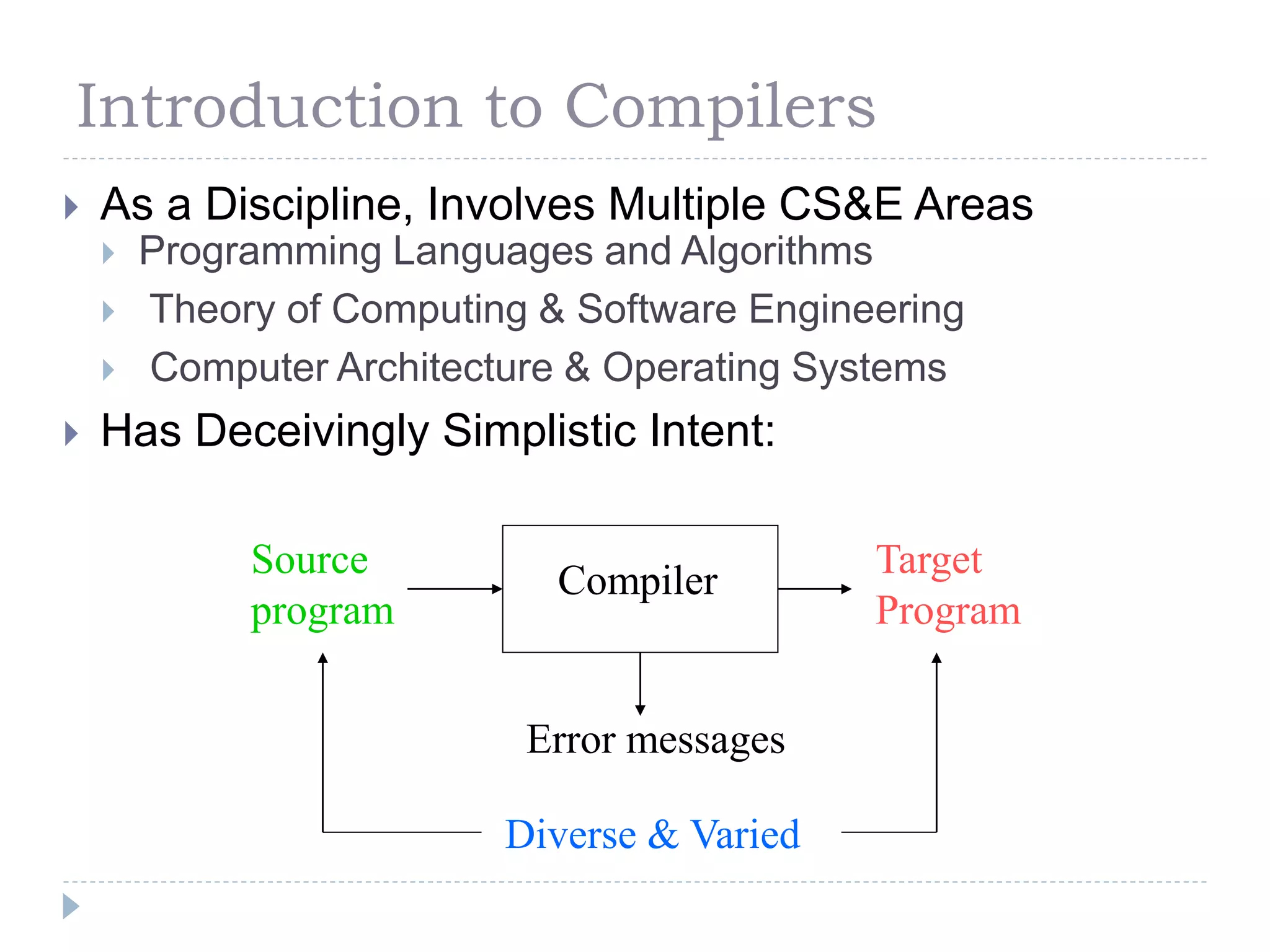
 As a Discipline, Involves Multiple CS&E Areas
 Programming Languages and Algorithms
 Theory of Computing & Software Engineering
 Computer Architecture & Operating Systems
 Has Deceivingly Simplistic Intent:
Compiler
Source
program
Target
Program
Error messages
Diverse & Varied
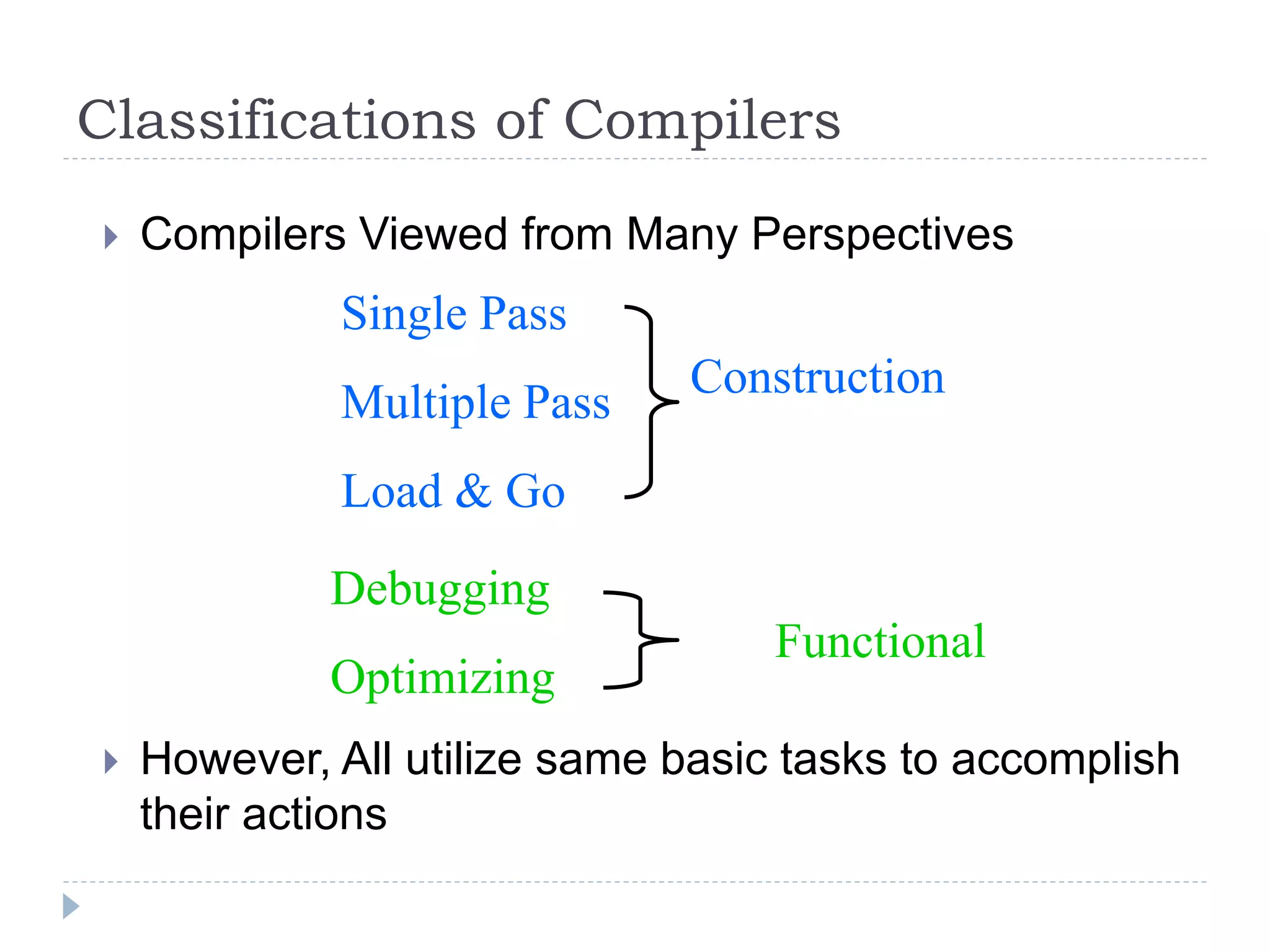
Classifications of Compilers
 Compilers Viewed from Many Perspectives
 However, All utilize same basic tasks to accomplish
their actions
Single Pass
Multiple Pass
Load & Go
Construction
Debugging
Optimizing
Functional
The Model
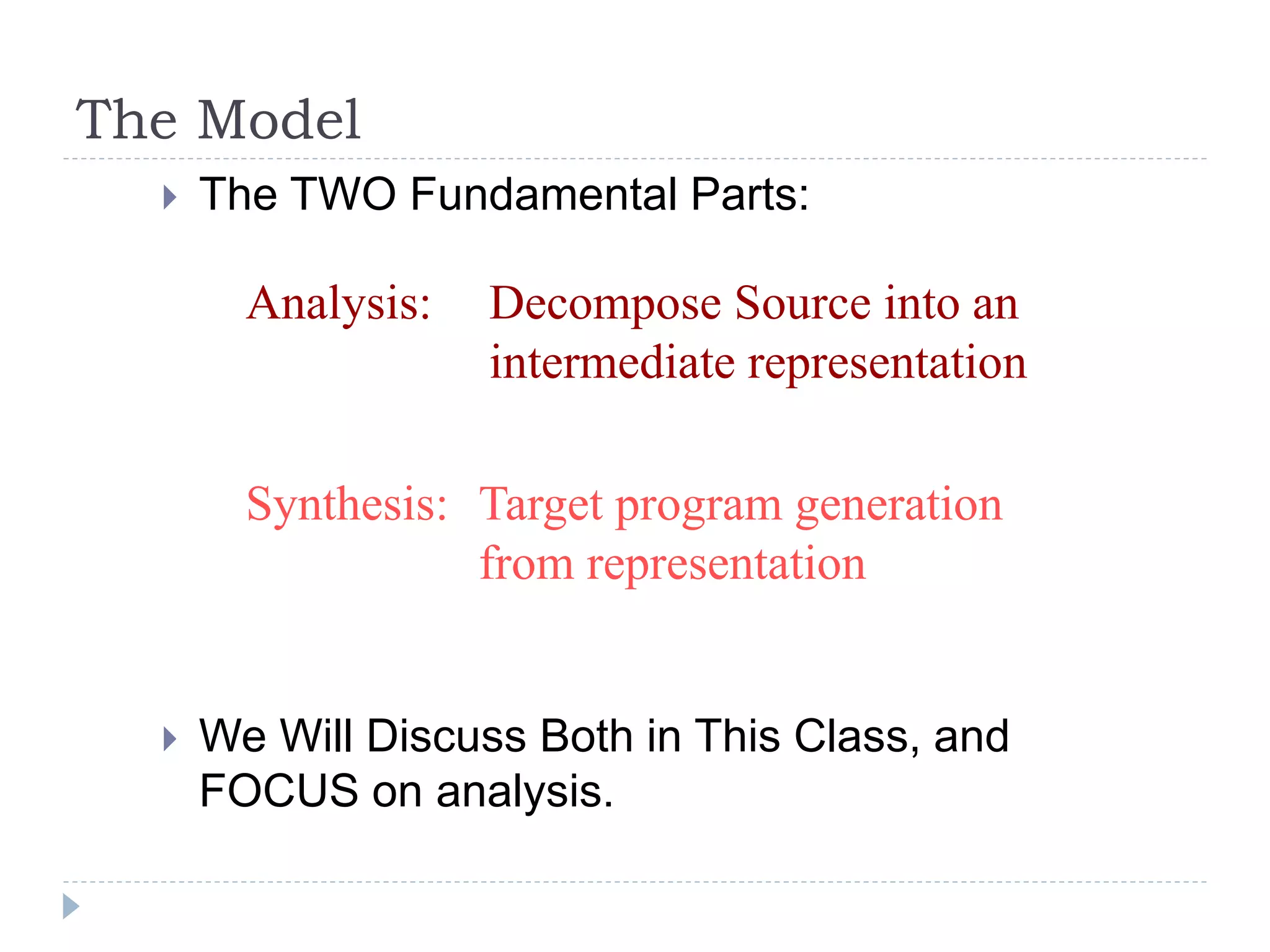
 The TWO Fundamental Parts:
 We Will Discuss Both in This Class, and
FOCUS on analysis.
Analysis:
Synthesis:
Decompose Source into an
intermediate representation
Target program generation
from representation
Important Notes
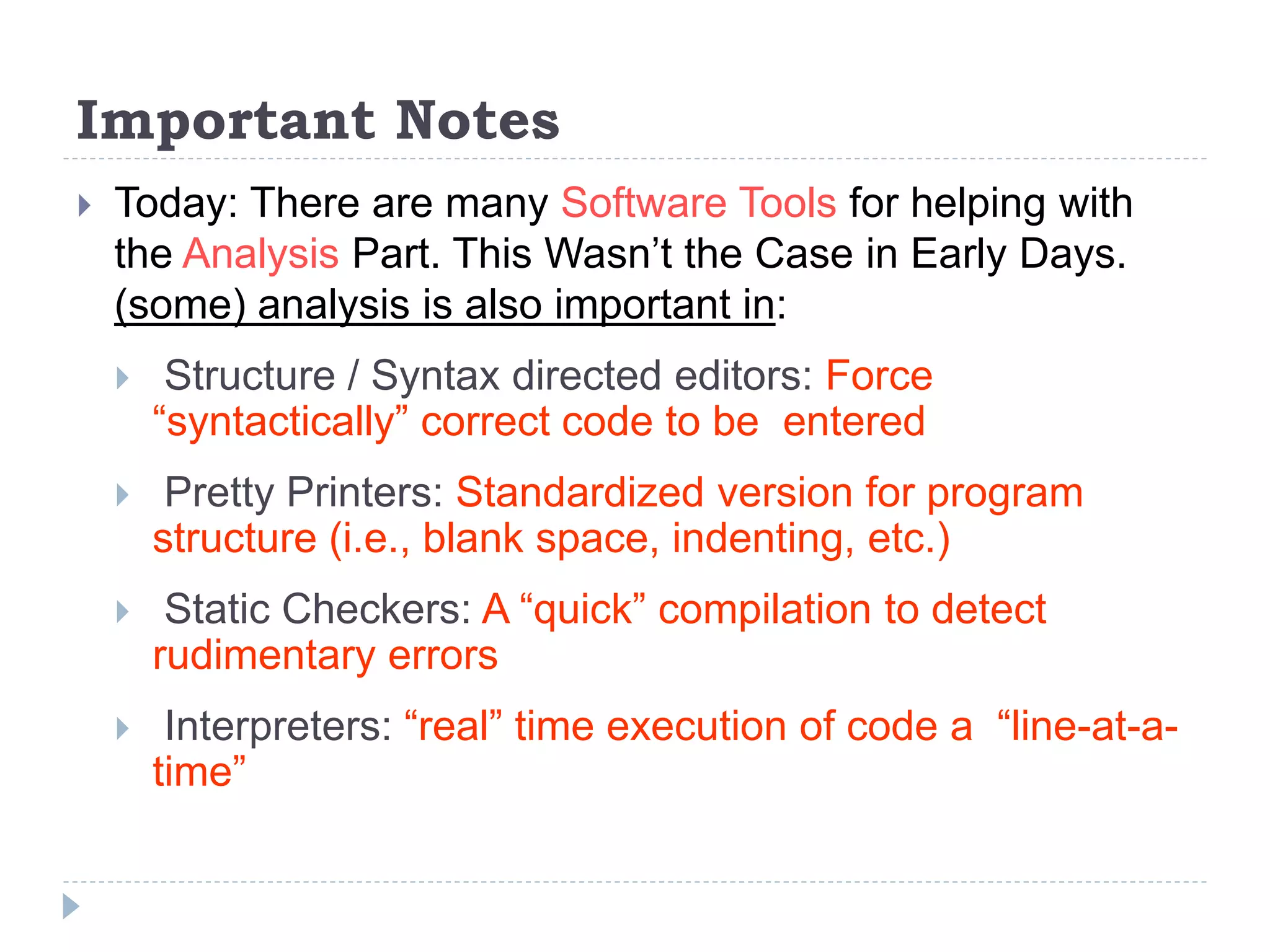
 Today: There are many Software Tools for helping with
the Analysis Part. This Wasn’t the Case in Early Days.
(some) analysis is also important in:
 Structure / Syntax directed editors: Force
“syntactically” correct code to be entered
 Pretty Printers: Standardized version for program
structure (i.e., blank space, indenting, etc.)
 Static Checkers: A “quick” compilation to detect
rudimentary errors
 Interpreters: “real” time execution of code a “line-at-a-
time”
Important Notes
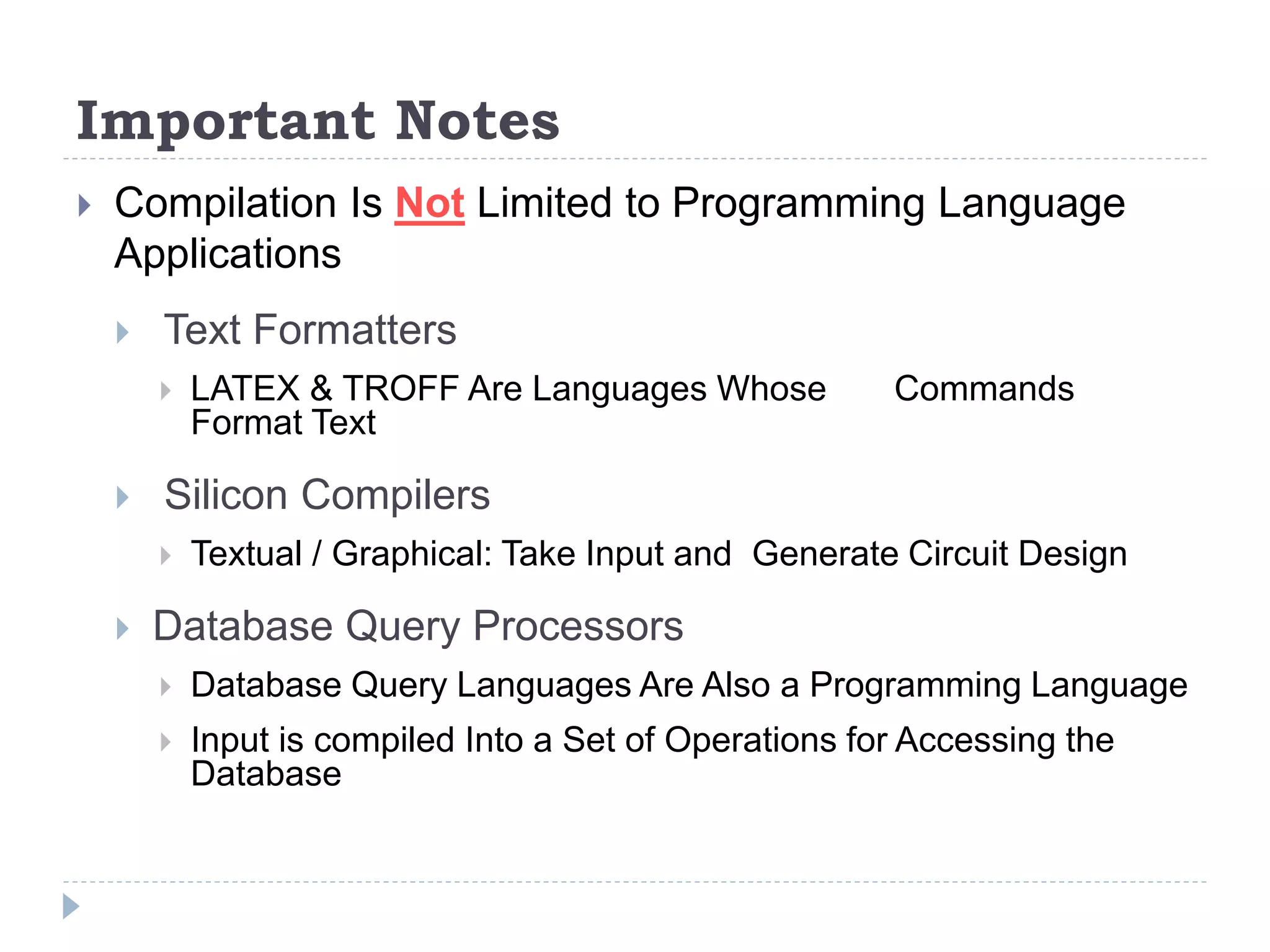
 Compilation Is Not Limited to Programming Language
Applications
 Text Formatters
 LATEX & TROFF Are Languages Whose Commands
Format Text
 Silicon Compilers
 Textual / Graphical: Take Input and Generate Circuit Design
 Database Query Processors
 Database Query Languages Are Also a Programming Language
 Input is compiled Into a Set of Operations for Accessing the
Database
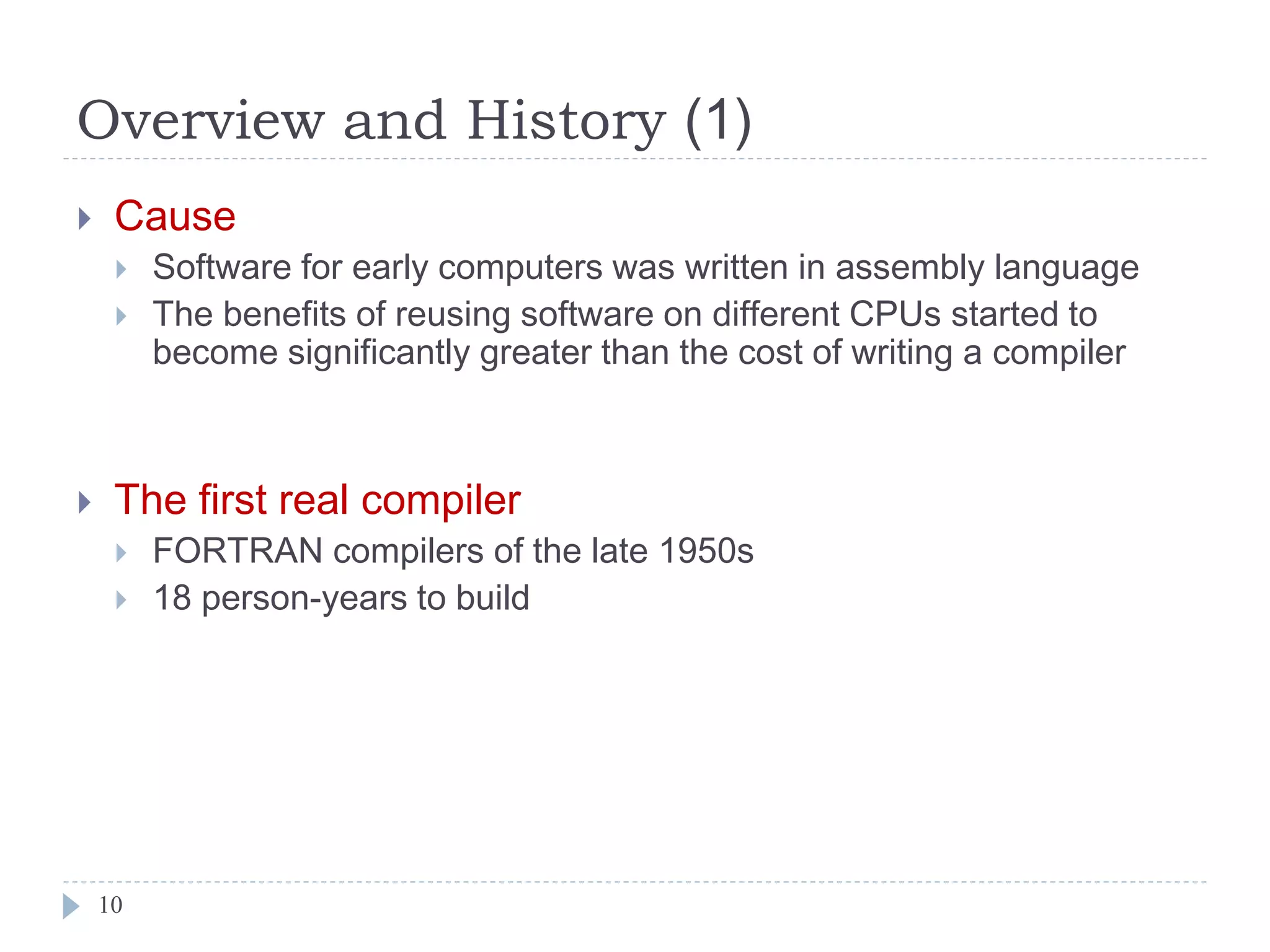
Overview and History (1)
 Cause
 Software for early computers was written in assembly language
 The benefits of reusing software on different CPUs started to
become significantly greater than the cost of writing a compiler
 The first real compiler
 FORTRAN compilers of the late 1950s
 18 person-years to build
10
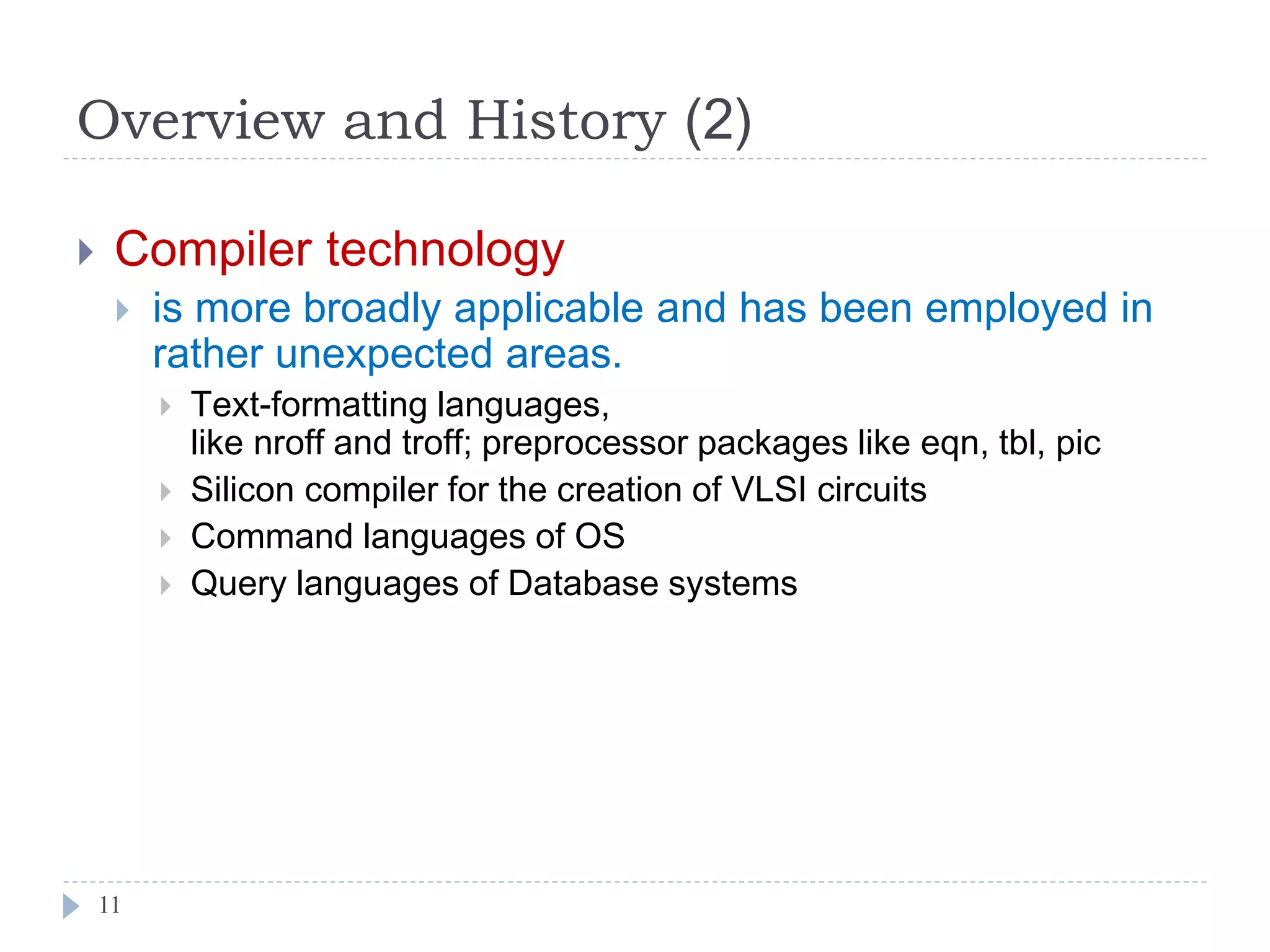
Overview and History (2)
11
 Compiler technology
 is more broadly applicable and has been employed in
rather unexpected areas.
 Text-formatting languages,
like nroff and troff; preprocessor packages like eqn, tbl, pic
 Silicon compiler for the creation of VLSI circuits
 Command languages of OS
 Query languages of Database systems
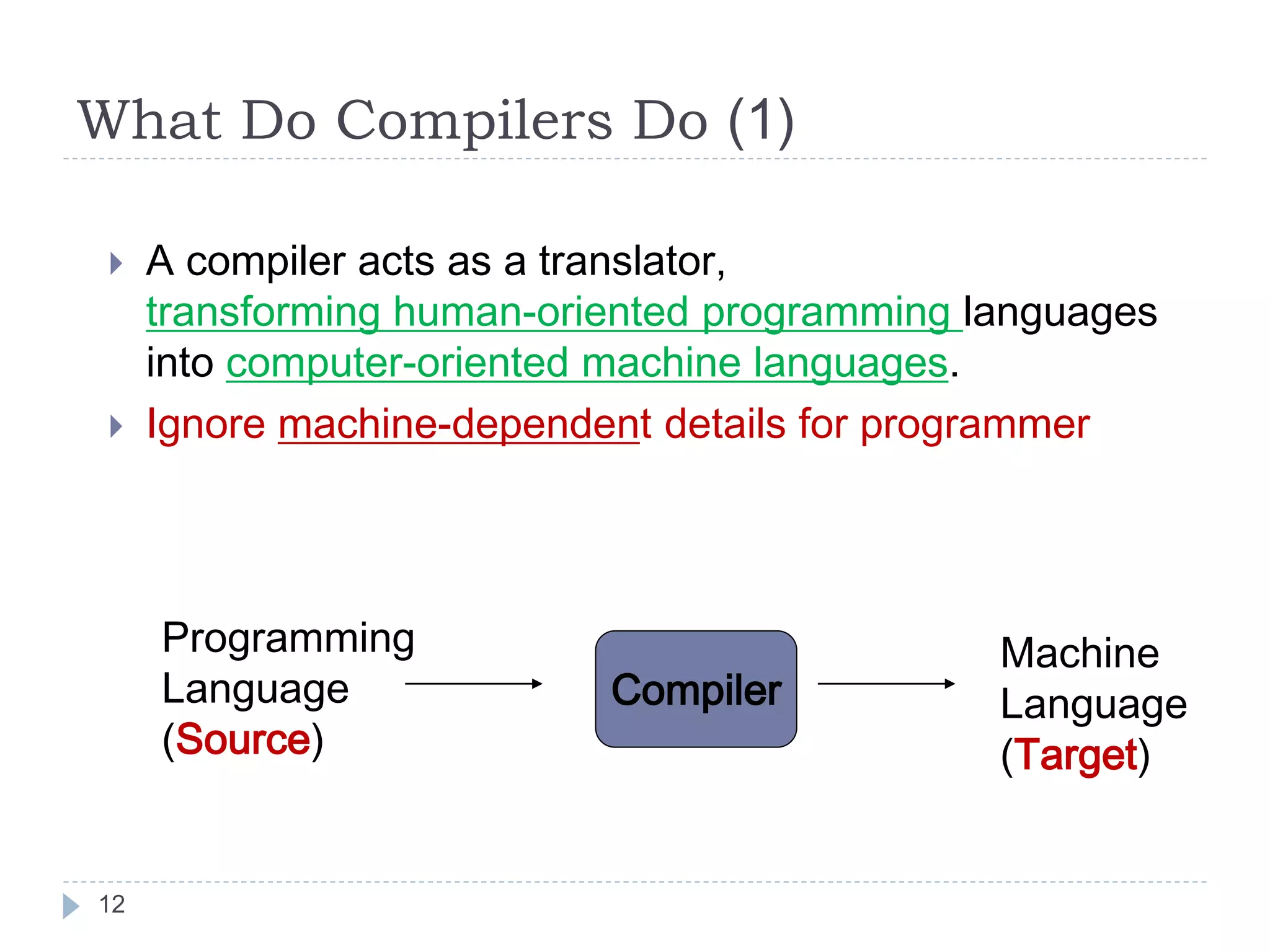
What Do Compilers Do (1)
12
 A compiler acts as a translator,
transforming human-oriented programming languages
into computer-oriented machine languages.
 Ignore machine-dependent details for programmer
Programming
Language
(Source)
Compiler
Machine
Language
(Target)
What Do Compilers Do (2)
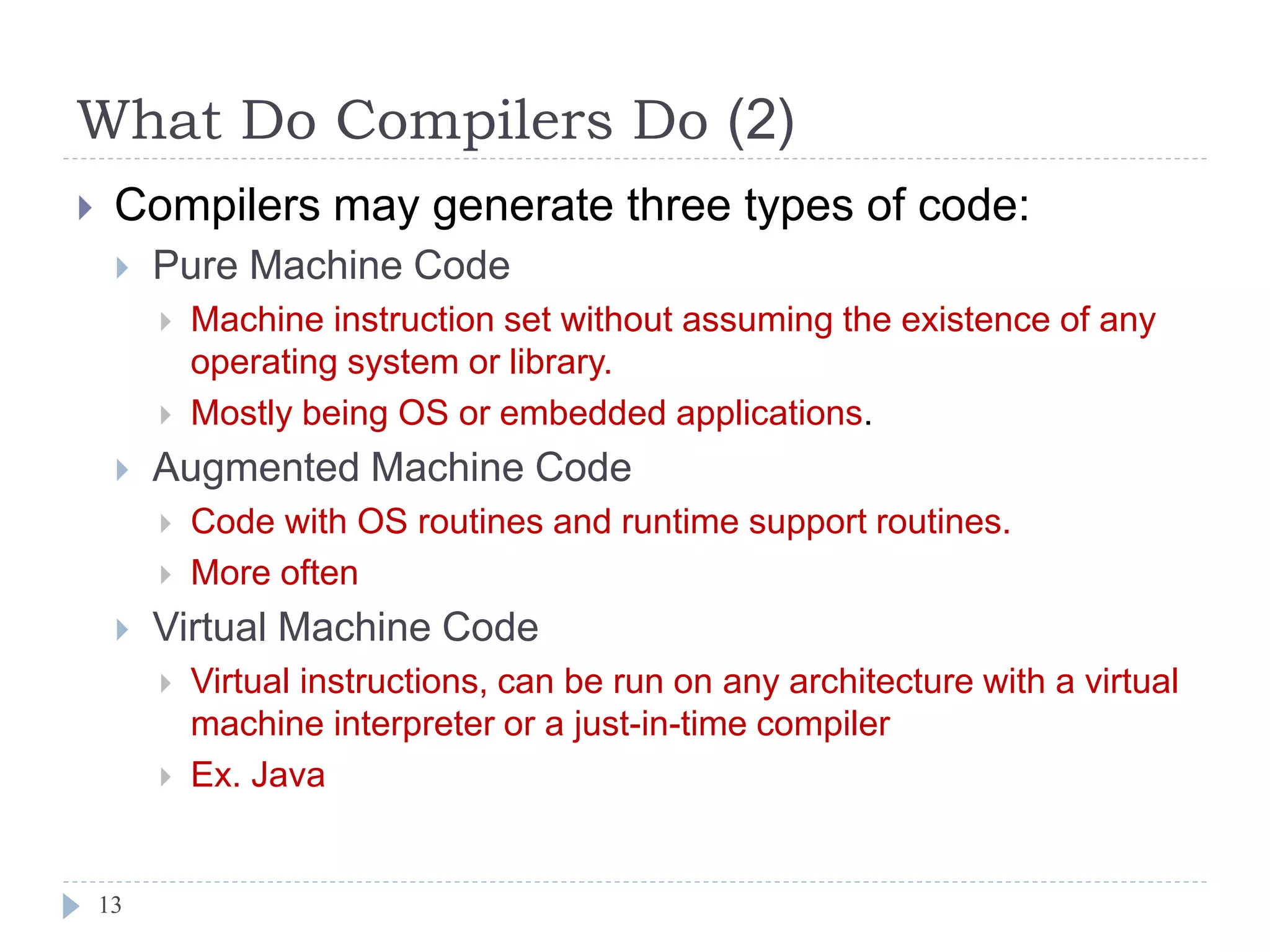
 Compilers may generate three types of code:
 Pure Machine Code
 Machine instruction set without assuming the existence of any
operating system or library.
 Mostly being OS or embedded applications.
 Augmented Machine Code
 Code with OS routines and runtime support routines.
 More often
 Virtual Machine Code
 Virtual instructions, can be run on any architecture with a virtual
machine interpreter or a just-in-time compiler
 Ex. Java
13
What Do Compilers Do (3)
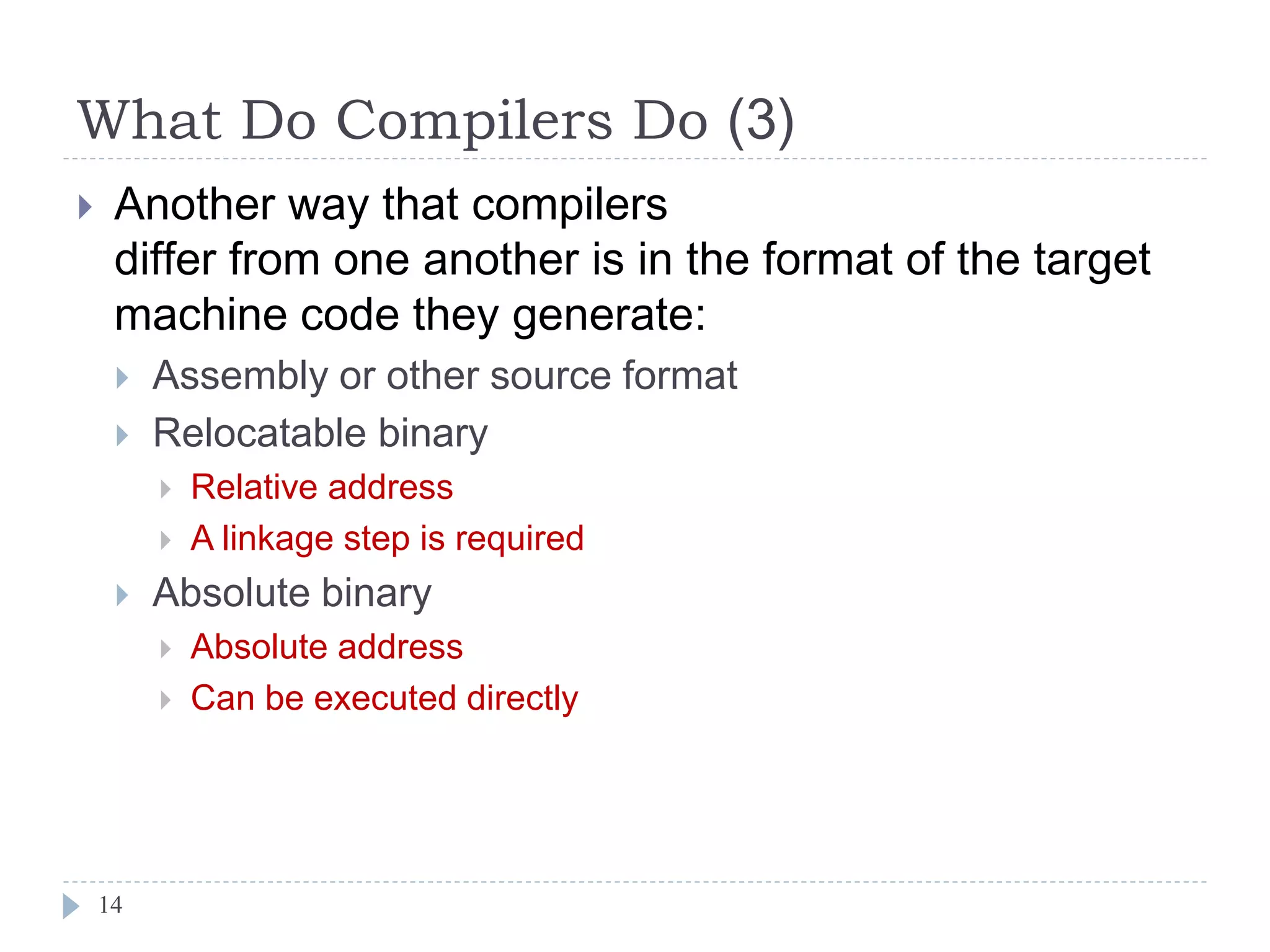
 Another way that compilers
differ from one another is in the format of the target
machine code they generate:
 Assembly or other source format
 Relocatable binary
 Relative address
 A linkage step is required
 Absolute binary
 Absolute address
 Can be executed directly
14
15
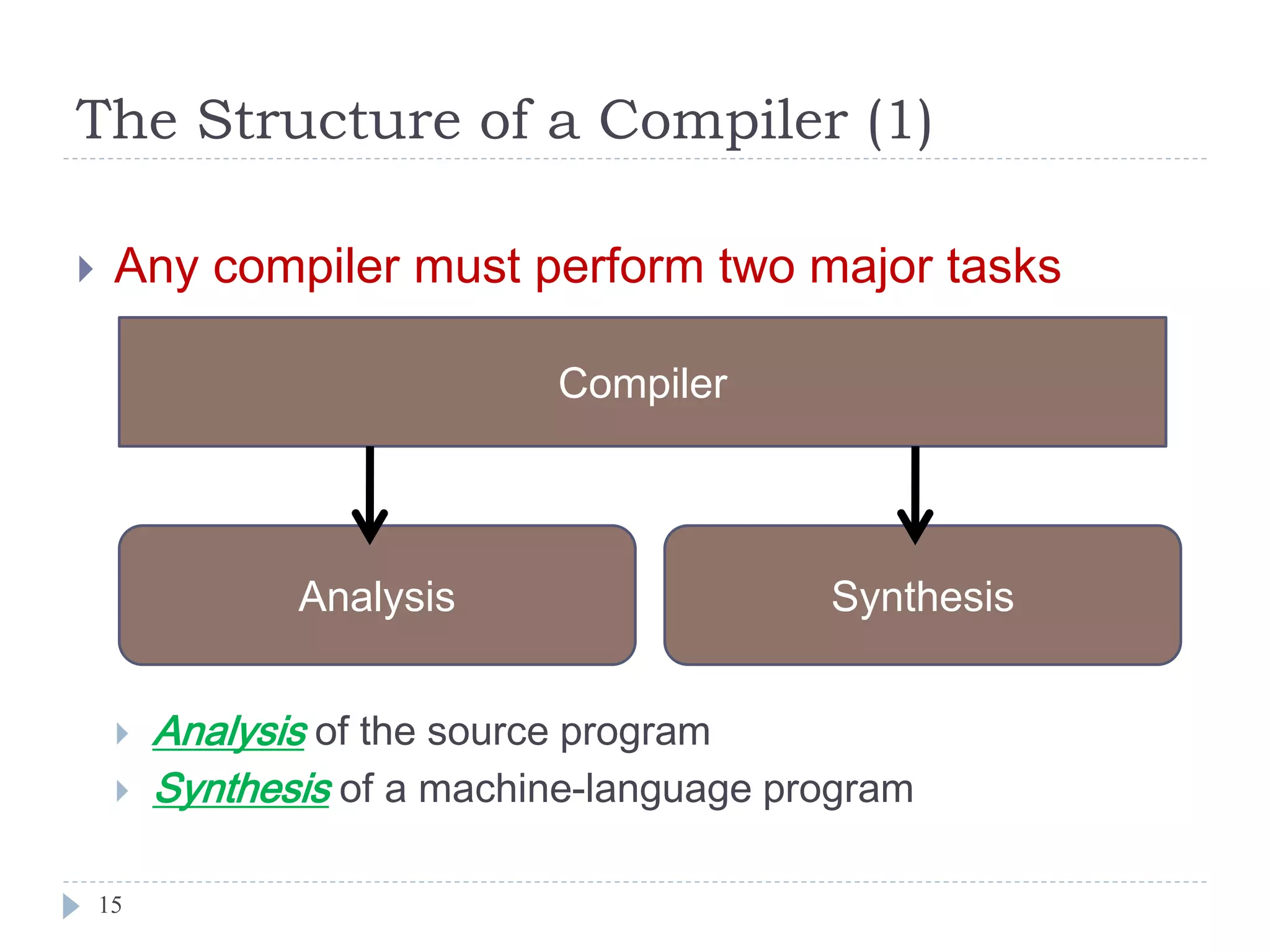
 Any compiler must perform two major tasks
 Analysis of the source program
 Synthesis of a machine-language program
The Structure of a Compiler (1)
Compiler
Analysis Synthesis
Video
1. Introduction to Compiler.
Questions..
1. Define Compiler?
Homework..
1. What is Analysis and synthesis?

SS UI Lecture 1

  • 1.
    System Software (5KS03) Unit1 : Introduction to Compiling Lecture : 1 Introduction to Compiling: Phases of a compiler, A S Kapse, Assistant Professor, Department Of Computer Sci. & Engineering Anuradha Engineering College, Chikhli
  • 2.
  • 3.
    Objectives…  Upon completionof this lecture, you will be able  To understand the basics Compiler  To understand analysis and synthesis.  To understand use and purpose of compiler
  • 4.
    Review…./ Concepts  Whatdo you mean by Software?  What do you mean by Operating System?  What do you mean by system?  What do you mean by compiler?
  • 5.
    Introduction to Compilers As a Discipline, Involves Multiple CS&E Areas  Programming Languages and Algorithms  Theory of Computing & Software Engineering  Computer Architecture & Operating Systems  Has Deceivingly Simplistic Intent: Compiler Source program Target Program Error messages Diverse & Varied
  • 6.
    Classifications of Compilers Compilers Viewed from Many Perspectives  However, All utilize same basic tasks to accomplish their actions Single Pass Multiple Pass Load & Go Construction Debugging Optimizing Functional
  • 7.
    The Model  TheTWO Fundamental Parts:  We Will Discuss Both in This Class, and FOCUS on analysis. Analysis: Synthesis: Decompose Source into an intermediate representation Target program generation from representation
  • 8.
    Important Notes  Today:There are many Software Tools for helping with the Analysis Part. This Wasn’t the Case in Early Days. (some) analysis is also important in:  Structure / Syntax directed editors: Force “syntactically” correct code to be entered  Pretty Printers: Standardized version for program structure (i.e., blank space, indenting, etc.)  Static Checkers: A “quick” compilation to detect rudimentary errors  Interpreters: “real” time execution of code a “line-at-a- time”
  • 9.
    Important Notes  CompilationIs Not Limited to Programming Language Applications  Text Formatters  LATEX & TROFF Are Languages Whose Commands Format Text  Silicon Compilers  Textual / Graphical: Take Input and Generate Circuit Design  Database Query Processors  Database Query Languages Are Also a Programming Language  Input is compiled Into a Set of Operations for Accessing the Database
  • 10.
    Overview and History(1)  Cause  Software for early computers was written in assembly language  The benefits of reusing software on different CPUs started to become significantly greater than the cost of writing a compiler  The first real compiler  FORTRAN compilers of the late 1950s  18 person-years to build 10
  • 11.
    Overview and History(2) 11  Compiler technology  is more broadly applicable and has been employed in rather unexpected areas.  Text-formatting languages, like nroff and troff; preprocessor packages like eqn, tbl, pic  Silicon compiler for the creation of VLSI circuits  Command languages of OS  Query languages of Database systems
  • 12.
    What Do CompilersDo (1) 12  A compiler acts as a translator, transforming human-oriented programming languages into computer-oriented machine languages.  Ignore machine-dependent details for programmer Programming Language (Source) Compiler Machine Language (Target)
  • 13.
    What Do CompilersDo (2)  Compilers may generate three types of code:  Pure Machine Code  Machine instruction set without assuming the existence of any operating system or library.  Mostly being OS or embedded applications.  Augmented Machine Code  Code with OS routines and runtime support routines.  More often  Virtual Machine Code  Virtual instructions, can be run on any architecture with a virtual machine interpreter or a just-in-time compiler  Ex. Java 13
  • 14.
    What Do CompilersDo (3)  Another way that compilers differ from one another is in the format of the target machine code they generate:  Assembly or other source format  Relocatable binary  Relative address  A linkage step is required  Absolute binary  Absolute address  Can be executed directly 14
  • 15.
    15  Any compilermust perform two major tasks  Analysis of the source program  Synthesis of a machine-language program The Structure of a Compiler (1) Compiler Analysis Synthesis
  • 16.
  • 17.
  • 18.
    Homework.. 1. What isAnalysis and synthesis?