1
Chapter 12
Instruction Sets: Characteristics and Functions
2
Learning Objectives
After studying this chapter, you should be able to
 Present an overview of essential characteristics of machine
instructions.
 Describe the types of operands used in typical machine
instruction sets.
 Describe the types of operands supported by typical machine
instruction sets.
3
1. Machine Instruction Characteristics
Elements of a Machine Instruction
 The operation of the processor is determined
by the instructions it executes, referred to as
machine instructions or computer
instructions.
 The collection of different instructions that
the processor can execute is referred to as
the processor’s instruction set.
 Each instruction must contain the information
required by the processor for execution.
4
 What are the typical elements of a machine instruction?
These elements are as follows;
Operation code , Source operand reference, Result operand reference
and Next instruction reference
■ Operation code: Specifies the operation to be performed (e.g.,
ADD, I/O). The operation is specified by a binary code, known as
the operation code, or opcode.
■ Source operand reference: The operation may involve one or
more source operands, that is, operands that are inputs for the
operation.
5
■ Result operand reference: The operation may produce a result.
■ Next instruction reference: This tells the processor where to
fetch the next instruction after the execution of this instruction is
complete.
Source and result operands can be in one of four areas:
■ Main or virtual memory:
As with next instruction references,
the main or virtual memory address
must be supplied
■ Processor register:
A processor contains one or more
registers that may be referenced by
machine instructions.
■ Immediate:
The value of the operand is contained
in a field in the instruction being
executed
■ I/O device:
The instruction must specify the I/O
module and device for the operation.
 What types of locations can hold source
and destination operands?
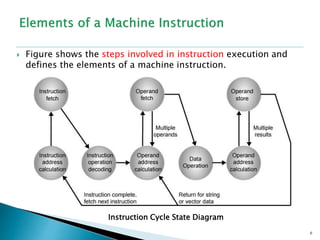
 Figure shows the steps involved in instruction execution and
defines the elements of a machine instruction.
Instruction Cycle State Diagram
6
7
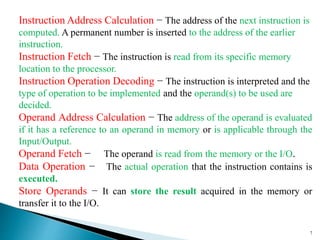
Instruction Address Calculation − The address of the next instruction is
computed. A permanent number is inserted to the address of the earlier
instruction.
Instruction Fetch − The instruction is read from its specific memory
location to the processor.
Instruction Operation Decoding − The instruction is interpreted and the
type of operation to be implemented and the operand(s) to be used are
decided.
Operand Address Calculation − The address of the operand is evaluated
if it has a reference to an operand in memory or is applicable through the
Input/Output.
Operand Fetch − The operand is read from the memory or the I/O.
Data Operation − The actual operation that the instruction contains is
executed.
Store Operands − It can store the result acquired in the memory or
transfer it to the I/O.
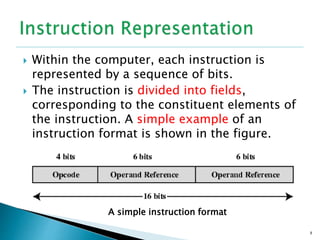
 Within the computer, each instruction is
represented by a sequence of bits.
 The instruction is divided into fields,
corresponding to the constituent elements of
the instruction. A simple example of an
instruction format is shown in the figure.
8
A simple instruction format
 In machine code each instruction has a
unique bit pattern.
 For human consumption (programmers) a
symbolic representation of machine
instructions is used.
9
 Opcodes are represented by abbreviations,
called mnemonics, that indicate the
operation.
 Common examples include:
◦ ADD - Add
◦ SUB - Subtract
◦ MUL - Multiply
◦ DIV - Divide
◦ LOAD - Load data from memory
◦ STOR - Store data to memory
10
 Operands are also represented symbolically.
 For example, the instruction ADD R,Y
 (R R + Y ) may mean add the value
contained in data location Y to the contents
of register R.
 In this example, Y refers to the address of a
location in memory, and R refers to a
particular register.
 Note that the operation is performed on the
contents of a location, not on its address.
11
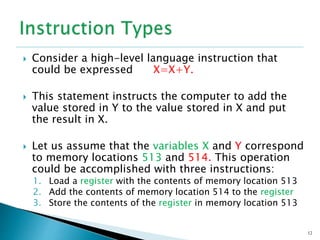
 Consider a high-level language instruction that
could be expressed X=X+Y.
 This statement instructs the computer to add the
value stored in Y to the value stored in X and put
the result in X.
 Let us assume that the variables X and Y correspond
to memory locations 513 and 514. This operation
could be accomplished with three instructions:
1. Load a register with the contents of memory location 513
2. Add the contents of memory location 514 to the register
3. Store the contents of the register in memory location 513
12
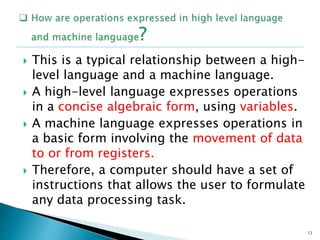
 This is a typical relationship between a high-
level language and a machine language.
 A high-level language expresses operations
in a concise algebraic form, using variables.
 A machine language expresses operations in
a basic form involving the movement of data
to or from registers.
 Therefore, a computer should have a set of
instructions that allows the user to formulate
any data processing task.
13
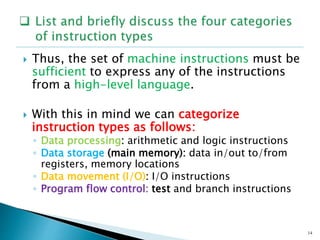
 Thus, the set of machine instructions must be
sufficient to express any of the instructions
from a high-level language.
 With this in mind we can categorize
instruction types as follows:
◦ Data processing: arithmetic and logic instructions
◦ Data storage (main memory): data in/out to/from
registers, memory locations
◦ Data movement (I/O): I/O instructions
◦ Program flow control: test and branch instructions
14
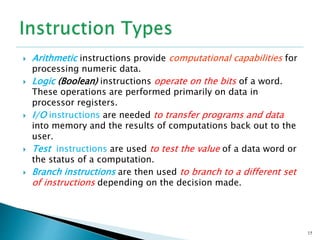
 Arithmetic instructions provide computational capabilities for
processing numeric data.
 Logic (Boolean) instructions operate on the bits of a word.
These operations are performed primarily on data in
processor registers.
 I/O instructions are needed to transfer programs and data
into memory and the results of computations back out to the
user.
 Test instructions are used to test the value of a data word or
the status of a computation.
 Branch instructions are then used to branch to a different set
of instructions depending on the decision made.
15
 One of the traditional ways of describing
processor architecture is in terms of the
number of addresses contained in each
instruction.
 What is the maximum number of addresses
one might need in an instruction?
 All arithmetic and logic operations are either
unary (one source operand) or binary (two
source operands).
16
17
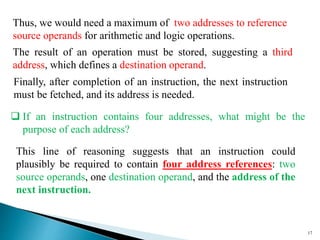
Thus, we would need a maximum of two addresses to reference
source operands for arithmetic and logic operations.
The result of an operation must be stored, suggesting a third
address, which defines a destination operand.
Finally, after completion of an instruction, the next instruction
must be fetched, and its address is needed.
This line of reasoning suggests that an instruction could
plausibly be required to contain four address references: two
source operands, one destination operand, and the address of the
next instruction.
 If an instruction contains four addresses, what might be the
purpose of each address?
18
In most architectures, many instructions have one, two, or three
operand addresses, with the address of the next instruction being
implicit (obtained from the program counter).
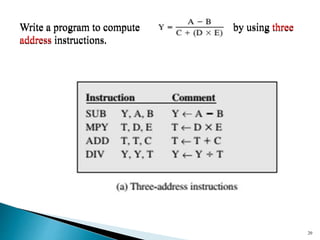
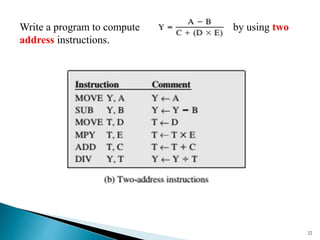
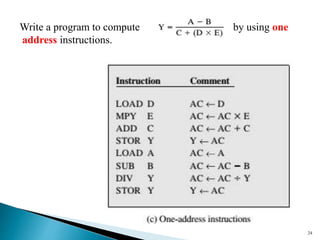
Compare typical one-, two-, and three- address instructions that
could be used to compute
Y = (A - B)/[C + (D * E)].
For example, the load and store multiple instructions of the ARM
architecture, designate up to 17 register operands in a single
instruction
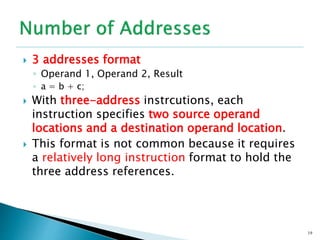
 3 addresses format
◦ Operand 1, Operand 2, Result
◦ a = b + c;
 With three-address instrcutions, each
instruction specifies two source operand
locations and a destination operand location.
 This format is not common because it requires
a relatively long instruction format to hold the
three address references.
19
20
Write a program to compute by using three
address instructions.
Write a program to compute by using three
address instructions.
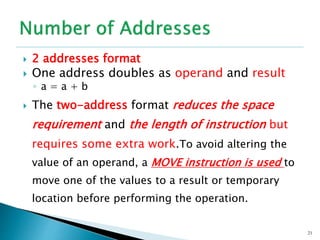
 2 addresses format
 One address doubles as operand and result
◦ a = a + b
 The two-address format reduces the space
requirement and the length of instruction but
requires some extra work.To avoid altering the
value of an operand, a MOVE instruction is used to
move one of the values to a result or temporary
location before performing the operation.
21
22
Write a program to compute by using two
address instructions.
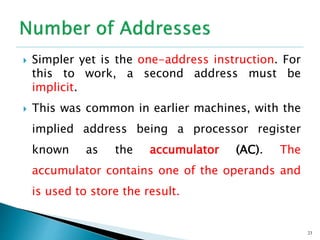
 Simpler yet is the one-address instruction. For
this to work, a second address must be
implicit.
 This was common in earlier machines, with the
implied address being a processor register
known as the accumulator (AC). The
accumulator contains one of the operands and
is used to store the result.
23
24
Write a program to compute by using one
address instructions.
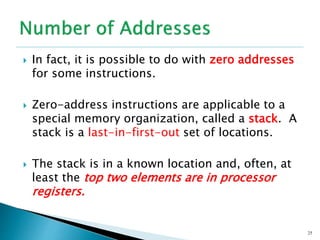
 In fact, it is possible to do with zero addresses
for some instructions.
 Zero-address instructions are applicable to a
special memory organization, called a stack. A
stack is a last-in-first-out set of locations.
 The stack is in a known location and, often, at
least the top two elements are in processor
registers.
25
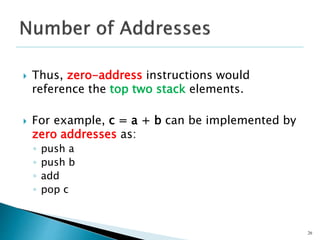
 Thus, zero-address instructions would
reference the top two stack elements.
 For example, c = a + b can be implemented by
zero addresses as:
◦ push a
◦ push b
◦ add
◦ pop c
26
27
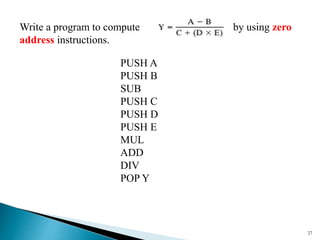
Write a program to compute by using zero
address instructions.
PUSH A
PUSH B
SUB
PUSH C
PUSH D
PUSH E
MUL
ADD
DIV
POP Y
28
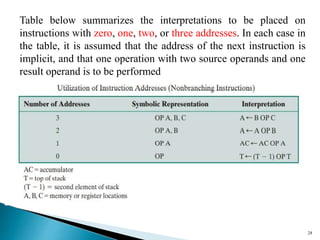
Table below summarizes the interpretations to be placed on
instructions with zero, one, two, or three addresses. In each case in
the table, it is assumed that the address of the next instruction is
implicit, and that one operation with two source operands and one
result operand is to be performed
 More addresses per instruction results;
◦ More complex instructions
◦ Fewer instructions per program
◦ More registers
 Fewer addresses per instruction results;
◦ Less complex instructions
◦ More instructions per program
◦ Faster fetch/execution of instructions
 For reasons of flexibility and ability to use multiple
registers, most contemporary machines employ a
mixture of two- and three-address instructions.
29
 The design of an instruction set is very
complex because it affects so many aspects
of the computer system.
 The instruction set defines many of the
functions performed by the processor and
thus has a significant effect on the
implementation of the processor.
 The instruction set is the programmer’s
means of controlling the processor.
30
 Instruction set design issues includes:
◦ Operation repertoire
 How many operations ? What can they do?
 How complex are they?
◦ Data types
◦ Instruction formats
 Length of op code field
 Number of addresses
◦ Registers
 Number of CPU registers available and which
operations can be performed on which registers?
◦ Addressing modes by which the address of an operand
is specified.
31
 The most important general categories of
data are:
◦ Addresses (In many cases, some calculation must
be performed on the operand reference in an
instruction to determine the main or virtual memory
address.)
◦ Numbers (Integer/floating point)
◦ Characters (ASCII etc.)
◦ Logical Data (Bits or flags)
32
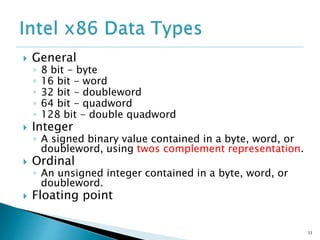
 What types of operands are typical in machine instruction sets?
 General
◦ 8 bit - byte
◦ 16 bit - word
◦ 32 bit - doubleword
◦ 64 bit - quadword
◦ 128 bit - double quadword
 Integer
◦ A signed binary value contained in a byte, word, or
doubleword, using twos complement representation.
 Ordinal
◦ An unsigned integer contained in a byte, word, or
doubleword.
 Floating point
33
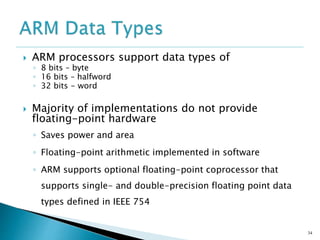
 ARM processors support data types of
◦ 8 bits – byte
◦ 16 bits – halfword
◦ 32 bits - word
 Majority of implementations do not provide
floating-point hardware
◦ Saves power and area
◦ Floating-point arithmetic implemented in software
◦ ARM supports optional floating-point coprocessor that
supports single- and double-precision floating point data
types defined in IEEE 754
34
 The number of different opcodes varies widely
from machine to machine. However, the same
general types of operations are found on all
machines.
 A useful and typical categorization is the
following:
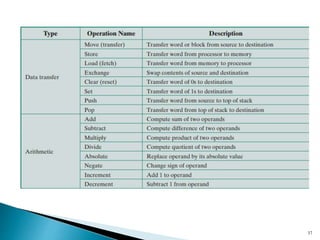
◦ Data Transfer
◦ Arithmetic
◦ Logical
◦ Conversion
◦ I/O
◦ System Control
◦ Transfer of Control
35
 Transfer data from one location to another.
 The data transfer instruction must specify the
location of the source and destination operands.
 Each location could be memory, a register, or the
top of the stack.
 If memory is involved:
◦ Determine memory address
◦ Perform virtual-to-actual-memory address
transformation
◦ Check cache
◦ Initiate memory read/write
36
37
38
39
40
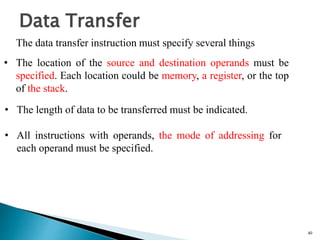
Data Transfer
The data transfer instruction must specify several things
• The location of the source and destination operands must be
specified. Each location could be memory, a register, or the top
of the stack.
• The length of data to be transferred must be indicated.
• All instructions with operands, the mode of addressing for
each operand must be specified.
41
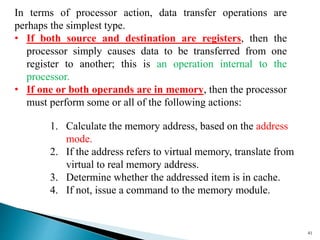
In terms of processor action, data transfer operations are
perhaps the simplest type.
• If both source and destination are registers, then the
processor simply causes data to be transferred from one
register to another; this is an operation internal to the
processor.
• If one or both operands are in memory, then the processor
must perform some or all of the following actions:
1. Calculate the memory address, based on the address
mode.
2. If the address refers to virtual memory, translate from
virtual to real memory address.
3. Determine whether the addressed item is in cache.
4. If not, issue a command to the memory module.
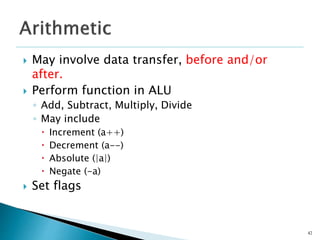
 May involve data transfer, before and/or
after.
 Perform function in ALU
◦ Add, Subtract, Multiply, Divide
◦ May include
 Increment (a++)
 Decrement (a--)
 Absolute (|a|)
 Negate (-a)
 Set flags
42
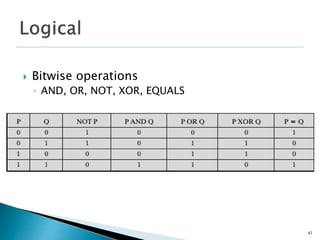
 Bitwise operations
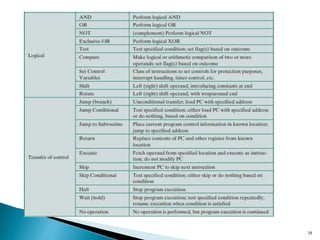
◦ AND, OR, NOT, XOR, EQUALS
43
44
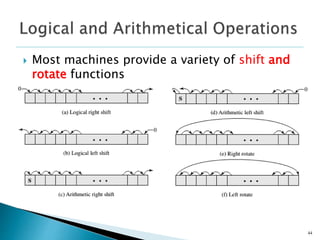
 Most machines provide a variety of shift and
rotate functions
45
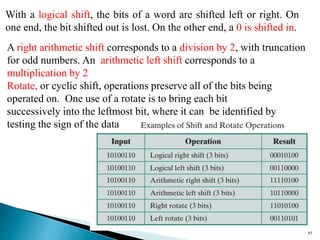
With a logical shift, the bits of a word are shifted left or right. On
one end, the bit shifted out is lost. On the other end, a 0 is shifted in.
A right arithmetic shift corresponds to a division by 2, with truncation
for odd numbers. An arithmetic left shift corresponds to a
multiplication by 2
Rotate, or cyclic shift, operations preserve all of the bits being
operated on. One use of a rotate is to bring each bit
successively into the leftmost bit, where it can be identified by
testing the sign of the data
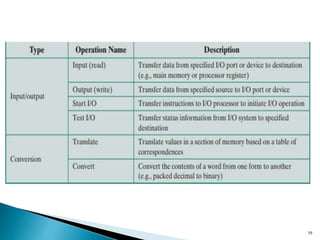
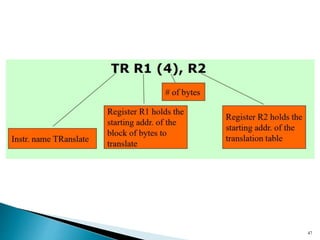
 Conversion instructions are those that change
the format or operate on the format of data.
 An example is converting from decimal to
binary.
 May involve special logic to perform
conversion.
46
47
 Issue command to I/O module
 There are a variety of approaches including
programmed I/O, interrupt driven I/O, DMA,
and the use of an I/O processor.
 Many implementations provide only a few I/O
instructions, with the specific actions
specified by parameters, codes, or command
words.
48
 System control instructions are those that can
be executed only while the processor is in a
certain privileged state or is executing a
program in a special privileged area of
memory.
 Typically, these instructions are reserved for
the use of the operating system.
◦ For example, a system control instruction may read
or alter a control register.
49
 A significant fraction of the instructions in any
program have as their function changing the
sequence of instruction execution.
 For these instructions, the operation performed
by the processor is to update the program
counter to contain the address of some
instruction in memory.
 The most common transfer of control operations
found in instruction sets are branch, skip and
procedure call.
50
51
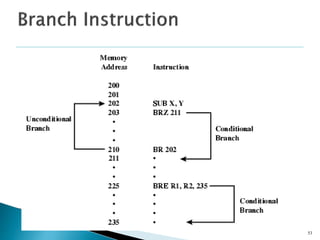
Branch instructions :
A branch instruction, also called a jump instruction, has as one of its
operands the address of the next instruction to be executed.
Most often, the instruction is a conditional branch instruction.
The branch is made (update program counter to equal address
specified in operand) only if a certain condition is met. Otherwise,
the next instruction in sequence is executed
A branch instruction in which the branch is always taken is an
unconditional branch.
52
On such a machine, there could be four different conditional
branch instructions:
BRP X : Branch to location X if result is positive.
BRN X : Branch to location X if result is negative.
BRZ X : Branch to location X if result is zero.
BRO X : Branch to location X if overflow occurs
Another approach that can be used with a three-address
instruction format is to perform a comparison and specify a
branch in the same instruction.
For example,
BRE R1, R2, X
(Branch to X if contents of R1 = contents of R2)
53
54
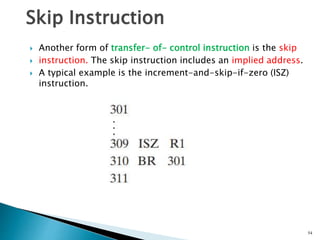
 Another form of transfer- of- control instruction is the skip
 instruction. The skip instruction includes an implied address.
 A typical example is the increment-and-skip-if-zero (ISZ)
instruction.
Skip Instruction
55
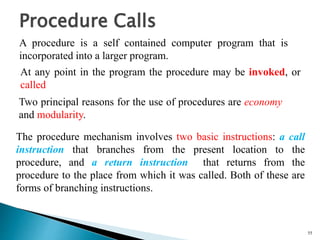
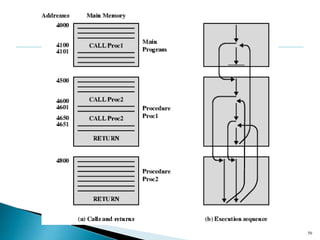
Procedure Calls
A procedure is a self contained computer program that is
incorporated into a larger program.
At any point in the program the procedure may be invoked, or
called
Two principal reasons for the use of procedures are economy
and modularity.
The procedure mechanism involves two basic instructions: a call
instruction that branches from the present location to the
procedure, and a return instruction that returns from the
procedure to the place from which it was called. Both of these are
forms of branching instructions.
56
57
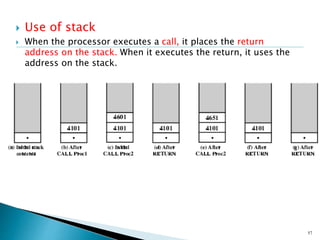
 Use of stack
 When the processor executes a call, it places the return
address on the stack. When it executes the return, it uses the
address on the stack.

ITEC582-Chapter 12.pptx

  • 1.
    1 Chapter 12 Instruction Sets:Characteristics and Functions
  • 2.
    2 Learning Objectives After studyingthis chapter, you should be able to  Present an overview of essential characteristics of machine instructions.  Describe the types of operands used in typical machine instruction sets.  Describe the types of operands supported by typical machine instruction sets.
  • 3.
    3 1. Machine InstructionCharacteristics Elements of a Machine Instruction  The operation of the processor is determined by the instructions it executes, referred to as machine instructions or computer instructions.  The collection of different instructions that the processor can execute is referred to as the processor’s instruction set.  Each instruction must contain the information required by the processor for execution.
  • 4.
    4  What arethe typical elements of a machine instruction? These elements are as follows; Operation code , Source operand reference, Result operand reference and Next instruction reference ■ Operation code: Specifies the operation to be performed (e.g., ADD, I/O). The operation is specified by a binary code, known as the operation code, or opcode. ■ Source operand reference: The operation may involve one or more source operands, that is, operands that are inputs for the operation.
  • 5.
    5 ■ Result operandreference: The operation may produce a result. ■ Next instruction reference: This tells the processor where to fetch the next instruction after the execution of this instruction is complete. Source and result operands can be in one of four areas: ■ Main or virtual memory: As with next instruction references, the main or virtual memory address must be supplied ■ Processor register: A processor contains one or more registers that may be referenced by machine instructions. ■ Immediate: The value of the operand is contained in a field in the instruction being executed ■ I/O device: The instruction must specify the I/O module and device for the operation.  What types of locations can hold source and destination operands?
  • 6.
     Figure showsthe steps involved in instruction execution and defines the elements of a machine instruction. Instruction Cycle State Diagram 6
  • 7.
    7 Instruction Address Calculation− The address of the next instruction is computed. A permanent number is inserted to the address of the earlier instruction. Instruction Fetch − The instruction is read from its specific memory location to the processor. Instruction Operation Decoding − The instruction is interpreted and the type of operation to be implemented and the operand(s) to be used are decided. Operand Address Calculation − The address of the operand is evaluated if it has a reference to an operand in memory or is applicable through the Input/Output. Operand Fetch − The operand is read from the memory or the I/O. Data Operation − The actual operation that the instruction contains is executed. Store Operands − It can store the result acquired in the memory or transfer it to the I/O.
  • 8.
     Within thecomputer, each instruction is represented by a sequence of bits.  The instruction is divided into fields, corresponding to the constituent elements of the instruction. A simple example of an instruction format is shown in the figure. 8 A simple instruction format
  • 9.
     In machinecode each instruction has a unique bit pattern.  For human consumption (programmers) a symbolic representation of machine instructions is used. 9
  • 10.
     Opcodes arerepresented by abbreviations, called mnemonics, that indicate the operation.  Common examples include: ◦ ADD - Add ◦ SUB - Subtract ◦ MUL - Multiply ◦ DIV - Divide ◦ LOAD - Load data from memory ◦ STOR - Store data to memory 10
  • 11.
     Operands arealso represented symbolically.  For example, the instruction ADD R,Y  (R R + Y ) may mean add the value contained in data location Y to the contents of register R.  In this example, Y refers to the address of a location in memory, and R refers to a particular register.  Note that the operation is performed on the contents of a location, not on its address. 11
  • 12.
     Consider ahigh-level language instruction that could be expressed X=X+Y.  This statement instructs the computer to add the value stored in Y to the value stored in X and put the result in X.  Let us assume that the variables X and Y correspond to memory locations 513 and 514. This operation could be accomplished with three instructions: 1. Load a register with the contents of memory location 513 2. Add the contents of memory location 514 to the register 3. Store the contents of the register in memory location 513 12
  • 13.
     This isa typical relationship between a high- level language and a machine language.  A high-level language expresses operations in a concise algebraic form, using variables.  A machine language expresses operations in a basic form involving the movement of data to or from registers.  Therefore, a computer should have a set of instructions that allows the user to formulate any data processing task. 13
  • 14.
     Thus, theset of machine instructions must be sufficient to express any of the instructions from a high-level language.  With this in mind we can categorize instruction types as follows: ◦ Data processing: arithmetic and logic instructions ◦ Data storage (main memory): data in/out to/from registers, memory locations ◦ Data movement (I/O): I/O instructions ◦ Program flow control: test and branch instructions 14
  • 15.
     Arithmetic instructionsprovide computational capabilities for processing numeric data.  Logic (Boolean) instructions operate on the bits of a word. These operations are performed primarily on data in processor registers.  I/O instructions are needed to transfer programs and data into memory and the results of computations back out to the user.  Test instructions are used to test the value of a data word or the status of a computation.  Branch instructions are then used to branch to a different set of instructions depending on the decision made. 15
  • 16.
     One ofthe traditional ways of describing processor architecture is in terms of the number of addresses contained in each instruction.  What is the maximum number of addresses one might need in an instruction?  All arithmetic and logic operations are either unary (one source operand) or binary (two source operands). 16
  • 17.
    17 Thus, we wouldneed a maximum of two addresses to reference source operands for arithmetic and logic operations. The result of an operation must be stored, suggesting a third address, which defines a destination operand. Finally, after completion of an instruction, the next instruction must be fetched, and its address is needed. This line of reasoning suggests that an instruction could plausibly be required to contain four address references: two source operands, one destination operand, and the address of the next instruction.  If an instruction contains four addresses, what might be the purpose of each address?
  • 18.
    18 In most architectures,many instructions have one, two, or three operand addresses, with the address of the next instruction being implicit (obtained from the program counter). Compare typical one-, two-, and three- address instructions that could be used to compute Y = (A - B)/[C + (D * E)]. For example, the load and store multiple instructions of the ARM architecture, designate up to 17 register operands in a single instruction
  • 19.
     3 addressesformat ◦ Operand 1, Operand 2, Result ◦ a = b + c;  With three-address instrcutions, each instruction specifies two source operand locations and a destination operand location.  This format is not common because it requires a relatively long instruction format to hold the three address references. 19
  • 20.
    20 Write a programto compute by using three address instructions. Write a program to compute by using three address instructions.
  • 21.
     2 addressesformat  One address doubles as operand and result ◦ a = a + b  The two-address format reduces the space requirement and the length of instruction but requires some extra work.To avoid altering the value of an operand, a MOVE instruction is used to move one of the values to a result or temporary location before performing the operation. 21
  • 22.
    22 Write a programto compute by using two address instructions.
  • 23.
     Simpler yetis the one-address instruction. For this to work, a second address must be implicit.  This was common in earlier machines, with the implied address being a processor register known as the accumulator (AC). The accumulator contains one of the operands and is used to store the result. 23
  • 24.
    24 Write a programto compute by using one address instructions.
  • 25.
     In fact,it is possible to do with zero addresses for some instructions.  Zero-address instructions are applicable to a special memory organization, called a stack. A stack is a last-in-first-out set of locations.  The stack is in a known location and, often, at least the top two elements are in processor registers. 25
  • 26.
     Thus, zero-addressinstructions would reference the top two stack elements.  For example, c = a + b can be implemented by zero addresses as: ◦ push a ◦ push b ◦ add ◦ pop c 26
  • 27.
    27 Write a programto compute by using zero address instructions. PUSH A PUSH B SUB PUSH C PUSH D PUSH E MUL ADD DIV POP Y
  • 28.
    28 Table below summarizesthe interpretations to be placed on instructions with zero, one, two, or three addresses. In each case in the table, it is assumed that the address of the next instruction is implicit, and that one operation with two source operands and one result operand is to be performed
  • 29.
     More addressesper instruction results; ◦ More complex instructions ◦ Fewer instructions per program ◦ More registers  Fewer addresses per instruction results; ◦ Less complex instructions ◦ More instructions per program ◦ Faster fetch/execution of instructions  For reasons of flexibility and ability to use multiple registers, most contemporary machines employ a mixture of two- and three-address instructions. 29
  • 30.
     The designof an instruction set is very complex because it affects so many aspects of the computer system.  The instruction set defines many of the functions performed by the processor and thus has a significant effect on the implementation of the processor.  The instruction set is the programmer’s means of controlling the processor. 30
  • 31.
     Instruction setdesign issues includes: ◦ Operation repertoire  How many operations ? What can they do?  How complex are they? ◦ Data types ◦ Instruction formats  Length of op code field  Number of addresses ◦ Registers  Number of CPU registers available and which operations can be performed on which registers? ◦ Addressing modes by which the address of an operand is specified. 31
  • 32.
     The mostimportant general categories of data are: ◦ Addresses (In many cases, some calculation must be performed on the operand reference in an instruction to determine the main or virtual memory address.) ◦ Numbers (Integer/floating point) ◦ Characters (ASCII etc.) ◦ Logical Data (Bits or flags) 32  What types of operands are typical in machine instruction sets?
  • 33.
     General ◦ 8bit - byte ◦ 16 bit - word ◦ 32 bit - doubleword ◦ 64 bit - quadword ◦ 128 bit - double quadword  Integer ◦ A signed binary value contained in a byte, word, or doubleword, using twos complement representation.  Ordinal ◦ An unsigned integer contained in a byte, word, or doubleword.  Floating point 33
  • 34.
     ARM processorssupport data types of ◦ 8 bits – byte ◦ 16 bits – halfword ◦ 32 bits - word  Majority of implementations do not provide floating-point hardware ◦ Saves power and area ◦ Floating-point arithmetic implemented in software ◦ ARM supports optional floating-point coprocessor that supports single- and double-precision floating point data types defined in IEEE 754 34
  • 35.
     The numberof different opcodes varies widely from machine to machine. However, the same general types of operations are found on all machines.  A useful and typical categorization is the following: ◦ Data Transfer ◦ Arithmetic ◦ Logical ◦ Conversion ◦ I/O ◦ System Control ◦ Transfer of Control 35
  • 36.
     Transfer datafrom one location to another.  The data transfer instruction must specify the location of the source and destination operands.  Each location could be memory, a register, or the top of the stack.  If memory is involved: ◦ Determine memory address ◦ Perform virtual-to-actual-memory address transformation ◦ Check cache ◦ Initiate memory read/write 36
  • 37.
  • 38.
  • 39.
  • 40.
    40 Data Transfer The datatransfer instruction must specify several things • The location of the source and destination operands must be specified. Each location could be memory, a register, or the top of the stack. • The length of data to be transferred must be indicated. • All instructions with operands, the mode of addressing for each operand must be specified.
  • 41.
    41 In terms ofprocessor action, data transfer operations are perhaps the simplest type. • If both source and destination are registers, then the processor simply causes data to be transferred from one register to another; this is an operation internal to the processor. • If one or both operands are in memory, then the processor must perform some or all of the following actions: 1. Calculate the memory address, based on the address mode. 2. If the address refers to virtual memory, translate from virtual to real memory address. 3. Determine whether the addressed item is in cache. 4. If not, issue a command to the memory module.
  • 42.
     May involvedata transfer, before and/or after.  Perform function in ALU ◦ Add, Subtract, Multiply, Divide ◦ May include  Increment (a++)  Decrement (a--)  Absolute (|a|)  Negate (-a)  Set flags 42
  • 43.
     Bitwise operations ◦AND, OR, NOT, XOR, EQUALS 43
  • 44.
    44  Most machinesprovide a variety of shift and rotate functions
  • 45.
    45 With a logicalshift, the bits of a word are shifted left or right. On one end, the bit shifted out is lost. On the other end, a 0 is shifted in. A right arithmetic shift corresponds to a division by 2, with truncation for odd numbers. An arithmetic left shift corresponds to a multiplication by 2 Rotate, or cyclic shift, operations preserve all of the bits being operated on. One use of a rotate is to bring each bit successively into the leftmost bit, where it can be identified by testing the sign of the data
  • 46.
     Conversion instructionsare those that change the format or operate on the format of data.  An example is converting from decimal to binary.  May involve special logic to perform conversion. 46
  • 47.
  • 48.
     Issue commandto I/O module  There are a variety of approaches including programmed I/O, interrupt driven I/O, DMA, and the use of an I/O processor.  Many implementations provide only a few I/O instructions, with the specific actions specified by parameters, codes, or command words. 48
  • 49.
     System controlinstructions are those that can be executed only while the processor is in a certain privileged state or is executing a program in a special privileged area of memory.  Typically, these instructions are reserved for the use of the operating system. ◦ For example, a system control instruction may read or alter a control register. 49
  • 50.
     A significantfraction of the instructions in any program have as their function changing the sequence of instruction execution.  For these instructions, the operation performed by the processor is to update the program counter to contain the address of some instruction in memory.  The most common transfer of control operations found in instruction sets are branch, skip and procedure call. 50
  • 51.
    51 Branch instructions : Abranch instruction, also called a jump instruction, has as one of its operands the address of the next instruction to be executed. Most often, the instruction is a conditional branch instruction. The branch is made (update program counter to equal address specified in operand) only if a certain condition is met. Otherwise, the next instruction in sequence is executed A branch instruction in which the branch is always taken is an unconditional branch.
  • 52.
    52 On such amachine, there could be four different conditional branch instructions: BRP X : Branch to location X if result is positive. BRN X : Branch to location X if result is negative. BRZ X : Branch to location X if result is zero. BRO X : Branch to location X if overflow occurs Another approach that can be used with a three-address instruction format is to perform a comparison and specify a branch in the same instruction. For example, BRE R1, R2, X (Branch to X if contents of R1 = contents of R2)
  • 53.
  • 54.
    54  Another formof transfer- of- control instruction is the skip  instruction. The skip instruction includes an implied address.  A typical example is the increment-and-skip-if-zero (ISZ) instruction. Skip Instruction
  • 55.
    55 Procedure Calls A procedureis a self contained computer program that is incorporated into a larger program. At any point in the program the procedure may be invoked, or called Two principal reasons for the use of procedures are economy and modularity. The procedure mechanism involves two basic instructions: a call instruction that branches from the present location to the procedure, and a return instruction that returns from the procedure to the place from which it was called. Both of these are forms of branching instructions.
  • 56.
  • 57.
    57  Use ofstack  When the processor executes a call, it places the return address on the stack. When it executes the return, it uses the address on the stack.