INTRODUCTION TO COMMUNICATIONTHEORIES
•Revolution in communication technology
•Media convergence
•Social theories
•Individual theories often have different objectives:
•To guide the decision making of political and social elites
•To seek transformation of the status quo
•Active versus passive audiences
•Theory
•Communication Theory
2.
DIFFERENT WAYS TOSTUDY COMMUNICATION THEORY
•Four eras of media theory
•McQuail’s four kinds of communication theories
•Communication theory viewpoints
•Perspectives on communication theories
•Genres of communication theory
•Communication metatheory
•Levels of communication
3.
FOUR ERAS OFMEDIA THEORY
1. Era of mass society theory
* Later half of the 19th
century
* Mass society theory
* Media undermine the traditional social order
* Fallacies of both technology critics and advocates
- mass society notions exaggerated the ability of
media to quickly undermine social order
- technology advocates failed to acknowledge
damaging consequences from applying technology
4.
FOUR ERAS OFMEDIA THEORY
2. Emergence of scientific perspective on mass communication
* During 1930’s
* Time of Paul Lazarsfeld
3. Era of Limited Effects
* media playing limited role in the lives of individuals and
the larger society
* During the 1960s
5.
FOUR ERAS OFMEDIA THEORY
4. Era of cultural criticisms
* US researchers vs. European researchers
* Neomarxists
* British cultural studies
* Deterministic assumptions---
* Cultural criticism- collection of perspectives concerned
with conflict of interests in society and the ways
communication perpetuates domination of one group over
the other.
6.
CRITICAL QUESTIONS
* Wheredo you stand on the fundamental issues of media
impact? Do you believe that media influence individuals,
society and culture? If you do, to what extent do they do so?
* How do you describe your self as a media audience? Are
you a passive or an active audience? Provide concrete
example/s to support your claim.
7.
MCQUAIL’S FOUR KINDSOF COMMUNICATION THEORIES
1. Social scientific theory- based on and guide empirical
research
2. Normative theory- explains how ideal media ought to operate
within a specific system of social values
3. Operational theory- how media operates to meet specific
needs
4. Everyday theory- refers to the knowledge and ideas all of us
have by simple virtue of engaging in mediated communication
8.
COMMUNICATION THEORY FRAMEWORK
1.Mechanistic- perfect transaction of a message from the
sender to the receiver
2. Psychological- act of sending a message to a receiver, and
the feelings and thoughts of the receiver
3. Social constructionist- product of the interactants sharing
and creating meaning
4. Systematic- new message created via “through put”
9.
PERSPECTIVES ON COMMUNICATIONTHEORY
• Scientific method vs. humanistic method
• Objectivity vs. subjectivity
• To reduce human difference in what is observed vs. to
understand individual subjective response
• “Out there” vs. “In here”
• Consensus vs. Interpretations
10.
PERSPECTIVES ON COMMUNICATIONTHEORY
• Reasons why the implementation of the scientific method a
difficult task for social researchers:
1. Most of the significant and interesting forms of human
behavior are quite difficult to measure
2. Human behavior is exceedingly complex
3. Humans have goals and are self-reflexive
4. Simple notion of causality is sometimes troubling when
it is applied to ourselves.
11.
PERSPECTIVES ON COMMUNICATIONTHEORY
• SOCIAL SCIENCES
• Social scholars make human beings the object of study.
To understand human behavior, scholars must observe it.
Observation must be objective as possible.
• Communication as a social science approach
12.
CRITERIA FOR AGOOD COMMUNICATION THEORY
• Scientific criteria:
a. Explanatory power- do the propositions of the theory
enable us to explain as much of the communication
phenomenon as possible?
b. Predictive power- do the propositions of the theory enable
us to forecast future events and outcome?
c. Parsimony- does the theory contain as few propositions as
possible to explain the communication phenomenon?
13.
CRITERIA FOR AGOOD COMMUNICATION THEORY
d. Testability- can the propositions of the theory be tested?
e. Internal consistency- the propositions that comprise the
theory should not contradict each other.
f. Heuristic potential- the propositions that comprise the
theory should suggest further hypotheses to be tested
through research.
14.
CRITERIA FOR AGOOD COMMUNICATION THEORY
• Aesthetic criteria:
a. New understanding- does the theory provide us with new
and fresh insights into the nature of the human condition?
b. Societal value- does the theory help us to improve the
human condition in some substantive ways?
c. Aesthetic appeal- does the theory capture our interest and
imagination?
d. Community agreement- is the theory accepted and
supported by like-minded scholars?
15.
GENRES OF COMMUNICATIONTHEORY
1. Structural and functional theories
* Designate the beliefs that social structures are real and
function in any ways that can be observed objectively.
* Structuralism (rooted in linguistics) vs. functionalism
(rooted in biology)
* Features of structural-functional approach:
- Assume stability over time– synchrony rather than
diachrony
16.
GENRES OF COMMUNICATIONTHEORY
2. Cognitive and behavioral theories
* Primary difference is their focus and history
* Cognitivism vs. behaviorism
* Cognitive theory of communication- addresses the way
people evaluate such message and it might predict the kinds
of information that would have an impact on how people
think
3. Interactionist theory
* View social life as a process of interaction.
* View communication as the glue of the society.
17.
GENRES OF COMMUNICATIONTHEORY
4. Interpretive theories
* Describe the process by which understanding occurs
* Goal of interpretation to uncover the ways people actually
understand their own experience
* Subjectivism or the preeminence of individual experience
18.
GENRES OF COMMUNICATIONTHEORY
5. Critical theories
* Focus on the issues of inequality and oppression
* Conflict of interest in society
19.
COMMUNICATION METATHEORY
• Metatheory-theory about theory
• Addresses the questions– what, how and in what form
• Three major themes:
1. Epistemology- branch of philosophy that studies
knowledge or how people know what they claim to know
- To what extent can knowledge exist before
experience?
- To what extent can knowledge be certain?
20.
COMMUNICATION METATHEORY
- Bywhat process does knowledge arise?
* Four positions:
a. mentalism or rationalism- power of human mind
b. empiricism- perception
c. constructivism- what they project themselves into
what they experience
d. social constructionism- knowledge is product of
symbolic interaction
21.
COMMUNICATION METATHEORY
- Isknowledge best conceived in parts or wholes?
a. Gestaltists
b. Analysts
- To what extent is knowledge explicit?
22.
COMMUNICATION METATHEORY
2. Ontology-possesses the question of what exactly it is the
theorists is examining
- To what extent do humans make real choices?
a. determinists- passive
b. pragmatists- plan their behavior
c. middle positions- they make choices
- Is human behavior best understood in terms of
states or traits?
a. States view- humans change/ dynamic
b. Trait view- humans are consistent
23.
COMMUNICATION METATHEORY
- Ishuman experience primarily individual or
social?
a. Individual- behavior as individualistic
b. Social- humans cannot be understood
apart from their relationships with other groups
- To what extent is communication contextualized?
* Behavior is affected by both general and
situational factors
- Actional vs. nonactional theories
a. Actional- individual create meaning
b. Nonactional- behavior is determined by
24.
COMMUNICATION METATHEORY
3. Axiology-concerned with what values drive a theorist to
develop a theory
- Can theory be value free?
- To what extent does the practice of inquiry
influence that which is studied?
- To what extent should scholarship attempt to
achieve social change?
a. Value conscious scholarship- direct values
on positive ways
b. Value neutral scholarship- science is aloof
in values
25.
LEVELS OF COMMUNICATIONTHEORY
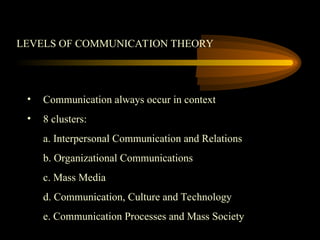
• Communication always occur in context
• 8 clusters:
a. Interpersonal Communication and Relations
b. Organizational Communications
c. Mass Media
d. Communication, Culture and Technology
e. Communication Processes and Mass Society
26.
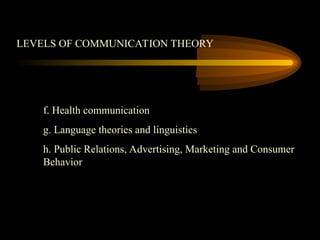
LEVELS OF COMMUNICATIONTHEORY
f. Health communication
g. Language theories and linguistics
h. Public Relations, Advertising, Marketing and Consumer
Behavior
27.
ASSIGNMENT
* Give atleast two possible communication theories under the
Interpersonal Communication and Relations cluster.
Editor's Notes
#1 We are in the midst of a revolution in communication technology that is transforming social orders and cultures around the world.
The convergence, which blurring the distinction among various forms of media, is transforming the media environment. Examples:
- Computers mainly as replacement of typewriters but now is being used as Internet facility—with cam, telephone, chatting, etc.
- Celphones as mobile telephone but now with text, video, internet, music, etc.
Each new technological device expands the possible uses of the existing technologies.
All social theory is a human construction—an active effort by communities of scholars to make sense of their social world.
Individual theories often have different objectives:
- To guide the decision making of political and social elites—theories ten d to focus on the structure of the society and how it can be best preserved.
- To seek transformation of the status quo—explore the dynamic processes that underlie social change. Their purpose is to guide useful social change.
Scholarly communities differ in what they want to accomplish with the theories they create.
Ideas have significantly drawn from humanities, especially from philosophy and literary analysis.
In every era, proponents of the new media technology would argue that it had the potential to interconnect people in powerful new ways, that technology could aid the formation of new communities by bridging cultural differences and dissolving barriers posed by space and time.
Active versus passive audiences.
- Active audiences- people find ways of making media serve them so that thei lives are more interesting and purposeful.
- Passive audiences- average people might be overwhelmed by new technologies, paralyzed by the mesmerizing power of new media.
Media theory should serve as a tool that guides our understanding and use of new technology. Media theory should enable us to shape media industries that serve our needs and minimize unplanned disruption to our personal lives and the society around us.
- Can media cause “chaos”?
- Did they simply reinforce existing condition?
Gain an understanding how current thinking about mass media has evolved.
- Why certain forms of theory are now considered obsolete even though they still appear interesting and potentially useful
- You will find that ideas of that contemporary media scholars consider outdated are still discussed as valid
- You will learn why specific theories have enduring appeal to present day researchers.
COMMUNICATION THEORY
Theory—a conceptual representation or explanation of phenomena. They are sets of statements asserting relationships among classes of variables. Stephen Littlejohn—scholar’s best representation of some state of affairs based on systematic observation. Dennis McQuail—sets of ideas of varying status and origin which may explain or interpret some phenomenon.
Communication theory- used to designate the collective wisdom found in the entire body of theories related to the communication process.
Everybody tries to make sense of their own experience. We assign meaning to what is going on, both inside us and around us. Sometimes, the meaning is shared, and sometimes it is not. Sometimes it is clear and sometimes it is vague or contradictory. By developing an understanding of a variety of theories of communication, we interpret events in more flexible, useful and discriminating ways
Theories provide a set of useful tools for seeing new and useful things.
#3 Era of mass society theory
Description of mass communication theory begins with a review of some of the earliest notions about media.
These ideas were developed in the later half of the 19th century where most of the new technologies were invented and popularized
Some theorists were optimistic while majority were extremely pessimistic. They blamed the media for any wrong doings in the 19th century urban life
The dominant perspective that emerged during this period is referred to as mass society theory
Mass society ideas held strong appeal for any social elites whose power was threatened by change
Monarchism (old values) versus revolution (change/ new values)
During this period, many intense political conflicts strongly affected thinking about the mass media
Essential argument in this era is that media undermine the traditional social order--- to cope with this argument, steps to be undertaken whether to go back or institute change
On the other hand, leaders of industrial revolution favored all forms of technological development. New technology would bring an end to social problems and lead to the development of an ideal social world.
The fallacies of both the theology critics and advocates are easily apparent:
- mass society notions exaggerated the ability of media to quickly undermine social order. Failed to consider that media’s power ultimately resides in the freely chosen uses that audiences make of it. Mass society thinkers are elitists in their criticisms about average people and in their fear that media’s corruption of the masses would inevitably bring social and cultural ruin
- technology advocates failed to acknowledge the many unnecessary, damaging consequences that resulted from applying technology without adequate consideration for its impact.
#4 Emergence of a scientific perspective on mass communications
During the 1930s, world events seemed to continually confirm the truth of mass society ideas
- In Europe, reactionary and revolutionary political movements used media in their struggles for political power
- German Nazis introduced propaganda techniques that exploited the power of media technology
Private ownership of media was replaced by direct government control in most European nations. All these efforts was geared in placing enormous power in the hands of ruthless leaders who were convinced that they personally embodied what was best for all their citizens
Paul Lazarsfeld provides a classical example of a transitional figure in theory development. He argued that it wasn’t enough to merely speculate about the influence of media on society.
According to Lazarsfeld with Berelson and Gaudet, it was not enough to assume that political propaganda is powerful—one needs evidence to prove the existence of such effects.
Conducted the VOTERS STUDIES. Interpretation of the data gathered proved that media were not merely as powerful as previously imagined.
He found that people had numerous ways of resisting media influence and were influenced by many competing factors.
Rather than serving as a disruptive social force, media seemed to reinforce existing social trends and strengthen rather than threaten the status quo.
Though Lazarsfeld never labeled his theory, it was now being referred to limited effects perspective.
Era of limited effects
View media as playing a very limited role in the lives of individuals and the larger society.
During the 1950s, limited effects notions about media continued to gain acceptance within the academia.
By the mid 1960s, the debate between mass society and limited effects notions appeared to be over.
The body of empirical research findings continued to grow and almost all of these findings were consistent with the limited effects notions.
Many communication scientists stopped looking for powerful media effects and concentrated instead on documenting limited effects.
#5 Era of cultural criticisms
Though most mass communication researchers in the US found limited effects notions and other empirical research findings on which they were based persuasive, researchers in other parts of the world were less convinced.
Mass society notions continue to flourish in Europe where both left-wing and right-wing concerns about the power of media were deeply rooted in WWII with experiences propaganda.
Europeans then were also skeptical about the power of scientific, quantitative social research methods to verify and develop social theory because these methods were widely viewed as distinctly American fetish.
Although, some European academics welcomed American ideas, others strongly resisted them and argued for maintaining approaches considered to be less biased or more traditionally European.
The neomarxists, one group of European social therists, vehemently resisted post-war US influence. NEOMARXISTS (left-wing social theorists) believe that media enable dominant social elites to maintain their power.
Media provide the elite with the convenient, subtle yet highly effective means of promoting world views favorable to interests.
Mass media can be viewed as a public arena in which cultural battles are fought and a dominant culture is forged.
Elite dominate these struggles because they start with important advantages. Opposition is marginalized and the status quo is presented as the only logical, rational way of structuring society.
1960s, neomarxists in Britain developed a school of social theory known as the British cultural studies. It focuses heavily on mass media and their role in promoting a hegemonic world view and a dominant culture among the various subgroups in the society.
Researchers studied how members of those groups used media and demonstrated how this use lead people to develop ideas that supported dominant elites. They discovered that people often resisted the hegemonic ideas and propagated alternative interpretations of the social world.
Although British cultural studies began with deterministic assumptions (assumption that media have powerful, direct effects), their work came to focus on audience reception studies that revived important questions about the potential power of media in certain types of situation and the ability of active audience members to resist media influence.
1970s, questions about the possibility of powerful media effects were again raised within US universities. Initially, these questions were often advanced by scholars in the humanities who were unrestrained by the limited effects perspective and untrained in the scientific method.
Their arguments were routinely ignored and marginalized by social scientists because they were unsupported by “scientific evidence.” Some attempted to create an “authentic” American school of cultural studies—they drew heavily on Canadian scholars like Harold Innis and Marshall McLuhan.
Cultural criticism refers to the collection of perspective concerned with the conflict of interests in society and the ways communication perpetuates domination of one group over the other.
Cultural criticism gradually established itself as a credible and valuable alternative to minimal effects notion.
#7 MCQUAIL’s 4 kinds of mass communication theories:
- Social scientific theory- based on and guide empirical research. These statements or hypotheses are tested by making systematic and objective observations regarding mass media, media use and media influence. Example- theories explaining the television and aggression link.
- Normative theory- explains how ideal media ought to operate within a specific system of social values. Example- press role in a democracy.
- Operational theory- this type of theory is normative but with a little bent. It involves not only how media should ideally operate, but how they can operate to meet specific ends. Example- theories of advertising and consumer behavior.
- Everyday theory- refers to the knowledge and ideas that all of us have by simple virtue of engaging in mediated communication.
#8 COMMUNICATION THEORY FRAMEWORK
Different viewpoints
- Mechanistic- considers communication to be a perfect transaction of a message from the sender to the receiver.
- Psychological- considers communication as the act of sending a message to a receiver, and the feelings and thoughts of the receiver upon interpreting the message.
- Social Constructionist (Symbolic Interactionism)- considers communication to be the product of the interactants sharing and creating meaning.
- Systematic- considers communication to be the new message created via “through-put” or what happens as the message is being interpreted and reinterpreted as it travels through people.
#9 SCIENCE AND HUMAN BEHAVIOR
Scientific method- a search for truth through accurate observation and interpretation of act. It is often associated with objectivity
Scientists attempt to look at the world in such a way that all other observers, trained the same way and using the same methods, would see the same thing. Replications of study should yield identical result.
Social scientists examine relationships among phenomena in the human or social world. If science is associated with objectivity, humanities are associated with subjectivity.
If the aim of science is to reduce human difference in what is observed, the aim of the humanities is to understand individual subjective response.
Whereas, science is an “out there” activity, the humanities stress the “in here”. Science focus on the discovered world; the humanities focus on the discovering person.
Science seeks consensus, humanities seek alternative interpretations.
Some social researchers have tried applying the scientific method to the study of human behavior and the society. But there are 4 reasons why the implementation of the scientific method a difficult task for social researchers:
- Most of the significant and interesting forms of human behavior are quite difficult to measure. We can easily measure speed or temperature, but how can we measure civic duty? Or violence aggression in a TV show? How to measure attitude?
- Human behavior is exceedingly complex. Human behavior does not easily lend itself to causal description. It would be easy to identify a single factor that causes water to boil. But it has proved impossible to isolate single factors that serve as the exclusive cause of important actions of human behavior. How do we control which forms of media people choose to use? How do we control the amount of attention they pay to specific types of news? How do we measure how well or poorly they comprehend whet they consume?
- Humans have goals and are self-reflexive. We do not always behave in response to something that has happened, but very often, we react in response to something we hope or expect will happen. Moreover, we constantly revise our goals and make highly subjective determinations about their potential for success or failure. For instance, water boils after the application of heat. It doesn’t think about boiling. Humans think about their actions and inactions, we reflect on our values, beliefs and attitudes.
- The simple notion of causality is sometime troubling when it is applied to ourselves. Humans want to know how things work, what make things happen. We don’t need experts telling us about ourselves or explaining to us why we do things.
How about social sciences? It includes elements of both science and humanities but is different from both. In seeking to observe and interpret pattern of human behavior, social scholars make human beings the object of study. To understand human behavior, the scholar must observe it. Observation must be objective as possible.
Communication as a social science approach. Communication involves understanding how people behave in creating, exchanging and interpreting messages.
#10 SCIENCE AND HUMAN BEHAVIOR
Scientific method- a search for truth through accurate observation and interpretation of act. It is often associated with objectivity
Scientists attempt to look at the world in such a way that all other observers, trained the same way and using the same methods, would see the same thing. Replications of study should yield identical result.
Social scientists examine relationships among phenomena in the human or social world. If science is associated with objectivity, humanities are associated with subjectivity.
If the aim of science is to reduce human difference in what is observed, the aim of the humanities is to understand individual subjective response.
Whereas, science is an “out there” activity, the humanities stress the “in here”. Science focus on the discovered world; the humanities focus on the discovering person.
Science seeks consensus, humanities seek alternative interpretations.
Some social researchers have tried applying the scientific method to the study of human behavior and the society. But there are 4 reasons why the implementation of the scientific method a difficult task for social researchers:
- Most of the significant and interesting forms of human behavior are quite difficult to measure. We can easily measure speed or temperature, but how can we measure civic duty? Or violence aggression in a TV show? How to measure attitude?
- Human behavior is exceedingly complex. Human behavior does not easily lend itself to causal description. It would be easy to identify a single factor that causes water to boil. But it has proved impossible to isolate single factors that serve as the exclusive cause of important actions of human behavior. How do we control which forms of media people choose to use? How do we control the amount of attention they pay to specific types of news? How do we measure how well or poorly they comprehend whet they consume?
- Humans have goals and are self-reflexive. We do not always behave in response to something that has happened, but very often, we react in response to something we hope or expect will happen. Moreover, we constantly revise our goals and make highly subjective determinations about their potential for success or failure. For instance, water boils after the application of heat. It doesn’t think about boiling. Humans think about their actions and inactions, we reflect on our values, beliefs and attitudes.
- The simple notion of causality is sometime troubling when it is applied to ourselves. Humans want to know how things work, what make things happen. We don’t need experts telling us about ourselves or explaining to us why we do things.
How about social sciences? It includes elements of both science and humanities but is different from both. In seeking to observe and interpret pattern of human behavior, social scholars make human beings the object of study. To understand human behavior, the scholar must observe it. Observation must be objective as possible.
Communication as a social science approach. Communication involves understanding how people behave in creating, exchanging and interpreting messages.
#11 SCIENCE AND HUMAN BEHAVIOR
Scientific method- a search for truth through accurate observation and interpretation of act. It is often associated with objectivity
Scientists attempt to look at the world in such a way that all other observers, trained the same way and using the same methods, would see the same thing. Replications of study should yield identical result.
Social scientists examine relationships among phenomena in the human or social world. If science is associated with objectivity, humanities are associated with subjectivity.
If the aim of science is to reduce human difference in what is observed, the aim of the humanities is to understand individual subjective response.
Whereas, science is an “out there” activity, the humanities stress the “in here”. Science focus on the discovered world; the humanities focus on the discovering person.
Science seeks consensus, humanities seek alternative interpretations.
Some social researchers have tried applying the scientific method to the study of human behavior and the society. But there are 4 reasons why the implementation of the scientific method a difficult task for social researchers:
- Most of the significant and interesting forms of human behavior are quite difficult to measure. We can easily measure speed or temperature, but how can we measure civic duty? Or violence aggression in a TV show? How to measure attitude?
- Human behavior is exceedingly complex. Human behavior does not easily lend itself to causal description. It would be easy to identify a single factor that causes water to boil. But it has proved impossible to isolate single factors that serve as the exclusive cause of important actions of human behavior. How do we control which forms of media people choose to use? How do we control the amount of attention they pay to specific types of news? How do we measure how well or poorly they comprehend whet they consume?
- Humans have goals and are self-reflexive. We do not always behave in response to something that has happened, but very often, we react in response to something we hope or expect will happen. Moreover, we constantly revise our goals and make highly subjective determinations about their potential for success or failure. For instance, water boils after the application of heat. It doesn’t think about boiling. Humans think about their actions and inactions, we reflect on our values, beliefs and attitudes.
- The simple notion of causality is sometime troubling when it is applied to ourselves. Humans want to know how things work, what make things happen. We don’t need experts telling us about ourselves or explaining to us why we do things.
How about social sciences? It includes elements of both science and humanities but is different from both. In seeking to observe and interpret pattern of human behavior, social scholars make human beings the object of study. To understand human behavior, the scholar must observe it. Observation must be objective as possible.
Communication as a social science approach. Communication involves understanding how people behave in creating, exchanging and interpreting messages.
#12 CRITERIA FOR A GOOD COMMUNICATION THEORY
Scientific criteria for a good theory
Explanatory power- do the propositions of the theory enable us to explain as much of the communication phenomenon as possible? Theoretical scope relies on the principle of generality. Explanations must be sufficiently general to cover a range of events beyond a single observation.
Predictive power- do the propositions of the theory enable us to forecast accurate future events and outcomes? Open to other possibilities. It acknowledges its own incompleteness.
Parsimony- does the theory contain as few propositions as possible to explain the communication phenomenon; is it as simple as it can be? If two theories are equally valid, the one with the simplest logical explanation is said to be the best.
Testability- can the propositions of the theory be tested, and therefore falsified or proven wrong?
Internal consistency- the propositions that comprise the theory should not contradict each other. Appropriateness. One criterion by which theories can be evaluated is whether their claims are consistent with their assumptions
Heuristic potential- the propositions that comprise the theory should suggest further hypotheses to be tested through research. Will the theory generate new ideas for research and additional theory?
#13 CRITERIA FOR A GOOD COMMUNICATION THEORY
Scientific criteria for a good theory
Explanatory power- do the propositions of the theory enable us to explain as much of the communication phenomenon as possible? Theoretical scope relies on the principle of generality. Explanations must be sufficiently general to cover a range of events beyond a single observation.
Predictive power- do the propositions of the theory enable us to forecast accurate future events and outcomes? Open to other possibilities. It acknowledges its own incompleteness.
Parsimony- does the theory contain as few propositions as possible to explain the communication phenomenon; is it as simple as it can be? If two theories are equally valid, the one with the simplest logical explanation is said to be the best.
Testability- can the propositions of the theory be tested, and therefore falsified or proven wrong?
Internal consistency- the propositions that comprise the theory should not contradict each other. Appropriateness. One criterion by which theories can be evaluated is whether their claims are consistent with their assumptions
Heuristic potential- the propositions that comprise the theory should suggest further hypotheses to be tested through research. Will the theory generate new ideas for research and additional theory?
#14 Aesthetic criteria for a good theory
New understanding- does the theory provide us with new and fresh insights into the nature of the human condition?
Societal value- does the theory help us to improve the human condition in some substantive way? does it stimulate or generate change?
Aesthetic appeal- does the theory capture our interest and imagination? does it pique our curiosity about the phenomenon being explained?
Community agreement- is the theory accepted and supported by like-minded scholars?
#15 Structural and functional theories- generally, they designate the belief that social structures are real and function in ways that can be observed objectively.
Although, structuralism and functionalism are often considered in combination, they differ in emphasis. Structuralism, rooted in linguistics, stresses the organization of language and social systems. Functionalism, rotted in biology, stresses the ways organized systems work to sustain themselves.
Features of structural-functional approach:
- Assume stability over time, which is called synchrony, rather than assuming change or diachrony. Example—researchers have found that elites will often violate the territory of the masses, but the masses will rarely violate the territory of the elites.
- Focus on the unintended consequences of action rather than purposeful outcome. More interested in features of the organization that are outside the awareness and control of workers, such as the naturally occurring networks that have evolved but were not planned.
- Share a belief in independent reality. They subscribe to the discovery method in which knowledge is discovered through careful observation.
- Theories tend to separate language and symbols from the thoughts and objects being symbolized. This tendency is an example of dualism because it implies two distinct parts—the object and the symbol
Specify general categories and relations among variables in systems of all types. They are weak in revealing the tone and color of individual events and particular human experiences. Example, a functional theory of organizations could indicate the consequences of certain managerial styles of productivity, but it would not help you understand the feelings that individual workers might have about their supervision.
#16 Cognitive and behavioral theories- primary difference between SFT is their focus and history. SFT focus on social and cultural structures, while CBT tend to focus on the individual.
Cognition refers to thinking or mind. Cognitivism focuses on how people think. It recognizes the stimulus-response link but take one step further by emphasizing the information processing that occurs between the two.
Behaviorism deal with the connection between stimuli or inputs and behavioral response and output—the relationship between rewards and learning.
Cognitive theory of communication address the way people evaluate such message features as credibility, organization and argumentation and it might predict the kinds of information that would have an impact on how people think.
They say little about the dynamics of social group. They are not well suited to explain how action is accomplished jointly, between people.
Example- it might tell how an individual weighs information in forming an attitude about a topic, but it cannot reveal the meanings which are created over time or how attitudes are affected by cultural values.
Interactionist theories- view social life as a process of interaction. Communication (interaction) is the vehicle by which we learn how to behave and what things mean.
View communication as the glue of the society. Meaning, society could not exist without it.
Social structures (organization, group, families, institutions) do not preexist. They are created and sustained by interaction. It makes communication the most important force in social life.
Example, a family is shaped by the way its members communicate.
Meaning is not something objective to be transferred but is created by people in the act of communication.
#17 Interpretive theories- describe the process by which understanding occurs, making sharp distinction between understanding and scientific explanation.
The goal of interpretation is not to discover laws that govern events, but to uncover the ways people actually understand their own experience.
Interpretive theorists celebrate subjectivism, or the preeminence of individual experience. They usually emphasize language as the center of experience, believing that language creates a world of meaning within which the persons live and through which all experience is understood.
Critical theories- consist of a loose confederation of ideas held together by a common interest in the quality of communication and human life.
These theories focus especially on issues of inequality and oppression. Critical theorists do not merely observe. They criticize.
Most of these theorists are concerned with the conflict of interest in society and the ways communication perpetuates domination of one group over the other.
Example is the feminist scholarship, which examines and questions the division of experience into masculine and feminine categories.
#18 Interpretive theories- describe the process by which understanding occurs, making sharp distinction between understanding and scientific explanation.
The goal of interpretation is not to discover laws that govern events, but to uncover the ways people actually understand their own experience.
Interpretive theorists celebrate subjectivism, or the preeminence of individual experience. They usually emphasize language as the center of experience, believing that language creates a world of meaning within which the persons live and through which all experience is understood.
Critical theories- consist of a loose confederation of ideas held together by a common interest in the quality of communication and human life.
These theories focus especially on issues of inequality and oppression. Critical theorists do not merely observe. They criticize.
Most of these theorists are concerned with the conflict of interest in society and the ways communication perpetuates domination of one group over the other.
Example is the feminist scholarship, which examines and questions the division of experience into masculine and feminine categories.
#19 COMMUNICATION METATHEORY
Metatheory is a body of speculation on the nature of inquiry that is above or over the specific content of given theories. It is theory about theory.
It addresses the following questions:
- what should be observed
- how observation should take place
- what form theory should take
Can be grouped into three major themes:
- Epistemology- branch of philosophy that studies knowledge, or how people know what they claim to know. The basic issues can be expressed as questions:
- *to what extent can knowledge exist before experience? Many believe that knowledge exist because of experience. For example, children do not learn language from hearing it spoken. Rather, they may acquire language by using innate models to test what they hear.
- *to what extent can knowledge be certain? Communication theorists vary in their assumption about the certainty of truth.
- *by what process does knowledge arise? Four positions on the issue. (a) mentalism or rationalism, suggests that knowledge arises out of the sheer power of the human mind to know the truth. “I call them as they are” (b) empiricism, states that knowledge arises in perception. We experience and see what’s going on. “I call them as I see them” (c) Constructivism, holds that people create knowledge in order to function pragmatically in the world and what they project themselves into what they experience. “They aint nothing till I call them” (d) social constructionism, teaches that knowledge is the product of symbolic interaction within social groups. “they are what we agree they are”
- *is knowledge best conceived in parts of wholes? Gestaltists believe that phenomena are highly interrelated and operate as a system. Analysts, believe that knowledge consists of understanding hoe parts operate separately.
- *to what extent is knowledge explicit? Many scholars believe that you cannot know something unless you can state it.
#20 COMMUNICATION METATHEORY
Metatheory is a body of speculation on the nature of inquiry that is above or over the specific content of given theories. It is theory about theory.
It addresses the following questions:
- what should be observed
- how observation should take place
- what form theory should take
Can be grouped into three major themes:
- Epistemology- branch of philosophy that studies knowledge, or how people know what they claim to know. The basic issues can be expressed as questions:
- *to what extent can knowledge exist before experience? Many believe that knowledge exist because of experience. For example, children do not learn language from hearing it spoken. Rather, they may acquire language by using innate models to test what they hear.
- *to what extent can knowledge be certain? Communication theorists vary in their assumption about the certainty of truth.
- *by what process does knowledge arise? Four positions on the issue. (a) mentalism or rationalism, suggests that knowledge arises out of the sheer power of the human mind to know the truth. “I call them as they are” (b) empiricism, states that knowledge arises in perception. We experience and see what’s going on. “I call them as I see them” (c) Constructivism, holds that people create knowledge in order to function pragmatically in the world and what they project themselves into what they experience. “They aint nothing till I call them” (d) social constructionism, teaches that knowledge is the product of symbolic interaction within social groups. “they are what we agree they are”
- *is knowledge best conceived in parts of wholes? Gestaltists believe that phenomena are highly interrelated and operate as a system. Analysts, believe that knowledge consists of understanding hoe parts operate separately.
- *to what extent is knowledge explicit? Many scholars believe that you cannot know something unless you can state it.
#21 COMMUNICATION METATHEORY
Metatheory is a body of speculation on the nature of inquiry that is above or over the specific content of given theories. It is theory about theory.
It addresses the following questions:
- what should be observed
- how observation should take place
- what form theory should take
Can be grouped into three major themes:
- Epistemology- branch of philosophy that studies knowledge, or how people know what they claim to know. The basic issues can be expressed as questions:
- *to what extent can knowledge exist before experience? Many believe that knowledge exist because of experience. For example, children do not learn language from hearing it spoken. Rather, they may acquire language by using innate models to test what they hear.
- *to what extent can knowledge be certain? Communication theorists vary in their assumption about the certainty of truth.
- *by what process does knowledge arise? Four positions on the issue. (a) mentalism or rationalism, suggests that knowledge arises out of the sheer power of the human mind to know the truth. “I call them as they are” (b) empiricism, states that knowledge arises in perception. We experience and see what’s going on. “I call them as I see them” (c) Constructivism, holds that people create knowledge in order to function pragmatically in the world and what they project themselves into what they experience. “They aint nothing till I call them” (d) social constructionism, teaches that knowledge is the product of symbolic interaction within social groups. “they are what we agree they are”
- *is knowledge best conceived in parts of wholes? Gestaltists believe that phenomena are highly interrelated and operate as a system. Analysts, believe that knowledge consists of understanding hoe parts operate separately.
- *to what extent is knowledge explicit? Many scholars believe that you cannot know something unless you can state it.
#22 - Ontology- possess the question of what exactly it is the theorists is examining. Deals with the nature of things we seek to know. Four issues:
- *to what extent do humans make real choices? People perceive choice but there is a long standing debate on whether real choice is possible. (a) determinists, states that behavior is caused by multitude of prior conditions and that humans are basically reactive and passive. (b) pragmatists, claim that people plan their behavior to meet future goals. They see people as active beings who affect their own destinies. (c) middle positions, either people make choices within a restricted range or that some behavior is determined whereas other behavior is a matter of freewill.,
- *is human behavior best understood in terms of states or traits? States are temporary conditions affecting people. They argue that humans change and go through numerous states in a course of a day, year, or lifetime. They characterize human as dynamic. The trait view believes that people are mostly predictable because they display more or less consistent characteristics. People may change because their traits might change.
- *is human experience primarily individual or social? Many social scientists view humans as individuals. Although, these scholars understand that people are not in fact isolated from one another and that their interaction is important, they understand behavior as individualistic. Their unit of analysis is the individual human psyche. Others, however, focus on social life as the primary unit of analysis. They believe that humans cannot be understood apart from their relationships with others in groups and cultures.
- *to what extent is communication contextualized? The question is whether behaviors is governed by universal principles or whether it depends on situational factors. The middleground on this issue is that behavior is affected by both general and situational factors.
- *actional vs. nonactional theories- actional theory assumes that individual create meaning, have intentions and make real choices. They further assume that individual behavior is not governed entirely by prior events, instead, people behave differently in different situations because rules change. Nonactive theory assumes that behavior is determined by and responsive to biological environment. Laws are usually viewed as appropriate.
#23 - Ontology- possess the question of what exactly it is the theorists is examining. Deals with the nature of things we seek to know. Four issues:
- *to what extent do humans make real choices? People perceive choice but there is a long standing debate on whether real choice is possible. (a) determinists, states that behavior is caused by multitude of prior conditions and that humans are basically reactive and passive. (b) pragmatists, claim that people plan their behavior to meet future goals. They see people as active beings who affect their own destinies. (c) middle positions, either people make choices within a restricted range or that some behavior is determined whereas other behavior is a matter of freewill.,
- *is human behavior best understood in terms of states or traits? States are temporary conditions affecting people. They argue that humans change and go through numerous states in a course of a day, year, or lifetime. They characterize human as dynamic. The trait view believes that people are mostly predictable because they display more or less consistent characteristics. People may change because their traits might change.
- *is human experience primarily individual or social? Many social scientists view humans as individuals. Although, these scholars understand that people are not in fact isolated from one another and that their interaction is important, they understand behavior as individualistic. Their unit of analysis is the individual human psyche. Others, however, focus on social life as the primary unit of analysis. They believe that humans cannot be understood apart from their relationships with others in groups and cultures.
- *to what extent is communication contextualized? The question is whether behaviors is governed by universal principles or whether it depends on situational factors. The middleground on this issue is that behavior is affected by both general and situational factors.
- *actional vs. nonactional theories- actional theory assumes that individual create meaning, have intentions and make real choices. They further assume that individual behavior is not governed entirely by prior events, instead, people behave differently in different situations because rules change. Nonactive theory assumes that behavior is determined by and responsive to biological environment. Laws are usually viewed as appropriate.
#24 - Axiology- concerned with what values drive a theorist to develop a theory.
- *can theory be value free? Classical science claims that theories and researches are value free; scholarship is neutral, attempting to get the facts as they are. The contention is that science is not value free because the researcher’s work is guided by an interest in ceratin ways of conducting inquiry.
- *to what extent does the practice of inquiry influence that which is studied? Centers on the question of whether scholars intrude on and thereby affect the process being studied. Traditional scientific viewpoint is that scientists must observe carefully without interference, so that accuracy can be achieved. Critics doubt this is possible
- *to what extent should scholarship attempt to achieve social change? Responsible scholarship involves an obligation to promote positive change. 2 general positions (a) value conscious scholarship, recognizes the importance of values to research and theory and makes a concerted effort to direct those values in positive ways. (b) value neutral scholarship, believes that science is aloof from values and not a great concern.
#25 Communication always occur in context—in a setting or situation.
Unfortunately, organizing communication in this way reinforces the tendency to think of these communication levels as types that are different from one another. The levels merely offer a convenient way of organizing certain theories.