BUSINESS & INDUSTRY
Asst Professor Geeta Rajan
Christ college pune
BUSINESS
Business is established when an individual or a group of individuals decide to start
something on their own. Legal formalities like registration are to be fulfilled. Business
involves production and exchange of goods and services For example-production of
soaps, shampoos, TV sets etc. The person who performs the activities related to
business is called a businessman.
A firm established to carry a business activity is called a business enterprise. No
specific qualifications are required. Amount of capital depends upon the type of
business. Business activities are performed in order to earn profit. Profit is the main
motive behind such activities. Risk of loss is also there because wherever profit
exists, risk is involved. One can transfer his business by following certain legal
formalities.
Industry on the other hand is that part of business activities which works for the
production of want satisfying goods with the help of material resources readily
available. It creates form utility of goods. The work of the industry is to use the
natural resources and bring them into such a form that is useful for further use
For example—farms, factories, mines etc. Goods that fulfill the needs of the people and are
convenient to them are often produced. In the industry, human beings are engaged in activities
of extraction, production, processing, construction and fabrication of products.
B. O. WHEELER
Business is an institution organized and operated to provide goods and services
to society under the incentive of private gain.
L. H. HANEY
Business may be defined as human activity directed towards producing or
acquiring wealth through buying or selling goods.
Dr.W.R.SPRIEGEL
Business may be defined as human activity directed towards producing or
acquiring wealth through buying or selling goods.
CHARACTERISTIC OF BUSINESS
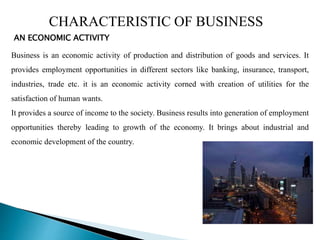
AN ECONOMIC ACTIVITY
Business is an economic activity of production and distribution of goods and services. It
provides employment opportunities in different sectors like banking, insurance, transport,
industries, trade etc. it is an economic activity corned with creation of utilities for the
satisfaction of human wants.
It provides a source of income to the society. Business results into generation of employment
opportunities thereby leading to growth of the economy. It brings about industrial and
economic development of the country.
2. Buying and Selling:
The basic activity of any business is trading. The business involves buying of raw
material, plants and machinery, stationary, property etc. On the other hand, it sells the
finished products to the consumers, wholesaler, retailer etc. Business makes available
various goods and services to the different sections of the society.
3. Continuous process:
Business is not a single time activity. It is a continuous process of production and distribution
of goods and services. A single transaction of trade cannot be termed as a business. A
business should be conducted regularly in order to grow and gain regular returns.
Business should continuously involve in research and developmental activities to gain
competitive advantage. A continuous improvement strategy helps to increase profitability of
the business firm.
4. Profit Motive:
Profit is an indicator of success and failure of business. It is the difference between income and
expenses of the business. The primary goal of a business is usually to obtain the highest
possible level of profit through the production and sale of goods and services. It is a return on
investment. Profit acts as a driving force behind all business activities.
Profit is required for survival, growth and expansion of the business. It is clear that every
business operates to earn profit. Business has many goals but profit making is the primary goal
of every business. It is required to create economic growth.
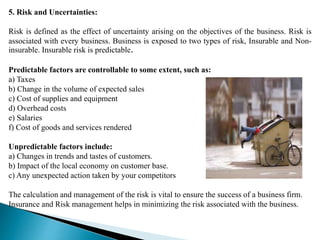
5. Risk and Uncertainties:
Risk is defined as the effect of uncertainty arising on the objectives of the business. Risk is
associated with every business. Business is exposed to two types of risk, Insurable and Non-
insurable. Insurable risk is predictable.
Predictable factors are controllable to some extent, such as:
a) Taxes
b) Change in the volume of expected sales
c) Cost of supplies and equipment
d) Overhead costs
e) Salaries
f) Cost of goods and services rendered
Unpredictable factors include:
a) Changes in trends and tastes of customers.
b) Impact of the local economy on customer base.
c) Any unexpected action taken by your competitors
The calculation and management of the risk is vital to ensure the success of a business firm.
Insurance and Risk management helps in minimizing the risk associated with the business.
6. Customer satisfaction:
The phase of business has changed from traditional concept to modern concept. Now a
day, business adopts a consumer-oriented approach. Customer satisfaction is the ultimate
aim of all economic activities.
Modern business believes in satisfying the customers by providing quality product at a
reasonable price. It emphasize not only on profit but also on customer satisfaction.
Consumers are satisfied only when they get real value for their purchase
The purpose of the business is to create and retain the customers. The ability to identify
and satisfy the customers is the prime ingredient for the business success.
7. Creative and Dynamic:
Modern business is creative and dynamic in nature. Business firm has to come out with
creative ideas, approaches and concepts for production and distribution of goods and
services. It means to bring things in fresh, new and inventive way.
One has to be innovative because the business operates under constantly changing
economic, social and technological environment. Business should also come out with new
products to satisfy the growing needs of the consumers.
8. Social Activity:
Business is a socio-economic activity. Both business and society are interdependent. Modern
business runs in the area of social responsibility.
Business has some responsibility towards the society and in turn it needs the support of
various social groups like investors, employees, customers, creditors etc. by making goods
available to various sections of the society, business performs an important social function
and meets social needs. Business needs support of different section of the society for its
proper functioning.
9. Government control:
Business organizations are subject to government control. They have to follow certain rules and
regulations enacted by the government. Government ensures that the business is conducted for
social good by keeping effective supervision and control by enacting and amending laws and
rules from time to time.
Some important acts framed by the government include:
i. The Competition Act, 2002
ii. Foreign Exchange Management Act, 1999
iii. The Environment Act, 1986
iv. Indian Companies Act, 1956
v. Consumer protection Act
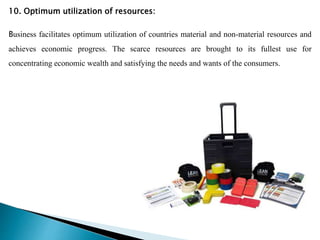
10. Optimum utilization of resources:
Business facilitates optimum utilization of countries material and non-material resources and
achieves economic progress. The scarce resources are brought to its fullest use for
concentrating economic wealth and satisfying the needs and wants of the consumers.
INDUSTRY
The production side of business activity is referred as industry. It is a business
activity, which is related to the raising, producing, processing or manufacturing
of products.
Expansion of trade and commerce depends on industrial growth. It represents
the supply side of market. The term industry refers to that part of the business
activity which is concerned with:
Extracting materials like coal, iron ore, petroleum (called extractive industry);
 Processing and converting raw materials into finished products like soap,
bread, fans, machines, cement (called manufacturing industry); and
 Construction activity like buildings, dams, bridges, roads (called construction
industry).
Thus, the activities of human beings engaged in extraction, production,
processing, construction and fabrication of goods come under industry.
In another sense, industry means a group of factories usually specializing
in a particular product line.
For example, all those factories which produce cotton textiles together
constitute cotton textile industry.
All the cement factories together constitute cement industry.
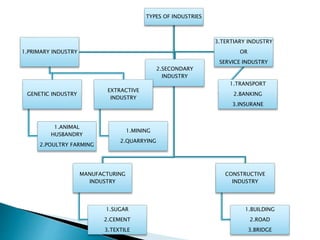
CLASSIFICATION / TYPES OF INDUSTRIES
There are various types of industries. These are mentioned as follows:-
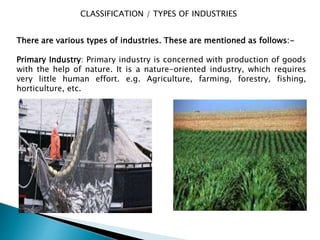
Primary Industry: Primary industry is concerned with production of goods
with the help of nature. It is a nature-oriented industry, which requires
very little human effort. e.g. Agriculture, farming, forestry, fishing,
horticulture, etc.
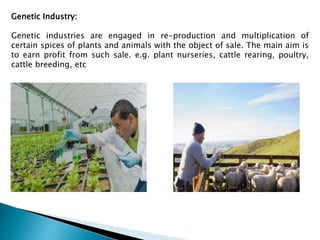
Genetic Industry:
Genetic industries are engaged in re-production and multiplication of
certain spices of plants and animals with the object of sale. The main aim is
to earn profit from such sale. e.g. plant nurseries, cattle rearing, poultry,
cattle breeding, etc
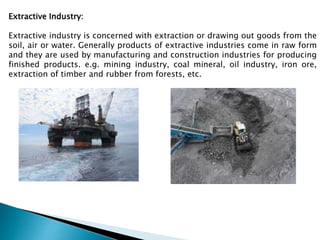
Extractive Industry:
Extractive industry is concerned with extraction or drawing out goods from the
soil, air or water. Generally products of extractive industries come in raw form
and they are used by manufacturing and construction industries for producing
finished products. e.g. mining industry, coal mineral, oil industry, iron ore,
extraction of timber and rubber from forests, etc.
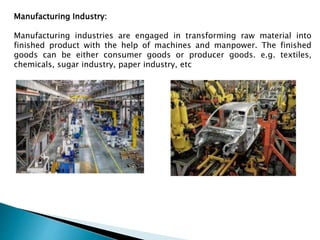
Manufacturing Industry:
Manufacturing industries are engaged in transforming raw material into
finished product with the help of machines and manpower. The finished
goods can be either consumer goods or producer goods. e.g. textiles,
chemicals, sugar industry, paper industry, etc
Construction Industry:
Construction industries take up the work of construction of buildings,
bridges, roads, dams, canals, etc. This industry is different from all other
types of industry because in case of other industries goods can be produced
at one place and sold at another place. But goods produced and sold by
constructive industry are erected at one place.
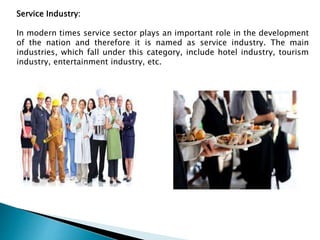
Service Industry:
In modern times service sector plays an important role in the development
of the nation and therefore it is named as service industry. The main
industries, which fall under this category, include hotel industry, tourism
industry, entertainment industry, etc.
TYPES OF INDUSTRIES
MANUFACTURING
INDUSTRY
1.SUGAR
2.CEMENT
3.TEXTILE
2.SECONDARY
INDUSTRY
CONSTRUCTIVE
INDUSTRY
1.BUILDING
2.ROAD
3.BRIDGE
1.PRIMARY INDUSTRY
GENETIC INDUSTRY
1.ANIMAL
HUSBANDRY
2.POULTRY FARMING
EXTRACTIVE
INDUSTRY
1.MINING
2.QUARRYING
3.TERTIARY INDUSTRY
OR
SERVICE INDUSTRY
1.TRANSPORT
2.BANKING
3.INSURANE
Business and industry

Business and industry

  • 1.
    BUSINESS & INDUSTRY AsstProfessor Geeta Rajan Christ college pune
  • 2.
    BUSINESS Business is establishedwhen an individual or a group of individuals decide to start something on their own. Legal formalities like registration are to be fulfilled. Business involves production and exchange of goods and services For example-production of soaps, shampoos, TV sets etc. The person who performs the activities related to business is called a businessman. A firm established to carry a business activity is called a business enterprise. No specific qualifications are required. Amount of capital depends upon the type of business. Business activities are performed in order to earn profit. Profit is the main motive behind such activities. Risk of loss is also there because wherever profit exists, risk is involved. One can transfer his business by following certain legal formalities.
  • 3.
    Industry on theother hand is that part of business activities which works for the production of want satisfying goods with the help of material resources readily available. It creates form utility of goods. The work of the industry is to use the natural resources and bring them into such a form that is useful for further use For example—farms, factories, mines etc. Goods that fulfill the needs of the people and are convenient to them are often produced. In the industry, human beings are engaged in activities of extraction, production, processing, construction and fabrication of products.
  • 4.
    B. O. WHEELER Businessis an institution organized and operated to provide goods and services to society under the incentive of private gain. L. H. HANEY Business may be defined as human activity directed towards producing or acquiring wealth through buying or selling goods. Dr.W.R.SPRIEGEL Business may be defined as human activity directed towards producing or acquiring wealth through buying or selling goods.
  • 5.
    CHARACTERISTIC OF BUSINESS ANECONOMIC ACTIVITY Business is an economic activity of production and distribution of goods and services. It provides employment opportunities in different sectors like banking, insurance, transport, industries, trade etc. it is an economic activity corned with creation of utilities for the satisfaction of human wants. It provides a source of income to the society. Business results into generation of employment opportunities thereby leading to growth of the economy. It brings about industrial and economic development of the country.
  • 6.
    2. Buying andSelling: The basic activity of any business is trading. The business involves buying of raw material, plants and machinery, stationary, property etc. On the other hand, it sells the finished products to the consumers, wholesaler, retailer etc. Business makes available various goods and services to the different sections of the society.
  • 7.
    3. Continuous process: Businessis not a single time activity. It is a continuous process of production and distribution of goods and services. A single transaction of trade cannot be termed as a business. A business should be conducted regularly in order to grow and gain regular returns. Business should continuously involve in research and developmental activities to gain competitive advantage. A continuous improvement strategy helps to increase profitability of the business firm.
  • 8.
    4. Profit Motive: Profitis an indicator of success and failure of business. It is the difference between income and expenses of the business. The primary goal of a business is usually to obtain the highest possible level of profit through the production and sale of goods and services. It is a return on investment. Profit acts as a driving force behind all business activities. Profit is required for survival, growth and expansion of the business. It is clear that every business operates to earn profit. Business has many goals but profit making is the primary goal of every business. It is required to create economic growth.
  • 9.
    5. Risk andUncertainties: Risk is defined as the effect of uncertainty arising on the objectives of the business. Risk is associated with every business. Business is exposed to two types of risk, Insurable and Non- insurable. Insurable risk is predictable. Predictable factors are controllable to some extent, such as: a) Taxes b) Change in the volume of expected sales c) Cost of supplies and equipment d) Overhead costs e) Salaries f) Cost of goods and services rendered Unpredictable factors include: a) Changes in trends and tastes of customers. b) Impact of the local economy on customer base. c) Any unexpected action taken by your competitors The calculation and management of the risk is vital to ensure the success of a business firm. Insurance and Risk management helps in minimizing the risk associated with the business.
  • 10.
    6. Customer satisfaction: Thephase of business has changed from traditional concept to modern concept. Now a day, business adopts a consumer-oriented approach. Customer satisfaction is the ultimate aim of all economic activities. Modern business believes in satisfying the customers by providing quality product at a reasonable price. It emphasize not only on profit but also on customer satisfaction. Consumers are satisfied only when they get real value for their purchase The purpose of the business is to create and retain the customers. The ability to identify and satisfy the customers is the prime ingredient for the business success.
  • 11.
    7. Creative andDynamic: Modern business is creative and dynamic in nature. Business firm has to come out with creative ideas, approaches and concepts for production and distribution of goods and services. It means to bring things in fresh, new and inventive way. One has to be innovative because the business operates under constantly changing economic, social and technological environment. Business should also come out with new products to satisfy the growing needs of the consumers.
  • 12.
    8. Social Activity: Businessis a socio-economic activity. Both business and society are interdependent. Modern business runs in the area of social responsibility. Business has some responsibility towards the society and in turn it needs the support of various social groups like investors, employees, customers, creditors etc. by making goods available to various sections of the society, business performs an important social function and meets social needs. Business needs support of different section of the society for its proper functioning.
  • 13.
    9. Government control: Businessorganizations are subject to government control. They have to follow certain rules and regulations enacted by the government. Government ensures that the business is conducted for social good by keeping effective supervision and control by enacting and amending laws and rules from time to time. Some important acts framed by the government include: i. The Competition Act, 2002 ii. Foreign Exchange Management Act, 1999 iii. The Environment Act, 1986 iv. Indian Companies Act, 1956 v. Consumer protection Act
  • 14.
    10. Optimum utilizationof resources: Business facilitates optimum utilization of countries material and non-material resources and achieves economic progress. The scarce resources are brought to its fullest use for concentrating economic wealth and satisfying the needs and wants of the consumers.
  • 15.
    INDUSTRY The production sideof business activity is referred as industry. It is a business activity, which is related to the raising, producing, processing or manufacturing of products. Expansion of trade and commerce depends on industrial growth. It represents the supply side of market. The term industry refers to that part of the business activity which is concerned with: Extracting materials like coal, iron ore, petroleum (called extractive industry);  Processing and converting raw materials into finished products like soap, bread, fans, machines, cement (called manufacturing industry); and  Construction activity like buildings, dams, bridges, roads (called construction industry).
  • 16.
    Thus, the activitiesof human beings engaged in extraction, production, processing, construction and fabrication of goods come under industry. In another sense, industry means a group of factories usually specializing in a particular product line. For example, all those factories which produce cotton textiles together constitute cotton textile industry. All the cement factories together constitute cement industry.
  • 17.
    CLASSIFICATION / TYPESOF INDUSTRIES There are various types of industries. These are mentioned as follows:- Primary Industry: Primary industry is concerned with production of goods with the help of nature. It is a nature-oriented industry, which requires very little human effort. e.g. Agriculture, farming, forestry, fishing, horticulture, etc.
  • 18.
    Genetic Industry: Genetic industriesare engaged in re-production and multiplication of certain spices of plants and animals with the object of sale. The main aim is to earn profit from such sale. e.g. plant nurseries, cattle rearing, poultry, cattle breeding, etc
  • 19.
    Extractive Industry: Extractive industryis concerned with extraction or drawing out goods from the soil, air or water. Generally products of extractive industries come in raw form and they are used by manufacturing and construction industries for producing finished products. e.g. mining industry, coal mineral, oil industry, iron ore, extraction of timber and rubber from forests, etc.
  • 20.
    Manufacturing Industry: Manufacturing industriesare engaged in transforming raw material into finished product with the help of machines and manpower. The finished goods can be either consumer goods or producer goods. e.g. textiles, chemicals, sugar industry, paper industry, etc
  • 21.
    Construction Industry: Construction industriestake up the work of construction of buildings, bridges, roads, dams, canals, etc. This industry is different from all other types of industry because in case of other industries goods can be produced at one place and sold at another place. But goods produced and sold by constructive industry are erected at one place.
  • 22.
    Service Industry: In moderntimes service sector plays an important role in the development of the nation and therefore it is named as service industry. The main industries, which fall under this category, include hotel industry, tourism industry, entertainment industry, etc.
  • 23.
    TYPES OF INDUSTRIES MANUFACTURING INDUSTRY 1.SUGAR 2.CEMENT 3.TEXTILE 2.SECONDARY INDUSTRY CONSTRUCTIVE INDUSTRY 1.BUILDING 2.ROAD 3.BRIDGE 1.PRIMARYINDUSTRY GENETIC INDUSTRY 1.ANIMAL HUSBANDRY 2.POULTRY FARMING EXTRACTIVE INDUSTRY 1.MINING 2.QUARRYING 3.TERTIARY INDUSTRY OR SERVICE INDUSTRY 1.TRANSPORT 2.BANKING 3.INSURANE