ASSESSMENT
Dr. Manjeet Yadav
Assistant Professor
R.L.S. College of Education, Sidhrawali
https://www.mentimeter.com/app/presentation/alnusuyp3w2
3rog4titopy7ozg4cha22/bbbxxvvc6ijc/edit
WHAT IS ASSESSMENT?
• the process of determining to what extent
the educational objectives are being
realized.
• systematic examination of educational &
social progress.
• assessing the strengths & weaknesses of
programs, policies, students, etc. to improve
their effectiveness.
How well did we do?
How much did we do?
PURPOSES OF ASSESSMENT
• To provide short-term goals to the students.
• To clarify the intended learning outcome.
• To determine the level of knowledge &
understanding in students.
• To diagnose the strengths & weakness of
students.
PURPOSES OF ASSESSMENT
CONT…
• To encourage students' learning by measuring
their achievement.
• To provide information to students for
overcoming learning difficulties.
• To estimate the effectiveness of the
instructional media used.
PURPOSES OF ASSESSMENT
CONT…
• To assess the nonscholastic domains of the
student’s personality.
• To assess the student’s progress throughout
the year.
• To ascertain if the teaching strategies are
effective or not.
• To improve curriculum in light of recent
advances.
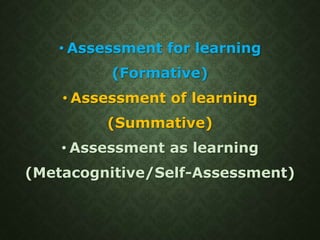
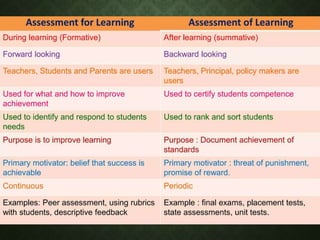
• Assessment for learning
(Formative)
• Assessment of learning
(Summative)
• Assessment as learning
(Metacognitive/Self-Assessment)
TYPES OF ASSESSMENT
BASED ON TIME
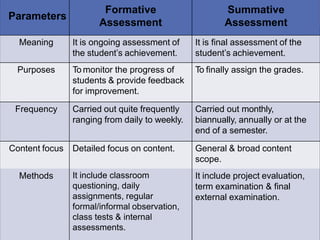
• Formative
• Summative
Parameters
Formative
Assessment
Summative
Assessment
Meaning It is ongoing assessment of
the student’s achievement.
It is final assessment of the
student’s achievement.
Purposes To monitor the progress of
students & provide feedback
for improvement.
To finally assign the grades.
Frequency Carried out quite frequently
ranging from daily to weekly.
Carried out monthly,
biannually, annually or at the
end of a semester.
Content focus Detailed focus on content. General & broad content
scope.
Methods It include classroom
questioning, daily
assignments, regular
formal/informal observation,
class tests & internal
assessments.
It include project evaluation,
term examination & final
external examination.
BASED ON MANNER OF RESULT
INTERPRETATION
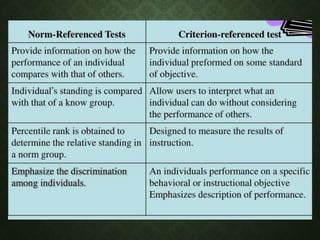
• Norm-Referenced
• Criterion-Referenced
CRITERIAFOR SELECTIONOF ASSESSMENT
TECHNIQUE/METHOD
Congruent with educational
objectives
Objectivity
Practicability
Constructed on wide
curricular content
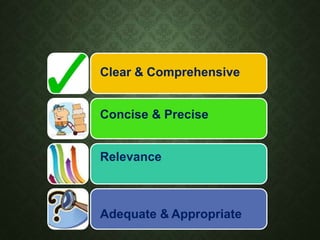
Clear & Comprehensive
Concise & Precise
Relevance
Adequate & Appropriate
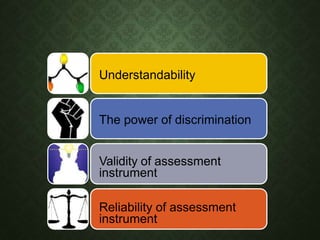
Understandability
The power of discrimination
Validity of assessment
instrument
Reliability of assessment
instrument
TOOLS
https://www.mentimeter.com/app/presentation/alnusuyp3w
23rog4titopy7ozg4cha22/hxbanfxju1fz/edit
• Test
• Exam
• Observation
• Interview
• Questionnaire
• Focus Group Discussion (FGD)
• Self-report Inventories
• Check List
• Rating Scale
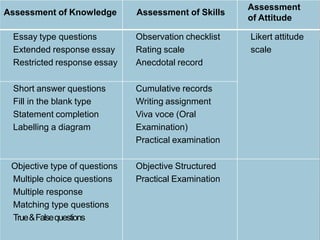
Assessment of Knowledge Assessment of Skills
Assessment
of Attitude
Essay type questions Observation checklist Likert attitude
Extended response essay Rating scale scale
Restricted response essay Anecdotal record
Short answer questions Cumulative records
Fill in the blank type Writing assignment
Statement completion Viva voce (Oral
Labelling a diagram Examination)
Practical examination
Objective type of questions Objective Structured
Multiple choice questions Practical Examination
Multiple response
Matching type questions
True&Falsequestions
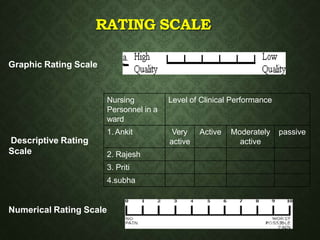
RATING SCALE
Descriptive Rating
Scale
Nursing
Personnel in a
ward
Level of Clinical Performance
1. Ankit Very
active
Active Moderately
active
passive
2. Rajesh
3. Priti
4.subha
Graphic Rating Scale
Numerical Rating Scale
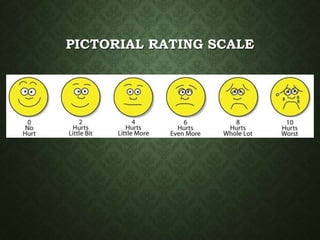
PICTORIAL RATING SCALE
DEVELOP A RATING SCALE FOR ASSESSING THE
OVERALL PERFORMANCE OF YOUR STUDENT IN YOUR
SUBJECT/ CLASS.
Classroom Environment Observation Schedule.pdf
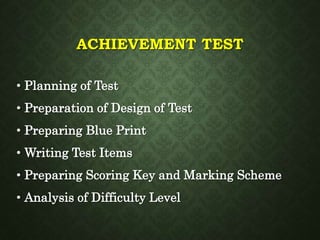
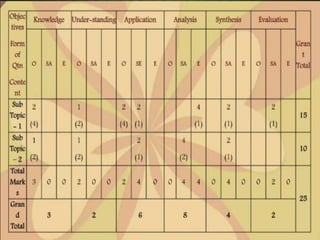
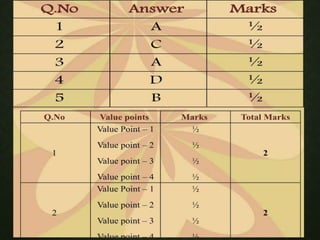
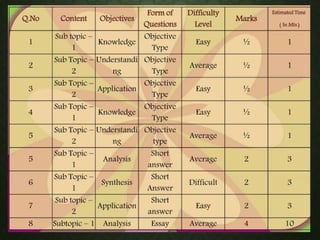
ACHIEVEMENT TEST
• Planning of Test
• Preparation of Design of Test
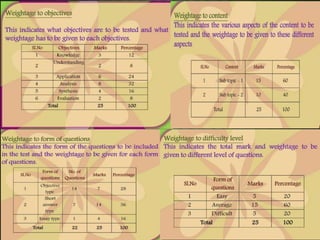
• Preparing Blue Print
• Writing Test Items
• Preparing Scoring Key and Marking Scheme
• Analysis of Difficulty Level
PREPARE AN ACHIEVEMENT
TEST
THANK YOU

Assessment.pptx