Pharmacology 2nd
year D. Pharm
Introduction and scope
of pharmacology
Prepared By,
Miss. Sakshi R. Deogade
(Assistant professor)
Manwatkar College of Pharmacy, Ghodpeth
Physiology
The study of internal processes and functions (Growth, repair , metabolism etc.)
associated with the life is known as physiology.
Disease
Any alteration in life sustaining processes i.e abnormal physiology is called as disease.
Drug
(French: Drouge – a dry herb)
 The substance used for diagnosis, cure or prevention of a disease (abnormal physiology).
 The WHO (1966) given definition “ Drug is any substance or product that is used or is intended to be
used to modify or explore physiological systems or pathological states for the benefit of the recipient.
Pharmacology
(Pharmakon = a drug , Logos = science / study)
 It is science of drugs.
 It mainly deals with effects of drug on living body.
 Pharmacology can be defined as the study of interaction of exogenously administered chemical
molecules with living systems.
 It includes the knowledge of History, Sources, Biochemical and physiological effects,
Mechanism of action, Therapeutics use.
History
 Rudolf Buchheim (first institute of pharmacology 1847)
 Oswald Schmiedeberg (father of pharmacology)
 Ram Nath Chopra (father of Indian pharmacology)
Branches of Pharmacology
1. Pharmacokinetics
(Kinesis – movement)
 What the body does to drug.
 It includes the study of drug Absorption,
Distribution, Metabolism, Excretion (ADME).
2. Pharmacodynamics
(Dynamis – power)
 What the drug does to the body.
 It contains the pharmacological effect of drug on
various organ and their mechanism of action.
4. Toxicology
 It is the study of poisonous effect of drugs and other chemicals.
 It emphasis detection, prevention and treatment of poisoning.
 It also include study of adverse effects of drug.
3. Therapeutics index
 A drug should have maximum therapeutic effectiveness and least toxicity.
 The therapeutics index is a measure of drugs safety .
 It is defines as the ratio between the median lethal dose(LD50) and median effective dose (ED50) of a drug.
h
𝑇 𝑒𝑟𝑎𝑝𝑒𝑢𝑡𝑖𝑐 𝐼𝑛𝑑𝑒𝑥 (𝑇𝐼 )=
𝐿𝐷 50
𝐸𝐷50
LD50 : the dose of drug that causes toxicity in 50% of
population
ED50 : the dose of drug that produces desired effect in
50% of population
5. Pharmacotherapeutics
(Pharmakon = a drug , Therapeutics = to treat / art of medicine)
 Therapeutics means any measure which is taken in treatment of disease.
Eg. Psychotherapy, Radiotherapy, Physiotherapy
 Pharmacotherapy is the use of drugs in prevention and treatment of disease.
 Application of pharmacological information together with knowledge of the disease for its prevention or
cure.
6. Chemotherapy
 It is the treatment of systemic infection/malignancy with specific drugs that have selective toxicity for
the infecting organism/ malignant cell with no/ minimal effects on the host cells.
 Chemotherapeutics agents are used to cure infectious diseases and cancer.
Classification of drug
On the basis of pharmacological drugs can be divided into the following three main groups :
1. Chemotherapeutic Agents
These are the agents are used to cure infectious diseases and cancer
Eg. Sulfa drugs, Antibiotics, Antivirus, Anticancer
2. Pharmacodynamic Agents
These are the agents are used to treat non-infectious disease.
Designed to have pharmacodynamic effects in the recipient.
Eg. Cholinergic, Adrenergic, Hallucinogenic, sedatives
3. Miscellaneous Agents
Eg. Narcotic analgesic, Local anesthetics
Sources of drugs
1. Plants
• Alkaloids : Vinblastin, Morphine, Atropine
• Glycosides : Strophanthin, Digitalis
• Oils : castor oil, clove oil
• Resins : Oleogum resins
• Gums : Agar, Acacia, Tragacanth (Pharmaceutical aids)
• Tannins : Catechu, Tannic acid
2. Animal
Eg. Insulin, Heparin, Thyroid extract
3. Mineral
Eg. Magnesium sulphate, Liquid paraffin, Kaolin, Gold
• Mineral oils : Petroeleum
4. Micro-organisms
Eg. Penicillin, Rifampicin, Streptomycin
5. Synthetic
Eg. Sulphonamide, Aspirin, Corticosteroids
6. Recombinant DNA technology (Biotechnology)
Eg. Human growth hormone, Insulin from E.coli
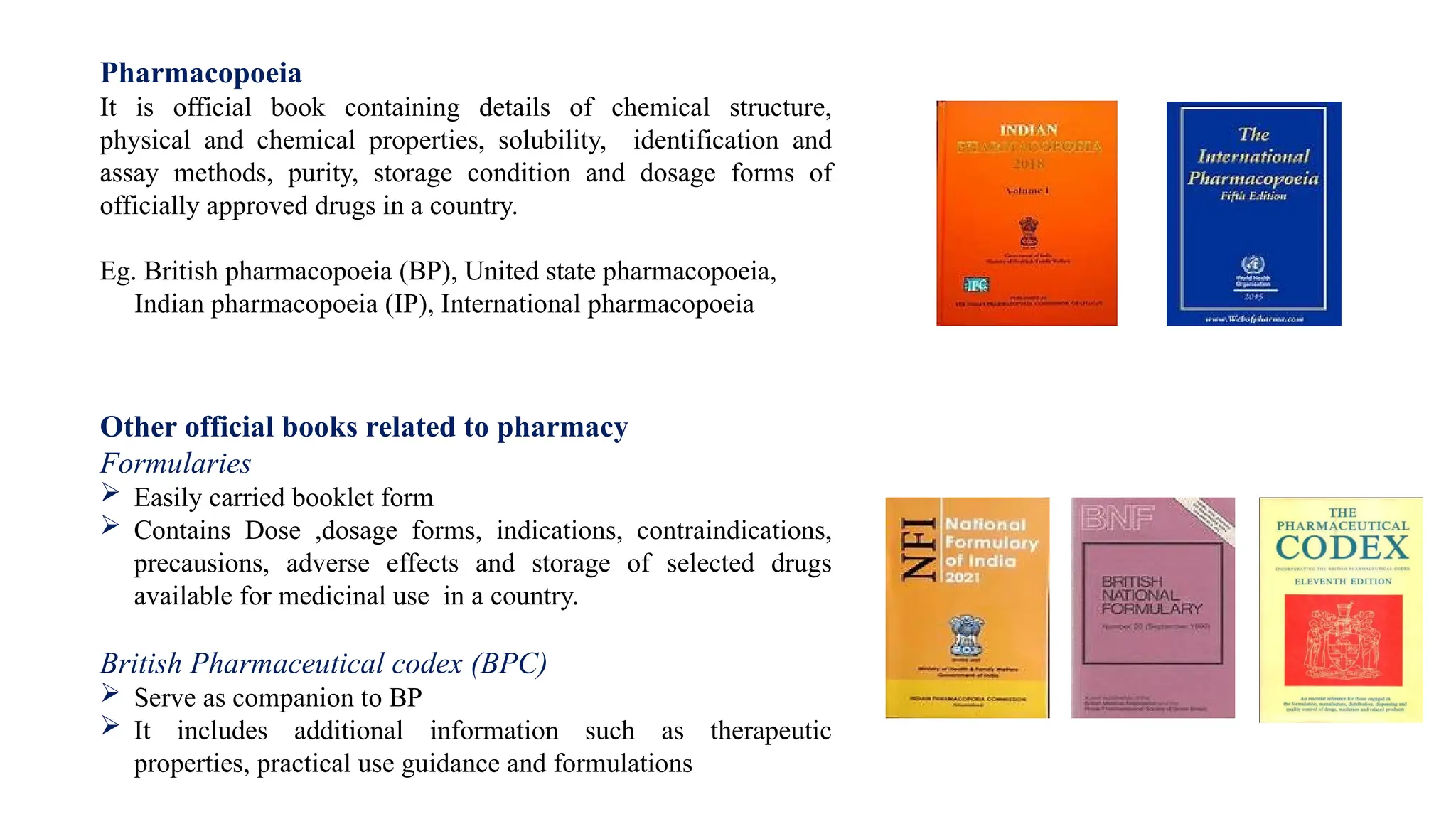
Pharmacopoeia
It is official book containing details of chemical structure,
physical and chemical properties, solubility, identification and
assay methods, purity, storage condition and dosage forms of
officially approved drugs in a country.
Eg. British pharmacopoeia (BP), United state pharmacopoeia,
Indian pharmacopoeia (IP), International pharmacopoeia
Other official books related to pharmacy
Formularies
 Easily carried booklet form
 Contains Dose ,dosage forms, indications, contraindications,
precausions, adverse effects and storage of selected drugs
available for medicinal use in a country.
British Pharmaceutical codex (BPC)
 Serve as companion to BP
 It includes additional information such as therapeutic
properties, practical use guidance and formulations
THANK
YOU !!

Introduction & scope of Pharmacology 2nd yr.pptx

  • 1.
    Pharmacology 2nd year D.Pharm Introduction and scope of pharmacology Prepared By, Miss. Sakshi R. Deogade (Assistant professor) Manwatkar College of Pharmacy, Ghodpeth
  • 2.
    Physiology The study ofinternal processes and functions (Growth, repair , metabolism etc.) associated with the life is known as physiology. Disease Any alteration in life sustaining processes i.e abnormal physiology is called as disease. Drug (French: Drouge – a dry herb)  The substance used for diagnosis, cure or prevention of a disease (abnormal physiology).  The WHO (1966) given definition “ Drug is any substance or product that is used or is intended to be used to modify or explore physiological systems or pathological states for the benefit of the recipient.
  • 3.
    Pharmacology (Pharmakon = adrug , Logos = science / study)  It is science of drugs.  It mainly deals with effects of drug on living body.  Pharmacology can be defined as the study of interaction of exogenously administered chemical molecules with living systems.  It includes the knowledge of History, Sources, Biochemical and physiological effects, Mechanism of action, Therapeutics use. History  Rudolf Buchheim (first institute of pharmacology 1847)  Oswald Schmiedeberg (father of pharmacology)  Ram Nath Chopra (father of Indian pharmacology)
  • 4.
    Branches of Pharmacology 1.Pharmacokinetics (Kinesis – movement)  What the body does to drug.  It includes the study of drug Absorption, Distribution, Metabolism, Excretion (ADME). 2. Pharmacodynamics (Dynamis – power)  What the drug does to the body.  It contains the pharmacological effect of drug on various organ and their mechanism of action.
  • 5.
    4. Toxicology  Itis the study of poisonous effect of drugs and other chemicals.  It emphasis detection, prevention and treatment of poisoning.  It also include study of adverse effects of drug. 3. Therapeutics index  A drug should have maximum therapeutic effectiveness and least toxicity.  The therapeutics index is a measure of drugs safety .  It is defines as the ratio between the median lethal dose(LD50) and median effective dose (ED50) of a drug. h 𝑇 𝑒𝑟𝑎𝑝𝑒𝑢𝑡𝑖𝑐 𝐼𝑛𝑑𝑒𝑥 (𝑇𝐼 )= 𝐿𝐷 50 𝐸𝐷50 LD50 : the dose of drug that causes toxicity in 50% of population ED50 : the dose of drug that produces desired effect in 50% of population
  • 6.
    5. Pharmacotherapeutics (Pharmakon =a drug , Therapeutics = to treat / art of medicine)  Therapeutics means any measure which is taken in treatment of disease. Eg. Psychotherapy, Radiotherapy, Physiotherapy  Pharmacotherapy is the use of drugs in prevention and treatment of disease.  Application of pharmacological information together with knowledge of the disease for its prevention or cure. 6. Chemotherapy  It is the treatment of systemic infection/malignancy with specific drugs that have selective toxicity for the infecting organism/ malignant cell with no/ minimal effects on the host cells.  Chemotherapeutics agents are used to cure infectious diseases and cancer.
  • 7.
    Classification of drug Onthe basis of pharmacological drugs can be divided into the following three main groups : 1. Chemotherapeutic Agents These are the agents are used to cure infectious diseases and cancer Eg. Sulfa drugs, Antibiotics, Antivirus, Anticancer 2. Pharmacodynamic Agents These are the agents are used to treat non-infectious disease. Designed to have pharmacodynamic effects in the recipient. Eg. Cholinergic, Adrenergic, Hallucinogenic, sedatives 3. Miscellaneous Agents Eg. Narcotic analgesic, Local anesthetics
  • 8.
    Sources of drugs 1.Plants • Alkaloids : Vinblastin, Morphine, Atropine • Glycosides : Strophanthin, Digitalis • Oils : castor oil, clove oil • Resins : Oleogum resins • Gums : Agar, Acacia, Tragacanth (Pharmaceutical aids) • Tannins : Catechu, Tannic acid 2. Animal Eg. Insulin, Heparin, Thyroid extract 3. Mineral Eg. Magnesium sulphate, Liquid paraffin, Kaolin, Gold • Mineral oils : Petroeleum 4. Micro-organisms Eg. Penicillin, Rifampicin, Streptomycin 5. Synthetic Eg. Sulphonamide, Aspirin, Corticosteroids 6. Recombinant DNA technology (Biotechnology) Eg. Human growth hormone, Insulin from E.coli
  • 9.
    Pharmacopoeia It is officialbook containing details of chemical structure, physical and chemical properties, solubility, identification and assay methods, purity, storage condition and dosage forms of officially approved drugs in a country. Eg. British pharmacopoeia (BP), United state pharmacopoeia, Indian pharmacopoeia (IP), International pharmacopoeia Other official books related to pharmacy Formularies  Easily carried booklet form  Contains Dose ,dosage forms, indications, contraindications, precausions, adverse effects and storage of selected drugs available for medicinal use in a country. British Pharmaceutical codex (BPC)  Serve as companion to BP  It includes additional information such as therapeutic properties, practical use guidance and formulations
  • 10.