Introduction to Pharmacology
Objectives
• Discuss the terminologies related to pharmacology
• Discuss the history of pharmacology briefly
• Identify the purposes of medication
• Identify the source of medication
• Discuss the classification of drugs
• Describe the three type of drug supply system.
• Discuss the drugs standards and legislation.
• Identify resource to collect and utilize drug information.
• Learn to prepare drugs cards
• Definition: Pharmacology is the science that deals with
the study of drugs and their interaction with the living
systems.
• The word Pharmacology is derived from Greek –
pharmacon means drug and logos means study.
Pharmacology
Cont…
• In actual use, however, its meaning is limited to the study of
the actions of drugs.
• Pharmacology has been defined as “an experimental science
which has for its purpose the study of changes brought about
in living organisms by chemically acting substances (with the
exception of foods), whether used for therapeutic purposes or
not.”
Cont….
• Pharmacology studies the effects of drugs and how they exert
their effects.
• There is a distinction between what a drug does and how it
acts.
• Thus, amoxicillin cures a strep throat, and cimetidine
promotes the healing of duodenal ulcers.
• Pharmacology asks “How”? Amoxicillin inhibits the synthesis
of cell wall mucopeptide by the bacteria that cause the
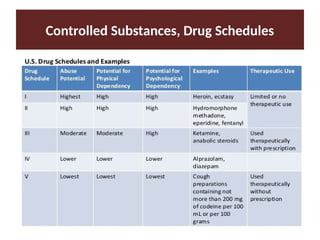
infection, and cimetidine inhibits gastric acid secretion by its
antagonist action on histamine H2 receptors
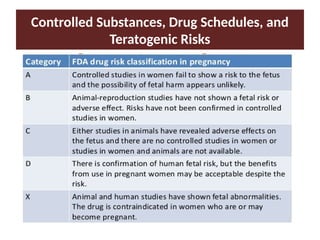
Scope Of Pharmacology
• The scope of Pharmacology is rapidly expanding and
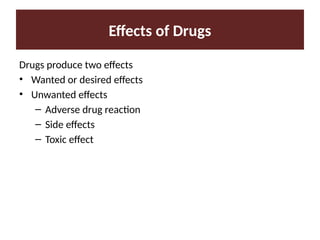
Provides the rational bases for therapeutic use of
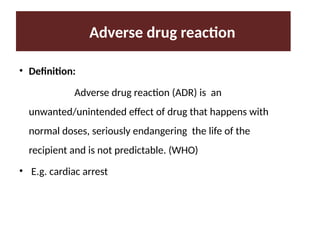
drug.
• On the basis of study of drug it is divided into two
branches .
Branches of Pharmacology
Basic Pharmacology : the study of drugs in isolated
tissues animals and other related living beings such as
bacteria and viruses for experimental work is called
basic Pharmacology.
Branches of Pharmacology
Clinical Pharmacology: The study of drugs in human
beings is called clinical pharmacology.
OR
• The study of drugs in animals for treatment of
diseases is also called clinical pharmacology.
General Definition of Drug
• Any chemical agent that is used for diagnosis,
prevention, treatment and curement of disease is
called drug.
• This disease oriented definition of drug is not
applicable to some drugs such as oral contraceptives
and general anesthetics etc.
WHO definition of drug
• In 1966 WHO define drug as: “Any agent that is used
or intended to be used for the treatment of disease
or modifying pathological/physiological condition or
to explore pathological/physiological condition is
called drug”.
Basic definitions
• Drug means any substance which change the physiology of
cell tissue, organ, or organism.
• Medicine: Whenever, a drug is formulated into a suitable
dosage form for prevention, cure, and diagnose of a disease in
a proper dose.
• Dose means the amount of medicine taken
• Dosage form means the physical form of the medicines
(solids, liquids, gas etc.)
Cont…
• Therapeutics: Therapeutics deals with the use of drugs in the
prevention and treatment of disease.
• Toxicology: Toxicology deals with the adverse effect of the
drug and also the study of poisons, i.e detection ,prevention
and treatment of poisoning. (Toxicon =poison in greek.
Cont…….
• Pharmacodynamics means the mechanism by which the drug
exerts its effect. For example, how aspirin work as analgesic.
What the drug does to the body.
• Pharmacokinetics means the movement of drugs within the
body (absorption, distribution, biotransformation, and
excretion). What the body does to the drug.
• Over the counter (OTC) medicine: those medicines for which
the physician prescription is not required. For examples,
analgesics, antacids.
• Analgesic means those medicines which are used for pain
• Antipyretics means those drugs which are used for fever
Cont……
• Idiosyncratic means unexpected drug reaction
• Teratogenic means harmful effects of drugs on the fetus
• Synergism means when the combination of drugs increase the
effect
• Antagonism means when the combination of drugs decreases
the effects
• Patient compliance: The extent to which the patient follows the
clinical prescription
Cont…….
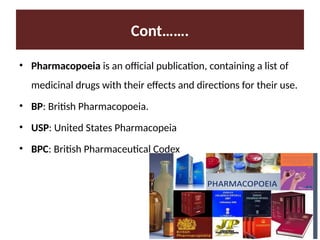
• Pharmacopoeia is an official publication, containing a list of
medicinal drugs with their effects and directions for their use.
• BP: British Pharmacopoeia.
• USP: United States Pharmacopeia
• BPC: British Pharmaceutical Codex
Cont…….
• Active ingredient means biologically active substance which
produce effect
• An excipient is a pharmacologically inactive substance
formulated alongside the active pharmaceutical ingredient of
a medication e.g.. Cellulose derivatives
• Purposes served by excipients:
– Provide bulk to the formulation. (Fillers, Diluent)
– Facilitate drug absorption or solubility and other
pharmacokinetic considerations.(Disintegrates)
– Provide stability and prevent from denaturation. (Binders,
Preservatives)
Cont…….
• Efficacy means maximum effect that a drug can produce
regardless of dose.
• Potency means amount of a drug that is needed to produce a
given effect
• Bioavailability is the degree to which or the proportion of the
drug that is available to the site of action or target tissue to
produce the desired effect.
Cont……..
• Half-life (t1/2) is the time taken by the plasma concentration
of the drug to decrease by 50%, or reach half of the original
concentration. Initially, If a drug has plasma concentration
of100 mg/ml and after passing 2 hours it reduces to 50
mg/ml, then the half life would be????..
• Prophylactic agent is any drug that prevents a disease or
illness from occurring (vaccines)
A brief history of pharmacology
• Originating in the 19th century, the discipline makes drug
development possible.
• Pharmacology is one of the cornerstones of the drug
discovery process.
• The birth date of pharmacology is not as clear-cut.
• In the early 19th
century, physiologists performed many
pharmacologic studies.
• François Magendie studied the action of nux vomica (a
strychnine-containing plant drug) on dogs, and showed that
the spinal cord was the site of its convulsant action. His work
was presented to the Paris Academy in 1809.
History Cont…
• In1842, Claude Bernard discovered that the arrow poison
curare acts at the neuromuscular junction to interrupt the
stimulation of muscle by nerve impulses.
• Pharmacology was held to have emerged as a separate
science in 1847, when Rudolf Buchheim was appointed
professor of pharmacology at the University of Dorpat in
Estonia (then a part of Russia).
• Lacking outside funding, Buchheim built a laboratory at his
own expense in the basement of his home. Although
Buchheim is credited with turning the purely descriptive and
empirical study of medicines into an experimental science, his
reputation is overshadowed by that of his student, Oswald
Schmiedeberg.
Oswald Schmiedeberg (1838–1921)
• Oswald Schmiedeberg is generally recognized as the founder of
modern pharmacology.
• Schmiedeberg obtained his medical doctorate in 1866 with a
thesis on the measurement of chloroform in blood.
• In 1872, he became professor of pharmacology at the University
of Strassburg, receiving generous government support in the
form of a magnificent institute of pharmacology.
• He studied the pharmacology of chloroform and chloralhydrate.
• In 1869, Schmiedeberg showed that muscarine evoked the same
effect on the heart as electrical stimulation of the vagus nerve.
• In 1878, he published a classic text, Outline of Pharmacology
• In 1885, he introduced urethane as a hypnotic.
History Cont….
• In the United States, the first chair in pharmacology was
established at the University of Michigan in 1890 under John
Jacob Abel, an American who had trained under
Schmiedeberg.
• In 1893, Abel joined Johns Hopkins University in Baltimore.
• His major accomplishments include the isolation of
epinephrine from adrenal gland extracts (1897–1898),
isolation of histamine from pituitary extract (1919), and
preparation of pure crystalline insulin (1926). His student Reid
Hunt discovered acetylcholine in adrenal extracts in 1906.
• Today, there is a pharmacology department in every college of
medicine or pharmacy.
Purposes of Medication
Medications can be administered for the following purposes
• Diagnostic Purpose: to identify any disease (e.g. Contrast, dyes)
• Prophylaxis: to prevent the occurrence of disease e.g. heparin
to prevent thrombosis and antibiotics to prevent infections
• Therapeutic Purpose: to treat or cure disease / decrease
symptoms, restore normal function or maintain normal function
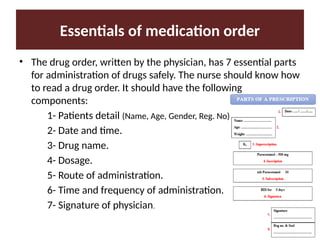
Essentials of medication order
• The drug order, written by the physician, has 7 essential parts
for administration of drugs safely. The nurse should know how
to read a drug order. It should have the following
components:
1- Patients detail (Name, Age, Gender, Reg. No).
2- Date and time.
3- Drug name.
4- Dosage.
5- Route of administration.
6- Time and frequency of administration.
7- Signature of physician.
Types of Medication Orders
• STAT order: needed immediately
• Single order: given only once
• PRN order: given as needed
• Routine orders: given within 2 hours of being written
and carried out on schedule
• Standing order: written in advance carried out under
specific circumstances
Cont…..
• Basic principles (Safety) in medication administration 3 checks and 7
Rights:
– Right patient
– Right drug
– Right dose
– Right route
– Right time
– Right Frequency
– Right Documentation
3 Checks
– Right Documentation
– Right Reason
– Right Response
Sources of Drugs
The sources of drugs could be natural or synthetic ,
NATURAL SOURCES:
• PLANTS, e.g. Atropine, Morphine, Quinine, digoxin, pilocarpine,
Physostigmine.
• ANIMALS e.g. Insulin ,heparin, gonadotropins and antitoxic sera.
• MINERALS, Magnesium sulphate, Aluminum hydroxide, iron,
sulphur and radio active isotopes.
• MICROORGANISMS, Antibacterial agents are obtained from
some bacteria and fungi. we thus have penicillin, cephalosporin,
tetracycline and other antibiotics.
Cont…….
• HUMAN: some drugs are obtained from man ,e.g.
Immunoglobulin from blood, growth hormone from anterior
pituitary and chorionic gonadotropins from the urine of
pregnant woman.
• SYNTHETIC : Most drugs are now synthesized e.g. quinolones,
omeprazole, sulfonamides, pancuronium, neostigmine.
• Genetic Engineering: some are now produced by recombinant
DNA technology e.g. human insulin,
Classifications Drugs
• Drugs can be categorized in a number of ways. In pharmacology,
a drug can be classified by its chemical activity or by the
condition that it treats.
• In general, drugs are classified based on
– Therapeutic classification
– Pharmacologic classification (based on mechanism of action
and mode of action)
– Chemical classification –
– Legal classification (Controlled Substances, Drug Schedules,
and Teratogenic Risks)
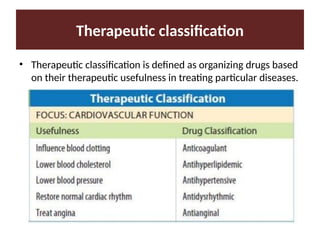
Therapeutic classification
• Therapeutic classification is defined as organizing drugs based
on their therapeutic usefulness in treating particular diseases.
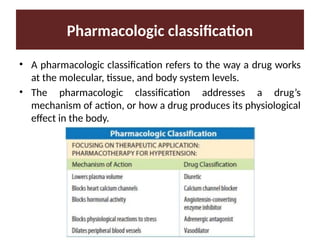
Pharmacologic classification
• A pharmacologic classification refers to the way a drug works
at the molecular, tissue, and body system levels.
• The pharmacologic classification addresses a drug’s
mechanism of action, or how a drug produces its physiological
effect in the body.
Chemical Classification
• The three basic types of drug names are chemical, generic,
and trade name.
• A chemical name is assigned using standard nomenclature
established by the International Union of Pure and Applied
Chemistry (IUPAC).
• A drug has only one chemical name, which is helpful in
predicting a substance’s physical and chemical properties.
Example: Chemical name for aspirin is 2-acetoxybenzoic acid.
Chemical classification
• The generic name of a drug is assigned by the U.S. Adopted Name
Council.
• Generic names are less complicated and easier to remember than
chemical names.
• The Food and Drug Administration (FDA), the official
Pharmacopoeia, and the World Health Organization (WHO),
routinely describe a medication by its generic name.
• A drug’s trade name is assigned by the company marketing the
drug.
• The name is usually selected to be short and easy to remember.
• The trade name is sometimes called the proprietary or product or
brand name.
Legal Classification:
Controlled Substances, Drug Schedules, and
Teratogenic Risks
• Some drugs are frequently abused or have a high potential for
addiction.
• According to law, drugs that have a significant potential for
abuse are placed into five categories called schedules.
• These scheduled drugs are classified according to their
potential for abuse:
– Schedule I drugs have the highest potential for abuse
– Schedule V drugs have the lowest potential for abuse
Controlled Substances, Drug Schedules
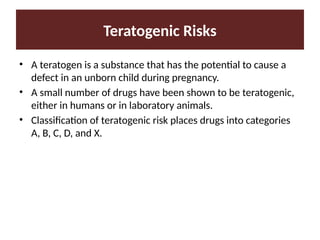
Teratogenic Risks
• A teratogen is a substance that has the potential to cause a
defect in an unborn child during pregnancy.
• A small number of drugs have been shown to be teratogenic,
either in humans or in laboratory animals.
• Classification of teratogenic risk places drugs into categories
A, B, C, D, and X.
Controlled Substances, Drug Schedules, and
Teratogenic Risks
Effects of Drugs
Drugs produce two effects
• Wanted or desired effects
• Unwanted effects
– Adverse drug reaction
– Side effects
– Toxic effect
Adverse drug reaction
• Definition:
Adverse drug reaction (ADR) is an
unwanted/unintended effect of drug that happens with
normal doses, seriously endangering the life of the
recipient and is not predictable. (WHO)
• E.g. cardiac arrest
Side effect
• Side effect is also an unwanted/unintended effect of drug that
happens with normal doses, not seriously endangering the
life of the recipient and is predictable.
• E.g. drowsiness with Cetirizine
Toxic effect
• Toxic effects : drug toxicity occurs when a person has
accumulated too much of a drug in his bloodstream, leading
to adverse effects on the body. Drug toxicity may occur when
the dose given is too high or the liver or kidneys are unable to
remove the drug from the bloodstream, allowing it to
accumulate in the body.
Drugs Supply
• Drugs supply is defined as the system of drug procurement,
storage, and distribution
• Efficient drugs supply systems are integrally linked to strong
health care systems.
• Adequate human resources, sustainable financing,
comprehensive information systems, and coordinated
healthcare partners and institutions are key components to
ensure uninterrupted availability and accessibility of essential
medicines
According to WHO, an efficient drugs supply system should
undertake the following function
• Selection of Essential Medicines
• Quantification and Forecasting Demand for Medicines
• Procurement of medicines
• Storage of Essential Medicines
• Distribution of medicines
Drugs Supply
Drugs Distribution in the Hospitals
• Drugs distribution is defined as: “physical transfer of
medicines from storage area in the hospital to the patient’s
bedside.”
• This involves two types of drugs distribution. They are:
1. Inpatient
2. Outpatient
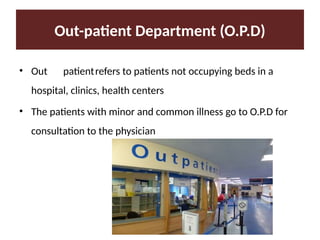
Out-patient Department (O.P.D)
• Out patientrefers to patients not occupying beds in a
hospital, clinics, health centers
• The patients with minor and common illness go to O.P.D for
consultation to the physician
Classification of Out-Patients
• The patients visiting the OPDs may categorized as
1. General Patients e.g. diabetic patients, hypertensive
patients
2. Emergency Patients e.g. heart attack, epilepsy patients
3. Referred Patients e.g. Patients suffering from eye, ear,
nose and teeth disorders
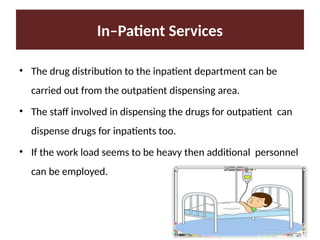
In–Patient Services
• The drug distribution to the inpatient department can be
carried out from the outpatient dispensing area.
• The staff involved in dispensing the drugs for outpatient can
dispense drugs for inpatients too.
• If the work load seems to be heavy then additional personnel
can be employed.
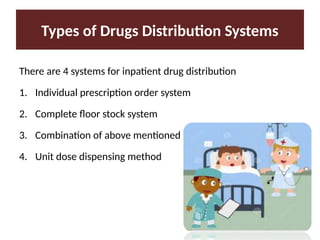
Types of Drugs Distribution Systems
There are 4 systems for inpatient drug distribution
1. Individual prescription order system
2. Complete floor stock system
3. Combination of above mentioned
4. Unit dose dispensing method
1) Individual Prescription Order System
• In this system, the physician write the prescription and ask the
patient or the relative of the patient to get the medicine from
any licensed medical store or hospital dispensary by paying
own charge
• This system is mainly used in small or private hospitals
because of its economic consideration and reduced
manpower requirements
Advantages:
• Less numbers of staff is required
• All medication orders are directly reviewed by pharmacist
• It provides a closer connection among pharmacist, physician,
nurse and the patient
• It provides closer control of inventory
Disadvantages
• There may be possible delay in obtaining the required
medications for administration to the patient
• Emergency medicines are not quickly supplied
• Increase in the cost to the patient
2) Complete Floor Stock System
• Drugs are stored at the nursing station and are administered
by a nurse according to the chart order of the physician
• Only commonly used drugs are stocked on the floor
Advantages:
• The drugs are readily available for administration
• Minimum return of drugs
• Reduced in-patient prescription orders
• Reduction in number of pharmacy personnel required
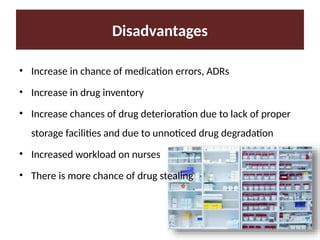
Disadvantages
• Increase in chance of medication errors, ADRs
• Increase in drug inventory
• Increase chances of drug deterioration due to lack of proper
storage facilities and due to unnoticed drug degradation
• Increased workload on nurses
• There is more chance of drug stealing
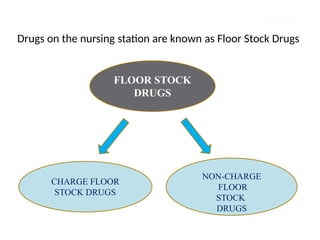
Drugs on the nursing station are known as Floor Stock Drugs
NON-CHARGE
FLOOR
STOCK
DRUGS
FLOOR STOCK
DRUGS
CHARGE FLOOR
STOCK DRUGS
A)Dispensing of Charge Floor Stock Drugs
• These are drugs for which patient is charged for every single
dose administered to him/her
• Selection of these drugs is made by
Pharmacy and Therapeutic committee
• Charge floor stock drugs are stored at various nursing stations
• An envelope is used to dispense such drugs
B) Dispensing of Non-charge Floor Stock Drugs
• These are medicaments placed at the nursing station for the
use of all patients on the floor
• These are cheaper and commonly used drugs
• The costs of these drugs are included in to the day to day
expenditures of the hospitals
3) Combinations of Individual Prescription
Order and Floor Stock System
• It is a type of drug distribution system that uses individual
prescription or medication order system as their primary
means of dispensing but also utilize a limited floor stock
• This system is followed by in the governments and private
hospitals who run on the basis of no profit and no loss
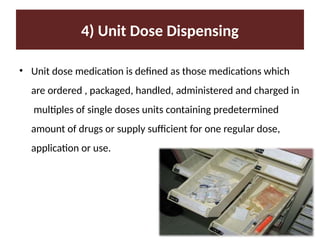
4) Unit Dose Dispensing
• Unit dose medication is defined as those medications which
are ordered , packaged, handled, administered and charged in
multiples of single doses units containing predetermined
amount of drugs or supply sufficient for one regular dose,
application or use.
Advantages
• Patient receives improved services and are charged for only
those doses which are administered
• Nurses get more time for direct patient care
• Medication errors are reduced
• More space is available in nursing station by eliminating
bulky floor stock
• It eliminates wastage of drug and pilferage
Disadvantages
• It requires separate man power for pre-packaging.
• It requires increased number of skilled personnel in the
pharmacy
• Separate containers, closures, machinery and also space is
required
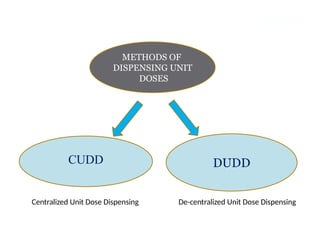
METHODS OF
DISPENSING UNIT
DOSES
DUDD
CUDD
Centralized Unit Dose Dispensing De-centralized Unit Dose Dispensing
1. Centralized Unit Dose Drug Distribution
System
• All in-patient drugs are dispensed in unit doses and all the
drugs are stored in central area of the pharmacy and
dispensed at the time the dose is to be given to the patient
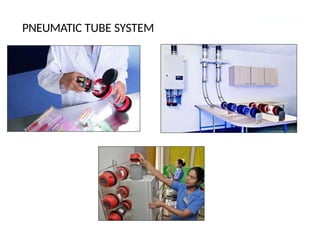
• To operate the system, delivery devices such as medication
carts or pneumatic tubes are required
PNEUMATIC TUBE SYSTEM
2. Decentralized Unit Dose Drug
Distribution System
• This operates through small satellite pharmacies located on each
floor of the hospital
• The main pharmacy is for procurement, storage,
manufacturing and packing
Procedure:
• Patient profile card is prepared upon admission to the hospital
• Prescriptions are sent directly to the pharmacists/ pharmacy
Cont…
• Pharmacists checks the medication orders
• Junior pharmacists/ Technicians picks medication order and
place drugs in cart
• Pharmacist check cart prior to release
• The nurse administers the drugs and make the entry in
their records
• Upon return to the pharmacy the cart is rechecked
Dispensing of Controlled Drugs:
• These drugs should kept under lock and key
• A separate register should be maintained to register them
PROCEDURE
• Medical superintendent is overall responsible for handling of
controlled drugs.
• Chief pharmacist procures, stores and dispense the drugs
Cont…
Prescription of narcotic drugs under Narcotics and psychotropic
substances act 1985 must include following information
• Patients full name
• Address
• Date
• Name and strength of drug
• Quantity of drug
• Signature of prescriber
• Dose and route of administration
Cont…
• If the required drug is not in the stock, the complete
controlled drug prescription must be written on hospital
prescription blank form by registered medical practitioner
and signed
• Delivery of narcotic drugs from pharmacy to wards should be
carried out by reliable person
• After dispensing, nurses resume responsibility for
administration, control and auditing of the inventory
• If patient refuse or doctor cancels any dose , nurse should
destroy the drug in to sink and record “Refused by patient” or
“Cancelled by doctor”
Drug Regulation and Legislation
• Drug regulation is the control of drug use by international
agreement and/or by regulatory authorities such as Food
and Drug Administration (FDA), the European Medicines
Agency (EMA) and the Pharmaceutical and Medical Devices
Agency (PMDA).
• Pharmacopeias also regulates drugs and makes various
legislation for drugs
Resources to Collect and Utilize Drug
Information
Primary Resources
• Researcher’s and manufacturer’s information
• Scientific journals
• Provide original studies or reports E.g. Clinical trial, case series,
case report
Secondary Resources
• Abstract or index which summarizes the information arising in
primary source
Cont……
Tertiary Resources
• Textbooks
• handbooks
• online drug compendia
Selected websites
• http://dda.gov.np/
• http://www.nepalpharmacycouncil.org.np
• http:www.nhrc.org.np/
General Considerations when Examining and
Using Textbooks
a) The author , publisher , or both: What are the author 's and
publisher's areas of expertise?
b) The year of publication (copyright date) or last revision date?
c) The edition of the text : Is it the most current edition?
d) The presence of a bibliography: I f a bibliography is included,
are important statements accurately referenced? :
Cont,……
e) How accessible is the information?
f) Alternative resources that are available (e.g. , primary and
secondary sources, other relevant texts)
Other Sources
• Libraries Research associations
• Government bodies Information center in industries
• Analyst labs
Drug Cards
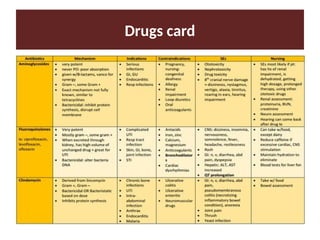
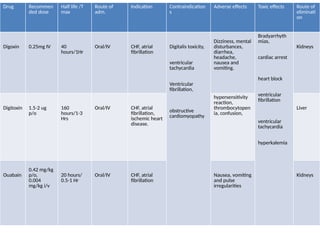
Drugs card
Drug Recommen
ded dose
Half life /T
max
Route of
adm.
Indication Contraindication
s
Adverse effects Toxic effects Route of
eliminati
on
Digoxin 0.25mg IV 40
hours/1Hr
Oral/IV CHF, atrial
fibrillation
Digitalis toxicity,
ventricular
tachycardia
Ventricular
fibrillation,
obstructive
cardiomyopathy
Dizziness, mental
disturbances,
diarrhea,
headache,
nausea and
vomiting.
Bradyarrhyth
mias,
cardiac arrest
heart block
ventricular
fibrillation
ventricular
tachycardia
hyperkalemia
Kidneys
Digitoxin 1.5-2 ug
p/o
160
hours/1-3
Hrs
Oral/IV CHF, atrial
fibrillation,
ischemic heart
disease.
hypersensitivity
reaction,
thrombocytopen
ia, confusion,
Liver
Ouabain
0.42 mg/kg
p/o,
0.004
mg/kg i/v
20 hours/
0.5-1 Hr
Oral/IV CHF, atrial
fibrillation
Nausea, vomiting
and pulse
irregularities
Kidneys

Pharmacology Basic Terminologies Presentation.pptx

  • 1.
  • 2.
    Objectives • Discuss theterminologies related to pharmacology • Discuss the history of pharmacology briefly • Identify the purposes of medication • Identify the source of medication • Discuss the classification of drugs • Describe the three type of drug supply system. • Discuss the drugs standards and legislation. • Identify resource to collect and utilize drug information. • Learn to prepare drugs cards
  • 3.
    • Definition: Pharmacologyis the science that deals with the study of drugs and their interaction with the living systems. • The word Pharmacology is derived from Greek – pharmacon means drug and logos means study. Pharmacology
  • 4.
    Cont… • In actualuse, however, its meaning is limited to the study of the actions of drugs. • Pharmacology has been defined as “an experimental science which has for its purpose the study of changes brought about in living organisms by chemically acting substances (with the exception of foods), whether used for therapeutic purposes or not.”
  • 5.
    Cont…. • Pharmacology studiesthe effects of drugs and how they exert their effects. • There is a distinction between what a drug does and how it acts. • Thus, amoxicillin cures a strep throat, and cimetidine promotes the healing of duodenal ulcers. • Pharmacology asks “How”? Amoxicillin inhibits the synthesis of cell wall mucopeptide by the bacteria that cause the infection, and cimetidine inhibits gastric acid secretion by its antagonist action on histamine H2 receptors
  • 6.
    Scope Of Pharmacology •The scope of Pharmacology is rapidly expanding and Provides the rational bases for therapeutic use of drug. • On the basis of study of drug it is divided into two branches .
  • 7.
    Branches of Pharmacology BasicPharmacology : the study of drugs in isolated tissues animals and other related living beings such as bacteria and viruses for experimental work is called basic Pharmacology.
  • 8.
    Branches of Pharmacology ClinicalPharmacology: The study of drugs in human beings is called clinical pharmacology. OR • The study of drugs in animals for treatment of diseases is also called clinical pharmacology.
  • 9.
    General Definition ofDrug • Any chemical agent that is used for diagnosis, prevention, treatment and curement of disease is called drug. • This disease oriented definition of drug is not applicable to some drugs such as oral contraceptives and general anesthetics etc.
  • 10.
    WHO definition ofdrug • In 1966 WHO define drug as: “Any agent that is used or intended to be used for the treatment of disease or modifying pathological/physiological condition or to explore pathological/physiological condition is called drug”.
  • 11.
    Basic definitions • Drugmeans any substance which change the physiology of cell tissue, organ, or organism. • Medicine: Whenever, a drug is formulated into a suitable dosage form for prevention, cure, and diagnose of a disease in a proper dose. • Dose means the amount of medicine taken • Dosage form means the physical form of the medicines (solids, liquids, gas etc.)
  • 12.
    Cont… • Therapeutics: Therapeuticsdeals with the use of drugs in the prevention and treatment of disease. • Toxicology: Toxicology deals with the adverse effect of the drug and also the study of poisons, i.e detection ,prevention and treatment of poisoning. (Toxicon =poison in greek.
  • 13.
    Cont……. • Pharmacodynamics meansthe mechanism by which the drug exerts its effect. For example, how aspirin work as analgesic. What the drug does to the body. • Pharmacokinetics means the movement of drugs within the body (absorption, distribution, biotransformation, and excretion). What the body does to the drug. • Over the counter (OTC) medicine: those medicines for which the physician prescription is not required. For examples, analgesics, antacids. • Analgesic means those medicines which are used for pain • Antipyretics means those drugs which are used for fever
  • 14.
    Cont…… • Idiosyncratic meansunexpected drug reaction • Teratogenic means harmful effects of drugs on the fetus • Synergism means when the combination of drugs increase the effect • Antagonism means when the combination of drugs decreases the effects • Patient compliance: The extent to which the patient follows the clinical prescription
  • 15.
    Cont……. • Pharmacopoeia isan official publication, containing a list of medicinal drugs with their effects and directions for their use. • BP: British Pharmacopoeia. • USP: United States Pharmacopeia • BPC: British Pharmaceutical Codex
  • 16.
    Cont……. • Active ingredientmeans biologically active substance which produce effect • An excipient is a pharmacologically inactive substance formulated alongside the active pharmaceutical ingredient of a medication e.g.. Cellulose derivatives • Purposes served by excipients: – Provide bulk to the formulation. (Fillers, Diluent) – Facilitate drug absorption or solubility and other pharmacokinetic considerations.(Disintegrates) – Provide stability and prevent from denaturation. (Binders, Preservatives)
  • 17.
    Cont……. • Efficacy meansmaximum effect that a drug can produce regardless of dose. • Potency means amount of a drug that is needed to produce a given effect • Bioavailability is the degree to which or the proportion of the drug that is available to the site of action or target tissue to produce the desired effect.
  • 18.
    Cont…….. • Half-life (t1/2)is the time taken by the plasma concentration of the drug to decrease by 50%, or reach half of the original concentration. Initially, If a drug has plasma concentration of100 mg/ml and after passing 2 hours it reduces to 50 mg/ml, then the half life would be????.. • Prophylactic agent is any drug that prevents a disease or illness from occurring (vaccines)
  • 19.
    A brief historyof pharmacology • Originating in the 19th century, the discipline makes drug development possible. • Pharmacology is one of the cornerstones of the drug discovery process. • The birth date of pharmacology is not as clear-cut. • In the early 19th century, physiologists performed many pharmacologic studies. • François Magendie studied the action of nux vomica (a strychnine-containing plant drug) on dogs, and showed that the spinal cord was the site of its convulsant action. His work was presented to the Paris Academy in 1809.
  • 20.
    History Cont… • In1842,Claude Bernard discovered that the arrow poison curare acts at the neuromuscular junction to interrupt the stimulation of muscle by nerve impulses. • Pharmacology was held to have emerged as a separate science in 1847, when Rudolf Buchheim was appointed professor of pharmacology at the University of Dorpat in Estonia (then a part of Russia). • Lacking outside funding, Buchheim built a laboratory at his own expense in the basement of his home. Although Buchheim is credited with turning the purely descriptive and empirical study of medicines into an experimental science, his reputation is overshadowed by that of his student, Oswald Schmiedeberg.
  • 21.
    Oswald Schmiedeberg (1838–1921) •Oswald Schmiedeberg is generally recognized as the founder of modern pharmacology. • Schmiedeberg obtained his medical doctorate in 1866 with a thesis on the measurement of chloroform in blood. • In 1872, he became professor of pharmacology at the University of Strassburg, receiving generous government support in the form of a magnificent institute of pharmacology. • He studied the pharmacology of chloroform and chloralhydrate. • In 1869, Schmiedeberg showed that muscarine evoked the same effect on the heart as electrical stimulation of the vagus nerve. • In 1878, he published a classic text, Outline of Pharmacology • In 1885, he introduced urethane as a hypnotic.
  • 22.
    History Cont…. • Inthe United States, the first chair in pharmacology was established at the University of Michigan in 1890 under John Jacob Abel, an American who had trained under Schmiedeberg. • In 1893, Abel joined Johns Hopkins University in Baltimore. • His major accomplishments include the isolation of epinephrine from adrenal gland extracts (1897–1898), isolation of histamine from pituitary extract (1919), and preparation of pure crystalline insulin (1926). His student Reid Hunt discovered acetylcholine in adrenal extracts in 1906. • Today, there is a pharmacology department in every college of medicine or pharmacy.
  • 23.
    Purposes of Medication Medicationscan be administered for the following purposes • Diagnostic Purpose: to identify any disease (e.g. Contrast, dyes) • Prophylaxis: to prevent the occurrence of disease e.g. heparin to prevent thrombosis and antibiotics to prevent infections • Therapeutic Purpose: to treat or cure disease / decrease symptoms, restore normal function or maintain normal function
  • 24.
    Essentials of medicationorder • The drug order, written by the physician, has 7 essential parts for administration of drugs safely. The nurse should know how to read a drug order. It should have the following components: 1- Patients detail (Name, Age, Gender, Reg. No). 2- Date and time. 3- Drug name. 4- Dosage. 5- Route of administration. 6- Time and frequency of administration. 7- Signature of physician.
  • 25.
    Types of MedicationOrders • STAT order: needed immediately • Single order: given only once • PRN order: given as needed • Routine orders: given within 2 hours of being written and carried out on schedule • Standing order: written in advance carried out under specific circumstances
  • 26.
    Cont….. • Basic principles(Safety) in medication administration 3 checks and 7 Rights: – Right patient – Right drug – Right dose – Right route – Right time – Right Frequency – Right Documentation 3 Checks – Right Documentation – Right Reason – Right Response
  • 27.
    Sources of Drugs Thesources of drugs could be natural or synthetic , NATURAL SOURCES: • PLANTS, e.g. Atropine, Morphine, Quinine, digoxin, pilocarpine, Physostigmine. • ANIMALS e.g. Insulin ,heparin, gonadotropins and antitoxic sera. • MINERALS, Magnesium sulphate, Aluminum hydroxide, iron, sulphur and radio active isotopes. • MICROORGANISMS, Antibacterial agents are obtained from some bacteria and fungi. we thus have penicillin, cephalosporin, tetracycline and other antibiotics.
  • 28.
    Cont……. • HUMAN: somedrugs are obtained from man ,e.g. Immunoglobulin from blood, growth hormone from anterior pituitary and chorionic gonadotropins from the urine of pregnant woman. • SYNTHETIC : Most drugs are now synthesized e.g. quinolones, omeprazole, sulfonamides, pancuronium, neostigmine. • Genetic Engineering: some are now produced by recombinant DNA technology e.g. human insulin,
  • 29.
    Classifications Drugs • Drugscan be categorized in a number of ways. In pharmacology, a drug can be classified by its chemical activity or by the condition that it treats. • In general, drugs are classified based on – Therapeutic classification – Pharmacologic classification (based on mechanism of action and mode of action) – Chemical classification – – Legal classification (Controlled Substances, Drug Schedules, and Teratogenic Risks)
  • 30.
    Therapeutic classification • Therapeuticclassification is defined as organizing drugs based on their therapeutic usefulness in treating particular diseases.
  • 31.
    Pharmacologic classification • Apharmacologic classification refers to the way a drug works at the molecular, tissue, and body system levels. • The pharmacologic classification addresses a drug’s mechanism of action, or how a drug produces its physiological effect in the body.
  • 32.
    Chemical Classification • Thethree basic types of drug names are chemical, generic, and trade name. • A chemical name is assigned using standard nomenclature established by the International Union of Pure and Applied Chemistry (IUPAC). • A drug has only one chemical name, which is helpful in predicting a substance’s physical and chemical properties. Example: Chemical name for aspirin is 2-acetoxybenzoic acid.
  • 33.
    Chemical classification • Thegeneric name of a drug is assigned by the U.S. Adopted Name Council. • Generic names are less complicated and easier to remember than chemical names. • The Food and Drug Administration (FDA), the official Pharmacopoeia, and the World Health Organization (WHO), routinely describe a medication by its generic name. • A drug’s trade name is assigned by the company marketing the drug. • The name is usually selected to be short and easy to remember. • The trade name is sometimes called the proprietary or product or brand name.
  • 34.
    Legal Classification: Controlled Substances,Drug Schedules, and Teratogenic Risks • Some drugs are frequently abused or have a high potential for addiction. • According to law, drugs that have a significant potential for abuse are placed into five categories called schedules. • These scheduled drugs are classified according to their potential for abuse: – Schedule I drugs have the highest potential for abuse – Schedule V drugs have the lowest potential for abuse
  • 35.
  • 36.
    Teratogenic Risks • Ateratogen is a substance that has the potential to cause a defect in an unborn child during pregnancy. • A small number of drugs have been shown to be teratogenic, either in humans or in laboratory animals. • Classification of teratogenic risk places drugs into categories A, B, C, D, and X.
  • 37.
    Controlled Substances, DrugSchedules, and Teratogenic Risks
  • 38.
    Effects of Drugs Drugsproduce two effects • Wanted or desired effects • Unwanted effects – Adverse drug reaction – Side effects – Toxic effect
  • 39.
    Adverse drug reaction •Definition: Adverse drug reaction (ADR) is an unwanted/unintended effect of drug that happens with normal doses, seriously endangering the life of the recipient and is not predictable. (WHO) • E.g. cardiac arrest
  • 40.
    Side effect • Sideeffect is also an unwanted/unintended effect of drug that happens with normal doses, not seriously endangering the life of the recipient and is predictable. • E.g. drowsiness with Cetirizine
  • 41.
    Toxic effect • Toxiceffects : drug toxicity occurs when a person has accumulated too much of a drug in his bloodstream, leading to adverse effects on the body. Drug toxicity may occur when the dose given is too high or the liver or kidneys are unable to remove the drug from the bloodstream, allowing it to accumulate in the body.
  • 42.
    Drugs Supply • Drugssupply is defined as the system of drug procurement, storage, and distribution • Efficient drugs supply systems are integrally linked to strong health care systems. • Adequate human resources, sustainable financing, comprehensive information systems, and coordinated healthcare partners and institutions are key components to ensure uninterrupted availability and accessibility of essential medicines
  • 43.
    According to WHO,an efficient drugs supply system should undertake the following function • Selection of Essential Medicines • Quantification and Forecasting Demand for Medicines • Procurement of medicines • Storage of Essential Medicines • Distribution of medicines Drugs Supply
  • 44.
    Drugs Distribution inthe Hospitals • Drugs distribution is defined as: “physical transfer of medicines from storage area in the hospital to the patient’s bedside.” • This involves two types of drugs distribution. They are: 1. Inpatient 2. Outpatient
  • 45.
    Out-patient Department (O.P.D) •Out patientrefers to patients not occupying beds in a hospital, clinics, health centers • The patients with minor and common illness go to O.P.D for consultation to the physician
  • 46.
    Classification of Out-Patients •The patients visiting the OPDs may categorized as 1. General Patients e.g. diabetic patients, hypertensive patients 2. Emergency Patients e.g. heart attack, epilepsy patients 3. Referred Patients e.g. Patients suffering from eye, ear, nose and teeth disorders
  • 47.
    In–Patient Services • Thedrug distribution to the inpatient department can be carried out from the outpatient dispensing area. • The staff involved in dispensing the drugs for outpatient can dispense drugs for inpatients too. • If the work load seems to be heavy then additional personnel can be employed.
  • 48.
    Types of DrugsDistribution Systems There are 4 systems for inpatient drug distribution 1. Individual prescription order system 2. Complete floor stock system 3. Combination of above mentioned 4. Unit dose dispensing method
  • 49.
    1) Individual PrescriptionOrder System • In this system, the physician write the prescription and ask the patient or the relative of the patient to get the medicine from any licensed medical store or hospital dispensary by paying own charge • This system is mainly used in small or private hospitals because of its economic consideration and reduced manpower requirements Advantages: • Less numbers of staff is required • All medication orders are directly reviewed by pharmacist • It provides a closer connection among pharmacist, physician, nurse and the patient • It provides closer control of inventory
  • 50.
    Disadvantages • There maybe possible delay in obtaining the required medications for administration to the patient • Emergency medicines are not quickly supplied • Increase in the cost to the patient
  • 51.
    2) Complete FloorStock System • Drugs are stored at the nursing station and are administered by a nurse according to the chart order of the physician • Only commonly used drugs are stocked on the floor Advantages: • The drugs are readily available for administration • Minimum return of drugs • Reduced in-patient prescription orders • Reduction in number of pharmacy personnel required
  • 52.
    Disadvantages • Increase inchance of medication errors, ADRs • Increase in drug inventory • Increase chances of drug deterioration due to lack of proper storage facilities and due to unnoticed drug degradation • Increased workload on nurses • There is more chance of drug stealing
  • 53.
    Drugs on thenursing station are known as Floor Stock Drugs NON-CHARGE FLOOR STOCK DRUGS FLOOR STOCK DRUGS CHARGE FLOOR STOCK DRUGS
  • 54.
    A)Dispensing of ChargeFloor Stock Drugs • These are drugs for which patient is charged for every single dose administered to him/her • Selection of these drugs is made by Pharmacy and Therapeutic committee • Charge floor stock drugs are stored at various nursing stations • An envelope is used to dispense such drugs
  • 55.
    B) Dispensing ofNon-charge Floor Stock Drugs • These are medicaments placed at the nursing station for the use of all patients on the floor • These are cheaper and commonly used drugs • The costs of these drugs are included in to the day to day expenditures of the hospitals
  • 56.
    3) Combinations ofIndividual Prescription Order and Floor Stock System • It is a type of drug distribution system that uses individual prescription or medication order system as their primary means of dispensing but also utilize a limited floor stock • This system is followed by in the governments and private hospitals who run on the basis of no profit and no loss
  • 57.
    4) Unit DoseDispensing • Unit dose medication is defined as those medications which are ordered , packaged, handled, administered and charged in multiples of single doses units containing predetermined amount of drugs or supply sufficient for one regular dose, application or use.
  • 58.
    Advantages • Patient receivesimproved services and are charged for only those doses which are administered • Nurses get more time for direct patient care • Medication errors are reduced • More space is available in nursing station by eliminating bulky floor stock • It eliminates wastage of drug and pilferage
  • 59.
    Disadvantages • It requiresseparate man power for pre-packaging. • It requires increased number of skilled personnel in the pharmacy • Separate containers, closures, machinery and also space is required
  • 60.
    METHODS OF DISPENSING UNIT DOSES DUDD CUDD CentralizedUnit Dose Dispensing De-centralized Unit Dose Dispensing
  • 61.
    1. Centralized UnitDose Drug Distribution System • All in-patient drugs are dispensed in unit doses and all the drugs are stored in central area of the pharmacy and dispensed at the time the dose is to be given to the patient • To operate the system, delivery devices such as medication carts or pneumatic tubes are required
  • 62.
  • 63.
    2. Decentralized UnitDose Drug Distribution System • This operates through small satellite pharmacies located on each floor of the hospital • The main pharmacy is for procurement, storage, manufacturing and packing Procedure: • Patient profile card is prepared upon admission to the hospital • Prescriptions are sent directly to the pharmacists/ pharmacy
  • 64.
    Cont… • Pharmacists checksthe medication orders • Junior pharmacists/ Technicians picks medication order and place drugs in cart • Pharmacist check cart prior to release • The nurse administers the drugs and make the entry in their records • Upon return to the pharmacy the cart is rechecked
  • 65.
    Dispensing of ControlledDrugs: • These drugs should kept under lock and key • A separate register should be maintained to register them PROCEDURE • Medical superintendent is overall responsible for handling of controlled drugs. • Chief pharmacist procures, stores and dispense the drugs
  • 66.
    Cont… Prescription of narcoticdrugs under Narcotics and psychotropic substances act 1985 must include following information • Patients full name • Address • Date • Name and strength of drug • Quantity of drug • Signature of prescriber • Dose and route of administration
  • 67.
    Cont… • If therequired drug is not in the stock, the complete controlled drug prescription must be written on hospital prescription blank form by registered medical practitioner and signed • Delivery of narcotic drugs from pharmacy to wards should be carried out by reliable person • After dispensing, nurses resume responsibility for administration, control and auditing of the inventory • If patient refuse or doctor cancels any dose , nurse should destroy the drug in to sink and record “Refused by patient” or “Cancelled by doctor”
  • 68.
    Drug Regulation andLegislation • Drug regulation is the control of drug use by international agreement and/or by regulatory authorities such as Food and Drug Administration (FDA), the European Medicines Agency (EMA) and the Pharmaceutical and Medical Devices Agency (PMDA). • Pharmacopeias also regulates drugs and makes various legislation for drugs
  • 69.
    Resources to Collectand Utilize Drug Information Primary Resources • Researcher’s and manufacturer’s information • Scientific journals • Provide original studies or reports E.g. Clinical trial, case series, case report Secondary Resources • Abstract or index which summarizes the information arising in primary source
  • 70.
    Cont…… Tertiary Resources • Textbooks •handbooks • online drug compendia Selected websites • http://dda.gov.np/ • http://www.nepalpharmacycouncil.org.np • http:www.nhrc.org.np/
  • 71.
    General Considerations whenExamining and Using Textbooks a) The author , publisher , or both: What are the author 's and publisher's areas of expertise? b) The year of publication (copyright date) or last revision date? c) The edition of the text : Is it the most current edition? d) The presence of a bibliography: I f a bibliography is included, are important statements accurately referenced? :
  • 72.
    Cont,…… e) How accessibleis the information? f) Alternative resources that are available (e.g. , primary and secondary sources, other relevant texts)
  • 73.
    Other Sources • LibrariesResearch associations • Government bodies Information center in industries • Analyst labs
  • 74.
  • 75.
  • 76.
    Drug Recommen ded dose Halflife /T max Route of adm. Indication Contraindication s Adverse effects Toxic effects Route of eliminati on Digoxin 0.25mg IV 40 hours/1Hr Oral/IV CHF, atrial fibrillation Digitalis toxicity, ventricular tachycardia Ventricular fibrillation, obstructive cardiomyopathy Dizziness, mental disturbances, diarrhea, headache, nausea and vomiting. Bradyarrhyth mias, cardiac arrest heart block ventricular fibrillation ventricular tachycardia hyperkalemia Kidneys Digitoxin 1.5-2 ug p/o 160 hours/1-3 Hrs Oral/IV CHF, atrial fibrillation, ischemic heart disease. hypersensitivity reaction, thrombocytopen ia, confusion, Liver Ouabain 0.42 mg/kg p/o, 0.004 mg/kg i/v 20 hours/ 0.5-1 Hr Oral/IV CHF, atrial fibrillation Nausea, vomiting and pulse irregularities Kidneys

Editor's Notes

  • #27 Plants; Roots, bark, sap, leaves, flowers, seeds were sources for drugs e.g. Digitalis from foxglove, opium from the poppy plant.