By Marwa Ayad
 What is Cloud Computing?
 Why Cloud Computing?
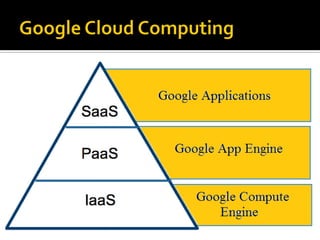
 Cloud Computing Service Models
 IaaS – PaaS – SaaS
 Cloud Computing Deployment Models
 Private – Public – Hybrid – community
 Google Cloud Platform
 Google Computing Engine
 Google App Engine
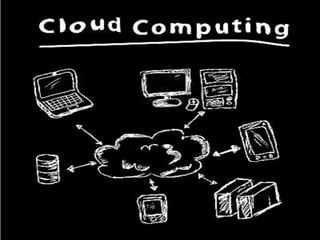
 Cloud Computing is a range of services which
are provided by an Internet-based.
 Cloud Computing provide shared pool of
configurable computing resources (e.g.,
networks, servers, storage, applications, and
services)
 CC=On demand computing=pay as you go
computing.
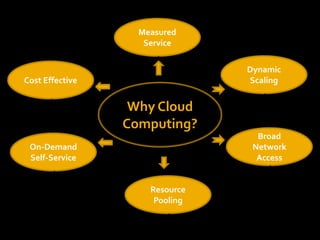
Why Cloud
Computing?
Cost Effective
Dynamic
Scaling
On-Demand
Self-Service
Resource
Pooling
Measured
Service
Broad
Network
Access
 On-Demand Self-Service: Users can provision servers and networks with
little human intervention.
 Resource Pooling: Multiple users can access clouds that serve other
consumers according to demand. Resources include storage, processing,
memory, network bandwidth, and virtual machines.
 Broad Network Access:Any computing capabilities are available over
the network. Many different devices are allowed access through
standardized mechanisms.
 Dynamic Scaling : Capabilities can be rapidly and elastically provisioned
for unlimited and can be purchased in any quantity at any time.
 Measured Service: Resource usage can be monitored, controlled and
optimized automatically through metering capabilities.
 Cost Effective
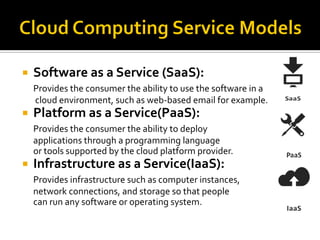
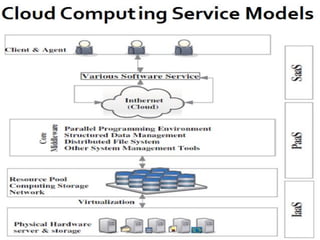
 Software as a Service (SaaS):
Provides the consumer the ability to use the software in a
cloud environment, such as web-based email for example.
 Platform as a Service(PaaS):
Provides the consumer the ability to deploy
applications through a programming language
or tools supported by the cloud platform provider.
 Infrastructure as a Service(IaaS):
Provides infrastructure such as computer instances,
network connections, and storage so that people
can run any software or operating system.
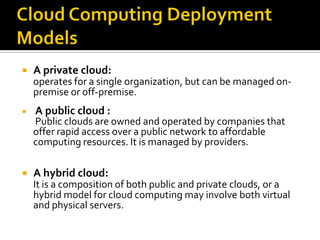
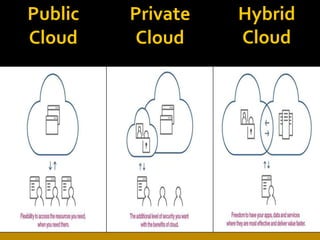
 A private cloud:
operates for a single organization, but can be managed on-
premise or off-premise.
 A public cloud :
Public clouds are owned and operated by companies that
offer rapid access over a public network to affordable
computing resources. It is managed by providers.
 A hybrid cloud:
It is a composition of both public and private clouds, or a
hybrid model for cloud computing may involve both virtual
and physical servers.
Hybrid
Cloud
Private
Cloud
Public
Cloud
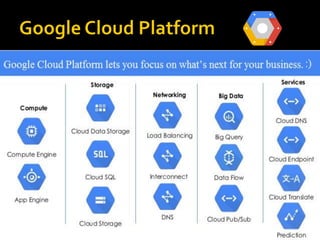
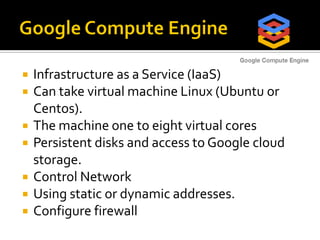
 Infrastructure as a Service (IaaS)
 Can take virtual machine Linux (Ubuntu or
Centos).
 The machine one to eight virtual cores
 Persistent disks and access to Google cloud
storage.
 Control Network
 Using static or dynamic addresses.
 Configure firewall
 Is Google Answer web services
 Google Compute Engine can be accessed via
the Developer Console, RESTful API or
Command Line Interface.
 Platform as a service (PaaS)
 Developing and hosting web application in
Google-managed data centers.
 App EngineApplication is easy to Build ,
maintain and Scale.
 No need to manage or maintain any servers
only upload and run.
 Automatic Scaling ,change Storage scale
automatically.
 Allow developer to get the advantage of
Google compute engine and storage
infrastructure.
 Load balancing.
 Support PHP, JAVA , Python and Go.
 Authentication using Google Account.
https://eg.linkedin.com/in/marwa-ayad-mohamed-0a405215

 Introduction google cloud platform

  • 1.
  • 2.
     What isCloud Computing?  Why Cloud Computing?  Cloud Computing Service Models  IaaS – PaaS – SaaS  Cloud Computing Deployment Models  Private – Public – Hybrid – community  Google Cloud Platform  Google Computing Engine  Google App Engine
  • 4.
     Cloud Computingis a range of services which are provided by an Internet-based.  Cloud Computing provide shared pool of configurable computing resources (e.g., networks, servers, storage, applications, and services)  CC=On demand computing=pay as you go computing.
  • 5.
  • 6.
     On-Demand Self-Service:Users can provision servers and networks with little human intervention.  Resource Pooling: Multiple users can access clouds that serve other consumers according to demand. Resources include storage, processing, memory, network bandwidth, and virtual machines.  Broad Network Access:Any computing capabilities are available over the network. Many different devices are allowed access through standardized mechanisms.  Dynamic Scaling : Capabilities can be rapidly and elastically provisioned for unlimited and can be purchased in any quantity at any time.  Measured Service: Resource usage can be monitored, controlled and optimized automatically through metering capabilities.  Cost Effective
  • 7.
     Software asa Service (SaaS): Provides the consumer the ability to use the software in a cloud environment, such as web-based email for example.  Platform as a Service(PaaS): Provides the consumer the ability to deploy applications through a programming language or tools supported by the cloud platform provider.  Infrastructure as a Service(IaaS): Provides infrastructure such as computer instances, network connections, and storage so that people can run any software or operating system.
  • 9.
     A privatecloud: operates for a single organization, but can be managed on- premise or off-premise.  A public cloud : Public clouds are owned and operated by companies that offer rapid access over a public network to affordable computing resources. It is managed by providers.  A hybrid cloud: It is a composition of both public and private clouds, or a hybrid model for cloud computing may involve both virtual and physical servers.
  • 10.
  • 13.
     Infrastructure asa Service (IaaS)  Can take virtual machine Linux (Ubuntu or Centos).  The machine one to eight virtual cores  Persistent disks and access to Google cloud storage.  Control Network  Using static or dynamic addresses.  Configure firewall
  • 14.
     Is GoogleAnswer web services  Google Compute Engine can be accessed via the Developer Console, RESTful API or Command Line Interface.
  • 15.
     Platform asa service (PaaS)  Developing and hosting web application in Google-managed data centers.  App EngineApplication is easy to Build , maintain and Scale.  No need to manage or maintain any servers only upload and run.  Automatic Scaling ,change Storage scale automatically.
  • 16.
     Allow developerto get the advantage of Google compute engine and storage infrastructure.  Load balancing.  Support PHP, JAVA , Python and Go.  Authentication using Google Account.
  • 17.